Tag: Lloyd Bridges

Sahara (1943)

Sahara (1943)

Bogart does desert warfare, in this tense, very well-made war film both men-on-a-mission and a siege film

Director: Zoltán Korda

Cast: Humphrey Bogart (Sgt Maj Joe Gunn), Bruce Bennett (Waco Hoyt), J. Carrol Naish (Giuseppe), Lloyd Bridges (Fred Clarkson), Rex Ingram (Sgt Maj Tambul), Richard Nugent (Captain Jason Halliday), Dan Duryea (Jimmy Doyle), Carl Habord (Marty Williams), Patrick O’Moore (Bates), Louis Mercier (Frenchie), Guy Kingsford (Stegman), Kurt Kreuger (Captain von Schletow), John Wengraf (Major von Falken)
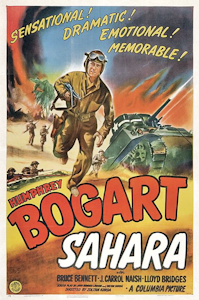
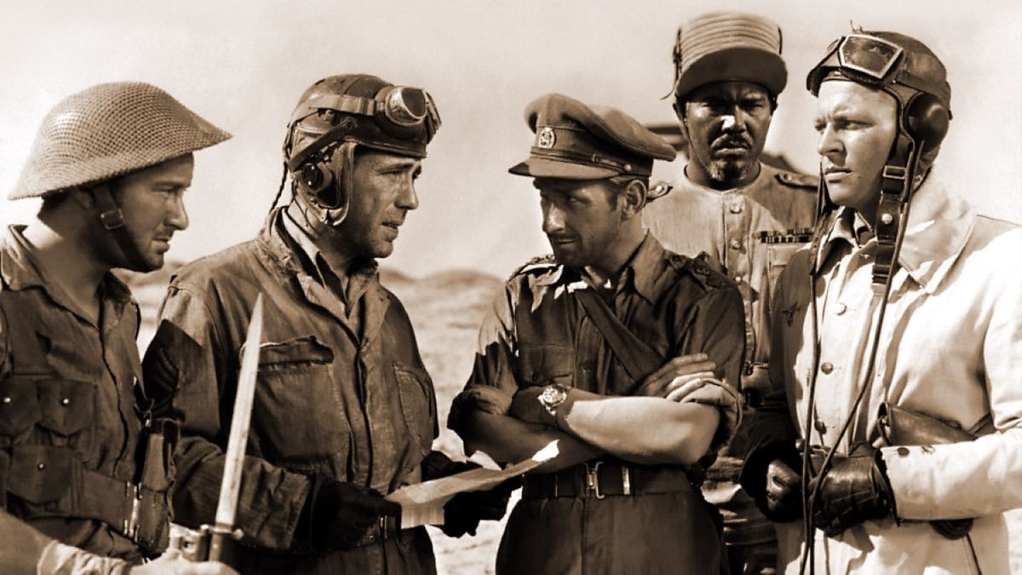
Sahara was ripped from the headlines: with the war still in full swing. So much so, it not only told a tale of a battle effectively still being fought but is also perhaps the only American film in existence to credit a Soviet film for providing the original story. It’s 1942 and the British army are in full retreat from Rommel’s Afrika Korps. Among them is Sgt Joe Gunn (Humphrey Bogart) and his tank Lulubelle, one of a small group of American tanks getting some real life combat experience with the Brits. Heading South through the desert, Gunn and his crew, Waco (Bruce Bennett) and Joe (Dan Duryea), pick up a motley collection of Allied soldiers led by Captain Dr Halliday (Richard Nugent) including Sudanese sergeant Tambul (Rex ingram) and his Italian prisoner Giuseppe (J. Carrol Naish). All of them are caught between two enemies: the Germans and the complete lack of water in the desert.

Sahara is an exciting, assured war film that combines a ‘men on a mission’ set-up with a classic ‘base under siege’ setting. Our heroes eventually find themselves at a dried-up desert well and the target of a desperately thirsty German battalion. Gunn decides to hold the dry well to slow the German advance down, fighting a gruelling siege, desperately waiting for relief, as the battle takes a terrible burden. This is Boys Own Adventure stuff, but told with a genuinely affecting sense of duty and sacrifice, as our heroes knuckle down in impossible circumstances.

At the heart of it, Bogart delivers exactly the movie star charisma the film needs while. Rudolph Maté’s photography is extraordinary, transforming the Californian desert into the African sands. Sahara brilliantly understands the importance of resources in the desert, and Korda captures perfectly the sweaty, sand-covered desperation for liquid. Sahara is tense, exciting and surprisingly hard-hitting with a strong cast.

What it really is of course, is a celebration of the attitudes that separate the Allies from those nasty Nazis. The Allies are a smorgasbord of nationalities, all of whom are shown (after some clashes) to work together with respect, admiration and a shared sense of purpose. Richard Nugent’s medical officer modestly defers leadership to the tank-and-combat experience of Bogart’s sergeant – no awkward arguments of seniority. Despite the collection of Americans, Brits, a South African, a Free Frenchman, a Canadian and a Sudanese sergeant, there is almost no trace of either national or racial clashes.

These men work in partnership, deferring to other’s areas of expertise to survive. Rex Ingram – excellent as Sergeant Tambul – instantly proves himself invaluable with his survival knowledge and ability to locate water. It’s Tambul who is at the heart of a tense search for any moisture in the seemingly dried up well our heroes hole up at, and later he is pivotal in the defence of the well. Saraha has a marvellously low-key but affecting scene of cross-cultural understanding as Tambul and Bruce Bennett’s Texan Waco jokingly compare outlooks on the world that are far more similar than they expect.

The message here is clear: teamwork, respect and the ‘dignity of freedom’ gives the Allies the moral edge over the Axis. The supportive respect, good humour and unflashy bravery of the Allies who get on with it and put duty first while respecting the rules of war is contrasted with the Germans. Bogart may flirt with the idea of abandoning Giuseppe in the desert (to preserve their water supply) but of course, when push comes to shove, he won’t (as Waco and Jimmy suspected he wouldn’t). Later, Bogart will even share the same limited water ration with their German prisoners.

Compare and contrast with the Germans. Their main representative, captured pilot von Schletow (played with a wonderfully smug viciousness by Kurt Kreuger), is portrayed as an instinctive racist (he’s the only character to make any slur towards Tambul), a bully and fanatic. There’s very little trace of decency in him: he’s confrontational, two-faced and dripping with nationalist superiority. The other Germans we see aren’t much better: a German soldier turns on his companion for a drop of water, a senior German officer breaks on a truce and the Germans fight as individuals rather than a supportive unit.

Caught in the middle? The Italians, represented by Giuseppe. J. Carrol Naish is excellent (and Oscar-nominated) as a soldier a million miles from Kreuger’s fanatic: a family man who keeps his word and just wants to go home. Naish has two knock-out scenes: the first a desperate pleading to Gunn to not be left to certain death in the desert and the second a contemptuous denunciation of German fanaticism to von Schletow: as he puts it, it’s a job to the Italians but a way of life to the Germans. Perhaps it was easier (with America’s large Italian population) to give the Italians more of a pass, but it allows the film to suggest there is some hope that behind the fanatics stood many regular people (something it’s hard not to see mirrored in the desperate German soldiers).

Sahara marshals all of this into a final siege that threatens to head the film into very dark territory indeed. Death is a constant in Sahara: the film opens with a view of the wreckage of battle, the unforgiving harshness of the desert is constantly stressed and we are shown repeated images of makeshift graves as bodies pile up and it becomes clear no-one is safe. Many heroic deeds have fatal outcomes and there is a hardened realism to the fighting. Like the Allies, the viewer ends up hoping for a miracle. It’s makes for a gripping and overlooked war film, that provides a genuinely hard-hitting taste of how unforgiving war can be. Tense, well-filmed and exciting it’s a little gem.

High Noon (1952)

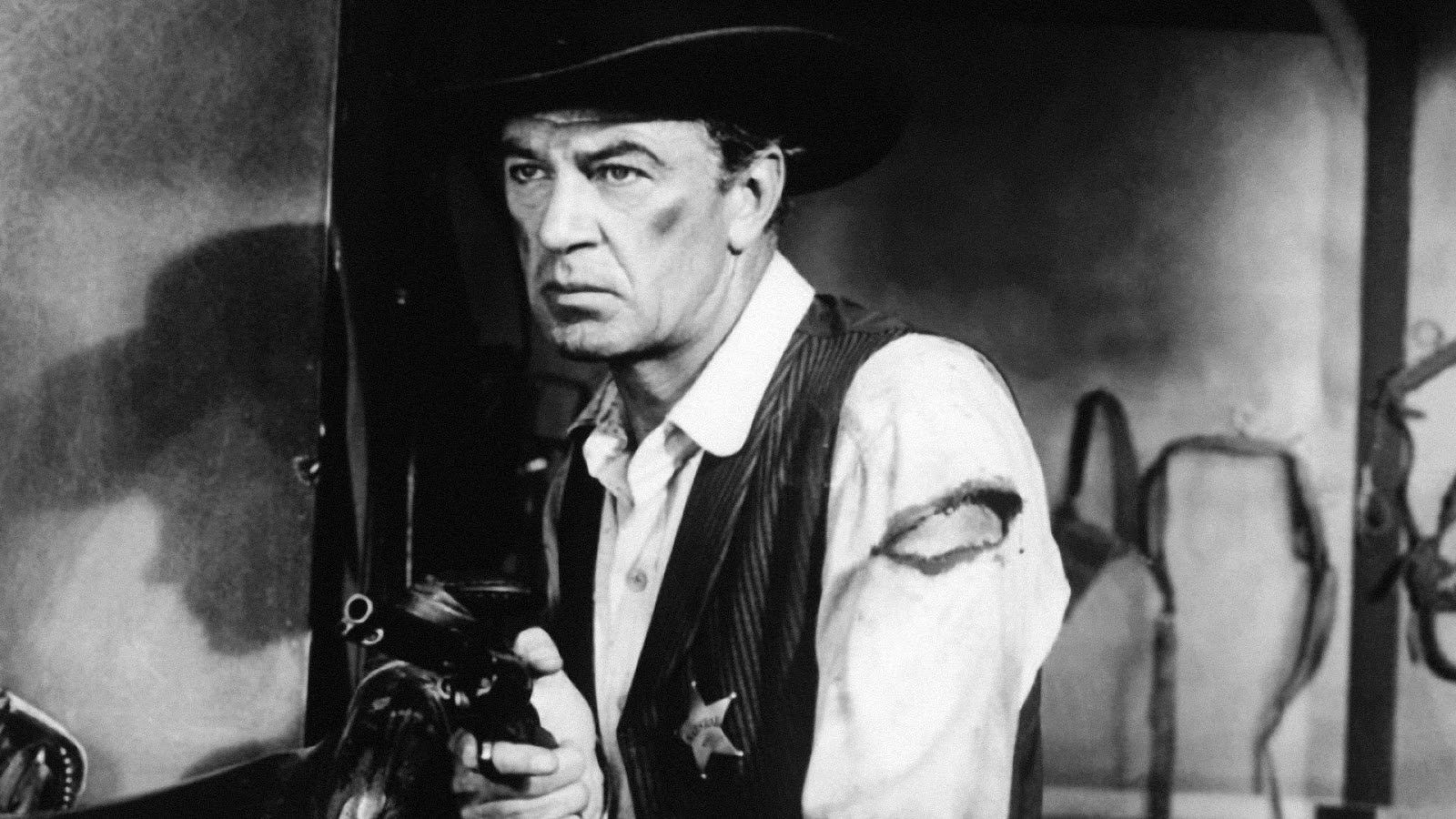
Gary Cooper stands alone in High Noon

Director: Fred Zinnemann

Cast: Gary Cooper (Marshal Will Kane), Grace Kelly (Amy Fowler Kane), Thomas Mitchell (Mayor Jonas Henderson), Lloyd Bridges (Deputy Marshal Harvey Pell), Katy Jurado (Helen Ramirez), Otto Kruger (Judge Percy Mettrick), Lon Chaney Jny (Marshal Martin Howe), Eve McVeagh (Mildred Fuller), Harry Morgan (Sam Fuller), Morgan Farley (Minister Mahin), Ian MacDonald (Frank Miller), Lee Van Cleef (Jack Colby)

It’s 10:35 am on the day of the wedding of retiring Marshal Will Kane (Gary Cooper) to Quaker Amy Fowler (Grace Kelly). It should be the happiest day of his life – but events are interrupted by news that Frank Miller (Ian MacDonald), a killer Kane put away, has been released and will arrive on the midday train with his gang to kill Kane. Kane’s first instinct – and the town’s – is for Kane to flee the town: but Kane doesn’t want to spend his life looking over his shoulder, and besides his friends and colleagues in the town will stand with him right? He decides to make his stand – to the outrage of his pacifist wife – only to find one-by-one the citizens of the town excuse themselves from helping Kane. After all, who wants to die?

Playing out like a Western 24, Kane has got a little under 90 minutes to put together a posse to give himself a fighting chance against these hardened killers. Zinnemann’s film is full of carefully placed shots of clocks that hammer home the ominous approach of Kane’s seemingly inevitable death. In a brilliant use of contrasts, Kane walks with growing desperation in virtually every shot through the increasingly abandoned town, mixed with clever cut-backs to the Miller gang waiting patiently at the train station (with deep focus shots of the train lines stretching on forever) for Miller to arrive and kick off the killing. Using a wonderful combination of low-angles, tracking shots and one superb crane shot that pulls out and away to show Kane stranded alone in the abandoned town, Zinnemann’s film stresses Kane’s isolation, anxiety and growing desperation.

Because Kane is scared. And why shouldn’t he be? He’s past-his-best and over-the-hill, a long-serving hero on his last day in the job, outmatched by his opponent. Why on earth wouldn’t he be desperate for help? John Wayne and Howard Hawks hated the film, loathed its perceived anti-American-spirit and, most of all, couldn’t stand the idea of a Western hero being scared and desperate for help. They even made a twist on the film, Rio Bravo, where Wayne played a marshal turning down any and all help in order to do what a man needs to do alone. For them that was a Western hero, and this self-doubting, anxious pussy Kane – the man even cries at one point! – was an abomination.

Cooper seemed to be no-one’s choice for the film – Heston, Brando, Fonda, Douglas, Clift and Lancaster all turned it down – but scooped the Oscar as Kane. Then 51, his obvious age and vulnerability – at one point Lloyd Bridges almost beats the crap out of him – make him feel even more at risk from this threat. In a performance devoid of vanity – other than perhaps Kane landing the radiant (and thirty years younger) Grace Kelly as his wife – Cooper is sweaty, nervous, twitchy and a mix of All-American duty and genuine nerves, resentment and terror at what feels almost certain to be his end. Kane knows why he must do it, but to Wayne’s disgust, he still doesn’t like it.

Carl Foreman, the screenwriter, was to be pulled before the House of Un-American Activities for his communist sympathies. And the entire film is pretty clearly a commentary on the McCarthyite era, specifically the abandonment of those pulled before the house by those who seemed to be their friends. Like the blacklisted Hollywood writers and actors, Kane opens the film with admirers and friends all of whom eulogise his greatness and decency: and all of them turn their back on him as the chips go crumbling down.

Most of the film is given over to Kane desperately going from ally to ally, only to find that he is offered only platitudes, excuses and outright cowardice. His deputy demands a recommendation for Kane’s job, and chucks in his star when Kane refuses. Old friends hide in their houses and refuse to come out when Kane comes calling. Lon Chaney Jnr’s retired marshal pleads illness. The judge rides straight out of town and suggests Kane does the same. At a town meeting in the church, the voices calling to help Kane are few and far between, and Mayor Thomas Mitchell praises Kane to the skies, before concluding the town would be better off if he could ride away and not come back. The one man who volunteers backs down when he finds out no one else has volunteered, and the only person eager to fight is a 14 year old boy. 

So much for loyalty and the American way. When the chips are down, words mean nothing and it’s the actions that show the man. Customers in the saloon talk about how life wasn’t that bad when the Millers ruled the town (to show how wrong this is, literally their first action when riding into town is to steal something from a milliners). Others moan that all this law enforcement from Kane has actually made business a bit worse for the town. Why do the hard thing, why make the stand, when it’s so much easier to just look down, keep quiet and let the just suffer while your life ticks on.

Cooper’s Kane is masterfully low-key, subtle, using only the slightest gestures to show deep-rooted, only barely hidden resentment and bitterness, covering fear. What he’s doing he’d give anything not to do, but he sees no choice. There is no other Western where the hero writes a will, and quietly weeps with his head on his hands on his desk. There is no other Western where the hero spends so long trying to make a manly task easier to do. There is no other Western where the self-serving cowardice and hypocrisy of the townsfolk are more blatant. No wonder Cooper – in the final insult for Wayne – drops his tin star in the dirt at the film’s end, as the townsfolk rush out to congratulate him on winning the duel. This is a film that looks at America as it really is – and many people didn’t like that one little bit.

Zinnemann’s direction is spot on, a perfect blend of tension build and technical mastery, mixed with superb dialogue from Carl Foreman. Not a word or shot is wasted, and every single character and event is carefully sketched in, established and build up with no effort at all. Cooper is superb, Grace Kelly just as good in a thankless role as the humourless Quaker wife who struggles with her life-long principles against her love for her husband. Beautifully filmed, with a wonderful score with Dimitri Tiomkin, High Noon is a classic for a reason, a masterpiece of slow-build and enlightened social commentary.