
Tag: Louis Jourdan

Three Coins in the Fountain (1954)

Three Coins in the Fountain (1954)

The first big travelogue hit, full of beautiful images and a nice song – and almost no plot

Director: Jean Negulesco

Cast: Clifton Webb (John Frederick Shadwell), Dorothy McGuire (Miss Frances), Jean Peters (Anita Hutchins), Louis Jourdan (Prince Dino di Cessi), Rossano Brazzi (Giorgio Bianchi), Maggie McNamara (Maria Williams), Howard St. John (Burgoyne), Kathryn Givney (Mrs. Burgoyne), Cathleen Nesbitt (Principessa)

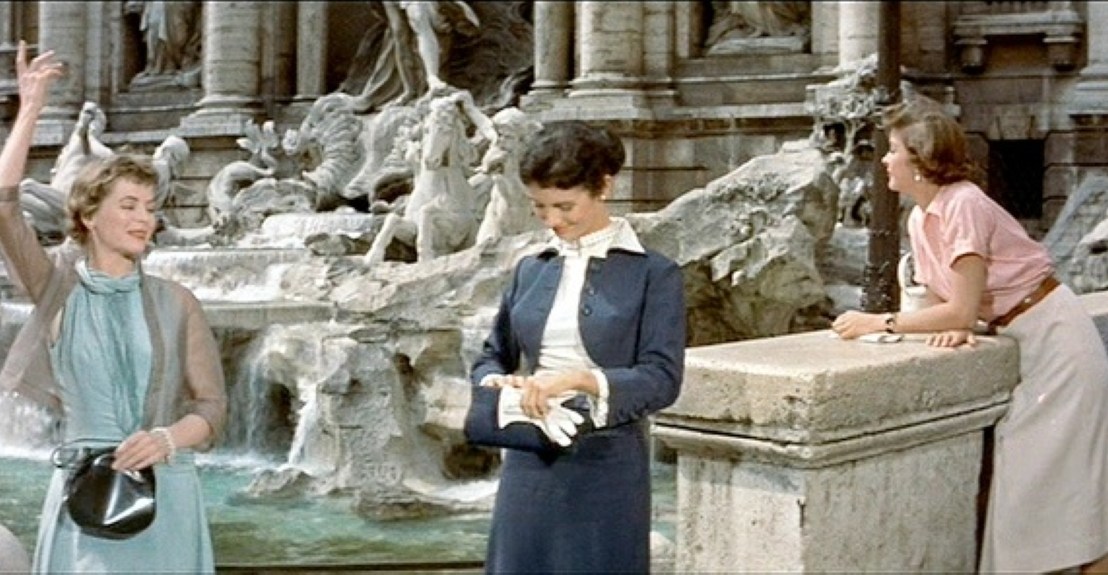
Did you ever visit the Eternal City and wondered why the Trevi Fountain seems to be full of small change? Well, a large chunk of the responsibility probably lies with this film. Three Coins in the Fountain, the very first Cinemascope travelogue super smash, meanders from our heroes chucking a coin into the fountain in line with the local myth that it means they will, one day, return to Rome. I can’t blame them – pretty sure I did the same when I was there. Whether many people have ever tossed a coin wishing to return to Three Coins in the Fountain is another question.

But Three Coins in the Fountain, a picturesque romance as shallow as the fountain itselfmade the idea internationally famous (it doesn’t trouble itself, by the way, with the fact only two of them actually toss a lira in). The story from there is as thin as paper. Our three leads are American secretaries: Frances (Dorothy McGuire) works for famed expat author John Frederick Shadwell (Clifton Webb) whom she secretly loves, Anita (Jean Peters) is seeing out her final weeks in the American embassy before flying home to a fictional fiancée, training up her replacement Maria (Maggie McNamara). Anita can’t afford to marry her Italian translator beau Giorgio (Rossano Brazzi) with his family of thousands to support. Maria sets her cap at Prince Dino (Louis Jourdan), ruthlessly researching and copying his views and opinions on everything from art to playing the piccolo.

Will these three relationships end well? What do you think! Drama in any case largely takes a complete back seat to the film’s main focus: filling the screen with the gorgeous architecture of Rome (and Venice as a two-for-one, thanks to a brief stop-off in Dino’s private plane) and basically giving the American cinema-going public a mouth-watering chance to see in glorious technicolour sights they had only previously seen in black-and-white photos. If 20th Century Fox and director Jean Negulesco didn’t have some shares in the Italian tourist industry squirreled away somewhere, I’ll eat my Panama hat.

Surely one of the most forgettable Best Picture nominees of all time, Three Coins in the Fountain did win two Oscars for its most memorable features. The first was Milton Krasner’s picture-postcard cinematography, making Rome look like the sort of place you’d jump on the first plane to get to. The other was Jule Styne and Sammy Cohn’s charming little ditty Three Coins in the Fountain (the velvet vocals of a surprisingly unbilled Frank Sinatra must have helped here). You can enjoy the finest moments of each in the film’s opening three minutes that plays the entire song (endlessly refrained again throughout the film) while the camera glides through the most beautiful sights of Rome. Truthfully, the rest of the running time is more of the same with added soap suds.

The plot lines are so slight and insubstantial it almost feels mean to poke critical holes in them. Few moments in this film ever ring true, but then this is the sort of luxurious fairy tale where American secretaries live in what seems to be a five-star hotel with panoramic views and work jobs that are really just time-fillers for their real quest of finding husbands. (The sexual politics of Three Coins in the Fountain, where women can’t imagine any other life horizon than typing up a gruff employer’s dull thoughts, and dream of swopping that for setting up house-and-home for a wealthy man, is as dated today as Anita and Maggie seemingly working for the 50s equivalent of USAID). Three Coins in the Fountain knows though the romantic plots are just there to keep us occupied between the postcards, and so long as they don’t offend or bore the viewer they’ve done their job.

Dorothy McGuire invests all the charm she can in playing a role written as a fussy busy-body interfering in her friend’s romantic lives and pining for Clifton Webb’s John Patrick Shadwell but seems oblivious to the fact that he is all too clearly coded to be what gossip columnists of the day called ‘a confirmed bachelor’. Their resolutely sexless ‘companionship’ contrasts with Jean Peter’s Anita giving a lusty fire to her flirtation with Giorgio (an underused Rossano Brazzi, who got a much better go round at this sort of thing in David Lean’s vastly superior Summertime). Various artificial obstacles are placed in their way (a modern film, unburdened by the Hays Code, would have leaned more into hints of a pregnancy scandal in Anita’s otherwise inexplicable decision to leave Rome).

Finally, Maggie McNamara gives a lightness of touch to a hilariously transparent campaign of romantic deception launched by Maria to win the heart of Prince Dino. Dino is, of course, deeply hurt that ‘the only woman I can trust’ has been lying to him – but I couldn’t help but feel most men at the time would jump like Casanova in heat on a woman who smilingly repeated back their own opinions to him with total conviction. Louis Jourdan, like Clifton Webb, charmingly offers up the sort of Euro-charm he was called to produce for most of the 50s.

There are amusing moments in Three Coins. Webb (clearly having a nice holiday in between dialling in his trademarked waspy socialite) is always pretty good value, and his arch glance through Maria’s charade is as grin-inducing as Frances being seen as so destined to become a frustrated spinster that Shadwell’s maid gives her a cat so she won’t be alone. Giorgio’s family eagerness to practically shove Anita into a wedding dress the second they meet her is almost as funny as watching the clueless Anita fail to control Giorgio’s truck as it rolls wildly downhill (inexplicably she tries to put it into gear rather than, oh I don’t know, hitting the brakes…)

But moments like this are few and far between in an otherwise gentle amble through the tourist hotspots of Rome. (The Venice shots, hilariously, see all the actors appear in brief scenes in front of projected images – clearly just the camera crew got that trip.) Negulesco keeps it all flowing forward like the pro he was, but by the time it ends you’ll be left with a vague longing to stroll around the streets of one of the world’s most beautiful cities – and only a vague idea about whether there was any other point to the film you just watched.

Letter From an Unknown Woman (1948)

Letter From an Unknown Woman (1948)

Lusciously filmed melodrama that might also be an exploration of dangerous obsession

Director: Max Ophüls

Cast: Joan Fontaine (Lisa Berndle), Louis Jourdan (Stefan Brand), Mady Christians (Frau Berndle), Marcel Journet (Johann Stauffer), Art Smith (John), Howard Freeman (Herr Kastner), Carol Yorke (Marie), John Good (Lt. Leopold von Kaltnegger)

Faded pianist and lothario Stefan Brand (Louis Jourdan) plans to skip town in 1920s Vienna before his duel with a reputed crack-shot. He’s packed up and ready to go, but halts when his butler passes him a letter from a woman unknown to him that opens “By the time you read this letter, I may be dead”. The writer is Lisa Berndle (Joan Fontaine), a young woman who has loved Stefan since first seeing him when she was an impressionable 15-year-old living in his apartment block in 1900. All her life she has shadowed Stefan and twice they have met – once ten years before, spending a few romantic days together and then again recently under another name – but Stefan has no idea who she is.

Adapted from a Stefan Zweig short story, Letter From an Unknown Woman becomes a richly elaborate display of film-making from Max Ophüls, a show-case for his gorgeous camera work and luscious sense of visual theatre. This is classic melodrama, the characters thrown together after years apart by chance and contrivance, heightened emotions guiding every scene, with the suspense hook at all times of wondering who will see clearly first: will Stefan recognise this woman who has loved him from afar all his life, or will Lisa acknowledge that what she wants from Stefan, a full recognition and genuine return of her feelings, he is unable to give?

It makes for perfect material for Ophüls almost-unmatched visual sense. Letter From an Unknown Woman is packed with the sort of elaborate, carefully planned tracking shots and fluidic camera movements Ophüls made his own. From the start, the camera roves upwards, following the young Lisa as she excitedly runs up a spiral staircase to creep into the apartment of Stefan. There is a superbly handled tracking shot through the street of Venice, as a mid-twenties Lisa walks with a soldier would-be-suitor whose proposal she will immediately reject. And, most triumphantly of all, a tracking shot through a grand society theatre, that roams past crowds of hoi-polloi with Lisa, before focusing on her reaction as she glances Stefan from a distance across the hall.

It’s a visual richness Ophüls triumphs at and he uses it to give an intensity to several scenes, in particular the lost opportunity weekend Lisa spends with Stefan. This is marked by a beautifully framed late-night café dance, before a walk full of romantic lingering in a nearly-abandoned fairground. What’s superb about what Ophüls does with these sequences is to make them look romantic while also suggesting a sort of broken decadence to them (the locations, like the slightly faded café with its bored band, are always slightly past their best). There is a faded grandeur in Letter From an Unknown Woman, with everyone clinging to something they’ve lost or never had, hopes of love or artistic success that are never quite going to happen.

It’s easy to see Letter from an Unknown Woman as a traditional romance of the loyal loving woman, who sticks with her love for a man for better-or-worse. But, particularly today, it’s also clear that the film walks a fine line where its possible to see its lead character as both richly romantic and a delusional, obsessive border-line stalker, fixated on a heartless seducer. Is love a force to be praised at all times, or a destructive force that prevents someone from maturing? For all the richness of the photography and music, it’s hard not to think it’s the latter. And I think Ophüls lets this play on the edges, the camera lingering at points on Fontaine’s face full of obsessive self-sacrifice monomania.

It make for a richly complex role for Joan Fontaine, playing the young Lisa from age 15 to 35, taking her from doe-eyed, love-struck teenager to a woman seasoned by years of regrets, obsessively clinging to has last chance of finding a love she has spent her whole life pining for. Fontaine is giddy, excited but that glimmer of obsession is always there. Ophüls presents her at one point standing, stalker-like, outside Stefan’s apartment, her eyes craning up for just a glance of the object of her affection. In his presence, she’s breathless and excited but also with a touch of pain and desperation, longing for him to give her some sort of validation after years of dutiful, unremarked-on love. Fontaine manages to keep Lisa vulnerable and sympathetic, even as she goes about her life with an obsessive self-destruction, discarding other suitors, spending years working a menial role in a dress shop on the off-chance it might lead to an encounter with Stefan.

Self-destruction is what this ‘relationship’ brings to Lisa, a woman who stubbornly refuses to move on in her life from the decisions and emotions she first experiences as a teenager and will discard attentive lovers, husbands and even children all to the chance of finding a few moments of bliss with the object of her affection. She does this with a real sense of fragility, a longing that keeps her vulnerable, but also something that keeps her from really living her life. Particularly since Stefan – and the film uses Louis Jourdan’s cool, detached arrogance to great effect – emerges as a heartless roué, who thinks only of the immediate and destroys his own promise in a hedonistic clinging to the moment rather than really building something.

For all its luscious romance, Letter from an Unknown Woman carries this air of self-destructive futility about it. Is cradling a teenage obsession healthy for Lisa? Especially as its object is scarcely worthy of the effort? After all, Stefan meets and seduces (as he sees it) the same woman twice several years apart without ever joining the dots up in his head- repeating the same smooth pick-up lines both time. It doesn’t stop Lisa, until the very end, lighting up with a sort of youthful joy you imagine she’s not felt at any other time But Ophüls is using it to build towards a moment where Stefan may perhaps finally remember Lisa – and even more strikingly may realise the shallow emptiness of his whole life and the lost opportunity of being genuinely loved by someone.

That feeling exists, even if you feel (as I do) that Stefan is the unworthy figure of an emotionally-immature woman’s unhealthy obsession. Perhaps Lisa’s life would have been better and happier if she had moved on, as we all do, from our first crushes. But Letter from an Unknown Woman also celebrates a sort of strength in this, by contrasting the morally pure and consistent Lisa with the shallow and mercenary Stefan. His flaws are obvious but, in a way, they also serve to cement Lisa’s own innocence and vulnerability – and add to the impact as Stefan realises the path not taken.

Gigi (1958)

Louis Jourdan forms an unusual romance with Leslie Caron’s Gigi

Director: Vincente Minnelli

Cast: Leslie Caron (Gigi), Louis Jourdan (Gaston Lachaille), Maurice Chevalier (Honoré), Hermione Gingold (Madame Alvarez “Mamita”), Eva Gabor (Liane d’Exelmans), Jacques Bergerac (Sandomir), Isabel Jeans (Aunt Alicia), John Abbott (Manuel)

In 1958 Gigi was littered with Oscars, winning all nine of its nominations to become one of the most successful films at the ceremony ever. It’s bizarre considering this is a run-of-the-mill musical with all the production values you would expect from an Arthur Freed production, but not really anything special compared to several other films from the same stable. It’s one of those moments when you remember Singin’ in the Rain didn’t even get nominated for Best Picture

Anyway, based on a book by Collette, Gigi deserved some sort of award for sneaking under the Hays code a story about a young girl training to be a courtesan, and the heartless playboy her family want her to seduce. Leslie Caron is Gigi, while the man who she has a sisterly affection for is Gaston (Louis Jourdan), the man around town bored with all the artificiality around him. Both Gigi and Gaston are heavily guided by their mentors: in Gigi’s case her grandmother, famed former courtesan Madame Alvarez (Hermione Gingold), in Gaston’s his uncle Honoré (Maurice Chevalier) a charming old rake. Everyone wants the two of them to become lovers, but do Gigi and Gaston want the sort of relationship of convenience their mentors expect?

That the film exists at all is a triumph of careful negotiation between Freed and the Hays Code, not usually open to films about high-class prostitutes and their marks. It does make for an occasional bit of confusion from the viewer – and a truncated plot as key ideas are circuited around (or over) – but also marvellous scenes, well written by Alan Jay Lerner, where Madame Alvarez and her sister (and courtesan trainer) Aunt Alicia (Isabel Jeans) discuss Gigi having “matured” to the correct age to become Gaston’s mistress by using unfinished sentences and raised eyebrows.

It makes for a slightly odd viewing experience today, especially with our far more enlightened views of the role women can have in society. The film mines comic material out of Gaston’s jilting of an unfaithful mistress (including Honoré toasting him for having driven the poor girl to attempted suicide after her public humiliation), while the comedic training sequences as Alicia attempts to turn Gigi into every man’s dream of the perfect mistress carries more than a whiff of exploitation today. But the film comes from a different r time, where such matters wouldn’t have occurred to either audiences or film makers.

Theres is a similar vibe in the film’s now most notorious sequence (and its opening) as Maurice Chevalier’s Honoré introduces the film and its world by crooning “Thank Heaven For Little Girls”. It’s a great catchy song (wonderfully delivered by Chevalier) but its lyrics thankful that “little girls get/Bigger every day”, matched with the septuagenarian Chevalier leering at a group of schoolgirls playing in the park, carry more than a whiff of the paedophile today. 

While you could say that this is all part of Minelli and Lerner’s intentions – that under the elaborate design of the film, there runs an undercurrent of selfish men carelessly using women for their own entertainment and many women enabling and encouraging this – it’s presented with such lightness, froth and charm that any potential darkness underneath it gets lost all together. Instead, its charming outer confection tends to obscure the difficult morals under the surface and prevents the viewer from engaging with them.

And the film’s design is what it’s really about. The first major musical to be shot largely on location – compare to An American in Paris which recreated the city of romance on a sound stage – its camera work is fairly reserved and focused on admiring the sets and locations more than providing a bit more to really engage the eye with. The design is impressive, mixing art nouveau and Cecil Beaton’s elaborate style, and the sets and costume (all Oscar-winning of course) really impress, even if the opulence ends up becoming overwhelming, not least with the overpowering reds that fill Gigi’s rooms. Minelli’s love of opulence and art ends up crushing the film.

That design also overwhelms the character. It’s telling that among its nine nominations, not a single one was for acting. Leslie Caron and Louis Jourdan do perfectly acceptable jobs, but their characters are not particularly interesting. Surprisingly for a musical – one starring Leslie Caron! – there is no dancing either. The film really misses the presence of people like Gene Kelly, the kind of leading man or woman who could carry a film on charisma. The real charisma comes from Chevalier (the one surprise to miss an Oscar nomination), who is so perfect as Honoré, so charming and dry (and who delivers his songs so well) that the film flags dramatically when he is absent (which he is for much of the final act). But the film misses a real heart.

It makes for a film that looks good, but is more a triumph of style and ingenious storytelling than it is storytelling with impact. Its Oscar win is perhaps a tribute to its faultless opulence and big budget spectacle. Because, boiled down to it, it’s a film with a story that hinges slightly on things that aren’t exactly tasteful revolving around people who aren’t very interesting. It has some good songs and moments from the Alan Jay Lerner script, but there is a reason this Best Picture winner has stuck in the collective memory so little, despite its record-breaking haul.