

Bergman experiments with form and genre in this fascinating collection of female-led short stories
Director: Ingmar Bergman
Cast: Anita Björk (Rakel), Eva Dahlbeck (Karin), Maj-Britt Nilsson (Marta), Birger Malmsten (Martin Lobelius), Gunnar Björnstrand (Fredrik Lobelius), Karl-Arne Holmsten (Eugen Lobelius), Jarl Kulle (Kaj), Aino Taube (Annette), Håkan Westergren (Paul Lobelius), Gerd Andersson (Maj), Björn Bjelfvenstam (Henrik Lobelius)
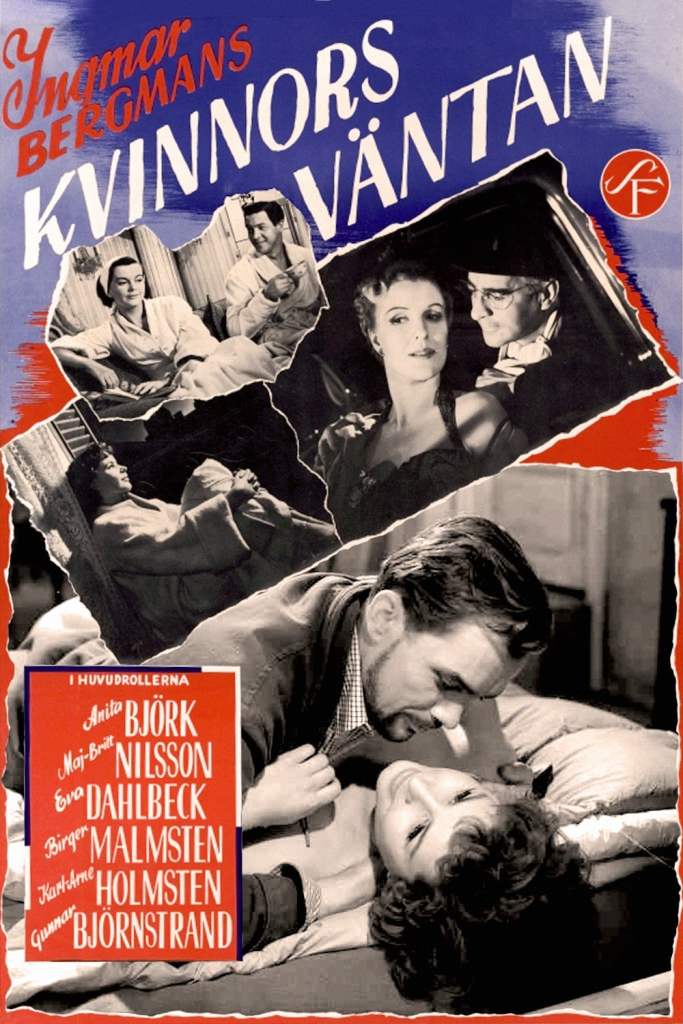
Waiting Women is another early step in Bergman becoming one of the great directors in cinema. It’s easy to feel it’s a film worth seeing largely for completeness sake – I certainly felt that, seeing this unknown nesting at the bottom of a BFI box set containing Wild Strawberries, Smiles of a Summer Night and The Seventh Seal. But Waiting Women is a playful and inventive film that sees Bergman experimenting with form and genre and show-piecing his inventive use of the camera (it’s a key reminder this famed wordsmith also worked with two of the most gifted cinematographers in movie history, Gunnar Fischer and (later) Sven Nykvist).
Three women sit waiting at a country-side retreat (echoes of the holiday home in Wild Strawberries) waiting for their husbands (three brothers) to arrive. While they wait, they share stories. Rakel (Anita Björk) talks about her husband Eugene’s (Karl-Arne Holmsten) suicidal response to discovering her affair with childhood friend Kaj (Jarl Kulle). Marta (Maj-Britt Nilsson) remembers keeping her pregnancy from her now-husband Martin (Birger Malmsten), who she met thinking he was a penniless artist rather than the son of an industrial power-house family. And Karin (Eva Dahlbeck) remembers a night after a function which she and driven husband Fredrik (Gunnar Bjornstrand) spent trapped in a lift and almost rekindled the spark in their marriage.
Bergman’s takes these three stories and presents each in strikingly different ways. The first he packages as a full-blown romantic melodrama, with heightened passions, elaborate threats of death and dramatic proclamations of affection and desperation. The second shifts gear into a moody expressionistic drama, almost a silent-movie, with minimal dialogue and the scene shifting from striking shadow-play on hospital walls to silent comedy in a Parisian nightclub. The third caps the film with a single-location farce with witty wordplay and a dollop of sadness and regret.
It makes for a film that constantly surprises you – and a director looking to experiment and stretch his artistic legs, finding new ways of expressing himself in film. (He even pops up for a Hitchcock-like cameo!) It’s also three entertaining (in different ways) short stories and another, superb, Bergman female-centric film. Because, make no mistake, our sympathies are all with the women, whose stories leave you with more than a little impression – for all they have joyfully prepared the house for their husbands – that each of them are not leading the lives they might have wished.
The first story is the most conventional – perhaps because Rakel’s hormonal love-affair with a long-lost school friend feels like a twist on Bergman’s Summer Interlude. But all is carefully dialled up to eleven in a romance that would not feel out-of-place in Emily Brontë. The flirtatious lust between Rakel and Kaj – centred around a joint trip to a bathing house which drips with illicit sexual energy – simmers. There is an early Chekovian introduction of a gun, before Kaj’s essential coldness is revealed and Eugen’s shock swiftly turns to anger and suicidal resentment. It’s a marvellous Bergman scripting touch that Eugen always feels like the sort of man who will shoot himself to make his wife feel bad about herself rather than because of his own pain.
Bergman shoots it with brisk tracking shots interspersed with close-ups and allows the action to become increasingly bombastic as it builds towards its melodramatic conclusion of Eugen shuttered away in a boat house, threatening to end it all. It makes for a striking gear change as our second story begins, and the visual mastery of Bergman and Fischer’s partnership comes to the fore in a middle-chapter that homages the Silent Masters. Marta’s memories of her pregnancy and her meeting with her husband, begins with the nightmareish image of a face behind frosted glass, distorted out of all recognition (Bergman, as always, the lost great-horror director) before she finds herself in a hospital ward, breathing in anaesthetic gas, and seeing the shadows of the branches from the tree outside, twist and dance like possessive hands on the walls around her.
Played with a sympathetic sweetness, tinged with just the right touch of edgy defiance, by Maj-Britt Nilsson, Marta’s memories of meeting her husband in Paris plays out in her memory like an expressionistic film. In a Parisian nightclub, the camera ducks and swerves around exotic dancers, beautiful compositions of body and movement in every frame. She drops her GI boyfriend for a Martin after a series of surreptitious glances across the room and passed notes. Their courtship and early relationship in his blissful studio play out like a romance – until his family arrive with a chilling explosion of words about expectations and duties that shatter the illusion. The chapter closes with something that could be either memory or dream – Martin and Marta, with the warmth of their early days returned, on a beach together. Reality or regret? Bergman gives reasons to believe both.
The final story is the most enjoyable, lightest and also (in its own way) saddest. Beautifully shot largely in a single confined location – and this is a workshop for Bergman to build his confidence with composition – it gains hugely from the witty and controlled performances of Dahlbeck and Björnstrand as the austere married couple. Home truths and flashes of attraction seep out – and Bergman makes us feel for a moment that a corner has been turned when they return (at last) to their family home. It’s all an illusion though – its still Bergman after all – as the mood is shattered by Fredrik’s almost immediate resumption of his professional duties after a chance phone-call.
If its one thing you can pick up from these three stories, its that finding love, contentment and satisfaction is difficult for women. As three very different women, Björk, Nilsson and Dahlbeck are all superb, and the little hints of sadness Bergman gives all of them turns what could be a collection of shaggy dog stories into something suddenly, surprisingly, profound. Yes they are waiting – but is it for their husbands, or for the lives they (privately) might wish they had? As Marta’s sister Maj (Gerd Andersson) considers elopement with Marta’s nephew Henrik (Björn Bjelfvenstam), the normal expectations of discouraging such an action are challenged. After all, why shouldn’t Marta try for happiness? What’s the worst that could happen: that they could gain wisdom (as the other women have done?) from a summer of forbidden and confused love? Perhaps Bergman wanted to find out: his next film was the romantic first-love fable that turns sour Summer with Monika.

 Movie Musings