Tag: Mark Strong

Robin Hood (2010)

Russell Crowe takes aim as Robin Hood

Director: Ridley Scott

Cast: Russell Crowe (Robin Longstride), Cate Blanchett (Marian Locksley), William Hurt (William Marshal), Mark Strong (Sir Godfrey), Mark Addy (Friar Tuck), Oscar Isaac (Prince John), Danny Huston (King Richard), Eileen Atkins (Eleanor of Aquitaine), Max von Sydow (Sir Walter Locksley), Kevin Durand (Little John), Scott Grimes (Will Scarlet), Alan Doyle (Allan A’Dale), Matthew Macfadyen (Sheriff of Nottingham), Lea Seydoux (Isabella), Douglas Hodge (Sir Robert Locksley)

When this film was developed, it was a CSI style medieval romp called Nottingham. Russell Crowe was cast as the film’s hero – an ahead-of-his-time Sheriff of Nottingham, busting crimes in Olde England and dealing with rogue thief (with good press) Robin Hood. Yes that really was the original idea. Mind you, it would at least have been more original than what we ended up with after Scott and Crowe had a bit of a rethink.

So here we are: Robin Hood: Origins (as it might as well have been called). Russell Crowe is Robin Longstride, on his way back from the crusades as an archer in the army of King Richard (Danny Huston) army. When Richard is killed at a siege in France (it was one last siege before home – what are the odds!), the messengers carrying the news back to France are ambushed and killed by wicked Sir Godfrey (Mark Strong). Robin finds the bodies and assumes the identity of Sir Robert Locksley, travelling to England to tell Prince John (Oscar Isaac) the news of his succession – then returning to Nottingham with his friends, where Robert’s father Sir Walter (Max von Sydow) asks him to continue pretending to be Robin for dull tax reasons – and soon feelings develop between Robin and Sir Robert’s widow Marian (Cate Blanchett). But John is intent on farming the land for taxes, and Sir Godfrey is in cahoots with the French to conquer England.

Robin Hood is a semi-decent, watchable enough retread of a story so totally and utterly familiar that even the things it rejigs end up feeling familiar. In fact, to be honest you sit watching it and wondering why on earth anyone really wanted to make it. Scott brings nothing original and different to it, and the film looks like a less visually interesting retread of Kingdom of Heaven. Plot wise it’s empty. What’s the point of it all? It slowly shows us all the pieces of the Robin Hood myth coming together, so best guess is that it was intended to be the first of a series (there seems to have been no interest or demand for a sequel of any sort). 

And then we’ve got Russell Crowe. Leaving aside everything else, Crowe looks about 10 years too old for the part. He delivers some sort of regional accent that meanders from Ireland to Yorkshire in its broadness, a laughable stumble around the country. Crowe does his slightly intense, sub-Gladiator mumbles and stares at the camera and attempts to suggest a deep rooted nobility, but actually comes across a bit more like a snoozing actor awaiting a pay-cheque.

Cate Blanchett does her best, lending her prestige to the whole thing in an attempt to make it land with some dignity (she of course does the opening and closing narration, which struggles to add some sort of grandeur to the whole flimsy thing). She’s saddled with a Maid Marian who is granted various “action” moments, but still has to be saved by Robin and face possible rape from a leering Frenchman (at least she saves herself from that one). 

It also doesn’t help either actor that their romance plays out in the dull middle third of the film, where the plot grinds to a halt as we deal with Sir Walter (Max von Sydow almost literally acting blindfolded) using Robin as some sort of tax dodge scheme. The film is overloaded with characters, all of whom are separated at this point and struggling manfully to make their disconnected plotlines interesting: so we get John dealing with the pressures of office, Sir Godfrey scheming and looting, William Marshal trying to find a middle ground, Robin and Marian falling in love – it’s a mess. On top of this a get a ludicrous reworking of the Magna Carta as some Medieval version of the Communist Manifesto (it’s written by Robin’s executed dad no less, giving him a bizarre “painful backstory” to overcome). None of these plots really come together, and so little time is spent with each of them that they all end up getting quite boring.

The film culminates in a totally ridiculous battle scene on a beach, as Sir Godfrey’s French allies arrive on the shores of medieval England in some sort Saving Private Ryan landing craft. The tactics of this landing and the battle that ensues are complete nonsense. Every single character rocks up at this battle, which should feel like all the plot threads coming together but instead feels like poor script-writing. When Marian turns up, disguised as a man (how very Eowyn), leading a group of warrior children (I’m not joking) who feel yanked from the pages of Lord of the Flies, it’s just the crowning turd on this nonsense.

And all this fuss to defeat Sir Godfrey? Why cast Mark Strong and give him such a nothing part? Sir Godfrey is a deeply unintimidating villain. Everything he does goes wrong. He is bested in combat no less than three times in the film (once by a flipping blind man!). His motivations are never even slightly touched upon. He has less than one scene with John, the man who he is supposed to be manipulating. He runs away at the drop of a hat and Robin gets the drop on him twice on the film. He’s neither interesting, scary or feels like a challenging adversary or worthy opponent.

But then nothing in this film is particularly interesting. The set-up of the merry men around Robin (they seem more like an ageing band of mates on tour by the way than folk looking to rob from the rich and give to the poor) is painfully similar to dozens of other film, particularly in the Little-John-and-Robin-fight-then-become-brothers routine. Crikey even Prince of Thieves shook up the formula by making Will Scarlet Robin’s brother. Scott is going through the motions, like it was one he was committed to so needed to see through to the end despite having long-since lost interest. It’s not a terrible movie really, just a really, really, really average one with a completely miscast lead and nothing you haven’t seen before.
Sherlock Holmes (2009)

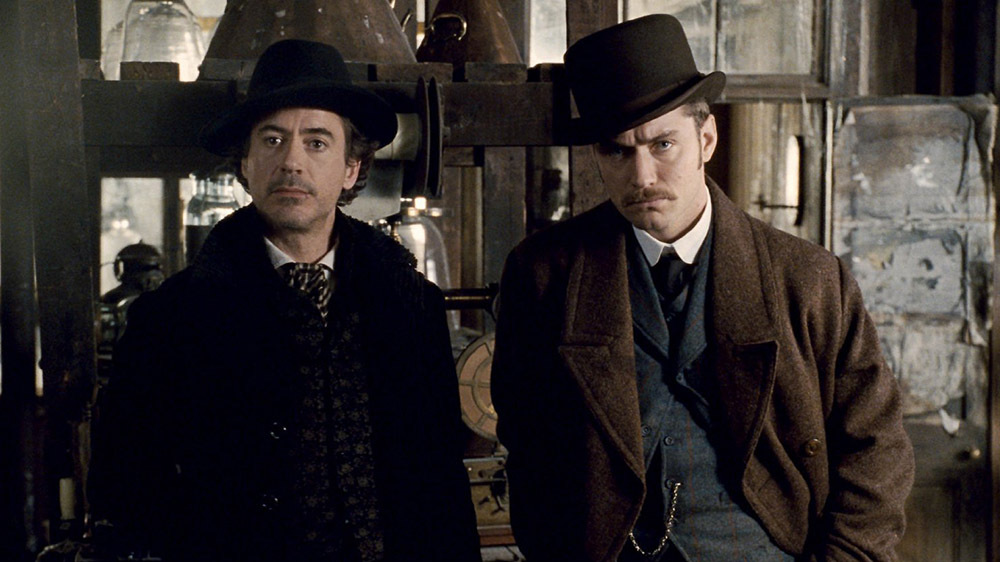
Robert Downey Jnr and Jude Law made a great odd couple in Sherlock Holmes

Director: Guy Richie

Cast: Robert Downey Jnr (Sherlock Holmes), Jude Law (Dr John Watson), Rachel McAdams (Irene Adler), Mark Strong (Lord Henry Blackwood), Kelly Reilly (Mary Morstan), Eddie Marsan (Inspector Lestrade), Hans Matherson (Lord Coward), James Fox (Sir Thomas Rotheram), Geraldine James (Mrs Hudson), William Houston (Constable Clark), William Hope (Ambassador Standish)

I don’t think there has been a single character brought to the screen more often than Sherlock Holmes. Sure there are certain tent-pole performances (Rathbone, Brett, Cumberbatch) that people automatically think of when you say “Sherlock Holmes”, but there are hundreds of others. It’s a character that survives constant re-imagination. In fact, you could argue it’s pretty much vital to bring something of your own to the table when putting together a Sherlock Holmes dramatisation. It’s what made Sherlock so successful. And it’s something that works very well here.

Sherlock Holmes (Robert Downey Jnr) is part Bohemian artist, part mad scientist, part kickboxer. The sort of guy who can think so far ahead he can plan out an entire fight in his mind before it even begins. He’s partnered up with determined, smart, handy-with-a-sword Dr Watson (Jude Law). With Watson preparing to move out of 221B to marry Mary Morstan (Kelly Reilly), they take on their last case: defeating creepy Dracula-lite Lord Blackwood (Mark Strong), who claims to have returned from the dead and wants to take over the British Empire. Along the way they are helped (or hindered) by the mysterious Irene Adler (Rachel McAdams) an old flame of Holmes’.

Guy Ritchie’s rollicking adventure is actually a huge amount of fun that, underneath the crashes and bangs, actually has a really strong respect for the original stories (the film is littered with references and quotes from the originals, none of which feel shoe-horned in except maybe Rachel McAdams’ Irene Adler, perhaps because the producers felt Holmes needed a love interest to stop any worries that he might be a bit too much in love with Watson). Ritchie has crafted a Holmes-Watson relationship that repositions them as a sort of odd-couple surrogate brothers, a marriage of equals (and make no mistake, a marriage is basically what this Holmes and Watson have). It’s big and silly, but then so were the original stories (The Creeping Man anyone?). 

Ritchie is a film-maker it’s easy to find faintly annoying, with his faux-geezer attitudes, his bizarre philosophical views and his love of the poor-taste gag. But on this film he’s basically a director-for-hire rather than putting his own story together and, you know what, putting this director into a studio strait-jacket is actually pretty good. It smacks some disciple on him, makes him drop his indulgent and poor-taste jokes and instead brings his strengths as a director – his sense of pace, his eye for a witty image, his rollicking sense of fun – to the fore. That’s probably why this is his most enjoyable and best film. 

It’s a film that mainly works because Downey Jnr and Law make a terrific pairing as Holmes and Watson. They have great chemistry, they spark off each other extremely well as performers and they really give the sense of two life-long devoted friends. Both actors are very good here. The film hits these notes of male friendship extremely well – a mixture of mocking and abuse, mixed with devotion and loyalty. The film gets the balance of these things exactly right: from debates to fights, you really get a sense that these two are honorary brothers, almost a bickering old married couple. 

In fact, the whole film revolves quietly around this relationship coming under threat (as Holmes sees it) of Watson leaving Holmes to get married – although, nicely, the film makes clear his fears of Mary are completely unfounded. Part of the dual engine of the film is Holmes continuing to tempt Watson into getting more and more involved with his cases, because he doesn’t want to lose his friend. It’s actually quite sweet. As are the protective feelings both have for the other: Watson knows Holmes puts himself at ridiculous risks, in turn Holmes shows a gentle worry for Watson’s gambling addiction (a popular Sherlockian society interpolation from references in the story).

All this warm, brotherly stuff from two excellent performers is built into a dramatic, thrillingly shot, series of action and detection scenes. The film’s big gimmick is Holmes’ ability to use his analytical abilities to accurately predict the outcome of fights (which the film communicates with slow motion and forensic narration by Downey Jnr, before staging the entire fight again at real time). It’s actually a fairly neat way of turning his deductive abilities into a visual language. Alongside this, plenty of this great fun – exciting or, as in Holmes’ battle with a 7ft giant, funny. All hugely entertaining.

Placing the focus on this relationship and the action does mean that the mystery elements of the plot get a bit short-changed. The story is a rather silly series of near-Dracula style high-Gothic mysteries that may or may not be real (all these occult references more than echo The Young Sherlock Holmes!). There isn’t much in the way of the small intricate puzzles of the early stories here – but then plenty of the later ones became increasingly hyper-real Gothic stories, so I guess that is fine. Mark Strong does a decent job as the villainous Blackwood, using his sinister looks and imperious voice extremely well. 

It also looks wonderful – the photography and set design is marvellous – and the score by Hans Zimmer must be one of his best ever, a sprightly mix of Irish music, Westerns and Music Hall. Ritchie directs it with a wonderfully, tongue-in-cheek, entertaining sprightliness, like Sherlock Holmes meets Indiana Jones. Holmes more than survives his re-imagination as an action superhero – and in fact he brings across a lot of the tone and character of the original book along with him. A terrific entertainment and a more than worthy entry to the Holmes movie cannon.

The Young Victoria (2009)

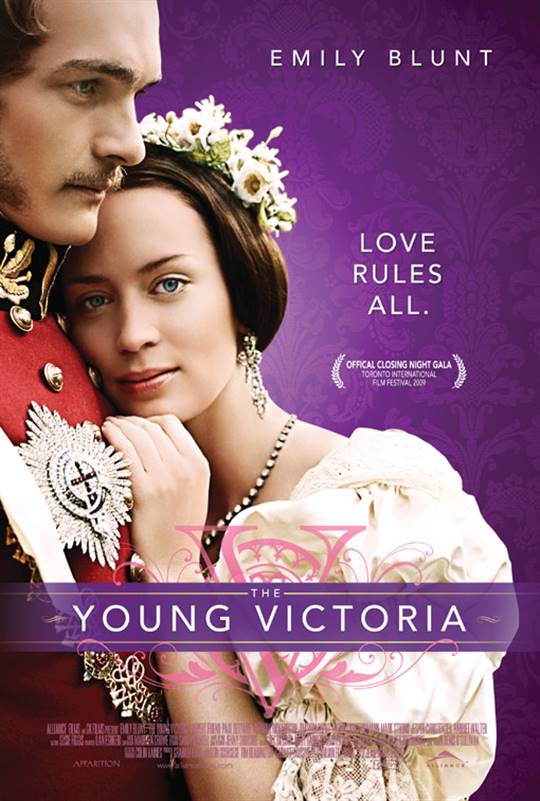
Emily Blunt and Rupert Friend play the royal couple in the cozy The Young Victoria

Director: Jean-Marc Vallée

Cast: Emily Blunt (Queen Victoria), Rupert Friend (Prince Albert), Paul Bettany (Lord Melbourne), Miranda Richardson (Duchess of Kent), Mark Strong (Sir John Conroy), Jim Broadbent (King William IV), Harriet Walter (Queen Adelaide), Thomas Kretschmann (King Leopold), Jesper Christensen (Baron Stockmar), Jeanette Hain (Baroness Lehzen), Julian Glover (Lord Wellington), Michael Maloney (Sir Robert Peel), Michel Huisman (Prince Ernest), Rachael Stirling (Duchess of Sutherland)

Now ITV’s Victoria exists, it’s a bit strange to go back and watch The Young Victoria. With the love today of long-form drama, and the time it can invest in things, it’s funny to see what the drama took almost 8 hours to do being crammed into an hour and a half here. But saying that, The Young Victoria is still an entertaining, luscious viewing experience which, while it has some strange ideas about certain events, is the sort of relaxing Sunday afternoon viewing that will take you out of yourself.

After the death of William IV (a slightly overripe Jim Broadbent), Victoria (Emily Blunt) is elevated to the throne. Finally able to shed the control of her mother’s (Miranda Richardson) domineering secretary Sir John Conway (Mark Strong), Victoria is determined to steer her own course. But she is surrounded by competing influences, not least from the charming arch-politician Lord Melbourne (Paul Bettany). King Leopold of Belgium (Thomas Kretschmann) dispatches his nephew Prince Albert (Rupert Friend) to England with the express interest of marrying Victoria and controlling her – but Albert and Victoria find themselves as kindred spirits, supporting each other to rule.

The Young Victoria is the epitome of prestige costume dramas. It looks fantastic, the cinematography is ravishing, the production and costume design exquisite. It’s pretty clear what the producers thought would sell the picture abroad. The royal regalia is pushed very much to the fore, and we get some wonderfully sweeping scenes, not least an impressively large-scale coronation. The soundtrack brilliantly riffs on Handel, and Julian Fellowes’ script mixes period regal style with a sweeping feeling of romance between Victoria and Albert.

The film actually does a very good job of repositioning Victoria as a young woman, and gives her a strong quality of self-determination and a desire to be herself in a man’s world. It’s really helped in this by the combination of imperial strength, girlish wilfulness and sharp intelligence Emily Blunt brings to the role. Blunt and the film also aren’t afraid to show that, however much Victoria had guts and determination, she was also quite a headstrong woman not above making emotionally led mistaken decisions. In fact, much of the drama spins out of Victoria learning to try and put these youthful crushes and prejudices aside.

Having said that, it’s interesting that the successful conclusion of the film centres on Victoria accepting that she needs the help of Albert to run the kingdom, and that she needs to remove competing influences for her affection – Melbourne and Lehzen – to focus her affection and loyalty on him. The film frames this as a winning romance and a successful partnership (which it was) – but it’s also vaguely creepy if you think about it. Mind you, since all the affectionate influences on Victoria are implied by the script to be at least partly motivated by self-interest, with the possible exception (eventually) of Albert, it manages to suggest this was for the best.

Albert’s background gets some interesting exploration here. He’s very much presented at first as the tool of Leopold as a means of controlling British politics. But he is far too independent, smart and noble to ever be the means of manipulation. Friend is very good here – his performance is quiet, authoritative but also heartfelt. Fellowes guilds the lily a bit to show his devotion by having Albert shot by a would-be assassin late-on in the film. Historically the assassin’s pistol wasn’t loaded, and Albert didn’t get shot (though Fellowes protests Albert didput himself in front of Victoria and that this intent is what’s important, not whether he was shot or not) but the moment does work – it gives the drama a boost and it’s undeniably moving.

While Albert is presented overwhelmingly sympathetically, interestingly Lord Melbourne gets quite a kicking. Paul Bettany is presented far more as a rival love interest than the sort of father-figure Melbourne was in real life (Bettany is probably 20 years younger than the real Prime Minister). Melbourne is shown as cynical, controlling, manipulative and overwhelmingly motivated by self-interest (a few more pushes and he would virtually become the film’s villain). He’s constantly contrasted negatively with Michael Maloney’s upright, honest Sir Robert Peel (one of my favourite statesmen of the 19th century so at least I’m pleased) – and his relationship with Victoria is one of self-promotion, which seems odd seeing as historically the two of them were so close. 

The film introduces other villains for us to hiss at. Kretschmann and Christensen do a good job as arch political schemers. Our real villain though is Mark Strong, who does a great job of scowling, controlling nastiness as the failed-bully Sir John Conroy. Strong’s performance works so well because he makes it clear that Conroy feels that his “Kensington System” (an attempt to manipulate and cow Princess Victoria into being a submissive puppet) is genuinely in her best interest, and that he genuinely cares for her. His partnership with Miranda Richardson as Victoria’s near-love-struck mother works very well.

The Young Victoriathrows in enough interesting character beats like this for it to really work as an enjoyable afternoon period-drama. With some great performances – Emily Blunt carries the movie brilliantly – and while some of the historical characterisation is a bit off, and other moments feel a little too chocolate box it’s a very entertaining, undemanding view., it’s great fun. The hardcore Victorian costume-drama fans will probably prefer Victoriafor the same story in more depth – but this film does it with great sweep (and doesn’t cram in Victoria’s stupid below-stairs plotlines!).

Stardust (2007)

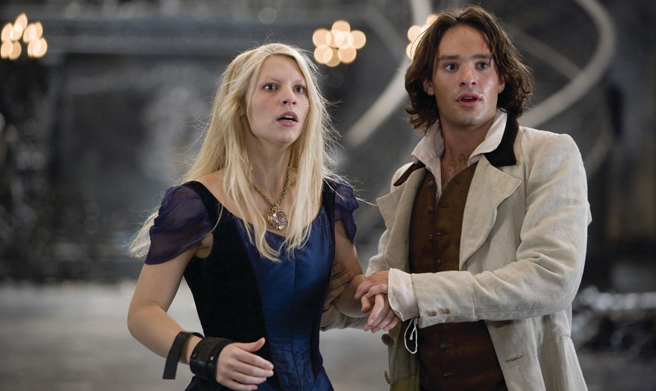
Claire Danes plays a star and Charlie Cox a village boy in charming adventure fairy-tale Stardust

Director: Matthew Vaughn

Cast: Claire Danes (Yvaine), Charlie Cox (Tristan), Michelle Pfeiffer (Lamia), Mark Strong (Prince Septimus), Robert De Niro (Captain Shakespeare), Sienna Miller (Victoria Forester), Jason Flemyng (Prince Primus), Rupert Everett (Prince Secundus), Kate Magowan (Una), Ricky Gervais (Ferdy), Peter O’Toole (King of Stormhold), Joanna Scanlan (Mormo), Sarah Alexander (Empusa), Nathaniel Parker (Dunstan Thorn), Henry Cavill (Humphrey), Dexter Fletcher (Skinny Pirate), Ian McKellen (Narrator)

Stardust is loosely adapted from Neil Gaiman’s novel of the same name, an adult fairy tale refashioned into a crowd pleasing family film: a warm and genuine adventure story, stuffed with romance, excitement and drama.

Tristan (Charlie Cox) is a dreamy young man in the village of Wall, which neighbours the mystical and forbidden world of Stormhold. In love with the selfish Victoria (Sienna Miller), Tristan vows to travel to Stormhold and bring her back a fallen star. However, the star has landed in the form of a beautiful young woman, Yvaine (Claire Danes), and the two of them find themselves on a difficult journey to return to Wall. Along the way they must dodge the witch Lamia (Michelle Pfeiffer) who wishes to sacrifice Yvaine to regain her beauty, and the surviving sons of the late king of Stormhold, particularly the ruthless Septimus (Mark Strong), who need Yvaine’s necklace to claim the throne.

What works about Stardust is that it has an air of whimsy about it, without ever feeling whimsical or corny. It’s a grown-up fairy tale, in the sense that it has some black humour and acknowledgement of sex, but really it’s more of a charming adventure story in a fantasy setting, which manages to keep its tongue in its cheek and not take itself too seriously. Matthew Vaughn’s direction has a very light touch and never allows this soufflé of a film to either puff itself up too much, or to deflate. Instead it rolls along with a giddy charm, with a delightful odd-couple love story at the centre. It’s a film that totally gets its tone spot-on, helped by confident direction and a wonderful score.

Charlie Cox plays romantic lead Tristan with a great deal of charm and really captures the romance at his centre. He also manages that extremely difficult task of being likeable – you can’t help but warm to him despite the fact that his self-awareness is completely off for a large chunk of the film. Claire Danes is equally good as the prickly Yvaine, hiding a great capacity for emotion and longing under a defensive exterior. Their romance is of course highly traditional – they bicker because they love each other! – but both actors carry it off with a great deal of style. You can’t help but want them to get over their problems and get together.

The romantic plotline is also never overwhelmed by the faintly Pythonesque comedy that surrounds it, particularly from the ghostly chorus of deceased Princes of Stormhold. Vaughn produces a great cast of comic actors for this group, while entrusting Mark Strong with the lion’s share of the screentime as the dashing decoy antagonist. In fact, the construction of the film’s narrative is rather neatly done, as this plotline of the inheritance of Stormhold is largely kept separate narratively from the romantic Tristan/Yvaine storyline, with the intersections only occurring at key points.

The real antagonist of the film however is Michelle Pfeiffer’s witch Lamia, Pfeiffer offering a neat portrait of vanity intermixed with cruelty. It’s a very decent inversion of a “movie star” glamour performance, and Pfeiffer’s heartless ruthlessness is a very nice contrast with Tristan’s altruistic openness. In fact Pfeiffer is very good in this film: she gets the balance so right that Lamia constantly keeps you on your toes as to how villainous or not she may be. I’m not quite sure that the film quite manages to completely bring the two characters plot lines together to provide a really effective narrative drive to the film, but she certainly works as an effective antagonist.

The film’s structure is a combination shaggy dog story and classic quest structure, which allows each sequence to take on its tone and structure, from thriller to comedy, depending on the characters involved. What threads this together is the growing (and very sweetly structured) love story between Tristan and Yvain which keeps the momentum up as the film moves from location to location, with cameo roles sprinkled throughout, without the film losing momentum (though it is probably 15 minutes too long). The film’s comfort with letting it sequences expand is clear with Robert De Niro’s Captain Shakespeare, a feared cloud pirate whose secret desires are not so secret as he might think. The film delights in essentially extended jokes like this – but it gets away with it because these jokes manage to be quite funny (De Niro in particular turns in a very good comic performance).

It’s a film that manages to remain distinctive and original, while appealing to a wide audience, which is quite some trick to pull off. It also manages to do this without losing its distinctive rhythm, which is both endearing and enjoyable. The “rules” of its world are clearly established, and while many of the actors are slightly tongue in cheek, they never laugh at their characters but only gently tip the wink at the audience. This freedom largely comes from the conviction and honesty Danes and Cox endow the central characters with, to ground the film. It alsohas a great sense of emotional intelligence to it, and brings a lot of depth to the characters. It also helps that it’s brilliantly designed, looks ravishing and is full of several delightful performances.

There’s lots of terrific stuff in this film, with a very sweet story at its centre. In fact this sweetness is probably the secret of its success: it never takes itself very seriously, it dances lightly from scene to scene and never allows itself to become too overblown. It’s got a terrific cast and is well directed, with a snappy bounce. At moments it does feel a little long, and some sequences overstay their welcome a bit too much – but the central characters are so winningly played that you don’t really mind. Sure this is not a masterpiece, but it has a sort of magic about it, the charm, excitement, adventure and romance, all mixed together with such confidence that it’s a pleasure to watch.

Kingsman: The Secret Service (2014)


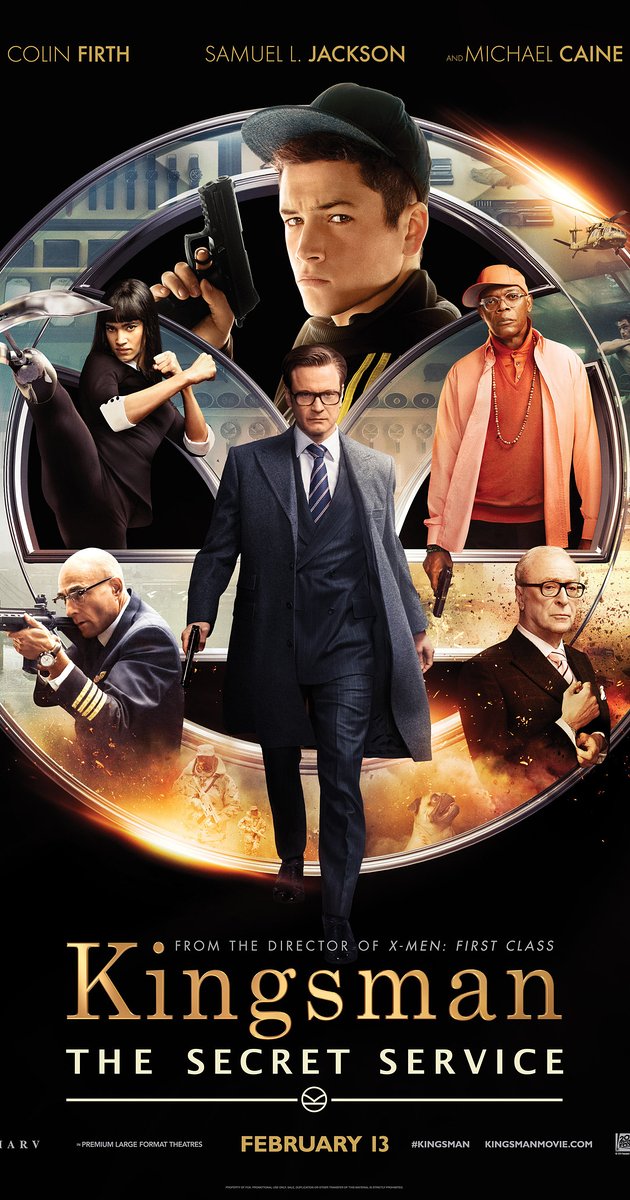
Colin Firth means business in super-violent Bond spoof Kingsman

Director: Matthew Vaughan

Cast: Colin Firth (Harry Hart/Galahad), Samuel L. Jackson (Richmond Valentine), Mark Strong (Merlin), Taron Egerton (Gary “Eggsy” Unwin), Michael Caine (Chester King/Arthur), Sophie Cookson (Roxy Morton), Sofia Boutella (Gazelle), Samantha Womack (Michelle Unwin), Geoff Bell (Dean), Edward Holcroft (Charlie Heskith), Mark Hamill (James Arnold), Jack Davenport (Lancelot)

Okay Kingsmen. I’ll hit a beat later on which explores a major problem I had with this movie, but let’s talk about the rest of the film first shall we?

Firstly, Kingsmen is for the most part rather good fun (even if it is too long). It’s an excitable, teenage-focused riff on James Bond films that throws in ultra-violence and foul language alongside the overblown villains, insane plots and super-spy skills (all themselves amped up to 11). “Eggsy” (Taron Egerton) is a drifting, working-class young man from a council estate who is recruited as a candidate for super-secretive espionage firm “The Kingsmen” by Harry Hart (Colin Firth). Bucking against the system, Eggsy must prove himself against the privileged, public-school types he is competing against for a place. Meanwhile, Hart investigates sinister plans from tech billionaire Richmond Valentine (Samuel L. Jackson), aiming at reshaping the world to fit his own insane ideas.

Kingsmen basically has a teenage sensibility, with a “too cool for school” love for swearing and extreme (if comic book) violence. It deliberately sets itself out as a grimy, modernish, street version of Roger Moore’s Bond movies (at one point, Hart and Valentine even discuss “old spy films” – presumably copyright prevented a namecheck for Britain’s finest). The plot (and the cascade of exploding heads, satellites, sinister cross world signals, world leaders in danger etc.) all have the air of the sort of stupidity you found in Moonraker or The Spy Who Loved Me: the joke being that these fantastical elements have been mixed in with a sweary working-class hero and graphic violence. It has a pop-culture knowingness about it which it just (by the skin of its teeth) manages to prevent becoming too smug or self-satisfied.

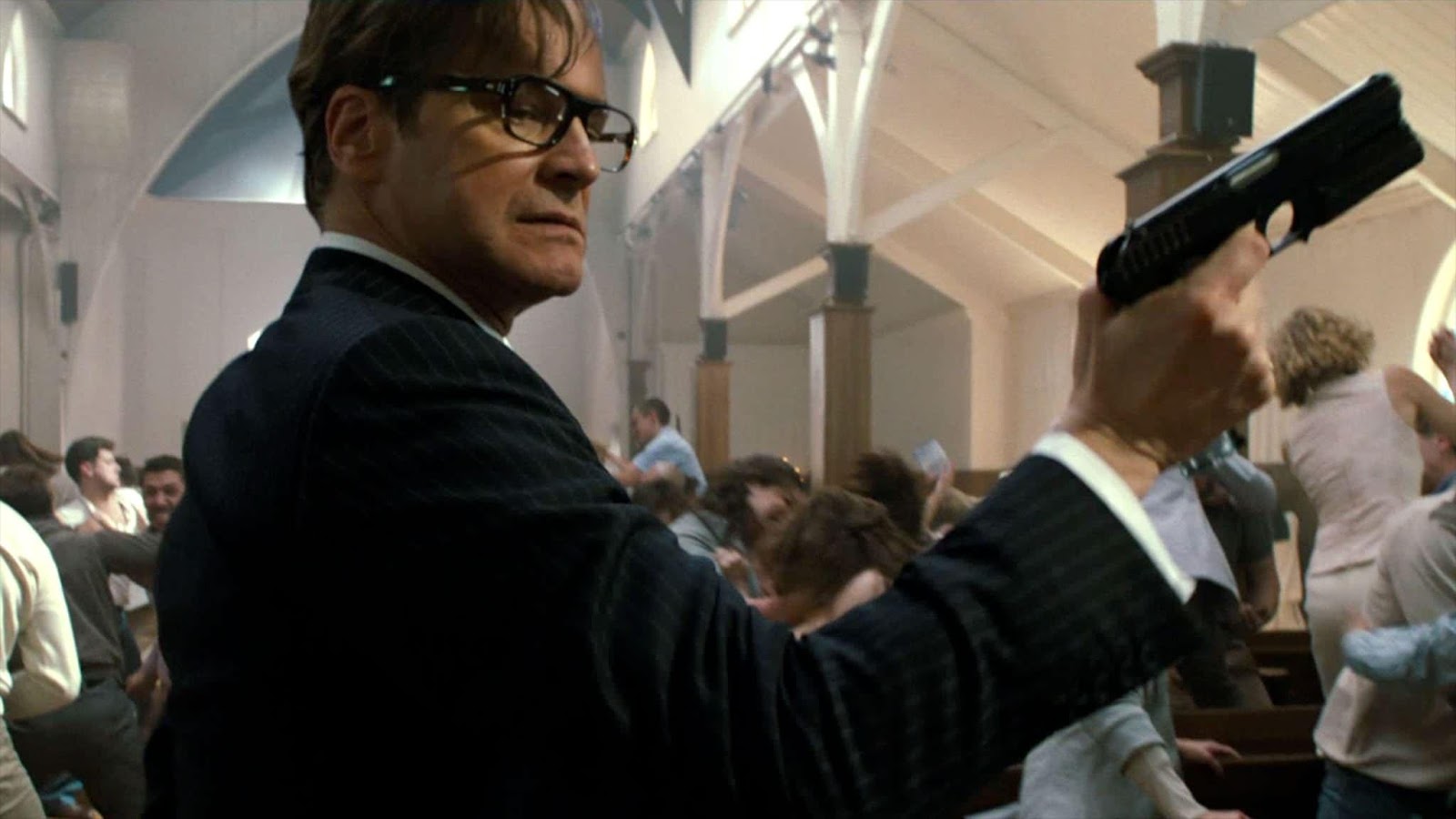
This is partly because it is so well made. The violence and fighting are rather well done in their overblown, excessive excitement. Vaughan shoots it with a loving camera, revelling in the dynamism and speed of his agents (and their ruthless efficiency) in a way that’s very hard not to find entertaining. Some interesting music choices also add an ironic commentary to the killing. Vaughan’s also to be commended for spotting the potential for ass-kicking super-spy in Colin Firth (even if Firth himself probably plays the whole film marginally too seriously). The film’s main set piece a jaw-droppingly violent but slickly made fight sequence in a church is probably the only thing it will be remembered for in ten years time – but is certainly worth remembering. The fighting is fun to watch – it’s a shame it’s not married with a wittier script, as if the wit of the visuals couldn’t be carried across to the dialogue in case we got bored.

Vaughan’s script also wants to fight the corner of the working class – although saying that, since every other working class character in the film except for Eggsy and his Mum are criminals, wannabe gangsters or thugs, it could just as well be fighting the corner of the “deserving poor”. Some rather obvious notes are hit during Eggsy’s training as he clashes with the chinless wonders that populate the Kingsmen candidates. It would perhaps work better if Eggsy himself was a more engaging and sympathetic lead – but as it is, the parts of the film without Firth (and Strong as a Scottish, grumpy Q) do drag a bit, which is unfortunate when your film is already over two hours long. It’s hardly Saturday Night and Sunday Morning but it pushes through its Pygmalion-plot line reasonably well.

For the most part, Kingsmen is stupid, teenage fun. It takes place in a spoof James Bond world of huge bases in mountains and plans to destroy the world that can only be foiled by dynamic acrobatic fighting. If you were a male teenager watching this it would probably be your favourite film ever. It’s probably a little too knowing and isn’t really as charming as it really needs to be to work really well, but it’s entertaining enough. I was happy to leave it like that. And then this happens quite late on in the film:

Now it’s important to remember when watching this, that the video contains all the interactions in the movie between these two characters. Now I suppose you could just say it’s a smutty joke that, like the rest of the movie, takes the elements of a Bond movie (“Keeping the British end up sir!”) and amps them up to 11. But it’s cruder and (in my opinion) too clumsy and sexist for that. Not only that, but it’s the sort of exploitative, sexualised rubbish that makes you suddenly address the entire film’s attitude towards women.

The film has five female speaking roles (at a push). Each of these roles fills a specific stereotyped, trope-based function. One is a victim in an abusive relationship (the mother). Another is a standard “hot action chick” (the villain’s henchperson). Another exists solely to die early on. The character in the clip only exists to provide the hero with anal sex as a reward. None of these characters serve any purpose in themselves, other than how they relate to the male characters of the movie. All of them to varying degrees require protection from a man, or exist purely to service his needs. The cliché of a physically-strong-but-still-really-hot woman being created in place of an actual character is so tired, I’ll just leave it here as I can’t be bothered to type up why this isn’t a good balance.

That leaves Roxy, Eggsy’s fellow candidate. On paper, Roxy is a strong female role – only of course she isn’t. There is the standard hand wave that she is “the best in the class” during training – but she’s also established as the only candidate to have a genuine fear (of heights) that she has to be coaxed through by the hero. Her role in the conclusion is conquering this phobia again. The subtle implication is that Eggsy to some degree sacrifices coming top of the class himself to support Roxy.

I’m sure this is all po-faced political correctness and I’m being the sort of humourless prig sitting among the “20% of offended people” Matthew Vaughn said should basically get a sense of humour. But I mean, come on. The last shot of the film is a woman’s naked bottom rearing towards the camera. And yes I know, I know, I know it’s all riffing on Bond films but at least there the heroine was a presence throughout the film. I actually would have much less of a problem if these two characters had spent at least some time throughout the film together – but jumping straight to anal sex? It’s too much. It also seems to be fighting battles of the 1960s. Overt class consciousness from the rich is terrible – but women? Nope they’re just there for the sexier times.

Leaving everything else aside, it’s not that funny a joke. It’s such a terrible joke it leaves a bad taste in the mouth. So what’s otherwise a decent, fun film chooses to end with its lead character invited to perform anal sex by a complete stranger. And how a film ends tells us something about the film we’ve just watched – and for Kingsmen it’s not good.

Zero Dark Thirty (2012)


Zero Dark Thirty tries to raise questions and views, but dodges many of them

Director: Kathryn Bigelow

Cast: Jessica Chastain (Maya), Jason Clarke (Dan), Jennifer Ehle (Jessica), Mark Strong (George), Kyle Chandler (Joseph Bradley), James Gandolfini (CIA Director), Stephen Dillane (National Security Advisor), Harold Perrineau (Jack), Mark Duplass (Steve), John Barrowman (Jeremy), Joel Edgerton (Patrick), Chris Pratt (Justin)

Zero Dark Thirty is a deeply troubling film: a journalistic investigation into the hunt for Bin Laden, shot with an action thriller film ethos. It wears its factual accuracy and research with an ostentatious pride on its sleeve, but ducks out of making any judgement on the issues it presents, as if afraid to pollute the events it displays with editorialising. But some events demand discussion and a point of view: as one critic said, you wouldn’t make a film about slavery that focuses on the cotton output. Similarly, a film that drives us towards the killing of the vile Bin Laden should also challenge us more about the methods used to capture him, the extent to which we “became what we hunted”.

And I don’t buy that the film is challenging us to recognise this ourselves. It starts with recordings from the 9/11 flights (a moment which made me feel uneasy to say the least and many family members were also unhappy with), its lead character Maya is caught up in two bombings and an assassination attempt, her best friend (well played by Jennifer Ehle) is killed in a suicide bombing. All of this, along with the film’s omission of any exploration of the terrorists themselves, is encouraging us to look at a particular side of the argument. Cementing this is the end of the film which, despite caveats, has a “mission accomplished” feeling – it may not be flag waving, but it does want us to feel the professionalism of a job well done, reinforced by the tearful release of 12 years of tension from Maya. We are not being encouraged to question the attitudes or assumptions of the characters in front of us; we are being steered towards a particular view of these characters and events. Without an explicit endorsement, but implicit suggestions that ends may well have justified means.

Of course, 9/11 was an abomination – but setting the deck the way the film does means it makes it easier to condone the terrible things that the CIA do in this film to get the results it got. That’s the problem with the film’s “stanceless stance” – its patting itself on the back for not taking sides means it doesn’t acknowledge any depths to its facts, it gives no context. There are many, many issues and motivations, from both sides, behind the events we see here – but we don’t learn anything about any of them. Instead the film is like a Wikipedia page with brilliant photography and editing: a skilfully presented PPT deck that shows us what happens, but doesn’t feel like it tells us anything about why or how it happened.

Torture is of course the main issue here. The film opens with a gruelling extended torture sequence of almost 25 minutes. The information it yields directly is questionable, but it does eventually lead to a crucial name, which is backed up later by Maya watching videos of others undergoing “extreme interrogation” and saying the same name. Now, torture in something like 24 feels different: there at least (a) the whole world was a cartoon, (b) the danger was immediate (“a nuclear bomb will go off in thirty minutes dammit!”) and (c) there was a sense of conflict in its perpetrators. Neither is the case here.

That’s not a defence of 24, but here it’s full on psychological and physical assault over a sustained period of time with no identified imminent threat and no real sense that the torturers feel they are doing anything wrong (I guess the film is suggesting they have become deadened to it, but still would it hurt to say something along those lines?). And it actually happened, and not just to bombers and terrorist kingpins, but (in this film) to couriers and bankers. Surely that demands some sort of acknowledgement in the film that it was wrong? Instead the film fudges this and the torture of suspects is shown to contribute in some way to the successful delivery of Bin Laden; there is no real questioning of whether the value of the information it directly obtained justified its use.

Part of the problem of the film is that it was originally commissioned as a film about the hunt for Bin Laden – the US actually finding him rather screwed up the narrative. There are elements of that original film in there: a hunt for a chimera, an obsession with one man that blinds us all to the bigger picture: “You’re chasing a ghost while the whole fucking network grows all around you” Kyle Chandler’s character cries out with frustration at one point. Maya (and the film) slaps him down – it never questions whether Bin Laden was worth the focus and expense. But it hints at the repurposed nature of the film, which would have had to tackle this question head on before Bin Laden was found. Was this the best use of their efforts? Was there a benefit to the war on terror outside of the satisfaction of punishing Bin Laden? How in control was Bin Laden of the jihad by then?

It feels to me that this film is two films uneasily mixed together. One film wants to explore the nature of obsession, and wants to question if it’s worth catching one man at the cost of diverting attention from hundreds of others. The other film is a triumphant story of patience and dedication rewarded. You can’t help but feel that a film released prior to Bin Laden’s killing might have been a more interesting and profound piece of work, which could have looked at the nature and cost of obsession. Instead, history itself pushes the film into saying “well it had ups and downs but the ends justified the means eventually”.

None of this doubt about the final film is of course an apology for the appalling crimes of Bin Laden and his followers. And Zero Dark Thirty is, however you cut it, a very well made film and Bigelow is an extremely good director. Jessica Chastain invests a character almost devoid of personality, about whom we learn almost nothing, with an emblematic depth that makes her feel like a profound embodiment of American determination and will, like some sort of morally conflicted female Gary Cooper. The film also does feel like it has something to tell us about an America under siege – although again, by shying away from editorialising, it loses the chance to present a specific commentary on how 9/11 affected the country, and its sudden sense of vulnerability and unease in the world.

It’s a troubling film, a film that seems to be dodging taking a moral stand on areas. It could still have said “some of things that were done were bad but the end result was good”: that would have been fine. But by not making any statement at all, it feels like it’s dodging the issue, not challenging us.

Good (2008)

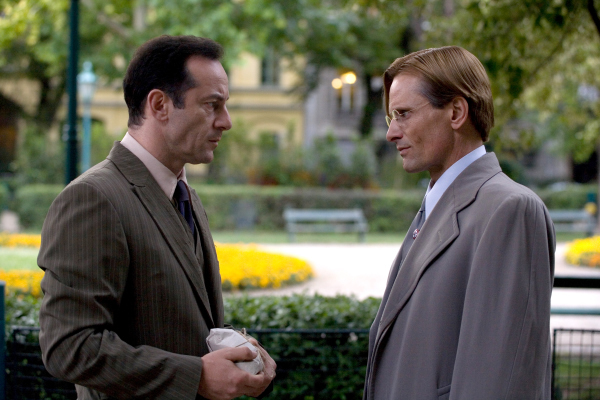
Viggo Mortensen and Jason Isaacs are conflicted brothers in arms in this all too familiar (in every sense) Nazi Germany story

Director: Vincente Amorim

Cast: Viggo Mortensen (John Halder), Jason Isaacs (Maurice Israel Glückstein), Jodie Whittaker (Anne), Steven Mackintosh (Freddie), Mark Strong (Philipp Bouhler), Gemma Jones (Halder’s Mother), Anastasia Hille (Helen Halder), Steven Elder (Adolf Eichmann)

Is there a more overused quote than Edmund Burke’s “All that is necessary for the triumph of evil is that good men do nothing”? It’s virtually become a cliché and can be heard spouted with chin-stroking smugness in everything from Law & Order episodes, opening title cards to crappy action films to the message-boards of the internet. If Good can have any claim to history (and it probably can’t), it can say that it’s the film of the phrase.

Our Good Man is John Halder (Viggo Mortensen). Our Evil is Nazism. Halder is a literature professor in 1930s Germany. He’s written a novel in support of euthanasia: this brings him to the attention of the party authorities, who need intellectual support for their own plans. Halder accepts an honorary rank in the SS – and from there it’s compromise after compromise that leads to the Holocaust. His good and bad angels are his new young wife Anne (Jodie Whittaker), who loves the advantages party membership brings, and his Jewish best friend Maurice (Jason Isaacs), whose situation goes from bad to worse.

It’s a very, very earnest film which wears its heart on its sleeve. Which is the main problem – the film-makers were clearly desperate to “tell it right” and stay true to the original play – but the whole idea comes across slightly outdated, obvious and far too familiar. Whatever point the play had to make when first staged in 1981, has now been said and done to exhaustion. Despite the care and attention, there now isn’t much originality or freshness. As such, it never really rouses any feelings.

The story it tells of its lead’s reluctant seduction into being an active Nazi can probably be charted fairly accurately without watching the film. The plot device of the Jewish friend feels too on the nose and obvious (compelling as Jason Isaacs is in the role), and the betrayals by inaction follow well-established patterns. The few moments of interest are shied away from – when Halder first puts on his SS uniform (to take grudging part in Kristallnacht) his wife is so aroused she performs oral sex on him: it could have been an interesting point about the sexual seduction of power and the brilliant design of Nazi regalia, but the film rushes over it.

I was also not sure about the device of Halder haunted by visions of various figures he encounters lip-synching to scratchy recordings of Mahler songs. You can guess where this going when you see the film, but it’s a device that is a little unclear. It’s meant to signpost moments of Halder’s moral disintegration (Halder flirts with his new-wife-to-be? The music. He accepts SS rank? The music. Congratulations from Goebbels? The music. He abandons his friend? The music.). It’s final reveal, an echo from Halder’s future trip to Auschwitz is interesting but not exactly profound or revealing – and the device is heavy handed in its use in any case. It’s clear Halder is a failed man and this device doesn’t tell us anything about that.

Despite the film’s predictability and lecturing, it does have good moments. Many of the scenes of Nazi brutality are shot with an affecting simplicity (I admired the cold, POV shooting of Halder’s visit to the arrival point of a camp implied to be Auschwitz), and much of the acting is on form. Mortensen holds the film together well as the deluded moral weakling blown by every wind; he avoids any temptation for histrionics and is happy to make his character detestable in his weakness (this is a film that challenges us to accept that we would probably be as cowardly as Halder is). This in turn gives more freedom for fireworks from Isaacs, who delivers a passionate and intense performance of angry powerlessness. Whittaker is impressive in a shallowly written part as Halder’s ambitious young wife. Mark Strong’s cameo as a suave party big-wig is great, as is Steven Mackintosh’s role as a genial SS officer, moaning about his career.

It’s got its moments but this is a stagy, talky film that tells a familiar old story without panache or originality. It settles for making the same point over and over again. It bravely offers no possible redemption for Halder at all, but his general story is so familiar it never engages as much as it should. Essentially the film’s script could just as easily have had its characters endlessly repeat Burke’s famous phrase – in fact, the one surprise in the film is that neither the quote nor Edmund Burke ever gets name checked. Very, very, very noble but lacks life.