Tag: Martin Balsam

The Taking of Pelham 123 (1974)

The Taking of Pelham 123 (1974)

Effective thrills on a well made heist drama with some interesting social points to make

Director: Joseph Sargent

Cast: Walter Matthau (Lt. Zachary Garber), Robert Shaw (Mr. Blue), Martin Balsam (Mr. Green), Héctor Elizondo (Mr. Grey), Earl Hindman (Mr. Brown), James Broderick (Denny Doyle), Dick O’Neill (Correll), Lee Wallace (Mayor), Tony Roberts (Warren LaSalle), Jerry Stiller (Lt. Rico Patrone), Rudy Bond (Police Commissioner), Julius Harris (Inspector Daniels)

Colour coded crooks carry out a crime? Tarantino was clearly a fan of The Taking of Pelham 123. And who can blame him? This is exactly the sort of well-constructed, entertaining thriller Hollywood used to churn out so well. It even manages to mix its cunning crooks with more than a bit of cynical social commentary on the contemporary mess that was New York. It’s grimy, surprisingly hard-edged but with a lean slice of black humour: you can see why it’s a bit of a cult classic.

On the New York City subway, a gang of determined, efficient criminals take control of the front car of downtown train ‘Pelham 1-2-3’ (a train name now banned in New York due to copycat fears!). They are led by polite but utterly ruthless Mr Blue (Robert Shaw) and include nervous train-expert Mr Green (Martin Balsam), loyal Mr Brown (Earl Hindman) and trigger-happy Mr Grey (Hector Elizondo). Their demands are simple: $1million dollars (such humble ambitions these days!) in one hour, or they execute one of their 18 hostages every minute. And no negotiation, no matter how much City Transit Police cop Zachary Garber (Walter Matthau) might try over the radio. With the crooks seemingly having thought of everything, can Garber stop playing catch-up and work out their plan?

You only need to look at the popularity of Die Hard to see what guilty pleasure there is in fanatically prepared criminals trying to get away with it. The Taking of Pelham 123 has all of this. Blue’s team is professional, prepared and have anticipated everything. From calmly telling the passengers how futile any escape attempt would be, to anticipating every single action of the authorities, to delivering (with fatal results) on every one of their promises, these guys have the sort of competence we always sneakly admire in film. Match that with Mr Blue’s strangely samurai-like sense of honour (he’ll keep every deal he makes, despises anger and sadism and respects worthy opponents – even while he emotionlessly executes a hostage) and a bit of you will root for the criminals to get away with it. Right up to, of course, when they start to deliver on their fatal promises.

Of course, it helps that The Taking of Pelham 123 takes some intriguingly sharp pops at the forces ranged against the criminals. The mayor’s ineffectiveness is underlined by having him spend virtually the entire film in bed with a stinking cold. His decision about what to do hinges on how many votes he might get. He resents going to the scene, complaining he’ll get booed (guess what happens!) and is frequently brow-beaten by his more accomplished deputy. When he whines about where they are going to raise the money from (stop to remember for a second what a bankrupt, crime-ridden, mess New York was at the time) it’s even suggested (half-jokingly) he considers cleaning out one of his Swiss bank accounts. Around them many members of the police are heavy-handed, trigger-happy and frequently flustered by the relentless deadlines while the main representative of the train network sees the risk of 18 deaths as an irritating obstacle to an efficient transport system.

This has all been factored into the criminal’s plans. Ask for a big amount, but not so big that the authorities find it politically impossible to deliver. Give a deadline that is achievable but too short to allow anyone the time to make a plan. Count on the general disorganisation of the system being your best ally. Yup The Taking of Pelham 123 is a very 70s crime thriller, when cynical expectations about the efficiency and honesty of the authorities is crucial to the scheme!

Naturally, in a world like this, an awkward looking, scruffy maverick is our hero. Walter Matthau is the man you call for – particularly when the villain is Robert Shaw at his most smooth, clipped and articulate. Matthau’s homespun wisdom and gut instincts are, of course, the only thing the villains haven’t anticipated. It’s Garber’s focus on the people – as opposed to the obsession everyone else has about saving face and passing the buck – that marks him out: that and his authority-shirking cynicism and complete lack of interest in work-place turf battles.

The Taking of Pelham 123 barrels along from there with surprising efficiency and a little dark humour. Some of this humour is even – rather bravely – at the characters own lazy assumptions. One of Garber’s most knuckle-dragging colleagues is seemingly unable to comprehend the idea of a female police-officer. Garber himself isn’t immune: his increasingly rude handling of a group of Japanese transport officials rebounds on him with acute embarrassment when they reveal on departure that they speak perfect English (so understood all his derogatory slurs) and, on meeting his police liaison (Julius Harris) Garber awkwardly fails to hide his astonishment at discovering the authoritative, intelligent man he’s been talking to on the radio is Black (a surprise all too clearly noted by Harris).

Whimsical humour rebounds – not least the impact of the recurring cold of an excellently world-weary and avaricious Martin Balsam’s Mr Green and Garber’s instinctive, polite Gesundheit – among the surprisingly hard-edged violence and no bullets-pulled shootings. But the main thing that ends up compelling you is trying to work out, like Garber, exactly what the criminals are planning and how they intend to get away with it. In that sense, Sargent’s film keeps itself lean, mean and focused and zeroed in on the plot details. A stripped down, always exciting entertainment.
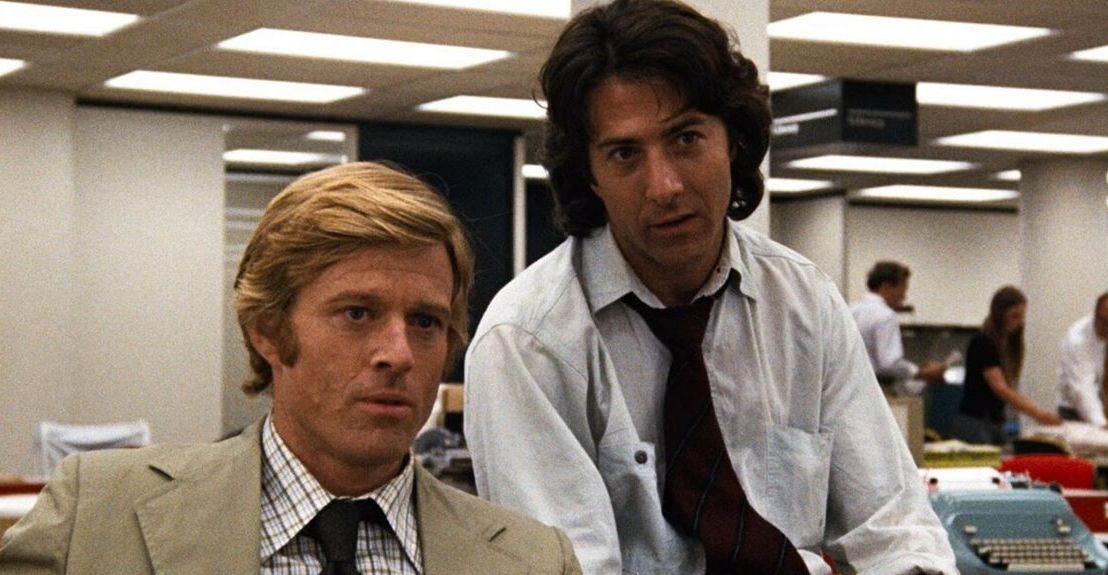
All the President’s Men (1976)

All the President’s Men (1976)

The greatest film about journalism ever made? This dense, detailed conspiracy thriller is a marvel.

Director: Alan J Pakula

Cast: Robert Redford (Bob Woodward), Dustin Hoffman (Carl Bernstein), Jason Robards (Ben Bradlee), Jack Warden (Harry M Rosenfeld), Martin Balsam (Howard Simons), Hal Holbrook (“Deep Throat”), Jane Alexander (The Bookkeeper), Stephen Collins (Hugh W Sloan Jnr), Ned Beatty (Martin Dardis), Meredith Baxter (Deborah Murrah Sloan), Penny Fuller (Sally Aiken)

If anything, even remotely, dodgy happens in politics than, quick as a flash, you can bet the suffix “gate” is added to it. It all stems from Watergate, the Washington building that was the location of the most disastrous attempted burglary in political history. Agents from the Committee to Re-Elect the President (CREEP to you and me) broke into the Democratic office on a dirty tricks mission. They got caught, Nixon and his cronies decided to cover it up and obstruct justice – and when the story broke, it broke Nixon and his Presidency as well.

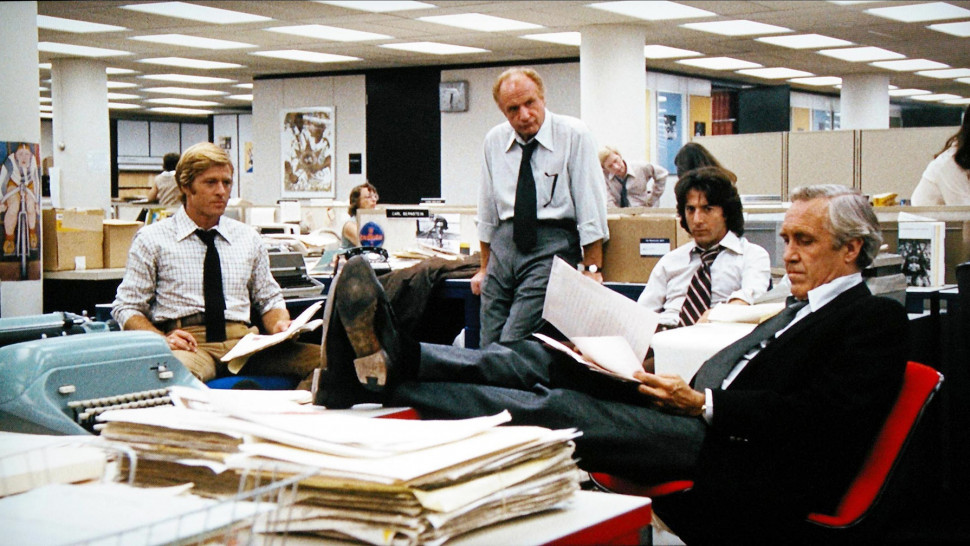
All the President’s Men covers the early days of how that story was broken by two junior reporters on the Washington Post: Bob Woodward (Robert Redford) and Carl Bernstein (Dustin Hoffman). Involved in the case from the night of the break-in, the film (adapted from the book by ‘Wood-stein’) covers their pain-staking investigation to work out what lies behind this burglary and, if there is a conspiracy of silence, how far up the chain of the Presidency it reaches. As well as winning the trust of sources, they must also persuade editor Ben Bradlee (Jason Robards) their reporting is rigorous and worth placing the full might of the paper behind them.

Produced by Redford, All the President’s Men is grounded in realism and the painstaking, methodical series of telephone calls, knocked doors, flicked reference books and sleepless sorting of facts and theories that lies behind investigative reporting. While never once slacking on the patience-defying, unglamourous, exhausting work, All the President’s Men may just have inspired more journalists to choose their career than any other film. This is journalism in all its freedom-of-speech, speaking-truth-to-power might and with Woodward and Bernstein already the most famous journalists alive, their glamour could only be doubled by being played by Redford and Hoffman.

The main obstacle All the President’s Men faced during its development was, how do you make the most famous political scandal in history suspenseful? After all (particularly in 1976) everyone watching the film knew more than the characters at every single step. The solution was fascinating. Not only does the film only focus on the second half of Woodward and Bernstein’s book – culminating in one of their biggest blunders – but the film would try and match the same confusion the journalists felt. All the President’s Men takes an already dense conspiracy – with a plethora of names and uncertain links – and works hard to make it more obtuse and obscure at every turn. Just like the journalists, mist surrounds us. Leads peter out. The focus shifts from scene-to-scene, from people to money. Nothing has been simplified or stream-lined. Instead, the film brilliantly captures the confusion the reports felt, making each revelation a beam of light.

It should, therefore, make the film disengaging and alienating. It’s quite the opposite. Alan J Pakula was already a master of 1970s American paranoia noir, and All the President’s Men is awash of the tension of questions answered and threats and dangers left hanging. There are shadowy implications throughout of dark forces at work, blocking our heroes. Potential witnesses seem terrified – in particular a CREEP book-keeper (a superb, Oscar-nominated, cameo of suppressed fear and nervy strength of purpose by Jane Alexander) who sits rigidly still, willing herself to share revelations.

Pakula’s film is tightly paced and frequently jumps over what could be otherwise clumsy narrative structures – the journalists frequently jump from A to C with the film avoiding functional scenes showing how they passed through B. With its quiet air of looming, indefinable menace – Gordon Willis’ photography makes for a superb mix of light and shade – All the President’s Men makes the unspooling of this conspiracy into pre-tension filled cinema.

It’s also a triumph of sound-mixing and editing. Sound levels drop in and out on key conversations – sometimes phrases are deliberately missed, at other times background sound drops out to sharply narrow our focus. The office of the Washington Post is a hive of background noise. Bernstein talks to a source and literally has to shout over a passing plane. The film sets its sound stall out with an opening eighteen seconds of grayish silent screen – until a crash like a gunshot reveals we have been starring at paper in a typewriter, the keys hammering letters in with earth-shattering impact.

It’s attention to journalistic detail is stunning. The offices of the Washington Post were recreated in detail, shot by Gordon Willis with a low-ceilinged brightness that contrasts completely with almost every other location in the film (in particular the car park, laid out with pillars that echo the office, where Woodward meets with shady informer “Deep Throat” it’s darkness where secrets are hid the polar opposite of a newsroom where secrets are revealed). In gripping single-takes, we watch Woodward conduct phone calls juggling sources (Redford even flubs a line at one point but works it seamlessly into the take) or Bernstein desperately track down sources for last-minute confirmations.

Willis uses a split dopter to brilliant effect. Effectively, this splits the lens in two – one half becomes a close-up, the other long-distance focus. It makes the screen a deeply unsettling mix of blur and crystal-clear clarity. So, while Woodward sits at his desk, we see blurred distance immediately around him – but on the other side of the screen far away other journalists clearly. Not only does this brilliantly create a sense of the endless bustle of the newsroom (also helped by the sound designs superb mix of typewriters and office noise) but also adds a visual metaphor of misty confusion that literally envelops our heroes.

All the President’s Men is a resolutely unflashy film for all of this. Its brilliance is all in its mastery of small details. It means more attention-grabbing shots – like the aerial shot of a circular library – carry even greater impact. The lack of flash also carries across to its stars, who have arguably never been better. Initially presented in two-shot exchanges (particularly in their first encounter over Bernstein rewriting Woodward’s text without his agreement), the two increasingly share the frame. Redford and Hoffman even learned each other’s lines so they could complete each other’s sentences – they almost become one character (‘Woodstein’).

The two actors were also wonderful contrasts, reflecting the two men they played. Redford, who worked hard to keep the project grounded, has a WASPY boy-scout decency and a relaxed unfussy star delivery, Hoffman the twitchy fiddling of the working-class reporter made good. Both actors have rarely been better. Equally good is the Oscar winning Robards who perfectly captures Bradlee’s avuncular professionalism while Holbrook is superbly enigmatic as the shadowy ‘Deep Throat’.

All the President’s Men demands attention like few other films – but it’s deliberately dense plot exactly matches the mystifying journey of the journalists themselves. It also turns journalism itself into a cause for typewriter knights (you could argue the downside of its legacy is journalism focused on ‘gotcha’ rather than informing). Pakula’s marvel is crammed with stunning sound and visual design and a lingering sense of paranoic fear. The film wants us to be as uncertain about what is happening as the characters – but in doing so it makes the greatest argument in favour of the power of journalism ever made by cinema.

Seven Days in May (1964)

Burt Lancaster and Kirk Douglas find themselves on opposite sides of a military coup in Seven Days in May

Director: John Frankenheimer

Cast: Burt Lancaster (General James Mattoon Scott), Kirk Douglas (Colonel Jiggs Casey), Fredric March (President Jordan Lyman), Ava Gardner (Eleanor Holbrook), Edmond O’Brien (Senator Ray Clark), Martin Balsam (Paul Girard), Andrew Duggan (Colonel Mutt Henderson), George Macready (Secretary of the Treasury), Whit Bissell (Senator Fred Prentice), John Houseman (Admiral Barnswell)

President Jordan Lynman (Fredric March) has completed his signature policy: a nuclear disarmament treatment with the USSR. Some are thrilled, others are horrified. In the latter camp are the Joint Chiefs of Staff, none more so than chairman General James Mattoon Scott (Burt Lancaster). General Scott has a plan: a coup to be launched in seven days time, during a training op. But word leaks to his assistant Colonel Casey (Kirk Douglas) who, however much he admires Scott, won’t be party to treason. Casey warns the President – and a race against time begins to stop the coup.

Seven Days in May opens with documentary style footage of clashing crowds outside the White House (one pushing for peace, the other for war) and then carefully balances that style with an unsettling sense of paranoia throughout. People suddenly disappear (once from frame to frame), most of the action takes place in confined spaces. When characters do head outside, they constantly seem to be looking over their shoulder, with the camera watching like a distant observer. The lack of music all adds the eerie feeling that this could just happen.

And, of course you, feel it could. Because we’ve not lost a tingling sense of unease at an over-powerful military. It’s a shame therefore that Seven Days in May doesn’t grip quite as much as it should. I think a large part of that is because the plot is exposed very early – and when Casey goes to the authorities with his suspicions, they are instantly acted on. Thrillers like this often work best with a “one man stands alone” vibe – it’s missing here, and instead we get the President and the cabinet laboriously investigating different elements of this conspiracy looking to turn up enough evidence to prevent the coup before it starts.

The drop in tension could have been counter-balanced if the film had more successfully explored the conflicts and contradictions in America. This is after all a country priding itself as being the home of freedom and democracy – but since George Washington, has had a fondness for installing military men in a job role pointedly called “Commander-in-Chief”. This is a film that could have explored how different parts of American society might admire either an Adlai-Stevenson-style intellectual or a blood-and-guts ‘simple’ soldier. But the film dodges this – and works hard to stress both men act within what they define as honour and the needs of the country. The film is to nervous about any suggestion that Scott’s coup could lead to a proto-dictator vetoing the electorate.

There is also a naivety about the film. A long subplot (not particularly interesting) features Casey being side-lined into uncovering evidence of Scott’s long-term affair. Ava Gardner does her best with a largely thankless part as the woman in question, but there is a touching faith that evidence of this will be enough to destroy Scott. It’s a faith in the system: while the public might be shaken slightly in their belief that Scott is like King Arthur reborn, finding out he’s actually Lancelot is hardly going to weaken his hold over many of his followers – or his military machine.  For a conspiracy film, Seven Days believes conspiracies are a relatively simple matter to defeat.

What’s best about the film – not surprisingly since it’s largely a chamber piece – is the strength of the acting. Produced by Douglas (who generously cast himself in the most thankless role as the decent-but-dull Casey), a cast of stars was assembled. Lancaster was perhaps the only choice as the holier-than-thou Scott, arrogant, morally-superior, cold, distant but capable of inspiring immense loyalty – it’s the perfect role for him and he plays it to the hilt.

The film’s finest sequence is a late confrontation between Scott – Lancaster oozing moral superiority and unhidden contempt – and Fredric March’s intellectual President. March is brilliant, a born negotiator and compromiser – all the skills you need to be a successful politician – with just the right edge of irritation, arrogance and pride for you to know that, even if he is right, he’s no saint. March also gives Lyman an old-school sense of honour and moral principle that makes him unable to cross lines Scott can leave behind him, while still be jittery and waspish to colleagues and friends.

Filling out the cast, O’Brien gives a wonderful (Oscar-nominated) turn as a hard-drinking, good-old-boy Senator who turns out to have principles of iron and the guts to match. Martin Balsam delivers one of his patented put-upon functionaries, struggling to keep stress at bay. Macready is great value as a bombastic cabinet member while Houseman glides above it all as an Admiral to smart to say anything certain either way.

Acting is eventually what powers Seven Days in May and if it never becomes the white-knuckle conspiracy thriller or the insightful political commentary it should be, it just about has enough entertaining scenes to keep you watching.

Cape Fear (1991)

Robert De Niro terrorises his lawyer’s family in Cape Fear

Director: Martin Scorsese

Cast: Robert De Niro (Max Cady), Nick Nolte (Sam Bowden), Jessica Lange (Leigh Bowden), Juliette Lewis (Danielle Bowden), Joe Don Baker (Claude Kersek), Robert Mitchum (Lt Elgart), Gregory Peck (Lee Heller), Illeana Douglas (Lori Davis), Fred Dalton Thompson (Tom Broadbent), Martin Balsam (Judge)

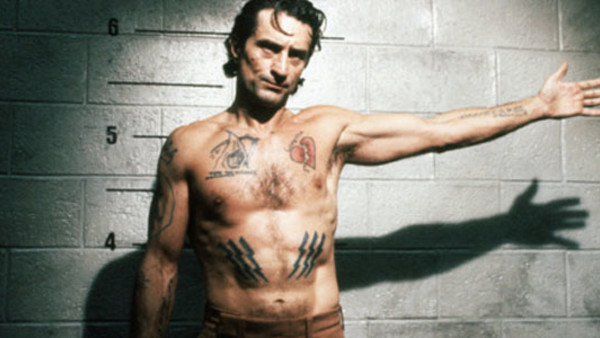
Max Cady (Robert De Niro) is out of prison after 14 years. He went in as an ill-educated psychotic bum, sent down for the rape and assault of a young woman after his appalled lawyer Sam Bowden (Nick Nolte) buried evidence on her sexual history that might have lightened his sentence. He comes out as a self-educated, articulate and psychotic force of nature, not sorry for one minute and intent on making Sam and his wife Leigh (Jessica Lange) and daughter Danielle (Juliette Lewis) pay. 

Scorsese’s remake of J. Lee-Thompson’s deliberately Hitchcock-esque thriller sees the great director go one better by trying to channel Hitchcock’s style as closely as possible. Framing and editing decisions echo Hitchcock, its design apes as much as possible cinematographer Robert Burk’s lensing, Elmer Bernstein remixes the original film’s Bernard Herrmann score into something even more Hitchcockesque than the original. Scorsese throws in several of the master’s favourite themes, with sexual obsession and frustrated, working men forced to defend themselves in extreme situations. Combined with the sort of lavish violence and extreme imagery Hitchcock couldn’t use, we end up with something like an odd film-school experiment, by film students who have watched too many slashers. It’s grim, tasteless, overlong and troubling – and not in a good way.

The film adjusts Nolte’s character from a lawyer and witness against Cady into his corrupt lawyer (no matter that his corruption in this case was well intentioned). The film has a slightly unpleasant concern with modern worries about masculinity, with Bowden now concerned he is not “man enough” to defend his home – the film constantly passes subtle judgement against Bowden’s lack of physical prowess. It also readjusts Bowden into a weasel, corrupt at work and having an affair with a young attorney (whom Cady then beats and rapes later in the film, with a slightly queasy air that she is at least partly culpable by allowing Cady to pick her up in a bar beforehand). To be honest Bowden is hard to sympathise with, and his quest to assert his masculinity rather than rely on the law or hiring others to do his dirty work not really that pleasant. Frankly Nolte was never the actor to engage sympathies in the way original choice Harrison Ford (he wanted to play Cady) would do.

Cady himself is played by Robert De Niro, channelling heavily the original’s star Robert Mitchum (with lashings of The Night of the Hunter) as the sort of articulate psychopath so beloved by film. It’s fun to watch De Niro grandstanding as this sort of violent Tyrannosaur, weaving both psychological and shockingly violent games to unnerve and panic Bowden and his family. The film doesn’t give much scope to make Cady much more than a sort of comic-book monster, but De Niro does at least have moments of reflection in amongst his insanity. And there is a sort of admirable emotional intelligence in Cady’s knack of detecting the underlying tensions in the Bowden’s marriage and family life and exploiting these to torment the family.

The film’s most effective moments are the quieter ones, none more so than Cady’s quiet befriending/seduction of Bowden’s daughter Danielle behind her parents’ back. This culminates in a deeply unsettlingly seduction scene in Danielle’s school hall, where Juliette Lewis (extremely good) fascinatingly and bashfully becomes entranced with Cady’s interest in her teenage reading list and problems with her parents. The sexuality of the scene is possibly even more unnerving today and a highlight of the film – not least, ending as it does, with Danielle sucking Cady’s thumb before kissing him and leaving with the giddy, confused excitement of someone both scared and fascinated. Few other things in the film match this moment for psychological complexity – or the unsettling exploration of teenage sexuality overlapping with rebellion against domineering parents. 

Least of all the film’s overblown and final confrontation between the Bowden family and Cady, in which Cady rises from death no  less than three times and which stretches on forever, jettisoning all the small stock of goodwill the film had built up in its quieter moments. But then this is just part of a film that chooses the graphic and the overblown over calculated and chilling, every chance it gets. It’s a shame as there is a more chilling, psychological terror film – with Cady as a demonically clever opponent – struggling to come out here, but which keeps tripping into slasher territory with Cady as an invulnerable Michael Myers.

Perhaps Scorsese just thought of the whole thing as a sort of cineaste’s private joke? All the Hitchcock references, the careful apeing of styles, even the casting of the original’s leads in small roles (a joke further amplified by casting Mitchum as the police officer, while ultimate straight arrow Gregory Peck plays a lawyer even more corrupt than Bowden). But jokes like this don’t really make for long-term entertaining films, and Cape Fear is so full of basically horrible people doing horrible things to each other (in an increasingly Grand Guignol fashion) that after a while you more than cease caring about it. You start getting actively annoyed by it.

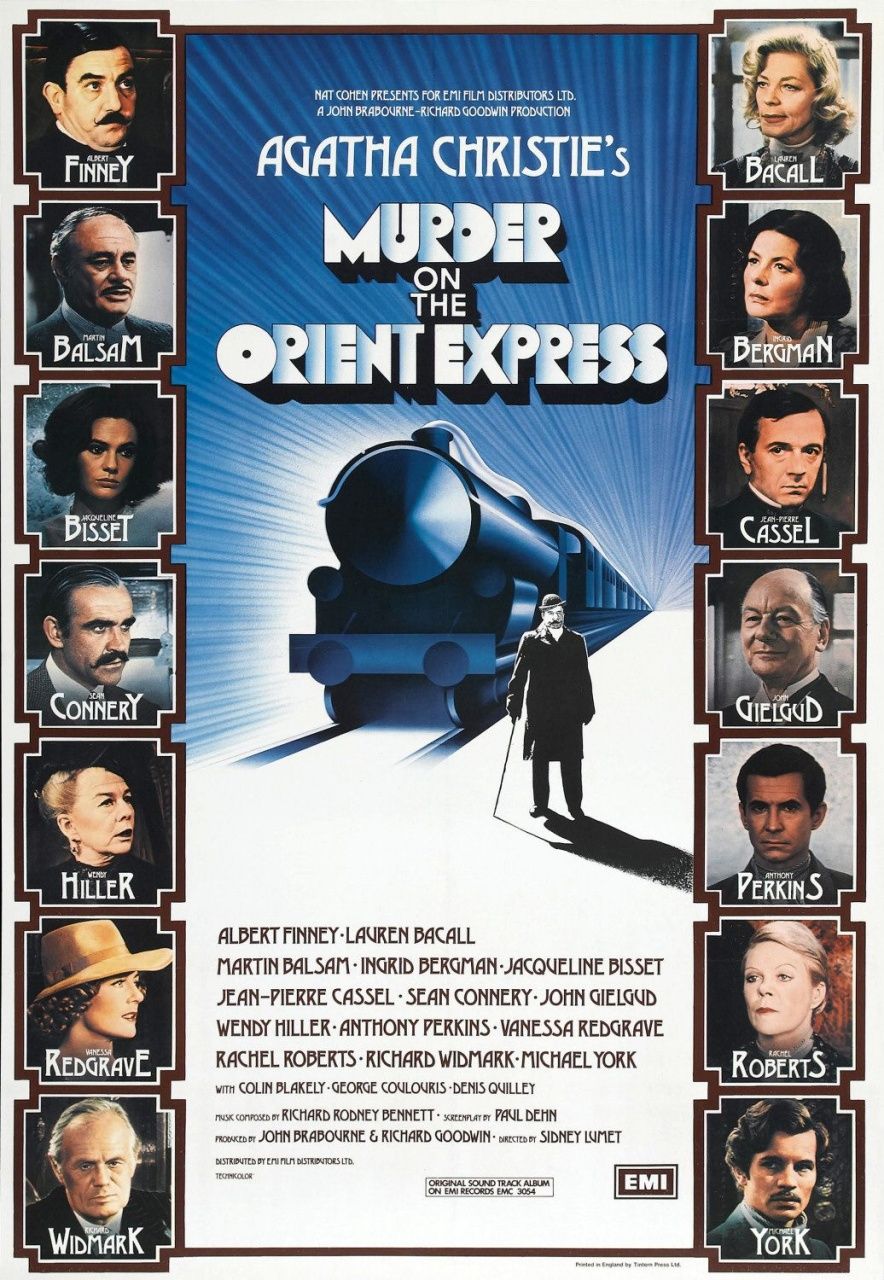
Murder on the Orient Express (1974)

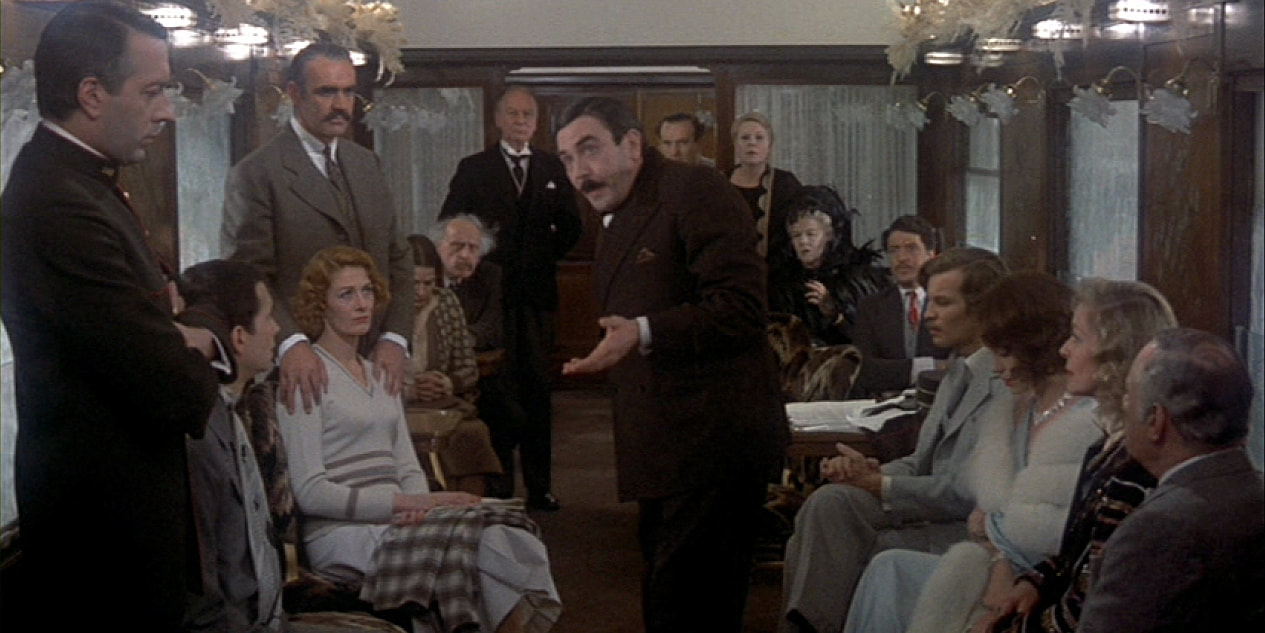
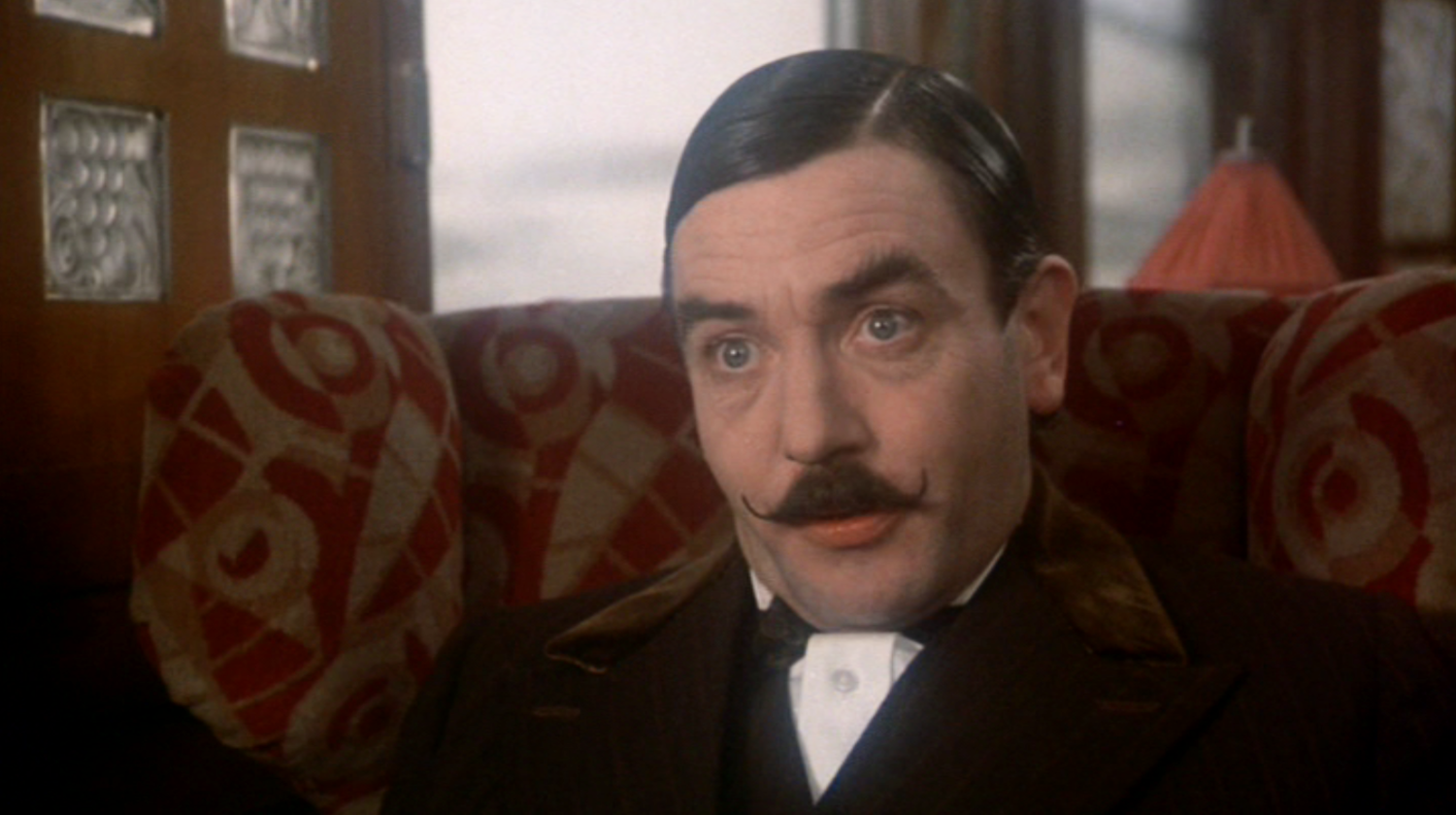
Albert Finney interrogates an all-star cast in Murder on the Orient Express

Director: Sidney Lumet

Cast: Albert Finney (Hercule Poirot), Lauren Bacall (Linda Arden), Martin Balsam (Signor Bianchi), Ingrid Bergman (Greta Ohlsson), Jacqueline Bisset (Countess Helena Andrenyi), Jean-Pierre Cassel (Pierre Paul Michel), Sean Connery (Colonel John Arbuthnot), John Gielgud (Edward Beddoes), Wendy Hiller (Princess Natalia Dragomiroff), Anthony Perkins (Hector McQueen), Vanessa Redgrave (Mary Debenham), Rachel Roberts (Hildegarde Schmidt), Richard Widmark (Ratchett), Michael York (Count Rudolf Andrenyi), Colin Blakely (Cyrus Hardman), George Coulouris (Dr Constantine), Denis Quilley (Antonio Foscarelli)

If there was a film that set the template for our expectations for an Agatha Christie adaptation, it was probably this one. A big starry cast. Luscious period detail. An engrossing plot with clues and double meanings in every corner. A healthy mix of the OTT and the chilling. Marshalled by Sidney Lumet, almost certainly the best director to take on a Christie mystery ever, this film was a massive hit then and remains a hugely enjoyable, rewarding treat now, the sort of masterclass in quality film-making and bravura acting that is guaranteed to leave a smile on your face.

You surely must know the plot by now right? Hercule Poirot (Albert Finney) returning from a successful case in the East hitches a ride on the Orient Express on the way home. During the journey he is asked by American businessman Ratchett (Richard Widmark) if he would take up the role of his bodyguard after threats against his life. Poirot turns him down – and sure enough the next morning Ratchett turns up dead in his compartment, with no less than a dozen knife wounds in his chest. With the train stranded in a snow drift, the killer must be one of the other twelve passengers in the carriage. And so the case begins…

Sidney Lumet’s superb, classy piece of murder mystery is a triumph of design and style. The train looks superb, the period detail is perfect, the costumes are luscious. But what Lumet brings to it all underneath all this Sunday afternoon splendour is a genuine sense of chilling menace. Helped a great deal by Richard Rodney Bennett’s haunting musical cues, this film never lets the viewer forget that the heartless destruction of an entire family is at the root of the crime itself, or that the desires for revenge we find in ourselves can take us to dark places. 

Lumet’s film opens with a brilliantly constructed series of newspaper stills, establishing the horrors of the Daisy Armstrong case that underpins the mystery, the kidnapping and murder of a young child (based on the Lindbergh kidnapping) that led to tragic consequences for an entire family. This chillingly sad and tragic back story is echoed throughout the film, and immediately establishes the stakes for all involved.

So we spend the film then trying to work out how all the suspects might fit it into this story. Lumet’s concept of bringing together an all-star cast was a brilliant idea, not only giving each of the suspects a quickly established personality (partly inspired by the actor’s body of work), but also assembling a group of such talented actors that they can sketch out a character within a few moments. Lumet’s first recruit for the cast was his old collaborator Sean Connery – and the agreement of Connery to take on a supporting role brought a host of actors to follow. It all adds to the fun, an enjoyable star-spotting exercise, and also an amusing game of watching sometime wildly competing acting styles.

Connery plays Arbuthnot with a stiff-upper lip English reserve, but then you also have a wonderfully arch (and very funny) John Gielgud, a dementedly twitchy Anthony Perkins (McQueen seems to have been adapted into a junior brother of Norman Bates), a show-boatingly larger-than-life Lauren Bacall (great fun), a Germanic stern Rachel Roberts and an inscrutable Vanessa Redgrave. That’s just a few of a terrific collection of actors, and arguably only Wendy Hiller’s overly imperious Princess Dragamiroff is a bit of a miss.

Lumet’s strength in depth allowed him to push his actors into demanding places – complex set-ups and, most especially, a series of long takes in his often confined performance spaces. The highlight – in fact it won her an Oscar – is Ingrid Bergman’s five-minute (practically only) scene where the camera slowly rotates around her across five minutes as she tells her story. Bergman’s shy, nervy, gentle and timid missionary comes across as achingly vulnerable. Bergman had been offered the larger role taken by Wendy Hillier, but wisely turned it down for this show-stopping moment.

The advantage of having such accomplished actors was most clear in the burden placed on Finney as Poirot. Watching it now – familiar as we are with decades of David Suchet’s definitive performance – it’s easy to see Finney’s performance as a little too much. Covered with make-up and a fat-suit, his shoulders hunched around his neck, his hair plastered down with grease and his accent frequently heading way out over the top, Finney certainly leaves very little in the dressing room. His Poirot is an amiable showman, a man willing to adjust his personality and approach from suspect to suspect, but in the end a man with a well-being arrogance and a deep sense of personal morality as well as a profound sense of humanity.

Finney was a surprising Oscar nominee for Best Actor, but he almost certainly owed this to his final speech, an almost thirty-minute tour-de-force. Lumet, operating in small confines, determined that the best way of getting the most dramatic energy from the speech was to use long takes, elegant camera moves, and the minimum of cutting – to let Poirot cast his spell over the audience as much as he does over the suspect. As such Finney – in a tiny, crowded, set – performed the complete monologue several times (each time apparently flawlessly) so that the camera could be positioned in each point in the confined set at a time. The result is seen in the final sequence, which uses dizzying long takes and careful camera moves to draw us brilliantly into the reveals that come thick and fast.

Finney’s performance is magnetic in its theatricality and commitment, and Lumet’s directing decisions throughout the sequence really help to make this sequence as effective as it is. Lumet’s peppers this sequence with a series of brief flashbacks to earlier in the film, which skilfully present snippets of the characters testimonies represented at different camera angles, which is both eerie and also throws a new light on the scenes we have already seen. For all that Finney is a bit much at times, you can’t help but enjoy this piece of showmanship.

The final resolution remains justly famous, and it largely owes a lot to this film. Agatha Christie even was favourable to the film (one of only two films of her work she liked, the other being Billy Wilder’s adaptation of Witness for the Prosecution) although (in words I presume heard by Kenneth Branagh) she bemoaned the smallness of Finney’s moustache. There have been several film and TV adaptations that have followed, but only David Suchet’s version has challenged it for the title of the best. With its gorgeous settings, imaginative direction and wonderful cast I never tire of watching it.

The Anderson Tapes (1971)

Sean Connery plans the perfect crime under the noses of the government in The Anderson Tapes

Director: Sidney Lumet

Cast: Sean Connery (John “Duke” Anderson), Dyan Cannon (Ingrid Everleigh), Martin Balsam (Tommy Haskins), Ralph Meeker (Captain Delaney), Alan King (Pat Angelo), Christopher Walken (The Kid), Val Avery (“Socks” Parelli), Dick Anthony Williams (Edward Spencer), Garrett Morris (Everson), Stan Gottleib (“Pop”)

Everywhere we go now we kind of know that we are being watched. There are cameras everywhere. Satellite links build into our cars. Heck we all carry everywhere we go a portable tracking and recording device that can be listened into. So the idea of surveillance being ever present wouldn’t be a surprise to us. But in 1971, the idea that the government could be listening all the time, at any time was something that couldn’t cross anyone’s mind. 

It certainly doesn’t occur to John “Duke” Anderson (Sean Connery) just out of chokey after a ten year stretch. He’s back into a world he hardly understands, but it doesn’t take longer than five minutes in the swanky apartment block of his girlfriend Ingrid (Dyan Cannon) for him to case the joint and plan to do it over – all the apartments at once. Putting a crew together, Duke plans to clean out all the whole block of all its valuable property in one go, with financial backing from the Mafia (who owe him for unspecified reasons). Problem is, Duke’s entire plan is being recorded and monitored by different government agencies from top to bottom who – even if they aren’t speaking to each other – are in position to wreck his plans the instant anyone puts the clues together…

The Anderson Tapes is part crime thriller, part black comedy caper. It generally plays it pretty light – with flashes of violence or danger – and throws in some satire on the surveillance age. The tapes in question are different levels of surveillance at every location Duke seems to stop at. His time in the apartment is recorded by a PI following his girlfriend. The feds bugging his mafia contacts. Most of his criminal gang are being watched by the cops. All this recording creates a load of trees which block the view of the forest. Not one of these agencies thinks about joining up their thinking, meaning the actual robbery comes as a complete surprise to all of them. It’s a neat satirical mark on the incompetence of administrative led organisations – when the robbery is finally being reported by a ham radio operator, the news almost doesn’t get through because of a refusal by the 911 operator to transfer a call without an agreement on who will pay the charges for the call.

In all this surveillance Duke is like a romantic hangover from a by-gone time. As played by Sean Connery he’s a romantic figure, like some sort of working-class Raffles, living by the principles of a gentleman thief. He abhors violence, gets on well with all races and creeds, respects his victims and protects them (so long as they don’t get in his way) and runs operations designed to be clean, quick and painless. He justifies his thievery with talk of how most of the property he nicks is just sitting pointlessly in safes, that the insurance will pay out and that in a way he’s giving a bit of excitement to bored middle-class people. Connery is rather good in this role, channelling this rogueishness and expertly maintaining Lumet’s light tone.

Lumet’s direction is competent, professional and assured. Lumet did not hold the film in high regard – it was one he did “for the money” – but he expertly constructs the film, keeps it tight and brings more than enough intriguing directorial flourishes to it. The action frequently pauses in the criminals conversation for a jump cut to the feds listening to the recordings, having paused the recordings themselves (the paused action even uses voiceover from the feds asking for confirmation of who they are listening to). Later, Lumet uses a similar device in the robbery interjecting flash forwards to the people in the apartment bloc being interviewed on site by the police, commenting on events we have often just seen while the aftermath plays out behind them, that throws in plenty of narrative curve balls and misdirects as the action pans out.

The film is dated in places. Quincy Jones’ score often uses a jarring series of electronic beeps that are meant to echo the surveillance of the piece, but actually sounds impossibly dated and jarring. An opening monologue of Connery on the thrill of safe cracking uncomfortably sounds like he is comparing it to non-consensual sex, Martin Balsam’s gang member is an impossibly limp-wristed antiques expert (although he is immediately believable as someone who wouldn’t be questioned surveying apartments for architectural improvements while he is actually casing the joint). There are other moments – but the film gets by because it never leans too hard on any of these attitudes. Indeed the apartment concierge, is depicted as inflatteringly racist and homophobic, in stark contrast to the multi-ethnic, un-prejudiced gang carrying out the robbery.

The Anderson Tapes is an enjoyable, is very 1970s, piece of work that has more than enough to entertain you. It has a clever structure and makes some sound points on surveillance which probably make it more relevant today than it even was then. Connery is very good in the lead role and there is some excellent support (Christopher Walken is strikingly charismatic in one of his first roles). It’s not in the first rank of its director’s films, but it’s still a very fine caper thriller.

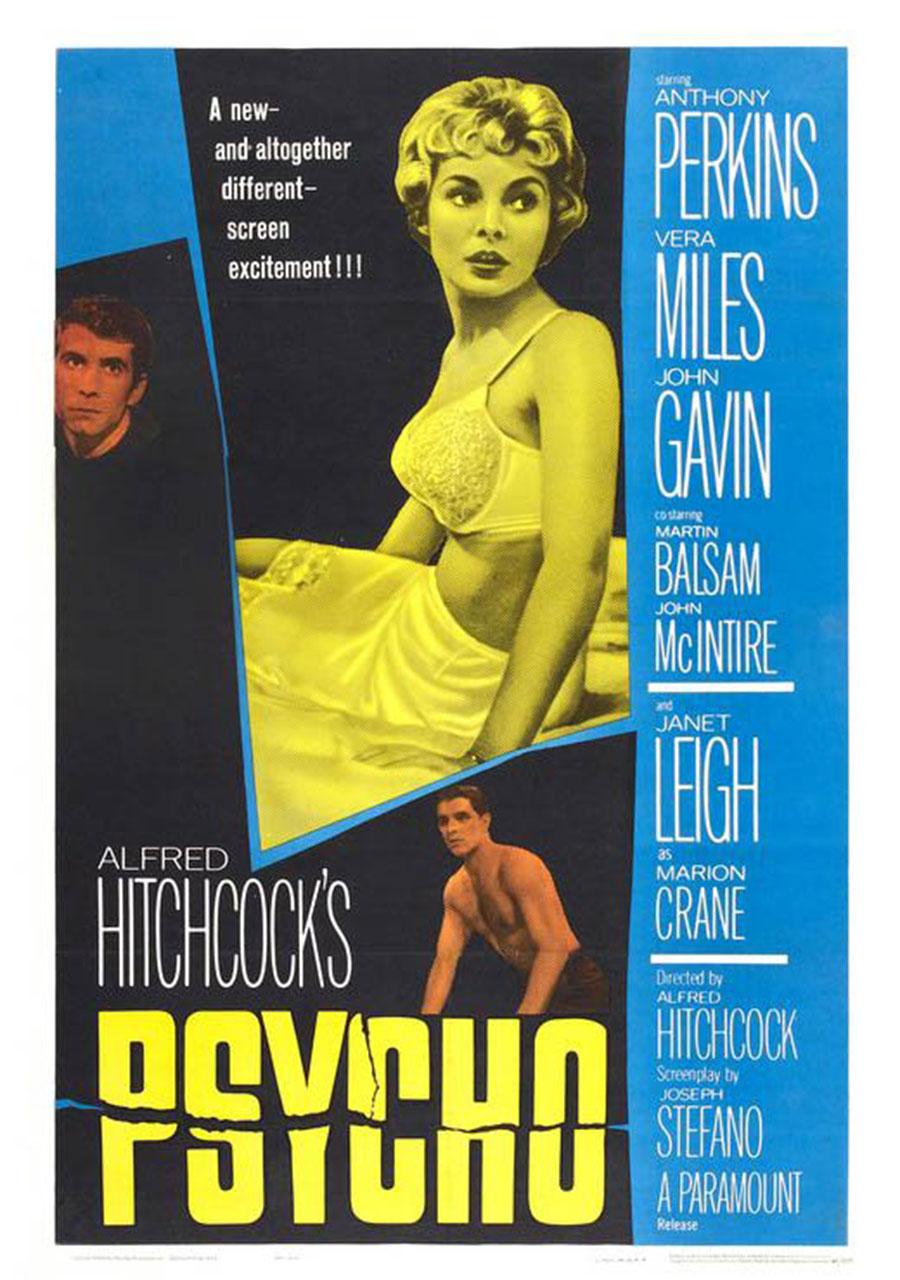
Psycho (1960)


Janet Leigh takes an unwise shower in Alfred Hitchcock’s disturbing slasher-noir Psycho

Director: Alfred Hitchcock

Cast: Anthony Perkins (Norman Bates), Janet Leigh (Marion Crane), Vera Miles (Lila Crane), John Gavin (Sam Loomis), Martin Balsam (Detective Milton Arbogast), John McIntire (Sheriff Al Chambers), Simon Oakland (Dr Fred Richman)

Psycho is so famous it’s almost impossible to watch it as Hitchcock intended. When it was released, the old showman made a huge amount of play from literally banning people from entering the cinema after it had started, with huge billboards in theatres urging people on no account to tell anyone what happens. It was the first major anti-spoiler campaign – and it worked a treat, because the film became a sensation. Such a sensation, that I don’t think there can be many people alive who aren’t familiar with the basic intricacies of its plot, whether you’ve seen it not.

Marion Crane (Janet Leigh) steals $40,000 from her employer, in order to marry her love Sam Loomis (John Gavin). Fleeing New York, she drives through two nights, changes her car, frets about being caught – and finally rests for the night at the Bates Motel, run by shy Mummy’s-boy (“A mother is a boy’s best friend!”) Norman Bates (Anthony Perkins). Exhausted by two days of stress, Marian thinks it’s time to have a shower – and so we suddenly switch genres completely….

Psycho is a masterpiece of mis-direction. If you didn’t know what the film was about, you would expect, from the first act, you are in for some sort of mix between Double Indemnity and a documentary true-crime thriller. The entire first act is essentially a brilliant Hitchcock MacGuffin – both the money and Marion Crane turn out to be things of immense importance to the characters, but essentially less so to the audience. Hitchcock pulls one of his best con tricks by presenting Janet Leigh as the main character, only to dispatch her brutally less than halfway through the film. 

Which is of course during one of the most famous scenes in film history: the shower scene. It’s a masterclass of unsettling, suggestive editing, disturbing imagery (you never see the knife plunging into flesh, but you certainly feel like you do, with constant cuts from knife, to body, to movement, to blood in the bathtub – but no links between them on screen), and of course Bernard Herrmann’s jagged strings scoring it all. For no other reason, this scene would cement the film in cinema history. It’s a slasher scene filmed by a master of cinema, a clear and simple statement for everyone else to come that this was how it was done – and no other director of slasher horror has come anywhere near Hitchcock’s skill here. It’s a phenomenal, terrifying, powerful piece of cinema.

It works so well because Marion Crane is not a faceless victim. Unwittingly, we’ve carefully followed her through the last few days of her life. We’ve seen her love affair with Loomis, we’ve felt her despair at their only being able to meet in motels, felt her temptation and then shared her paranoia and anxiety as she flees with the money. Leigh is barely off-screen for the entire opening third of the movie – and we’ve completely invested in her by the time the water is flowing. Leigh is excellent as Crane – and an overlooked coda to the shower scene is Hitchcock’s tight closeup on her eye immediately after the attack – Leigh pulls off the hugely difficult trick of letting her eye seem like the life is fading away from her in that second. 

It’s one of many outstanding directing feats in the film. Hitchcock slowly builds the uneasy atmosphere of the Bates motel from the moment Marian arrives there, using increasingly unsettling, gothic angles to capture Norman and to suggest that all is not what it seems. As our characters explore the Bates motel, jump cuts to innocuous objects make them carry great peril and uncertainty. Everything at the Bates motel is unnerving, unusual and every shot is not quite right. The Bates motel itself looks like the most nightmarish gothic mansion (seriously who would want to stay there?!).

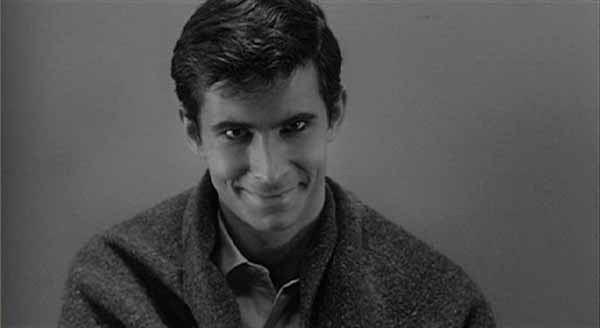
The identity of the murderer is pretty well known. Anthony Perkins is twitchy and fidgety, a softly-spoken peeping tom who is unable to meet anybody’s eyes and is obsessed with taxidermy – is it any great surprise? Perkins is perfect as Bates, and Hitchcock expertly inverts his boyish good looks to masterful effect. Could someone so shy, quiet and innocent-looking be a killer? As the final scenes show us mother’s disturbed voice in Bates’ mind (while the camera slowly tracks in on his increasingly unhinged, grinning face) we not only get some more Hitchcock tricks (a subliminal imposing of the mother’s decayed face over Bates) but also another wonderful scene, of iconic acting and simple but powerful camera work. Hitchcock could do it all.

Mother – oh yuck. It’s brilliant misdirection again. Who is mother? Where is she? Who is the woman we keep seeing? Who is the female murderer? Even when we are told categorically that mother died years ago, that information itself is immediately questioned (“If she wasn’t buried then who was?”). When we do find the truth it’s another horror moment – the greatest ever turn-the-body-around-to-see-the-horror moment you’re going to see in the movies. Lila’s scream and raised arms knock a lightbulb, which swings casting alarming light and shade over the scene.

So Psycho is a masterpiece of film, because it is such an unsettling clash of genres. It’s a film noir whose main character accidentally stumbles into a slasher film. Investigating the disappearance of Marion, Loomis and her sister Lila keep returning again and again to the money that has gone missing, assuming it is the motive of the crime – but they couldn’t be more wrong. 

As is explained to them at the end by the film’s psychiatrist character. This is the weakest mis-step in the film: a psychiatrist explains in a dull lecture exactly what has happened, what was wrong with Norman blah-blah-blah. Maybe we are just much more familiar with things like that, but this scene surely always had a “let me tell you all the answers” flatness to it. Sam Loomis and Lila Crane are not exactly the most interesting characters you are ever going to see – Loomis in particularly seems at first he is going to be a slight rogue, but the character quickly settles into being a bore (what does Marion see in him?). After the first 45 minutes have gone by, most of the scenes outside of the Bates Motel are (whisper it) dull – probably because they focus on a lot of discussion about the money, an issue the audience has long since lost interest in. Did Hitchcock deliberately make these scenes flatter, knowing we needed the rest from the horrors of the Bates Motel?

Psycho, though, is a classic and it will always be a classic. A slasher film and psycho-thriller, directed by an absolute master filmmaker at the top of his game. When Hitchcock made this film – on a low budget, using a TV crew, in black-and-white – people wondered why he was slumming it, why he was wasting his talent. They weren’t asking that after the film was released. Psycho is one of his purest, most unsettling thrill-rides, as horrifying, compelling and unsettling now as it was when it was first released.

12 Angry Men (1957)


Henry Fonda must win over 12 good men and true in 12 Angry Men

Director: Sidney Lumet

Cast: Henry Fonda (Juror #8), Lee J Cobb (Juror #3), Ed Begley (Juror #10), E.G. Marshall (Juror #4), Jack Warden (Juror #7), Martin Balsam (Juror #1), Jack Klugman (Juror #5), Joseph Sweeney (Juror #9), John Fiedler (Juror #2), Edward Binns (Juror #6), George Voskovec (Juror #11), Robert Webber (Juror #12)

A young man is on trial for murder. The jury retires to consider. On the first vote, only one man (Henry Fonda) questions his guilt. The other jurors are convinced they are right – can Fonda turn them around?

Who hasn’t done jury service and dreamed of being Henry Fonda? 12 Angry Men is perhaps the most compelling courtroom drama ever, for that very reason: hardly any of us are judges or lawyers, but we’ve all got a decent chance of doing jury service. What would we do in this situation? How thoughtful would we be about the evidence? And, of course, that little stab of ego – could we be charismatic and persuasive enough to sway a room of people? I think this is why this film sticks with people and has become such a persuasive part of our popular culture – we all wanna be Fonda.

12 Angry Men is a film that I feel touches perfection. I thought quite heavily about whether I could identify any flaws in it at all: the closest I got at was the shot Lumet throws in of the suspect (a sweet looking kid). I suspect this shot was required so that the 50s audience could be confident that Fonda was crusading for someone who at least looked innocent (although it always makes me think, since so many of the other jurors make snap decisions, why doesn’t at least one of them look at that cute kid and think “he ain’t no killer…”). Aside from that, I don’t think there is a single mis-step in the filming, acting or writing of the film – and how many times can you say that?

Lumet is a director who doesn’t get a lot of public recognition. He subordinates his skills to the requirements of the story, rather than an auteur who imposes his style. This works perfectly for this compelling slow-burn. Lumet’s expert filming quietly lets the actors and dialogue stand front-and-centre, while cleverly using his camera language and shot choices to amp up the tension.

At first, Lumet uses wider and high angle shots, allowing us to get a sense of the room and the characters. But the real effect of this plays out over the rest of the film, as Lumet slowly moves to tighter angles at POV height, until the final sequences are played out over a series of close-ups cutting from juror to juror, at low angles. What this achieves brilliantly is to make the film feel tighter and more claustrophobic – the room feels like it’s actually shrinking in on the jurors as they argue. You can get a sense of it in the videos below, both early and later in the film.

The film also works so brilliantly because it offers a brilliant insight (and critique even?) of the legal system. The one legal professional we see is a bored judge. All references to the unseen lawyers mention either their showmanship or inadequacy. Even the jury system is subtly called into question: several of the jurors are motived more by prejudice and personal experience than by any analysis of the evidence. Others are flawed in other ways; #12 switches sides indecisively three times while #7 is so impatient and bored with the whole process, he follows the direction of the least resistance. Without #8, a decision would have been made with no discussion at all. Even the very process of taking the vote is shown to root many of the jurors down to “sides” and creates an atmosphere of competition that becomes as important as seeing justice done. And in a system of trial by your peers, only #4 in any way identifies himself as sharing the background of the man on trial. Is this a perfect system?

These ideas, though, are skilfully interwoven in the background of a gripping legal thriller. 12 Angry Men is completely objective. We never see the witnesses whose performance is the cause of such analysis. We never see the scene of the crime. We don’t have any confirmation at all that either side is right. It’s a film about the importance of reasonable doubt – and the need to be absolutely certain before sending someone to the chair. Fonda feels that doubt – and persuades the other jurors of it – but we never know if he was right or not. We never know if any of the suppositions in the jury room are true – the important thing is how high the possibility is that they might be true – and how much that affects our willingness to convict.

The film is one brilliant set-piece after another, as each piece of evidence is interrogated. I honestly can’t decide which one I like the most. What makes it work is the variation of how each case is presented. The film is as comfortable with the drama of #8 flinging a replica of the “unique” murder weapon onto the table, as it is with a careful dialogue-led dissection of the eyesight of a key witness. Who can resist Fonda limping around an approximation of the next-door neighbour’s flat to see if he can cover a certain distance within a certain time. It helps that the dialogue is incredibly rich – it has to convey a lot of information, but also manages to sketch out each of the characters so swiftly and carefully that each of them feels real.

And we’ve come all this way and not even mentioned the performances. Again, each viewing gives me a chance to appreciate a new performance: my eye was caught on this viewing by Robert Webber’s seemingly cool and collected advertising man, who has far less certainty than he projects. Needless to say each actor is brilliant. Fonda (who also produced) is the very image of moral authority – as well as a generous collaborator on the movie. Is this his best performance? It’s got to up there – #8 is a humanitarian, but he’s never smug or self-serving, just a man who feels a strong sense of his own obligation.

If Fonda is the superego, Cobb’s #3 (the primary antagonist, if there is such a thing) is the ego – raging, elemental, decisive, unshaken in his beliefs. Cobb’s performance veers the closestto a little too stagy, but it’s a character that demands it. His bluster and swaggering are vital to the character in order to make his later emotional collapse work as well as it does – and #3’s final emotional disintegration really rings true. It’s a ferociously intense performance.

Each actor gets his chance to shine. Voskovec’s sensitive immigrant has a wonderful speech on the responsibility of passing judgement. The most barnstorming speech is Begley’s racist outburst late in the film. It’s beautifully done as this loud-mouthed bully explodes with frustration, then slowly and even rather sadly collapses as he talks on and on, each sentence making him weaker and weaker, more defensive and vulnerable. But it’s never a scene about just one man – the reactions are as well judged as everything else. And I can’t tell you how much I love #4’s “I have [listened to you]. Now sit down and don’t open your mouth again” one-line response which caps the scene.

In fact just mentioning #4 brings on my love of E.G. Marshall’s performance in this film. #4 should be one of the least engaging characters in the film – coldly analytical, professional, assured and clear minded. But he’s always human, never an antagonist, but a respected citizen – the only one of the jurors who is motivated by judgement rather than prejudice. I love his calmness, his cool lack of regard for #3 and #10’s loud-mouthed berating, his patient, studied explanation of his convictions. I adore his calm puncturing and counterview of each point Fonda puts forward, until he is finally won over – and its his winning over which makes the film work. If this thoughtful, intelligent man has doubts, shouldn’t we all?

But I repeat they are all great. Jack Warden’s #7 is totally convincing as (the film’s real villain?) a man indifferent to right and wrong when compared to his own needs. Balsam’s decent but ineffectual #1 is the perfect mediocrity in above his head. Sweeney’s wry, observant and shrewd #9 is a delight (Sweeney was the only member of the original TV play to be retained). Fiedler’s #2 grows in moral force throughout, belaying his quiet appearance. Klugman’s #5 is quietly defiant and conflicted. Binn’s #6 reveals himself as a mild, humble and honourable man.

I think I could watch 12 Angry Men every week of the year. It’s brilliantly filmed (how could I not mention the oppressive rain soundtrack that accompanies the latter part of the film) and wonderfully directed. The script is simply perfect, Reginald Rose expanding and enriching his original TV adaptation. The acting is nearly flawless from all concerned. It’s, quite simply, a great movie. I simply can’t imagine anyone not reflecting on this movie when heading into jury service. It subtly comments on the legal system, but never gets bogged down in this, telling a gripping and compelling story about things we never see. It’s pretty damn near close to perfection.