Tag: Mary Alice

Awakenings (1990)

Awakenings (1990)

Decent performances from the leads can’t save a shamelessly manipulative, saccharine movie

Director: Penny Marshall

Cast: Robert De Niro (Leonard Lowe), Robin Williams (Dr Malcolm Sayer), Julie Kavner (Eleanor Costello), John Heard (Dr Kaufman), Penelope Ann Miller (Paula), Max von Sydow (Dr Peter Ingham), Ruth Nelson (Mrs Lowe), Alice Drummond (Lucy), Judith Malina (Rose), George Martin (Frank), Dexter Gordon (Rolando), Keith Diamond (Anthony), Anna Meare (Miriam), Mary Alice (Margaret)

There can be few things more terrifying than being trapped inside your own body, unable to engage with the world, but to be in a sort of waking coma for years. Imagine how wonderful – and how terrible – it might be if you briefly woke to normality, only to return to your catatonic shell? This actually happened to patients of Dr Oliver Sacks – here re-imagined as Dr Malcolm Sayer (Robin Williams) – in a Bronx hospital in 1969. Looking after catatonic survivors of the encephalitis lethargica epidemic of 1919-30, Sayer discovered they responded to certain stimuli: their name, music, catching balls etc. With an experimental drug he discovers he can restore the patients to ‘life’ – foremost among them Leonard Lowe (Robert De Niro), just a boy when afflicted – only to discover the effects won’t last and they are doomed to return to their coma-like state.

It’s such a terrible thing to think about that it even gives genuine emotional force to Awakenings an otherwise hopelessly manipulative, sentimental film that plays like a TV-Movie weepie. It certainly didn’t need the naked emotional manipulation that washes over the whole thing like a wave, with Randy Newman’s sentimental, tear-jerking score swells with every single heart-string tucking moment. Awakenings is so determined to make you feel every single moment it eventually starts to make the story less affecting than it really is. A simpler, less strenuous film would have been more moving rather than this film almost genetically engineered into ‘life-affirming’.

Everything in Awakenings feels like it is always trying too hard. Every moment is laid on for maximum emotional impact. Adapted from Oliver Sacks’ book chronicling individual cases, it presents a stereotypical Hollywood ‘feelings’ film, with lessons for all. Worse, there is a tedious ‘seize the day’ message that keeps ringing out of the film. The awakening is, of course, not only literal but metaphorical – the patients (and their doctors) ‘awoke’ to appreciate life and living more. It’s hard not to think at times there is something rather patronising about partially using Leonard’s brief experience as a lesson for Dr Sayer to stop being so damn timid and ask a nurse out on a date. As traumatic as it is for Leonard to return to his coma, at least Dr Sayer learned to live a little!

It’s a very fake attempt at a hopeful ending to an otherwise down beat true-story. Dr Sayer is a retro-fitted version of Oliver Sacks, sharing many of his characteristics – but not his sexuality or decades long celibacy – and the film presents him, as Hollywood loves to with geniuses, as a shy, awkward type who no-one of course could expect anything of. He combines this with quiet maverick tendencies, putting the patients first against the ‘numbers-first-risk-free’ obstructionist bureaucrats (represented, of course, by John Heard, though he does thaw a little) who run the hospital and poo-poo his ideas.

Awakenings is full of sickly moments of heavy-handed sentimentality – its opening shot of Leonard as a boy carving his name in a bench under the Brooklyn Bridge tells you immediately one of the first places he’ll go as an adult for a wistful smile – that keep trying to do the work for you. (Of course, all the nurses and cleaning staff offer up cheques to help pay for the patients drugs!) The story doesn’t need it. Just seeing the facts of these vibrant adults emerge for a brief time in the sun is moving enough. Leonard quietly, but with dignity, asking the hospital board for permission to go outside alone is more moving than watching him forcibly dragged from the door by porters or seeing him rant on the mental ward he’s been consigned to as a punishment. We don’t need Sayer to literally tell us some things are too sad for him to film, when we can see it on Williams’ face.

The leads are not always immune to the try hard nature of the film, but they do some decent work. De Niro (Oscar-nominated) brings a touching sweetness to Leonard, essentially a boy who wakes in the body of an adult. There is a genuine wonder in his eyes at the world around him – wonder that transforms into frustration at the continued restrictions placed on his freedom. There is something slightly studied about the physical effects (especially in the film’s final act) but De Niro understands that underplaying and quiet honesty is more moving than when the film pushes him towards grandstanding.

Williams is also very good – if at times a little mannered – as the quiet, awkward Sayer. With the less flashy – but potentially more complex role – he again shows how close humour is to pathos. It’s a performance with several little eccentric comic touches, but wrapped up in a humanitarian shell of earnestness that is quite affecting. It’s a shame that the film constantly undermines his restraint by using every conceivable trick of framing, scoring and composition to wring sentiment from him.

But then that’s Awakenings all over. You can imagine the script covered with annotations along the lines of ‘make them cry here’. And it worked with a great many people, the mechanical nature of the film working overtime to tickle the tear ducts. But the film’s utterly unnatural sense of artifice constantly prevents you from really feeling it. You are always aware of Marshall nudging you to remind you of the unbearable emotion and the tragedy of lives not lived. All easily washed down in a narrative structure as old as the hills – Sayer is an outsider who proves himself, he and Leonard fall out then come back together stronger than ever etc. etc. – that continually reminds you of its functional, manipulative nature.

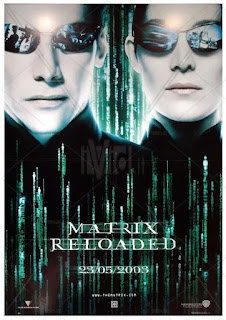
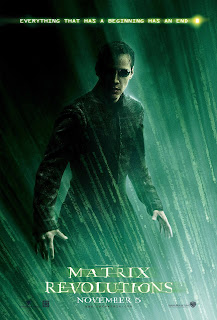
The Matrix Reloaded and The Matrix Revolutions (2003)

The Matrix Reloaded and The Matrix Revolutions (2003)

Tension, drama and thrills… all go missing in these increasingly ponderous self-important sequels

Director: The Wachowskis

Cast: Keanu Reeves (Neo), Laurence Fishburne (Morpheus), Carrie-Anne Moss (Trinity), Hugo Weaving (Agent Smith), Jada Pinkett Smith (Niobe), Monica Bellucci (Persephone), Lambert Wilson (The Merovingian), Gloria Foster/Mary Alice (The Oracle), Helmut Bakaitis (The Architect), Harold Perrineau (Link), Ian Bliss (Bane), Harry Lennix (Commander Lock), Collin Chou (Seraph), Nona Gaye (Zee), Gina Torres (Cas), Randul Duk Kim (The Keymaker), Daniel Bernhardt (Agent Johnson)

If you ever want to study a crash-course in how not to make sequels to a genre redefining film, these might be the perfect examples. I’m going to break a golden rule here and review them both together, which I’ve not done for anything else so far in this blog. The flaws in these films are so interlinked, I think you have to almost treat the whole misfire as one single, dreadfully disappointing film. And I just couldn’t bear the idea about writing two articles about each of them.

It’s six months after the events of The Matrix. Neo (Keanu Reeves) is an invulnerable phenomenon in the Matrix. He and Trinity (Carrie-Anne Moss) are in love. Morpheus (Laurence Fishburne) is being dragged over the coals by Starfleet Command (I know it isn’t called that, but it might as well be) for disobeying orders. And even worse news than that: the Machines have found the location of Zion, the secret last human city in the world. And they plan to destroy it – in 72 hours. Neo must undertake one final mission in the Matrix to find the secrets that will prevent this destruction of the human race – and he’ll have to do it with only the support of his friends, as the rest of mankind decides to batten down the hatches and wait for the uncoming storm. But is there more going on here than we think? Is there more to Neo’s existence than meets the eye? Why is he being plagued with dreams of Trinity’s death? And what is going on with Smith (Hugo Weaving) who know seems to be acting as rogue agent, working against man and machine?

The answers are all eventually revealed, with maximum pomposity and self-importance, over the nearly five hours these sequels drone on, seemingly determined to drain out everything that anyone found cool about the original movie and leave it with a stuffy, pretentious, dull shell that won’t win any new converts over. Before these films, The Matrix was a franchise that would have a life in films, video games, anime and fan fiction for decades to come. After them, it was dead in the water.

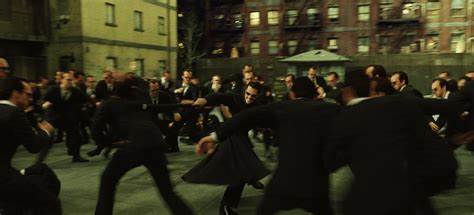
Why? What did people like about the first film? They liked the action sure, and they liked the cool action and visuals and the anti-authoritarian nose thumbing. But those all really worked because we related to the characters, we saw that they were vulnerable, outmatched and in peril. In the real world they were plucky, brave resistance fighters. In the Matrix they were desperate rebels who could do really cool things. This all gets blown away here. In the Matrix, Neo is now so invulnerable, that fights are pointless: they are little more than dull displays of choreography with inevitable outcomes. Reloaded hammers home time and again Neo can do anything he likes in the Matrix. Fighting hundreds of clones of Smith at once? No problem. Flying faster than the speed of sound? Sure thing. Reworking the reality to suit him? It’s just a shrug of the shoulders.

This is a disaster to drama in two ways. Firstly, it drains all the peril out of any moment in the Matrix world because we know that there is no way Neo can get hurt – or that he will allow any of his friends to get hurt. Secondly, it means to get any tension Neo has to be somehow depowered or separated from everyone else. This happens three times over the films: Neo gets dispatched to China, flung into an underground station purgatory and blinded in the real world. When the film becomes reliant on continuously finding a way to put its hero out of the way (a blight that also often hits Superman on film), you know you are in trouble.

Where Neo is still vulnerable, is the real world where the films spend more and more time. Sadly, the real world is a tedious, uninvolving place. Remember in the first film where Morpheus seemed like a super cool, sage-like leader of a rebellion? Well in fact he’s just a cog in a large, stuffy command structure that takes all the worst, most uncool elements of Star Trek’s Starfleet and doubles down on it. Zion is a stereotypical sci-fi city, with characters dressed in flowing robes, quasi-uniforms or urban rags (that’s when they are dressed at all – Reloaded’s early doors rave/orgy rightly draw oceans of sniggers). The real human world isn’t a gang of plucky, anti-authoritarian types but a typical sci-fi, rules-bound society. The flair of our characters is stripped from them.

All this is wrapped in a package that doubles down on the stuffy, Bluffer’s Guide to Philosophy that popped up in the first film. There it added a bit of self-regarding intellectual heft to a film about people kicking each other and dodging bullets, here it’s the be-all-and-end-all. But the films are nowhere near as clever as they think they are: various characters parrot crudely scripted stances on everything from free will to determinism to the greater good. None of it is new or intriguing, and nearly all of it feels like the directors straining to show off their reading list.

It hits its apotheosis in Reloaded as the Architect (Helmut Bakaitis), the bearded brain behind the Matrix, lays out in a long speech how Neo is in fact a part of the Matrix programme designed to help the system reboot and refresh in cycles, an interesting idea totally crushed under the weight of needlessly long, incomprehensible words, phrases and Latin quotes that don’t sound smart, only like the speech was written out in plain English and then run through a thesaurus.

And it was a neat idea that our Messiah might actually have been created by the machines to help their prison renew itself. But it gets lost in the clumsy, pleased with itself delivery, in conversations about choice and free will (will Neo choose his destiny or saving Trinity’s life? Guess!) and the generally turgid plotting. This gets worse in Revolutions which finally seeps the life out of the franchise, with a video-game shoot-out at Zion (which makes no tactical sense), a trek by Neo and Trinity to commune with the machines and Agent Smith converting every human being in the Matrix into a copy of himself, in a vague philosophical comment on the death of individuality.

The worst thing about these films is that they are self-important, hard to enjoy and often more than a little silly. Fights take place at great length with very little tension. Reloaded does have a fab freeway car chase – but again it depends on Neo being absent for any tension to exist (and as soon as he turns up it’s all solved in seconds). Almost everything in the real world is stuffy, earnest and bogged down in the sort of uncool sci-fi tropes the first film stayed away from. Nearly anything in the Matrix involves watching a God like figure hitting things (including a bizarre ten-pin bowling effect when Neo knocks over a host of Smiths).

The actors struggle to keep up the genre-redefining cool that made the first film so popular. Fishburne looks bored (and rightly so, since his dialogue is awful and he’s given almost nothing to do in Revolutions) and Weaving treats the whole thing as a joke. Reeves is earnest, but frequently restrained by the dullness of his role as an almighty God. Moss has most of the best material as Trinity makes drastic decisions for love and faith. The rest of the cast struggle with either paper-thin characters, painfully over-written dialogue or a mixture of both.

The Matrix sequels managed to drain out everything that was great about the original. Where that was nimble, these were stuffy. Where these were anti-authoritarian, these laid out a dull and stereotypical sci-fi society. Where the first was gripping, desperate and adrenalin fuelled, this sees invulnerable heroes, extended runtimes and a frequent lack of peril. Worst of all Revolutions in particular feels like hundreds of other “sci-fi war films” and about a million miles from the actual revolution of the first film. It doubles down on nearly everything that was less good in the original and strips out the things that most impacted people. How not to make a sequel.