

Lubitsch’s delightful early musical mixes European class with battle of the sexes wit
Director: Ernst Lubitsch
Cast: Maurice Chevalier (Count Alfred Renard), Jeanette MacDonald (Queen Louise), Lupino Lane (Jacques), Lillian Roth (Lulu), Eugene Pallette (Minister of War), E. H. Calvert (Sylvanian Ambassador), Edgar Norton (Master of Ceremonies), Lionel Belmore (Prime Minister)
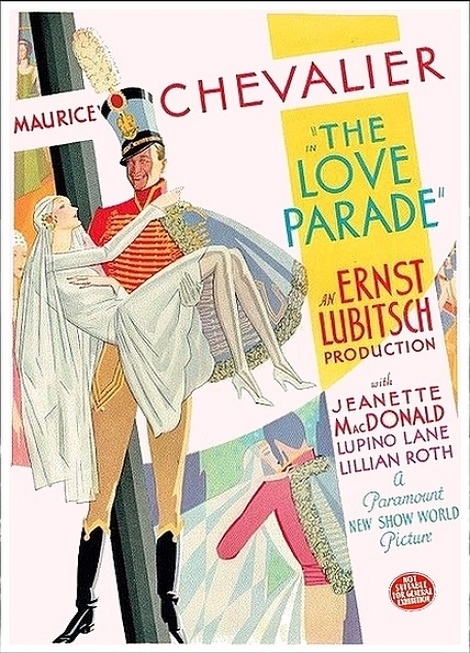
Sylvania has a problem with its ambassador in France, Count Alfred Renard (Maurice Chevalier) – largely that he can’t stop seducing anything that moves. Renard is swiftly recalled to his homeland… where he catches the eye of young, unmarried Queen Louise (Jeannette MacDonald), who immediately thinks he might just be the man for her. Renard isn’t averse to marrying into royalty, but quickly finds himself chafing in the role of Prince Consort – this isn’t what marriage is supposed to be, the husband doesn’t defer to the wife!
It is of course a slightly dated version of marriage, and The Love Parade could be seen as a very light piece of Taming of the Shrew style-action where a strong woman learns true happiness is sometimes being the number two. The fact that, despite this, The Love Parade is still charming, funny and more than a little delightful is partly due to the immensely skilled lightness it’s directed with by Lubitsch (it feels the whole sweet confection could burst with a puff of strong air) and the huge charm of its leads. After all, Chevalier is no-one’s idea of a Petruchio while Jeanette MacDonald manages to marry up romantic longing with being tired of the restrictive burdens of royalty, that you believe she’d be happy to share some of it out.
The Love Parade was one of the first ‘talkie-musicals’ and it’s assembled with such pace and energy by Lubitsch (at his very best) that you almost don’t notice how often its forced into static framing for the talking and singing (where couples frequently sit or stand opposite each other to burst into song). That’s because the film is awash with swift intercutting between different locations, often to great comic effect (not least cut aways to groups of ministers, soldiers and servants excitedly commentating from afar on the lead’s first date) and intermixes this with smoothly seductive tracking shots through grand Habsburg-style sets.
Lubitsch’s film however uses sound effectively and remarkably imaginatively. Establishing his confidence with it, it opens with us overhearing dialogue from outside a room before the door swings open and we see Chevalier stride in and confide directly to us. Sound is used throughout for comic effect, either in its presence – the highly suggestive ‘400 cannon blasts’ on the night of the wedding or the frustrated drumming of fingers on the table our happy couple do in the midst of an early row to the awkwardly quiet march-past of a group of soldiers trying not to disturb the Queen’s lie-in. It’s creative stuff, considering the limitations at the time, and bounces effectively off the parade of songs and witty dialogue that powers the film.
Alongside that, the film works because it’s such an interesting exploration of social mores and etiquette, not to mention a cheeky love of the sort of content code-Hollywood would have frowned on. The opening sequence revolves around the aftermath of one of Renard’s seductions, with shots of garters, a furious husband and a gun loaded with blanks (Renard seems to have a drawer full of these for just such occasions). Queen Louise is all too clearly extremely aroused by reading about Renard’s string of sexual conquests, immediately running into her dressing room to apply more make-up before she can greet him with all the coquetteish excitement she can manage.
There is innuendo throughout (“My wife has told me everything” one of Renard’s embassy colleagues announces, something Chevalier’s face tells us is clearly far from true). Lubitsch uses visual humour expertly, cutting away from Renard’s delighted recounting of one of his adventures to a shot outside where we watch Renard and his audience talking silently from the other side a window, with only their reactions clueing us into how saucy the story is. All this is classic ‘Lubitsch touch’, which thrives among these gorgeously grand sets and costumes.
The Love Parade manages to keep us feel sympathy for the likeable Renard, not least once he discovers, as Prince Consort, his duties seem to be little more than shaving (because, as he tells Louisa, he looks terrible in a beard) and resting (so he’s nice and ready for the evening’s fun later). He literally can’t eat a meal until Louisa arrives to eat first (he’s reduced to plucking an apple from a tree to beat off hunger) and finds his advice is instantly handed back to him unread by one of Louisa’s many court flunkies. Sure, you’d prefer that The Love Parade works its way into a proper partnership at the end, rather than just reversing the power to it’s ‘natural order’ but at least you can see Renard has a point.
It’s interesting that a more natural partnership actually seems to develop between their two servants, Renard’s valet Jacques (Lupino Lane) and Louisa’s maid Lulu (Lilian Roth). Lane and Roth give energetically charming comedic performances – and also by far the most engaging and dynamic musical sequences. The highlight here is ‘Let’s be common’, that brilliantly uses Lupino’s double-jointed flexibility to stage the film’s most overtly entertaining number. There is a Mozartian quality to these super-smart servants – so much so, I’d willingly trade a few of Chevalier or MacDonald’s numbers for a couple more with them.
Which isn’t to disparage the stars. Chevalier’s comic skills are exploited to the max here – his reaction to ‘being shot’ in the opening sequence is a masterclass in timing – and it’s a part he invests with huge charm which sells Renard’s slight selfishness as genuine likeability. Lubitsch throws in a few neat gags about his accent, not least Renard’s penchant to voice his frustrations in perfect, rat-a-tat French to bewildered Sylvanians (he’s deeply disappointed when he asks one obstructive courtier if he speaks French only to get the answer ‘yes’). Jeannette MacDonald is also skilfully sharp and just frustrating enough, from her opening scene where she is poutishly pissed that he flunkies can’t find her a consort (despite the fact she doesn’t want one) to her mix of romanticism and imperiousness that runs through the film.
The Love Parade is an engaging and funny Lubitsch masterclass in his particular genre of sophisticated comedy, as well as a strikingly original use of sound and music. It remains engaging and entertaining today.


 Movie Musings