Tag: Melville Cooper

Random Harvest (1942)

Random Harvest (1942)

Two superb leading performances hold together a romantic confection of a film

Director: Mervyn Le Roy

Cast: Ronald Colman (Charles Rainier/”Smithy”), Greer Garson (Paula Ridgeway/ “Margaret Hanson”), Philip Dorn (Dr. Jonathan Benet), Susan Peters (Kitty Chilcet), Henry Travers (Dr. Sims), Reginald Owen (Biffer), Bramwell Fletcher (Harrison), Rhys Williams (Sam), Una O’Connor (Tobacco Shopkeeper), Aubrey Mather (Sheldon), Margaret Wycherly (Mrs. Deventer), Arthur Margetson (Chetwynd Rainier), Melville Cooper (George Rainier), Alan Napier (Julian Rainier), Jill Esmond (Lydia Rainier)

Random Harvest is one of the most fondly remembered romances of Golden Age Hollywood – if you want yearning dedication bought to life, this is the film for you. It might also be one of the barmiest films ever made, stuffed with so many outlandish plot developments, hilarious logic gaps and hand-waved contrivances it would put a Netflix soap to shame. You can see why Syndey Pollack and Anthony Minghella eventually abandoned remakes: you can’t imagine a modern audience going with Random Harvest’s essential loopiness and not laughing somewhere along the line. Which is not to say it isn’t beautifully made and winningly bought to life at times.

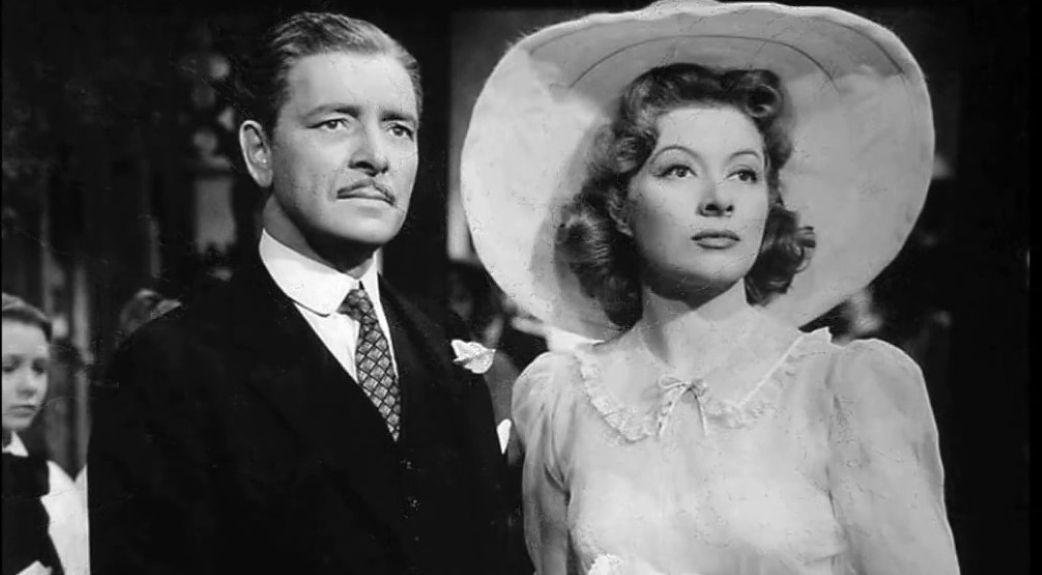
It’s the final days of World War One, and amnesic soldier “John Smith” (Ronald Colman) can’t remember anything about his life. On the final day of the war, he sneaks out of the asylum and runs into music hall performer Paula (Greer Garson). She takes a shine to “Smithy” and decides to save him. They run away to the country, fall in love, get married, have a baby, he starts to write, goes to Liverpool to start a journalism career… and gets hit by a cab. The collision restores his original memory – but also causes him to forget everything about Paula and his life as Smithy. Instead, he restarts his original life as industrial heir Charles Rainier, presumed dead by his family. While he lives this life for years, Paula takes a job as his secretary “Margaret”. Will he remember who she is?

It says a lot that that summary only scratches the surface of a plot that throws in the kitchen sink in attempting to ring as many tear-soaked tissues out of you as possible. Smithy and Paula carry out their little memory dance over the course of over twenty years. It’s the sort of a film where millionaire Charles only thinks about investigating what might have happened to him in Liverpool when nudged to do so after over a decade. Where the couple enter a ‘marriage of convenience’ as the memory-free Charles and fake Margaret. Where Charles’ owns a major factory in the town where our lovers first met, but neither (a) stepped foot there in 15 years (since the moment he does his memory starts to return) and (b) the heir to the town’s major employer wasn’t recognised by anyone while living in an asylum five minutes walk down the road.

Take it on the merits of logic and conventional narrative and Random Harvest crashes and burns. But this isn’t a film about those things. This is a classic weepie that stole the hearts of a war-torn nation in 1942 (it was the biggest hit of the year). Powered by two committed and emotional performances, if it hits you in the right mood its probably irresistible. The sort of long-term adversity that makes Romeo and Juliet’s look like a casual dalliance (so full of tragedy, the death of their son is literally a throwaway moment). It’s framed with a great, sensual beauty by Mervyn LeRoy and powered by an emotionally throbbing score by Herbert Stothart that’s just the right side of sickly.

Ronald Colman’s performance is quiet, measured and vulnerable (especially in his “Smithy” performance). From the start, he has eyes of hesitant, unknown sorrow and stumbles into a relationship with Paula like a new-born discovering life. Threads of his gentleness and excitability work their way into his Charles persona, tinged this time with the natural confidence of wealth. Nevertheless, Colman makes Charles a man who has dealt with unnerving amnesia by actively not thinking about it, carrying on a watch-chain the key to his “Smithy” home as a subconscious reminder. It’s a fine performance – so much so you can overlook he’s twenty-five years too old (the restored Charles forgoes returning to university, something that looks long gone for Colman).

Just as fine is Greer Garson, fully embracing an emotional roller-coaster as Paula. Introduced as a good-natured music hall singer (and Garson sings a high-kicking She’s Ma Daisy number in possibly the shortest skirt the Hays Code ever allowed), Garson’s warm and playful Paula is drawn towards “Smithy” in ways she almost can’t understand. But it’s a wonderfully different side for an actress so often associated with self-sacrificing wives and mothers: Paula is vivacious, forward and seizes the things she wants from life. It’s the second half – the patient, yearning desperation of “Margaret” hoping her husband will remember her – that leans more into her Mrs Miniver wheelhouse, but Garson mixes this with a real lingering, desperate sadness tinged with just enough hope that her husband might just recognise her.

Both performers overwhelmingly lift this otherwise (frankly) slightly contrived film into something rather sweet and endearing. It is, however, a film that would be even more so if it was shorter: the general morass of missed opportunities, misunderstandings and wrong ends of sticks being grasped would be easier to sustain over 90 than 120 minutes. It’s a rare film that covers so much ground over so much time that it’s lead character is declared dead twice.

The second declaration is Paula gaining that status for “Smithy”, dissolving their marriage and removing (you suspect for Hay’s Code reasons) the risk that Charles might accidentally commit bigamy by marrying his young niece. This is a lovely performance of youthful idealism and earnest devotion from Susan Peters (a tragic accident shortly after curtailed her promising career), and if the whole years-long subplot of the possibility of Charles marrying his besotted niece is a narrative cul-de-sac the overall film would be better without, it does at least mean we get the pleasure of Peters, performance captured forever.

But Random Harvest remains a pure romance: where no less than two women spend decades of their life in selfless, one-sided devotion for the lead and he still comes across as the sort of saintly man cheered by his own factory workers for sorting out a strike. The whole confection is a very fragile thing, but LeRoy carries this fully-loaded glass ornament with pure skill and the performances of Colman and Garson set the bar for classic Hollywood tragic romance. Minghella and Pollack were right – our cynical age can’t believe the nonsense – but on its own terms it still works.

The Adventures of Robin Hood (1938)

Errol Flynn hits the spot in The Adventures of Robin Hood

Director: Michael Curtiz, William Keighley

Cast: Errol Flynn (Robin Hood), Olivia de Havilland (Maid Marian), Basil Rathbone (Sir Guy of Gisbourne), Claude Rains (Prince John), Patrick Knowles (Will Scarlet), Eugene Pallette (Friar Tuck), Alan Hale (Little John), Herbert Mundin (Much, the Miller’s Son), Melville Cooper (Sheriff of Nottingham), Una O’Connor (Bess), Ian Hunter (King Richard)

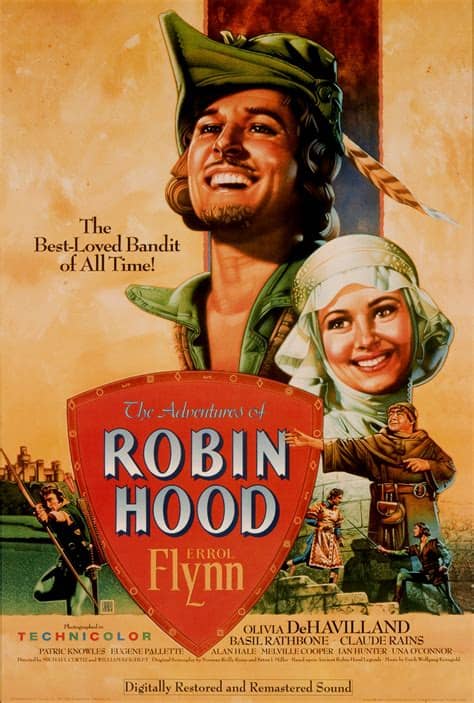
Has a more enjoyable film ever been made? The Adventures of Robin Hood is such a glorious technicolour treat it’s pretty much an archetype of a Hollywood blockbuster. Reportedly the only film in history that had exactly no changes made to it after preview screenings (so much did the audience lap it up), it’s been entertaining people pretty much non-stop since 1938. Never mind its influence on Robin Hood legend – almost every Robin Hood based film or show recycles elements of the plot here – it’s pretty much built up a picture of what a classic Hollywood Olde Medieval England epic is.

It’s Medieval England at the time of the Crusades (actual history is of course no-one’s concern). King Richard’s wicked brother, the greedy Prince John (Claude Rains) is plotting to seize the throne while bis brother languishes in an Austrian dungeon. Up go the taxes – especially on those pesky Saxons who still fill England’s lands, under the yoke of their Norman rulers. Who can stand in the way of John – and his arrogantly ruthless right-hand man Sir Guy of Gisbourne (Basil Rathbone)? Only the Lincoln-green coated Saxon nobleman Robin of Locksley (Errol Flynn), the most upstandingly, thigh-slappingly, decent chap you could imagine. Taking the name Robin Hood, he takes refuge in Sherwood Forest and builds up a group of like-minded fellows who resolve to rob from the rich, give to the poor and protect the realm for Richard. But things get complicated when Robin falls in love with brave and whipper-smart Maid Maran (Olivia de Havilland) – especially as she is the intended of non-other than the wicked Sir Guy of Gisbourne…

Looking like an explosion in a technicolour workshop, The Adventures of Robin Hood is fast-paced, crammed with rollicking action, packed with good lines and played with a knowing wink by a cast of actors clearly having a whale of a time. It’s a prime slice of entertainment, and it succeeds completely. It’s hard to imagine someone not finding something to enjoy here. Sword fights and chases? Check. Romance and flirtation? Check. Some cheeky gags and a hero thumbing his nose at authority? Check. Villains to hiss and heroes to cheer? You better believe it. I don’t think there is a single type in Hollywood history where the cocktail of action and entertainment was mixed better.

The film has two credited directors. William Keighley was the original, who shot the material in the film shot on location. It’s Keighley who helped tee up the atmosphere, and to get the actors to relax into the style of the thing. Crucial sequences showing the characters meeting (including the encounter with Little John) and a large chunk of the middle-act archery contest were Keighley’s work. So, we have him to thank for working in a competition that includes an arrow piecing straight through the middle of another (a stunt put together with a bit of clever wire work and some genuinely gifted archery skills). However, Keighley was less accomplished at shooting action. And to be honest you can see it, during the sequence where Robin and his Merry Men take hostage Gisborne and the Sheriff. It’s fine, but there is a reason why it’s also not a scene anyone particularly remembers from the film. When the shoot returned to Hollywood for the interiors, a new director was sought out to handle the rest – which included all the big fight scenes.

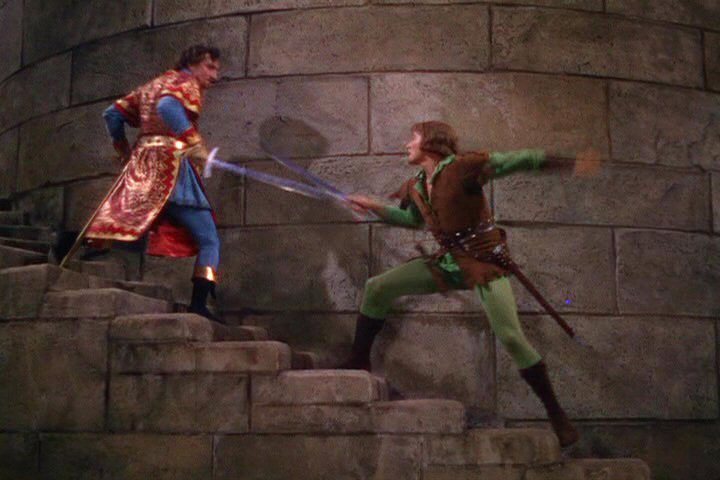
The man they called on was one of the masters of the studio system, Michael Curtiz. A director famed for his dictatorial approach to film-making (hilariously Flynn agreed to the film on condition that it wouldn’t be directed by Curtiz, the relationship between the two having collapsed during earlier collaborations), what Curtiz could do that Keighley couldn’t was add a really visual scale to the action. And it worked a treat – because Curtiz gifted us two of the greatest, instantly recognisible, action showpieces in Hollywood history. Both epic sword fights in Nottingham Castle are down to him, his camera employing crane, tracking and long shots to add an epic quality. He was also full of cool ideas – it’s him we have to thank for a portion of the closing sword fight being shown through shadow play.

It’s the pace as well that Curtiz really understand. Compare the careful, single shot, used by Keighley for the quarterstaff duel between Robin and Little John. Now admittedly the stakes are lower. But then watch the immediacy and dynamism of Curtiz’s camera moves while Robin fights for his life in Nottingham against dozens of guards, or duels with Sir Guy. The energy – and above all the pace and speed – of these scenes help make them gripping. And it wasn’t just the action. Curtiz bought a romantic jolt of energy to the interplay between Maid Marion and Robin, framing a key scene with a romantic intimacy on the edge of a window sill. While Keighley laid the ground work, it’s arguably Curtiz’ work that makes the film what it is.

Well that and the actors. Errol Flynn was perfectly cast as Robin Hood, the part a wonderful fit for his ability to mix charm with just a hint of rogueish sexuality and cheek. Combine that with his athleticism – some of the stunts he carries out in this film are eye-openingly intense – and you’ve got the man you pretty much cemented the public impression of who Robin Hood was. It’s beyond bizarre to imagine the original choice of actor – James Cagney – playing the role.

Flynn also of course has winning chemistry with Olivia de Havilland. De Havilland uses her great skill to make Maid Marian far more than just a damsel in distress. She’s proactive, plugged in and defiant, convinced of the need for justice and more alert to dangers and opportunities than almost anyone else in the film.

Both of these two go up against one of the finest arrays of baddies I think film has ever seen. Rains is arrogant, aloof and ever-so-slightly camp as the superior Prince John. Rathbone is scowlingly austere and deliciously pleased-with-himself as Sir Guy. And for the chuckles we have the bumbingly cowardly Sheriff, played with comic delight by Melville Cooper. All three of these actors combine perfectly, offering a marvellous troika of villains, each a mirror image of different facets of Flynn’s hero.

It makes for a gloriously entertaining film, all washed down with Erich Wolfgang Korngold’s marvellous symphonic score, the bombast and romantic sweep of the music perfectly counterbalancing the action on screen. Still the greatest of all Robin Hood films, The Adventures of Robin Hood is entertaining no matter when you watch it.

The Lady Eve (1941)

Henry Fonda is bamboozled by Barbara Stanwyck in the delightful The Lady Eve

Director: Preston Sturges

Cast: Barbara Stanwyck (Jean Harrington), Henry Fonda (Charles Poncefort Pike), Charles Coburn (“Colonel” Harrington), Eugene Pallette (Horace Pike), William Demarest (Muggsy), Eric Blore (Sir Alfred McGlennan Keith), Melville Cooper (Gerald), Janet Beecher (Janet Pike)

In the 1940s, Preston Sturges hit a rich vein of form that led to him making some of the finest comedies in Hollywood history. Perhaps the greatest of that run of hits was the hilariously heartfelt The Lady Eve, a comedy that is as much a rich, twisted romance as it is a fast-paced screwball comedy of long cons and deception. Played to the hilt by a perfectly selected cast, Sturges’ dialogue zings in every scene, making this timeless entertainment.

Charles Poncefort Pike (Henry Fonda) is the young heir to a brewery fortune (the most famous brand being “The Ale That Won for Yale”). Naïve and shy, Charles is a passionate ophiologist (that’s snake-expert to you and me) who is just returning from a year-long expedition in the Amazon. On the cruise ship taking him back home, Charles is the target of every single woman on the boat – and also for a pair of expert con artists, Jean (Barbara Stanwyck) and her father “Colonel” Harrington (Charles Coburn). At first it’s his money they want, but Jean surprises herself by falling hard for Charles on the voyage – only to be stung when Charles coldly rejects her after learning the truth about her. So Jean decides on revenge, disguising herself as ex-pat aristocrat “Lady Eve” and proceeding to win over Charles’ upper-class New York family, and seduce Charles all over again.

Not a single opportunity for comedy is missed in Sturges fast-paced, beautifully done film. As well as some truly wonderful word-play and verbal comedy, the film is crammed with vintage sight gags (Charles’ struggles with an overly affectionate horse is a hilarious highlight) and keeps up a series of perfectly judged running gags (one of the best of which falls to William Demarest’s befuddled bruiser-turned-valet Muggsy). But the comedy works because it’s invested in characters who feel real – despite all the absurdity – and demonstrate real emotions alongside all the comic invention. It has a story that you care deeply about it, all while you are laughing your head off.

Because deep down this is a romance between two very unlikely people. Barbara Stanwyck radiates wit, intelligence and incredible sex appeal as Jean, a role that seems all surface but actually contains a huge amount of depth and shade. She may well be a sort of con-woman with a heart, but the creeping onset of love surprises (and almost confuses) her as much as it might throw off an audience. Not that that ever stops her from being (usually) two steps ahead of everyone around her, a nature that suits perfectly for her revenge act in the second half, where she aims to teach Charles a little humility. Stanwyck’s comic timing is perfect, but it’s the human heart she gives the character that works, and makes us warm to her.

It also makes a superb contrast with Henry Fonda as Charles. Riffing on his screen-image for upright purity (he’s Honest Abe for goodness sake!), Fonda creates a man who is sweet, honest, naïve – but also has an inverted sense of snobbery that comes from being convinced you are usually right. For all his innocence, Charles is surprisingly abrupt when he dismisses his romance from Jean, and his slightly priggish self-satisfaction is evident when he proudly presents his (feeble) card tricks to the card sharps he finds himself on board with. Fonda also proves himself a surprisingly deft physical comedian, a key running gag being Charles’ continual prat falls (a neat metaphor for him both figuratively and literally falling in love with Jean).

Together these two power a lightening-fast series of comic masterpiece scenes from Sturges. But the director is also confident enough to throw in other beats: a stationary single shot of Jean cradling Charles for several minutes (after a semi-pretend shock at discovering his pet snake) sizzles with sexuality. Later Stanwyck delivers Jean’s joy at finding love a heartfelt wonder, which she neatly inverts to heartbreak on her rejection. Her father, played with a delightful wryness by Charles Coburn, has no problem with fleecing people (although of course “Let us be crooked, but never common”) and delights in his ingenuity (cheating) with the cards, but he also has the humanity to warn his daughter about the sometimes unforgiving purity of decent folk.

And those decent folk are quite snobby. The second half of the film gets a gleeful energy from throwing the knowing Jean in amongst a group of upper-class rich snobs, who will believe anything that comes out of someone’s mouth with a British accent. It’s certainly been working for years for “Sir Alfred”, a conman sponger played with twinkling glee by Eric Blore. Jean’s almost deliberately ludicrous story (arrival on a submarine and a hilariously convoluted backstory) gets lapped up – and of course seduces Charles all over again. No wonder he keeps falling over.

The final act – with a deliciously funny final line that deserves to be more famous than it is – makes for a superb cap to what is a marvellously sparkling comedy. It also manages to avoid sentimentality or mawkishness – not a sudden surprise, considering it’s stuffed with people pretending to be what they are not. Sturges’ direction is sharp – even if visually he isn’t the most imaginative director in the world – but the main thing that gives this such zip is the dialogue and the acting. Stanwyck is simply sensational, Fonda just about perfect, and the whole thing is a delight. Surely one of the greatest classic Hollywood comedies of all time.