
Tag: Michael Wincott

Robin Hood: Prince of Thieves (1991)

Robin Hood: Prince of Thieves (1991)

I can’t lie: no matter how many faults it has, Costner’s Robin Hood epic is above all criticism for me

Director: Kevin Reynolds

Cast: Kevin Costner (Robin of Locksley), Morgan Freeman (Azeem), Mary Elizabeth Mastrantonio (Lady Marian), Christian Slater (Will Scarlett), Alan Rickman (Sheriff of Nottingham), Geraldine McEwan (Mortianna), Michael McShane (Friar Tuck), Brian Blessed (Lock Locksley), Michael Wincott (Guy of Gisborne), Nick Brimble (Little John), Harold Innocent (Bishop), Walter Sparrow (Duncan), Daniel Newman (Wulf), Daniel Peacock (Bull), Sean Connery (King Richard)

I find there’s a simple way of telling if someone is the same generation as me. Hum a few bars of Bryan Adam’s Everything I Do. Adopt an American accent and proclaim you are showing “English courage”. Rasp about cutting someone’s heart out with a spoon or calling off Christmas. Mime shooting a flame tipped arrow or say before carrying out anything complex that you’ve “seen it done many times…on horses.” All of which is to say, if you haven’t already guessed from this parade of in-jokes, that Robin Hood: Prince of Thieves is one of those films of my youth immune from criticism.

The second biggest box-office hit of 1991, having beaten a crowd of Robin Hood pictures to the screen, Prince of Thieves is, to be honest, a ridiculous cheese-fest of wildly inconsistent tone and acting styles, murkily shot and hurriedly plotted. It feels at times like what it is – a film rushed to the screen as quickly as possible to hit a deadline. I know truth be told, it’s a bit of a mess. But it doesn’t matter. I love it. If you, like me, saw this for the first time around 12 or 13 how could you not? For all its many flaws, it’s a massive, rollicking adventure. So, while my head tells me Errol Flynn is the finest Robin Hood on screen…my heart will always be with Costner’s oddly accented outlaw.

In 1194 Robin of Locksley (Kevin Costner) the son of a baron (Brian Blessed of all people!), is captured by the Moors on Crusade and escapes along with fellow prisoner Azeem (Morgan Freeman), who vows to repay his life debt to him. Together they arrive in England to find the land in urgent need of healing. The tyrannical Sheriff of Nottingham (Alan Rickman) plots to seize the throne and Robin is named an outlaw. He and Azeem find sanctuary in Sherwood Forest, where Robin becomes the leader of a band of outlaws. He robs the rich to give to the poor, romances Marian (Mary Elizabeth Mastrantonio), and fights to uphold justice.

All of this is played out in the very best blockbuster style, with logic frequently thrown out of the window in favour of excitement, jokes and gravity defying arrows. Kevin Reynolds was hired to direct to lure on board his fellow Kevin (and mate) Costner, then the biggest star in the world. Costner as the wealth-redistributing bandit is, in reality, as bizarre a piece of casting as Richard Gere playing Lancelot. Never the most confident with accents, rushed producers essentially told Costner told to not bother, concluding most moviegoers wouldn’t give a toss if Nottingham’s most-famous son spoke with a Californian twang. They were right. And to be honest, it’s part of the film’s crazy charm.

After all, the film plays fast and loose with everything else about England. This is the film where Robin arrives at the White Cliffs of Dover and announces it’s a day’s walk to Nottingham. That is, let me tell you, a very long day – particularly when you go via Hadrian’s Wall (which Costner then confidently tells us is but five miles from Nottingham). Any grasp of actual English history is completely irrelevant to a film set in a fantasy merrie-England, where the Bayeux Tapestry, Celtic warrior tribes, lords who dress like the KKK, witches and a King Richard who looks and sounds like Sean Connery (the real Richard was 38 and French) all co-exist.
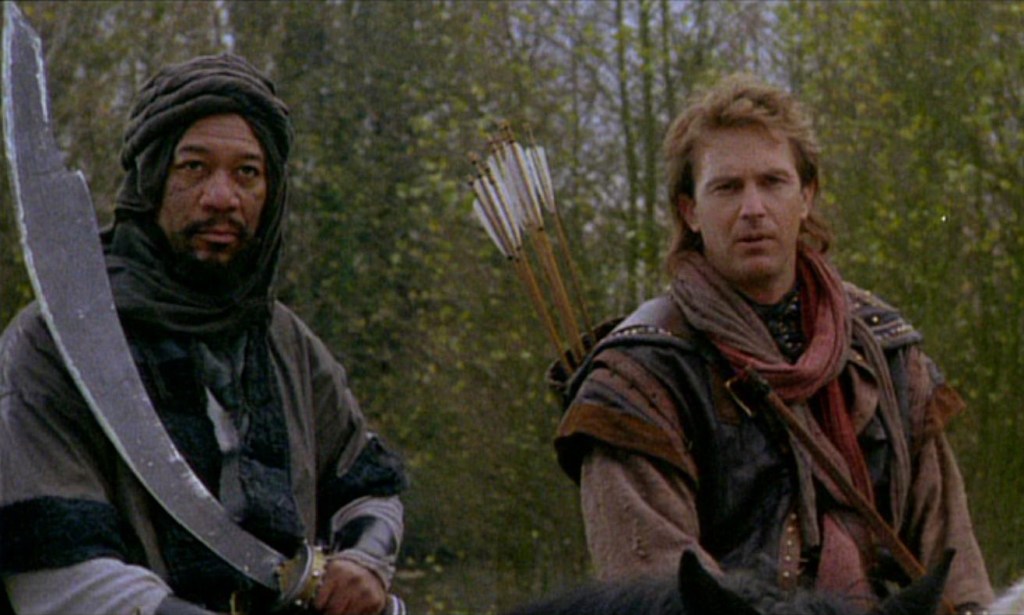
But who cares? Nothing in the film is meant to be taken seriously, and surely Reynolds and co reckoned we’d work that out when Costner – for whom five years in prison has made no impact on his film-star good-looks but left his fellow prisoners scrawny, wasted men of skin and bone – slams his hand down on an anvil and announces to a man preparing to cut his hand off “This is English courage!” in that Californian lilt. It’s not just him: accent-wise the film is all over the place. Christian Slater also makes no attempt at an accent while Mastrantonio’s is impeccable; the Merry Men come from all over the place, Mike McShane vaguely flattens his Canadian accent and Morgan Freeman goes all in on a Moorish accent. This all adds to the fun.

And what fun it is. Reynolds can shoot the hell out of an action set piece and if you don’t get a buzz from seeing Costner shoot a flaming arrow in slow-mo, firing another through a rope, or taking down rampaging Celts with them like they were heat-seeking missiles, there is something wrong with you. A flame-soaked battle in Sherwood is an action highlight – full of drama and terror – and the film’s closing grudge-match between Robin and the Sheriff a high-octane mano-a-mano sword fight.

It gains a huge amount from its impeccable score. Of course, we all remember Bryan Adam’s Everything I Do (it was number one for most of 1991). But the film’s real MVP is Michael Kamen, whose luscious, rousing score lifts even the film’s weakest moments to the heights of classic action adventure. The film’s opening number is a triumph of epic scene-setting. His work fills moments of triumph with joy, beautifully complements (and improves!) comedy and provides a genuinely moving romance theme that bolsters the chemistry between Costner and Mastrantonio’s strong-willed and independent Marian (even though film rules demand the woman introduced to us as something akin to a ninja ends the film a white-dressed damsel-in-distress).

The film’s other MVP is, of course, the late, great Alan Rickman. If you wonder why a generation of people worshipped Rickman, you need only look at his leave-nothing-in-the-dressing-room performance here. So reluctant to play another villain that he only agreed when given carte blanche to play the role however he wanted (including re-writing all his lines with the aid of friends Ruby Wax and Peter Barnes), Rickman delivers his second iconic villain after Gruber. He has a gleeful, OTT, pantomime glee, seething with frustrated impatience at his incompetent underlings but carrying more than enough genuine menace to be threatening. Every line he has – almost every single one – is laugh-out loud funny, either due to its grandiosity or Rickman’s utter commitment and darkly sexy energy (he also makes a beautiful double bill with Geraldine McEwan: two pros milking the film’s comic potential for all it is worth).

Rickman dominates the film – although of course, as he himself said, he had the far more fun and wilder part than Costner – and is central to many of its most iconic moments. What makes it work is Rickman is very serious about not taking the film very seriously: he’s not laughing at it or wanting us to know how superior he is to it: instead he throws himself with gusto into an all-action panto.

With this sort of thing, you can forgive the film’s wildly inconsistent tone (it ends with a prolonged semi-rape joke for goodness sake!), its at times forced attempt to suggest a community among a random collection of Brit character actors playing the merry men, or its meandering into some dark material. Morgan Freeman not only shows surprising action chops, he also gets a showcase for his mentor and comedic abilities. The resolution of the antagonistic relationship between Robin and Will Scarlett is surprisingly effective (it’s another note of the film’s bizarreness that we are meant to believe Costner and Slater both sprang from the Blessed loins) and those action set-pieces work.

The film wasn’t always a happy experience – Reynolds was forced to shoot it in ten weeks on no real prep and was locked out of the editing suite – but perhaps the rush helped create the boisterous adventure we end up with. Maybe years of study and research would just have been less fun. Who cares about dusty books when Robin and Marian can kiss at a misty riverside to the tune of Bryan Adams or Costner splits an arrow in two with another arrow at a thousand paces? Robin Hood: Prince of Thieves is a big, silly, action film full of flaws. And I wouldn’t change a frame of it.
Nope (2022)

Nope (2022)

Be afraid of looking in Jordan Peele’s puzzling but less enlightening horror suspense film

Director: Jordan Peele

Cast: Daniel Kaluuya (Otis Jnr “OJ” Haywood), Keke Palmer (Em Haywood), Steven Yeun (Ricky “Jupe” Park), Brandon Perea (Angel Torres), Michael Wincott (Antlers Holst), Wrenn Schmidt (Amber Park), Keith David (Otis Haywood Snr), Donna Mills (Bonnie Clayton)

Spoiler warning: Peele loves to keep ALL the plot details on the QT – so I discuss more than he would want, but hopefully not enough to spoil the plot.

Jordan Peele’s previous horror films brilliantly married up genuine chills with acute social commentary. Plot details have often been kept under wraps – after all half the joy of watching Get Out or Us the first time is working out what the hell is going on. Nope continues this trend, but for the first time I feel this is to the film’s detriment. I actually think Nope would be improved if you know going into it that this was Peele’s dark twist on Close Encounters of the Third Kind (with added body horror). Instead, Nope plays its enigmatic cards so close to its chest that it ends up never having a hand free to punch you in the guts.

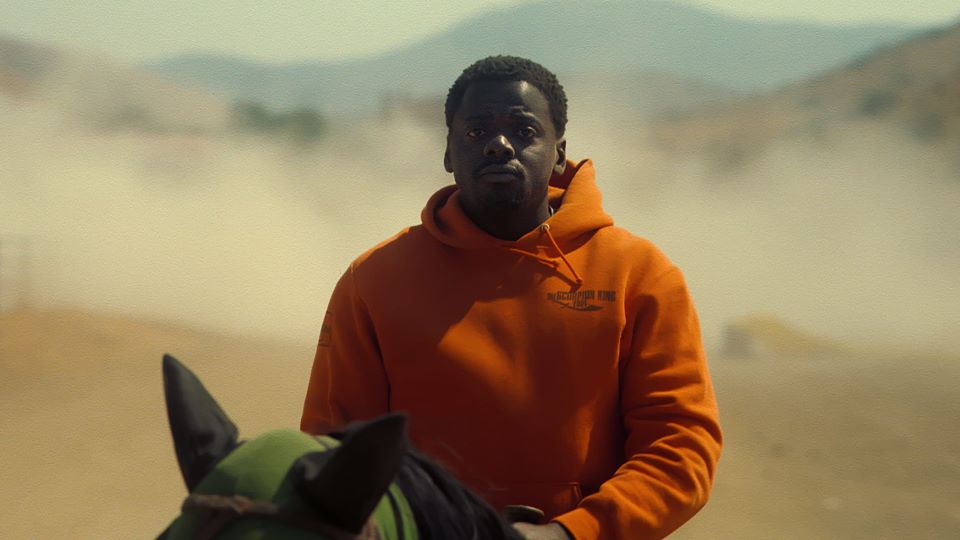
Pensive and guarded Otis Jnr (Daniel Kaluuya) – known, unfortunately, as OJ – and his exuberant wanna-be-star sister Em Haywood (Keke Palmer) are trying (with differing levels of enthusiasm) to keep their father’s Hollywood horse handling business alive after his freak death from a coin falling from the sky (everyone assumes it fell from a plane). The business is struggling, with OJ forced to frequently sell their horses to their neighbour, a former child star turned ranch theme-park owner, Ricky (Steven Yeun). Their lives are altered however when they discover a huge UFO living in a cloud near their ranch, sucking up horses (and other animals) and spitting out any inorganic remains. Seeing this as their path to fortune (and in Em’s case fame) they try and capture the UFO on film.

Nope is all about our compulsive need to look. Nothing draws our eyes like spectacle – and what could be a bigger spectacle than a huge saucer in the sky that eats people? It doesn’t matter if we know we shouldn’t, our eyes are drawn up (now imagine if Peele had been able to call the film Up!). We want to be part of the big event, whether that’s seeing the latest blockbuster at the big screen or rubber-necking at a roadside accident. Nope hammers this point home, when it becomes clear you are only at danger from the saucer when you look directly at it. Spectacle literally kills!

This is all an inversion of the mid-West America that starred at the skies in wonder in Close Encounters. There the Aliens capped the film with a glorious light show with awe and wonder from the humans watching. Here the appearance in the sky is a prelude to sucking you up, digesting you and vomiting out blood and bits of clothing a few hours later. Despite this, Ricky tries to make an entertainment show out of the creature (something he, of course, learns to regret), and OJ and Em find little reason to re-think their attempts to capture the animal on screen.

Peele’s film takes a few light shots at social media culture. Of course our heroes’ first instinct is to reach for their phones (they are looking for that “Oprah shot” that will guarantee fame and fortune). OJ at least is largely motivated by the cash influx his struggling business needs – Em wants the fame. But the film still attacks the shallow “main event-ness” of social media, where having the best and most impressive thing to show off (for a few seconds) is the be-all-and-end-all.

Peele remains too fond of these characters to judge them too harshly. But he has no worries about taking shots at the fame-and-money hungry Ricky, or a TMZ reporter who arrives at the worst possible moment and dies begging to be handed his camera so he can record the moment. Arguably Ricky would have made a more interesting lead: a man chewed up and spat out by the fame machine and angling for a second chance, who thinks he’s way smarter than he actually is.

The film opens with a chilling shot of what we eventually discover was the bloody aftermath of the disastrous final filming day of Ricky’s sitcom from his childhood-acting days, Gordy’s Home. Gordy was a chimp living with an adopted family: until the chimp actor snapped in bloody fury. It sets up a sense of danger, but the plot never quite marries it up with the main themes of Nope. Parallels are thinly drawn with Ricky’s attempt to commercialise this infamous tragedy, but it feels forced: the whole section plays like a chilling short story inserted into the main narrative. And the film never explores in detail the lesson from this bloody tragedy, that we underestimate the dangers animals can pose (despite the film being littered with creatures).

Instead, Peele settles for a stately reveal of his plot. It takes almost an hour for the film’s true purpose to become clear, but it lacks the acute and darkly funny social commentary that made his previous films so fascinating while they took their time showing you their hand. Interesting points are made about how black people are (literally) whitewashed out of Hollywood’s history (the Haywoods claim to be descended from the black jockey featured in the first ever moving film made in America). But it’s a political point that sits awkwardly in a satire (about something else!), and Peele overstretches the opening without making the central mystery compelling enough.

There are, however, fine performances from the actors, Kaluuya’s shuffling physique – slightly over-weight, the troubles of the world weighing him down – is matched with his charismatically sceptical looks. Keke Palmer is engaging and funny as his slap-dash sister, and the warm family bond between these two works really well. It never quite makes sense that someone as publicity-averse as OJ would really want to become a social media sensation, but you can let it go.

There is lots of good stuff in Nope – it’s beautifully filmed and assembled and once it lets you in on its plans, it has a strong final act. But its social commentary isn’t quite sharp or thought-provoking enough – people are shallow and love spectacle and social media, who knew – and neither the mystery or the plot are quite compelling enough. It’s told with imagination and Peele has a fascinating and unique voice: but Nope isn’t much more than a solid story well told.

The Count of Monte Cristo (2002)

Guy Pearce and Jim Caviezel as friends turned foes in The Count of Monte Cristo

Director: Kevin Reynolds

Cast: Jim Caviezel (Edmond Dantès), Guy Pearce (Fernand Mondego), Dagmara Dominczyk (Mercedès Mondego), Luis Guzmán (Jacopo), Richard Harris (Abbè Faria), James Frain (JF Villefort), Michael Wincott (Armand Dorleac), Henry Cavill (Albert Mondego), Albie Woodington (Danglers), JB Blanc (Luigi Vampa), Alex Norton (Napoleon Bonaparte), Patrick Godfrey (Morrell), Freddie Jones (Colonel Villefort), Helen McCrory (Valentina Villefort)

Alexander Dumas’ novels are beasts. The Count of Monte Cristo is a real mountain of a book, a sprawling story of adventure and revenge. Kevin Reynolds’ film had a near impossible task to turn this into a film – most have gone down the route of adapting the book into a TV series – but triumphantly succeeds by locating in it a very clear, very filmic narrative.

In 1815, Edmond Dantès (Jim Caviezel) and Fernand Mondego (Guy Pearce) are young men serving on a merchant ship, who wash up on Elba where Napoleon (Alex Norton) is in exile. Tricked into taking a letter for Napoleon back to France, Dantès is betrayed by Mondego, who desires Dantès’ fiancée Mercedès (Dagmara Dominczyk) and resents his own envy for the far poorer Dantès. The corrupt magistrate Villefort (James Frain) colludes to protect his own family’s secrets, and Dantès is locked up in the dreaded Chateau d’If for 15 years, during which time he meets fellow prisoner Abbè Faria (Richard Harris) who teaches him politics, mathematics, philosophy and sword-fighting. Faria shares with Dantès the secret of the vast treasure he hid on the island of Monte Cristo – treasure Dantès dreams of using for his revenge.

This is actually a fairly nifty adaptation of a huge novel into something cinematic. Almost every change made to the original book ends up working extremely well – and adds an immediately understandable dramatic tension to it. I’d actually go so far as to say this might be a masterpiece of cinematic adaptation. The decision to make Dantès and Mondego childhood friends and rivals instantly adds a real frisson of betrayal to Mondego’s actions, as well as adding a very personal element to the revenge portion of the narrative. The simplification of the other “betrayers” also works extremely well, while the careful links throughout back to Dantès’ upbringing never let us forget the roots he has come from.

The script is also packed full of fun interjections. The idea of the chess piece, which Dantès and Mondego pass from one to the other, becomes laced with symbolism, while the changing of Jacopo into a sort of Brooklyn pirate works extremely well (Guizmán gets some of the best lines, but also gets to show a touching loyalty and concern for Dantès). On top of which, the pushing to the fore of the swashbuckling sword-fighting excitement sets us up for a cracking final sword fight between our two friends-turned-enemies. 

Reynolds also shoots the film extremely well with a host of interesting angles and framing devices showing how Dantès position and confidence change throughout the story. The film’s climactic sword fight is brilliantly staged and the film charges forward with a real momentum (there are of course no sword fights in the book!). 

Particularly well handled through is the sequence that is (in many ways) most faithful to the original book – Dantès’ time in the Chateau d’If. What I love in this sequence is that it’s a perfect combination of stuff from the book, Karate Kid style training, and some good old-fashioned warm character building. It’s also got two terrific performances from Michael Wincott as an almost comically dry sadistic guard and Richard Harris as the imprisoned Abbè Faria, the quintessential wise-old-mentor (the relationship between Faria and Dantès is beautifully judged).

The film perfectly balances its sense of fun and adventure with a very real-feeling story of a man who has to learn there is more to life than revenge. The plot that Dantès puts together probably isn’t the most complex piece of chicanery you are ever going to see, but it doesn’t really matter because the focus is the fun of the journey, and the thrill of someone being a few steps ahead of everyone else. 

Jim Caviezel is very good as Dantès, just the right blend of forthright moral strength and simmering resentment (few actors do stoic suffering better than Cavizel). There is a really nice questioning throughout the film of Dantès’ motives and whether revenge is really worth the candle, which adds a lovely depth to Cavizel’s performance.

But the film probably gets waltzed off by Guy Peace (who turned down the role of Dantès because he thought Mondego was more fun) who gets to campily simmer, sulk and fume at the edge of every scene. Mondego is brilliantly reinvented as a fearsomely proud, selfish, hedonistic aristocrat with a major inferiority complex, who takes everything from Dantès and still isn’t happy at the end of it. But Pearce has a whale of a time with his cruelty and resentment, and it’s a great reminder of how much he is (as an actor) in love with make-up, Mondego being scruffy, slightly pock-marked and increasingly bad of tooth.

He’s a villain you can scowl at and he’s a perfect counter-point for a hero whose emotional distance is designed to make him at times a difficult man to invest in. The film’s expansion of their personal relationship in its early section works really well, setting up the innate inequalities between them (wealth on one side, bravery and decency on the other) during the film’s cheeky and amusing opening sequence on Elba with Napoleon.

The Count of Monte Cristo is an extremely well structured, hugely entertaining adventure film. It’s very much like a 1930s swashbuckler, and every scene has some delightful moment that you’ll love. There are some very good performances in here as well, working with a very good conversion of this doorstop of a book into a film. Skilfully directed, interestingly shot, well acted – it’s a gem that’s far too overlooked.