Tag: Mike Faist

Challengers (2024)

Challengers (2024)

Dynamic, mature, hilarious and moving relationship drama, an absolute delight

Director: Luca Guadagnino

Cast: Zendaya (Tashi Duncan), Josh O’Connor (Patrick Zweig), Mike Faist (Art Donaldson), Darnell Appling (New Rochelle Final Umpire), AJ Lister (Lily Donaldson), Nada Despotovich (Tashi’s mother), Naheem Garcia (Tashi’s father), Hailey Gates (Helen)

Tennis superstar Art Donaldson (Mike Faist) is on the slide after six majors – he’s lost his click and can’t even struggle past up-and-comers from the lower rungs of the tour. His coach, manager and wife Tashi (Zendaya) has an idea for how to get his groove back: he’ll enter a lowest-rung Challenger tournament, chalk up an easy win and return to confidence. Problem is, Art’s estranged former friend and doubles partner Patrick Zweig (Josh O’Connor) is also in the tournament and the two of them now line up for a grudge match in the final. But there is more going on than meets the eye, as Guadagnino’s film unfolds in a non-linear style to reveal the complex, confused and frequently ambiguous sexual, emotional and sporting tensions that have beset the three over 13 years.

Challengers feels like it might be a ripe piece of teen click-bait fluff – but reveals itself to be a whipper-sharp, funny, involving and cleverly open-ended film stuffed full of excellent dialogue by Justin Kuritzkes that frequently catches you off-guard with its plot developments. Challengers is a thrillingly mature, adult and very truthful exploration of the underlying attractions and tensions between three people, all of whom seem confused about their exact feelings and motivations.

What is clear – as made explicitly clear by an intensely erotic late-night encounter in a hotel room between the three of them thirteen years earlier – is the rich, unspoken attraction they all share. Art and Patrick are strongly attracted to Tashi, she seems equally interested in different aspects of each of them, while Art and Patrick’s homoerotic bond (clued in before this by their affectionate, casual physical intimacy as well as their intense celebrations on winning the Junior US Open) is immediately clear to the savvy Tashi and briefly embraced by the two men.

Sport – particularly mano-a-mano games like tennis – has an undercurrent of sexual energy to it. Adrenalin-filled men pounding away at each other from across the net, bodies glistening with sweat? Teammates grasping each other in victory with an intensity often beyond anything they would show to a romantic partner? Challengers explores how close a dance sport and sex is, the remarkably similar effects both have on our bodies. It’s what Tashi – a former tennis sensation whose career was ended in tragic circumstances – is getting at when she says the best tennis matches aren’t about tennis. They are semi-romantic couplings, the perfect rally being two bodies in perfect harmony.

This all develops thrillingly in the inter-relationships between the three leads, each excellent. Zendaya is superb as a woman forced to live her tennis dreams vicariously through her husband, who values the loyalty of Art while being quietly troubled by his neediness, infuriated by Patrick’s arrogant performative selfishness while being deeply attracted to his don’t-give-a-damn independence. She has a tight knot of tension throughout that is compelling, a constant sense we are watching a woman struggling to find some sort of resolution from a lifetime of competing resentments and desires.

Equally superb – revelatory in fact – is Josh O’Connor, who makes Patrick a cocksure, confident, selfish but immensely charming guy. Patrick scraps a career from natural skill that he never bothered to hone (witness his bizarre crooked-arm serve), embraces his sexual confidence, bounces around with a breezy bro-confidence and does everything he can to hide the lonely, lost boy he really is. This is breathtaking work from O’Connor, from hilariously funny when shamelessly pimping himself on tour for a roof over his head, and tragically vulnerable in bashful confessions with Tashi.

Mike Faist has the least flashy role but is equally wonderful. Art is – if you will – the most closeted of the three, the least confident, most dutiful, who dedicates himself to things and doesn’t stop to think deeply about his true feelings. You suspect the unspoken intense romantic bond between Art and Patrick remains unspoken in their youth because Art himself is uncertain (scared?) about what he feels. Just as he buttons up and represses his own resentments and anger towards Tashi.

Challengers switches and re-aligns these characters beautifully and constantly leaves us guessing. When Tashi (and by extension Art) refuses to see Patrick after her injury, is this because she genuinely blames him for unsettling her before the match or because she just needs something other than random chance to blame? Does she drive Art into becoming a Grand Slam winning machine out of love, a vicarious desire for success or anger (as she shapes into something he isn’t) because she blames him as well? Does Art know or care? Does he realise how much his depression comes from severing connections with his alter-ego Patrick and does Patrick slog it out on the circuit because it’s the only way he can still feel in-any-way close to the only two people he loves (but won’t admit?).

Watching all this unfold, seeing each scene reveal a new piece of information that refocuses what we thought about each character, is compelling – helped a great deal by the vibrant, emotional and intensely sympathetic performances from the three leads. Challengers is also a superbly assembled film, sharply and snappily edited and with an electric, emotionally well-judged score by Trent Reznor and Atticus Ross that skilfully uses refrains to link back to key emotions and sensations. It’s also a film that shoots tennis more electrically than any other. With sweeping crane shots, hand-held camera and every trick in the book, we see matches from the perspective of everything: the players, the ground, even the ball itself. It’s stunningly visually inventive.

It culminates in a truly wonderful, open-ended, emotionally satisfying ending that I actively adored. It’s a film about love, about three people who feud over petty things for years but need each other to be complete, who find there are elements of each other’s personalities that serve to complete themselves. Who are fiercely sexually attracted to each other, but also have a deep, intense emotional bond they need more than they realise. Challengers is an absolutely gorgeous, delightful, superb film – another emotional, mature triumph from Guadagnino, with three brilliant actors working wonders with a sharp script. It’s a film to love and treasure.
West Side Story (2021)

West Side Story header
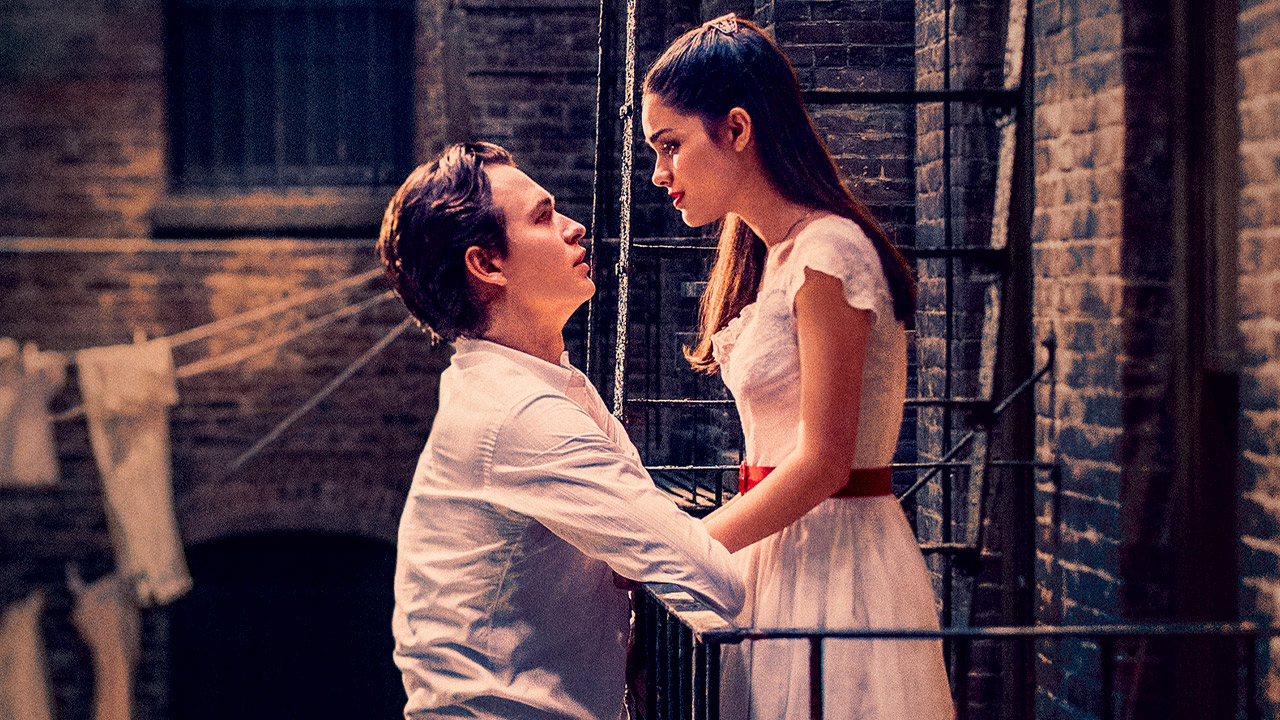
Ansel Elgort and Rachel Zegler are star cross’d lovers in Spielberg’s triumphant West Side Story

Director: Steven Spielberg

Cast: Ansel Elgort (Tony), Rachel Zegler (Maria), Ariana DeBose (Antia), David Alvarez (Bernardo), Mike Faist (Riff), Rita Moreno (Valentina), Brian d’Arcy James (Officer Krupke), Corey Stoll (Lt Schrank), Josh Andres Rivera (Chino), Iris Menas (Anybodys)

Was there actually a need to remake West Side Story? It’s the question everyone was asking before the film’s release. Judging by the disaster at the Box Office (also connected to our old friend Covid), it’s a question people are still asking. Well, you remake it by refocusing and partially reinventing it while remaining loyal to the roots of what makes this one of the greatest 20th century musicals. Spielberg’s triumphant film does exactly this, in many places even exceeding the Oscar winning original. This West Side Story is full of toe-tapping, heart-breaking numbers, gloriously choreographed numbers and scenes of high emotion and social insight.

In 1957 in Manhattan’s West Side, it’s the dying days of the San Juan Hill district, which is being slowly bulldozed to build the Lincoln Centre. Scrambling to retain control of what’s left are two gangs of youths: the Jets, a group of white rough kids led by Riff (Mike Faist) and the Sharks, a migrant Puerto Rican gang led by would-be boxer Bernardo (David Alvarez). The two groups plan a ‘rumble’ to settle matters forever. A fight that ends up carrying even more importance when both communities are outraged by the burgeoning romance between former Jet leader Tony (Ansel Elgort) and Bernardo’s sister Maria (Rachel Zegler). Will love triumph over hate? Well, it’s based on Romeo and Juliet, so I’ll leave it to you to work that out.

The original, Oscar-laden, West Side Story is a ground-breaking and brilliant musical. Based closely on the triumphant original Broadway production, it showcased earth-shatteringly brilliant choreography by Jerome Robbins. The sort of grace, power, passion and beauty in movement that very few productions of anything have got anywhere near matching. Spielberg’s remake can’t match that – and wisely doesn’t try, rejigging and reinventing the choreography with touches of inspiration from Robbins’ work. But, in many ways, it matches and even surpasses the other elements of the original.

The musical’s book is radically re-worked by playwright Tony Kurshner to stress the racial and social clashes between these two very different communities. Helped as well by the racially accurate casting (memories of Natalie Wood passing herself off as Puerto Rican are quickly dispatched), Spielberg’s film transforms West Side Story into a film exposing the kneejerk jingoism and xenophobia of the Jets (who are often deeply unlikeable) and the touchy, insecure defensiveness of the Puerto Rican Sharks.

Everything in the film works to establish the difficulty the Pueto Rican community had in settling in America. From language problems – most of the characters are still mastering English, with Spanish exchanges untranslated – to the obvious bias of police officers like Corey Stoll’s bullying Lt Schrank (officers and others frequently order the Puerto Ricans to “speak English”). Maria and Anita no longer work in a dress shop, but as cleaners in a department store. Racial slurs pepper the dialogue (Spic and Gringo litter the dialogue). The Jets are first seen defacing a mural of a Pueto Rican flag. Loyalty to your community – both of whom see themselves as under siege – is more important than anything. The film bubbles with an awareness of time, place and the dangers and troubles faced by migrant communities far more than the original.

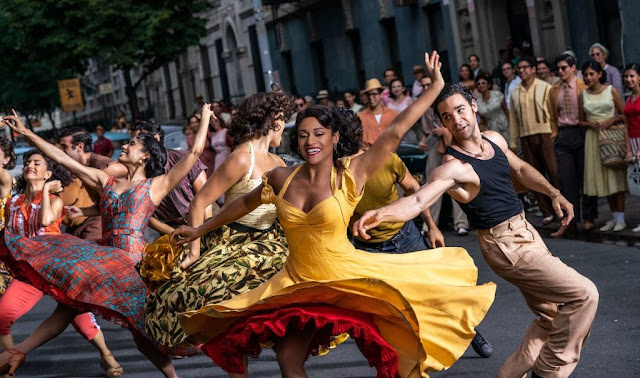
For that choreography, Justin Peck keeps the inspiration of Robbins, but mixes it with his own fast-paced, electric dynamism. The big numbers dominate the screen, from opening confrontation of the Jets and Sharks to the carnivalesque America, the playful Office Krupke, the frentic Gym Dance and the ballet inspired Cool. The choreography is earthier and punchier (in some cases literally so) more than Robbins, with a rough and tumble physicality and strenuous attack that contrasts with the balletic perfection of the original. It’s both a tribute to the original and also very much its own thing – and works perfectly.

Balancing tribute and forging its new identity is also at the heart of Spielberg’s brilliant direction. He’s confident enough to shoot many of the musical numbers with a Hollywood classic style – which allows us to see and admire all the choreography. But he also mixes this with sweeping, immersive camera work, thrilling tracking shots and beautiful images – there is a great one of Tony standing in a puddle surrounded with apartment window reflections, which looks like he’s surrounded with stars. Spielberg brings the demolished buildings very much into the visual design, part of making this West Side Story, earthier and rougher. The film is electrically paced and lensed with an expert eye.

The film’s two leads are both superior to the originals. Ansel Elgort is a fine singer (with a heartfelt rendition of Maria) and dancer (he excels at Cool), even if he at times struggles to bring his slightly bland character to life. He gives Tony a puppy dog quality – that does make hard to believe this version of the character killed a man in a brawl – as well as a wonderful sense of youthful impetuousness. Opposite him Rachel Zegler – plucked from YouTube by an open casting call – is sensationally wide-eyed, youthful radiance as Maria, naïve and in love, a superb singer.

Even better though are the supporting roles. Finest of all is Ariana DeBose, for whom this film feels like the unearthing of a major talent. Her singing and dancing is awe-inspiring, but it’s DeBose’s ability to switch from warm and motherly, to flirtatious and sexy, to grief, rage and confusion and all of it feeling a natural development from one to another is extraordinary. Her major songs are the films main highlights, stunningly performed. David Alvarez is a passionate, head-strong Bernardo, convinced that he is acting for the best (like DeBose his singing and dancing is extraordinary). Mike Faist is brilliantly surly and enraged (and struggling with repressed feelings for Tony) as Riff.

And, of course, there is Rita Moreno, now playing Valentina, a re-invention of the original production’s character of Don. Moreno worked closely as a consultant with Spielberg and Peck, and gives her scenes a world-weary sadness and desire for hope. She sparks beautifully with Elgort and to see her save Anita from gang rape (still a shocking scene, as it was when Moreno played it) and then angrily spit her contempt and rage at these boys is very powerful.

West Side Story needed to justify its existence. It does this in so many ways. Wonderfully performed by the cast, Spielberg pays homage to the original and classic Hollywood musicals but mixes this with electric film-making and a far greater degree of social and racial awareness (without ever hammering the points home) that allows you to see this tragedy from a new perspectives. It reimagines without dramatically reinventing and sits beautifully alongside the original. It’s more than justified its existence: in many ways it’s even better than the original.