
Tag: Mike Hodges

Croupier (1999)

Croupier (1999)

Slow-burn delight in this low-key but compelling British crime and gambling drama

Director: Mike Hodges

Cast: Clive Owen (Jack Manfred), Alex Kingston (Jani de Villiers), Gina McKee (Marion Neil), Kate Hardie (Bella), Nicholas Ball (Jack Manfred Snr), Nick Reding (Giles Cremorne), Paul Reynolds (Matt)

The last thing would-be writer Jack (Clive Owen) wants is to be sucked back into the grimy underbelly of the casinos where his father (Nicholas Ball) made his living. Jack fears his addiction to the places. But his buzz is not the gambling or the chance of raking in cash himself. Nah, his particular hit is the cold voyeuristic delight of watching others lose. The greedy, the arrogant, the clueless, the desperate: he gets the same buzz from sweeping their chips away from the table in front of them. Jack knows you play, you only guarantee you will lose: but will glamourous South African Jani (Alex Kingston) persuade him to join her in another game against the casino?

Mike Hodges’ fascinating crime drama struck out of the blue to restore Hodges from yesterday’s man – the forgotten master of Get Carter – as a vibrant voice in British cinema. Typically, of course, this was only after the film had been all but ignored in Britain but became a hit in America. An Oscar campaign was planned but cancelled when it emerged a single screening on Dutch TV before its release in LA made it ineligible. Nevertheless, the film’s cold, arch mix of distance, cool and menace was a keen reminder of what a great director of mood and intention Hodges could be.

Hodges also has the perfect actor in its lead role. Clive Owen’s precision, quiet exactitude and mastery of the micro-expression is perfect for a man as distant, observant and (at times) uncaring as Jack. Only someone as effortlessly cool and striking as Owen could have made us like Jack as much as we do, a particular challenge as he is a cocky shit with an almost sociopathic coldness, viewing the creep of the voyeur who loves control. Owen captures all this perfectly, his voice rarely rising, his life lived to a sort of bizarre samurai code where he the only person he needs to impress with his superiority is himself.

Hodges film is one of mood and sensation rather than plot. Events unfurl with an increasingly dream-like logic, dictated by Jack’s noir-like voiceover as he slowly turns his life and experiences in the casino more-and-more into fiction. Sections of the film are divided into chapters in voiceover and Jack’s arch commentary exposes his views of those around him (communicated only by the most micro expressions on Owen’s face). Jack dreams of publishing a novel that will worm its way inside people: it’s the yearning not of the artist but the control freak, as excited by the sensation of knowing his words can guide people’s reactions and feelings just as a flick of his wrist at the card table or the roulette wheel can enrich them or drive them to destitution.

Jack’s control makes him a perverse stickler for rules. Jack’s professional croupier life – slicing money with a thunk down a pipe to the cashier or sweeping lost chips into a count-up oblivion (Hodges’ eye for the brutality and violence in the mechanisms of gambling is matched by his brilliance in demonstrating the businesses cold-eyed indifference to short-tern winning and losing) – is one of masterly control. His personal something else. The drama comes from wondering how far he will stick to that when offered the temptation, not of wealth but of proving he’s smarter than anyone else. There he allows himself the risks that he would never take when working.

Three women rotate around Jack. Gina McKee has the most thankless role of the three, a cop turned store detective who seems to be propping up the initially bohemian (a blonde, porkpie hatted Owen) Jack but offers the sort of dull, parental support lacking in his life. Two other women appeal to different parts of him. Kate Hardie’s Bella – a fellow croupier as chillingly professional as the DJ-suited Jack – is a sort of half-mirror image, bubbling with temptation (and very appealing to an egotist like Jack, who would like nothing better than to sleep with himself). Most striking of all is Alex Kingston’s erotic punter Jani, a mysterious South African who attempts to both seduce and bring out the protective side in Jack. Jack may never gamble his money, but risk in her personal life seems a harder dodge. He sleeps with women, gets in fights – which he engages in with a terrifying capacity for violence – and casually seems to invite dangers to drop into his path.

Spontaneously taking Jani to a weekend at the country-house of a would-be publisher, Jack mixes his buzz of voyeuristic control with the temptation of doing something wild and dangerous. He agrees to join a late-night card-game as dealer only – and promptly uses his card shark skills to deal out a series of progressively brilliant hands to the players in the final game. He then goes to bed with Jani, doesn’t touch her but quietly listens to her offer of ten grand in return for his aid in stealing from the casino. This is not the behaviour of a normal man.

If the film has a flaw, it’s the almost indifference with which Hodges wraps up most of these plots. There is a shock death, but the impact of it is almost deliberately passing and the heist of the casino is as laughable in its amateurishness as it is sudden in its resolution. Is it because we have moved from the real world to Jack’s noirish I, Croupier novel without realising it? You could imagine, as the film grows more dreamlike, that at some point we shifted from Jack’s reality to the constructed one he has formed for his novel. What better thrill for a control freak than to become ‘God’ of the narrative. After all Jack dreamed of his novel climbing inside people’s brain and infesting their thoughts.

Jack ends the film the smartest, most well-adjusted addict you could ever imagine, The short-term job at the casino is something he cannot let-go and Hodges’ shooting of this den of addiction, this theatre of destitution turns it into a mirror-lined sess-pit of human frailty, reflecting vice back into itself, presided over by a man who delights in weakness. More money is swept, triumphantly, from the table by Jack and its clear being there for him is the real triumph. Atmosphere, style and vicarious thrills. It’s these chilling things Croupier finds so thrilling, enticing and fascinating.
Get Carter (1971)

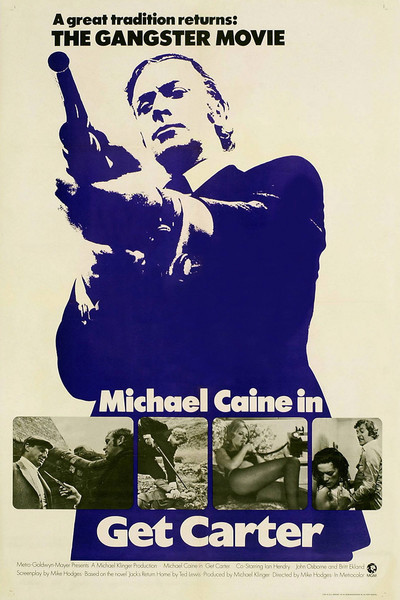
Get Carter (1971)

Brutal, dark and nihilistic British gangster film removes any chance that you might fancy trying a life of crime

Director: Mike Hodges

Cast: Michael Caine (Jack Carter), Ian Hendry (Eric), John Osborne (Kinnear), Britt Ekland (Anna), Brian Mosley (Cliff Brumby), George Sewell (Con McCarty), Tony Beckley (Peter the Dutchman), Glynn Edwards (Albert Swift), Alun Armstrong (Keith), Bernard Hepton (Thorpe), Petra Markham (Doreen), Geraldine Moffat (Glenda), Dorothy White (Margaret)

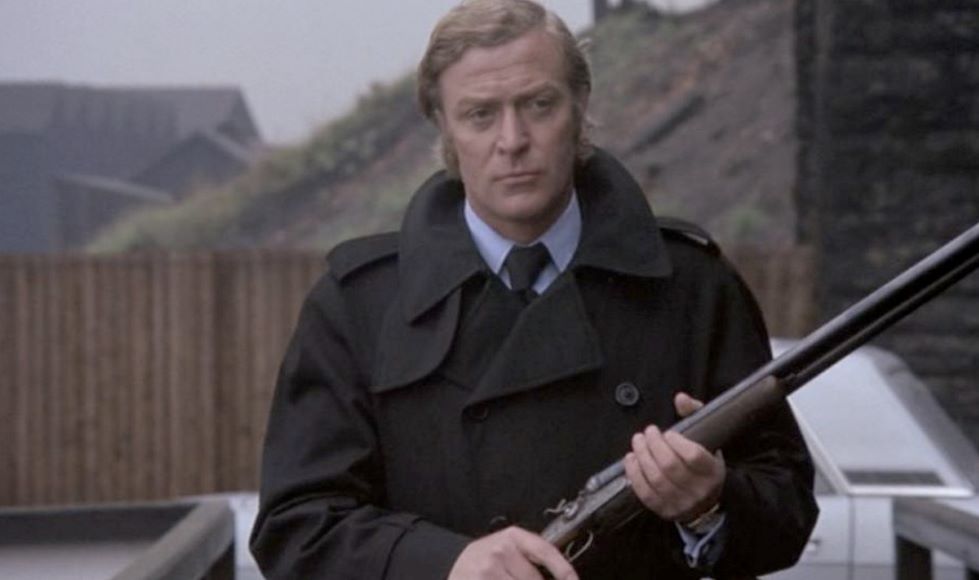
It’s probably the finest British gangster film ever made. Get Carter is a cold, dark, grimy film – a punch to the solar plexus, which completely rejects any sense of charm in its gangster characters. Michael Caine called Jack Carter a shadow Caine, the man he could have become if his life had broken out slightly differently. It’s set in an unremittingly bleak Newcastle, but it feels like it might be happening in an anti-chamber of hell, with its thoroughly amoral lead barely aware he’s spiralling towards destruction. It’s a sociopathic, Jacobean revenge tragedy set among the dirt filled suburbs of Newcastle.

Jack Carter (Michael Caine) is a professional fixer for London gangster brothers. He returns to his childhood home of Newcastle after the sudden death of his brother. But he’s not satisfied with the official explanation. Instead, he dives into an investigation, in which he cares not a jot about the collateral damage he causes or the likely reaction of the underworld powers that be as he rocks the boat to destruction, trashing the lives of everyone he meets, good and bad.

Powered by an extraordinary performance of blank nihilism and cold, unexpressed fury by Caine, nominally Jack is a man motivated by the harm done to his family. However, Hodges film is so cold-eyed and realistic about the mentality of gangsters, we know it’s just an excuse. Carter is never heart-broken, he’s annoyed. His brother may have been punished and his niece (it transpires) misused, but fundamentally what motivates Carter is the affront. By taking a pop at his family, he feels they really think they can take a pop at him. How dare they: he’s Jack Carter.

Any charm Carter has, solely comes from residual affection for Caine. By any measure, Carter is an awful man (even if he has a good turn of phrase). He is a sociopath with no concern for anyone. When friendly Keith (a young Alun Armstrong) is beaten black and blue for helping Carter, how does our hero respond? Tosses a few bank notes on his bed and tells him “buy some karate lessons”. Carter sees the world solely as made up of debts, which can be discharged by money, never mind the situation. His niece throws beer over a friend? He’ll pay for the dry-clean. Keith gets bashed up: take a roll of twenties, what’s your problem?

Carter directly kills four people (and is responsible for several other deaths), all with a blank-eyed lack of reaction. There isn’t any sadism to what he does – the deaths are mostly efficient and to his mind, justified, because by taking actions against his family they disrespected him. When he locks a woman in the boot of his car, and a pair of heavies push the car into the Tyne he doesn’t bat an eyelid at her inevitable death (never mind he slept with her hours before). People who find themselves close to Jack, or drawn into his circle, suffer terribly and he literally couldn’t care less.

Get Carter is the bleakest of all gangster films, shot with an imaginative kitchen-sink beauty by Mike Hodges, which actually carries a lot more visual glory than you might expect. Drained out colours abound – there are virtually no bright primary colours in this, with the whole of Newcastle a mix of muddy browns, soot-stained greys and filthy charcoals. Hodges’ film is also dynamic and fast-paced: he throws in striking aerial and crane shots (there is a beautiful shot that follows a car chase from a bird’s eye view), but also gets down and dirty in this grainy world.

It’s an urgent, lean and mean film constantly kicking you in the shins, but told with skill and artistry. Hodges pieces together a marvellous early scene, where Carter visits local heavy Kinnear (a suave, chillingly well-spoken John Osborne): simultaneously, in one single location, two scenes (both with vital information) play out at the same time – Carter chats to Kinnear’s moll Glenda (Geraldine Moffat), picking up vital information while on the same sofa Kinnear beats his guests at cards. Everything though is perfectly clear: masterful stuff. It’s also a film crammed with small details that reward careful viewing: Carter’s bed has a cross-stitch of “What would Jesus say?” above it (I dread to think) and on his train journey, look out for a fellow passenger with a distinctive ring.

So confidently is this put together, it’s amazing to think Hodges was a first-time director. This is a film dripping with menace, but also a horrifyingly immersive camera. We are frequently thrown into the midst of the action. Carter frequently looms over the camera or is filmed in violent motion moving towards his next goal. There is not a jot of romanticism around the film: neither about the gangsters or the bleak world they operate in. Newcastle is pre-Thatcherite hellhole, with precious little glamour. Even the gangster locales – the clubs and pubs – are bashed-up and unpleasant.

Across the board, the gangsters are exposed as cruel, heartless and vile. Touches of class are ruined by everyone’s fundamental lack of class. Cliff Brumby’s (Brian Mosley) planned classy restaurant sits atop a concrete multi-story car-park. Kinnear’s (John Osborne) fancy country house is the setting of the grimmest, most depressing orgy you’re likely to see. Carter is trying his best to dress classily, but his cruelty always punctures the illusion. He’s introduced watching a porn film with his bosses in London and the film revolves around the seamy underworld of homemade porn.

The women in the film are primarily used by the gangster as props for these films, and Get Carter doesn’t shy away from the exploitative fate for women in this world. However, you can’t disagree that it takes in a bit of exploitation itself. Britt Ekland has high billing for her single scene, where she lies mostly naked on a bed pantily having phone sex with Carter (who goes about this, as all things, with a functional efficiency, at least as interested in the excited reaction of his middle-aged landlady who is sitting in the room with him while he chats on the phone). It’s undeniably a moment for us to gawp but it still feels less cold and cruel than those awful porn films.

Carter discovers his niece has found her way into these. He even sheds a tear over this: but he doesn’t care because of what has happened to her. Again it’s all about him: Carter couldn’t care less about the morals and is perfectly happy for porn to soak up other women. He’s not really that interested in his niece: it’s all about the damage to him, that a “made man” like him should have a member of his family getting boffed like a slag for others entertainment. How bloody dare they?

Get Carter understands this is a dark and soulless world, and is a film bereft of hope. Its hero is a revenge obsessed sociopath, who only smiles in the film after he has burnt everything around him down. Gangsters destroy everything they touch and care about nothing other than themselves. All debts can be settled with money, all women are toys to be used and thrown away. Death means nothing and the world is a drained-out hell of shabby houses and dirty clubs. It’s the grimmest and finest British gangster film out there. Who would want to be gangster after seeing this?

Flash Gordon (1980)


Flash Gordon: Sometimes words fail you

Director: Mike Hodges

Cast: Sam J Jones (Flash Gordon), Melody Anderson (Dale Arden), Max von Sydow (Ming the Merciless), Topol (Hans Zarkov), Ornella Muti (Princess Aura), Timothy Dalton (Prince Barin), Brian Blessed (Prince Vultan), Peter Wyngarde (General Klytus), Mariangela Melato (General Kala), Richard O’Brien (Fico), John Osborne (Arborian Priest), Philip Stone (High Priest Zogo), John Hallam (General Luro)

Well. If almost 40 years on, Flash Gordon is a cult favourite and beloved by millions, then there is hope yet for Jupiter Ascending. By any objective standards, Flash Gordon is a terrible film. But it gets a pass from millions because it’s one people have grown up with. I dread the same reaction to The Phantom Menace from those people whose first exposure to Star Wars was through that film.

Ming the Merciless (Max von Sydow) rules the planet Mongo and decides to destroy the Earth for his own amusement. Disgraced ex-NASA scientist Hans Zharkov (Topol) is the only man on Earth who believes a series of natural disasters are the actions of invaders from space. Zharkov flies a rocket into space to find them – accompanied, for strange reasons, by professional football star “Flash” Gordon (Sam J Jones) and travel agent Dale Arden (Melody Anderson). Arriving at Mongo, they encourage its citizens – especially the forest people led by Prince Barin (Timothy Dalton) and the hawkmen led by Prince Vultan (Brian Blessed) – to unite and rise up against Ming.

Yup you read that right. It’s all as barmy as you might expect. Any film that asks to believe Brian Blessed can fly is always going to be odd. Flash Gordon does at least have its tongue firmly in its cheek. The whole thing is as camp as Christmas. In an age where science fiction and comic books are treated like holy texts, it is at least interesting to see a film that treats its source material with such a breezy lack of respect. The entire film is an exercise in high camp, cheaply put together, that refuses to take anything seriously and actively encourages the respected actors in its cast to take the piss.

So what is Flash Gordon? Is it a big old joke? Yes it probably is. No one is taking it seriously. The actors clearly think it’s a pile of campy rubbish. The producers seem determined to throw as much technicolour cartoon colours at everything as possible. The film is so cartoonish it all but has “Pow!” and “Thwack!” appear on screen as punches land. At a time when Star Wars (and it’s hard to believe it, but George Lucas only made Star Wars because he couldn’t get the rights for this) took its space opera roots rather seriously, this seemed to miss the point completely. It’s a would-be Star Wars rip off that has nothing in common with the tone of the thing its ripping off. Usually that would be a good thing: here I’m not sure it is.

So the dialogue is terrible, the plot line makes no real sense, the film barrels around telling jokes against itself as inopportune moments. Characters shrug off events with no problems at all – at one point a character undergoes brainwashing torture: two scenes later he’s fine (“I just didn’t think about it” he gleefully tells someone. It’s never mentioned again.) The special effects, even for the time, are shockingly bad (the backdrops are sub-Doctor Who. The costumes and design are ludicrously overblown, like an explosion in a campy dressing-up box. It’s a terrible display of excess married with a complete lack of understanding about what made the things it’s trying to rip off successful in the first place. But yet, and yet, and yet it’s still in a terrible, terrible, terrible way quite good fun.

But perhaps the most interesting thing about its campy rubbishness, is how much odd sexual stuff creeps in under the radar. There are also lashings of sadomasochism, incest, orgasms, sex dens, threesomes, swinging, voyeurism – acres of cheeky sexual humour. Ming has a ring that can induce orgasms (it’s so effective on Dale Arden that it’s even commented only Ming’s daughter has had such a response). Ming has a harem, full of opiates to encourage “performance”. There are references to pleasure planets and sex toys. Ming’s daughter is whipped while tied to a bed by Ming’s henchmen (while Ming watches eating some popcorn). The arborians have a bizarre ritual which seems laced with wanking references. It never stops. At least they had some fun.

Some of the actors are also clearly enjoying themselves. Of course Brian Blessed throws himself into it: an actor who never knowingly underplays, Blessed rips through a bizarre role that sees him perform in a jockstrap with some unconvincing wings. Timothy Dalton channels Errol Flynn. Max von Sydow chews the scenery and virtually everything else in sight as a campy, moustachio-twirling Ming. Peter Wyngarde has a great voice and uses it to marvellous effect as pervy security chief Klytus, while Mariangela Melato plays his dominatrix assistant. There are bizarre, eclectic casting choices: so we get Look Back in Anger author John Osborne playing a high priest, Blue Peter’s Peter Duncan as an initiate, and Richard O’Brien (of course!) playing – well to be honest himself.

Sam J Jones is of course simply awful as Flash (wooden, dull and confused). Melody Anderson isn’t a lot better as Dale Arden, while Ornella Muti gets some awful dialogue which she does at least deliver with some conviction (sometimes too much: “Not the BORE WORMS!” sticks in the mind as a bizarre moment of over such over conviction that it simply becomes funny). It’s a bizarre mix of acting styles and overblown, fourth-wall leaning. It’s so bad, I suppose, that to many people it’s good. But actually it gets a little overbearing.

Because nothing is taken seriously at all, the film actually becomes a bit wearing after a while. The writer later regretted playing everything for laughs: it removes any stakes from this ridiculous film. It says a lot that Brian Blessed – the most overblown actor in it – is the only one who really emerges with dignity intact. Blessed at least knows it’s utter crap and plays it like he’s taking the piss in every scene. He commits so fully to the scenery chewing that it sort of works. The rest of the cast can only aspire to his levels of camp. Flash Gordon is a terrible film. But age and fondness have been kind to it, and made it remembered as something better than it is. It’s a misfiring gag with some great Queen songs. It goes on forever, it looks awful but it fails utterly as anything but a joke. But hell maybe that’s enough.