
Tag: Mike Myers

Amsterdam (2022)

Amsterdam (2022)

Lots of quirk, whimsy and smugness, not a lot of interest or dynamism in this satirical mis-fire

Director: David O. Russell

Cast: Christian Bale (Burt Berendsen), Margot Robbie (Valerie Voze), John David Washington (Harold Woodsman), Robert De Niro (General Gil Dillenbeck), Chris Rock (Milton King), Rami Malek (Tom Voze), Anya Taylor-Joy (Libby Voze), Zoe Saldana (Irma St Clair), Mike Myers (Paul Canterbury), Michael Shannon (Henry Norcross), Timothy Olyphant (Tarim Milfax), Andrea Riseborough (Beatrice Vandenheuvel), Taylor Swift (Elizabeth Meekins), Matthias Schoenaerts (Detective Lem Getwiller), Alessandro Nivola (Detective Hiltz), Ed Begley Jnr (General Bill Meekins)

David O Russell’s has made a niche for himself with his ensemble awards-bait films, filled with touches of quirk and offering rich opportunities for eccentric, showy performances from actors. Some of these have walked a fine line between charm and smugness: Amsterdam tips too far over that line. Like American Hustle it’s a twist on a real-life event (opening with a pleased with itself “A lot of this really happened” caption) but, unlike that film, it fails to insert any compelling storyline, settling for a whimsical shaggy-dog story that frequently grinds to a halt for infodumps or lectures.

Set in 1933, just as Roosevelt has taken office, it follows three friends who formed a friendship for life in post-war Amsterdam. They are: wounded veterans doctor Burt Berendsen (Christian Bale) and lawyer Harold Woodsman (John David Washington) and socialite-artist-turned-nurse Valerie Voze (Margot Robbie). Berendsen and Woodsman lost touch with Valerie in the 1920s, but now they are all bought together after the murder of their respected former commander as part of a plot from various nefarious types to overthrow the government in a fascist-inspired coup.

Sounds gripping right? Well, Amsterdam fails to find any urgency in this. In fact, details of this plot and the political context it’s happening in are sprinkled around the film as if Russell kept forgetting what the film was supposed to be about. It’s almost as if he stumbled on an unknown piece of American history – a rumoured coup attempt, thwarted by being denounced by the ex-Marine General approached to lead it (here represented by De Niro’s ramrod straight General Dillenbeck) – but got more and more bored with it the longer he spent on it.

Instead, his real interest is in the faint overtones of Jules et Jim style thruple between Berendsen, Woodsman and Voze (though this is American not French, so any trace of homoeroticism is dispatched, despite the obvious bond between the two men). The most engaging part of the film is the Act two flashback to these three healing, dancing and bonding in post-war Amsterdam, in a “our troubles are behind us” bliss. Even if it’s self-satisfied in its bohemianism.

To be honest, even then, they have an air of smugness behind them. They pass the time singing improvised nonsense songs based on words pulled out of a hat and playfully posing in Valerie’s modernist artwork. Valerie is played with almost enough charm by Robbie for you to overlook she is a standard Manic Pixie Dreamgirl, the sort of babe who pulls shrapnel from bodies to turn it into artistic tea-sets as a commentary on the madness of war. She and Woodsman form a relationship (with the married Berendsen as a sort of – well I’m not sure what, but definitely not a sexual third wheel) and these blissful Amsterdam days are the times of their life. Russell is so keen for us to know it, that all three pop up in short cutaways at key moments to whisper “Amsterdam” direct to the camera, an affectation that fails to deliver the spiritual impact its straining for.

It’s better than the shaggy dog story around the conspiracy that fills the 1930s part of the storyline. This remains so poorly defined, that Bale has to narrate a concluding slideshow of clips and fake newsreel and newspaper coverage to explain what on earth has just happened. The lack of clarity about the stakes – and the general lack of seriousness or urgency anyone treats them with –fails to provide any narrative oomph. Instead, it drifts along from casual meeting to casual meeting, every scene populated with a big-name actor showboating.

There is a lot of showboating in this film. Bale, an actor with an increasingly worrying tendency for funny voices and tics, fully embraces the facially scarred, glass-eye wearing Berendsen, perpetually stooped with a war wound and prone to fainting from pain-killer overuse. It’s a showy, actorly performance with a licence to go OTT. Bale does manage to invest it with an emotional depth and vulnerability, but there’s more than an air of indulgence here.

Most of the rest follow his lead. Malek and Taylor-Joy sink their teeth into a snobby socialite married couple. Rock essentially turns his role as a veteran into a less sweary extension of his stand-up act. Myers and Shannon seize with relish roles as ornithologist spies (is this meant to be a joke about the origins of the James Bond name from the author of a bird-spotting guidebook?) Poor John David Washington ends up feeling flat with his decision to underplay (like he’s in a different movie) and only De Niro really manages to feel like anything other than an actor on holiday.

Russell wants to make a point about the continual corruption of the rich and how their hunger for more power will never be sated. There are some half-hearted attempts at attacking racism, with the ill treatment of black veterans, but it lacks bite or edge. His attempts to draw parallels with Trump are all too clear, but the film largely fails to integrate these ideas into the film. In fact, it ends up relying on voiceover lectures from Bale about dangers to democracy. It ends up like being hectored by an angry socialist after a student revue night.

The film is shot with a series of low angle shots and medium and close ups that eventually made me feel like I was watching it from the bottom of a well. A vague sepia-ish tone is given by Emmanuel Lubezki, but the film looks flat and visually uninteresting (so much so I was stunned to see $80million had somehow been blown on it, despite most of the cast working for scale). It drifts towards a conclusion, without giving us anything human to invest in (as Russell managed so well in Silver Linings Playbook or The Fighter) or providing the sort of caper enjoyment he delivered in American Hustle. Instead, it’s oscillates between smug and dull.
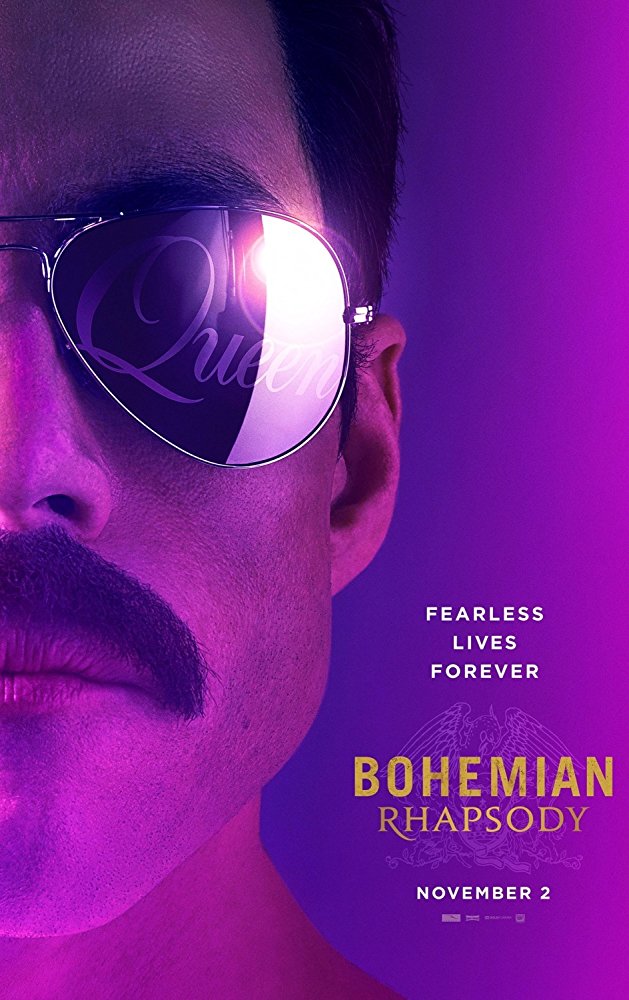
Bohemian Rhapsody (2018)

Rami Malek brings Freddie Mercury to life in crowd-pleaser Bohemian Rhapsody

Director: Bryan Singer (Dexter Fletcher)

Cast: Rami Malek (Freddie Mercury), Lucy Boynton (Mary Austin), Gwilym Lee (Brian May), Ben Hardy (Roger Taylor), Joe Marzello (John Deacon), Aidan Gillen (John Reid), Allen Leech (Paul Prenter), Tom Hollander (Jim Beach), Mike Myers (Ray Foster), Aaron McCusker (Jim Hutton), Ace Bhatti (Bomi Bulsara), Meneda Das (Jer Bulsara)

Biography can be a tricky territory on film. How can you hope to capture a whole life, with all its ups and downs, its shades of grey, in a single sitting of two hours? Well the truth is you can’t really – and Bohemian Rhapsody is an enjoyable but very safe and traditional attempt to tell something of Mercury’s life. It carefully organises his life into a clear five act structure (Beginnings, Early success, Triumph, Temptation and fall, Redemption) that wouldn’t have been unfamiliar to the writer of a medieval mystery play.

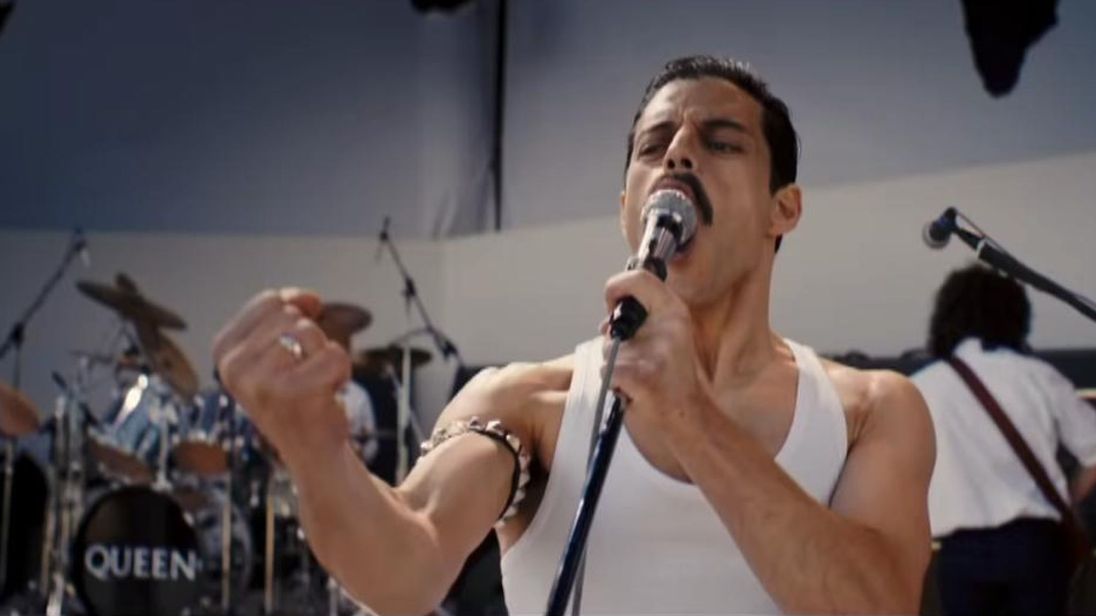
The film uses Queen’s legendary Live Aid performance as the book ends for a story that covers Freddie Mercury (Rami Malek) as he joins Queen, works closely with the band to compose the hit songs that would make them legends, then falls tragically under the influence of band manager Paul Prenter (Allen Leech) and leaves the band to build a solo career and succumbs to those dreaded demons of drink, drugs and sex. The film culminates in a brilliant recreation of Live Aid (by the way, only making the vaguest of passing references to the cause behind Live Aid, with the main motivation for performing seeming to be that everyone else is) which, despite some wonky CGI at points, brilliantly captures the atmosphere of being at an electric live gig. 

Bohemian Rhapsody is an affectionately made crowd-pleaser of a film which has convention running through its soul like sugar at the centre of stick of rock. With the heavy involvement of the surviving members of Queen and their manager, it’s a film that wants to very carefully avoid anything too controversial – which is fair enough when it’s people making a film about their friend – and does its best to shave off his rough edges, and apportion blame for faults anywhere other than Freddie.

As such, the film defines Freddie’s successes as those he achieved as part of “the family” of Queen – and his failures when he fell under the influence of others who were using him. The film draws Freddie as being desperate to find love and acceptance – from his struggles to be accepted by his traditional father (a very good performance by Ace Bhatti), to his deep love for his wife Mary Austin (while guiltily struggling with his homosexuality), to his sometimes prickly relationship with the rest of Queen, who are basically a band of brothers. Is it any wonder that someone as desperate for love as Freddie might fall under the influence of someone offering constant but not genuine affection?

Anyway, the film very carefully spreads the genius of Queen neatly around the band (we see them all chucking in songs and key ideas, even if Freddie is the driving force). Part of the reason the film works is that the band are right – these are songs for everyone. These are songs that make you want to be involved in their performance, that make you want to sing along and stamp your feet. It’s the magic alchemy of the band’s own genius that the film is so dependent on – even if the film does sometimes struggle to dramatise the act of creating art. Early on we see Freddie idly play the opening bars of Bohemian Rhapsody on the piano. “What’s that, it’s beautiful” asks his wife – “It has promise” Freddie shrugs. That’s about par for the course for how the songs come together in this film. What makes it work is the chemistry between the actors and the general lightness of the story telling.

That lightness is largely missing from the sections of the film that chart Freddie’s “dark days”. Keen to absolve Freddie as much as possible from fault, the film largely takes all his negative traits and actions and basically pours them into another man and identifies him as the reason for everything bad that happens in the film. I have no idea if the real Paul Prenter (a moustache twirling performance by Allen Leech) bore any resemblance to the chippy, bitter, scheming, selfish, greedy bad influence who appears in this film – but then Prenter has been dead for over 20 years so we’ll never know. The film blames everything – and I mean everything – on Prenter and paints Freddie as an innocent victim led astray.

The film also shies away as much as possible from showing us anything too gay. In fact, it’s hard not to get the awkward (if no doubt inadvertent) feeling that the film’s implying that the more Freddie got immersed in the gay underworld, the more he was consumed by his flaws and by bad things. In any case we get shots of Freddie at S&M parties, but shot with a dream like wistfulness that concentrates on Freddie walking towards the camera disconnected from his surroundings. The film juggles the timeline of Freddie’s life as much as possible to make for a clean narrative (in actual fact Prenter wasn’t dismissed until two years after Live Aid, Queen never split up and reformed and Freddie wasn’t diagnosed formally with AIDS until 1989), and it adds to a feeling that we are seeing a carefully formed drama that is telling a “better” version of Freddie’s life.

The biggest weapon in the film’s arsenal is Rami Malek’s performance in the lead role. His recreation of Freddie’s style and on-stage swagger is so faultless, you start to believe you are seeing the real thing. He also really adds a vulnerability, loneliness and sensitivity to Freddie’s private life. He can be prickly and arrogant, but it all stems from a deep insecurity that Malek brilliantly builds with a tender empathy. It’s a star-making performance, and he is very well supported by the rest of the cast, including Lucy Boynton as his loving wife, Gwilym Lee, Ben Hardy and Joe Mazzello very good as the other members of the band and Tom Hollander excellent as their eventual manager.

The main issue with the film is its strident conventionality. It obeys all the rules you would expect of a good biopic, and builds a picture of Freddie’s life that perfectly fits an ideal drama structure. Its basically safe, traditional and largely directed with a lack of imagination (although it’s troubled production, Bryan Singer’s dismissal due to “personal problems” and Dexter Fletcher’s late parachuting in to finish the film no doubt contributed to this) which offers very little that will surprise you and, in its quesiness on homosexuality, some that might offend you. But I think it provides enough pleasure from Queen’s wonderful discography that it almost rocks you.