Tag: Murray Hamilton

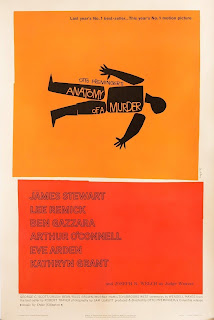
Anatomy of a Murder (1959)

Anatomy of a Murder (1959)

The mechanics of courtroom showmanship is ruthlessly exposed in this gripping drama

Director: Otto Preminger

Cast: James Stewart (Paul Biegler), Lee Remick (Laura Mannion), Ben Gazzara (Lt Frederick Manion), Arthur O’Connell (Parnell McCarthy), Eve Arden (Maida Rutledge), Kathryn Grant (Mary Pilant), George C. Scott (Claude Dancer), Orson Bean (Dr Matthew Smith), Russ Brown (George Lemon), Murray Hamilton (Alphonse Paquette), Brooks West (Mitch Lodwick), Joseph N Welch (Judge Weaver)
Winston Churchill once said Democracy was the worst form of government, except for all the others. You could say something similar about trial by jury: it ain’t perfect, but it’s better than any other justice system we’ve given a spin to in human history. Trials aren’t always forums for discovering truths: they are stages to present arguments (or stories), and they are won by whoever has the best one. Maybe cold, hard facts and evidence make up your story, maybe perceptions. Maybe it’s about how you tell the story. Elements of all three are found in Otto Preminger’s brilliant courtroom drama, Anatomy of a Murder.

In a small town in Michigan, a US army lieutenant, Frederick Manion (Ben Gazzara) is arrested for the murder of innkeeper Barney Quill. Manion says he did the deed only because Quill raped Manion’s wife Laura (Lee Remick). Representing him is lawyer Paul Biegler (James Stewart), a former district attorney looking to start-up a new practise. On the opposite side is new DA Mitch Lodwick (Brooks West) and, far more of a worry, hot-shot lawyer Claude Dancer (George C. Scott) all the way from the Attorney General’s office. They say there was no rape – only a jealous murder after a consensual affair. It’s he-said-she-said, only “he” is dead. How will the trial clear that one up?

Otto Preminger was the son of a noted Austrian jurist, and Anatomy of a Murder can be seen as a tribute to his father, and to the process of the law itself. Not that it’s a hagiography. The film recognises the virtues as well as the faults of the system. Above all, that the system is not perfect, it can’t base every decision on firm facts and often requires people to take leaps of faith based on their gut instinct about who may, or may not, be telling the truth.

Preminger’s film does its very best to put us in the position the jury is in. We get no real evidence about what happened beyond what they get, and very few bits of additional information (except, perhaps, for seeing what many of the characters are like outside of the courtroom). Instead, the viewer is asked to make their mind-up on whether events fell-out as Manion claims (or not) based on our own judgement of the probabilities and of his (and Laura’s) character. The film opens with the crime committed and closes shortly after the verdict: there are no flashbacks or pre-murder scenes to help nudge us towards one view or another. The murder victim appears only as a photo. Like the jury we have to call it on what we see in front of us.

Anatomy of a Murder also makes clear there are plenty of shades of grey in the process of justice. During his first consultation with Manion, Biegler carefully suggests he consider whether he was in fact insane when he committed the deed – as that sort of defence will be much easier, since he doesn’t deny the killing. Sure enough, on their second meeting, Manion is now deeply unsure about his state of mind. Biegler then works backwards to establish precedent for the plea (a finds a single, over 75 years old one) to pull together a defence of irresistible impulse and to peddle hard a picture of the victim as an unrepentant rapist practically asking for a wronged husband to do the deed.

Biegler’s case is flimsy – but the key thing is to present it with pizzazz. And that’s what he’s got. Stewart’s performances in Hitchcock classics are highly regarded, but this might well be his finest dramatic performance. This is a brilliantly sly deconstruction of Stewart’s aw shucks charm: Biegler promotes an image of himself as a down-on-his-heels, bumpkin-like country lawyer, punching above his weight against the big city lawyers, Stewart dialling up the famous drawl. But it’s miles from the truth: Biegler is a former DA, an experienced trial lawyer and a formidable advocate. Stewart flicks the switch constantly, visibly putting on his persona like a skin, shedding it when no longer needed.

There is a constant suggestion that everything Biegler does is for effect. From fiddling with fishing tackle during the prosecution’s opening statements, to furious court-room theatricals as he thuds tables at slights and injustices. All of it is carefully prepared, rehearsed and delivered to make an impact on the jury. The constant parade of effect, manufactured outrage and appeals to an “us against them” mentality provokes exasperation from his opponents and a weary toleration from the Judge (played by real-life McCarthy confronting attorney Joseph N Welch). Stewart uses his Mr Smith Goes to Washington nobility, but punctures it at every point with Biegler’s cynicism and opportunism. Biegler, at best, persuades himself his client is innocent – but I would guess he doesn’t really care either way. He immediately perceives the personalities of his clients and then does his best to shield their less flattering qualities from the jury.
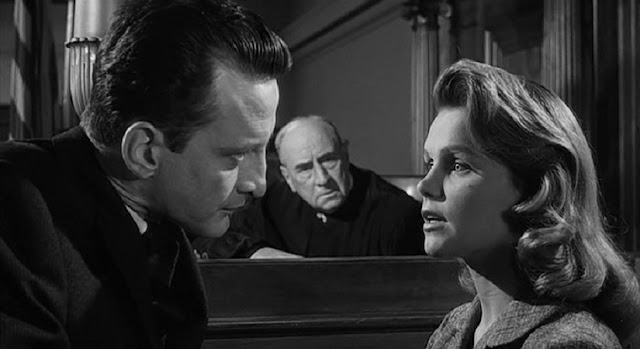
The one advantage we have over the jury is the additional insight we get into this strange couple, living a possibly unhappy, and certainly love-hate, marriage. Manion plays wronged fury in the court – but Gazzara gives him a lot of self-satisfied smarm and bland indifference to his crime in real life, meeting every event with a smirk that suggests he’s sure he can get away with anything. Equally good, Lee Remick’s Laura presents such a front of decency and pain in court, you’ll find it hard to balance that with the promiscuous, blousy woman we see outside of it, who provocatively flirts with intent with anything that moves. But it’s all about the show: present them right, and these unsympathetic people can be successfully shown as a conventional loving couple.

The prosecution is playing the same game. George C. Scott is superb as a coolly professional lawyer, who will use any number of tricks – from angry confrontation, to seductive reasonableness – to cajole a witness to say anything he wishes them to say. He will turn on a sixpence from being your friend, to berating you as a liar. And he’s not averse to his own morally questionable plays in court. Like Biegler, he knows presenting a good story is what is needed to win: the truth (or otherwise) isn’t enough.

Anatomy of a Murder still feels like a hugely insightful look at the legal process. Most of its runtime takes place in court, which Preminger shoots with a calmly controlled series of long-takes and two-shot set-ups, that help turn the film into something of a play (as well as a showpiece for fine acting). Along with its very daring (for the time) exploration of rape, it has a very cool soundtrack from Duke Ellington, that drips with allure and gives the film a lot of edge. The acting is all brilliant – along with those mentioned, Eve Arden is first-class as Biegler’s loyal secretary and Arthur O’Connell sweetly seedy as his heavy-drinking fellow lawyer. Anatomy of a Murder gives a first rate, at times cynical, look at the flaws and strengths of trial by jury – and is an outstanding courtroom drama.
The Graduate (1967)

Dustin Hoffman is out of his depth in coming-of-age comedy The Graduate

Director: Mike Nichols

Cast: Dustin Hoffman (Benjamin Braddock), Anne Bancroft (Mrs Robinson), Katharine Ross (Elaine Robinson), William Daniels (Mr Braddock), Murray Hamilton (Mr Robinson), Elizabeth Wilson (Mrs Braddock), Buck Henry (Room clerk), Brian Avery (Carl Smith), Walter Brooke (Mr McGuire), Norman Fell (Mr McCleery)

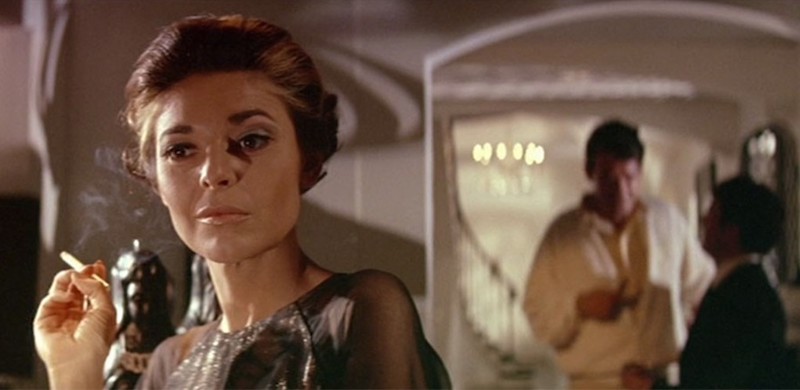
In 1967, the world went crazy for The Graduate. This comedy of manners and sex tapped into a whole generation’s growing sense of rebellion. Who wants to be told their life has already been mapped out for them? The Graduate seemed to capture that mood and was celebrated as the ultimate example of how someone could break out of the mould. It’s a young person’s film, and perhaps you need to be young to watch it. The older you get – and the further away from those dreamlike days of the late sixties where everything seemed possible – the more the film feels like an amusing but soulless story, with a privileged bore at its heart.

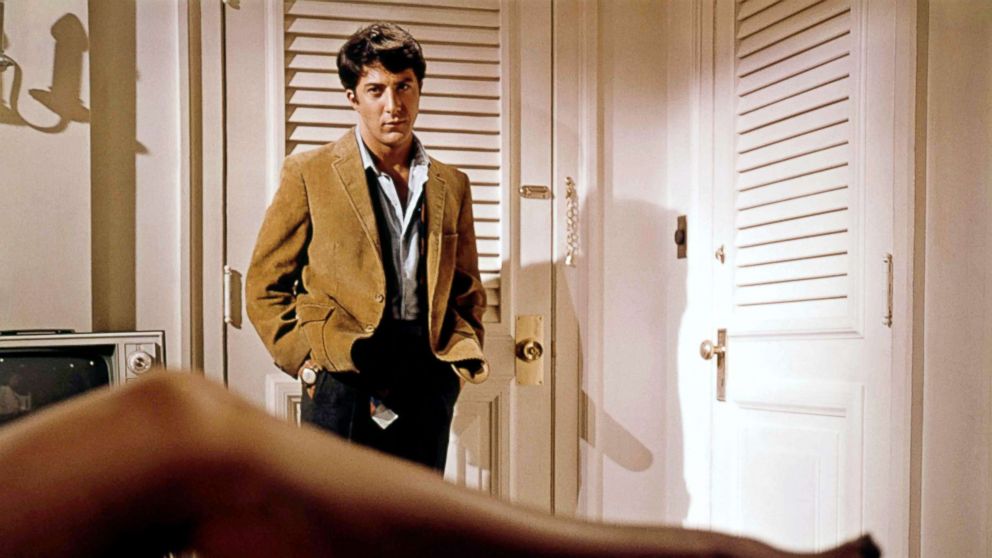
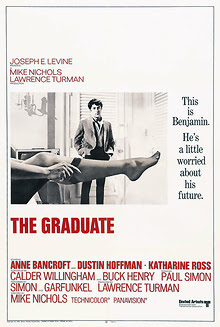
Benjamin Braddock (Dustin Hoffman – actually nearly 30) is a fresh-faced young graduate, top of his class and a sports star. Arriving back home in California, he’s depressed, lost, uncertain about what he wants from life, but pretty sure it isn’t the litany of office, marriage and a career in “plastics” that his parents expect. His isolation brings him to the attention of Mrs Robinson (Anne Bancroft – only 6 years older than Hoffman), the wife of his father’s business partner. She sets about to seduce him, partly out of boredom, partly perhaps because she feels the same ennui and depression as he does (not that Benjamin ever notices – more on that later). They start a long summer affair, conducted with supreme awkwardness on Benjamin’s part, which suddenly becomes complex when he falls for her daughter Elaine (Katharine Ross). Can true love triumph?

The good first. The film’s popularity was grounded in its wit – and it has a very funny script by Buck Henry, who also appears in one of the film’s funniest sequences, as an overly helpful desk clerk at the hotel where Benjamin is awkwardly trying to book a room for his assignation. The film is pacey and energetic and full of imaginative cuts (a brilliant one sees Benjamin flopping out of a pool, jump cutting to him descending onto Mrs Robinson in bed) and directorial flourishes. It’s a dynamic and sexy young film, full of bounce and appeal, with some great jokes.

Mike Nichols – who won the film’s only Oscar for Best Director – shoots the film with real vibrancy. He does a fantastic job getting us to invest in Benjamin. A huge percentage of the film sees the camera focus in on Benjamin, usually in medium-shot or close-up – and it’s a rare moment when he isn’t in frame. The camera rarely leaves him for the first ten minutes, first zooming out from a close-up of him sitting on a plane, following him along a conveyor belt to the terminal (where his blankness slowly changes to fearful anticipation of what waits at home) to tracking along beside him at his welcome home party. This party is stuffed with his parents’ friends, and Ben’s isolation, claustrophobia and insecurity seem all the more striking as the camera gets closer and closer to him. It’s a superb example of using the camera to build empathy for the character.

Nichols’ excellent work continues throughout the film, which makes excellent use of shots, editing and zooms to make us experience Benjamin’s emotions, helping us root for him. It also helps that the film is scored to some of the finest music Simon and Garfunkel ever performed. The slightly sad, wistful feel to their songs – from Sound of Silence to Scarborough Fair – seems to perfectly frame Benjamin’s doubts, just as the slightly more hopeful beats of Mrs Robinson seem to capture him embracing freedom at the film’s end.

The decision to cast Hoffman pays off in spades. Hoffman is no one’s idea of a WASPy sports-star alpha male, but he’s everyone’s idea of an outsider. His performance is pitched perfectly – awkward, shy, uncertain, unaffected and natural. In fact, the film is pretty much perfectly cast. Anne Bancroft’s performance defined her whole career, the predatory Mrs Robinson whom she invests with touches of emotional vulnerability and more than a trace of the very same depression and fear that Benjamin is feeling. An entire generation effectively fell in love with the charming Katharine Ross.

Freedom is what the film is all about. But today, you feel the film skims only lightly on depths it could explore in detail. Benjamin can feel all the ennui he likes: he’s got it so made, I wish I had his problems. With his wealth, his fast car, the vast array of businessmen falling over themselves to offer him low-work-high-reward jobs, not to mention the gallery of attractive women throwing themselves at him, it’s the sort of misery only the rich enjoy. Almost constantly dressed in suit and tie, with his combed down hair, he looks a million miles from the generation that would party at Woodstock and protest Vietnam. Benjamin probably went on to vote for Reagan (twice). There is nothing counter-culture about him whatsoever. He ticks off noisy teenagers at a drive in and seems to find the young as hard to understand as the old. He’s less a generation adrift, more of an individual misfit.

The film though loves him to pieces, in the same way it largely treats Mrs Robinson as somewhere between a joke and a monster. She’s written as either a horny exploiter of youth, or a vengeful harpy. Rather than a ruthless cougar, today she seems to be more of a vulnerable, damaged figure. Every scene with Bancroft carries moments of pain, sadness and world-weary depression. Why else is she so able to spot these traits in Benjamin? Watch her desperation and hurt when Benjamin starts to date her daughter. That’s real humanity there, miles from the empty selfishness of Benjamin, who genuinely doesn’t get why she could take it so amiss that he intends to replace her with her own daughter.

The most striking moment in the film that captures this is the scene where Benjamin attempts small talk during one of their nights together. The film wants us to think Ben is looking for something real, and that Mrs Robinson just wants the sex. But the conversation is a masterclass from Anne Bancroft of suppressed pain and regret, as she talks of having to drop her art degree because she was seduced by her husband, of years of living an empty life. Benjamin of course doesn’t get it – he guesses she dropped the art because she wasn’t interested – and then gets cross when he feels he’s being belittled. Mrs Robinson’s sad eagerness to persuade him to stay is rather affecting – more than the film really allows. I credit Anne Bancroft with much of this.

And then we have Elaine. The second half of the film shifts gear dramatically from the first. While the first half is a sex comedy and study of suburban discontent, the second seems to change into the sort of celebration of youthful energy that the first half could be said to be partially satirising. Elaine is an independent young woman, embracing her education and the opportunities it offers. Suddenly, an energised Benjamin is tearing across country to win Elaine back (let’s put aside that Benjamin behaves in this section like something between a stalker and a creep).

However, as the film nears its conclusion, that celebration of the promise of youth is undercut somewhat, as Elaine chooses to make  all the same mistakes her mother made. The film even hints at this with its famous ending shot. After eloping from her wedding, Elaine and Ben sit on the back seat of the bus. The camera holds the shot as they laugh, until they stop laughing and then sit next to each other, and then awkwardly look this way and that as if waiting for someone to tell them what to do. What do they really have in common? Having made a spontaneous decision like this, what happens next? It’s another little genius flourish by Nichols – although it’s also the film having its cake and eating it, selling the sequence before this as a triumph of true-love, then asking us to question if the world is that simple.

Some of these ideas felt lost in the excitement of the film’s first release, when it captured a wave of public feeling. But the older the film gets, the more awkward it looks. As if the kids who watched it in the sixties and turned into the Reaganite Baby Boomers of the 1980s, slowly realised that the message it was selling was not quite true and perhaps their parents weren’t that different after all.

Watching The Graduate today, I found it hard to shake the feeling that if I flashed forward to the characters’ lives in 1997 I would find a very different, but still very similar story. Benjamin Braddock would be a wealthy businessman, still dressed in suit and tie, who went into plastics or computers or some such and swallowed the “greed is good” mantra from his corner-office. Elaine a depressed housewife, mother to a couple of kids, who left her dreams of forging her own life behind to marry the subject of a youthful fling. Who, with her own regrets, finally understands the sadness and misery at the core of her mother’s life. And is making eyes at that attractive young man next door…

Jaws (1975)

Shaw, Scheider and Dreyfuss take on the shark in Jaws

Director: Steven Spielberg

Cast: Roy Scheider (Martin Brody), Robert Shaw (Quint), Richard Dreyfuss (Martin Hooper), Lorraine Gray (Ellen Brody), Murray Hamilton (Mayor Vaughhn), Carl Gottlieb (Meadows)

Necessity can be the mother of invention. Perhaps no film demonstrates this better than Spielberg’s sensational smash-hit Jaws. If “Bruce” the animatronic shark had not been so unreliable and unconvincing would the film have become such a big hit? If Spielberg had been able to show a convincing shark, would he have dropped the suggestiveness and unseen terror – not to mention the famous creeping dread of John Williams’ score – and gone for more traditional scares? We just don’t know – but he was certainly forced to be as inventive as possible and it worked a treat.

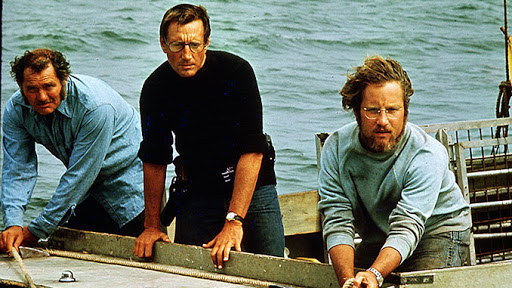
A quiet community on Amity Island suddenly finds itself falling victim to a terrifying series of attacks from a shark. As people panic – and the death toll rises – only local police chief Martin Brody (Roy Scheider) seems to want to close the beaches and declare an emergency (after all we can’t let the simple matter of a few kids ripped to shreds by the finned killer disrupt the holiday season). But when things eventually go too far on the first day of holiday season, Brody finally gets the go ahead to head to sea and take on the shark himself. Only problem is Brody has a fear of water and no idea how to hunt a shark. Just as well he’s teaming up with Marine Biologist Martin Hooper (Richard Dreyfuss) and grizzled old sea-dog and shark hunter Quint (Robert Shaw) for the mission. Though with this size of this sucker, they may need a bigger boat…

Spielberg’s film largely works so damn well because it pushes suggestion over what we actually see. The shark doesn’t appear on screen for well over an hour. Instead, we see only movement of the water, POV shots of the shark and the flailing terror of the victims, dragged hither and yon by the unseen opponent. Spielberg very generously – and perhaps accurately – attributed at least half of the film’s success to John William’s iconic score. The seemingly simple, but devilishly intoxicating music perfectly captures feelings of mounting dread and tension. It’s possibly the most instantly recognisable score in film history, and works an absolute treat to get across the terror.

Because that is what the film is all about. There is a reason why the tag line for the first sequel was “Just when you thought it was safe to go back into the water”. The film plays on the creeping concern with not knowing what is underneath the still surface of the waters. And the possibility that a monster lurks there ready to destroy us, taps into all those fundamental child-like terrors we have of monsters under the bed. The things we can’t see are terrifying. Spielberg taps into this brilliantly, with the frothing of water or the shark’s movement being substituted by other things – either a part of a pier being dragged in its wake, or the barrels that Quint attaches to it with harpoons to track its movement. A large part of the second half of the film revolves around Quint’s ship being chased by floating barrels – and it works never-the-less.

This sense of terror that the film captures so well – as well as the moments of shock of carefully chosen few beats of gore – is a surprise when you consider that Spielberg today is seen as a more sentimental, family-friendly director. But on this film, he was a young buck still out of the gate – this was only his second theatrical film. Spielberg wasn’t even first choice – although his TV movie Duel, which sees a driver chased by a giant truck, the driver of which remains unseen, was the perfect calling card. When he got on board, he made what he himself describes as a series of rookie mistakes, not least insisting on shooting at sea rather than in a tank or just off the coast. Not to mention the multiple delays from the shark. Despite the film’s nomination for Best Picture (and the millions it earned at the box office), Spielberg was denied an Oscar nod as suspicions abounded that the oft-delayed, over-budget film was “saved” in the editing suite. 

While the film is superbly edited – again that creeping power of suggestion and the way the film leaves much to the viewer’s imagination – it’s much easier now to accept Jawswas Spielberg’s first real flexing of his cinematic muscle. The decision to film at sea – while causing no end of problems for the crew – brilliantly allows for wide shot vistas that creates a real sense of isolation for the boat. It constantly looks small, rattled and fragile in a massive environment, making it feel like even more of a mismatch against the size of the shark. Throw in Spielberg’s brilliance at building tension, and you get a film that seizes you by the scruff of the neck and doesn’t let go. He’s a master here and the film has more than enough famous shots – including the famous reverse zoom on Scheider as he realises the shark is in the water – to show he was just warming up.

It also helps that the film front-and-centres character and good writing alongside all the thrills. Part of the benefit of the films continued delays is that the original script was constantly tinkered and improved by Carl Gottleib from Benchley’s original. Others were bought in to work on it – most famously John Milius who took a redraft pass at Quint’s famous Indianapolis speech, which Robert Shaw himself then rewrote. What we end up with is a script with three well-drawn – and distinctively different but complementary – characters and plenty of sharp lines.

The three stars fill these roles with aplomb. Scheider gracefully accepts the quieter role, but carries the film with an unshowy ease as an everyday hero, eventually pushed to his limits. Dreyfuss gets the more plucky, overtly comic role as the expert biologist and plucky young gun, with a sharp wit and a chippy younger man’s perspective. Shaw meanwhile gets some of the films best scenes as a grizzled seadog with no time for the kids and a dangerous obsession for proving he’s right. The three actors play off each other extremely well, despite the troubles on set (which Shaw was usually at the heart of, from his drinking, to his clashes with Dreyfuss, to his constant flying back to Canada at any opportunity for tax reasons).

But these three actors work brilliantly together, and the film’s tense brilliance still makes it a compelling watch today. And yes, Spielberg was right – that Williams score does play a huge part in its success. Try imagining what you are seeing in the film without the score playing over it? Necessity is the mother of invention.

Seconds (1966)

Trauma abounds in dull, self-important conspiracy thriller Seconds

Director: John Frankenheimer

Cast: Rock Hudson (Tony Wilson), Salome Jens (Nora Marcus), John Randolph (Arthur Hamilton), Will Geer (Old Man), Jeff Corey (Mr Ruby), Richard Anderson (Dr Innes), Murray Hamilton (Charlie Evans), Karl Swenson (Dr Morris), Khigh Dhiegh (Davalo), Frances Reid (Emily Hamilton), Wesley Addy (John)

In the 1960s, John Frankenheimer directed a string of conspiracy and paranoia thrillers, the most famous of which was The Manchurian Candidate. Seconds follows on in that genre, but where The Manchurian Candidate is first-and-foremost an adventure story with a deeper soul, Seconds is a self-important piece of overt arty cinema that quickly outstays its welcome.

This is particularly annoying as, on paper, this is a great story. A business makes its living from selling new, younger bodies (and new carefree lives), known as “seconds”, to old, rich people so they can start afresh. One such man is depressed banker Arthur Hamilton (John Randolph), who is reborn as artist Tony Wilson (Rock Hudson). The one rule? They can’t tell anyone about the procedure or about their old lives, and must leave everything behind. Needless to say, the prospect of a new life is a hell of a lot better than actually getting it.

Seconds really should go from there into a fascinating exploration of truth and identity: instead it swiftly gets bogged down in arty camera shots, self-important philosophising about the nature of identity, and tediously over-extended sequences of Hamilton/Wilson trying (and failing) to come to terms with his new life. The entire film never shakes the feeling that it believes it is stunningly important and everything it does is making crucially important, profound points, and it quickly loses the audience. 

The basic problem with it, above all others, is that we are given no reason at all to care about Hamilton/Wilson in either of his two personae. John Randolph is so effectively beige as the original Hamilton, you genuinely end up not caring what happens to him. Nothing in either his life or personality sparks any interest, or any sense of loss. Pile onto that the fact that it seems to take an age for him to commit to having the operation in the first place and you have a rather slow, dragging half-hour opening with a character you care very little about. And that’s just the first act.

The point the film wants to make is that changing your face and your life cannot always change the man inside: that the basic unhappy discontent of Hamilton/Wilson isn’t going to be fixed by giving him Rock Hudson’s face. Sad people are going to be sad whatever. The fact that I have summed up all the ideas of the film in a few short lines tells you everything. The film takes over an hour to make the same statements, with Wilson as tedious a lead as Hamilton was. In fact, one of the main problems is that the most interesting characters by far are those on the edge of the film – from Will Geer’s seemingly benign, but deeply sinister exec running the business to Wesley Addy’s scarily omniscient butler, these side characters all offer a lot more interest than our lead.

Wilson ends up in a beach community, filled with a host of suspicious-looking people and staffed by company representatives determined to make sure Wilson doesn’t disgrace himself or blow the gaff. Hudson makes a decent fist of the job – many commentators have made the rather clumsy point that the famously closeted Hudson probably had more understanding of what it was like hiding your real identity than any other Hollywood star around at the time – but it can’t change the fact that he’s basically not that strong or compelling a performer. Or that, even in the new body, Hamilton/Wilson is still a pompous and dull stick-in-the-mud.

So even in a new skin the character is not one you can feel any investment in. The community sequences are as slow and overplayed as the opening half hour. We are never really clear what exactly Wilson/Hamilton finds so terrifying and unsatisfying about the community, or why he finds the idea of other “seconds” so deeply traumatising. The sequence is also cursed with a bizarre “grape crushing” ceremony, that plays out like a sort of Woodstocky orgy. I imagine it is meant to convey the sudden appeal of free living – but it’s so skin-crawlingly awkward and embarrassing in its staging that it makes Frankenheimer feel like a stuffy dad attempting to relate to the sexy young kids. 

Seconds is basically too dry and empty the majority of the time to really care about or enjoy. Frankenheimer – and in particular his cinematographer James Wong Howe – shoot the film with an inspiring and trippy inventiveness as well as a disconcerting surreality. The woozy black-and-white photography constantly mixes unsettling angles, disconcerting zooms and intense POV framing to leave you uncomfortable and on-edge while watching the film. While this artiness and theatricality does sometimes make the film feel like it’s trying too hard (and makes it feel very of its time) it does at least offer most (if not all) of the interest in the film.

Maybe part of the problem as well is that Seconds is an almost unbearably depressing film, with possibly the most horrifyingly grim ending you can imagine, shot with intense horror by Frankenheimer (I’ll also say that Hudson’s desperation and fear as he realises the final fate the company has in mind for him is brilliant). It’s not exactly fun viewing, but it’s so intense you have to admire it even while finding it terrifying. It’s one of the few moments where the film’s pretensions, and pride in itself, really pay off with the final product. 

It’s the problem all over with Seconds. There are moments in there you can admire – and you can totally see why it has been reclaimed by many now as a lost classic. However, it’s also really easy to understand why the film was a box office bomb, unloved by the cinemagoers and why it’s not very well known today. There is so little in there for you to feel an emotional connection to – its lead character is a bore and a cold fish, his love interest sinister, and huge chunks of the story are delivered with a puffed up pride at how clever the whole thing is. It’s a huge disappointment, considering its potential.