Tag: Nikolaj Coster-Waldau

Kingdom of Heaven (2005)

Kingdom of Heaven (2005)

Scott’s crusader epic is a much better, more thoughtful film than you’ve been led to believe

Director: Ridley Scott

Cast: Orlando Bloom (Balian of Ibelin), Eva Green (Sibylla of Jerusalem), Jeremy Irons (Lord Tiberias), David Thewlis (Hospitaller), Liam Neeson (Godfrey of Ibelin), Brendan Gleeson (Raynald of Chatillon), Marton Csokas (Guy de Lusignan), Edward Norton (King Baldwin IV), Ghassan Massoud (Saladin), Michael Sheen (Priest), Velibor Topić (Almaric), Alexander Siddig (Imad ad-Din al-Isfahani), Kevin McKidd (Sergeant), Jon Finch (Patriarch Heraclius), Ulrich Thomsen (Gerard de Ridefort), Nikolaj Coster-Waldau (Godfrey’s nephew), Iain Glen (Richard I)

Version control: This review cover the Director’s cut of Kingdom of Heaven, a three-hour film that is much better than the original theatrical version.

For hundreds of years the Middle East has been the site of wars over land and religion: the more things change, the more they stay the same. Ridley Scott’s Kingdom of Heaven is a grand, melancholic epic about the crusades, a period of history that seems to become even more divisive and controversial if every passing year. During the First Crusade (1096-99), a European Christian army had bloodily seized control of Jerusalem (massacring its Muslim population). The Crusaders built a state that lived through fragile truces, in a constant state of cold war with the Muslim states that opposed their conquest. Scott’s film picks up the final years of that ‘kingdom of Heaven’.

He does so through fictionalised version of the events. Balian (Orlando Bloom), a former military engineer, is now a widowed blacksmith in Northern France – until Godfrey of Ibelin (Liam Neeson), a crusader lord, returns to claim him as his illegitimate son. Fleeing his home after murdering his bullying priest brother (Michael Sheen), Balian arrives in the Holy Land as the new Lord of Ibelin. But he not a paradise, but a kingdom full of ambitious lords and zealots, surrounded by the armies of Saladin (Ghassan Massoud) with the whole thing only just held together by the wise leper king Baldwin IV (Edward Norton). There is already a power struggle for who will control Baldwin’s heir, the child of his sister Sibylla (Eva Green). Will it be the moderates led by Tiberias (Jeremy Irons) or the zealot Templars led by Sibylla’s husband Guy de Lusignan (Marton Csorkas)?

I’ve always been interested in this period of history, and I’m a sucker for a grand historical epics. So I’m pretty much the target for this ambitious, luscious, flawed but engaging film. It helps when it’s assembled by a director as full of visual flair as Ridley Scott. Kingdom of Heaven is an extraordinarily beautiful film – one of those where you really could snip out every frame and hang it up on your wall. Gorgeously lensed by John Mathieson, it moves from a chilly, blue-filtered North France (a land of artistic snow fall and permafreeze) to a David Leanesque desert land, of rolling sand dunes and skies tinged with deepest blue. It’s a film of breathtaking scale, as medieval armies converge, legions of siege weapons roll up to never-ending city walls and the desert stretches as far as the eye can see.

It makes a fantastic backdrop for a film that’s tries really, really hard to take a measured, reasonable view on human nature and religion. It’s fair to say that this makes Kingdom of Heaven a very serious film (there is barely a few minutes of humour in its entire three hour runtime – a joke about Neeson once fighting three days with an arrow in his testicle is about all you’re gonna get), but it’s also nice to have a film celebrating compromise and moderation. Really, Kingdom of Heaven isn’t a true representation of the Crusader period at all – the real Balian and Baldwin would scarcely recognise the humanist liberals they become here – but as a sort of fantasia on balancing conflicting demands in a place that seems to make men mad, it’s hard not to be respect that it’s trying as hard as it is.

To achieve it’s aims, Kingdom of Heaven divides both sides of the argument into goodies and baddies. For the goodies, Baldwin and Saladin are reasonable, just men willing to strive for a world where all can worship freely. Edward Norton – unbilled under a silver mask and English accent – brings a great deal of strength and wisdom to Baldwin, matched by Ghassan Massoud’s superbly patient Saladin. On the other side, we have the “God wills it!” brigade. Admittedly on the Muslim side, they are embodied by one of Saladin’s advisors, whereas the crusaders are awash in angry, Holy War bloodlust types who believe any killing is justified if it’s in God’s name.

Kingdom of Heaven has a respect for faith, particularly when filtered through the words of characters who don’t believe painting a cross on their chest allows them to kill anyone who disagrees with them. Several times, Balian argues doing sensible, reasonable things technically against the word of the Biblewill be understood by God (if he’s worthy of the name). It playfully suggests David Thewlis’ (in an excellent performance) reasonable Hospitaler might actually be an angel, with his power to appear undetected and prodding of Balian towards doing the right thing (Thewlis even disappears into a burning bush at one point).

But, if I’m honest, much of the rest makes its points rather forcefully, showing a world where fine words are corrupted by ambition and anger. Many of those preaching faith are really motivated by a constant hunger for more –power, land, you name it. The closer a character is to the Church, the more likely they are to be either a pantomime, mustachio-twirling villain (like Marton Csorkas imperious Guy or Brendan Gleeson’s playfully-psychotic Raynald) or snivelling hypocrites like Jon Finch’s Patriach (who counsels converting to Islam and repenting later when the shit hits the fan).

Kingdom of Heaven lays out this earnest, well-meaning political viewpoint of how moderation should trump fanaticism, while filling its wonderful visuals with gorgeous costumes, stupendous sets, a brilliant score and some stunning battle sequences. But there is always a fascinating lack of hope in Kingdom of Heaven. When Balian troops up Gethsemane on his arrival in Jerusalem, he only hears the wind not the word of God. When offered the chance to save the kingdom from itself, it comes with such a morally compromised price-tag a straight-shooter like Balian is always going to say no. While his father (one of Neeson’s patented performances of weary, maverick nobility) clings to ideals, the film is perhaps best summed up by Jeremy Irons’ wonderfully world-weary performance as the cynical Tiberias: mournful, depressed and wondering what the hell it’s all been for.

It’s no wonder it’s such a savage world. Kingdom of Heaven doesn’t shirk on the medieval violence. Bodies are hacked to pieces with fountains of blood. It opens by introducing us to a regular Dirty Dozen of toughened Crusader veterans – only to slaughter nearly all of them in the first act. Death is only seconds away in this dangerous world: even sailing to the Holy Land is to risk near certain shipwreck. It’s fascinating that the film’s amazing reconstruction of the Siege of Jerusalem sees Balian fighting to make the siege so difficult that Saladin will be forced to offer terms rather than slaughter the city’s population as the First Crusaders did hundreds of years ago.

Sadly, the film’s main weakness is Orlando Bloom. Surfing the peak of his post LOTR popularity, Bloom’s limitations are ruthlessly exposed by carrying this historical epic. His delivery lacks shade and depth, he doesn’t have the charisma for the big speeches and he never convinces as either a man consumed with grief or a battle-hardened veteran (he doesn’t even remotely look like Michael Sheen’s older brother). It’s a part that needs a role of commanding presence, but Bloom doesn’t have it. It’s unlucky he also has to play off Eva Green giving a complex, well-judged performance as a Queen who learns humility the hard way (the director’s cut restores an entire plot-line for her, which adds hugely to the film’s quiet air of inevitable tragedy).

Kingdom of Heaven has a lot going for it: it looks amazing, it’s crammed with stunning scenes on a truly epic scale and gives excellent opportunities to a host of great actors. It’s an interesting, surprisingly glum exploration of the struggle to find peace. Sure, it’s view of the Crusades has very little link to do with the actual crusades and it’s a little one-sided in its views. But it’s also a thoughtful film that’s really trying to say something that’s worth hearing about moderation, all with some truly breath-taking epic film-making. It’s not a lost masterpiece, but it’s a much more impressive film than its reputation suggests.

Black Hawk Down (2001)

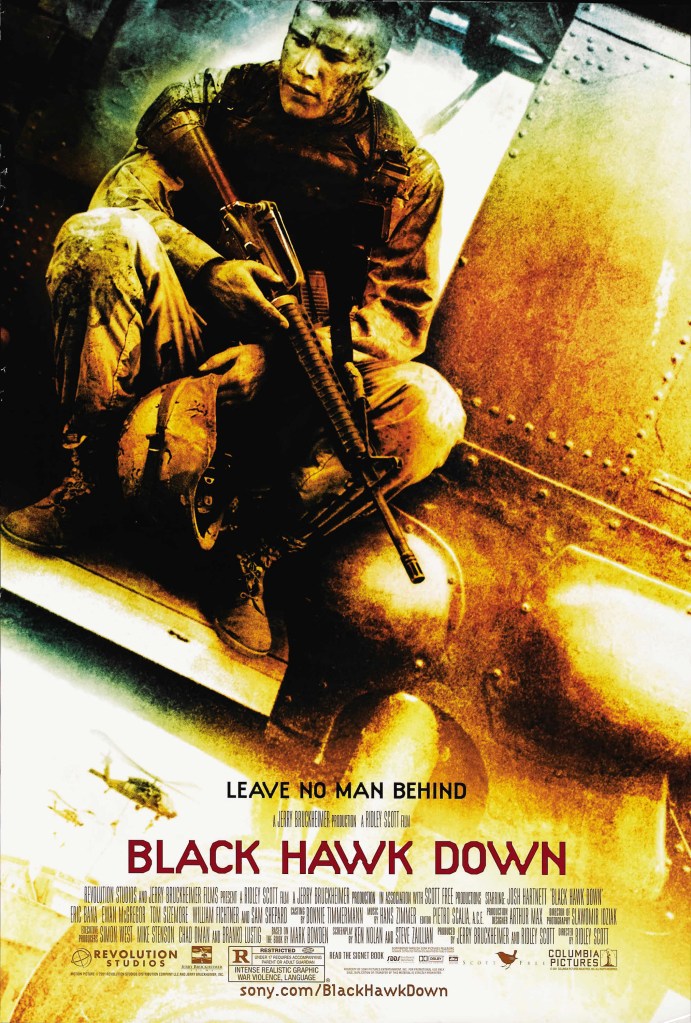
Black Hawk Down (2001)

Ridley Scott’s immersive combat film is politically simple but one of the great combat films

Director: Ridley Scott

Cast: Josh Hartnett (SSG Matt Eversmann), Ewan McGregor (SPC John Grimes), Eric Bana (SFC Norm ‘Hoot’ Gibson), Tom Sizemore (LTC Danny McKnight), Sam Shepard (General William F Garrison), Ron Eldard (CWO4 Michael Durant), William Fichtner (SFC Jeff Sanderson), Jeremy Piven (SW4 Clifton Wolcott), Ewen Bremner (SPC Shawn Nelson), Gabriel Casseus (SPC Mike Kurth), Hugh Dancy (SFC KURT Schmid), Jason Isaacs (CPT Mike Steele), Tom Hardy (SPC Lance Twombly), Orlando Bloom (PFC Todd Blackburn), Nikolaj Coster-Waldau (MSG Gary Gordon), Johnny Strong (SFC Randy Shughart)

On 4 October 1993, the US won a pyrrhic victory supporting UN efforts to prevent genocide in the Somalian Civil War. A mission in Mogadishu to capture the lieutenants of rebel leader Mohamed Farrah Aidid collapsed into a desperate overnight street battle as Aidid’s forces rose up en masse (up to 4,000 of them) in an attempt to cut off and wipe out the c. 160 US troops.

Although the majority escaped, it was one of the most costly American operations since Vietnam, with the loss of 18 dead and 73 wounded and two Black Hawk helicopters shot down. As many as 2,000 Somalians were also killed. Pictures of the bodies of American soldiers dragged through the streets by Somalian rebels led to a major realignment of US foreign policy, with a reluctance to join future peace keeping operations (most notably the Rwandan genocide).

This is bought to the screen in a virtuoso directorial achievement by Ridley Scott, one of the most immersive and gripping war films ever made. Black Hawk Down doesn’t shirk on an inch of the war experience. Combat is loud, sudden, all-consuming and a barrage on the senses. It’s scary, confusing and always unforgiving. Mud, blood and dirt are flung into a camera that runs through streets alongside the soldiers, embedded with them under siege. The slightest lack of focus or mistake is punished by horrific injury or death. The battle is a nightmare of confusion and desperate improvisation in which neither side (especially the Americans) really knows what’s going on.

It’s not surprising they don’t. The film expertly demonstrates how a multi-approach plan (helicopters delivering ground forces, an armed convoy to collect prisoners) was effectively a rashly planned house of cards, which collapsed when the hornet’s nest of an uncontrolled city, crammed with thousands of potential hostiles, roadblocks and a prepared and dedicated enemy (willing to suffer a level of loss the Americans were not) was unleashed. Ground forces are stranded, helicopters shot down, the exposed convoy becomes a slow-moving hospital, all under constant fire in a dusty, urban centre where every single civilian could be a enemy combatant.

Scott shoots and edits this with pulse-pounding intensity, aided by the dizzying camera work of Sławomir Idziak and the high-octane cutting of Pietro Scalia, whose work grips you by the throat and never lets go. It’s a “grunt’s-eye” view of the war, that puts the viewer very much in the trenches with the soldiers. We pretty much join them running through gauntlets of bullets, ducking into foxholes and desperately trying to stay alive. Scott’s work is outstanding here, a brilliant depiction of the chaos of battle in which events are both intimidatingly out of control but also crystal clear to the audience, assembled with a never-lets-up energy leaving the viewer tense and breathless.

As Eric Bana’s fiercely professional Hoot says “it’s about the man next to you”. That’s very much what Black Hawk Down is about. There’s very little context about the American operation in Somalia, the Somalian people, the impact on long-term American politics…  The film believes the whys and wherefores are less important than protecting the lives of your colleagues.

Argument has raged about whether Black Hawk Down is pro-war or not. I’m not convinced it is. Can a film which shows soldiers maimed, disfigured and literally torn in two, really be a celebration of war? But, what it clearly is, is pro-the American fighting man. The training and expertise of these soldiers – trained to make every shot count and keep their cool in terrifying situations – is crucial to their survival. (The scattergun indiscipline of the Somalian rebels is noticeable by comparison – and it’s fair to note that Black Hawk Down gives very little focus to the Somalians at all, other than as a faceless hostile mass).

The film is in awe of the soldiers’ willingness to sacrifice themselves for each other: the dramatization of Gary Gordon and Randy Shughart’s request to be dropped in to provide some sort of cover to one of the downed Black Hawk pilots (a request they know is a suicide mission) exemplifies “leave no man behind” bravery. Black Hawk Down is a tribute to soldiers.

Interestingly though, that also means it’s a film where characters are more important for what they do rather than who they are. We learn very little personal information about any of them. Hartnett’s newly-promoted SSG has sympathy for the Somali people and is nervous about his first command mission. McGregor’s admin officer is unsettled by his first field operation. Sizemore and Isaacs are professional officers, executing orders to the best of their ability; Fichtner and Bana experienced Rangers, samurai trained to adapt and improvise. But their personalities are only hooks to hang their deeds on. Each melts into the large cast as needed. Black Hawk Down is the triumph of the unit – be that fighting together or some member volunteering to die to help protect others.

It is fair to argue the film should have done more to contextualise events. Black Hawk Down focuses so much on celebrating the bravery of soldiers, it skips any political impact: it’s not made clear in the end captions that the US effectively withdrew from its peace-keeping responsibilities for years afterwards (only shocked back into it by 9/11). It never mentions the UN were slow to respond as they had been caught in an almost identical disaster a few weeks before (a lesson the US didn’t bother to learn from). It never mentions the cost of non-intervention in places like Rwanda. It never explores how these events – and American complacency, not least in the committed-but-unengaged soldiers – were a step toward a terrorist world that would culminate in 9/11.

Scott was aiming to make an immersive film. Perhaps his work on films like Body of Lies (and even Kingdom of Heaven) later was about adding more shading and depth to his presentation of world affairs (and critique of American policy). But, in its intent, Black Hawk Down is a triumph, one of the most unrelenting and compelling combat films ever made. You can argue it turns the Somalis into bogey men fighters – but it’s trying (rightly or wrongly) to be a representation of a single military action, from a single side’s perspective. And there is no doubt this is one of Scott’s finest achievements – and one of the great war films.

Oblivion (2013)

Tom Cruise goes all Top Gun (Olga Kurylenko is along for the ride, pretty much all she does in the movie) in would-be intellectual sci-fi thriller Oblivion

Director: Joseph Kosinski

Cast: Tom Cruise (Jack Harper), Morgan Freeman (Malcolm Beech), Olga Kurylenko (Julia Rusakova), Andrea Riseborough (Victoria Olsen), Nikolaj Coster-Waldau (Sykes), Melissa Leo (Sally)

Spoilers: I’m going to discuss the entire content of the plot from the third paragraph. You’ve been warned!

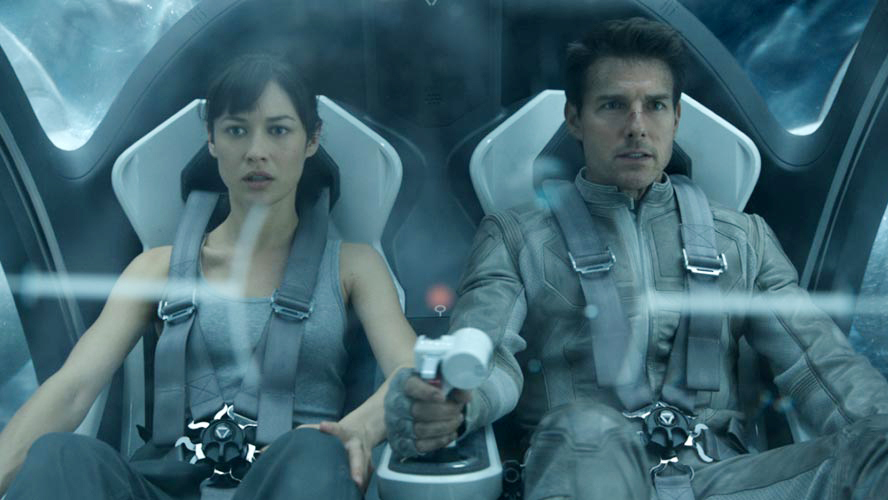
It’s 60 years after an alien attack. The world has been destroyed, cities lie in ruins, and mankind has fled to Jupiter’s moon Titan. Earth is being drained of its last few resources to power the new civilisation on Titan by massive machines. Drones fly around the planet, protecting the machines from the last surviving alien forces still on Earth. The drones are tended by Jack Harper (Tom Cruise) and Vika Wilson (Andrea Riseborough), whose memories have been wiped for security reasons and who are dedicated to keeping the drones functioning. 

Or is this all a lie?

Well it won’t be a huge surprise to hear that it is, of course. And there are some decent ideas in Kosinski’s film: the twist reveal that the organisation Harper and Wilson are working so hard to preserve is in fact the very alien invaders they so hate, or that the strange figures on the planet they are helping the drones to kill are actually the last surviving remnants of mankind. Harper and Wilson are clones of NASA astronauts captured 60 years ago and replicated over and over again in order to serve the robots. The “Tet” in space that they believe is their HQ is the alien mothership. These are all decent twists. So why do they combine together to have so little real impact?

I think it’s because Kosinski rushes the film. He’s so pleased with the narrative rug pulls that he seems to want to reveal many of them one after the other. Additionally, the biggest twist – Tom Cruise is actually working for the baddies! – immediately makes most of the rest easy to predict. Not least the constant references to Base 49 where he and Vika work – sure enough it’s a clone number, so the planet is filled with clones of this pair. The only thing stopping them bumping into each other is that they have been told everything outside of their “patrol zone” is irradiated and they must never enter it. 

All of this world building – and the film does take its time establishing it a piece at a time early on – is interesting stuff. But it loses its way once the film surrenders itself to a string of reveals that overwhelm it. By the time we are watching super-man Jack shooting down drones from his helicopter, the film seems to have lost the more meditative start. With Jack at first we get a sense of a guy longing to find more depth to live with. But the film loses this sense, with Jack become steadily less interesting the more we find out about him.

Then once you accept the idea of Cruise and Riseborough being endlessly cloned, the logic gap starts to click into place. It’s never explained why the aliens are so reliant on human engineers for their drones – if they have conquered loads of planets before without them, why do they need them here? Furthermore, we are told the first wave of Jacks were mindless soldiers who killed everyone on the planet – why then are these engineer Jacks and Vikas given so much independent thought? Why not just make them automatons? Why clone them and then lie to them about who they are working for – why not just program them to obey the robots?

Then after a slow build of questions and revelations about Jack’s world, we get a standard Independence Day style mission up into space to “blow up the mother ship”. Of course this is a mission that only your man Tom can do. And do it he does, because Tom Gotta Do What Tom Gotta Do. It’s all a rather disappointing resolution to a film that toys around with being something a bit more complex and interesting earlier on.

Ah, Tom Cruise. To be honest he’s probably miscast here. There is something so incredibly, movie-star strong about Cruise that he somehow overpowers the shocks and make them seem silly. On top of which, the part is another ego-stroke. Jack is the ultimate man’s man – he fixes things, he loves sports, he builds a cabin in the woods, he’s clearly dynamite in the sack; but he’s also sensitive and caring and in touch with his feelings. On top of which both female characters in the film – Riseborough’s sadly besotted Vika and Kurylenko’s mysterious astronaut who lands on Earth and awakens strange memories in Jack – are both pathetic ciphers who need Tom’s help for everything, while of course also being way, way, way too young for the Cruiser.

But the film still looks good, and still has some very interesting twists. The design and visuals are faultless – in fact they seem to become the main focus, all those long shots of deserted, sand consumed parts of New York. Its main problem is that it’s low on themes – I guess it’s trying to make a case that humanity can’t be bashed out of us, no matter how many times we try and clone it out of someone – but it gets lost a bit in plot mechanics and the delight the director has in executing them. For a film that only really has four characters in it, I still felt they were hazy and undefined. A lot is left to the viewer’s own suppositions, so the film gets pretty reliant on your adding the depth it needs. If you are inclined to do so, this works. But the essential dramatic thrust of the film itself isn’t compelling enough to make you willing to make the effort the film needs.

Oblivion wants to be the next big, thoughtful, twist-filled, sci-fi epic. But it just doesn’t have enough interest and complexity to really engage the viewer. Instead it all becomes a bit forgettable – not because it’s bad but because, at the end of the day, it’s nothing special.

Gods of Egypt (2016)

Just your standard Giant Meets Boy Gets Chased by Female Assassins Riding Giant Worms Story. Really didn’t anyone learn anything from Dune?

Director: Alex Proyas
Cast: Nikolaj Coster-Waldau (Horus), Gerard Butler (Set), Geoffrey Rush (Ra), Benton Thwaites (Bek), Chadwick Boseman (Thoth), Elodie Yung (Hathar), Courtenay Eaton (Zaya), Rufus Sewell (Urshu), Bryan Brown (Osiris)

Oh good lord where to begin. It’s not so much that this is a terrible film – although it is. It’s not offensive or unpleasant. It’s just a film that is almost impossible to take seriously whatever. It’s a fat, bloated, overblown mess where the plot makes almost no sense, the design is totally ridiculous, the acting bored or unengaging, and the directing totally lacking any charisma. It’s a film you can only laugh it, except for the fact that it’s so lamentably badly that it’s not even that funny. There is so little joy in the making of this bloated fart of a picture, that even as a joke it falls flat.

As far as I can tell, in a fictionalised ancient Egypt the Gods live among men. Horus’ coronation as the new king is interrupted by his uncle Set who seizes the throne, removes Horus’ eyes and sets about turning the realm into a dictatorship. He has some sort of overall plan but I’m really not sure what it was. Something to do with immortality or something. The film barely cares so neither should you. Set is a baddie. Horus is supposed to be a goodie, I guess, but he is such a humourless, arrogant, cold and (above all) boring God you probably won’t give a toss about him.

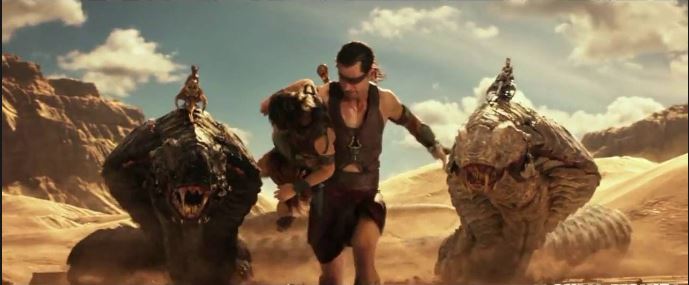
The film is a disaster almost from start to finish. In a decision that guarantees giggles every few minutes, the Gods are all 9 feet high, making the humans look like chippy midgets. Poor forced perspective hammers home this ridiculousness every few seconds. If this didn’t make the Gods silly enough, they also have some bizarre metal “battle modes” they transform into, which along with some piss poor special effects makes them look like refugees from Mighty Morphin Power Rangers. The colours are bright and primary and the sets all have the sheen of CGI, lacking any substance. The design decisions cross swiftly from daring into dumb. If you ever wanted to see a flying chariot pulled by winged scarabs or to see mix and match female hitmen ride giant worms chasing a giant and his normal sized friend, well hallelujah your day has come, this is the film for you.

The script, such as it is, is a loosely connected series of incoherent events. The acting is simply awful. Coster-Waldau completely lacks the big screen presence to carry the movie, his upper crust arrogance from Game of Thrones here comes across as insufferable and dull. Thwaites comic relief is about as funny as a hernia and his quest to save his true love has all the drama of running to catch a bus. Boseman aims for wisdom and grace but delivers camp and affectation in a truly terrible performance. Butler does at least have a bit of charisma, even though Set is such a poorly defined character he’s impossible to get interested in. Various other actors chip in autopilot performances for the cash. The female characters are little more than props. Geoffrey Rush needs a new agent: seriously how much money does he need?

The biggest problem though is it isn’t quite ridiculous, campy or shite enough to be a camp classic. Instead it’s just boring. It doesn’t have the sort of cosmic sweep or visual splendour to give you something to look at. Instead it’s loud, boring and stinks like animal droppings. That’s the worst thing of all: not even as a camp classic will this be remembered. Simply crap.