
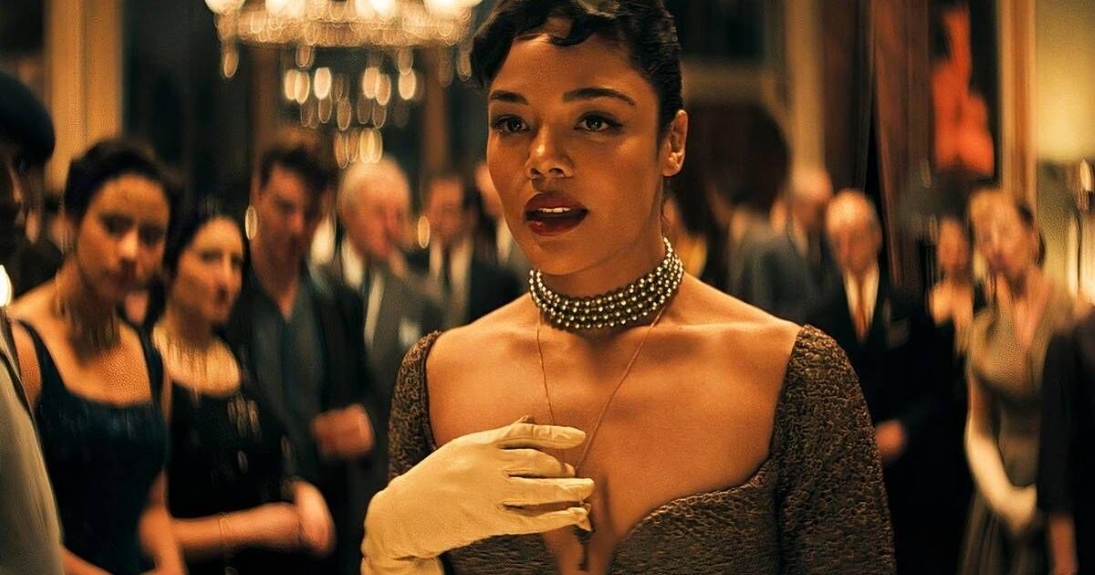
Tag: Nina Hoss

Hedda (2025)

Hedda (2025)

An imaginative Ibsen reworking that works brilliantly in some places but doesn’t make enough of an impact

Director: Nia DaCosta

Cast: Tessa Thompson (Hedda Gabler), Nina Hoss (Eileen Lovborg), Imogen Poots (Thea Clifton), Tom Bateman (George Tesman), Nicholas Pinnock (Judge Roland Brack), Finbar Lynch (Professor Greenwood), Mirren Mack (Tabita Greenwood), Jamael Westman (David), Saffron Hocking (Jane Ji), Kathryn Hunter (Bertie)
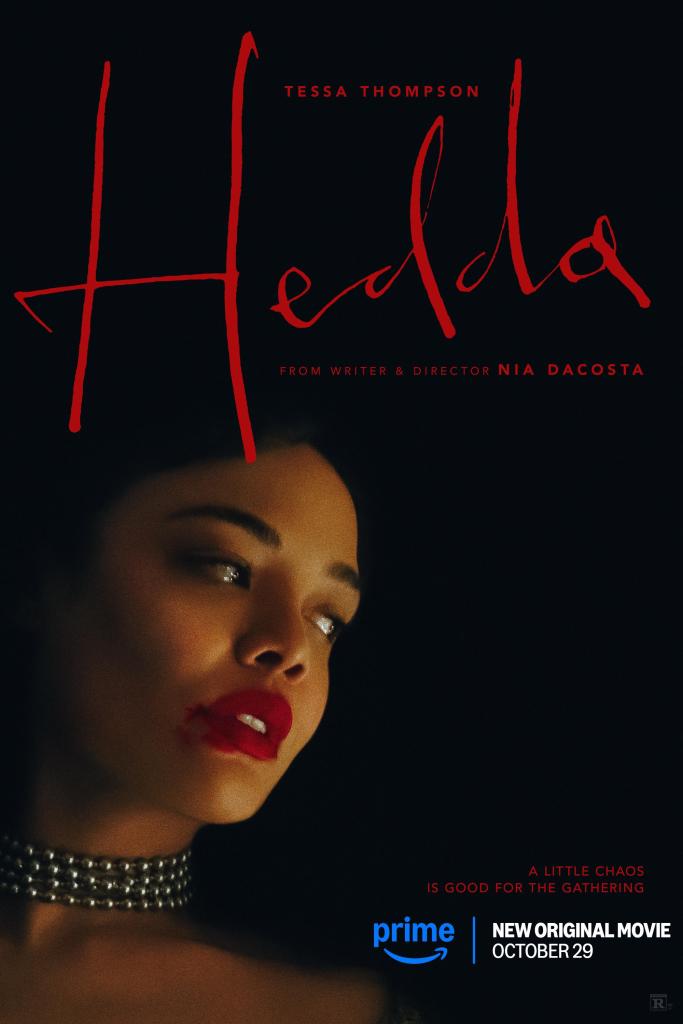
Ibsen’s Hedda Gabler is pretty much the closest you get to a female Hamlet: complex, multi-layered, torn between envy and vulnerability, selfishness and frustrated yearning, independence and stupefying domesticity. y Nia DaCosta’s intriguing adaptation mixes in some fascinating ideas but never quite lands with the force and energy it needs to really impact the audience.

DaCosta moves the action from nineteenth-century Sweden to a house party in 1950s England, in the palatial home of debt-ridden academic George Tesman (Tom Bateman) and his austerely cool wife Hedda Gabler (Tessa Thompson). George is making a desperate pitch for a professorship to repay his debts to sinister Judge Brack (Nicholas Pinnock), who seems more interested in getting payment-in-kind from Hedda.

Hedda affects a distanced, disinterested manner – until the arrival of her old flame Eileen Lovborg (Nina Hoss), with her new partner Thea (Imogen Poots) in tow. Eileen and Thea have written a revelatory new book (currently only one draft copy exists) that places Eileen in the driving seat for gaining George’s professorship. Shaken, Hedda instigates a campaign to destroy Eileen, based either on desperation, deep jealousy or self-loathing, that plays out during the increasingly debauched, night-long party.

There are so many good ideas in Hedda, it’s disappointing that the final product is so curiously uninvolving. DaCosta’s film, sharply directed with a lovely ‘bright young things’ flair mixed with some Du Maurier gothic menace, looks fabulous and confidently mixes intense character study with illicit sex, dramatic gunshots and desperate fisticuffs. The transplanting of Ibsen’s original to a new setting is surprisingly smooth and the idea to compress the whole story (which takes place over a couple of days in the original) to a single night does at points give it a propulsive energy, especially as characters’ inhibitions increasingly fracture under the influence of drink.

The best innovation in Hedda is translating Hedda’s old lover Eilert Lovborg into Eileen. This switch opens up a rich vein of possibilities which the film embraces in its most successful moments. Hedda has turned her back on her own sexuality to claim a place in society: a sexuality Eileen flaunts in front of her male peers, her costuming an intriguing fusing of styles. Hedda’s envy of Thea taking her place now has the double tinge of knowing that Thea – who has left her family and become more of an intellectual partner than Hedda ever was – is also a braver, more committed person than Hedda.

It also blows open even further the cosy, drawing-room, closed-shop nature of this world, where George and the peers he is so desperate to appeal to withdraw to private rooms for clubbable drinks and smutty gossip about girls. Professor Greenwood (a reptilian Finbar Lynch) drags around a trophy wife (Mirren Mack) whom he treats with indifference right up until exploding in fury at her cuckolding him. Judge Brack (a vilely smooth Nicholas Pinnock) alternates between patronising women and looming like a predator over them. George stands out as a genuinely decent man here, respectful of Eileen and uncomfortable with overt masculinity, but even he still sees Hedda’s place as tending to hearth and home rather than a true equal.

This theme of sexual politics comes roaring into life thanks to Nina Hoss’ magnetically charismatic performance, embodying Eileen with a swaggering, intellectual confidence that hides a deeper fragility that’s only just keeping her on the wagon. A wagon she spectacularly falls off (due to Hedda’s prodding) in an attempt to show she can be one of the boys, culminating in an attempt to barnstormingly dominate a room, drunkenly unaware (despite George’s efforts to warn her) that her lake-water soaked shirt is clinging suggestively to her body to the slathering delight of her male audience.

Hoss’ performance is brilliant, collapsing from assured distance, via frantic nervous energy, into wild-eyed desperate vulnerability. Charting an opposite course is Imogen Poots, very good indeed as Thea who feels like one of life’s doormats (not helped by the hideously unflattering dress Hedda insists she wears) but who reveals deep strength of character and determination. The film’s finest sequences revolve around these two, who offer the film’s most intriguing and best-explored modernisation. Credit also to Nicholas Pinnock’s marvellously predatory Judge Brack and Tom Bateman’s decent-but-timid George, a man so sheltered that raucous sex jokes fly obliviously over his head.

It’s unfortunate that the film stumbles more with its portrayal of Hedda. I’m not sure Hedda manages to really grasp the conflicting depths of its lead character. Tessa Thompson gives a committed performance, but it’s hard not to feel the English accent vocally constrains her (why not just let her use her own?) and the film rarely gives her a chance to fully explore the character’s depths. We should feel there is an explosive cauldron of feelings under Hedda’s surface, but only rarely (if at all) does the film ever manage to pierce it, rarely getting to grasp with the character’s conflicting impulses, settling more for an Iago-like drive to destroy, based on jealousy.

Hedda also misses a slight trick, I feel, by not playing up Hedda’s potential outsider nature in 1950s England via her race. (There is a throwaway comment on her ‘dusky skin’, but in a film of colour-blind casting, with the most powerful character played by a Black actor, it doesn’t land.) And making Hedda a bohemian contemptuous of high society doesn’t sit well with her obsession with her father’s status, or her desire to control her high surroundings.

It contributes to a film that never quite manages to come to life as it should, because we never quite understand our lead character, whose coldness and distance extends to us as well as the characters. In a film awash with good ideas, it’s a fatal flaw, and Hedda never quite catches fire emotionally or thematically as it should, because Hedda herself is curiously underserved and under-explored.

PS: Years ago, I played George Tesman in a production of Hedda Gabler where Tom Bateman played Eilert Loveborg. He was (of course!) brilliant, and it was a personal delight to see him as Tesman here (as well as a little odd, I won’t lie!), just one of many perfectly judged performances he’s given in his career.
Tár (2022)

Tár (2022)

Character flaws abound in this intriguing and challenging film, open to multiple interpretations

Director: Todd Field

Cast: Cate Blanchett (Lydia Tár), Nina Hoss (Sharon Goodnow), Noémie Merlant (Francesca Lentini), Sophie Kauer (Olga Metkina), Julian Glover (Andris Davis), Allan Corduner (Sebastian Brix), Mark Strong (Eliot Kaplan), Sylvia Flote (Krista Taylor), Mila Bogojevic (Petra)

Absolute power corrupts absolutely. It’s a maxim humanity manages to prove true, time and time again. It doesn’t matter what the field is, when someone holds sway over the dreams and ambitions of others, there’s a decent chance that power can be enjoyed so much it starts being abused. It’s an idea key to Todd Field’s gloriously complex and challenging Tár, a film that defies easy explanations and characterisations, both frighteningly in the “here and now” but also terrifyingly universal.

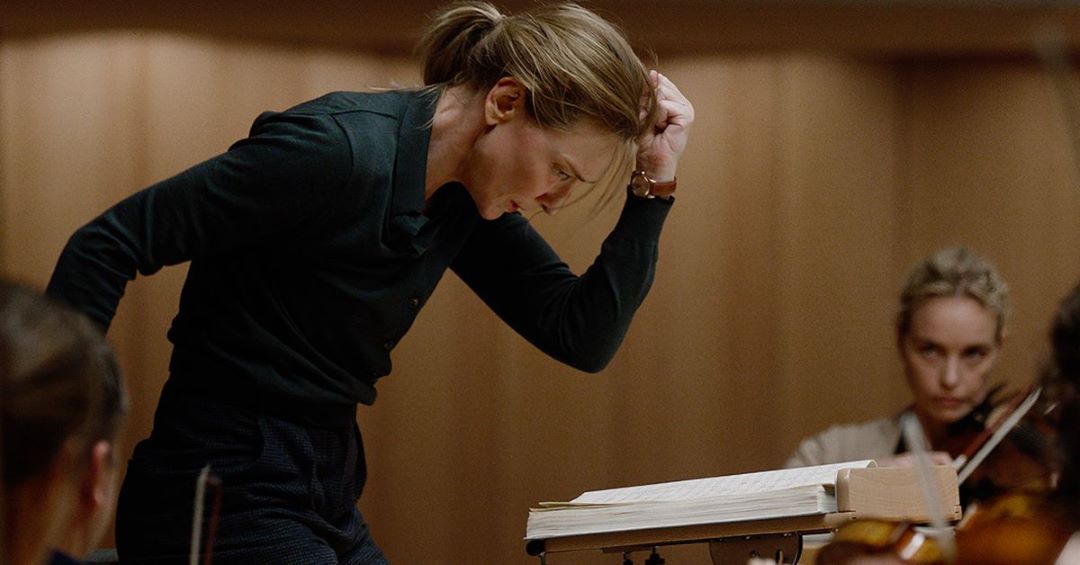
Lydia Tár (Cate Blanchett) is an internationally renowned conductor and composer. The first ever head of the Berlin Philharmonic Orchestra, she lives a jet-setting life of international acclaim and fame, praised at every stop-off for her stunning reinventions of classical music. But dark shadows swirl around her. She plays favourites: and her favourites are always attractive young women, just starting their career, who see her as inspiration and mentor. And Tár? She sees advantages to this. It’s unspoken knowledge to all, from her partner first violin Sharon (Nina Hoss) to the other members of the Orchestra. But as the suffering of one of Tár’s spurned proteges threatens to leak out into the public domain, her empire topples just as she reaches the summit of her career.

Tár is a brilliantly insidious film, a quiet but compelling character study that borrows elements of Kubrickian unknowability. In particular, Field avoids making moral decisions for the audience, but trusts we are smart enough to come to our own conclusions. Effectively, we spend the film following a deeply flawed, Spacey-like figure, whose life falls apart without being invited to feel morally superior to her. It allows us to feel the pain of her meeting the consequences of her actions, but never lets us forget her own arrogance and cruelty caused them in the first place.

Tár is both an inspirational genius and a dyed-in-the-wool bully. She solves problems with the mindset of an aggressive alpha – her solution to her daughter being picked on by a classmate, is outbullying the bully (“I will get you” she tells her, assuring her no one will believe her because Tár “is a grown-up”). She treats her assistant (and possibly former lover) Francesca who tags behind her in the hope of a junior conductor role like a slave, brow-beats Orchestra members and fellow conductors with friendly pressure and views every relationship in terms of what she can get out of it.

As this deeply flawed human-being, Cate Blanchett is mesmeric. Tár is a firm reminder that she is, perhaps, the greatest actor in the world and all her range is on show here. Blanchett is imperious, assured and totally brilliant. She invests Tár with such – admittedly deeply flawed – humanity, we have to constantly pull ourselves up to remember she’s a dreadful person. Tár is arrogant, convinced of her own genius and sees no-one as her peer. She’s also inspirational, charismatic and oddly charming. Blanchett’s mixes tragedy, grief, denial, panic and bottomless bitterness as Tár’s carefully constructed life falls apart like a time-delay car crash that suddenly jumps back into normal time.

Carefully paced – it’s difficult not to reflect on Tár’s opening words at a career retrospective interview on the importance of timing to give each moment its precise impact – Tár never rushes, unless it needs to and slowly, but assuredly unfolds the final days of her empire. It’s like watching the Indian Summer of an Astro-Hungarian Emperor, barely aware that huge global forces are about to sweep everything away and rob her of her control of events. Field reflects this in the film’s assembly: earlier sequences are marked by their long takes – virtuso set-pieces for Blanchett – and tracking camera, that constantly centres Tár. Later sequences become shorter, choppier, narrative information becomes less clear – it’s like Tár has lost control of the film as much as she has her life.

Control is central, and Tár’s abuse of it her undoing. Her (unspoken but implied) predatory demands for sexual favours in return for career advancement are an open secret among colleagues. Field adds a threatening sense of Tár being watched – either recorded on a phone, or shots of the red-haired back of a mysterious woman at key moments. The woman is Krista, a former protégé, the exact nature of her fall-out with Tár unclear, but who Tár has black-balled in the classical music world. Even as the fallout from this threatens to consume her, Tár can’t help herself from attempting to groom a new cellist (Sophie Kauer), fixing a blind audition, favouring her in private workshops and bypassing the orchestra’s new cellist to land her a juicy lead.

It’s part of Field’s wonderful and searching analysis of the corruption of power – even as the house of cards totters, people can’t seem to see it. While being a universal parable, the film is also fiercely topical. Tár has clear parallels with figures like Spacey. Her ageing former mentor (a crisp Julian Glover) bemoans how the slightest mistaken word to someone can be misinterpreted as lecherous abuse. Attention has focused on the idea of this as a cancel culture movie. Tár, at a Juillard lecture, does strongly disagree with a young BIPOC composer, who can’t relate to cis-gender old white guys like Bach. Tár pushes the rather self-righteous young man to justify himself, which he attempts. But she also goes increasingly further and further, moving from persuasion to brow-beating (her natural resort as a bully) and thinly veiled mockery. She’s smart enough to deconstruct the contradictions in the young man’s views – but cruel enough to mock his bravery at standing up. But Field allows both sides legitimate points, something that you don’t nearly get enough of in our polarised world.

Field also tips Tár more and more into something unsettling and other worldly. Tár’s uniquely perceptive hearing means she is plagued with strange noises: a chiming echoing around her bolt-hole apartment (the reveal of what this is, is another reminder of her indifference to other people), a screaming heard while out running, a metronome that wakes her at night. Strange daydreams, with ghostly, vampiric presences fill her mind. Late, she enters a damp-soaked abandoned building which feels like the gateway to some Lynchian parallel universe, guarded by a Tarkovsky-like dog who might as well be the gatekeeper to her nightmares. Much of the final act of the film unspools like a wild, terrible dream, where key events may not even be real. Reality crumbles, just as Tár’s control over her personal and professional life disintegrates.

Through it all we are invited by Field to empathise, but not sympathise, with this demanding and domineering woman. To understand her, but not forgive her, to dislike her but not tar and feather her. A lesser film would have done the moral work for us. Nothing is explicit about Tár’s cruelty, but the tears of her assistant (a superbly fragile Noémie Merlant) and the tight-lipped frustration of Sharon (Nina Hoss is terrifically pained and long-suffering in a difficult role) speak volumes. But yet, it’s hard not to feel something for someone as their life falls apart, no matter how earned the fall might be. Blanchett uses all her skills to make Tár someone who is frequently awful but never a bogeyman, is categorically in the wrong, but still a figure of hubristic tragedy.

Blanchett is earth-shatteringly good in the lead role and Field’s direction is subtle, balanced and plays just enough with your perceptions. Perhaps some of what we see takes place in Tár’s nightmares, perhaps we only see certain characters from Tár’s biased perceptions. It could even be a fabulous ghost story with past misdeeds haunting the frame, a deconstruction of our willingness to pull down the flawed, a study of the abuse of power – or all three and more. The fact you will debate it for weeks to come, means it’s definitely a great film.