Tag: Oskar Werner

Decision Before Dawn (1951)

Decision Before Dawn (1951)

Tense war drama finds sympathy for the enemy, in an over-looked war film

Director: Anatole Litvak

Cast: Richard Basehart (Lt Dick Rennick), Gary Merrill (Colonel Devlin), Oskar Werner (Corporal Karl Maurer “Happy”), Hans Christian Blech (Sgt Rudolf Barth “Tiger”), Hildegard Knef (Hilde), Wilfried Seyferth (Henitz Scholtz), Dominique Blanchar (Monique), OE Hasse (Oberst von Ecker), Helene Thimig (Paula Scheider)
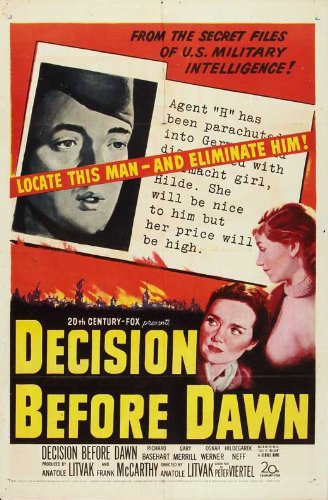
Decision Before Dawn tends to be remembered – if it is remembered – as an aberration in Hollywood history, one of the few films to receive only one nomination other than its Best Picture nod – with that nod generally put down to excessive Fox executive lobbying. I’d heard it described as a ‘fairly standard World War II film’ and expected it to be pretty disposable. But I guess I should have looked into things more: no less a director than Stanley Kubrick called it a hidden gem, claiming to have seen it five times. After a viewing, it’s hard not to think he might be right.

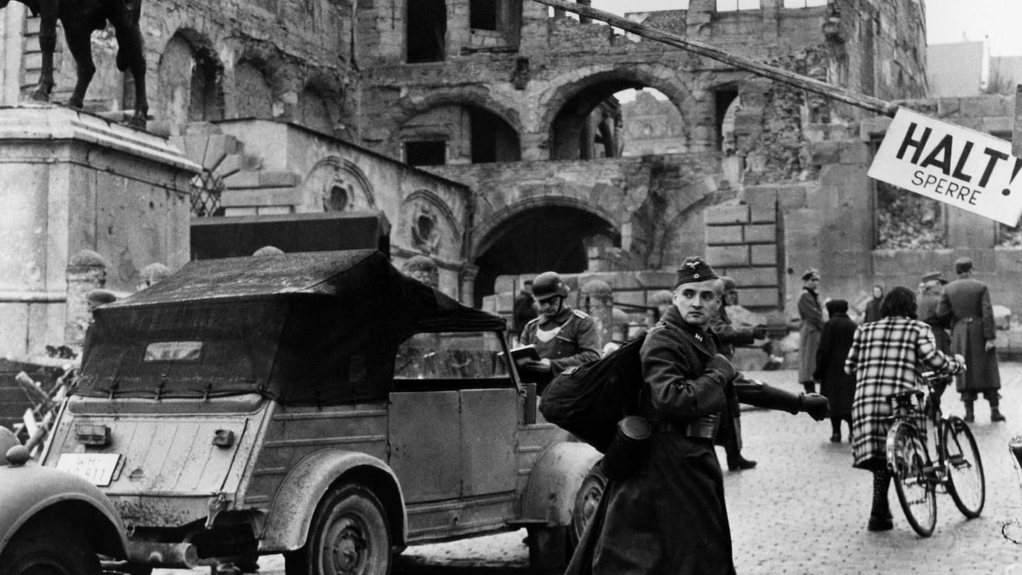
It’s a real, peeled-from-the-headlines tale. Shot entirely on location in Germany, in the very cities its characters are travelling through, still the bombed-out wreckage sites they were in 1944. With the assistance of (what was still then) the Occupying Powers, Fox and Anatole Litvak (himself a one-time refugee from the Nazis) recreated, to an astonishingly convincing degree, war-torn Germany six months before the death of Hitler, on locations littered with Germany military equipment. Everything in Decision Before Dawn feels astonishingly real because it largely is. When “Happy” tumbles through a bombed-out theatre or walks through bedraggled factories and grand houses converted to military bases, that’s the real thing.

Alongside this visceral sense of realism, is a surprisingly mature message. Helped by the presence of several German ex-pats, Decision Before Dawn casts a sympathetic eye over the Germans at a time when most of viewers would probably echo the initial sentiments of Richard Basehart’s scornful Lt Rennick: ‘they’re all just Krauts’. Rennick’s is part of an intelligence unit, tasked with ‘flipping’ German POWs and sending them back into Germany. Their two latest recruits couldn’t be more different: cynical Sgt Barth aka Tiger (Hans Christian Blech) motivated by earning a quick buck and thoughtful Corporal Maurer aka Happy (Oskar Werner) who believes Germany can only be saved when the madness of Nazism is defeated.

It’s Happy we follow when, after his recruitment, he is parachuted back into Germany and instructed to find the location of the XXth Panzer corp, while Rennick and Barth land further West to locate, and arrange the surrender of, a Wehrmacht Army Unit. Decision Before Dawn has already spent its opening act humanising erstwhile opponents via Happy. Happy is honest and principled with a strong sense of morality. He won’t lie to please his captors but he also won’t countenance the blind loyalty or bitter cynicism of his fellow prisoners. He is brave enough to save his country by ‘betraying’ it.

And it’s through Happy’s eyes we also see Germany. Many of his fellow POWs have no real love for Nazism; far from slathering fanatics, they are just guys knuckling down, wanting to stay alive. Behind-the-lines in Germany, the people Happy meets on his journey are striking in their everyday ordinariness. Decision Before Dawn’s most compelling sequences follow this ‘Pilgrim’s Progress’ through the Reich, where episodic encounters mix with moments of panic and terror as a Gestapo net draws tighter.

The only two true believers he encounters are a glasses-wearing (it still loves some of the cliches) relentless Gestapo officer, and a Hitler Youth kid who still swallows true loyalty to the Fuhrer because he doesn’t know anything else. The others, by and large, are ordinary people trapped in a nightmare, trying to carry on. From a senior officer who reluctantly executes a deserter days before he knows the army will surrender to a depressed widow trying to make a living turning tricks. They are among a parade of regular citizens who, other than that fact they are commuting through a war zone, could be no different from Americans in their everyday concerns.

This places much of the film’s success on the shoulders of Oskar Werner, making his English-language debut. Werner, himself a deserter opposed to Nazism, brings the role a quiet, deeply affecting sincerity, expertly breathing life into a man who lives by his own firm moral code. ‘Happy’ deplores the taking of life but will do so if there is a reason: that won’t involve poisoning a colonel or standing by during the lynching of a POW by his fellow prisoners, but he will turn a gun on a direct threat. Werner makes him a thoughtful, compassionate man while giving him a strong streak (a Werner speciality) of in-built martyrdom, that a feeling he is too strait-laced and honourable for this world.

By making our hero a German – and the character we follow for almost the whole movie (despite Basehart’s top billing) – Decision Before Dawn is invites it’s American audience to emphasise with the enemy. To learn, alongside Rennick, that they are not ‘all Krauts’ so that we and Rennick can both be appalled by the unfairness when a Corporal mutters this at the film’s. That’s quite a thing for an American film, a few years after the war. By giving us handsomely staged spectacle centred around a man most of the audience were primed to expect to turn traitor, rogue or coward is no mean feat.

Of course, not every German can be good. The other potential recruits (one of them a young Klaus Kinski) are not a promising bunch and ‘Tiger’ (a fine, weasily performance by Hans Christian Blech) is betrayed as selfish, cowardly and perfectly happy to sacrifice anyone and everyone around him to ensure his safety. Litvak’s film does acknowledge it’s easier for the Americans to relax their feelings for the Germans than many of the other nations of Europe. Dominique Blanchar’s OSS officer makes it perfectly clear that, while she likes ‘Happy’, she’s still a long way from every imagining a relationship with a German of any sort.

Decision Before Dawn is well-directed, Litvak easing expert tension behind-the-lines and wonderfully shot among the ruins of Germany. Its final resolution may seem a little pat and obvious – and Basehart’s Rennick is such a terminally dull character I can only assume a host of more famous actors turned it down – but there is a lot of rich, fascinating tension and excitement here. Putting it frankly, Decision Before Dawn is a very pleasant surprise: a unique and mature war film that deserves far more recognition.
Jules et Jim (1962)

The film that launched a thousand menages: Jules et Jim

Director: François Truffaut

Cast: Jeanne Moreau (Catherine), Oskar Werner (Jules), Henri Serre (Jim), Vann Urbino (Gilberte), Boris Bassiak (Albert), Marie Dubois (Thérèse), Michel Subor (Narrator)

Of all the films of the French New Wave, Jules et Jim was the one that really captured the global imagination. Its success rode came not only from its embracing of the new French style, but also from the way it captured some of the mood starting to build across the world in the 1960s. Truffaut’s third film, it turned its then 29-year-old director into one of the most renowned directors in the world. Filmed with verve and imagination, it still holds up brilliantly today as well.

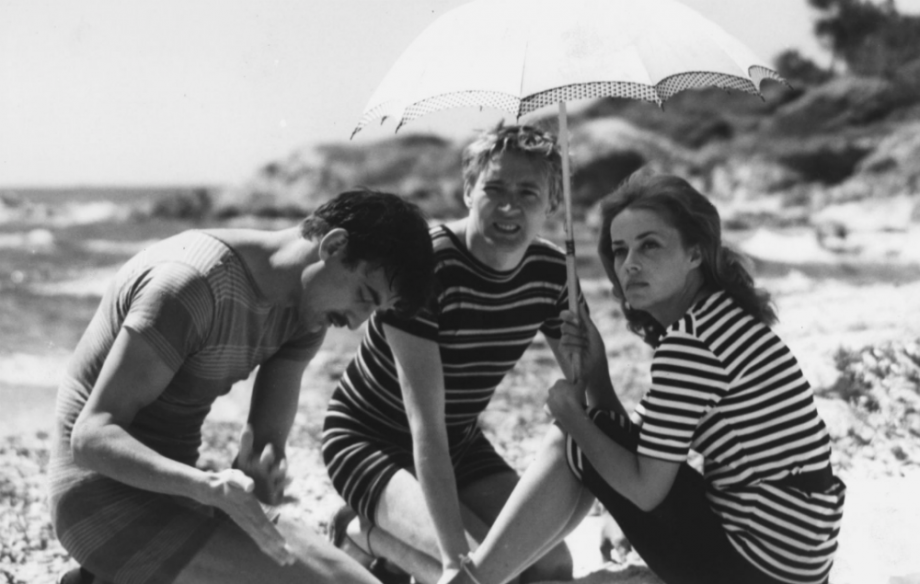
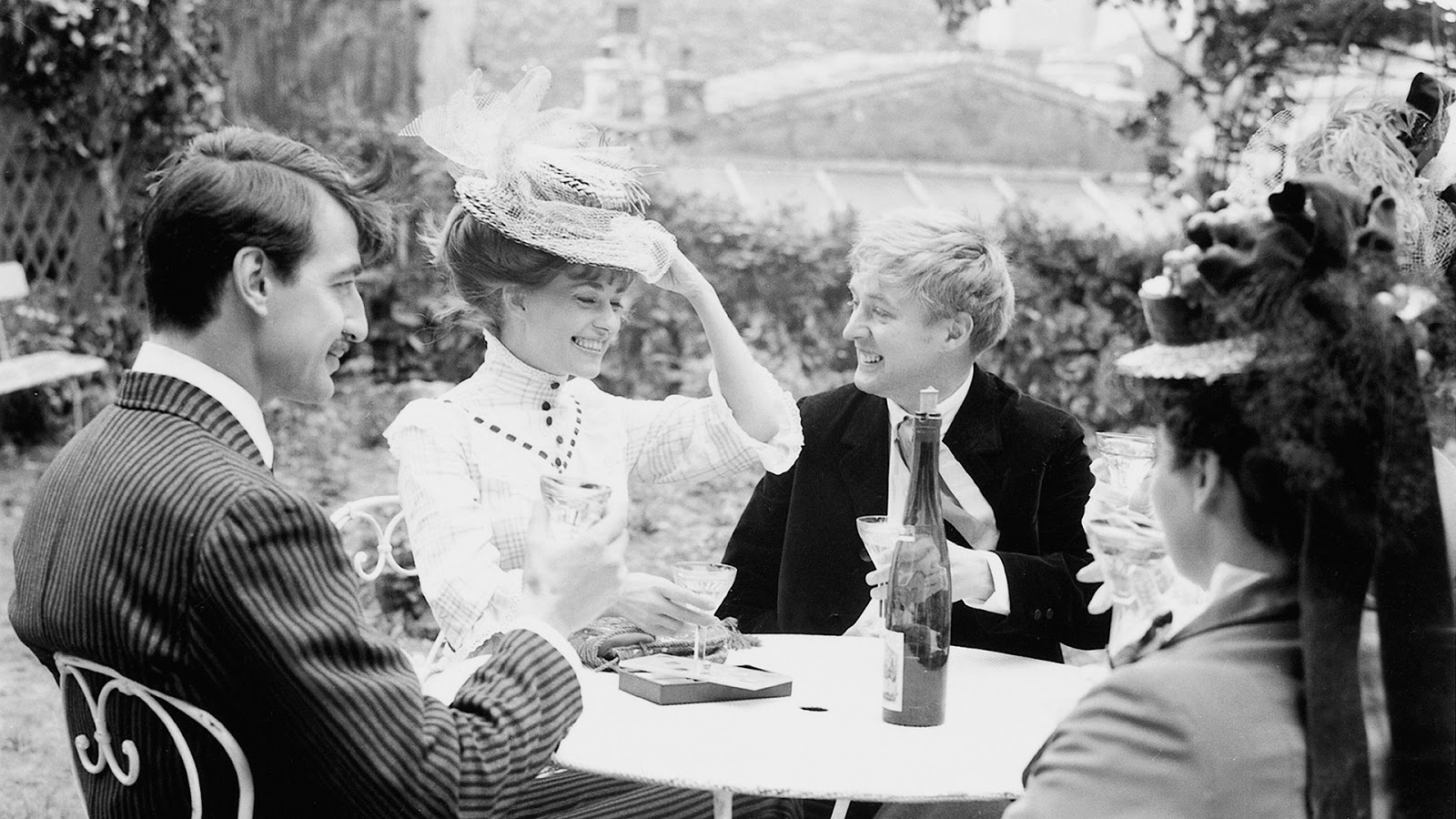
In Paris in the years before the First World War, French bohemian Jim (Henri Serre) and shy Austrian writer Jules (Oskar Werner) become best friends. They share everything – the arts, sport and occasionally women – and the bond between them is unshakeable. When both men meet Catherine (Jeanne Moreau), a free-spirited, extremely bohemian young woman, they both fall in love – although the infatuated Jules is the first to admit it. Both men fight for their countries in the Great War and return to civilian life: Jules marries Catherine and they have a daughter. But home life cannot keep Catherine bound down, and a visit to Jim throws the three of them into a curious but warm menage-a-trois. But can such bliss last forever?

Truffaut’s film is playful, vibrant and overflowing with style. While other French New Wave films prior to this had focused on sending the camera out into the streets and capturing the lives of everyday Parisians, Truffaut’s film mixes this with period trappings. Utilising the dynamic camera work of his peers, Truffaut throws in carefully selected newsreel footage and still photography. But all this material is edited with modern forcefulness, Truffaut using a range of freeze frames, wipes, dolly shots and several other editing and camera tricks to make this period story feel astonishingly fresh. The film is fast paced and brilliantly made, and Truffaut’s camera roves like an engaged but playful observer – a feeling added to by the use of a subtly wry narration.

According to legend, Truffaut found a copy of Henri-Pierre Roché’s semi-autobiographical novel in a charity bin and fell hard for the book. It’s a mark of Truffaut’s ability to judge the time he lived in, that he saw how clearly this story of bohemian free love in the 1920s would speak so strongly to the atmosphere of the 1960s. It’s a story that feels more dated today – and at times it’s hard not to feel a little bit annoyedby the very knowing, arty, exhibitionism of its characters, and the way they are very consciously living life as a performance – but it chimed like a bell back then. And the slight air of artificiality about many of the characters throughout gives even more of a jar of real emotion when they respond naturally to tragic and upsetting events.

Truffaut’s film – blessed with a simply sublime score from Georges Delerue, which captures the tone of the film perfectly – becomes a brilliant exploration of the freedom and imprisonment that comes from living your life for every new experience, and never settling. All three of the characters, to various degrees, refuse to settle for convention but are constantly striving for a marvellous new experience. Even the character least affected by these feelings, the more sensitive and weaker Jules, is willing to adapt and change his life constantly just so he can remain part of this circle and keep Catherine (with whom he is besotted) in his life.

Ah yes Catherine. Jeanne Moreau gives the sort of performance here that seems to define an entire generation. Again, today, Catherine’s constant striving for new experiences and addiction to the buzz of infatuation comes across at times as (to be honest) selfish. But she is also an electric figure, overflowing with life and joie-de-vivre. Moreau’s every scene is breathtakingly eye-catching – and Truffaut recognises this with carefully timed freeze-frames where the camera seems to soak in her beauty and dynamism as much as Jules and Jim. Moreau’s performance is truly iconic, like a force of nature, almost impossible to categorise – she is loving, selfish, brave, scared, flirtatious, bashful – and impossible to repeat.

It’s also clear why someone as unpredictable and all-consuming as Catherine gains the ever-lasting devotion of two close friends. Truffaut brilliantly captures both the hopeless devotion of these two men to this woman, and also the slight tinge of unspoken sexual bond between each other. Both men delight early in the film in each other’s permanent company, of this fact being recognised by all, and write each other poetry and stories. The film implies the fascination and longing both men have for Catherine, but also suggests that the strongest, most lasting bond is the one between the two men. Perhaps it is this that makes them so willing to settling into their menage – and certainly why, as Catherine’s interest in first one then the other waxes and wanes, it is each other’s company that they start to long for.

Of course that doesn’t mean that Jules doesn’t stay devoted to Catherine, a woman who gives him days of sunshine mixed with weeks of polite warmth. Oskar Werner is brilliantly sweet, gently naïve and vulnerable as Jules, filled with wit and tenderness but one of life’s passengers. He’s a man who follows rather than leads, or moves between the two other people in his life following the lead of first one or the other. The stronger willed Jim, played with a hardness and worldly realism by Henri Serre, is the one who both has the strength of character to hold Catherine longer and the will to turn away from her (even if for a short time).

The first half of the film is a marvellous explosion of relaxed joy, of pre-war innocence and youthful exuberance. It’s truly a young person’s film – and Truffaut’s  dynamic filming, inventive framing and giddy editing really captures this – and the film progresses much as life does into a middle age still clinging to the freedom of youth (like Europe attempting to recapture the innocence before the Great War) before beginning the descent towards the horrors to come of the 1930s. The film’s tragic conclusion has the sadness of a world lost, touched with the ridiculousness that seems inevitable for its exhibitionist characters. It makes for a marvellous and breathtakingly giddy ride, that (even if it looks at time dated in its very 1960s vibe) still carries a great deal of delight, joy and above all fun. Truffaut’s greatest achievement and most famous film still makes for a quite a calling card.

The Spy Who Came In From the Cold (1965)

Richard Burton lands in Cold War trouble in classic Le Carre adaptation The Spy Why Came In From the Cold

Director:  Martin Ritt

Cast: Richard Burton (Alec Leamas), Claire Bloom (Nan Perry), Oskar Werner (Fiedler), Sam Wanamaker (Peters), George Voskovec (East German Defence Attorney), Rupert Davies (George Smiley), Cyril Cusack (Control), Peter van Eyck (Hans-Dieter Mundt), Michael Hordern (Ashe), Robert Hardy (Dick Carlton), Bernard Lee (Patmore)

Spy stories fall into two camps. You get the wham-bam blast of James Bond and then you also get the grimy, isn’t-this-a-damn-dirty-trade stories that John Le Carré helped to turn into a major alternative. The book that really kicked off Le Carré’s career was The Spy Who Came in From the Cold, a slim, brilliantly written story of spies working exclusively in shades of grey. The book was a smash, the film was inevitable, and a damn fine film it turned out to be.

Richard Burton plays Alec Leamas, a former head of Berlin Station for the British Secret Service, who is recruited by the services’ leader Control (Cyril Cusack) as part of an elaborate scheme to discredit the cunning and dangerous head of the Stasi office in Berlin, Hans-Dieter Mundt (Peter van Eyck). Leamas will go through a pretence of disgraced dismissal, alcoholism, jail time and half a dozen other indecencies to attract the attention of the East German defector recruiters in the UK. But will the relationship he develops during his disgrace with librarian and idealistic communist Nan Perry (Claire Bloom) endanger the whole mission?

The Spy Who Came in From the Cold is shot in a grimy, gloomy black-and-white which is completely appropriate for the morally questionable escapades its characters get up to. Like Le Carré’s novel, the ends justify any means here, and questions of morality and justice are best benched. Characters who can’t let themselves to forget justice are doomed in this film. Genuine shows of real emotion and feeling are generally signs in this film that a person is doomed.

Martin Ritt’s literate script captures the style and tone of Le Carré extremely well – this is still one of the best, truest and most faithful capturing of Le Carré on the screen – and his direction also has a wonderful mixture of shabby kitchen-sink realism and classic Hollywood film noir class that makes for a brilliantly involving package. The pace of the film holds pretty well, beautifully carrying us through a parade of agents recruiting Leamas for the East Germans (each of which are dismissed with a shocking curtness by the next one along), and the final court room trial of Mundt (with its intricate exploration of the complex plotting of the novel) is extremely involving.

The film also has the benefit of a number of terrific performances, led by Richard Burton in the lead. By this stage of his career, Burton was already felt by many to be lost to serious acting in favour of big budget, Liz Taylor-starring pictures and Hollywood entertainment. But he rouses himself here to give one of his best ever performances. Leamas is a shabby, beaten down, little man (despite being played by Burton!) whose chippiness, dissatisfaction and aggression make him perfect as a possible defector. Ritt’s camera often focuses on Burton’s unflinching stares, his eyes seem to bore into the person he’s talking to, little oceans of anger and resentment.

Burton’s Leamas is deep down sick and tired of the world of spying, its betrayals and lies, and sickened with self-disgust at his own involvement in it. Burton skilfully underplays the role throughout, largely ignoring any temptation for grandstanding or big acting moments – instead he is as compromised, grey and lost as the rest of the film, in a superb performance of cynical disaffection. Bunched up, his grand voice dialled down, his eyes flickering with resentment – a great performance.

Claire Bloom is rather affecting as Nan (hilariously, her name was changed from Liz in the book as the producers feared she would be confused with the rather more famous Liz in Burton’s life) and Oskar Werner gives the film a major burst of energy just as it is flagging from one interrogation of Leamas too many, as a chippy, eager, sharp Stasi officer, who is determined to see justice done. The rest of the cast are filled out with some classy Brit character actors, who excel from suave (Robert Hardy) to seedy (Michael Hordern), while Cyril Cusack brings “Control” to cynical life and Rupert Davies gets to the be the first actor to play George Smiley on screen (even if he is only really an extra here).

Spy is a film of atmosphere. Frequently it trusts the viewer to catch up the plot as they go. Leamas actions are not always explained until late on – and we are constantly suspecting that we are only seeing half the story. Its a film that plays its cards close to the chest. This might alienate some, but it’s a true representation of Le Carre – and fits perfectly with the weary sense Leamas has of not being in control of his own life.

But what Ritt does so well is keeping that tonal sense of there always being another shady, compromising twist around the corner. All is never what it seems, and the film ends with an especially bleak series of footnotes as we find out just how ruthless both sides are prepared to be in this soulless chess game of Cold War politics. It’s the moments like this that Spy Who Came in From the Cold really nails. For Le Carré fans the film is a must: for those less interested in the world of espionage, they may find it takes a little too much time.

Ship of Fools (1965)

Simeone Signoret and Oskar Werner are just part of the kaleidoscope of humanity in Ship of Fools

Director: Stanley Kramer

Cast: Vivien Leigh (Mary Treadwell), Simeone Signoret (La Condesa), José Ferrer (Siegfried Rieber), Lee Marvin (Bill Tenny), Oskar Werner (Dr Wilhelm Schumann), Elizabeth Ashley (Jenny Brown), George Segal (David Scott), José Greco (Pepe), Michael Dunn (Carl Glocken), Charles Korvin (Captain Thiele), Heinz Rühmann (Julius Lowenthal), Lilia Skala (Frau Hutten), Barbara Luna (Amparo), Christiane Schmidtmer (Lizzi Spokenkieker), Alf Kjellin (Freytag), Werner Klemperer (Lt Huebner)

Stanley Kramer was the man who went his own way in Hollywood. Struggling to find work after returning from the Second World War, he set up his own production company which quickly specialised in critically acclaimed “message” films. It’s the sort of film making that hasn’t always aged well. Kramer’s style hasn’t often either – even at the time he was seen as achingly earnest and worthy. Ship of Fools was the sort of perfect project for him: a massive best-selling novel about a huge subject, humanity itself. It was about big themes and it felt really important. It was perfect Kramer material.

In 1933, a ship sails from Mexico back to a newly Nazified Germany. On board, the passengers and crew blithely continue their own personal dramas and obsessions – it really is literally a “ship of fools”, as we are informed in the film’s opening by wry observant German dwarf Carl Glocken (Michael Dunn) who serves as an occasional chorus. On board: a faded Southern Belle (Vivien Leigh) desperate to recapture her youth; a failed baseball player (Lee Marvin) bitter that his career never took off; a young artist (George Segal) intent on only drawing serious subjects to the frustration of his girlfriend (Elizabeth Ashley); a bigoted, bullying Nazi (JoséFerrer) trying to start an affair with an attractive younger blonde (Christiane Schmidtmer); a Jewish jeweller (Heinz Rühmann) who thinks the Nazi party can’t be that dangerous; and ship’s doctor Willi Schumann (Oskar Werner) who finds himself increasingly fascinated with La Condesa (Simeone Signoret), a drug addict and a social campaigner being transported to prison in Spain. Truly, the whole world is on board this boat! (Or so you can imagine the poster saying).

The success of the individual moments in Ship of Fools rise and fall depending on the level of engagement you feel in each of these stories. It’s a curious mixture of tales, some of them dancing around deeper meanings, some playing like dark farce, some plain self-important rubbish. What’s abundantly clear is Kramer feels this is all leading towards meaning something, though whether he gets anywhere near expressing what this something is really isn’t clear. In fact the only real categorical message I could take about this is that humanity has a tendency to fiddle whole Rome burns – and that of course the Nazis are bad. 

There is an attempt to suggest a world in microcosm – and some have argued that the smorgasbord of characters are basically like facets of one person’s personality – but really what many of these stories are deep down are soapy pot-boilers, brought to life by good writing and fine acting. Kramer marshals all these events with a professional smoothness: there is something quite admirable about the fact he clearly sees the director’s role as more like a producer’s, someone there to service the story and actors more than to cover the film with flash. It might not make for something compellingly visual, but it is refreshing.

What Kramer is less successful with is the heavy-handed importance the film gives its serious moments. Most infamous is a moment when Glocken and Jewish trader Julius Lowenthal are sitting on the veranda, listening to the band while chatting about current affairs in Germany. “There are nearly a million Jews in Germany. What are they going to do? Kill all of us?” Julius jovially states – the band music obviously ends the second he stops speaking, filling the screen with a chilling silence. It’s the sort of moment that is supposed to make us feel the chill of the oncoming storm – but instead feels manipulative and portentous. Every moment like that lands in the same way – the film is delighted with its exploration of these shallow people, very pleased with knowing the Nazi destruction is on the way. 

This self-important bombast dates the picture more than anything else in it. Nothing dates as badly as pretension. It’s a film that feels like it’s been made very consciously to make you think, and which wears its attempt to capture every level of society – from poor Spanish workers to rich Nazis – very heavily. It also makes obvious points: naturally the only true act of self-sacrifice comes from a poor Spanish worker, while the rich passengers can scarcely look past their own concerns. 

When it isn’t being self-important, the film too often finds itself mired in soapy rubbish. The plotline featuring George Segal as a failing artist and Elizabeth Ashley as a frustrated girlfriend is tedious beyond belief, a slog through the worst kind of coupley drama that adds very little to the film. A further plotline around the companion of a wheelchair-bound intellectual, obsessed with an exotic dancer on the ship, could sit just as easily in Coronation Street as it could in a highbrow drama like this.

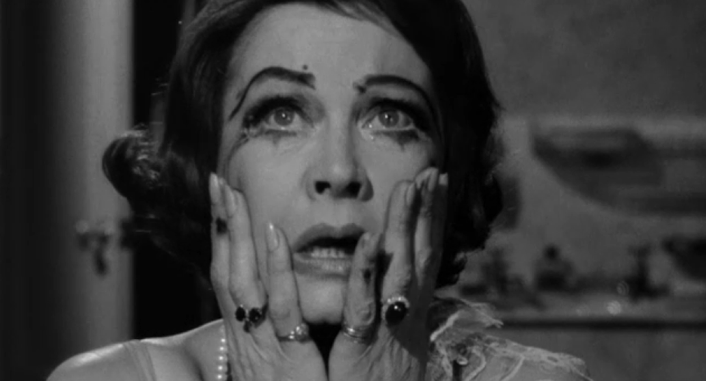
Despite all this, I have to say much of the acting is very strong – even if many of the actors are cast very much to type. Vivien Leigh, in her last performance, struggled with immense psychological difficulties during shooting, but brings a heartfelt realism to divorced Southern belle Mary Treadwell (an even more heartfelt version of her Blanche DuBois than in Streetcar). Kramer also allows her one of the film’s few moments of imaginative spontaneity when she suddenly bursts into a Charleston before stumbling back to her hotel room. 

Carrying a lot of the film’s emotional weight are Oskar Werner and Simeone Signoret (both Oscar nominated) as an unlikely romantic coupling. Werner brings great depth and sadness to the world-weary doctor who finds himself irresistibly drawn to Simeone Signoret’s Countess. Signoret channels her distant, fragile imperiousness from Les Diabloques and Room at the Top to marvellous effect as a woman struggling with an indolent drug addiction but who feels a genuine responsibility to the world. The quiet scenes between these two are the closest the film gets to touching some distant meaning, even if it never quite gets there – and again the points deep down are fairly straight forward.

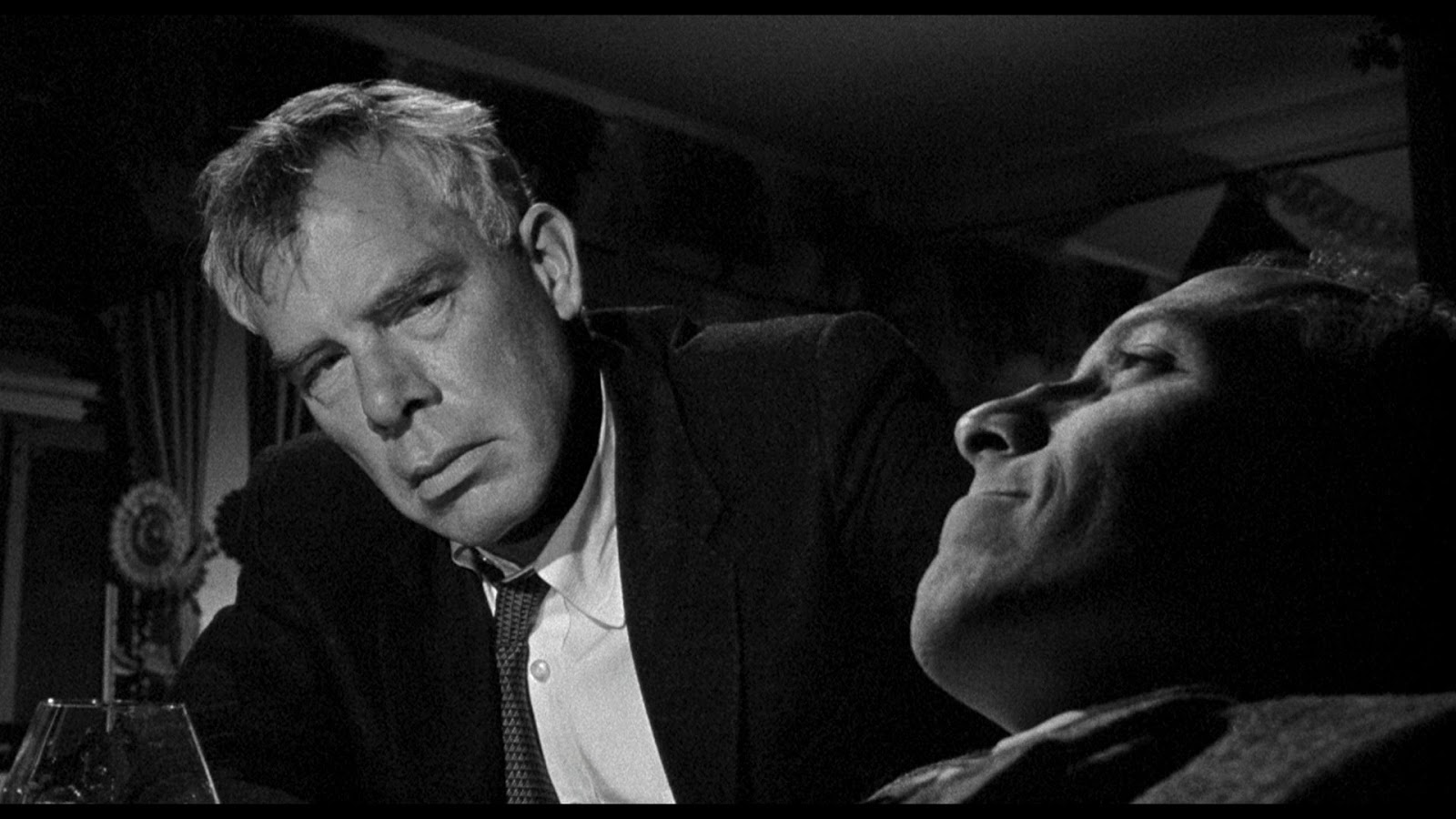
For the rest of the cast, there is hardly a weak link. Heinz Rühmann, in his only English-speaking role, campaigned heavily for the role of Jewish trader Julius and he is magnificent. José Ferrer swaggers convincingly as bullying Nazi Siegfried, even if he is saddled with the most obvious, poorly written, character. Michael Dunn (also Oscar nominated) makes a lot of his role as charming chorus and commentator. Lee Marvin is terrific as the frustrated and bitter baseball player. Charles Korvin gives a lot of depth to the thoughtful and compassionate captain.

Ship of Fools has plenty of moments of enjoyment. But as a whole it’s always a little self-consciously important, too determined to push you to be aware of the messages it wants you to take home. As the final shot sees a camera crane inexorably down onto a swastika you feel smacked around the face with the film wanting you to know that the darkness was just around the corner. The dread of Nazism should hang over the film like a shroud but instead it feels so repeatedly stressed to us that it loses all impact. The film wants us to know that we know more than the characters, and goes out of its way to remind us so that we can pat ourselves on the back when we spot the irony. Despite much of the quality of acting and dialogue, it gets wearing after a while.