Tag: Paul Dano

The Fabelmans (2022)

The Fabelmans (2022)

Spielberg explores his childhood in this warm but honest look at the triumph and pain of movie-making and family

Director: Steven Spielberg

Cast: Gabriel LaBelle (Samuel Fabelman), Michelle Williams (Mitzi Schildkraut-Fabelman), Paul Dano (Burt Fabelman), Seth Rogan (Bennie Loewy), John Butters (Regina Fabelman), Keeley Karsten (Natalie Fabelman), Sophia Kopera (Lisa Fabelman), Mateo Zoryan Francis DeFord (Young Sammy), Judd Hirsch (Boris Schildkraut), Jeannie Berlin (Hadassah Fabelman), Robin Bartlett (Tina Schildkraut), David Lynch (John Ford)
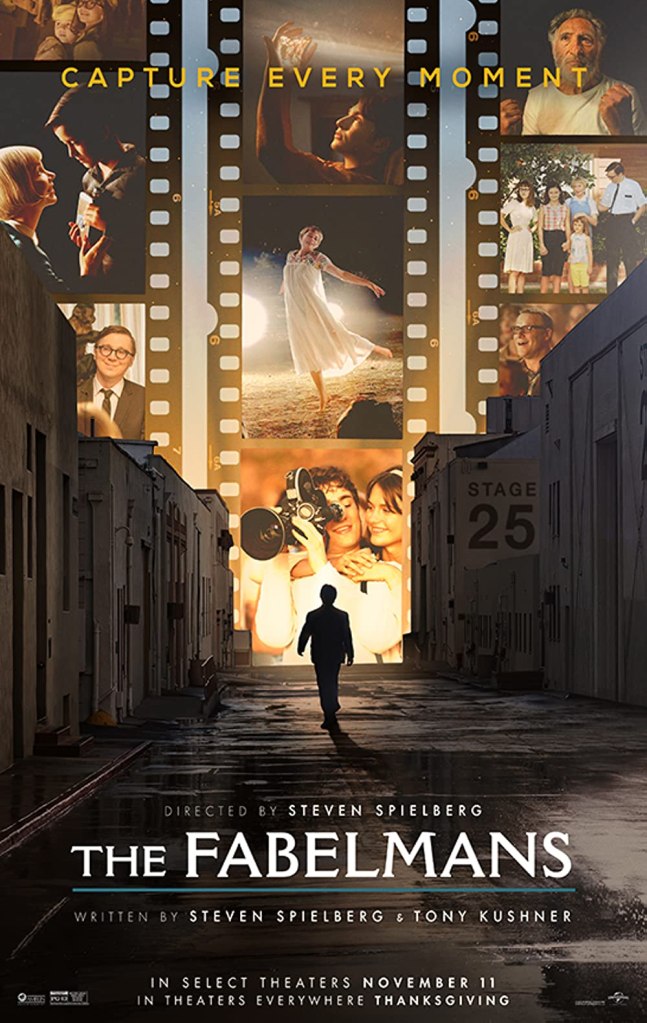
Perhaps no director is more associated with cinema’s magic than Steven Spielberg. And watching The Fabelmans, a thinly fictionalised story about his childhood, clearly few directors have as much of that cinematic magic in their blood. The Fabelmans joins a long line of post-Covid films about auteur directors reflecting on their roots (clearly a lot of soul searching took place in 2020). Surprisingly from Spielberg, The Fabelmans emerges as a film that balances sentiment with moments of pain and a love of cinema’s tricks with the suggestion of its darker powers rewrite reality according to the eye of the director (or rather the editor).

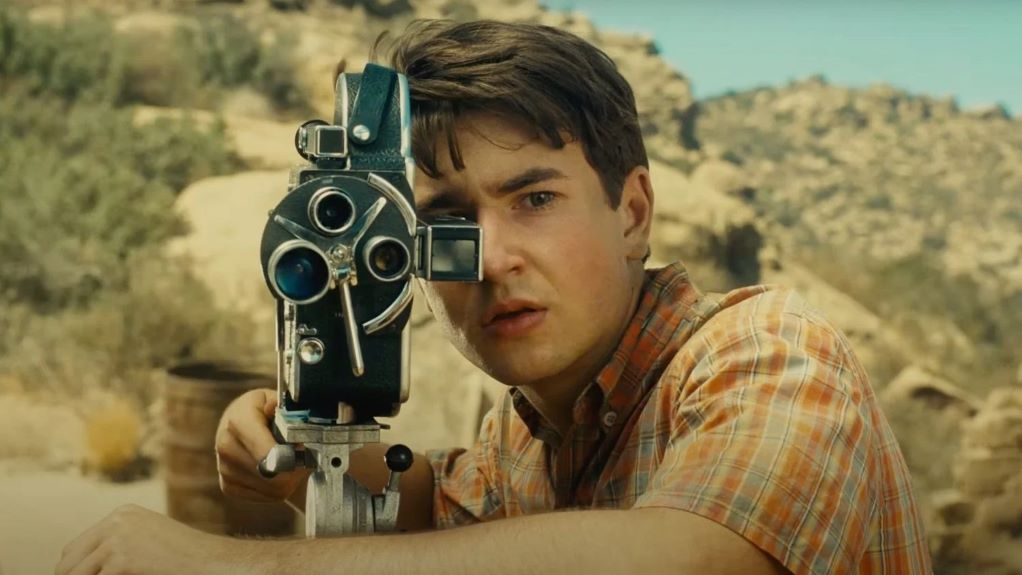
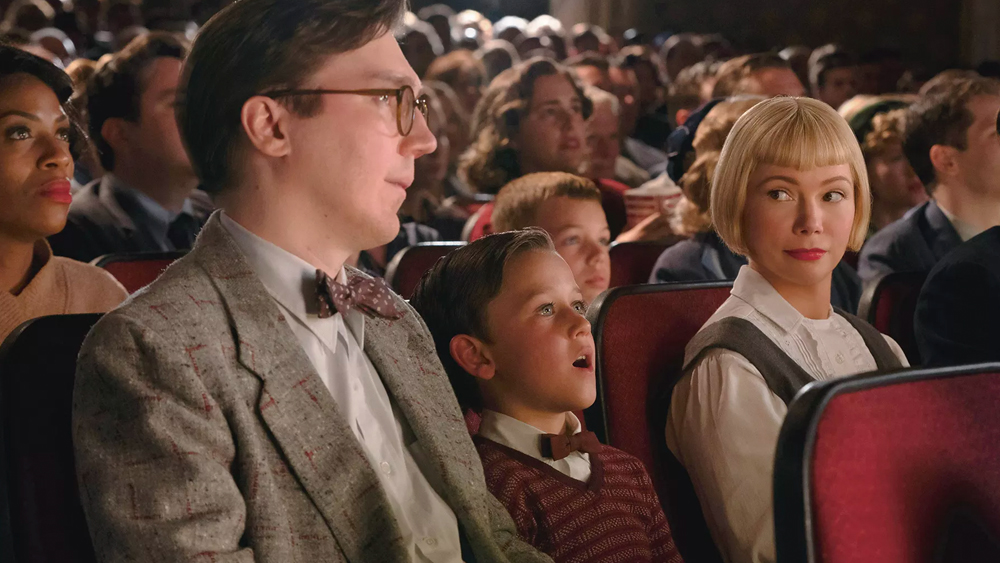
The film follows thirteen years in the life of the young Spielberg, here reimagined as Samuel Fabelman (Gabriel LaBelle, by way of Mateo Zoryan Francis-DeFord). His father Burt (Paul Dano) is an electrical engineer with a startling insight into the way computers will shape the modern world. His mother Mitzi (Michelle Williams) is a former concert pianist turned full-time Mom. The family moves from New Jersey to Phoenix and finally California, as Burt’s career grows. From a young age Samuel is enchanted by cinema, filming startling narrative home movies, packed full of camera and editing tricks. But he and the family are torn between art and science, just as Mitzi’s friendship with “Uncle” Bennie (Seth Rogan), Burt’s best friend, is revealed to go far deeper.

The Fabelmans is both a love letter to cinema and to family. But it’s a more honest one than you expect. It’s got an open eye to the delights and the dangers of both, the pain and joy that they can bring you. The film’s theme – expertly expressed in (effectively) a sustained monologue brilliantly delivered by Judd Hirsch in a brief, Oscar-nominated, cameo as Samuel’s granduncle a former circus lion tamer turned Hollywood crew worker – is how these two things will tear you apart. The creation of art makes demands on you, both in terms of time and dedication, but also a willingness to make reality and (sometimes) morality bend to its needs. And family are both the people who give you the greatest joy, and the ones that can hurt you the most.

Spielberg’s film tackles these ideas with depth but also freshness, lightness and exuberant joy. Nowhere is this clearer than the film’s reflection of Spielberg’s deep, all-consuming love for the art of cinema. Its opening scene shows the young Samuel – an endearingly warm and gentle performance from Francis-DeFord – transfixed during his first cinema visit by the train crash the concludes DeMille’s The Greatest Show on Earth. So much so he feels compelled to recreate it – much to his father’s annoyance – with an expensive gift trainset, before his mother suggests filming it. Even this 10-year olds film, shows a natural understanding for perspective and composition.

The young Samuel – in an inspired moment of Truffautesque brilliance – is so enraptured with his resulting film, that he plays it repeatedly, projecting it onto his hands, as if holding the magic. No wonder he becomes a teenager obsessed with movie-making, who talks about film stocks and editing machines at a hundred miles an hour, locking himself away for hours carefully snipping and editing footage. The film this young auteur directs – very close recreations of Spielberg’s actual movies – are breath-taking in their invention and the joy. A western with real gun flashes – Burt is astounded at the effect, achieved by punching holes in the film – an epic war film crammed with tracking shots and stunningly filmed action.  This is a boy who loves the medium, excited to uncover what it can do, who finds it an expression for his imagination.

He’s clearly the son of both his parents. Burt, played with quiet, loving dignity by Paul Dano (torn between holding his family together and the knowledge he can’t do that), is a quintessential man of science. It’s from him, Samuel gets his love for the nitty-gritty mechanics of film-making, its machinery and precision. But to Burt it’s only a “hobby” – real work is the creation of something practical. So his artistic sensibility films comes from his mother Mitzi, gloriously played by Michelle Williams as a women in a constant struggle to keep her unhappiness at bay by telling everyone (and herself) its all fine. She needs a world filled with laughter and joy.
It’s what she gets from Uncle Bennie (Seth Rogan, cuddly and kind). It’s also where the darkness of both family and film-making touches on this bright, hopeful world. Creating a film of a camping trip the extended family have taken, its impossible for Samuel not to notice at the edge of the frames that Bennie and his mother are more than just friends. His solution? Snip this out of the film he shows the family, then assemble an “alternative cut” which he shows his mother, showcasing the tell-tale signs of her emotional (if not yet physical, she swears) infidelity. The Fabelmans skirts gently however, over how Spielberg’s teenage fear of sexuality in his mother and the association of sex with betrayal may have affected the bashful presentation of sex in many of his movies.

Samuel’s camping film works best as a reassuring lie. He’ll repeat the trick a few years later, turning his jock bully (who flings anti-Semitic insults and punches) into the super-star of his high-school graduation film, a track superstar who is made to look like a superman. Confronted about it, Samuel acknowledges it’s not real – but maybe it just worked better for the picture. It’s as close as Spielberg has ever come to acknowledging the dark underbelly of cinematic fantasy: it can mask the pain and torment of real life and it can turn villains into heroes. His unfaithful Mum becomes a paragon of virtue, his school bully a matinee idol.

Why does he do it? Is it to gain revenge by confronting those who have let him down with idealised versions the know they can’t live up to? Even he is not sure. Perhaps, The Fabelmans is about the young Spielberg reconciling that even if the movies are lies, they can also be joyful, exciting lies that we need: and that there is more than enough reason to continue making them. Just as, angry as we might get with our parents, we still love them.

The film is held together by a sensational performance by Gabriel LaBelle, who captures every light and shade in this journey as well as being uncannily reminiscent of Spielberg. It’s a beautifully made film, with a gorgeous score by John Williams that mixes classical music with little touches of the scores from Spielberg classics. And it has a final sequence dripping with cineaste joy, from a film deeply (and knowledgably) in love with cinema. Who else but David Lynch to play John Ford, handing out foul-mouthed composition tips? And how else to end, but Spielberg adjusting the final shot to match the advice, tipping the hat to the legend?

The Fabelmans creeps up on you – but its love for film and family, its honesty about the manipulations and flaws of both and its mix of stardust memories and tear-stained snapshots feels like a beautiful summation of Spielberg’s career.

The Batman (2022)

The Batman (2022)

Robert Pattinson presents a noirish Bat in Matt Reeves’ dark, moody vision

Director: Matt Reeves

Cast: Robert Pattinson (Bruce Wayne/Batman), Zoë Kravitz (Selina Kyle/Catwoman), Paul Dano (The Riddler), Jeffrey Wright (Lt James Gordon), John Turturro (Carmine Falcone), Peter Sarsgaard (DA Gil Colson), Andy Serkis (Alfred Pennyworth), Colin Farrell (Oswald Cobblepot/Penguin), Jayme Lawson Bella Réal) Rupert Penry-Jones (Mayor Don Mitchell Jnr), Barry Keoghan (Arkham Prisoner)

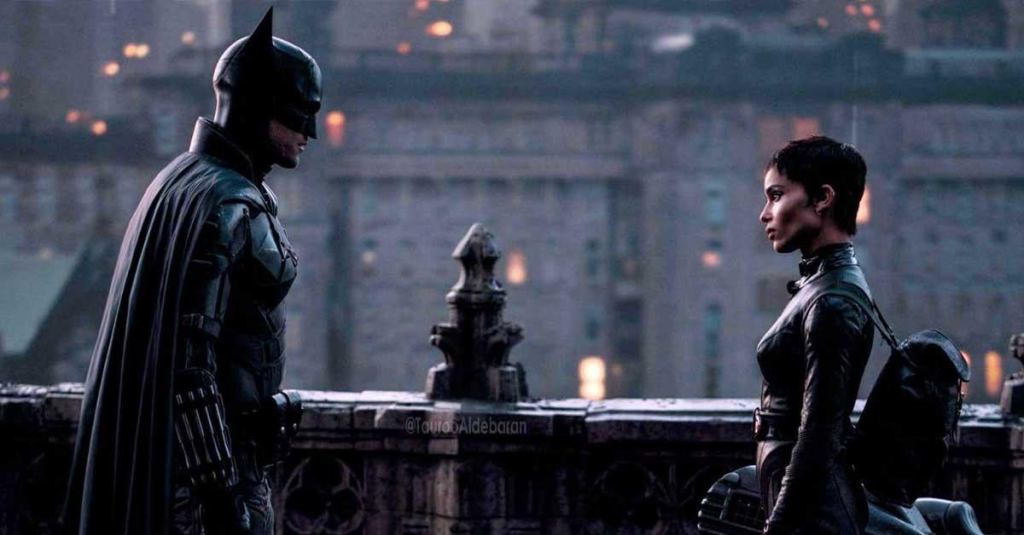
The rain pounds down on Gotham. In the shadows a masked man strikes terror into the hearts of wrong-doers. It could only be the start of a new Batman trilogy. At least that’s the intention, as DC Comics mines its strongest asset, in a dark, noirish version that positions Batman as a gumshoe pulp detective with fisticuffs. If Reeves film at times has more ambition than it knows what to do with, at least it is ambitious.

For two years Bruce Wayne (Robert Pattinson) has been crusading on the streets of Gotham as Batman, trying to fix the city’s problems one criminal at a time. He’s formed an uneasy alliance with police Lt James Gordon (Jeffrey Wright) and is just about tolerated by the official force. That starts to change when unhinged serial killer The Riddler (Paul Dano) begins a campaign of terror targeting Gotham’s elites, who he accuses of corruption. How far will the Riddler go? How do crime boss Carmine Falcone (John Turturro) and mysterious cat burglar Selina Kyle (Zoë Kravitz) fit in?

Reeves’ film is a grimy film-noir Batman. Pretty much the entire film is set at night-time, in seedy bars and filthy streets with barely a frame unaccompanied by the pounding of rain on the soundtrack. Atmospherically shot by Grieg Fraser, the film has a rain-sodden canvas with deep blacks and splashes of red. It’s sound design – and Michael Giacchino’s music – uses deep bases and reverbative sounds that give the film an intimidating rumble.

Reeves’ takes Fincher’s Seven and Zodiac as key inspirations, mixed with the shadowy darkness of Pakula and other 1970s filmmakers. Gotham is the hellish noir of Seven, where light is a stranger. The Riddler is radically re-interpreted as an ingenious psychopath, covering his crimes with cryptic clues, cultivating an online audience with videos where he conceals his face behind a sort of gimp mask and prominent spectacles – in methods and style he’s very similar to the Zodiac killer.

Batman is a tech-assisted private eye, working alongside the official forces, doing things they can’t do. Few other Batman films have zeroed in on the detective element of the character as much, but it’s possibly his main skill here: searching for clues, deftly cracking the Riddler’s cryptic clues, chasing down leads, utilising top-of-the-line surveillance equipment (a set of contact lenses that records everything he sees) and making connections from crime to crime. He’s a sort of miserable Sam Spade who punches lots of people.

Setting the film very early in Batman’s crusade allows for a rough and raw quality to Batman’s gear and approach, helped by Pattinson’s age. The suit has a homespun practicality to it, a hulking suit of armour that bullets bounce of, with various useful attachments. The batmobile is essentially a normal car with a massively souped-up engine. Batman often travels on a normal but powerful motorbike, and stakes out witnesses with his armour disguised under a hoodie. At times Bruce misjudges things: a fall from a building that almost goes horribly wrong, the odd fight where he bites of more than he can chew.

With an eemo look inspired by Kurt Cobain, Bruce Wayne is a surly recluse with serious emotional difficulties. He has a tense relationship with surrogate father Alfred (an effective Andy Serkis), who disapproves of how Bruce spends his evenings. The Batman has far less Bruce Wayne in it than almost any other Batman movie. This Bruce only feels comfortable behind the mask and has worked hard to crush all fear and emotion to find security in anonymity. He has cut himself off not only from the city, but from humanity, idealising his lost parents – and is a stern, humourless judge who describes his mission as one of vengeance.

There is a lot of vengeance needed in Reeve’s corrupt Gotham. The film bites off a huge chunk of content around corruption, class conflict and injustice. The Riddler’s crimes are all connected to corruption, people whose hands are actually filthy with drug money. His fury extends to the Wayne family – Gotham’s venerated philanthropists – and the film is at its best with this character when he functions as a sort of avenging angel of class war.

But it doesn’t quite manage to nail down exploring the morality of a serial killer, eliminating pernicious public figures. There is no discussion of the misguided merit in the twisted motives of the killer. He’s always presented as wicked and insane, with no scope given to understand or acknowledge the legitimate social points he makes. A late act reveal of his deeper plot comes from nowhere and (with its indiscriminate destruction) feels inconsistent with any point the film was trying to make earlier. It seems instead to exist to give us a big action set-piece. The film strains towards a coherent message about institutional, systemic corruption, but doesn’t quite give it the depth and shade it needs.

It’s all part of a film that isn’t quite smart enough, or a script that isn’t deft enough. Take a look at those riddles. Darkly fascinating as they are, their never quite strong or enigmatic enough. The film offers no ‘light-bulb moment’ when a hidden message is suddenly made clear. Batman cracks them all quickly, apart from one. Most audience members will quickly suss out that one and you suspect the only reason Batman doesn’t is that if he did the film would end quickly.

Ending quickly is something The Batman isn’t concerned about. At nearly three hours, it is far too long – particularly as it never quite works out what it is trying to say. There are too many sub-plots: an unrecognisable Colin Farrell is good value as The Penguin, but his entire presence is to set up future movies. The film drags out its ending with a sudden twists, which don’t feel like a wider plan playing out behind the scenes rather than slightly jarring extensions.

The Batman covers a lot, but none of it in enough depth. Very good as Robert Pattinson is, I don’t feel we learn a lot about Wayne. The Batman adds a romance with Selina Kyle (a dynamic Zoë Kravitz) and gives her a sub-plot of her own which largely just crowds the film. None of these plots are complex in themselves, but they all play out at the same time, reducing the focus on each of them. It’s all too much for you get to a handle on what the film is trying to be about.

Essentially, you feel Reeves had hundreds of ideas about what he wanted his Batman film to be – and didn’t have the heart to leave any of them out. But, even when over-ambitious, he’s an impressive and exciting film-maker. The Batman is crammed with great scenes (from action to disturbing splashes of horror). When the sequel comes, a clearer overall theme will help a great deal. But, with this dark but beautifully made film – and an impressive Batman from Robert Pattinson – I’ll be excited to see what Reeves does next.

There Will Be Blood (2007)

There Will Be Blood (2007)

Daniel Day-Lewis triumphs in this incomparable masterpiece from Paul Thomas Anderson

Director: Paul Thomas Anderson

Cast: Daniel Day-Lewis (Daniel Plainview), Paul Dano (Eli Sunday/Paul Sunday), Kevin J. O’Connor (Henry), Ciarán Hinds (Fletcher Hamilton), Dillon Fraser (HW Plainview), Russell Harvard (Adult HW Plainview), David Willis (Able Sunday), Hans Howes (William Brandy), Paul F. Tompkins (Prescott)

Citizen Kane’s original title was “American”. David Thomson observed perhaps there hasn’t been another film so deserving of that title until There Will Be Blood. This is one of those once-in-a-decade films, possibly the greatest American film of the twenty-first century and Anderson’s career-defining masterpiece. It’s a gripping exploration of what makes America tick, captured within the self-destructive greed and hunger for power of one man. It’s a stunning piece of work, a cast-iron masterpiece, that takes a stack of influences and reinvents them into something fresh, daring, bold and above all unrepeatably unique.

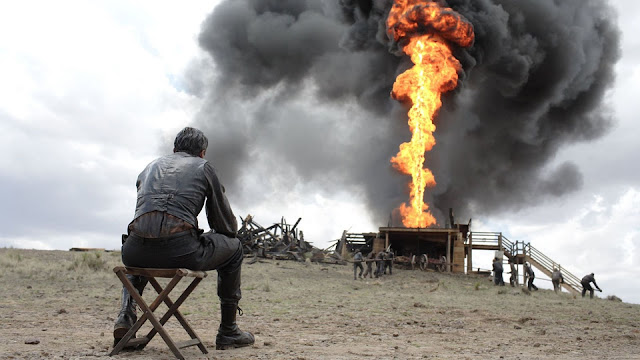
Adapted very loosely from Upton Sinclair’s novel Oil, the film follows thirty years in the life of Daniel Plainview (Daniel Day-Lewis), a misanthropic and fiercely ambitious empire-building oil man. Running a ‘family business’ with his adopted son HW (Dillon Fraser) – the boy’s father having been killed in a drilling accident – Plainview takes up a sea of leases across California. The film focuses on his exploitation of a rich seam under the community of Little Boston. A very religious community – dominated by the strong-willed Eli Sunday (Paul Dano), almost a mirror image of Plainview’s monomania – Little Boston becomes the setting for Plainview’s struggles with men and land, in a growing cacophony of drama that inevitably (as the title promises) builds towards an explosion.

Watching it you can see the inspirations. It reflects The Treasure of the Sierra Madre (which Anderson watched endlessly in preparation) in its chilling exploration of the impact of greed and Plainview is the grandfather of Charles Foster Kane. It’s set in a Fordian west, but filtered through the unique vision of Kubrick. But it’s not a slave to these: it’s a truly original work, an off-kilter epic, shot with a stunning beauty that’s half poetry, half gothic horror by Robert Elswit. It sounds like no film ever made, a deeply unsettling score that mixes discordant rhythm and baroque-inspired strings by Johnny Greenwood.

And it has two geniuses at its centre. Anderson, a director best known for large-scale ensemble pieces, inverts his style to focus on one single misanthropic force of nature, a man who sees people as only tools or rivals. His film hits every note from near silent-cinema expressionism, to Grand Guignol fever-dream intensity. It’s shot with an all-consuming urgency, long-takes of fluid camera movement, mixed with interrogative still shots. The film digs itself into your soul, takes hold and doesn’t let go. It’s at times as darkly funny, as it is horrifyingly bleak. No one else could have made it.

And no one else could have played Plainview. If There Will Be Blood cemented Anderson as one of the leading directors of the early 21st century, it confirmed Day-Lewis as the era’s greatest actor. Day-Lewis is beyond superb here: this is the sort of, epoch defining performance you see only a few times in your life. Hunched forward, like a man constantly on the move, dark eyes gleaming and his voice a malevolently rolling John-Huston inspired baritone, Day-Lewis makes Plainview a misanthropic monster. He’s articulate, instinctive and destructive. Achieving his dreams only makes him even more inhuman and bitter. And Day-Lewis makes clear the stunted, half-grown creature under the skin of the confident businessman.

It’s clear he’s desperately lonely, but seemingly only has enough humanity in him for one relationship at a time – even then, people still must serve a purpose. HW – and later Henry, the man who arrives on his land claiming to be his brother (a wonderful inscrutable performance from Kevin J O’Connor) – become props in the family business. Plainview reaches out to them for emotional connection, but it’s all one way. When an accident robs the young HW of his hearing, Plainview is incapable of caring for him – he treats the deafness like a betrayal. He banishes HW, just as he will banish and punish all those who he sees as betraying him, including Henry. There isn’t a scene that doesn’t have a piece of performative magic from Day-Lewis.

Alongside this genius, Anderson’s subject is America. It’s a stunning exploration of how capitalism, greed and an insatiable hunger for more – be it money, land, power or anything else worth a jot of value – has shaped the country. Plainview is the dark soul of pioneering American entrepreneurial spirit, obsessed to the elimination of anything else, with accumulation. Oil is the life blood of the country, God’s own gift of power wrapped in a dangerous black liquid. It’s pumping through the country’s soil, and to control it is to control the country’s circulation. It’s Plainview’s faith – and it’s the faith of all these men forging an empire out of the ground, motivated by the desire for more. It’s partly why the film is so focused on men – because it’s always grasping men like this, titans of industry, who shape the dark soul of our civilisation.

Nothing will please Plainview until he controls all around him, confessing in a quiet moment (there are no words for how brilliantly unrepentant, yet also strangely regretful Day-Lewis is in this underplayed scene) that he has “a competition within him. I want no one else to succeed. I hate most people.” Like the country itself, he has forged himself from nothing through naught but will-power and a determination to never know failure. There Will Be Blood argues that, much as we might want to think otherwise, America is built on the backs of men like Plainview – monsters with the vision and determination to turn a desert into a city.

God himself has no place in these calculations. Anderson contrasts the obsessive sweat of Plainview with the dogmatic and vainglorious Christianity of Eli Sunday (a brilliantly weasly Paul Dano). Eli’s church is a haven of evangelistic worship and showmanship, which Plainview immediately finds disgusting (does he recognise another expert peddler of bullshit?). Eli has a moral arrogance and as much as a desire to control as Plainview, and the battle that grows between these two for dominance not only shows the ruthlessness of both men, but also reflects the struggle between religious obligation and Mammon that has run through America’s history.

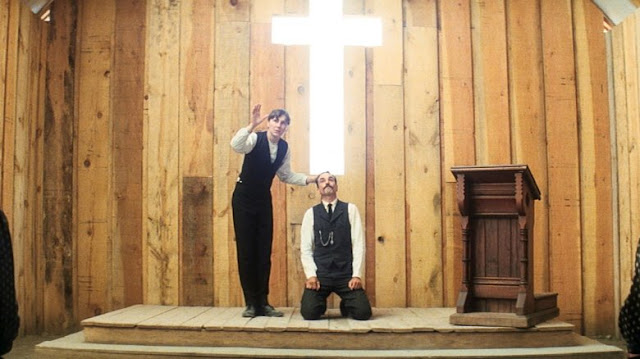
The rivalry between the two men revolves around three crucial confrontations. Having effectively robbed valuable land from Eli’s family for a pittance, Plainview then humiliates Eli, forcing him head first into the mud, refusing to allow him any influence over his dig. Eli’s revenge comes in spades: controlling a vital piece of land for Plainview’s pipeline, he demands Plainview comes to his church to be rebaptised. The resulting scene sees him goad, provoke and demean Plainview for his sins, forcing Plainview into a series of humiliating confessions (both actors are earth-shakingly brilliant).

Their final reckoning closes the film – and is both its most controversial and overblown sequence. Jumping forward fifteen years, to Plainview’s sprawling mansion (where Day-Lewis has become a dishevelled hermit, his misanthropy unchecked and his victories only confirming his loathing of humanity) it’s the famous ‘milkshake’ scene, played with the sort of OTT intensity only Day-Lewis could risk and which the film has carefully built us towards accepting. Blood-dripped in a Kubrickian setting of a bowling alley, it’s the final expression of two men’s mutual hatred and views of a world – Eli’s that it owes him something for his faith, Plainview’s that he controls it through will alone.

Only a film that has built on such firm grounding of escalating tension and excess could make such a scene a success. This is a film that starts with a near-silent 15 minutes, of Plainview hammering with a pickaxe obsessively in the belly of the country’s soil. It ends – after a long journey that has seen Plainview wheedle, steal, bully and grasp – with him entombed again, this time in his mausoleum of a home, no daylight allowed and the air filled with Plainview’s hate-filled rants. Along the way, we’ve seen the plains of California as a place of dreamy beauty, marshalled to the will of one man to control all around him, scenes of striking beauty and haunting intensity.

There Will Be Blood is a masterpiece, an inspired parable for American history, a showcase for one of the greatest actors of his generation to redefine his craft and a marvel of character study, epic vision and haunting lyricism from its director. There is not a false note in it and it stands towering as a landmark in American film history. The greatest American film of the 2000s? Possibly yes.

Youth (2015)


Michael Caine and Harvey Keitel try to embrace their past in Paolo Sorrentino’s mesmeric Youth

Director: Paolo Sorrentino

Cast: Michael Caine (Fred Ballinger), Harvey Keitel (Mick Boyle), Rachel Weisz (Lena Ballinger), Paul Dano (Jimmy Tree), Jane Fonda (Brenda Morel), Roly Serrano (Argentinian Footballer), Alex MacQueen (Queen’s emissary), Robert Seethaler (Luca Moroder), Ed Stoppard (Julian Boyle), Paloma Faith (Herself), Tom Lipinski, Chloe Pirrie, Alex Beckett, Nate Dern, Mark Gessner (Screenwriters)

Well this is something different. Youth is a hard to categorise film from Paolo Sorrentino. Sorrentino often seems the definition of (admittedly beautifully filmed) style over substance. But he’s also able to suggest great, unseen depth, a hard to define quality. Sometimes these qualities result in an impressive but frustratingly empty work. And sometimes it results in something simply wonderful. Youth falls firmly into the second category. In fact, it fits so firmly into this that I think it might be the most wonderful film Sorrentino has made. Put frankly, I loved this film. I can’t quite put my finger on why somehow, but I loved it.

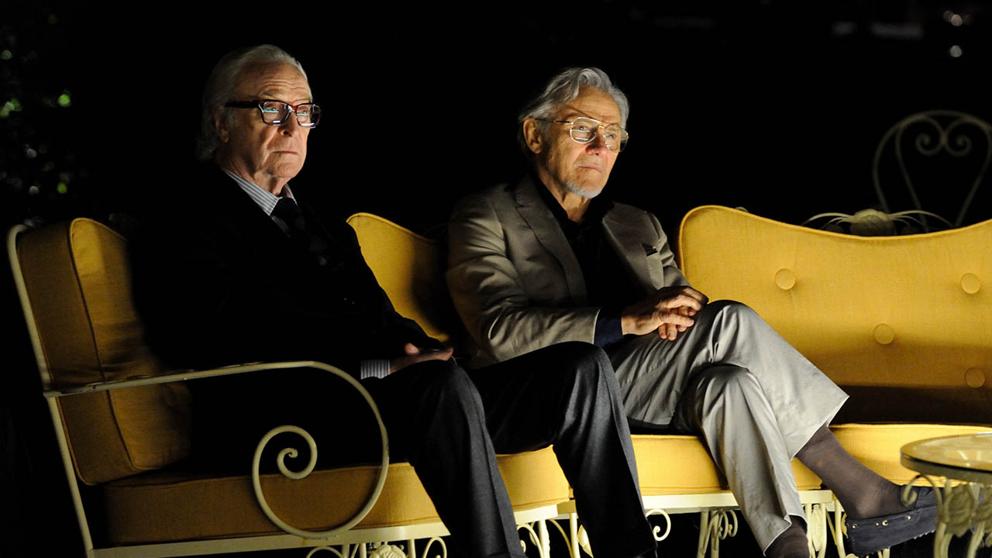
It’s set in a Swiss retreat, peopled by the rich and famous. There are film stars, Miss Universe, famous pop stars and an overweight former Argentinian footballer (who could be anyone right?). Fred Ballinger (Michael Caine) is a world-famous composer, a man officially in retirement, uninterested in answering entreaties from the Royal Family to perform his famous “Simple Song #3” at Prince Philip’s birthday. He is accompanied by his daughter Lena (Rachel Weisz), who acts as his assistant, and struggles with her father’s difficult personality and her resentment towards him. Fred’s best friend Mick Boyle (Harvey Keitel), a famous director, is also staying at the resort with a gang of screenwriters, preparing his script for what he intends to be his final film (his “testament”).

Youth is a film that conveys great depth and emotional strength, while never falling into any category or offering up clear answers or spoon-fed themes. Instead it explores, in a gentle way, age, disappointment, hope, lost opportunities and warm memories. It’s nominally a film about old people reflecting on their youth, but it’s also full of moments that show these characters still have moments of vibrancy. In a beautiful moment, the footballer (barely able to get himself out of a pool without oxygen) carries out a series of beautifully skilful keepie-uppies with a tennis ball for over a minute, before he wheezes and has to stop. That’s kinda the whole film right there in an image: age and youth all in one go. It’s beautiful. I loved it.

Sorrentino loves the flashy shot, and carefully framed image. This film is full of them, and they work wonderfully well. It’s sprinkled throughout with gorgeous dream sequences and fantasy moments, from Boyle seeing a field full of his leading ladies past, to Lena dreaming of a hilariously overblown music video showing her unfaithful husband (a slimy Ed Stoppard) and Paloma Faith (a very good sport) undulating over a speeding car. We see Fred sitting in a field conducting a semi-imaginary orchestra of cows with bells. Imaginative shots are sprinkled throughout, everyday things seen from new and unique angles. 

And its so emotionally fulfilling, filled with both lump-in-the-throat moments and moments of searing, magical hope and joy. It explores what matters to us as we get old – and how what matters to us in our lives changes as we age. Sometimes these things remain the same, sometimes we move with the times. Sometimes we adjust, and sometimes we don’t. It’s a film where some characters struggle to recall events, others reinterpret their lives as they happen. You could criticise the film for not having a clear central theme, but its theme if anything is life – and life is not easy to categorise. It’s a mountain of different moments and attitudes: and that is what this film likes. It’s messy and hard to predict. And it’s strangely beautiful. 

So Sorrentino crafts a feast of a film here, crammed full of dialogue that should be almost too weighty and overtly “important”, but somehow never comes across like that. It’s partly because it’s delivered with such experienced, lightly worn skill, but also because Sorrentino pulls off the trick of positioning it as profound rather than overbearing. Shot with a gentle, elegiac expressiveness, it’s a film that brilliantly works, that conveys and carries great weight. It’s about the human condition, and it feels real and human at all times.

It also helps that it’s superbly acted. There isn’t a dud performance here – and some give some of the most beautiful work of their career. Michael Caine takes a few minutes to accept as a world famous composer (something about him just doesn’t quite work), but you quickly let it go because he is astonishingly good here. Caine’s Fred carries great reserves of regret and loss, but also many memories of joy. Caine is beautifully expressive – part observer, part driver of the action. He has the wonderful air of being young-old and an old-young-at-heart. He’s playful but also tired. He’s strangely unknowable but at times open. It’s a beautiful performance.

Just as good is Harvey Keitel. The film is full of these two guys – like Stadler and Waldorf – moaning about getting old. But Keitel brings a great tragic depth to Boyle, a great director fallen on hard times, a man whose best days may well be behind him but who refuses to let the light die. He’s both funny and (by the end) incredibly moving. Rachel Weisz is radiant as Lena – a scene where she finally lets years of anger out is wonderful – but another late scene as she quietly weeps with a sort of sad joy is simply superb. She has a gentle romance that builds with real sweetness. She’s impossible to look away from in this, she’s brilliant.

Youth also has moments where it explores the nature of art and its legacy. Ballinger feels he is probably a good-but-not-great composer. Boyle feels there are moments he touched greatness, but is never sure if it’s there or not. Paul Dano plays a great stage actor who is known worldwide for his role as a robot in a Star Wars style smash. What is art? The film doesn’t dare to answer the question, but it does ask what are artists? How do they question themselves? Why do they do what they do? Artists in this film are always watching – even the footballer – they are always looking to become a part of their world or comment on it. 

Sorrentino’s film is marvellous. I really loved it. It’s crammed full of brilliant moments. Even Jane Fonda’s overblown cameo as a film star works (I think just). It’s played with such brilliancy, structured with such light playfulness, that it is able to carry great depth and grace. It’s a film that rewards reviewing – I’m not sure I’ve worked out the implications of the final shot, or what it might mean for how we should interpret Ballinger’s final actions – and I can’t wait to see it again.