Tag: Paul Muni

I Am a Fugitive From a Chain Gang (1932)

I Am a Fugitive From a Chain Gang (1932)

Pioneering social issues film remains an impressively mounted film, made with real passion

Director: Mervyn LeRoy

Cast: Paul Muni (James Allen), Glenda Farrell (Marie), Helen Vinson (Helen), Noel Francis (Linda), Preston Foster (Pete), Allen Jenkins (Barney Sykes), Berton Churchill (Judge), Edward Ellis (Bomber Wells), David Landau (Warden), Hale Hamilton (Reverend Allen), Sally Blane (Alice), Louise Carter (Mrs Allen)
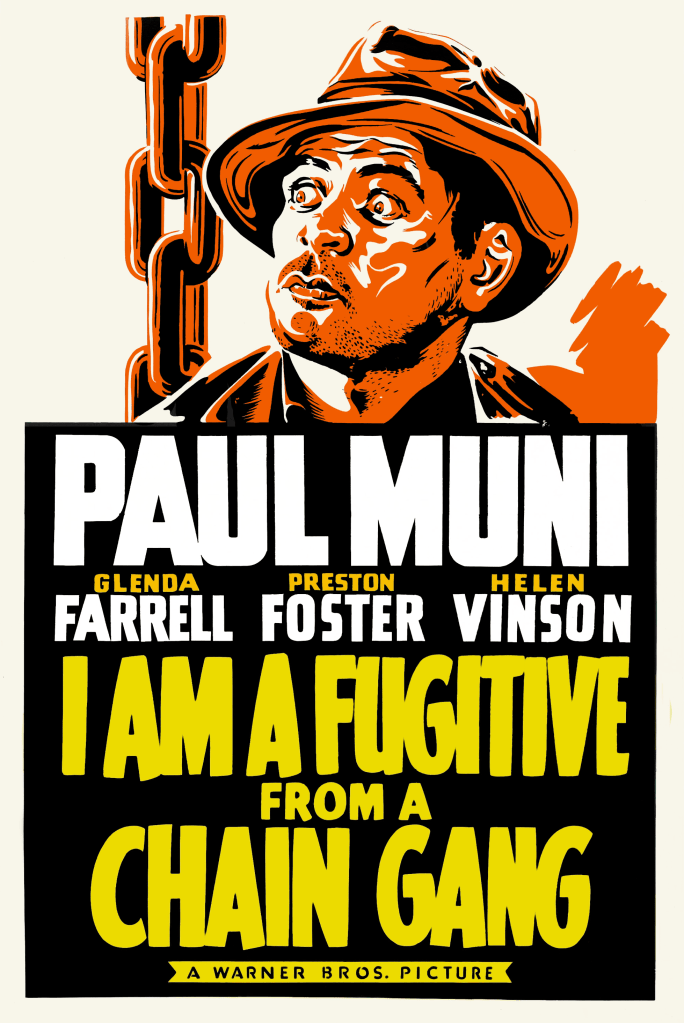
What are prisons for? Just punishment or should they encourage reform and change? To many in the South, its clear prisons were solely about the former and had nothing to do about the latter. That, in fact, you couldn’t reform a criminal – after a prison sentence he would always inevitably come back for more. I Am a Fugitive from a Chain Gang, based on a true story, is all about exploring a dehumanising system designed to turn men into working animals, beaten for looking the wrong way. No chance of a pardon, just chain men to each other, shove a pickaxe in their hand and give them a thrashing if they stop swinging it against a rock for more than second.

Based on a memoir by Robert Burns, James Allen (Paul Muni) returns from fighting in World War One with dreams of becoming an architect. Instead, he finds the American workplace is not a welcoming place for a flood of returning soldiers, drifting from state to state for work. Until, in an unnamed Southern State, he accidentally ends up in the middle of a $5 theft and is sentenced to ten years on a chain gang. The prison is a hotbed of inhumanity, with prisoners frequently beaten, dehumanised and all but worked to death. After a year he escapes and finds his way to Chicago where he reinvents himself as a successful surveyor – only, years later, for a bitter wife to expose his secret. Can he trust the Southern State that his sentence will be commuted if he agrees to return and give himself up?

I Am a Fugitive from a Chain Gang was one of the first – and probably one of the best – 1930s social issues films. It’s a surprisingly hard-hitting look at a cruel system, which (although keen to make our hero an unwitting participant in a minor crime, rather than clearly guilty like Burns) passes a sympathetic eye on criminals, asking us to question whether, whatever their crimes, they deserve this system. A system where prisoners can be randomly thrashed near to death by a thick leather belt, where pausing at work will lead to an instant beating. Where a prisoner tied to a post by his neck is such an everyday occurrence, the film is happy to throw it away in a passing shot. It makes a strong case that how we treat prisoners says as much about us as I does them – and that, sadistic wardens quickly become little better than the men they guard.

LeRoy’s film also makes a strong argument that we talk-the-talk but rarely walk-the-walk when it comes to supporting servicemen. James Allen returns a decorated hero – but his family, former employer and patronising reverend brother assume he will happily return to grunt work on the production line. War has expanded his horizons and ambitions, given him the skills to better himself. No one wants to hear it. He’s not alone: many drifters are ex-servicemen and when he tries to pawn his medals a pawnbroker sadly shows him a bucket full of worthless service decorations. It’s an indication that everyone has an assigned role and place and they shouldn’t for one minute expect to step outside this.

It’s no wonder that the prison sentence treats men like animals – a point LeRoy makes by cutting between donkeys and men both being chained up ready for a day’s work. IAAFFACG makes clear in this system all men are equal in their inequality, cutting back and forth from Black to white prisoners as they are prepare for the days work. (The film does make clear there is a higher number of Black prisoners than white). Allen protests at first, but learns to shrug his shoulders and turn away like the rest do. A freed prisoner showcases this indifferent acceptance of suffering, leaving at the same time as a deceased one, hitching a ride on the cart sitting merrily on a fellow worker’s coffin, striking a match for his cigarette on it. LeRoy shoots the prison beds where the men sleep chained together with a forbidding moodiness and the wide-open spaces where they slave in the beating sun with a scale and sense of heat bearing down on us.

Allen won’t be beaten though. His escape is a beautifully filmed and edited sequence, show-casing the film’s triumphant use of sound. LeRoy’s camera tracks both Allen and pursuers as they flee through the undergrowth, adding pace and intensity to the sequence, soundtracked to the bark of the hounds following him. It’s a sound you really notice disappear when Allen hurls himself into a river, using a reed as an air pipe, hiding feet away from his pursuers, in a series of underwater shots that have a haunting power. It’s superbly done, full of tension and fear.

Escaped, first thing James does is buy a suit and have a shave. Instantly he is above suspicion – even while he is perfectly described be a flatfoot cop sitting next to him in the barbers, not a trace of suspicion is placed on to him (thanks for the ‘close shave’ Allen drily says). Now looking like a respectable middle-class sort, James Allen – under his new name of Allen James – suddenly finds opportunities heading his way, moving quickly up the chain at his new job in Chicago. In this world, outward appearances make the man: and a guy in a new suit is always going to get the sort of attention a down-and-out can only dream of.

So much is Allen now an ideal prospect, he is blackmailed into marriage by Glenda Farrell’s hard-faced Marie, a decision that will bite him hard when he makes eyes years later at the sweet Helen (Helen Visnor). He’s pulled back into the world he thought he had left behind, only to find its not changed at all: to the ‘justice’ system his new professional achievements count for not a jot. To them he’s still the same subhuman scum he was before, an even harsher regime swiftly initiated to drive any vestige of humanity from him, even in the face of a national campaign.

At the centre of this film is a superb performance by Paul Muni. Sure, you can see touches of Muni’s love for melodrama, the odd overdone reaction. But this is an emotionally raw, deeply touching performance. Muni gives Allen a superabundance of energy, enthusiasm and hope at the film’s start all of which slowly drains away. The horror builds behind his eyes: it’s no surprise that, re-sentenced to the chain gang, Muni’s face crumbles into genuinely affecting tears of fear and hopelessness. Slowly, despite himself, Allen becomes the toughened, cynical, damaged man the system assumes he was at the start, strangling the hope and optimism that characterised him at the start. It’s a sensitive, deeply humane performance, of humanity being chiselled away.

It results, of course, in the film’s striking (and famous) closing shot, the now fugitive Allen whispering from the shadows, all chance of making an honest life gone. IAAFFACG has already symbolically shown how this system has twisted Allen: having dreamed his whole life of being a bridge builder, one of his final acts in the film is to destroy a bridge as part of a desperate escape. IAAFFACG doesn’t overegg its social commentary, but leaves a strong and lasting impression of how treating men like animals becomes a self-fulfilling prophecy. Leave them no choice and a man must turn to crime: it’s as true for abandoned veterans as it is for chain-gang criminals. In making an appeal for a fairer, kinder world, IAAFFACG doesn’t miss that we are a long way from it right now.

The Story of Louis Pasteur (1936)

The Story of Louis Pasteur (1936)

A visionary struggles against the blind in this genre-defining slightly cosy biopic

Director: William Dieterle

Cast: Paul Muni (Louis Pasteur), Josephine Hutchinson (Marie Pasteur), Anita Louise (Annette Pasteur), Donald Woods (Dr. Jean Martel), Fritz Leiber (Dr. Charbonnet), Henry O’Neill (Dr. Emile Roux), Porter Hall (Dr. Rossignol), Raymond Brown (Dr. Radisse), Akim Tamiroff (Dr. Zaranoff), Halliwell Hobbes (Dr. Joseph Lister), Frank Reicher (Dr. Pfeiffer)

Jack Warner was convinced no one would want to watch the life story of some crusty old scientist. But Paul Muni insisted they would – and he was a star – so with a threadbare budget and host of re-used costumes (many not from the correct period) and sets The Story of Louis Pasteur came to the screen – and much to Warner’s surprise was a hit. It can look like an oddly cliché-ridden affair today: until you realise many biopic tropes we’re used to were virtually coined here.

The Story of Louis Pasteur remixes huge portions of Pasteur’s life to make it more dramatic: the man who was the leading scientist in France for almost thirty years is repackaged as an outsider and laughing stock, constantly scorned by the medical establishment until (but of course!) he is triumphantly hailed as a genius by the same doctors who mocked him for years. Sound familiar? The film charts Pasteur’s efforts to discover vaccines, first for anthrax in sheep (leading to a famous test where 25 sheep were vaccinated and 25 were not, then all of them exposed to the disease, killing all the unvaccinated sheep) then rabies in dogs and treating those bitten by rabid dogs. Pasteur uses his unparalleled knowledge of microbes which (but of course!) every other doctor says cannot possibly have anything to do with infection.

There is a lot to enjoy in The Story of Louis Pasteur, an undeniably old-fashioned “Great Men” view of history that manages to turn bacteriology into effective entertainment. It recasts history into an easily digestible tale of visionaries and scoffers – but, crucially, no real baddies – crafting a series of small steps towards scientific discoveries into flashes of inspiration and triumphant revelations. Science is made simple, plain and understandable with Pasteur to talk us through a few shots of microbes under microscopes. At its centre we have a stubborn maverick determined that it is his way or the high-way and who won’t listen for a second to anyone questioning his theories.

There is something rather touching about the film’s admiration for science and celebration of an altruistic quest to make the world a better place. It carefully outlines the dangers of surgery and poor hygiene in medical practice – it opens with a doctor murdered for failing to save his killer’s wife, the reason for his failure pretty clear from the haphazard way he chucks medical equipment into a bag (dropping some of it on the floor en route). This lack of hygiene affects rich and poor (even Duchesses are not safe), in particular women in childbirth. Its truly the enemy of mankind, as a caption explaining the 1870 war stresses (European squabbles being a distant second). This is a problem that is truly noble to take on.

And it motivates Pasteur. Paul Muni is on Oscar-winning form as Pasteur, brilliantly precise and superbly conveying great intelligence mixed with an arrogant self-assurance. But Pasteur’s egotism comes not from vanity but from simply knowing more of which he speaks than anyone else. He’s also a man consumed by a sense of duty to the world: when his work can literally save lives (be they either animal or human) he will not let scorn stand in his way. Muni captures all this wonderfully, creating a prickly man with a playful streak determined to do the right thing the right way (Pasteur may disagree with his critics, but woe-betide their assistants disrespectfully doing the same).

Dieterle’s film crafts a series of excellent set-pieces to present Pasteur as a visionary ahead of his time. To make this really land, he’s therefore completely altered into being seen as a crank and pariah by everyone around him, rather than the influential scientific leader he actually was. This might be poor history, but it’s much better drama. From a furious encounter with Napoleon III (who won’t wear the idea his hand-picked doctors might be wrong about sterilization) to the Medical Academy publicly poo-poohing Pasteur’s outlandish ideas that vaccines might prevent anthrax. To give a face to this mocking of Pasteur (from an establishment we are told is totally wrong on every count) the film invents Dr Charbonnet (well played by Fritz Leiber), an honest but pig-headed critic who exists to be wrong (for noble reasons) on almost every single issue.

Noble as important: this film want to stress everyone acts for decent reasons, so that its final celebration of Pasteur is unblemished by deeply personal rivalry. Charbonnet and Pasteur are both framed as decent men and their relationship allows for plenty of fun melodrama, such as Charbonnet injecting himself with Pasteur’s (fortunately for him) weak rabies sample to ‘expose’ his ideas. When Pasteur’s daughter falls ill in childbirth, but of course Charbonnet is the only doctor available: he humours Pasteur’s sterilisation rules in exchange for a signed letter from Pasteur rubbishing his own theories (Muni’s shuffling flash of conflict that flows across his face at this moment is very well done). But of course, Charbonnet and Pasteur eventually reconcile in honour and decency.

This forms a fun thread throughout the movie, that’s never less than well-staged by Dieterle, with pace and energy. The anthrax test is very dynamic – all celebrating crowds and circus side-shows – and the dramatic appearance of a host of Russian peasants (led by Akim Tamiroff’s bombastic doctor) desperate for a cure for rabies-induced sickness is well-executed. Some beats work less well than others. Donald Woods gets dealt a rotten hand as the dull son-in-law of Pasteur. The women in Pasteur’s family get even worse, with most of Josephine Hutchinson’s lines being of the “stop trying to cure anthrax and come to bed Louis” variety. The costumes are bizarrely all-over-the-place (the women look more like Southern Belles) and there is a reassuring cosiness about everything.

But that’s also one of its most successful features. The Story of Louis Pasteur is a little twee – but it’s also effective. It’s why it laid down a template that worked for countless films that follow (A Beautiful Mind pretty much follows its model and won an Oscar for it 65 years later). That’s because there is also a feel-good factor to see someone who is, without doubt, in the right triumphing over the stubborn. With a great performance by Muni, it’s a rewardingly entertaining biopic.

Scarface (1932)

Paul Muni wants the world in Scarface

Director: Howard Hawks

Cast: Paul Muni (Tony Camonte), Ann Dvorak (Francesca Camonte), George Raft (Guino Rinaldo), Karen Morley (Poppy), Osgood Perkins (Johnny Lovo), C. Henry Gordon (Inspector Ben Guarino), Vincent Barnett (Angelo), Boris Karloff (Tom Gaffney)

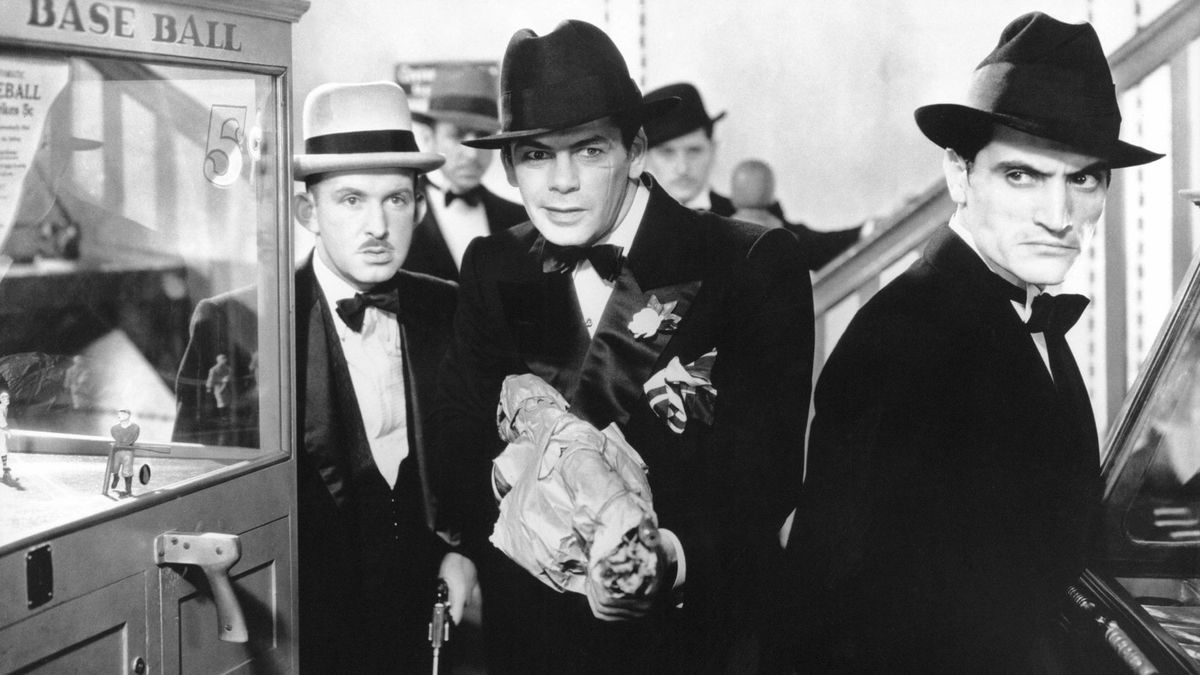
Before Tony Montana there was Tony Camonte. The suits may be sharper in 30s, but the bullets are just as lethal. Howard Hawks’ gangster film, strikingly violent for the 1930s (barely a scene goes by without a slaying), showcases the rise and fall of Tony Camonte (Paul Muni) an Italian gangster embracing the mantra “The World is Yours”. Starting as a junior hood in Johnny Lovo’s (Osgood Perkins) gang, he rises through the ranks due to his capacity for violence and his willingness to break any rule. He wants it all: money, power, Lovo’s girl Poppy (Karen Morley) and he won’t be happy until he runs this town. So long as he can still control his sister Francesca (Ann Dvorak) – because not even his best friend Guino (George Raft) can even think about touching her.

Hawks’ film is a dizzying whirligig of shootings, killings, mob violence and inventive camera-work. Fast paced and violent, many scenes are soundtracked by the rat-a-tat of Tommy guns. (Not a surprise in a film where the hero looks more excited grasping one of those in his hands than he ever does holding his girlfriend). Scarface has it all: fights, shoot-ours, car-chases, drive by shootings of bars, fist fights – you name it, Tony does it. It’s told with an electric pace and some nifty little tricks (my favourite a long cross fade of a calendar ripping off days and a Tommy gun blasting bullets, like its mowing down time itself).

Hawks uses a number of neat stylistic approaches to both present death and also signpost fate. Montage is used throughout the film, it’s inexorable build-up of violence and crime helping establish the excessive violence of Tony’s world. Shootings happen in a variety of ways, from silhouette to shadow to blatant on-screen death (though Tony’s fate, shot by several police guns, is the final blast, almost Bonnie and Clyde like as his body dances from bullet wounds under the streetlights).

You can get a good sense of whose card is marked by Hawks’ witty (and not overplayed) used of Xs. Before a St Valentine’s Day style shooting, the camera focuses on an iron girder above the victims with a series of X like metal cross beams in it – the camera returns to it, the row of Xs mirroring the victims lined up against the wall. Crime boss Gaffney is killed while bowling, his strike filled card literally marked with an X. The approach is subtle and even strangely witty.

The film is a maelstrom of excess. Starting in the aftermath of a wild party – which segues immediately into a gang hit – everything is overblown. From the violence, to the parties, to the wealth Tony builds up. It’s the same with the police as well – when it’s time for them to come out shooting they don’t hold back, assembling a small army of weapons fire which practically tears apart Tony’s apartment.

At its heart is a force-of-nature in Paul Muni’s Tony. Becoming increasingly Americanised as the film goes on (he starts heavily accented and the very picture of a scarred street thug, but becomes more-and-more accent free and smoothly dressed), Tony is not only ruthlessly ambitious he has a mania for getting more. Much like Montana, this is a man who is never satisfied until he has the world. He brags to his would-be girlfriend that he will only wear each of his new shirts once. He shows off his apartment and insists one of his henchmen (who is barely able to operate a phone) describe himself as his “secretary”. Muni’s performance mixes a grimy capacity for violence with a sordid impish delight at excess, all washed down with a childish lack of morality.

He’s also got a destructive obsession with his sister. Played with a coquettish charm by Ann Dvorak, Francesca is the apple of her brother’s eye. Is Tony even aware of the incestuous underlying his obsession? Any male attention at all sparks a jealous fury that goes way beyond a protective sibling. But there is perhaps as much to control as sexuality in this. Just as Tony wants to bring the entire city under his dominance, so he wants to control every element of his sister’s life. And in many ways she’s quite like him – as in love with flirtatious sexual excess as he is with the massive landgrab of power he’s carrying out.

Tony is moving shark-like through the city at every turn. Even while nominally following the orders of his boss Johnny (a strangely pathetic Osgood Perkins – but then power eventually makes all men weak in Scarface, even Tony. Perhaps it’s the fear of losing what you have?) he always pushes for bigger and bigger scores, making enemies Johnny can’t afford to make. The others seem paralysed in the face of him – Gaffney, default leader of the Irish mob, runs from safe house to safe house; despite the vast numbers of men following him, he never looks safe.

The film was criticised at the time for not having a sufficient moral message – tacked on in a studio reshoot was a more condemning ending with Tony (real “Shame of a Nation!” stuff), traces of which can still be seen in Tony’s brief flash of cowardice at the end. But really, in its excessive violence and cycle of destruction in a which an impulsive, brutal but not too bright killer (briefly) ends up on top was probably unsettling because it was a lot closer to the grim reality of organised crime in America. A world where the gun pays and a lunatic can take over the asylum. No wonder the censors at the time couldn’t take it. But Scarface’s compulsive violence, danger and relentless energy is what still makes it a classic today.

The Life of Emile Zola (1937)

The Life of Emile Zola (1937)

Oscar-winning biopic that laid down many of the conventions we expect

Director: William Dieterle

Cast: Paul Muni (Emile Zola), Gloria Holden (Alexandrine Zola), Gale Sondergaard (Lucie Dreyfus), Joseph Schildkraut (Captain Alfred Dreyfus), Donald Crisp (Maitre Labori), Erin O’Brien-Moore (Nana), John Litel (Charpentier), Henry O’Neill (Colonel Picquart), Morris Carnovsky (Anatole France), Louis Calhern (Major Dort), Ralph Morgan (Commander of Paris), Harry Davenport (Chief of Staff), Vladimir Sokoloff (Paul Cezanne)

One of the lesser-known Best Picture winners, The Life of Emile Zola is a prime example of the 1930s trend for “Great Man” pictures, setting the template for a whole genre of biographical movies. A whistle-stop tour of how the Great Man came to be, before a tight focus on what made him great – ideally ending in either triumph or disaster (or, as is the case here, with both). It’s from a time when the viewing public didn’t expect a rigid adherence to the fact – and when films were very open with their flexibility with the truth (the film opens with an on-screen caption which happily states most of what happens in it is made up.) Actually, I think being told from the start you are watching a heavily fictionalised version of the truth covers a multitude of sins: and that The Life of Emile Zola is pretty entertaining when you get past that.

Emile Zole (Paul Muni) is of course one of the most famous French authors. But he was also at least as famous for his campaigning and presence as he was for his volumes and volumes of best sellers. The film follows Zola, for its first forty minutes or so, from poverty-stricken writer, struggling to make ends meet in the draughty hovel he shares with similar future-genius Cezanne, to success (although in real life by the time he wrote Nana, the book that makes him a sensation here, he was already hugely famous). Zola becomes increasingly aimless. What worlds are there left to be conquered? That all changes when Lucie (Gale Sondergaard) the wife of army officer Alfred Dreyfus (Joseph Schildkraut) asks for his help to save his life from unjust imprisonment and exile on Devil’s Island. Because the army are convinced Dreyfus is a spy – and won’t let inconvenient things like evidence that someone else did it get in the way.

The film is called The Life of Emile Zola but really it might as well have been called The Dreyfus Affair. This infamous miscarriage of justice drives the entire second half of the movie – with Zola himself disappearing from focus for stretches as the film covers the conspiracies that led to Dreyfuss spending the best part of a decade imprisoned for something he didn’t do. What seems strange today is that the film makes no mention of the most famous angle of the case: Dreyfus was almost solely suspected because he was Jewish, and the case became one of the most infamous antisemitic persecutions in history. But the studio heads – Jewish themselves and nervous of being accused of making a film that criticised Nazi Germany – removed all reference to Dreyfus’ Jewishness from the script. It’s a curious omission, but by and large doesn’t affect the film’s final impact.

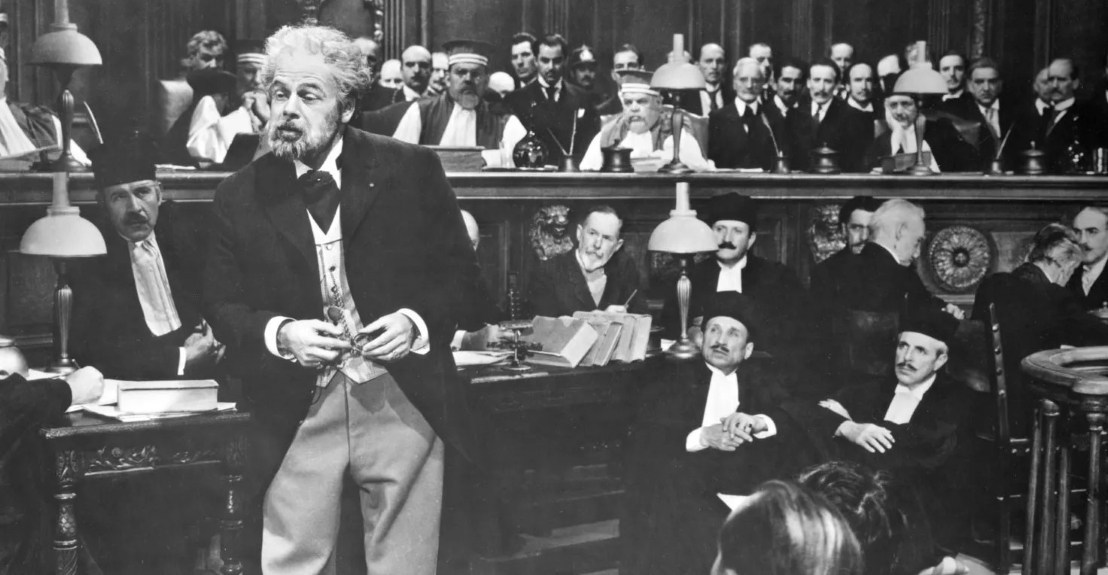
Dieterle’s movie is also one of the first courtroom dramas. A large chunk of the final third is given over to Zola’s trial for libel (after his famous J’Accuse article, denouncing the army’s persecution of Dreyfus). In a crowded courtroom, the film carefully follows the intricacies of the court case, from calling to witnesses to final speeches (all fairly accurate, even if Zola is given a larger role with a final speech). As in the trial itself, the blatant unfairness (witnesses shouted down, defence questions vetoed, evidence withheld and even invented) is hammered home with shocking regularity. Donald Crisp does fine work as the liberal lawyer, hamstrung by a crooked system.

The Dreyfus affair element is really what makes the film come to life. The French army officers are almost to a man a group of corrupt bullies, who have pre-decided the outcome of their investigation and are determined that every single element of it should support that decision. By contrast Joseph Schildkraut (winning an Oscar that feels more for Dreyfus than him, delivering an effective if rather one-note performance) is the soul of decency and nobility as a Dreyfus who is at first bewildered then fighting a manful struggle against despair. Even better is Gale Sondergaard, who gets an ahistorical impassioned speech to win Zola to the cause and carries a core of quiet anger under her shock.

The Dreyfus Affair was the struggle of Zola’s life, the crusade that would win him a place in history, perhaps even more than his books. It’s also the sort of campaigning material that gives rich rewards to actors. Paul Muni seizes the opportunity. The film was shot in reverse so Muni would need to spend less and less time in make-up as shooting went on: the old-age make-up and wigs are very effective, matched by Muni’s physicality and voice which subtly changes as the character ages.

Muni is an actor who seized any chance for a bit of grandstanding. The film gives him its best one with a five-minute monologue closing the trial, during which Zola argues with passionate but quiet reasonableness that Dreyfus is an innocent victim. It’s even more effective since Dieterle has kept Muni silently off-centre for much of the court case. Muni sometimes carries the whiff of stagey ham, but in several moments he brings both a charming cheek and strong morality to Zola. It’s a very strong performance from one of the leading actors of the 1930s.

The film itself is also a good mixture of the twee and the compelling. Most of the Dreyfuss material falls into the latter category. It’s the early days of Zola that falls into twee: Zola scrippling ideas, bantering with Cezanne on the purpose of art, playfully mining prostitute Nana for the material he will make into a hit book. There is a nice foreshadowing through the film with Zola’s obsession with blocking draughts – an obsession that will later cost him his life to a misfunctioning heater.

It’s a well directed film. Dieterle mixes in nice touches of humour (a husband and wife using subterfuge to disguise from each other that they are both buying Nana) and also effective details that speak of Dreyfus’ isolation (the letter that has been redacated into nothingness, the effective transition of several years at Devil’s Island that stresses how little has changed, Dreyfus’ giddy joy when finally allowed to walk unheeded in and out of his prison cell).

The Life of Emile Zola looks today like a surprising winner of Best Picture. But the patterns for both courtroom drama and many biographical dramas were laid down here. By the end, as the survivors pay tribute to Zola with high-blown speeches, the audience should be convinced that this was a man deserving of being honoured by a whole movie. It’s setting of a template copied many times over can make it look a little twee today, but its’ still well done, with some powerful flashes of effective film-making and great acting.