Tag: Peggy Wood

A Star is Born (1937)

A Star is Born (1937)

One of the first iterations of the tale, and with two winning performances one of the best

Director: William A Wellman

Cast: Janet Gaynor (Esther Blodgett/Vicki Lester), Fredric March (Norman Maine), Adolphe Menjou (Oliver Niles), May Robson (Lettie Blodgett), Andy Devine (Danny McGuire), Lionel Stander (Matt Libby), Owen Moore (Casey Burke), Peggy Wood (Miss Phillips), Elizabeth Jenns (Anita Regis), Edgar Kennedy (Pop Randall)

A Star is Born wasn’t the first time this story was told and it certainly wasn’t the last. Each generation in Hollywood has produced its own version of the story, not to mention a gallery of other culture creating their own unofficial and otherwise remakes. What Price Hollywood had even effectively told the same story five years earlier, and the entire concept has the air of a medieval ‘fortune’s wheel’ – two souls bound together, one goes up as the other goes down. There may in fact not be nothing new about A Star is Born at all but gave such a bright new polish to the familiar, that we’ve been inspired to come back to it again and again.

In the farmyard sticks, Esther Blodgett (Janet Gaynor) has a dream:  to become one of those stars of Hollywood’s silver screen. With grandma’s (May Robson) money in her pocket (‘What have I got to spend it on?’) she heads to Los Angeles, only to find the city is awash with similarly starry-eyed dreamers desperate for a big break. Esther gets hers in an unusual manner: serving drinks at a Hollywood party she strikes up conversation with famous star Norman Maine (Fredric March). Norman is very taken with Esther – in fact he’s almost immediately in love with her – and arranges a screen test. Soon Esther has a new career, a new name – Vicki Lester – and a new marriage to Norman. Problem is, as her star rises and she becomes the next big thing, Norman stops letting “his acting get in the way of his drinking” and his career slides into oblivion.

It’s high romance, very effectively filmed by Wellman, that requires – and gets – two very strong, highly relatable performances from its leads. Wellman’s film carefully gives both of them the space to grow a relationship that begins shyly and becomes deep and tender. Gaynor is bright, naïve and gentle with just enough ambition and determination to impress. She’s eager to please, but also firm and knows her own mind, far from a pushover in this town of press releases and media spin. Gaynor never lets us forget that under ‘Vicki Lester’ there’s that ordinary Esther Blodgett (could there be a more grounded, less starry name than Blodgett?), a woman with principles in a world of fakes.

Perhaps even better though is Fredric March (it’s the first indication, borne out by nearly all the remakes, that Norman is the better part). March is charismatic, engaging, funny, down-to-earth and everything you would want from a star – while also being a mean drunk with anger management issues. He’s introduced getting into a drunken scuffle at the Hollywood Bowl, and his love of booze makes him just as likely to laugh and flirt with Esther as it can make him take a slug at a guy who looks at him the wrong way. March’s drunk acting is very effectively restrained and he captures extremely well the self-disgust behind Norman at his weakness. March makes him a star who burns away his career through appalling choices, who fervently believes he can stay on the wagon until he can’t. In his hands it becomes a classic tragic piece, a Greek hero destroyed by his fatal flaw, his inability to escape the bottle.

This rich romantic tragedy builds wonderfully, Wellman keeping us deeply invested in this couple. The good times are really endearing: it’s hard not to grin along as they laugh and joke in a camper van after their elopement, or as they cover each other with encouragement and support for their careers. It makes the bad times unbearably painful: Norman’s drunken crashing of Esther’s Oscar win, a shambling monologue of self-pity and resentment, both heartbreaking and excruciatingly embarrassing. Norman’s fateful final decision is full of romantic imagery, as he smiling walks towards a sun-kissed beach, a beautifully staged inversion of a romantic ending.

A Star is Born’s other most interesting feature is its inside glimpse at Hollywood: or at least the version Hollywood was willing to present of itself to people. It even has a meta-theatrical element to it, the film book-marked by images of the shooting script describing the action immediately following or preceding it. Here Hollywood is a ruthless machine, chewing up the dreams of wannabes. An agent bluntly shows Esther the vast numbers of phone calls of wannabe extras they receive every day. Esther struggles just as much as assistant director Danny (Andy Devine) to find regular work. Careers are made and broken by chance, whims or the reaction of the audience to your face on screen. Names in lights one month and being pasted over the next.

Hollywood loves to be cynical about itself. A Star is Born delightedly shows its spin operation as ruthless, cut throat and controlling, planting stories about stars, covering up their misdemeanours (a regular requirement for the drunken Norman) and repackaging their lives into saleable commodities. Lionel Stander, as a heartlessly controlling press agent, is the heart of this, and the film doesn’t hold back on showing the dark powers of these studio fixers in action. But this is just a version of Hollywood: its telling that in A Star is Born while the middle management are condemned, the studio heads are absolved completely. Adolphe Menjou’s Selznick-like producer is an avuncular, uncle-like figure, endlessly caring and supportive of his stars who wouldn’t dream of any funny games to earn some money. This is a portrait of Hollywood where the top man is an affectionate saint – exposure only goes so far.

A Star is Born is also an interesting time capsule. Esther stares in admiration at a host of Hollywood Avenue stars of people must of the viewing public today would struggle to name (Norman Cantor anyone?). Seeking to impress while serving at a dinner party she’ll do impersonations of Garbo, Hepburn, Crawford and Mae West (the last even named). It’s a world where the continual production of content is even more on-going than on Netflix and the studios can start or end careers instantly. It’s a fascinating extra piece of interest in a highly effective, well-staged film. Even with its slightly murky early colour photography (it looks like a colourised black and white film), it’s a well-staged, effective romance with two very winning performances from its leads. Possibly one of the best versions of the story.

The Sound of Music (1965)

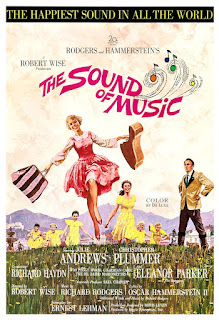
The Sound of Music (1965)

It’s the classic, feel-good film that seems to divide people than few others

Director: Robert Wise

Cast: Julie Andrews (Maria von Trapp), Christopher Plummer (Captain van Trapp), Eleanor Parker (Baroness Elsa von Schraeder), Richard Haydn (Max Detweiler), Peggy Wood (Mother Abbess), Charmian Carr (Liesl), Nicholas Hammond (Friedrich), Heather Menzies (Louisa), Duane Chase (Kurt), Angela Cartwright (Brigitta), Debbie Turner (Marta), Kym Karath (Gretl), Daniel Truhitte (Rolfe)

Has there been any film in history that has aroused feelings as strong as this one? Busloads of tourists conduct pilgrimages to Salzburg to follow in its footsteps – it’s a bigger draw than Mozart. Sing-along performances are attended by people in costume who know every nuance of Do-Re-Mi. On the other side, those who loath this musical, do so with the burning heat of a thousand suns, practically cheering the Nazis on or choking back vomit at the opening note of Edelweiss. It was ever thus: The Sound of Music was slaughtered by critics – Pauline Kael called it “the sugar-coated lie people seem to want to eat” – but became a box-office phenomenon, one of the most popular films ever and gilded with Oscars aplenty.

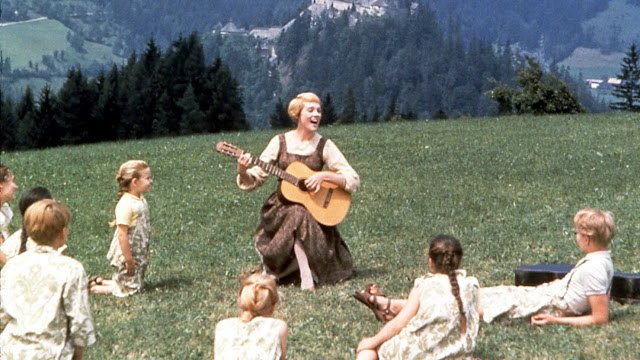
It’s loosely based on the real-life experiences of the von Trapp family. Maria (Julie Andrews), a young novice, arrives at the home of the widowed Captain von Trapp (Christopher Plummer) to serve as nurse for his seven (count em!) children. Von Trapp runs his house (literally) with military precision, but Maria introduces some fun into the children’s life. And, to his surprise, the Captain’s life as he finds himself drawn towards the wholesome and sweet Maria instead of his initial intended, the Baroness von Schraeder (Eleanor Parker). Marriage is inevitable – but then the family finds itself in a terrible position as the Anschluss weds Austria to Germany and the Captain is ordered to take up office in the Nazi navy. Will he do so – or will the family escape over those hills?

You would probably be fair to call The Sound of Music one of the most manipulative films of all time. But then aren’t films supposed to be about manipulating our emotions for effect? On that score you could possibly call it the greatest film ever made. I won’t, but there is a sentimental, feel-good charm to The Sound of Music that – in small doses (and some people watch this multiple times a year – once every few years is surely enough!) – can really hit the spot in the way few other films can. Sure, it tugs on your heart strings with never a trace of subtlety, but basically it’s heart is very much in the right place. It’s a kind, gentle music that, for all its treacle, is a tribute to warmth, love and family. Perhaps that’s why it’s been so embraced by so many.

Even the cast were aware it could all tip over the edge into outright sentimentality. Julie Andrews was worried it might be a little too similar to Mary Poppins (she was right in a way – Poppins is a darker film, but the success of this cemented Andrews in people’s mind as the World’s nanny). Most famously Christopher Plummer overcame huge uncertainty to star, partly to practise his singing for a Broadway musical (as it happened he got dubbed), partly on the promise he could add a tougher edge (no sign that happened). Plummer’s hate-tolerate relationship with the film is famous (he called it The Sound of Mucus) and at several points in it he is all too obviously only just avoiding sinking his head into his hands, but he even he eventually acknowledged any film that moved people as much as this, must have done something very right indeed.

It’s that emotional investment people make in this film that lifts it eventually above criticism. It’s a long film, with a slender plot. But it mines this plot for every single touch of emotional investment. It’s the ultimate triumph of one of Hollywood’s most reliable middle-brow directors, Robert Wise. Taking over from William Wyler (who just couldn’t get interested and left to make the almost diametrically opposite The Collector), Wise successfully keeps the momentum flowing and shoots the film in an economical way that lets the songs do their work. He still finds room for classic shots: that helicopter shot sweeping into Julie Andrews running up the hills is just about perfect (Andrews was literally blown over every time by the helicopter, explaining the sudden jump cut edit for her famous twirl and burst into song). Wise’s editing skills really come into play with Do-Re-Mi that cuts the song across several locations and he makes excellent use of a number of Salzburg locations (for which the tourist board thanks him).

A major part of the film’s success though must surely be directly connected to Julie Andrews. This is a career – perhaps even a life – defining performance. And even the most cynical watcher can’t help but admit Andrews is a superb, gifted performer. Her singing is beautiful, and very, very few performers could have managed to make Maria charming, sweet and someone who want to hug, rather than twee or slappable. Andrews makes you really invest in every single event in the film: she’s hugely endearing (from singing in those hills, to her little stumble of excitement as she runs from the Abbey to take up a job at the von Trapps), she’s completely unaffected and when she’s hurt (by her seemingly hopeless love for the Captain) you just want to give her a hug.

No wonder the children love her. Who wouldn’t? Sure, the film’s weakest beat might well be its romance between Andrews and Plummer (for which Plummer is mostly to blame), but it captures a wonderful sense of family loyalty and protection. Everyone, at some point, is a sucker for stories where sad and lonely children are introduced to a life where they can mess around and have fun – and get that emotional investment the Captain has (accidentally) denied them. After spending the first two hours of the film getting to know this family and seeing it come together, we feel even more intently their fear and panic at being forced into goose-stepping line with Hitler’s war machine.

The film’s final sequence around the Abbey is also surprisingly tense: the family sheltering behind tombs and trusting in the half-truths of the Nuns and the wavering loyalties of wannabe SA officer Rolfe to make their escape. Wise’s films successfully communicates the stakes. It also mixes in some comedy even here: the final lines going to the Nuns confessing their sins of sabotaging those Nazi cars. All this before we go back to where we started – Maria walking the hills, full of music, this time accompanied by a beloved new family.

It’s that desire to be part of a loving family that perhaps explains why The Sound of Music has been so popular – and why so many people turn to it for comfort time and again. With its heart-warming songs and themes, it’s a warm comfort blanket that makes people feel part of its loving family. You can’t argue against it being manipulative – but that’s the nature of films, and manipulation as effective and good-natured as this is a sort-of triumph of film-making art.