
Davies beautiful memory piece is quite unlike any other film in its poetic virtuosity
Director: Terence Davies
Cast: Pete Postlethwaite (Father), Freda Dowie (Mother), Lorraine Ashbourne (Maisie Davies), Angela Walsh (Eileen Davies), Dean Williams (Tony Davies), Jean Both (Aunty Nell), Michael Starke (Les), Debi Jons (Micky), Chris Darwin (Red), Pauline Quirke (Doreen)

When we study the past and our memories, we see an assortment of recollections of events and motionless snapshots of moments in time. The past can feel both distant and still, a long-ago series of happenings that our mind constantly shuffles and reinterprets depending on circumstance and situation. That vibe lies at the heart of Terence Davies’ poetic dive into that foreign land of memories, where events, people and snatched moments combine, shift and contrast in a visual attempt to reproduce our own sifting of our past lives.
Distant Voices, Still Lives follows the post-war lives of a working-class Liverpudlian family. Father (Pete Postlethwaite) is a depressive tyrant, who oscillates between moments of tenderness and acts of extreme violence. Mother (Freda Dowie) is a saint-like victim, who tries her best for her children. Maisie (Lorraine Ashbourne), Eileen (Angela Walsh) and Dean (Tony Davies) grow up, marry and forge their own lives in the community, sometimes repeating the mistakes of their parents, all in largely warm and welcoming working-class community.
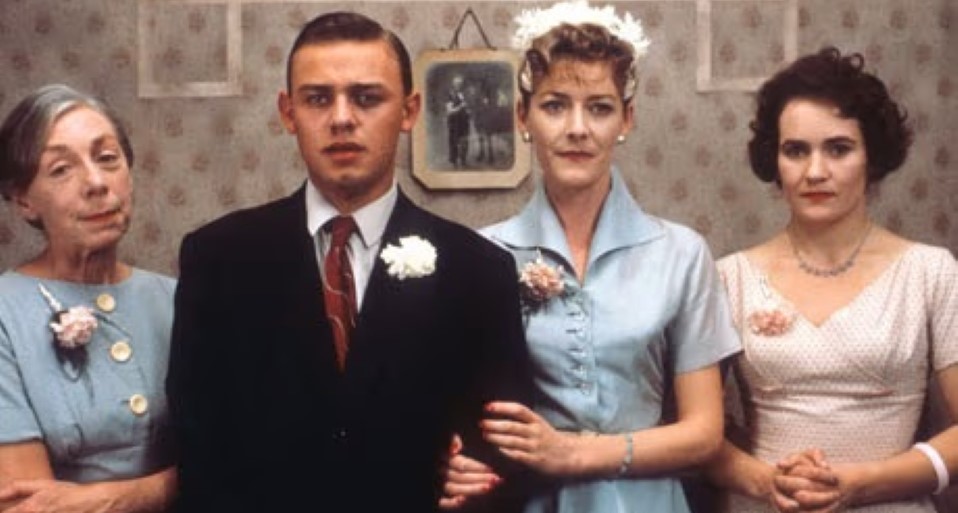
Terence Davies based much of Distant Voices, Still Lives on his own upbringing and memories of his family (a framed photo on the wall is of Davies’ own father). Shot with a rich, slightly sepia-toned classicism, the entire film replicates both the random workings of memory and watching a carefully constructed slide show. Events frequently are only tangentially connected to those preceding and following them: a memory of a marriage in the family, activates memories of the now-absent father at both his best and worst, a Christmas when he was affection itself, another when he overturned the dining room table in a sudden fury and demanded it cleaned up. It continues throughout the film, the narrative sliding from pre- to post-war, dictated more by tone and mood than by narrative.
It requires that you pay close attention to Davies’ film, to sift yourself through its moods and subtle shifts in tone. It opens with a carefully managed tracking shot that takes us inside the family house at an unspecified time, then fixes on a still shot on the staircase, while we hear conversation all around us. Is this happening at the same time? Or are we merely hearing the echoes of conversations past? In this film the past is both all around us and tantalisingly out of reach. Distant Voices, Still Lives is made up of frequent stationary, carefully assembled shots that resemble Mitchell and Kenyon photos that suddenly spring into movement (the image of the family preparing the wedding looks so like a photo, it’s a shock when all four actors suddenly walk out of frame). It’s a reminder that, to many of us, the past is a series of still lives, frozen in time.
Around everything, in a Dennis Potterish touch, is wrapped a musical backdrop of songs from the 40s and 50s. These tunes bring people together, knit together memories and (perhaps) even cover over and confuse events. Music is crucial in unity, the family and their friends frequently breaking into extended sing-alongs to popular tunes in the pub. It provides moments of warmth, closeness and intimacy – moments of mutual joy – which perhaps covers and balances the complex relations and struggles at home. It also makes the film often feel like an odd musical, like a sort of living slide show of images scored by the classics of yesteryear.
Distant Voices, Still Lives can be seen as a sort of poetic art installation, with its balance of still images bought to life and its poetic rhyming of events and persons. But it manages to involve the viewer, because it’s a very human film. There is real warmth and compassion in these memories and reflections. The love of a family, pulling together to survive trauma at home. Those moments of release in singing. The joy and delight – and tears – of coming together to watch a film at the cinema, swept up in the big screen emotion and imagination. Davies also finds a simple, pure beauty in the everyday: watching mother carefully tend and clean the house takes on a strange, natural beauty and power in the care and tenderness that lies behind it.
That’s particularly striking, considering the unflinching horror at home. Pete Postlethwaite is extraordinarily terrifying as a deeply unhappy and depressed man, who can process his complex feelings (and even, bizarre as it seems, his love for his family) only through anger and violence. He viciously beats his children and (in one terrible scene) his wife. He is charming and sweet with their friends. He oscillates between affection and fury. His children – particularly his son – are torn between despising the old man and wanting something – anything – from him in the way of affection. (Eileen will later bemoan his absence – due to death – at her wedding, to the disbelief and anger of her brother who often bore the brunt of his beatings). Davies’ film carries real power in its opening half, dominated by Postlethwaite’s tragic dark-heart, the ruler and gate-keeper of his home until his health collapses and he reverts to vulnerability.
The terrible impact on mother – beautifully played by Freda Dowie, in an extraordinary performance that feels like it’s been pulled direct from Davies’ memory of his own mother – dominates the emotional thread of the film. It also adds a dread to the possibility that Eileen’s own husband shows traces of jealousy and violence. But then the world is one of danger: the war could have ended the lives of the whole family (there is a striking sequence where they run trying to find their parents during an air raid warning, before finally finding the shelter and being greeted with relief and inevitable anger by their father). An accident nearly cripples Dean and Maisie’s husband – it’s echoes recurring throughout the film. Echoes touch nearly every moment of Davies film, flashes of memories activated by memories pulling together the film into an engrossing and heartfelt tapestry.
But the film’s real impact comes from the humanity that grounds it. It perfectly captures a moment of time, the bonds and interdependence of a working-class community in a film extraordinarily textured into something like a fictional documentary. The film is crammed with small moments of joyful intimacy, among the trouble and strife: friends laughing together, joy in music and film, laughing faces at shared jokes. All of this is shot with an exactitude that never manages to squash the tenderness at its heart. It’s a uniquely artistic, inventive and warm exploration of memory and time, with very few films even remotely like it – and rewatching it is a reminder of what a loss to cinema Terence Davies, a truly unique film-maker, is.








 Movie Musings