Tag: Peter Cushing

Alexander the Great (1956)

Alexander the Great (1956)

An odd epic, which both loathes its subject and also presents him as a golden-boy

Director: Robert Rossen

Cast: Richard Burton (Alexander the Great), Fredric March (Philip II), Claire Bloom (Barsine), Danielle Darrieux (Olympias), Barry Jones (Aristotle), Harry Andrews (Darius), Stanley Baker (Attalus), Niall MacGinnis (Parmenion), Peter Cushing (Memnon), Michael Hordern (Demosthenes), Marisa de Leza (Eurydice), Gustavo Rojo (Cleitus the Black), Peter Wyngarde (Pausanias), William Squire (Aeschenes)
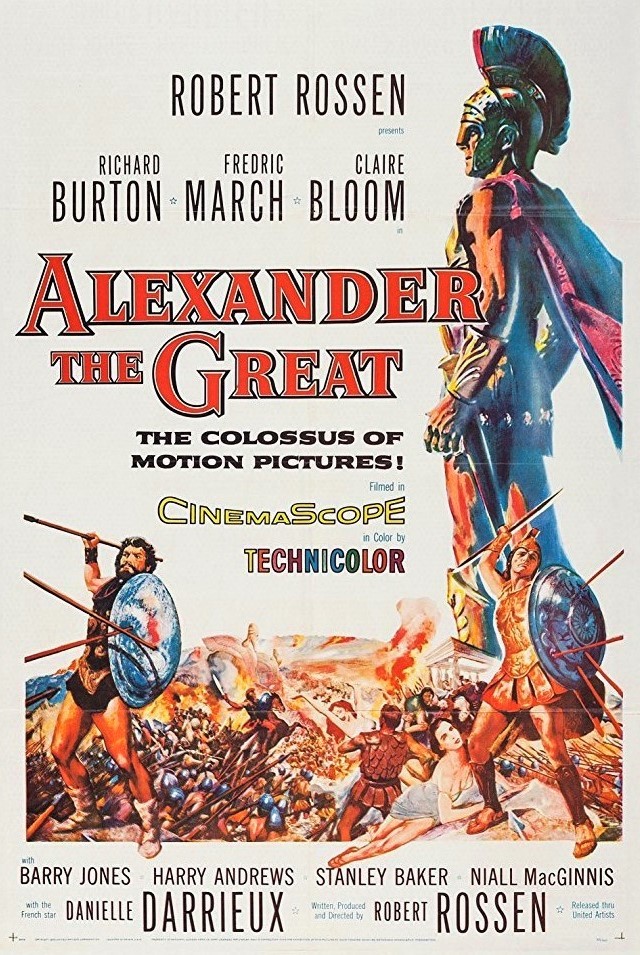
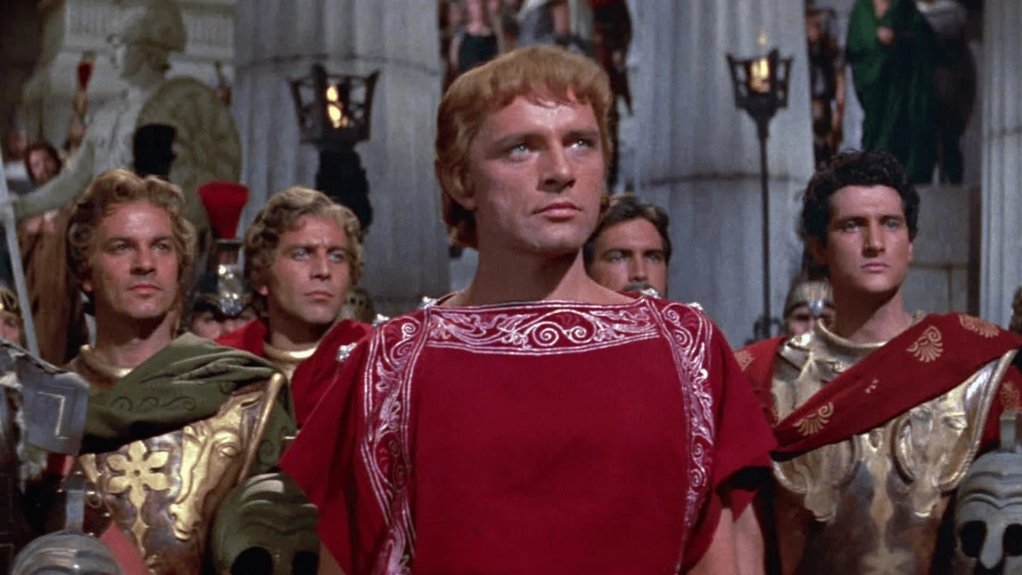
No one in history achieved so much, so young as Alexander the Great. He conquered most of the known world before he was thirty and left a legend that generations of would-be emperors found almost impossible to live up to. He did all this, while remaining a fascinatingly enigmatic figure: either a visionary nation-builder or a drunken man of violence, depending on who you talk to. Alexander the Great, in its truncated two hours and twenty minutes (sliced down from Robert Rossen’s original three-hour plus) can only scratch the surface of his story and that’s all it does.

As the great man, Richard Burton flexes his mighty voice in a film that splits its focus roughly equally between the early days of Alexander and his troubled relationship with both his father Philip II (Fredric March) and his mother Olympias (Danielle Darrieux) and his own kingship and conquest of the known world until his early death. Surprisingly, perhaps because the world is so vast, it’s the first half of the film that’s the most interesting – perhaps because showing up the internecine dynastic squabbles between petulant royals are more up director and writer Rossen’s alley than global dominance.

Perhaps as well because it feels pretty clear Rossen doesn’t particularly seem to like Alexander. Over the course of the film, the pouting monarch will prove to have a monstrous ego (even as a teenager fighting Philip’s wars, he cockily re-names a sacked city after himself), ruthlessly slaughters opponents after battles, is prone to fits of rage, informs his followers with wild-eyes that he’s God himself, leads his army into the dried out hell of the deserts of the Middle East and turns (at best) a blind eye to his mother’s plans to assassinate his father and then murder his father’s second wife and baby son.

The film culminates in a shamed Alexander kicking the bucket more concerned with maintaining his legend for future generations than assuring any kind of future for his kingdom. But the sense of hubris destroying the great man is never quite captured. This is partly because the grand figure we are watching lacks any personal feelings or fear. He can’t seem to experience loss or grief and only understands negative events in terms of their impact on his reputation. And he never seems to truly learn from this – even when he harms friends, his regrets are based around the impact such action will have on how those around him see him. At the same time, Rossen can’t quite follow his heart and make a real iconoclastic epic meaning he instead leaves titbits here and there for the cinema-goer to hopefully pick up among the spectacle.

As such, Alexander is still pretty persistently framed as we expect a hero to be, with a rousing score backdropping Burton’s speeches and poses, even while the film seems deeply divided about whether this guy who conquered most of the known world and lay waste to Babylon was a good or bad thing. While acting half the time like a egomaniac tyrant, the film still carefully partially shifts blame for his character flaws onto his mother’s Lady Macbethesque influence (Darrieux does a good line in whispering insinuation) or Philip’s bombastic egotism (March, growling with impressive vigour).

Rossen has far more admiration for people like the fiercely principled Memnon (a fine Peter Cushing) who refuses to compromise only to be rewarded by a post-battle one-sided butchering from Alexander after his offer to surrender and spare the lives of his men is turned down. Even Michael Hordern’s Demosthenes comes across as a man of principle, certainly when compared to Alexander’s Athenian-of-choice Aristotle, interpretated here as a pompous windbag cheer-leader for dictators. Oddly even Harry Andrews (possibly, along with Niall MacGinnis’ wily Parmenion, the films finest performance) as Darius comes across as a man of surprising human doubt under his regal exterior. But, perhaps because of choppy-editing cutting down a complex story into just over two hours, Alexander the Great can’t resist framing its hero as a sun-kissed golden-boy, towering above everyone else in the film.
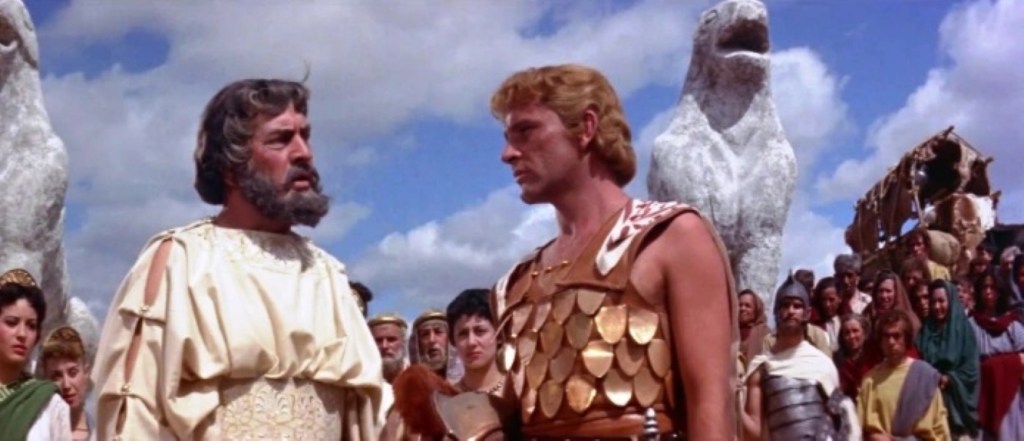
Watching Alexander the Great you get the feeling the film has effectively entombed him as a marble statue, so devoid is he of fundamental humanity. Perhaps this was Rossen’s solution to shooting a film about someone he seemed so devoid of human interest and sympathy for. There is a reason why Charlton Heston – the first choice for the role (can you imagine!) – called Alexander the Great “the easiest kind of picture to make badly”. Frequently Alexander the Great tips into a sort of sword-and-sandles camp made worse by how highly serious it takes itself. Not helped by Burton’s all-too-clear boredom with the part and contempt for the material, Alexander strikes poses and delivers speeches as if he’s been ripped straight out of Plutarch or a bust display in a museum.

Apart from rare moments – usually in the first half as he processes his complex feelings of love and loathing for his overbearing father – he is almost never allowed to be human. His friends – most notably his famed best-friend (and lover) Hephaestion – are reduced to a gang of largely wordless extras and only Claire Bloom’s Barsine is given any scope to talk to him as if he’s a man rather than just a myth. It gets a bit wearing after a while as you long for something human about the man you can cling onto.

It’s also a shame that Rossen seems uncomfortable with shooting the battle sequences. The battles of Granicus and a combined Issus-Gaugamela look rather like damp scuffles over shallow streams than some of the mightiest clashes of the Ancient world. Rossen communicates no visual sense of either strategy or scale (despite the bumper budget). Similarly, the grand sets look too theatrical and never quite as impressive as they should do, despite some fine painterly compositions. Rossen can never quite find a way to make his hundreds of extra seem like thousands and he falls back in the second half to communicating Alexander’s success through a tired combination of map montages, voiceover and repeated shots of men marching left to right and burning cities.

Alexander the Great is a deeply flawed epic. It’s neither swashbuckling fun that bowls you along, or a breath-taking piece of historical spectacle. Nor is it psychologically adept or insightful enough to show you something truly different about its hero. Instead, it tries to straddle both ways of thinking and ends up collapsing in the middle. If only Rossen had found his own Alexanderian solution to cutting this Gordian knot. Instead, the film just ends up a cut-about mess that fades from memory all too soon.

Hamlet (1948)

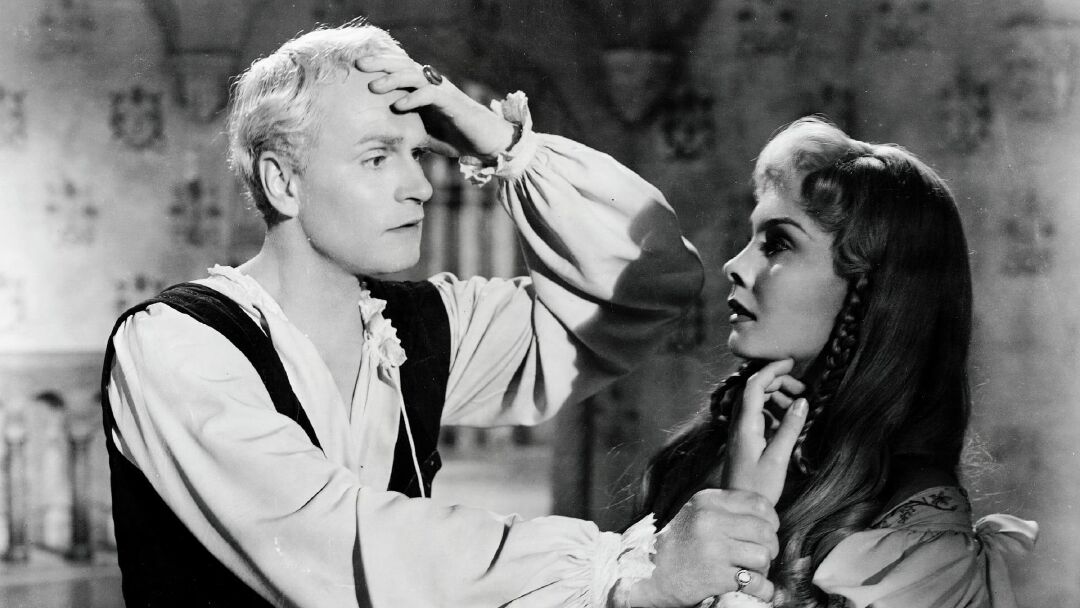
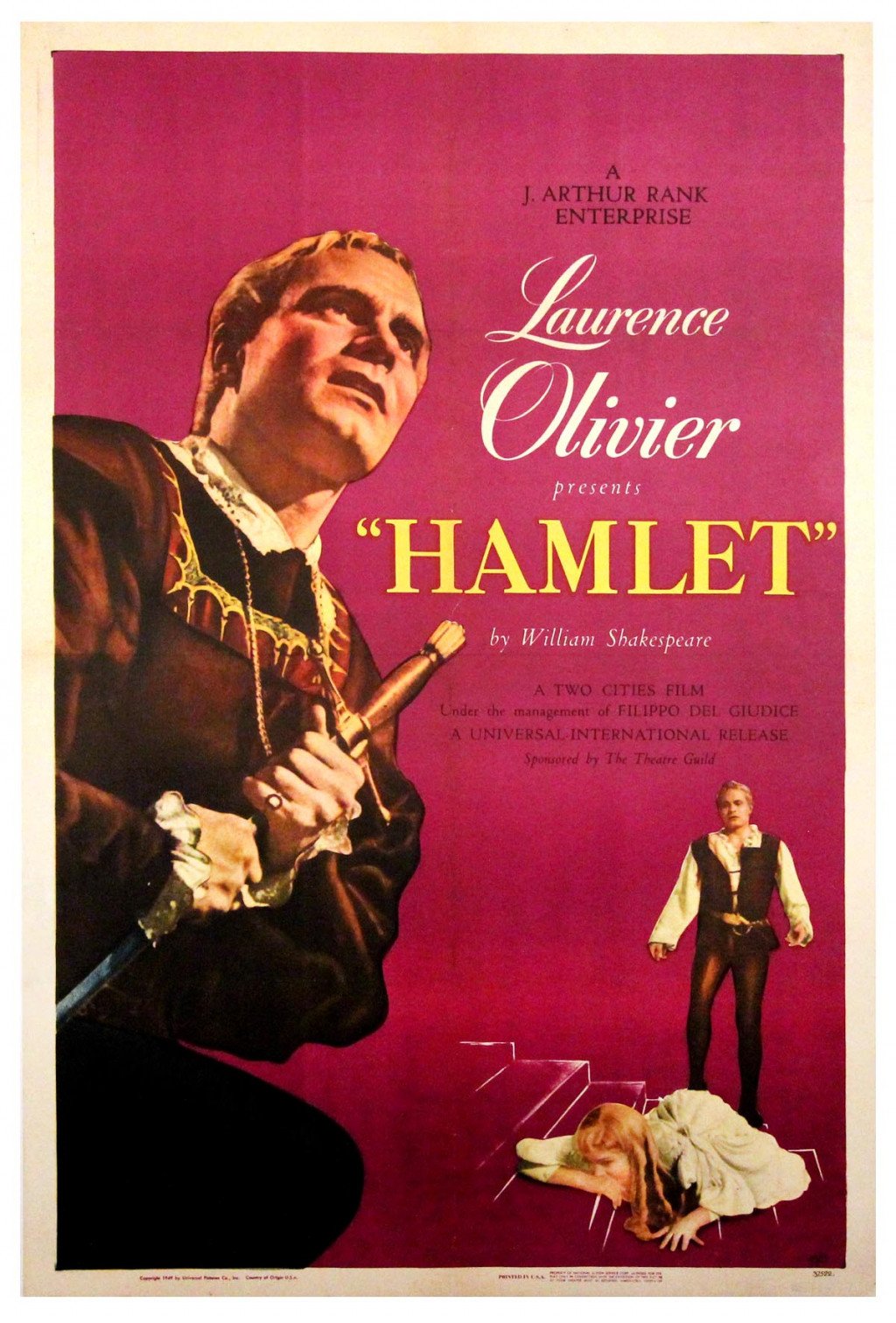
Laurence Olivier makes Shakespearean cinematic history in Hamlet

Director: Laurence Olivier

Cast: Laurence Olivier (Hamlet), Basil Sydney (Claudius), Eileen Herlie (Gertrude), Jean Simmons (Ophelia), Felix Aylmer (Polonius), Noman Wooland (Horatio), Terence Morgan (Laertes), Peter Cushing (Osric), Stanley Holloway (Gravedigger), Anthony Quayle (Marcellus), Esmond Knight (Bernardo), Russell Thorndike (Priest), Harcourt Williams (Player)

Close your eyes and picture Hamlet – chances are you will see an image inspired by Olivier. Olivier’s second Shakespearean directing outing coated him in plaudits. He became the only actor to win an Oscar for Shakespeare (and, until Roberto Benigni, the only actor to direct himself to an Oscar) and the film itself became the first non-American film to win Best Picture. Hamlet will live forever, a corner-stone production of the play and a part of Shakespearean and cinematic history. It skilfully weaves together theatre and cinema and still works as a cracking production of the play.

To bring it to the screen, Olivier made some big calls. Smaller parts were cut to ribbons (particularly the Player King) or in many cases (I’m looking at you Rosencrantz and Guildenstern) excised all together. Over half the dialogue cut, with the focus being bought onto domestic tragedy (the politics of Fortinbras is never mentioned). This is a family tragedy, and a Hamlet-centric production, where Claudius is a jovial villain and Gertrude a mother with confused feelings for her son.

Oliver set this in a sprawling medieval castle using the best elements of theatre and cinema. The sets are beautifully constructed: winding corridors, towering halls and imperious battlements provide the sort of realist set Olivier could only dream of in the theatre. But Olivier (and photographer Desmond Dickinson), lights this with the moody intensity of film noir. Shadows dominate the castle and the frame, frequently provide hiding places. Olivier’s debt to Wyler (and Welles) can be seen in his pictorial framing and use of deep focus, while domestic tragedy in a grand house has more than a few calls backs to Hitchcock’s Rebecca. Frequently shots show an actor in the foreground, being observed in long shot by a second actor in perfect focus.

It also takes inspiration from expressionist cinema, especially in its mist-laden battlements, with some neatly surreal touches. The Ghost (whose voice, heavily distorted, is also Olivier’s) is a shadowy demonic figure, emerging shrouded in mist. A wonderful series of shots sees the camera seem to soar away from the throne room steps where Ophelia weeps, through the castle towers, into the sky and then down towards Hamlet staring at the waves at the foot of the cliff, passing through his skull where the image of the crashing waves is overlaid across the interior of Hamlet’s skull. It’s a more effective use of visuals than the film gets credit for.

For all its traditional trimmings – cod-pieces and men-in-tights abound – it’s easy to forget how influential this was. It cemented for years a view of Hamlet as a man wracked by indecision and made it standard to see Gertrude and Hamlet locked in Freudian-inspired Oedipal lust. The first idea came from the opening narration’s reductive phrase “This is a tragedy of a man who could not make up his mind”. It’s an odd statement to make – especially as Olivier’s Hamlet hardly seems wracked by indecision – but it matched a perception of the play so, true or not, it stuck.

That relationship between Hamlet and Gertrude adds a perverted romantic twist to the bedroom scene between the two (you can sense the inspiration of Wyler’s Wuthering Heights), with the film frequently framing the encounter with romantic angles. Eileen Herlie, for all the unflattering make-up and filming, looks all too much like Hamlet’s contemporary rather than mother (Herlie was in fact nearly 12 years younger than Olivier). While the scene does have a little too much heavy-breathing – and Olivier overplays the heart-beat soundtrack as white noise – it’s an effectively unsettling balance of intimacy and incest. It also runs through the production – from Gertrude kissing Hamlet on the lips, to her conscious decision to drink the poison and protect Hamlet.

The production – partly driven by cuts – is fiercely Hamlet-centric. Olivier speaks most of the dialogue (all of Olivier’s films revolve around massive star-roles for himself, fitting his competitive dominance). His Hamlet is beautifully thoughtful, but also dynamic and energetic (not much doubt there). Olivier perfectly captures the intellectual, as well as the humanity, grace and charm. Some of the nuance of the soliloquies is lost by Olivier’s decision to deliver them in voice-over (although Olivier does a good job reacting along to the narration) – but fortunately “To Be or Not To Be” and his speech on Yorick’s skull remain delivered ‘live’, and coated in emotional honesty.

The rest of the cast are relegated. Sydney’s Claudius is little more than a scowling villain, Herlie has little presence. Norman Wooland makes a great deal of the loyal Horatio (a famously dull role), while Peter Cushing adds some comic energy as a foppish Osric. The best non-Hamlet moments go to Polonius and his children: Aylmer is the portrait of a doddering interferer nowhere near as smart as he thinks he is, while Morgan has a matinee idol energy as Laertes. Best of all is Jean Simmons, wonderfully heart-felt and fragile as Ophelia, whose gentleness dooms her.

Olivier might give himself most the best moments, but he allows plenty of directorial flourish elsewhere. There is a wonderful shot at Yorick’s tomb, where Hamlet’s shadow is cast over the skull, the skull seeming to become the shadow’s head. While a crane shot during Claudius-Laertes scheming is unwisely used twice in quick succession (more likely to raise chuckles), there is an impressive amount of camera movement and tracking shots. The production ends with a knock-out sword fight – and of course only Olivier would cap that with a life-and-limb risking dive from a platform. Olivier’s charisma is used brilliantly in these scenes, and while it’s not always quite clear emotionally what Hamlet is considering in these moments, his forceful presence drives the action and adds great weight to his final speech.

Because, this isn’t a film about a man not making up his mind. Sure, he’s a thinker – and one of the final shots brings us back to Hamlet’s chair, now empty – but when action is needed, this Hamlet grabs it. Just as Olivier grabbed the tools of cinema to create a production of the play that feels like a film. Some critics at the time were horrified that Hamlet should even be in the crude medium of film (Olivier took to calling it an “essay” on Hamlet) but today it stands quite rightly as both a great film and a key example of how to bring Shakespeare to the screen.

The Hound of the Baskervilles (1959)

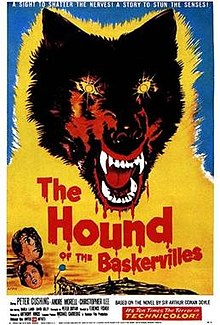
Hound of the baskervilles header
Peter Cushing is the great detective in The Hound of the Baskervilles

Director: Terence Fisher

Cast: Peter Cushing (Sherlock Holmes), André Morell (Doctor Watson), Christopher Lee (Sir Henry Baskerville), Marla Landi (Cecile Stapleton), David Oxley (Sir Hugo Baskerville), Francis de Wolff (Dr Mortimer), Miles Malleson (Bishop Frankland), Ewen Solon (Stapleton), John Le Mesurier (Barrymore), Helen Gross (Mrs Barrymore)

Arthur Conan Doyle’s most famous story hardly needs introduction. In 1959 it was told with a Hammer Horror twist. With its demonic dog, fog covered moor and blood-laden backstory surely no Sherlock Holmes story could be better suited to the studio. The film is fairly faithful to the basic outline of the original, although with added tarantulas and (more controversially) a new villain.

But it all works pretty much a treat, largely due to the performances of Cushing and Morell as Holmes and Watson. Cushing’s Holmes is sharp, analytical, has bursts of energy mixed with impatient distraction. Cushing went back to the stories and threw in many small details – from lines from Doyle to physical moments such as securing notes to the mantelpiece with a knife. His Holmes also uses rudeness in a Doylesque way he rarely does in film. Cushing has the intelligence and dynamism of the Detective – he’s one of the more overlooked actors to play the role – and had been determined to be faithful in his interpretation (sadly sequels were not forthcoming, although Cushing played the role several more times on the BBC).

Morell also returned to the novels to present a Dr Watson who was smooth, professional, assured and competent if uninspired. It was a far cry from the blundering buffoon which – thanks to Nigel Bruce – the public expected from Holmes’ faithful Boswell. Morell’s more patrician style made him a fine contrast with Cushing’s bohemian tinged Holmes. The two actors also spark beautifully off each other and create a feeling of a genuine friendship, underpinned by affection and loyalty, frequently showing genuine concern for each other’s safety.

Aside from these two excellent performances in the leads, the film is a solid if not spectacular adaptation, competently filmed. Terence Fisher’s direction sometimes struggles to cover the cheapness of the enterprise and some sets convince more than others. For a film that is quite short, the pace sometimes slackens (the Baskerville legend in particular gets far too much screen time, probably connected to the presence of the buxom servant girl Sir Hugo is planning to bed). Moments such as an attempt to assassinate Sir Henry via tarantula in London (which makes no sense at all) provides decent moments of tension but are basically filler.

The film does manage to address some of the problems of the novel by introducing a greater sense of mystery, in particular by providing motivations for several characters. Saying that, just as in the novel (where the mystery is solved by Holmes travelling to Scotland and reading some records – not good drama), here much of the mystery is resolved by Holmes carrying out an off-stage conversation with convict Seldon. Much as in the book, Holmes travelling to the area incognito doesn’t really add much to the story other than providing a late reveal.

Better invention however comes in the introduce of a femme fatale in Marla Landi’s Cecile Stapleton, here re-imagined as a sexy, wild girl of undefined (and nonsensical) European origin. She sparks off a neat chemistry with Christopher Lee’s Sir Henry – here playing for the only time in his career not the villain but the romantic lead! – and her development late in the film presents a fresh take on the resolution.

It’s certainly a little more fresh than the eventual scuffle with the dog – which to be honest doesn’t look either that intimidating or convincing. The dog itself is rather underwhelming, and more threat is actually conveyed by the moor itself, a mysterious stretch of land coated in fog covering treacherous bogs.

What Fisher and Hammer do really well is atmosphere, and the gothic feel of the piece is pretty much spot on. There is the expected claret red blood – and a suggestion of something really grotesque which befalls a victim on the moor – mixed in with sexy ladies. It’s an exploitation twist on Holmes, but then the novel itself was basically pretty much a B-movie in text. And the fundamental story is largely unchanged, with both the virtues and vices of the book captured.

The finest thing about it is the acting. Several scene-stealing actors chuck in neat cameos. Le Mesurier is perfect as the reserved butler Barrymore. De Wolff is a sharp and arrogant Mortimer. Malleson steals his scenes as an absent-minded Frankland (here re-imagined as an eccentric cleric). Christopher Lee relishes the chance to play against type, making Sir Henry a pillar of upright, honest decency. But the real delight is Cushing and Morell as Holmes and Watson, a brilliant combination.

Moulin Rouge (1952)

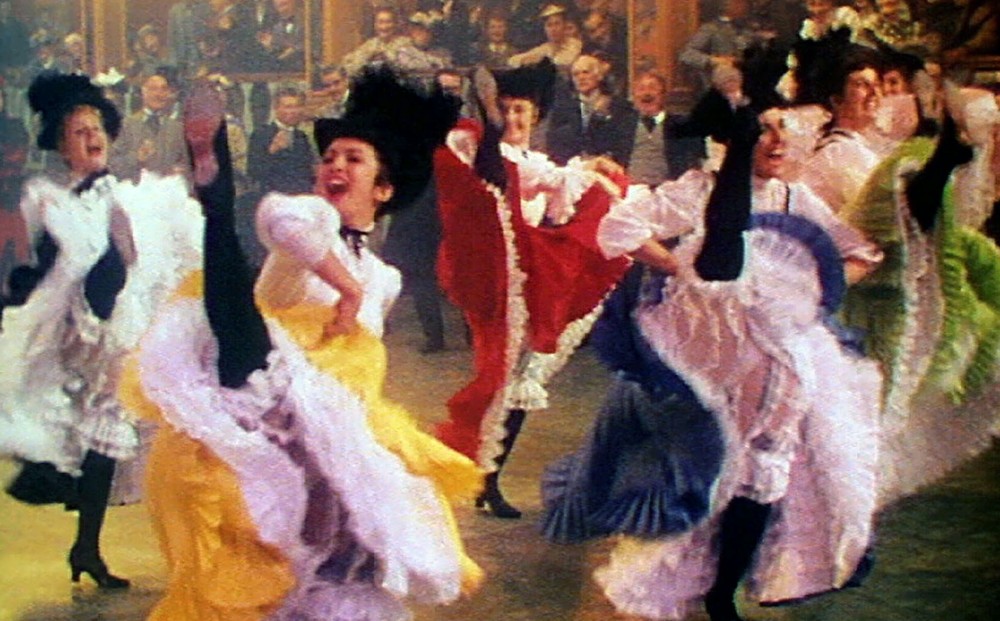
Dancers a go-go in John Huston’s Moulin Rouge (not that one!)

Director: John Huston

Cast: José Ferrer (Henri de Toulouse-Lautrec/Comte Alphonse de Toulouse-Lautrec), Zsa Zsa Gabor (Jane Avril), Suzanne Flon (Myriamme Hyam), Claude Nollier (Comtess de Toulouse-Lautrec), Katherine Kath (La Goule), Muriel Smith (Aicha), Colette Marchand (Marie Charlot), Georges Lannes (Sgt Patou), Theodore Bikel (King Milan IV), Peter Cushing (Marcel de la Voisier), Christopher Lee (Georges Seurat)

John Huston’s biography of Toulouse-Lautrec is less well known than its exclamation marked name-sake. It would be easy to say there is little in common, beyond the name and setting, between Huston’s film and Luhrmann’s operatic jukebox musical. But that’s to overlook the sprightly and confident shooting that Huston gives many of the scenes in the Moulin Rouge, and the mood of depression and corruption that underlies all the glamour of the club. These are two films very much drinking from the same well – even if the aesthetic and style of both are drastically different.

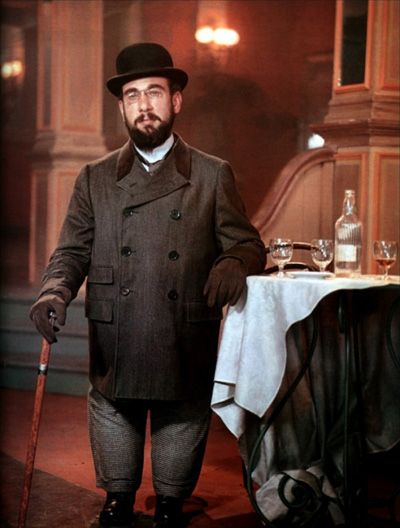
This artist biography focuses mostly on the last decade of Toulouse-Lautrec’s life. Played by José Ferrer (who also does double duty as the artist’s patrician father), it’s an exploration of the self-loathing and depression that drives the artist and funnels itself into his art. Art which is bold, animated with strikingly unique use of colours and movement. It’s all very different from the more timid, self-conscious crippled artist, the growth of whose legs was arrested after an accident in his childhood. Huston’s film front-and-centres Toulouse-Lautrec’s quest for love, but it has enough to say about the rest of its subject’s life.

Similar to his later work on Moby Dick, Huston aimed for a very particular look for his film, inspired by the colours used in the artwork of its subject. Shooting in Technicolour – and much to the objection of that company, who believed all films should showpiece it’s particularly striking bold colours rather than the muted colours Lautrec at times used – he manages to assemble a picture that feels like it completely captures not only the style of the artist, but also captures something of the more grimy and seedy side of the Parisian streets he walked. There is a neat little scene in the middle of the film where Lautrec argues with a printer over mixing his own specialised colours, rather than the more traditional colours he works with. Hard not to see that as a commentary on Huston’s own struggles with Technicolour.

It gives the film though its own very distinctive look, in which Huston uses a number of cinematic approaches that really capture the vibrancy of the Moulin Rouge. The opening scenes, that showcase a flashy can-can dance at the club is shot with immediacy, the camera roving in amongst the dancers, throwing us into the atmosphere and excitement of this ground-breaking night club. Alongside which – within the confines of the Hay’s Code – we get a sense of the sexuality of the nightclub, captured in the tempestuous clashes between the dancers and the pettiness and suddenness of feuds that spring up over every subject matter.

The film doesn’t quite continue all this vibrancy in the rest of its length as it focuses more on Lautrec’s own personal life. José Ferrer, always a distantly patrician actor, is perhaps a little too stilted to really invest us in the emotional pain of a man who didn’t believe he was worth loving. However his commitment to playing the part physically can’t be faulted. To play the diminutive Lautrec, Ferrer wore a contraption that folded his lower legs up behind him (he could only wear it for about 15 minutes before he had to restore the circulation to his legs), wearing this even in scenes he could not be seen full length, so as to get the posture of Lautrec correct. It’s a shame that Ferrer’s slightly reserved manner and precision leaves you feeling like the character is being studied at arms length rather than up-close and personally.

This affects slightly the focus on romance that the film takes – art gets its place, but the style very much looks at these in context of romantic struggles. Lautrec is presented as man convinced of his own ugliness and the barrier of his disability, who could never find a woman who would love him. This drew him, it seems, either towards destructive relationships (in particular with a ‘prostitute’ – not that you would know thanks to the Hays Code – played with an Oscar-nominated richness by Colette Marchand) or to relationships he convinced himself could only be hopeless, platonic obsessions (Suzanne Flon as an art-lover who only the most self-loathing of men couldn’t tell is devoted to Lautrec).

The film interestingly rather misses a sense of fun that you might expect from a nightclub scene. Lautrec is of course miserable for most of his life, self-medicating his physical pain and depression with drink. His parents are either guilty at the accident that crippled him, or frustrated at his choice to spend his life painting the dancers of the Parisian night-life. Huston does get a great sense of the compulsion of the artist – Lautrec is rarely seen not sketching something – and his film is very successful at capturing the loneliness that can accompany art.

If the film does sometimes become a slightly old-fashioned a-to-b story of an artist and his inspiration, it counter-balances this with the flashes of creativity and vibrancy Huston brings to the film. Huston was himself critical of the film in the future, thinking it a missed opportunity – I would suppose due to the general lack of sex in a story set in an environment soaked in it – but working within the limitations he had, it’s a fine piece of work. While you could wish for a slightly more engaging lead performance, it certainly works very effectively to bring its setting and story to life.