Tag: Peter O’Toole

Ratatouille (2007)

Ratatouille (2007)

Delightful and heart-warming cooking comedy with added rats – a Pixar gem

Director: Brad Bird

Cast: Patton Oswalt (Remy), Lou Romano (Alfredo Linguini), Ian Holm (Skinner), Brian Dennehy (Django), Peter Sohn (Émile), Peter O’Toole (Anton Ego), Brad Garrett (Auguste Gusteau), Janeane Garofalo (Colette Tatou), Will Arnett (Horst), Julius Callahan (Lalo), James Remar (Larousse), John Ratzenberger (Mustafa), Teddy Newton (Talon Labarthe)

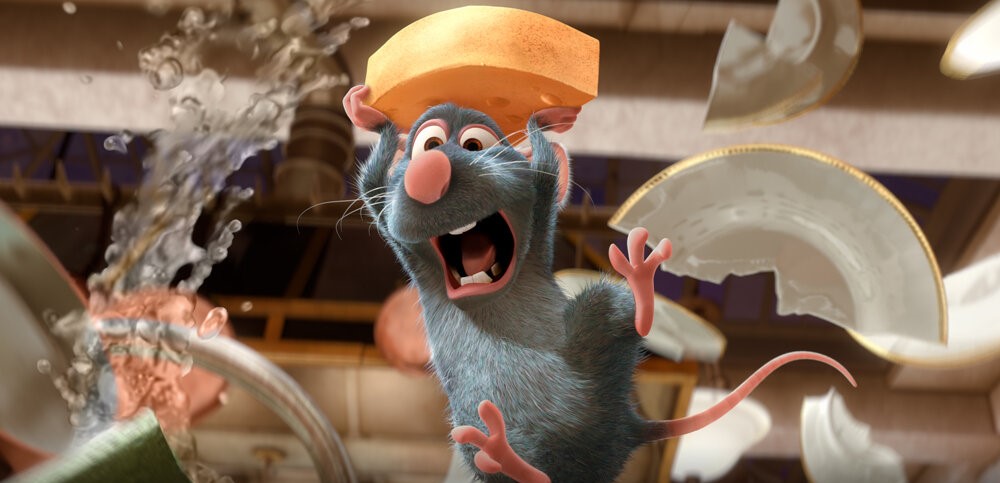
They say anyone can cook – but surely they don’t mean a rat can cook? But in Ratatouille that’s what we get: the greatest chef in Paris is a rat. Remy (Patton Oswalt) has a sense of taste and smell that’s light years ahead of his fellow rats. While they happily munch on rotten food, Remy longs for food that’s actually good. Separated from his family, Remy finds himself in the Parisian restaurant of legendary late chef Auguste Gusteau (Brad Garrett). There Remy’s natural instincts make him the secret brains behind the growing success of young Alfredo Linguini (Lou Romano), who overnight moves from dish cleaner to chef. His secret? Remy of course. Can they keep their secret in the face of the suspicion of head chef Skinner (Ian Holm), Linguini’s growing romance with fellow chef Colette (Janeane Garofalo), and the threat of a damning review by feared critic Anton Ego (Peter O’Toole)?

All this comes together in Brad Bird’s delightful confection, a superb dish where every flavour is perfectly balanced and all ingredients are seasoned to perfection. (I promise this won’t all be full of cooking puns.) It’s absolutely wonderful good fun and on top of that, it’s a real heart-string tugging treat. Ratatouille takes a fantastical set-up (a cooking rat manipulates a talentless chef’s body through precise hair pulling) and then throws in ounces of carefully judged comedy with real emotional pathos. Ratatouille never fails to make you laugh but then hit you with tear-inducing sincerity. The film is a total delight.

What Ratatouille is really about is truth. Being true to yourself, embracing the things you love, and the struggle to find acceptance for that, be it from family or the world around you. It’s the subtext behind Gusteau’s message that anyone can cook. This is not about anyone being able to crack an egg into a pan: it’s about good food coming from a person loving what they do and wanting to share that love with someone else. Remy – an utterly delightful voice performance by Patton Oswalt – wants to experience good food, but as a rat the home of good food is always the place he’s most likely to find himself skewered by a trap.  

Remy loves food in a way that the rest of his rat family – lead by his tough-as-nails father Django (Brian Dennehy) – can’t even begin to understand. They see food as just fuel. Who cares which flavours complement each other or even if its fresh? To them Remy’s extraordinary sense of smell is only useful for his ability to detect poison before it hits their mouths. And they can’t even begin to understand Remy might want more. But the very idea of heading to a kitchen – or interacting with humans who, to the other rats, get their kicks from slaughtering rats in their thousands – they can’t even begin to get their head round. Why can’t Remy be happy snuffling in the gutter?

Linguini (a very sweet, nervy Lou Romano) also has burdens of expectations that he can make a career in the kitchen. Anyone can cook – except for Linguini, who has no interest in (let alone flair for) flavours. The relationship between man and rat is beautifully done– even though neither can speak the other’s language. (In a neat touch, while we hear the rats talk – every human in the film just hears them squeak.) To Linguini, it doesn’t matter that Remy is squeaky vermin, what matters to him is that Remy is a master at what he does. But, Ratatouille gently asks: can hiding your true self make you happy in the long term?

Linguini’s success shows another side of being true: as fame goes to Linguini’s head, he starts to forget he’s the muscle not the brains of the operation. What will eventually alienate his growing relationship with fellow chef Colette (a wonderful Janene Garofalo) is not that he’s working with vermin to make the food, but that he’s lied to her about his skills. Something particularly tough since, like Remy, she has had to fight tooth and nail to live her dream in a male-dominated industry.

Accepting your true self and being happy in your own skin are themes our two villains also juggle with. Head chef Skinner (hilariously voiced with impotent rage by Ian Holm) has lost any love he once had for cooking, marketing his former mentor Gusteau as the face of a brand of cheap ready-meals (“with dignity” he absent-mindedly requests, as Gusteau is drawn as a burrito for the latest packaging) and his interest is only in turning a profit. The face of mass-produced, soulless fare, he’s the perfect antagonist of a film that praises lovingly crafted individualism.

And our other villain? Played with a beautifully plummy relish by Peter O’Toole, Anton Ego – drawn with a grey-faced, sepulchral chill – despairs that any food can meet his standards and seems to have forgotten somewhere along the line that excellence comes from love. Unlike Skinner though, Ego is (at heart) an idealist who may no longer quite remember what he is searching for – but will embrace it when he finds it at last. Ratatouille’s finest moment – always brings a tear to my eye for sure – is Ego’s being reminded at last what made him fall in love with his passion in the first place, perhaps one of the finest moments in Pixar’s long history.

Ratatouille’s emotional content and its themes of truth and acceptance are at the heart of its success, complemented always by the superb score from Michael Giacchini, crammed with Parisian inspiration. There is more life in this animated marvel than in hundreds of live-action films. And the animation is breath-taking: from the kitchen a marvel of pristine, gold and steel surfaces, via the sewers bringing back memories of The Third Man, to the visual imagination of Ego’s coffin-shaped office or the cobbled together rat colony (made from various bits of rubbish). Brad Bird’s flair (and Ratatouille is a wonderfully directed film) also carries across to his electric chase scenes through the streets and rivers of Paris, and the undeniable tension of watching Remy maneuverer his way around a kitchen without being detected.

Bird’s film though really succeeds because it has a warm-hearted love for all its characters and a heartfelt and appealing message for us to be the people we want to be, not what those around expect us to be. And who can’t relate to that? Throw in the sort of unexplained comic magic of watching a naïve young man having his body moved about by a cuddly rat sitting under his chef’s hat and with Ratatouille you onto an absolute winner. Bon appetit!

Murphy’s War (1971)

Murphy’s War (1971)

This heavy-handed anti-war Don Quixote story is far from a success

Director: Peter Yates

Cast: Peter O’Toole (Murphy), Siân Phillips (Dr Hayden), Phillipe Noiret (Louis Brezan), Horst Janson (Captain Lauchs), John Hallam (Lt Ellis)

In the dying days of World War Two, the merchant ship Mount Kyle is sunk in the Venezuelan Orinoco by a German U-Boat. Surviving the machine-gunning murder of the crew is Irish engineer Murphy (Peter O’Toole), who is treated at a Quaker mission by Dr Hayden (Siân Phillips). Murphy at first seems happy to be out of the war: but that changes, after the murder of fellow survivor Lt Ellis (John Hallam) by u-Boat captain Lauchs (Horst Janson), hunting the survivors. Murphy, assisted by Frenchman Louis (Phillipe Noiret), decides to take revenge, kitting out a crashed bi-plane to launch a series of increasingly obsessive attacks on the u-Boat with Murphy succumbing to a vendetta.

Peter Yates takes an action-adventure novel and adjusts into an anti-war epic that becomes increasingly shrill as it reaches its nihilistic ending. This shift led to several clashes between Yates and the film’s producer Michael Deeley, who was looking for a box-office hit with a charismatic star. While Yates’ film is complex in its eventual structure, the overall impact of the film is confused and blunted, its sympathies mixed and logic often flawed. It has its moments but doesn’t quite work.

As part of its anti-war set-up, Yates believed it was essential to humanise the German sailors (after all, he wanted the viewer to feel unease at Murphy’s destructive crusade). Unfortunately, creates a dissonance in the film. The first thing the German sailors do is ruthlessly machine-gun the Mount Kyle’s sailors as they tumble into burning waters. Graphically shown is every beat of the fear, as charred machine-gunned bodies fill the frame while the Germans show not a moment of regret (indeed we next see them celebrating the Captain’s award of an iron cross). The captain murders Lt Ellis with a face filled with regret, but his execution involves bullets causing Ellis’ body to jerk in its graphic death throws. How are we supposed to sympathise with them after that?

The focusing on such brutality fits the anti-war hell the film wants to lay out. But it fatally undermines the film’s aim to sure Murphy’s campaign to destroy the u-Boat as an obsessive and destructive campaign. With no reason given for the brutal war crimes committed by the u-Boat (for good measure they also machine gun the Quaker settlement, killing many of the villagers), its hard not to feel that actually Murphy has a point and that these guys deserve punishment. Would a throwaway line about a secret German mission or a need to hide have hurt the film?

The film can’t have it both ways. It can’t luxuriate in the destruction and murder war soldiers commit and then ask us to sympathise with these same soldiers when their death is threatened by another obsessive soldier on a quest for revenge. In a better developed film this sort of clash of sympathies might feel more natural. Instead, the Germans are either monstrous or sympathetic depending on the needs of the scene while Murphy himself makes an awkward shift late on from a guy with righteous anger into a destructive figure we are invited to condemn.

This is a particular shame as there is a lot in Murphy’s War to admire. Yates directs with an assurance and sense of epic scale. The Venezuelan scenery is shot with a real beauty by Douglas Slocombe and the film is edited with a professional excellence by future-Bond-director John Glen. The film’s first half hits a “boy’s own adventure” tone very effectively – making the later shift into 70’s anti-establishment nihilism more awkward – with inventive sequences as Murphy, McGiver-like, reassembles the downed biplane and jerry-rigs some home-made bombs.

A big part of any success is the charismatic performance of Peter O’Toole, who tears into the role of this Irish rebel with relish. Mixing insouciant wit with a bitter irony that slowly gives away to a sociopathic gleam as obsession takes hold, this is an excellent performance. O’Toole manages to make a character who is, in many ways, slightly incoherent work effectively. After all this rebel we hear condemning war with counter-culture cool, who fights to the bitter end; a guy who expresses indifference for his colleagues but goes to unimaginable lengths to avenge them. These contradictions don’t feel naturally developed, but ideas that are put in place to ease the plot.

Saying that, the film has some interesting beats as Murphy collapses more and more into Don Quixote like obsession, tilting at his underwater windmill. (Yates clearly had a passion for this angle as he would make two attempts to make a film of Don Quixote before finally making a TV version in 2000). O’Toole is perfect for this increasing severing from reality and as his Sancho Panza, Phillipe Noiret contributes a warm, humane performance as reluctant Louis, who silently acquiesces in a campaign he clearly feels is misguided and delusional. Equally good is Siân Phillips, balancing exasperation and affection for Murphy, finally unable to brake through his walls of aggression.

There are good ideas and moments in Murphy’s War but its poor-plotting (its story is also strikingly slight, with the preparation of the biplane and its test flight filling an elongated stretch of the film) and jumbled mix of adventure and anti-war sentiments eventually fatally undermine its effectiveness. Despite fine work from Yates and a charismatic and highly watchable performance from O’Toole it’s, at-best, an interesting failure.

The Last Emperor (1987)

Bernardo Bertolucci directs the epic, intriguing but slightly hollow The Last Emperor

Director: Bernardo Bertolucci

Cast: John Lone (Puyi), Joan Chen (Wanrong), Peter O’Toole (Reginald Johnston), Ying Roucheng (Prison Camp Governor), Victor Wong (Chen Baochen), Dennis Dun (Big Li), Ryuichi Sakamoto (Masahiko Amakasu), Maggie Han (Yoshiko Kawashima), Ric Young (Interrogator), Wu Junmei (Wenxiu), Cary-Hiroyuki Tagawa (Chang), Jade Go (Ar Mo), Henry O (Lord Chamberlain)

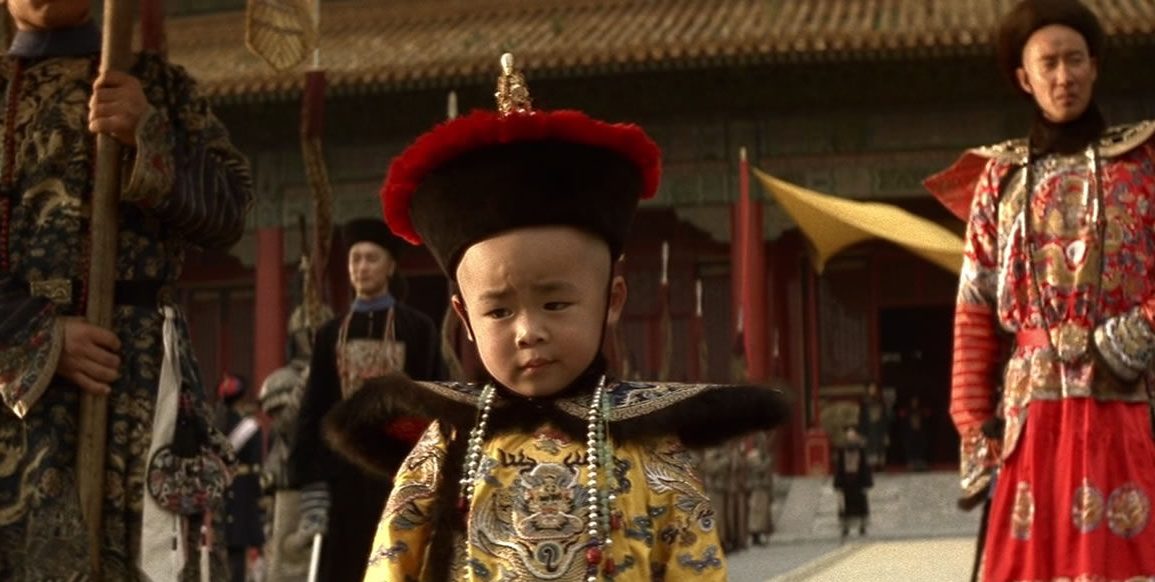
In 1908 a toddler, Puyi, became the last Emperor of China – but in 1912, revolution made China  a Republic and he was reduced to only being Emperor of The Forbidden City, a place he has never left since 1908 and will not leave until 1924 when he is expelled from the city. As an adult Puyi (John Lone) remains a puppet, becoming Emperor of the Japanese puppet state of Manchukuo, where he is again largely confined to his palace, his Empress Wanrong (Joan Chen) becoming an opium addict. After World War II, Puyi is imprisoned for ten years by the Maoist government, being re-educated into becoming an ordinary citizen of China.

Bertolucci’s film explores the life of this slight historical figure. I say slight, as Puyi is always and forever a puppet, buffeted by history. He owes whatever prominence he has to a quirk of fate, but never truly learns who he is or his purpose, only slowly realising his power is an illusion. It’s the main flaw of The Last Emperor – otherwise a sumptuous epic – that it is such a grand film about such a shallow person. Puyi is not particularly interesting in himself, and the film largely fails to turn him into an intriguing enigma. The Last Emperor – which hoovered up 9 Oscars, including Best Picture – is brilliantly made, frequently fascinating and breath-taking, but also strangely lifeless.

Bertolucci and producer Jeremy Thomas spent years raising the money and negotiating with the Chinese government to have unrestricted, exclusive access to the Forbidden City. It’s that which really makes the film effective. The first half of the film is set almost exclusively in The Forbidden City (flash forwards see the adult Puyi in post-war captivity, being questioned by his guards). The scale is stunning and is shot by Vittoro Storaro with a breath-taking opulence and fascinating eye for Chinese culture. Storaro also carefully distinguishes with colours each section of Puyi’s life, from the reds and golds of his childhood to the washed-out greens of his adulthood. The impact of this on screen remains impressive today – and Chinese co-operation produced almost 19,000 extras to populate it.

These early sections are the film’s strongest. Bertolucci was frequently intrigued with complex coming-of-age tales, balanced with leftish politics. The film is fascinated with the power/non-power of this child. He leads a strange dance of being a puppet and figurehead, who can still order his servants to obey his every whim. It’s an upbringing that would pervert any child – and Bertolucci shows it creates a man who lacks any sense of emotional awareness and maturity; not cruel as such, but unable to fully understand what it is to be human because he has never known anyone who is an equal.

His ‘power’ expresses itself in petulance, selfishness and sometimes acts of cruelty – and he becomes a man drifting through life, aware that he should feel more of a connection with people, but lacking the emotional self-awareness forming connections with people requires. It’s not helped by Puyi’s weak personality. Growing up effectively imprisoned – but all-powerful – in a single city means he constantly gravitates towards similar situations, be that a puppet ruler signing whatever he is told to in Manchukuo or expecting his servants to continue to dress him in prison (how is prison different really from the rest of his life?)

Bertolucci films this with an acute emotional understanding that counterpoints the wonderfully luscious scale of the film. All those expansive costumes, the gorgeous filming and the awe-inspiring location shooting helps us to understand the smallness and meekness of Puyi and his stunted emotional world. Only the arrival of an English tutor – played with an expressive playfulness by Peter O’Toole – shakes up this world and offers Puyi the chance of some sort of personality development. Sadly, his influence is all too short – and Puyi seems to take mostly the wrong lessons from it, of English exceptionalism and ‘doing your duty’ that convince him he’s got to try and maintain his position.

The first half of the film is breath-takingly, with Bertolucci carefully interweaving grace notes around Puyi’s lack of true parental love (his beloved wet nurse is expelled), his growing sexual awakening – from suckling at a late age to taking both a wife and a consort (and, for Bertolucci, the inevitable threesome scene – tastefully done). The bizarreness of this world, a tiny kingdom with its own rules and an empty figurehead living in a fantasy land are striking.

It’s after Puyi leaves that the film weakens. Perhaps knowing the Forbidden City sequences were the finest – and most gorgeous – parts of the film, most of Puyi’s life after is shunted into the final hour. This makes for rushed scenes and a number of “tell not show” moments, where characters bluntly (and swiftly) fill in various political and social events or openly state their thoughts and feelings. Puyi’s reasons for becoming Emperor of Manchukuo are only briefly sketched, but not as briefly of the characters of his new Japanese masters (Ryuichi Sakamoto – also the Oscar-winning composer – and Maggie Han, a seductive collaborator) as scenes race by as the film rushes towards its conclusion.

Perhaps also not surprisingly for an old Marxist (and with that need to secure the Chinese co-operation) the Maoist government gets a fairly easy ride, with the main representative of Maoist authority being a genial, supportive chap and the re-education camp treated as a genuine programme of self-improvement rather than indoctrination. But then you can also say it’s a sign of the film’s relative even-handedness – and it does touch on the Cultural Revolution (and its random denunciations) late, albeit with a gentle eye.

It’s a shame the second half of the film doesn’t hold up as well as the first half (a longer Director’s Cut fixes some of these problems), but the first half is intriguing, dynamically made and full of emotional insight. John Lone does a fine job in a rather thanklessly bland role as Puyi and Joan Chen moves from austere to depressed as his wife, but to be honest few other members of the cast make an impact (it’s one of the few modern Best Picture winners with no acting nominations).

Bertolucci’s film is superbly made, beautiful to look at, intriguing – and you can see its influence on Farewell My Concubine among others (Chen Kaige has a small role in the film, as does Zhang Yimou) – but it suffers slightly from being about such a non-person. You wonder how it might have worked better if it had kept a tighter focus – or skimmed over more of Puyi’s life rather than hurriedly trying to cover the whole lot – but what we end up with mixes the rushed with the extraordinary.

The Lion in Winter (1968)

Katharine Hepburn and Peter O’Toole are the feuding royals in The Lion in Winter

Director: Anthony Harvey

Cast: Peter O’Toole (Henry II), Katharine Hepburn (Eleanor of Aquitaine), Anthony Hopkins (Richard the Lionhard), John Castle (Prince Geoffrey), Nigel Terry (Prince John), Timothy Dalton (Philip II), Jane Merrow (Alais), Nigel Stock (Captain William Marshall)

James Goldman’s play The Lion in Winter did solid but not spectacular business on Broadway. But when it came to film, it surfed a wave of popularity for stories about British history and became one of the most financially successful films of its year, winning three Oscars (including for Goldman). Even more than that, it went on to be West Wing President Jed Bartlett’s favourite movie of all time. I think we know which prize is the most treasured.

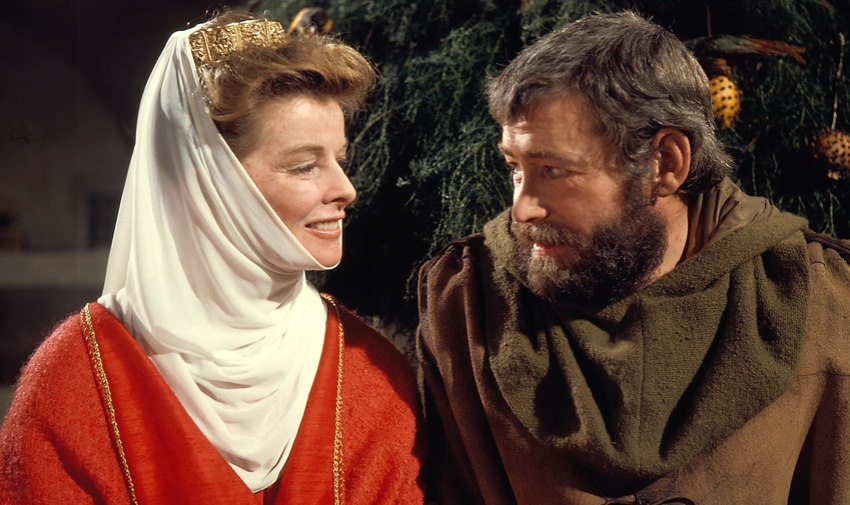
Christmas 1183 (including an ahistorical Christmas tree and gift wrapped presents and all) and Henry II (Peter O’Toole), king of England and huge chunks of France, wants nothing more than family around him to mark the occasion. Problem is, this is possibly the more dysfunctional family ever. His Queen Eleanor of Aquitaine (Katharine Hepburn) has been under “home arrest” for ten years in her castle, and his children Richard (Anthony Hopkins), Geoffrey (John Castle) and John (Nigel Terry) seem to take it in turns to conspire against their father, their allegiances shifting faster than even they can sometimes follow. For added complexity, Henry is living with his late eldest son’s intended Alais (Jane Merrow) as husband and wife and her half-brother the new King of France Philip II (Timothy Dalton) is joining the family for Christmas. Over one night, this family will fight, feud and change pacts and allegiances until hardly anyone knows where the games end and the hate begins.

Anthony Harvey’s film is a stately, often wordy, faithful reconstruction of Goldman’s script that gives front-and-centre to the often scintillating dialogue between the family members, that leans just the right side of ahistorical (sample line: “Hush dear, Mummy’s fighting”) but frequently allows it’s top-of-the-line cast to let rip on some glorious speeches and dialogue duets crammed with ideas, wordplay, character and wit. Harvey therefore basically decides to sit back as much as possible and allow the actors do the work, using a mixture of medium shots and close-ups to bring the focus as much as possible to the Broadway-style staging or into the actor’s faces. He also uses the strength of the performers to allow for a series of long takes as they burn through pages of Goldman’s dialogue. The fact that there is hardly an interesting shot in the film, and its visual language never matches it’s verbal fire is a shame, but a price the film thinks worth paying.

And it matters little when Harvey is able to work as well with actors as he does here. All the performers are at the top of their game. Katharine Hepburn (winning her fourth Oscar, in a tie with Barbra Streisand in Funny Girl) has the perfect level of acute intelligence and imperious arrogance for Eleanor. But Harvey encourages from her a softness at crucial moments, that in-between the barn-storming speeches and verbal putdowns, Hepburn finds moments of quiet sadness and loneliness – a sense that sometimes ten years of imprisonment means she has had enough of all this – that are some of her most affecting work on screen. She’s hilarious but deeply moving – and totally believable as one of the most powerful women of the middle ages. 

She also is matched perfectly with O’Toole. Playing a 50-year old King at 35, O’Toole brings all the fire and charisma of his personality to the part, in a film where he perfectly balances the larger-than-life gusto of Henry II with his own personal disappointments, guilt and sorrow. O’Toole had already triumphed once as the charismatically brilliant king in Becket (for which he was also Oscar nominated, as he was here), but this performance is even better. Not only is his facility with the dialogue faultless, he also utterly convinces as the sort of awe-inspiring figure who dominates every room he’s in not just with force of character but the acuity and sharpness of his intellect. This might be his finest screen performance – and the one where he was most cheated of the Oscar (losing to a highly active campaign, criticised at the time, from Cliff Robertson in Charly).

To fill the cast out around these pros at the top of their game, Harvey raided British theatre to pluck some promising gems from British Theatre, more or less all of them here in their film debut. Anthony Hopkins is marvellously proud, forceful but just a few beats behind most of the others as a Richard who says what he means and sticks to it. Timothy Dalton is his polar opposite (and equally brilliant) as a Philip II who never says what he means and manipulates with a playful ease everyone he meets. John Castle (an actor who never had the career he should have had) is smugly unlikeable and coldly superior as the unliked middle-brother Geoffrey, while Nigel Terry is a snivelling punching bag as two-faced coward John. Jane Merrow is heartfelt and earnest as Alais, the only unquestionably kind and good person in this bunch.

These characters rotate sides and allegiances over the course of one evening, raging at each other like a medieval Who’s Afraid of Virginia Woolf? The brilliance of the dialogue never stops entertaining – although towards the end the film loses a bit of energy (it probably peaks with Henry’s loud double bluff of dragging the family in the middle of the night to a wedding he has no intention of seeing performed), perhaps partly because the film itself never really comes to flight as something cinematic. This is despite the decision to downplay the glamour – costumes are simple and look lived in (the cast wore them for hours off set to make them look lived in) and sets are far from pristine. It perhaps contributes to the slightly mundane feel of the filmmaking.

But the tricks are all in the dialogue and perhaps the film works best with an interval and a chance to take stock. There are several marvellous scenes, even if the constant feuding and side changing does wear you out after a while. But it’s a treat for the acting. Hepburn and O’Toole are simply at the top of their game, and the rest of the cast more than keep up with them. With an excellently imposing score from John Barry (also Oscar-winning), it’s a shame the film itself is a little too flatly and uninspiringly filmed with a murky lack of visual interest, but there are more than enough qualities for you to issue a pardon.

Becket (1964)

Peter O’Toole and Richard Burton make unlikely friends (and then enemies) in Becket

Director: Peter Glenville

Cast: Richard Burton (Thomas Becket), Peter O’Toole (Henry II), John Gielgud (Louis VII of France), Donald Wolfit (Bishop Gilbert Foliot), Martita Hunt (Empress Matilda), Pamela Brown (Eleanor of Aquitaine), David Weston (Brother John), Sian Phillips (Gwendolen), Felix Aylmer (Archbishop of Canterbury), Paolo Stoppa (Pope Alexander III), Gino Cervi (Cardinal Zambelli)

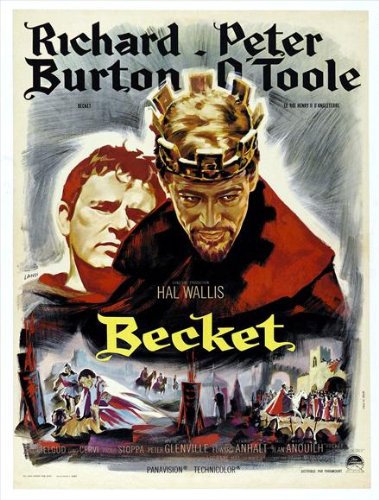
Burton and O’Toole in the same movie? There must have been a few late night benders on that shoot… You suspect actually that the backstage fun might have been just a little more sprightly and engaging than the movie itself, a lavish 1960s Hollywood Prestige film of English history. Based on Jean Anouilh’s semi-satirical play, it translates the clash between Church and State under Henry II into a very personal conflict between two men who each feel the other has let them down. 

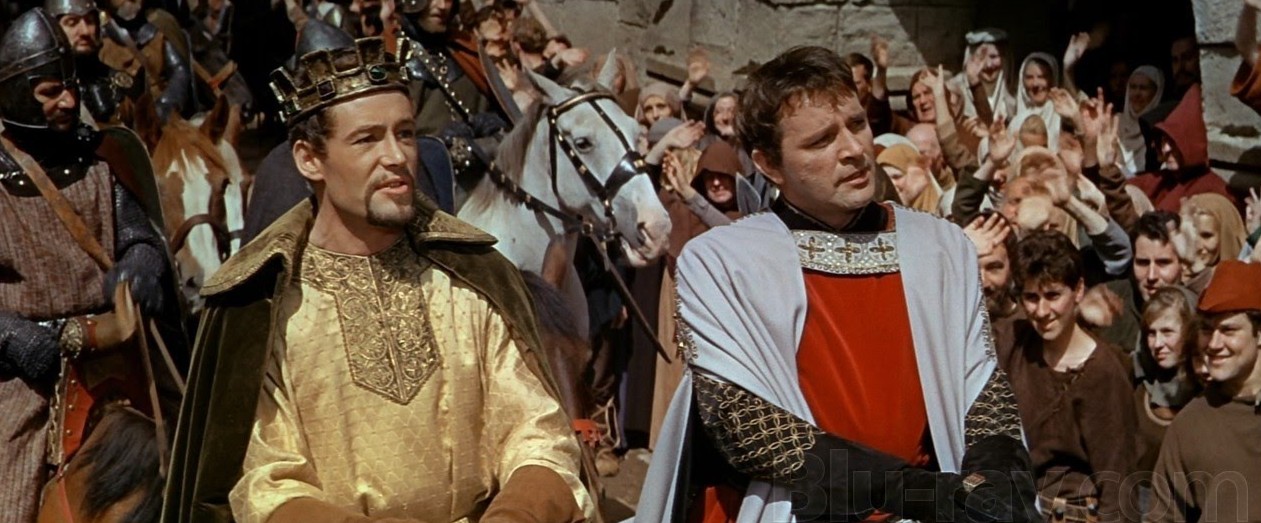
Thomas Becket (Richard Burton) is a Saxon who has risen high in the service of Henry II (Peter O’Toole) at a time when all the top jobs are held by Normans. Becket and Henry do everything together: hunting, hawking, whoring, you name it, the two of them are inseparable. But while both are sharply intelligent men, Henry is basically lazy and principally interested in enjoying life, while Becket always has a slight streak of responsibility for his people and their rights. But despite this, the two men both have England’s interests at heart and a strong friendship. So when Henry makes Becket Archbishop of Canterbury, it should work a treat, right? Well wrong, because Becket quickly begins to feel his loyalty is to the Church and God, not to Henry – and soon a debate over the legal rights of the church has blown up into a full scale clash between the two former friends. Will no one rid Henry of this turbulent priest?

Becket is a fairly sharply written, waspish play about the love/hate relationship between two men, but its themes and ideas are basically secondary to the showcasing opportunities it gives to its two lead actors. That’s pretty much what happens with this film: for all the ups and downs of the plot, the thing that really lifts this film are those two performances. Take that away and you essentially have a stately period pace, flatly and unimaginatively filmed with the look-at-the-scenery-and-costumes steadiness of other films of this genre and time. So it’s just as well that both leads are clearly having a whale of time.

Burton invests Thomas Becket with a quiet authority and a growing sense of something that, if it’s not morality, is at least a sort of moral certitude. Burton’s Becket is not the straightforward good-guy: his stances are always governed at least partly by his own pride and ambition. His defence of the Church is partly motivated by the need to secure his position, and in his career beforehand he constantly shows that he is won’t let doing the right thing damage his position at the court. But there are also touches of genuine faith throughout, and Burton plays the monologues imploring God for guidance with earnest conviction. Alongside this, he plays Becket with a great deal of wry observance and subtle wit that makes this kaleidoscopic character constantly fascinating: you never quite know what he is thinking.

Burton’s restraint also allows O’Toole more room in the more expansive role of Henry II. The powerful king – proud, controlling, intelligent and bombastic – was always a perfect role for O’Toole: indeed he would play it again four years later in another play adaptation, The Lion in Winter (becoming one of the few actors to get two Oscar nominations for the same character). O’Toole roars through the film, bringing immense energy and humour to Henry’s many scenes of intense speechifying. But what O’Toole does so well is balance this with a genuine sense of vulnerability, a genuine pain at losing Becket’s friendship. For all the power and control, O’Toole understands that Henry is essentially a very lonely man with only one man anywhere near his equal. O’Toole’s sharply intelligent, dynamic performance is a real treat.

And it feeds into the underlying theme of the film: this sense of unrequited love between the two men. Henry, for all his egotism, is clearly in love on some level with Becket: a fact that Becket seems aware of, but doesn’t quite return with the same intensity. And in fact, to double Henry’s pain, it feels like the friendship is one partly driven by Henry’s position rather than something genuine between the two men – Becket is always more guarded and more critical as a companion. Though of course that is fair enough: Henry is, however good-naturedly, a supreme ruler who cares little for the welfare of the Saxons under his rule, happy to help himself to attractive women from the peasantry if he wants them. But then perhaps it’s Becket’s very distance, his certain level of speaking truth to power, that makes him so appealing to Henry: when Becket is around, Henry has competition for smartest guy in the room.

There is a lot going on between the two leads, so it’s not surprising that much of the rest of the film doesn’t get a look in. For the other performers, John Gielgud landed an Oscar nomination for his two scenes (barely five minutes) as an arch and manipulative King of France, while Donald Wolfit is all puffed-up pomposity as Becket’s church rival. But the film is only focused on the two men and their political rivalry, so the context is always sketched in quickly, and the energy drops out of the film noticeably when they are apart. The film wants to frame the rivalry so much as a personal one that it doesn’t develop another interest in the political issues – so when scenes are obliged to focus on this, you feel the film starting to drag.

But that might also be because Anouilh’s play is famously historically inaccurate. For starters, Becket wasn’t Saxon, so his early lack of social standing makes no sense. The Constitutions of Clarendon (historically the reason for the falling-out in the first place) don’t merit a mention. Henry’s wife Eleanor of Aquitaine is presented as a shrew rather than one of the most intelligent women of the era, while Henry is also shown to be on poor terms with his mother, again contrary to the truth. 

But that stuff all stems from the play, and in the end it hardly matters as the film is positioning itself as the tale of a friendship turned sour between two men. O’Toole and Burton are sublime, and if the direction and film-making around them is pretty pedestrian (although the film looks great and has an impressive score) it doesn’t really matter in an actors’ piece like this. Most of what is good from the play is carried over to the film, and the dialogue and speeches are often very strong. It’s a very stately and rather overlong play that doesn’t really keep the momentum up. But it’s still enjoyable, still has plenty to admire and even if it’s overlong and dry, it gives you performances that really sing.

Troy (2004)


Brad Pitt sails into history and legend as Achilles in the misunderstood Troy

Director: Wolfgang Petersen

Cast: Brad Pitt (Achilles), Eric Bana (Hector), Orlando Bloom (Paris), Diane Kruger (Helen), Brian Cox (Agamemnon), Peter O’Toole (Priam), Rose Byrne (Briseis), Saffron Burrows (Andromache), Brendan Gleeson (Menelaus), Sean Bean (Odysseus), Julian Glover (Triopas), James Cosmo (Glaucus), John Shrapnel (Nestor), Julie Christie (Thetis), Garrett Hedlund (Patroclus), Vincent Regan (Eudorus), Nigel Terry (Archeptolemus), Trevor Eve (Velior), Tyler Mane (Ajax)

VERSION CONTROL: Some films are just vastly superior as Director’s Cuts. Troy is one. The longer cut of Troy,I can assure you, is a richer, deeper, more enjoyable film. So watch that one. I’m also spoiling The Illiad. For those who worry about such things.

When I was younger I loved the Greek myths. I had two or three books of them and I read them over and over again. I practically grew up knowing the whole story of the siege of Troy in intimate detail. This helped feed my love for sweeping epic films, with big casts, spectacle and themes. So it probably won’t surprise you to hear I love Troy. That I’ve seen it dozens of times. It’s the film I wish had existed when I was a kid, because I would have watched it again and again. I know it’s not perfect, but I can forgive it almost anything. 

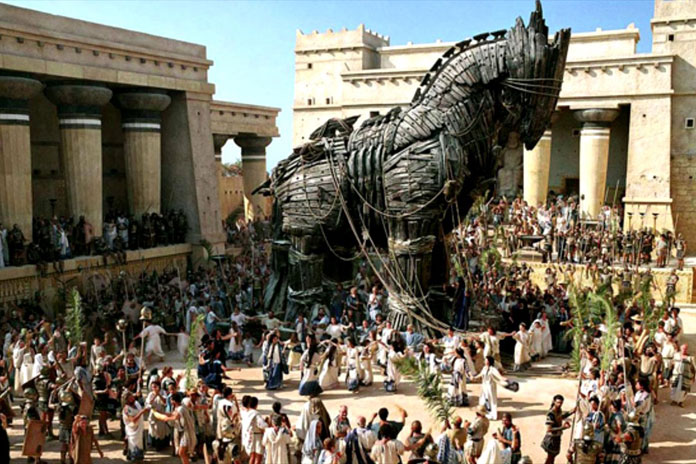
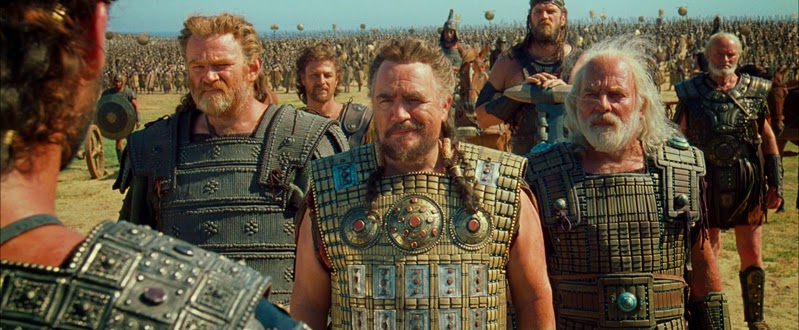
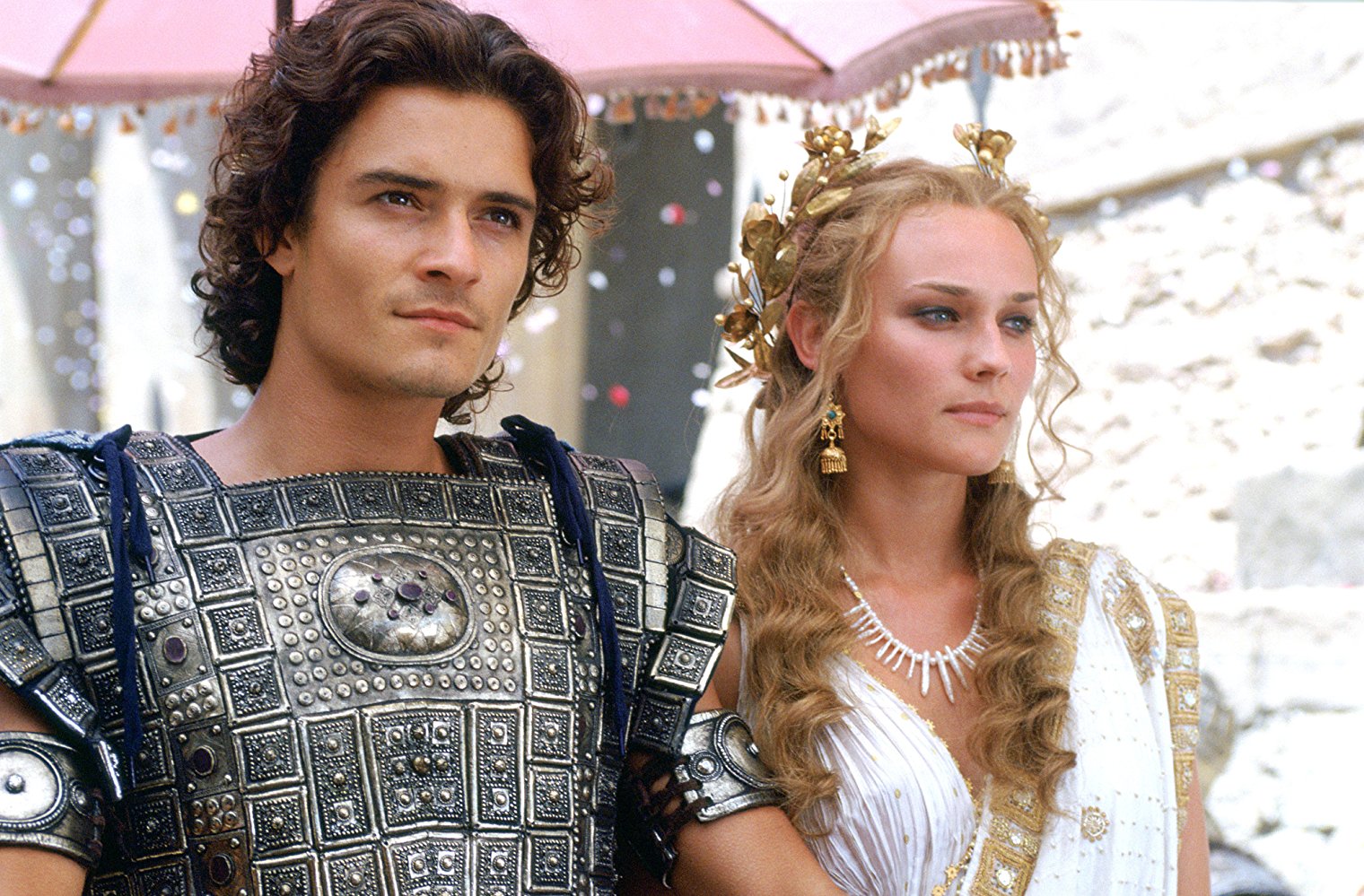
In Ancient Greece, a peace treaty has finally been agreed between Sparta’s King Menelaus (Brendan Gleeson) and Priam (Peter O’Toole) of Troy. Priam’s sons Hector (Eric Bana) and Paris (Orlando Bloom) are in Sparta to seal the treaty – only for Paris to fall in love with Menelaus’ unloved wife Helen (Diane Kruger). When they elope – despite Hector’s fears for the harm it will cause Troy’s people – Menelaus’ ambitious brother Agamemnon (Brian Cox) sees his chance to cement his hold over the last corner of the Mediterranean by conquering Troy. But to do so he’ll need the help of the greatest warrior in Greece, Achilles (Brad Pitt), who cares only for his legend and hates Agamemnon. 

Directed with an old-fashioned grandeur by Wolfgang Petersen, mixed with an unflinching look at the blood and guts of war, Troy is a grand, cinematic epic that looks fantastic. The production and costume design are spot-on, and there is a great mixture of the “real” and the “special effect” in what you see on screen. It’s also got some cracking battle and fight choreography. The sword fight choreographers worked overtime on this one. The film embraces the grace and style of Achilles – he’s not the largest or strongest, but he has a pace, speed, intelligence and ruthlessness that allows him to duck, sway and constantly be one step ahead of his opponents. It doesn’t shy away from the brutality of his violence, and the camera never forgets the fallen.

It’s a film that understands the impact of war. It makes us care about many of the characters – and frequently shocks us with senseless, sudden deaths, or devotes time to the grief of those they leave behind. Our hero Hector has an almost tortuous-to-watch lengthy build up to his final fight – and then the camera gives us a moment or two when he is fatally wounded to see the light start to go from his eyes before Achilles delivers the killer blow. It’s a film that moves the viewer, that excites us with action while letting us grieve the cost of war.

The script is also a reasonably decent adaptation of elements of Homer, remixed with a modern (God-free) twist – as if this was the “true” story legend has been spun from. The script is put together by Game of Thrones’ David Benioff, and has his recognisable mix of epic scope and noble principles, clashing with realpolitik.

So why was Troy rejected by so many people? Why was it so misunderstood on release? It’s a mis-sold and partly mis-cut story struggling to embrace its own implications. Maybe I’m reading stuff into it, but I feel like this is a different film than the marketing or filmmakers seem to have understood. 

Firstly, Achilles is (at least for the first two thirds) effectively the film’s villain. He has no interest in people, only a sociopathic wish to be remembered as a great warrior. He’s ruthless in combat and slaughters indiscriminately. He’s temperamental and emotionally stunted. Contrast him with Eric Bana’s Hector: a devoted family man, who values the lives of the people of Troy first and foremost. Hector is effectively reimagined from the source material as a very modern man – the audience surrogate, the hero we can relate to, compared to the greedy, rapacious Greeks.

The struggle the film has is its biggest star plays Achilles – and it doesn’t want to compromise his box office appeal. So it tries not to draw too much attention to this contrast, and avoids passing too much judgement on Achilles. So we struggle when Achilles and Hector fight – anyone with any sense is surely rooting for the guy with a wife who just wants to see his kid grow up, rather than the sociopath, even if he is played by a super-star. All the characters hammer home our distress at Hector fighting Achilles, by the fact all of them reckon he’s got no chance. There are moving farewells for Hector with his father, wife and son. Hard to sympathise with Achilles when he slays the film’s most sympathetic character and drags him in the dirt right?

Achilles only starts to develop humanity (and become a modern hero) when he hits rock bottom after killing Hector – and is shamed first by Priam’s humbling, controlled pain (a tour-de-force from Peter O’Toole) then by his slowly developing love for Briseis. From this point , Achilles fights specifically to protect others – and finally puts aside his longing for immortal fame to try and save Briseis from the slaughter of the sack of Troy. The film’s slightly muddled unwillingness to condemn Achilles earlier, and its desire to celebrate him at the end, muddies the water. But there is a clear character arc slowly developing of Achilles becoming a humbler, more humane man.

As Achilles doesn’t look that good opposite Hector, the film turns Agamemnon into a ruthlessly ambitious, vain and greedy tyrant (played with a lip-smacking, roaringly enjoyable style by Brian Cox). Agamemnon (like many of the Greeks) is a modern politician – he wants to fashion the Greek city states into a single nation (sure one under his control, but it’s a more modern idea). The film, however, uses him to make Achilles desire for lasting fame feel more sympathetic. We all hate hypocritical politicians and cowardly bullies, right? And we all prefer the romance of the individual fighter uninterested in worldly affairs, right? Ergo, says the film, if we don’t like Achilles because we prefer Hector, we can also like Achilles a bit more if we don’t like Agamemnon. It’s clever structure in a way – but because the film doesn’t completely commit to it, it gets a bit lost in the telling.

The film’s attitude to Agamemnon is reflected in its favouring of Trojans over Greeks. While the Greek commanders squabble, or engage in political chicanery, the Trojans have an old school nobility. The film is enamoured with Priam. He’s played by Peter O’Toole in his grandest style (and O’Toole, though he can’t resist a bit of ham here and there, is very good). But Priam is in fact a naïve idiot, who makes a mess of everything. He’s incapable of accepting the realities of the world – his decisions lead to disaster at every turn. He may be overtly noble, honest and full of integrity – but like Ned Stark in Game of Throneshe’s completely out of his depth in Agamemnon’s ruthless world. Achilles may call him a “far better king”, but by any modern standard, Priam is in fact a terrible king, who makes all his decisions based on his regard for the Gods, rather than a claim appraisal of the situation.

These two reasons are why the film struggles. The film despises the Greeks but wants us to love Achilles – while at the same time having him kill without compassion, including our main audience surrogate character. It wants us to aspire to the romantic ideals of Priam and the Trojans – even while it demonstrates time and again that these ideas are hopelessly misguided, and completely wrong. It goes part of the way to accepting these contradictions, but it can never quite bring itself to villainise Brad Pitt, or condemn the noble Peter O’Toole.

I like to watch it my own way, balancing these contradictions – and I think if you do that (like watching the TV show The Tudors if you accept what the show can’t: that Henry VIII is the villain) then the film is really rewarding, full of interesting ideas and packed with cracking scenes.

It also allows some wonderful performances. Brad Pitt is, I suppose, an odd choice for Achilles in many ways – and he seems a bit bound in by his 1950s-Hollywood-Epic-Transatlantic accent. But he really looks the part, and I don’t think he’s afraid to let Achilles look bad – and he sells his conversion into a more heroic figure. Eric Bana is terrific as Hector – warm, engaging, hugely admirable. He has a world-weary tiredness to him – while Pitt’s Achilles is as cold as marble, Bana’s Hector looks like he has the cares of the world on his shoulders, tired already of the violence and horror he has had to endure.

There are tonnes of excellent supporting performances. Sean Bean in particular is so good as the wry and infinitely wise Odysseus you will be wishing they had made an Odyssey sequel so you can see more of him. Cox and O’Toole are rather good (bless, they are clearly enjoying themselves) as flip sides of the same coin. Byrne is affecting as gentle Briseis. Brendan Gleeson makes a fiercely bullying Menelaus. I’m not sure Saffron Burrows has ever been better than here. James Cosmo and Nigel Terry shine in smaller roles.

Poor Orlando Bloom struggles with a part that is hugely difficult – Paris is basically a spoilt coward. The film makes great play of Helen (a pretty good Diane Kruger in a near impossible part as the most beautiful woman, like, ever) being attracted to Paris precisely because he’s more of a romantic, and not interested in violence – but he tends to come across more as a thoughtless playboy, who lands everyone in trouble. It’s tricky for Bloom as this is the purpose of the film – and in many ways he’s very good casting for it – but that’s partly because he’s not the most persuasive of actors. He has a slight redemption arc – but I’m not sure Bloom as the presence to really sell it. 

I can’t believe how much I’ve actually written about this– but, for all its faults and its confused structure  I actually rather deeply love it. Maybe it’s tied in too much with my love for Greek myths. Maybe I love these all-star character actor epics. But I think it’s a film that puts a lot at stake for its characters – and really makes you invest in them – and that draws some fine performances from its cast and frames them all in a brilliant vista. It’s crammed with some terrific scenes. It never fails to entertain me. It’s almost a go-to film. I’ve seen it dozens of times and yet it never tires for me. I love it. In many ways it’s one of my filmic (forgive me) Achilles’ heels.

Stardust (2007)

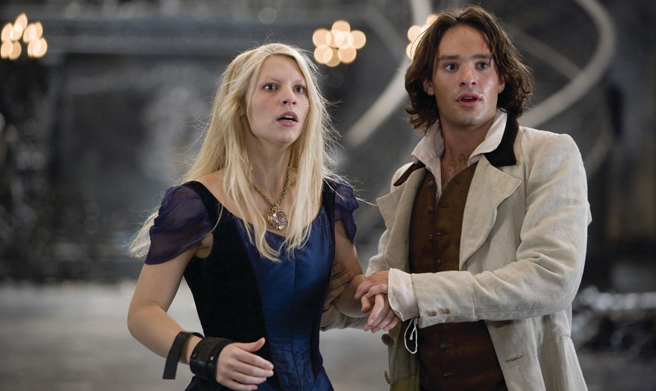
Claire Danes plays a star and Charlie Cox a village boy in charming adventure fairy-tale Stardust

Director: Matthew Vaughn

Cast: Claire Danes (Yvaine), Charlie Cox (Tristan), Michelle Pfeiffer (Lamia), Mark Strong (Prince Septimus), Robert De Niro (Captain Shakespeare), Sienna Miller (Victoria Forester), Jason Flemyng (Prince Primus), Rupert Everett (Prince Secundus), Kate Magowan (Una), Ricky Gervais (Ferdy), Peter O’Toole (King of Stormhold), Joanna Scanlan (Mormo), Sarah Alexander (Empusa), Nathaniel Parker (Dunstan Thorn), Henry Cavill (Humphrey), Dexter Fletcher (Skinny Pirate), Ian McKellen (Narrator)

Stardust is loosely adapted from Neil Gaiman’s novel of the same name, an adult fairy tale refashioned into a crowd pleasing family film: a warm and genuine adventure story, stuffed with romance, excitement and drama.

Tristan (Charlie Cox) is a dreamy young man in the village of Wall, which neighbours the mystical and forbidden world of Stormhold. In love with the selfish Victoria (Sienna Miller), Tristan vows to travel to Stormhold and bring her back a fallen star. However, the star has landed in the form of a beautiful young woman, Yvaine (Claire Danes), and the two of them find themselves on a difficult journey to return to Wall. Along the way they must dodge the witch Lamia (Michelle Pfeiffer) who wishes to sacrifice Yvaine to regain her beauty, and the surviving sons of the late king of Stormhold, particularly the ruthless Septimus (Mark Strong), who need Yvaine’s necklace to claim the throne.

What works about Stardust is that it has an air of whimsy about it, without ever feeling whimsical or corny. It’s a grown-up fairy tale, in the sense that it has some black humour and acknowledgement of sex, but really it’s more of a charming adventure story in a fantasy setting, which manages to keep its tongue in its cheek and not take itself too seriously. Matthew Vaughn’s direction has a very light touch and never allows this soufflé of a film to either puff itself up too much, or to deflate. Instead it rolls along with a giddy charm, with a delightful odd-couple love story at the centre. It’s a film that totally gets its tone spot-on, helped by confident direction and a wonderful score.

Charlie Cox plays romantic lead Tristan with a great deal of charm and really captures the romance at his centre. He also manages that extremely difficult task of being likeable – you can’t help but warm to him despite the fact that his self-awareness is completely off for a large chunk of the film. Claire Danes is equally good as the prickly Yvaine, hiding a great capacity for emotion and longing under a defensive exterior. Their romance is of course highly traditional – they bicker because they love each other! – but both actors carry it off with a great deal of style. You can’t help but want them to get over their problems and get together.

The romantic plotline is also never overwhelmed by the faintly Pythonesque comedy that surrounds it, particularly from the ghostly chorus of deceased Princes of Stormhold. Vaughn produces a great cast of comic actors for this group, while entrusting Mark Strong with the lion’s share of the screentime as the dashing decoy antagonist. In fact, the construction of the film’s narrative is rather neatly done, as this plotline of the inheritance of Stormhold is largely kept separate narratively from the romantic Tristan/Yvaine storyline, with the intersections only occurring at key points.

The real antagonist of the film however is Michelle Pfeiffer’s witch Lamia, Pfeiffer offering a neat portrait of vanity intermixed with cruelty. It’s a very decent inversion of a “movie star” glamour performance, and Pfeiffer’s heartless ruthlessness is a very nice contrast with Tristan’s altruistic openness. In fact Pfeiffer is very good in this film: she gets the balance so right that Lamia constantly keeps you on your toes as to how villainous or not she may be. I’m not quite sure that the film quite manages to completely bring the two characters plot lines together to provide a really effective narrative drive to the film, but she certainly works as an effective antagonist.

The film’s structure is a combination shaggy dog story and classic quest structure, which allows each sequence to take on its tone and structure, from thriller to comedy, depending on the characters involved. What threads this together is the growing (and very sweetly structured) love story between Tristan and Yvain which keeps the momentum up as the film moves from location to location, with cameo roles sprinkled throughout, without the film losing momentum (though it is probably 15 minutes too long). The film’s comfort with letting it sequences expand is clear with Robert De Niro’s Captain Shakespeare, a feared cloud pirate whose secret desires are not so secret as he might think. The film delights in essentially extended jokes like this – but it gets away with it because these jokes manage to be quite funny (De Niro in particular turns in a very good comic performance).

It’s a film that manages to remain distinctive and original, while appealing to a wide audience, which is quite some trick to pull off. It also manages to do this without losing its distinctive rhythm, which is both endearing and enjoyable. The “rules” of its world are clearly established, and while many of the actors are slightly tongue in cheek, they never laugh at their characters but only gently tip the wink at the audience. This freedom largely comes from the conviction and honesty Danes and Cox endow the central characters with, to ground the film. It alsohas a great sense of emotional intelligence to it, and brings a lot of depth to the characters. It also helps that it’s brilliantly designed, looks ravishing and is full of several delightful performances.

There’s lots of terrific stuff in this film, with a very sweet story at its centre. In fact this sweetness is probably the secret of its success: it never takes itself very seriously, it dances lightly from scene to scene and never allows itself to become too overblown. It’s got a terrific cast and is well directed, with a snappy bounce. At moments it does feel a little long, and some sequences overstay their welcome a bit too much – but the central characters are so winningly played that you don’t really mind. Sure this is not a masterpiece, but it has a sort of magic about it, the charm, excitement, adventure and romance, all mixed together with such confidence that it’s a pleasure to watch.