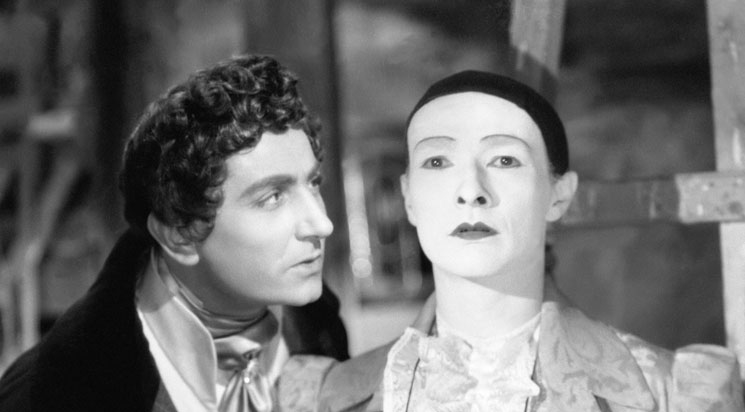
Tag: Pierre Brasseur

Quai des Brumes (1938)

Jean Gabin and Michèle Morgan are star-crossed lovers in Quai des Brumes

Director: Marcel Carné

Cast: Jean Gabin (Jean), Michel Simon (Zabel), Michèle Morgan (Nelly), Pierre Brasseur (Lucien), Édouard Delmont (Panama), Raymond Aimos (Quart Vittel), Robert Le Vigan (Le peintre), René Génin (Le docteur), Marcel Pérès (Le chauffeur), Léo Malet (Le soldat), Jenny Burnay (L’amie de Lucien)

It translates as “Port of Shadows” and it’s the shadows you are likely to remember in this noirish tinged classic of French cinema. A major success story when it was released in France, it also stands as some sort of milestone as being one of the few films condemned by both the pre-Vichy French government and Nazi Germany. More pleasingly, it’s also a firm testament to the brilliance and vibrancy of pre-War French cinema and the creative imagination of Marcel Carné.

Jean (Jean Gabin) is a soldier on the run, deserting his regiment to lead his own life in South America. Arriving in the port of Le Havre, he ends up in a run-down bar on the edge of the town where he meets the beautiful young Nelly (Michèle Morgan) a woman on the run herself from two unpleasant men. The first is local gangster Lucien (Pierre Brasseur) a braggart with whom Jean has already had a few run-ins. The other, even more dangerous, is Zabel (Michel Simon) Nelly’s godfather, a ruthless man under a genial façade who is obsessed with Nelly. Jean and Nelly fall in love, but how far will Jean go to put his own hopes for the future in doubt to protect Nelly?

Shadows dominate Carné’s beautifully atmospheric film. Jean emerges as if from nowhere on the road to Le Havre – nearly run over by the truck driver who picks him up. The bar is buried in the mists of the town. Shadows loom from every building and throw most of the city into a mysterious half-light. The action largely takes place in backrooms and cellars. Every frame tells you from the start things will not turn out well, with every decision carrying an underplayed air of foreboding. You can just tell every moment is putting another nail in the coffin of Jean’s chances of escape to that new life. The film is a brilliant slice of noir, expertly assembled with an artist’s eye by Carné, one of the most overlooked genius directors of his era. 

This darkened, gloomy style of the picture echoes the intentions of Carné and his regular collaborator, scriptwriter Jacques Prévert. The focus on the picture is the individual – in this case Jean and Nelly –trying to escape the control of both the state (the army) and also the domineering bullies that hold the local power (Lucien and Zabel). It’s no coincidence that Jean is an army deserter, and there is no sense of guilt on his part or even a fraction of recrimination is aimed towards him from anyone he encounters. Jean himself talks despairingly of the grim reality of killing and his wish to make his own choices. Carné was originally to make the film in Germany, but Goebbels was not having any film made in Berlin where the hero was an army deserter. 

So instead the film was shifted – wisely – back to France, not the French government was that happy either. With Carné and Prévert’s vision of a listless, tired, corrupted France where people like Jean simply refuse (it seems) to do what they are told, and where the few representatives of local government we meet are trivial non-entities, it’s not a surprise that the film was soon being blamed for sapping French spirit. As a sop to the French criticism of the script (and many of the films backers were desperate for its downbeat nihilism to be replaced by a more conventional upbeat, romantic ending) Jean does at least show respect for his army uniform – despite everything it’s never dirty, and when he takes it off its neatly folded. Today it seems even more like an impressionistic touch.

It’s the nihilism that runs through the film. We know Jean is good guy – he encounters a dog on the road to Le Havre that follows him with a singular devotion, unable to bear being parted from him – but the film itself has a shadowy feeling of despair and destruction throughout. Jean feels like a doomed hero from the start, a passive figure despite his bravado, who impulsively drifts from event to event – it’s when he chooses to become engaged that he dooms himself. Nelly is seemingly at first a femme fatale – and her reveal is a masterstroke of cinema – but really she’s as much a victim as Jean, someone very vulnerable, lonely and scared who wants a way out but can’t see how to even begin to find one. But then even the nemesis that runs through the film is low-key and trivial – Lucien is a joke, while Zabel for all his creepiness is also little more than a novelty gift shop owner.

The power of the film comes from seeing these two trapped figures surrounded by a world of darkness, listless depression and emptiness. And of course from the performances. The film is a reminder again that at this time Jean Gabin may well have been the greatest actor in the world. With a cigarette dangling, raffish cool under a surly salt-of-the-earth taciturnity, he turns Jean into the sort of enigmatic noir-hero years before the term was evented. Dripping with charisma in every frame, he’s both a Bogartish cynic and a De Niroish slice of muscle, a working class martyr. Nearly as good is Michèle Morgan, vulnerable and yearning into a surface of sexy cool. The two make a winningly attractive pair, not just sexy but with a growing romantic feeling.

It’s no wonder Jean throws himself into threatening and roughing up the pathetically weasily Lucien (Pierre Brasseur very good as a weak-willed bully who can lash out with the viciousness of a child) and squaring up to domineering Zabel. Michel Simon is terrific as the grandfatherly shop owner whose own dark obsessions and possible perversions become harder and harder to ignore. These two very different threats stand at opposite ends of the film and both contribute to its bleak ending.

Because of course Jean isn’t going to make that boat. The act of violence the film finally unleashes – after all that foreboding warning that it’s coming – is suitably shocking in a 1930s way, while the eventual fall of Jean is both fitting and also tragic in its low-key abruptness (it was later echoed by Brian de Palma in Carlito’s Way). With its gloomy atmosphere, its grim foreboding but also passionate love story at its heart, Quai des Brumes is a classic of French poetic realism.

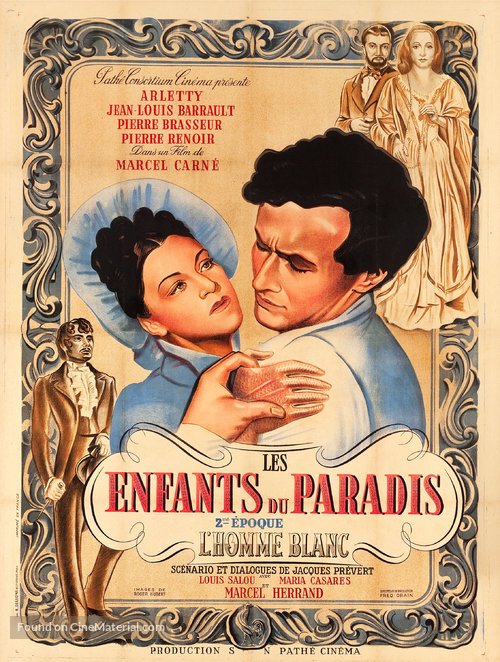
Les Enfants du Paradis (1945)

Jean Louis-Barrault mimes up a storm in French masterpiece Les Enfants du Paradis

Director: Marcel Carné

Cast: Arletty (Claire “Garance” Reine), Jean-Louis Barrault (Baptiste Deburau), Pierre Brasseur (Frédérick Lemaître), Marcel Herrand (Pierre-François Lacenaire), Pierre Renoir (Jéricho), María Casarès (Nathalie), Louis Salou (Comte Édouard de Montray), Gaston Modot (Fil de Soie), Fabien Loris (Avril), Marcel Pérès (Director of the Funambules), Pierre Palau (Stage manager)

Les Enfants du Paradis is France’s Gone with the Wind or Casablanca – a beloved classic that holds an unshakeable place in any list of great French films. And you can’t argue with that, this is the sort of gem of a film that should be watched and seen by anyone who loves movies. Carné’s magisterial epic hums with a mix of romance and drama, comedy and tragedy, hope and despair. It not only captures the magic of theatre, but also the different shades and variations of love and lust. A totemic expression of art and life, it opened immediately after the liberation and ran for 54 solid weeks in Paris.

Set in the Parisian theatre scene of 1820-1830, the film charts not only the early foundation of French theatre, but also four very different men who all share a love for one enchanting, elliptical and magnetic woman, the mysterious Garance (Arletty). These men (all fictionalised versions of real people, except de Montray) are pioneering mime artist Baptiste Deburau (Jean-Louis Barrault), aspiring classical actor Frédérick Lemaître (Pierre Brasseur), ruthless artiste and criminal Pierre-François Lacenaire (Marcel Herrand) and arrogant Comte Édouard de Montray (Louis Salou). The lives and feelings of these five characters clash and interweave over ten years.

In many ways, it’s a miracle that Carné’s film exists at all. It was shot on a high budget in occupied France. Filming was disrupted by the war and the peace – the actor originally playing small time hustler Jéricho was sentenced to death for collaboration and fled the country to be replaced by Pierre Renoir (son of the painter, brother to the director) – and its star Arletty was in prison for having an affair with a German Luftwaffe officer when the film was released. The film was split into two as Nazi rules prevented any films from being longer than 90 minutes. Half the vast number of extras were members of the Resistance using the film as cover. Its skilled art director Alexander Trauner and composer Joseph Kosma were secret Jews (Trauner was living under a false name with Carné). Filming delays struck the production time and time again. How did this get made?

Well it’s a wartime miracle, and a gift to any film-lover because Carné’s film is a magisterial achievement, a beautifully paced epic that mixes spectacle with human emotion. It looks simply sublime. Trauner’s set and design are astonishingly ambitious and real, beautifully bringing to life both the streets of Paris and the theatre of the early nineteenth century. The detail and costumes are sumptuous and the world it invokes all-consuming. You can see why the film was considered an almost unbelievable folly to mount during wartime. But it creates the perfect bustling, real life drama for Carné’s poetic story to be built around. 

Carné worked with Jacques Prevert, possibly France’s greatest screenwriter, on the script and crafted a romantic epic that manages to seem timeless. In its sweep and detail it shows every stratum of French society, and shows the same human emotions drive us all from high to low, no matter the background. On top of that, it mixes a romantic sweep with a real understanding of the selfishness, greed and flaws of humanity. Prevert’s script juggles the narrative balls of all these characters and uses each of them to show different facets of the passion and obsession of love. 

Carné’s camera works beautifully, exploring Trauner’s set brilliantly to recreate beautifully the beginnings of French modern theatre. He knows when to keep the camera simple, and when to use extravagant shots: his opening crane shots through the bustling streets of Paris are superb, as is the carefully static camera that captures Barrault’s early mime routine. He has a wonderful understanding of the backstage world of theatre: very few other films have captured the mood and atmosphere of life behind the scenes. He also is perfectly at home with Prevert’s literary and witty script, packed with good lines. There are superb scenes from start to finish – despite its length, everything feels essential and the pace never slackens, because each moment teaches us something about character or deepens our understanding of their relationships and the world of the film. This is possibly one of the paciest and leanest three-hour films you will ever see.

At the centre of all this is Arletty as the mesmerising Garrance. Arletty juggles a hugely difficult role: Garrance is, in some ways, with her desire for liberty, her strong will, her mysteriousness, her desire for independence clashing with her sense of being bent to the will of men, an expression of France herself, following in the footsteps of Delacroix’s Liberty or Joan of Arc. Arletty’s performance is fine, playing up to this legendary unknowability, although I will say she is (whisper it) at nearly 50 too old for the part (in high definition she looks noticeably older than most of the men courting her). I must confess re-watching it that I would have loved the astonishingly talented María Casarès to play the role (she is exceptionally heartfelt and tragic as Baptiste’s devoted but unloved wife-to-be), but it’s a very hard part, a role that has to be everything to all the men in the film, but also whose true desires (under the masks she must wear) are hard to know. 

Arletty’s slightly stagy and theatrical, mannered performance is perhaps shown up as well by the more genuine and enjoyable performances around her. As mentioned, Casarès is sublime as the tragic Nathalie. Pierre Brassuer is extraordinarily entertaining and larger-than-life as Lemaître, a bon-vivant with ambition but who is willing to accept that life moves on and relationships change. Marcel Herrand is wonderful as Lacenaire, a character of immense shades of grey, part ruthless crook, part bitter cynic, part romantic. Lacenaire’s actions defy characterisation but constantly feel true, and Herrand plays the role with a sly wit tinged with danger that I love.

Jean-Louis Barrault, himself a famous mime artist, is physically perfect as Baptiste – his mime sequences are extraordinary in their detail and grace – and he makes for a fascinating nominal lead. A romantic in some ways, a nervous young pup who idealises Garrance (while Lemaître sees her more as an equal partner, Lacenaire a kind of protégé, and the Comte as property who can be brought and sold) who turns down advances offers from Garrance due to his idealised view of her, his development is fascinating. Starting as our romantic lead, Prevert and Carné slowly reveal that the years turn him into someone approaching a selfish obsessive, barely able to function when Garrance is near, who jilts his wife and child in a heartbeat when he has the opportunity to see her, an obsessive who will sacrifice others without a thought to feed his fire. 

Does Garrance return this love? Perhaps yes, it’s one of the mysteries of the film. This is, after all, a world abounding with actors and liars, where people take on personalities all the time. A blind beggar gleefully shows his disability is a façade when someone buys him dinner. Pierre Renoir’s hustler Jéricho has as many nom-de-plumes as he does dodgy deals. Garrance perhaps recognises in Baptiste the only one of her potential lovers who has no desire to bend any part of her to his will – Lemaître will place his ambition first, Lacenaire would have her a partner in crime, the Comte would control her every move – and maybe this is what draws her to him. 

But the romance in the film is never that simple: instead it’s as likely to cause harm as happiness. Carné’s beautiful and wise film shows love is never simple and romance is never as harmless as we might like to think. The dialogue is perfectly assembled, the acting superb and every shot of the film is beautiful. Les Enfants du Paradis is a classic must for lovers of film, but also for lovers of theatre – its recreation of early nineteenth-century theatre is perfect – and a film that you can watch and enjoy time and time again.