Tag: Political satire

Don’t Look Up (2021)

Don’t Look Up (2021)

A host of stars tell us the world us coming to an end in this self-satisfied film

Director: Adam McKay

Cast: Leonardo DiCaprio (Dr Randall Mindy), Jennifer Lawrence (Kate Diabiasky), Rob Morgan (Dr Teddy Oglethorpe), Meryl Streep (President Janie Orlean), Cate Blanchett (Brie Evantree), Jonah Hill (Jason Orlean), Mark Rylance (Peter Isherwell), Tyler Perry (Jack Bremmer), Timothée Chalamet (Yule), Ron Perlman (Colonel Benedict Drask), Ariana Grande (Riley Bina), Scott Mescudi (DJ Chello), Himesh Patel (Philip Kaj), Melanie Lynsky (June Mindy), Michael Chiklis (Dan Pawketty)
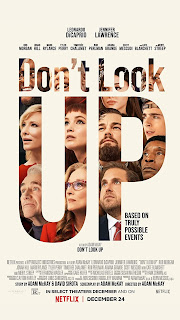
Climate Change. It’s the impending disaster where we stick our head in the sand and pretend it’s not incoming. Governments have been told for decades our carefree use of fossil fuels and slicing down of rainforests will have a cataclysmic impact. But it’s always easiest for governments and people to just say “nah” and not let those thoughts get in the way of our everyday lives. Adam McKay’s satire Don’t Look Now takes these trends of indifference, disbelief and denial climate scientists have faced their whole careers and reapplies them to a comet-hits-the-Earth disaster movie.

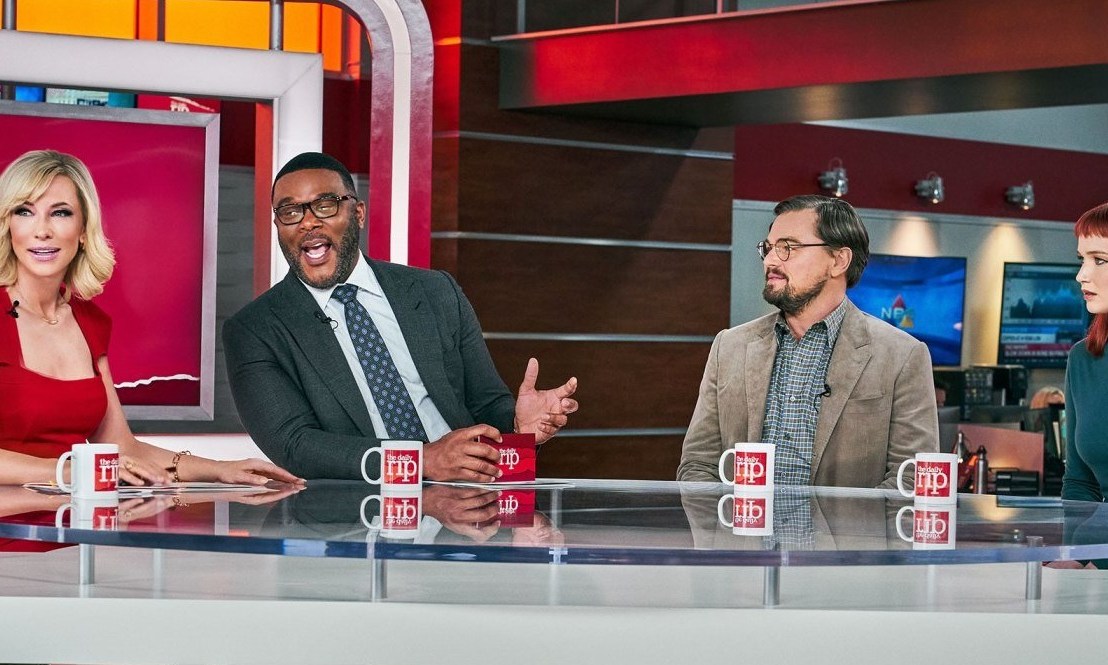
So, when Michigan State University astronomers Dr Randall Mindy (Leonardo DiCaprio) and Kate Diabiasky (Jennifer Lawrence) spot a hunk of ruck the size of Everest on a collision course with the Earth they are met with a chorus of… yawns, memes and flat-out denials. The Trumpian President (Meryl Streep) is only interested in her donors, the mid-terms and dodging the fall-out from a host of scandals. The media – represented by Fox News style anchors Brie Evantree (Cate Blanchett) and Jack Bremmer (Tyler Perry) – aren’t interested in a story they can’t process down into a feel-good social media meme. And even when people start to listen, plans to destroy the comet are benched in favour of a wildly risky scheme, dreamed up by Steve Jobs/Elon Musk style tech billionaire Peter Isherwell (Mark Rylance) to mine the rare ores it contains for money. What could go wrong?

I can see what Adam McKay is aiming for here, to create a sort of Dr Strangelove for climate change, where the great and the good we are counting on to get us through a crisis, turn out to be the blinkered morons who end up causing it. There are moments where it sort-of hits on a rich mixture of farce and genuine anger. Moments where first Kate then Mindy – thelatter with lashings of Howard Beale – melt down on National TV, apoplectic at the comet-denying indifference of millions of people stand out as both hilarious and also compelling.

But, like a lot of McKay’s would-be satirical attacks over the last year, on finance and politics, the message sometimes fails to land because of the heavy-handed, self-satisfied, smug tone of the delivery. Don’t Look Up frequently isn’t very funny – and yes I know it ends with the world being destroyed due to everyone’s indifference and incompetence – and it ladles most of the blame on obvious targets. It’s takedown of Trump – here represented by Meryl Streep – is basic, it hits open goals with the agenda-driven bias of American news reporters and takes pot-shots at messianic tech billionaires. A real punch would perhaps have focused in more on how all the mindless, unfocused greed and ambition of these people is fed by the bland, social media focused, sound-bite obsessed shallowness of the masses. But Don’t Look Up remains focused on the big people.

So focused in fact that, even in this satire, only America has the wherewithal to launch a mission against the comet. A joint Russian, Chinese and Indian mission fails to get off the ground and other world leaders are noticeable by their absence. We never really spend time with any normal people. While much of the blame does lie with governments not taking a lead, we do live in a world where normal people are radicalised by reading about nonsensical mush like QAnon through chat rooms. Imagine a satire that looked at how ordinary people can be made to believe wild theories rather than the evidence of their own eyes as a comet heads towards Earth? Instead Don’t Look Up wants to stick with something vaguely comforting – that there are big, selfish, elites running us who act out of greed and stupidity and they carry all the danger (and the blame).

Where the film is strongest is the doubt and nonsense thrown at scientists. Mindy and Diabasky are first ignored by the administration because they aren’t Ivy League. Attempting to leak their findings on the TV, they are overshadowed by an on-air-proposal of a celebrity DJ to his singer girlfriend and when they hit the news, the only takeaway is that Mindy is ‘cute’, while Diabasky is a freaky angry woman, ranting about the world ending (she’s a meme in minutes). At every point the science is questioned or put on the same level as gut feelings and political agendas. Even their campaign to encourage the world to “Just Look Up” to see the impending catastrophe is countered by the President’s “Don’t Look Up” campaign that persuades millions of people the comet isn’t real.

Really rule by social media and the dumbing down of humanity should be the main target here. A comet isn’t even a great metaphor for climate change – which is gradual, can’t be just blown up and needs to be prevented by society making changes to the way we live. In some ways, by replacing climate change with a comet, even the film is acknowledging its not sexy or exciting enough – and that it doesn’t want to turn its critical fire on millions of people who would rather turn the heating up or drive to the corner shop rather than push to make changes in their lives.
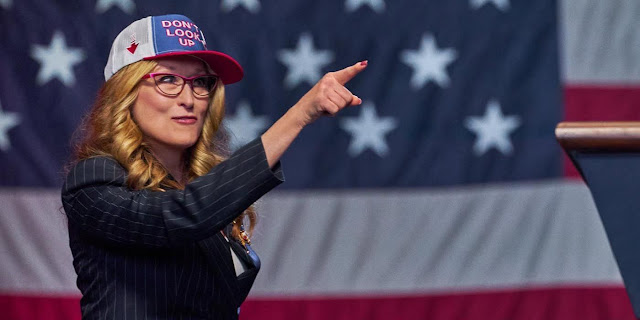
So, it’s easier and simple for McKay to create a cartoon freak show of easy targets and bash them rather than tackle the underlying causes of climate change – that our world and its population wants to have its cake and eat it, and governments for generations have been too focused on the here and now to ever worry about the years to come. So funny as it can be to see Streep Trump it up, or Rylance channel his softness into insanity, or Hill play another of his mindless frat boys turned power brokers, the film doesn’t feel like it really goes for the real causes of climate change: our own culture. It takes hits at our social media simpleness, but not at our short sightedness.

McKay does at least direct without much of the fourth-wall leaning flashiness of his earlier works, and there are committed – if not exactly stretching – performances from Lawrence (whose characters checks out in despair at the shallowness) and DiCaprio (who is seduced by fame, power and Blanchett into becoming an apologetic mouthpiece for the administration). But Don’t Look Up is a little too pleased with itself, a little too focused on easy targets and doesn’t do enough to spread the blame wider. It stills see many of us as victims or mislead – when really we are as to blame a everyone else.

Dr Strangelove; or How I Learned to Stop Worrying and Love the Bomb (1964)

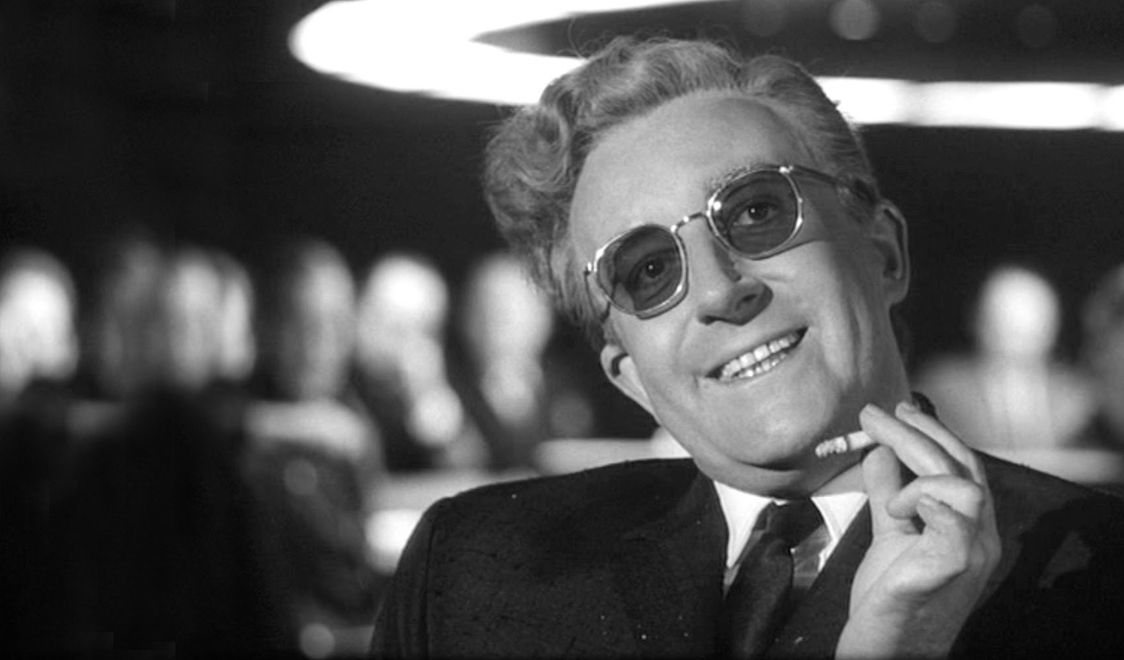
Peter Sellers tries to stop the end of the world in the terrific satire Dr Strangelove

Director: Stanley Kubrick

Cast: Peter Sellers (Group Captain Lionel Mandrake/President Merkin Muffley/Dr Strangelove), George C. Scott (General Buck Turgidson), Sterling Hayden (Brigadier General Jack D Ripper), Keenan Wynn (Colonel Bat Guano), Slim Pickens (Major “King” Kong), Peter Bull (Russian Ambassador), Jack Creley (Mr Staines), James Earl Jones (Lt Lothar Zogg), Tracy Reed (Miss Foreign Affairs)

“Gentlemen you can’t fight in here. This is the War Room!” Kubrick’s hugely influential satire helped shape our perceptions of the Cold War and its mantra of mutually assured direction. Showing no mercy to its targets, it mixes Goonish schoolboy humour with moments of genuine tension and rising horror. Sure it features some of the faults of its director –self-importance, cold distance and much of the wit is due to Sellers and the performers rather than the not-particularly-witty-Kubrick – but there is no doubt it remains a seminal classic.

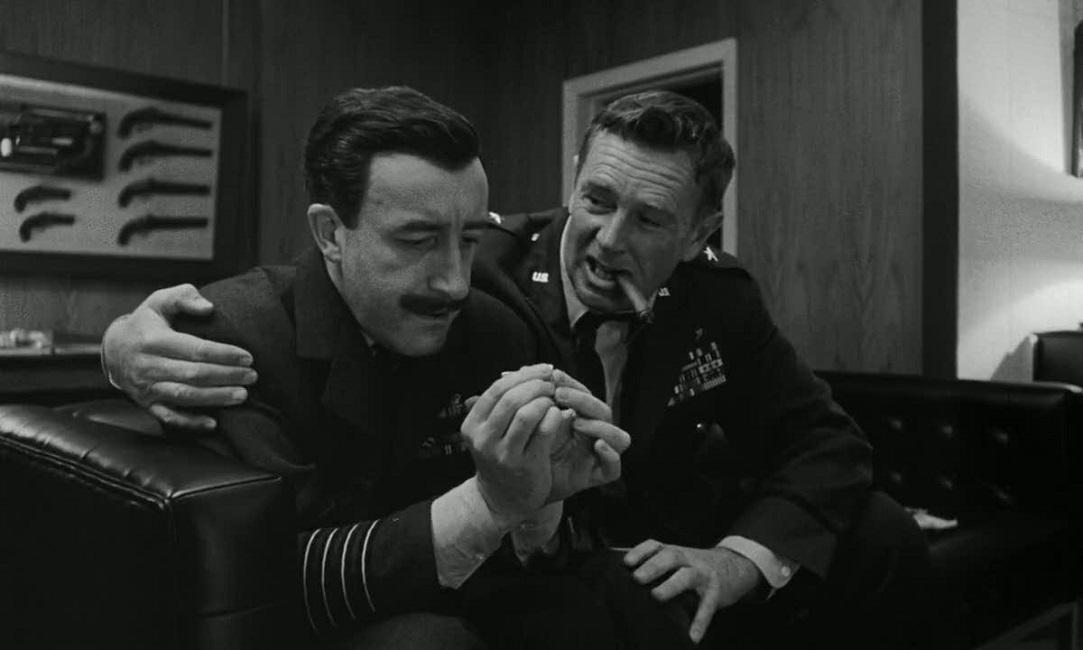
General Jack D Ripper (Sterling Hayden – excellent) orders his planes to drop their nuclear bombs on the USSR. Ripper is launching a pre-emptive strike to protect the American way of life from the Commies and, most importantly, to protect our precious bodily fluids. Yup he’s crazy, something his second-in-command RAF Group Captain Lionel Mandrake (Peter Sellers) quickly realises, but can’t do anything about. US President Merkin Muffley (Sellers again) reacts with horror at the prospect of all-out-war, negotiating with the Soviets to co-operate in shooting down the planes, while some of his advisors such as trigger-happy General Buck Turgidson (George C Scott, hilariously OTT) argue perhaps there is some merit in striking first. And sinister former-Nazi scientific consultant Dr Strangelove (Sellers one more time) spells out the impact of nuclear war.

Kubrick quickly came to the conclusion that if you were going to make a film about nuclear war, it almost couldn’t be anything buta comedy: after all the idea of two sides building a huge arsenal of weapons capable of destroying the world was so crazy, you wouldn’t believe it if you were told it. Dr Strangelove therefore ends up taking place in a world that’s one third grounded and two-thirds heightened reality. There is a great deal of college-style humour in the film (you can see it in those characters names which reference everything from the Whitechapel killer to female genitalia and excrement), but it works because its (mostly) played dead-straight.

Part of the film’s appeal was the number of sacred cows it slays. All the things that, at the time, America was meant to respect were ridiculed. The military, politicians, the Presidency, America’s moral authority, the ingenuity of American science and engineering. It’s all shown to be ineffectual, misguided, underpinned by fascist-tinged insanity, myopically obsessed with big bangs over humanity or plain ridiculous. Every single authority figure in the film is deconstructed over its course as some combination of childish, empathy-free or useless. You can’t come out of this film and every again have an unquestioning assurance our leaders know what they are doing.

This works, because it’s placed in a film that in many ways has the plot of a far more serious film (its very similar of course to Fail Safe). Chunks of it are played completely straight, or with just the merest touch of the surreal. In particular the sequences set on the bomber, commanded by Major Kong (played at short notice by Slim Pickens after injury prevented Sellers taking on that role as well) have that true sense of Kubrickian detail in their careful staging of all the procedures a bomber crew would follow (even if it still allows some fun to be poked at the expense of the survival kit, the contents of which would give a fella “a pretty good weekend in Vegas”).

Those bomber scenes sometimes outstay their welcome in their cold technicality (it’s odd to say that a film as short of this sometimes feels a little overlong), but that’s largely because in a film that is clearly demanding us to shake our heads at the madness, it struggles to get us invested in a more conventional heroic story (especially as success there is starting a nuclear conflagration).

Perhaps that’s because of the coldness in Kubrick’s style – emotion doesn’t often find its way into his greatest works, and he was often reliant on working with the right people (get a McDowell in it or a  Nicholson and things can click, get an O’Neal and you can get a different story). Humour isn’t his strong suit, but fortunately he worked with Sellers at his finest hours. Sellers takes on three roles, all of them a sharp contrast, and he’s masterful in all of them. There were fewer more gifted improvisational performers than Sellers, and each of his parts benefits hugely from the dynamism (of various sorts) he gives them. It’s also interesting that two of them are actually the “one sane man” (Muffley and Mandrake) while Strangelove is a pantomime monster of insanity (introduced late in the film, he’s the final indicator that our fates are in the hands of complete lunatics).

For Mandrake, Sellers parodied the stiff-upper lip upper class, with Mandrake a stuffed-shirt, attempting to wheedle recall codes out with Ripper with a clumsy bonhomie. Muffley is played almost dead-straight as a weak man out of his depth. But he does have a phone call monologue with the Russian premier (largely improvised with Sellers) that is one of the funniest things you’ll ever see. There’s no restraint in Strangelove, a wheel-chair bound grotesque with a phantom (hardcore fascist) hand, constantly suppressing involuntary Hitler salutes and trying to hide his mounting excitement at the prospect of worldwide annihilation (“Mein Fuhrer! I can valk!”).

Kubrick’s directorial approach – wisely – seems to have been to acknowledge that Sellers was providing so much of the madness and dark comedy the concept demands, that he could be more restrained. Interestingly, for being his most famous film, it often feels like one of his least personal ones. It stands outside much of the Kubrick cannon – it’s short, its often brisk, technically it’s unflashy and often unobtrusive – and it plays on the director’s weakest vein, comedy.

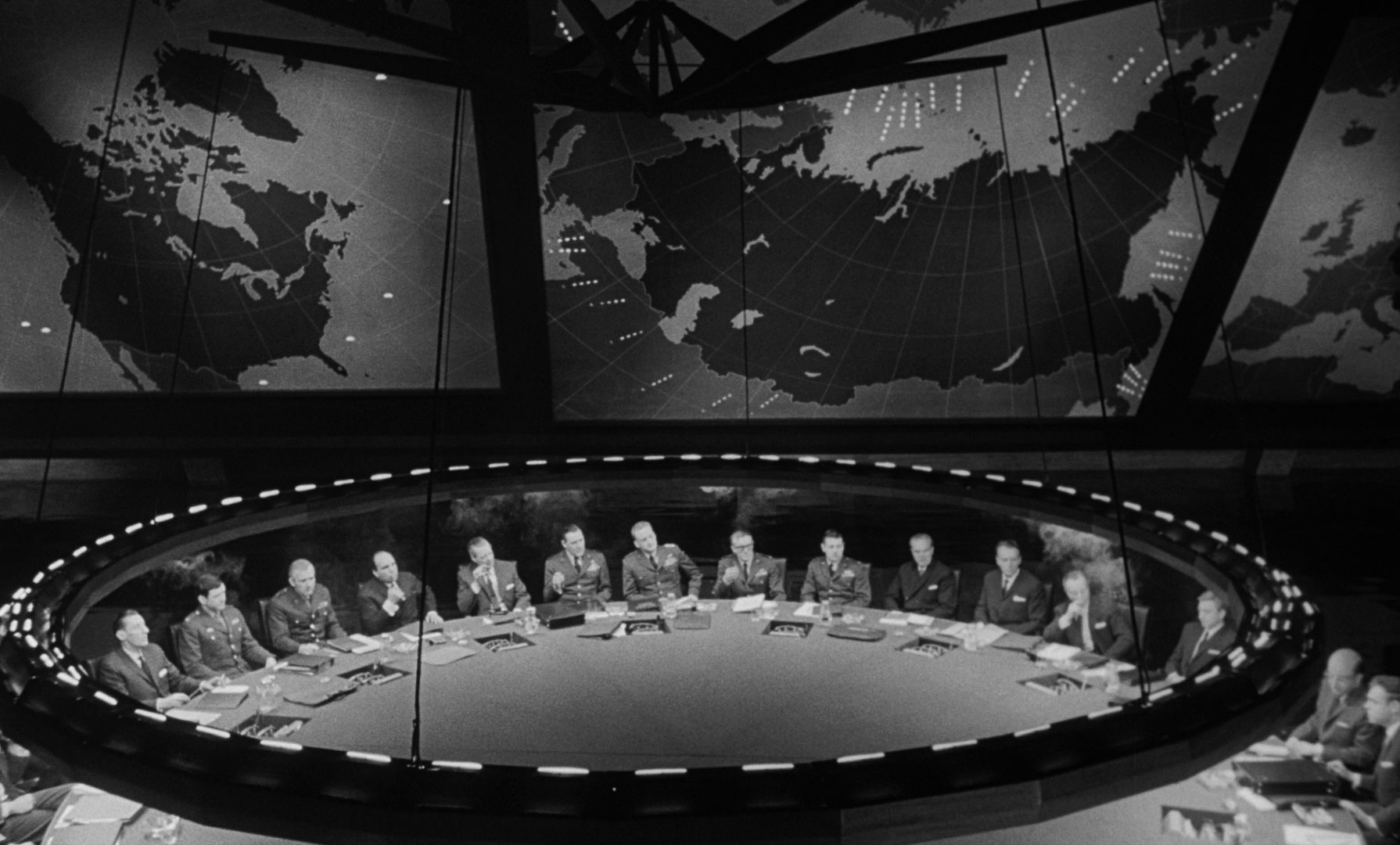
But it’s got his mastery of detail – partly also due to its faultless set design by Ken Adam. The reconstruction of the bomber interior is overwhelmingly convincing (the Air Force was amazed at how accurate it was). Ripper’s low-ceilinged office is a visual metaphor for the character’s insular insanity. Most influential of-all, the Bond villain-ish War Room, with its vast circular table and huge screens was so perfectly conceived, it cemented the idea for generations of what war planning rooms should look like (Reagan even asked where it was when he took office). The film may be darkly surreal, but its surroundings give it an authority that is essential for its success.

Authority is what the film needed to work. Perhaps that’s the greatest contribution of Kubrick, to create a structure of convincing reality, allowing the surreal and insane actions to work. From Ripper’s clear fixation on his own impotence (“I do not avoid women but I do deny them my essence”) – to Turgidson’s increasingly bombastic militarism (“I don’t say we won’t get our hair mussed, but I do say no more than 10 to 20 million killed. Tops.”), they all work because they contrast with a setting soaked in reality and detail. It also adds the important depth that gives the film impact: sure it wouldn’t happen like this, but something like this could happen.

Dr Strangelove’s humour has at times dated – there’s something undeniably schoolboyish about its tone. Stretches showing the detail of the bomber’s operation go on way too long. The film itself also takes a while to get going, and like many Kubrick films it has an air of being pleased with itself. But in Sellers it has a comic genius at the height of his game and its impact in changing the way we think about the world can’t be denied. Still a classic.

Mr Smith Goes to Washington (1939)

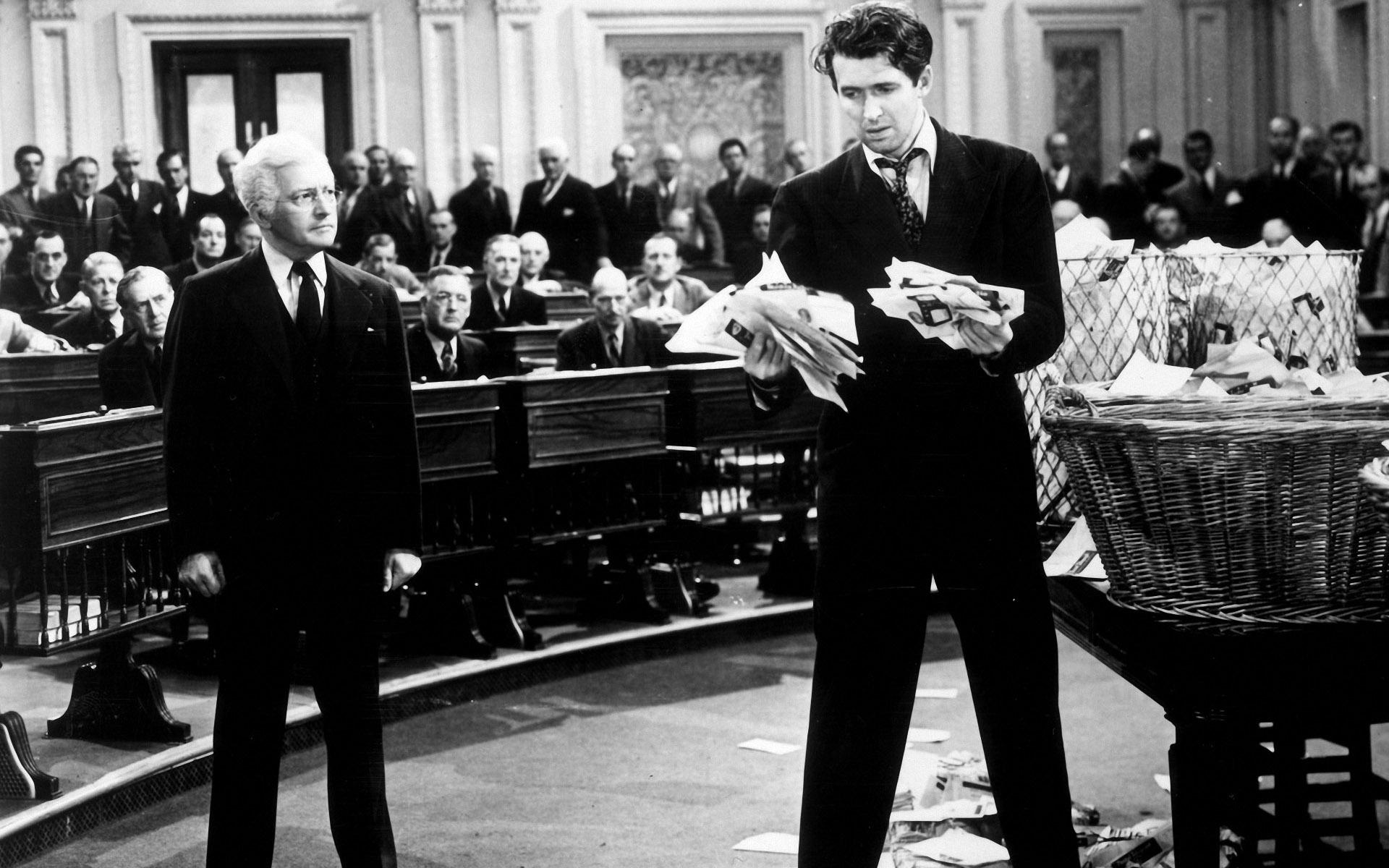
James Stewart campaigns for truth and justice in Capra’s classic Mr Smith Goes to Washington

Director: Frank Capra

Cast: James Stewart (Jefferson Smith), Jean Arthur (Clarissa Saunders), Claude Rains (Senator Joseph Harrison Paine), Edward Arnold (Jim Taylor), Guy Kibbee (Governor Hubert “Happy” Hopper”), Thomas Mitchell (“Diz” Moore), Eugene Pallette (Chick McGinn), Beulah Bondi (Ma Smith), H.B. Warner (Senate Majority Leader), Harry Carey (President of the Senate), Astrid Allwyn (Susan Paine)

Capra’s film are known, above everything, for their fundamental optimism about life, friendship and the American Way. Few films cemented that opinion more than Mr Smith Goes to Washington, the quintessential “one man in the right place can make a difference” movie. And where else would that one man need to be, but Washington? Where laws are framed and ideals come to die. It’s our hope that those at the heart of the political system are there for the good of the people. Of course, even Capra knew most of them were there to line their pockets and do their best for powerful business interests. So who can blame Capra for a little fantasy where naïve, innocent but morally decent Jefferson Smith decides enough is enough?

In an unnamed mid-Western State (the story the film is based on named it as Montana), the junior senator unexpectantly dies. The Governor (Guy Kibbee) needs a new man. Should he go for a reformer or the latest stooge put forward by political power broker in the State Jim Taylor (Edward Arnold). A tricky choice, so he splits the difference by appointing Boy Rangers leader Jefferson Smith (James Stewart) – because he’s wholesome and clean but also naïve enough to manipulate. Jeff heads to Washington, under the wing of Senator Joseph Paine (Claude Rains) – but Paine is in the pocket of Taylor.

Taylor and his cronies want an appropriation bill forced through that includes a clause to build a dam in their state. The dam will be built on land secretly bought up by Taylor and others, making them a fortune from public money. When Jeff announces in the Senate a bill to host a national boy’s summer camp on that same land, it throws a spanner in the works. Despite threats and bribes, Jeff refuses to go along with the shady deal over the dam, so they set out to destroy his reputation. With the help of his secretary Clarissa Saunders (Jean Arthur), Jeff mounts an epic filibuster in the Senate to clear his name, stop the dam and reveal the political corruption in his state.

Capra’s film is earnest, well-meaning and at times even a little bit sanctimonious and preachy – but it gets away with it because it’s also so energetic, honest and fun. It’s strange watching it today to think that the Senate at the time responded so poorly to it. Leading public figures either denounced it’s view of government and even tried to have it banned. Ironically of course, it probably inspired more people to get involved in Government than any other movie.

That was bad news for the corrupt political machines that ran so many parts of America at the time. Capra’s film is remarkably open-eyed about how these machines worked. Powerful business interests at the centre, with a raft of politicians in their pay – from Governors and senators on down. Jim Taylor – very well played with a swaggering, crude, bullying tone by Edward Arnold – only has to snap his fingers to get things done. During the film he mobilises the press, the police, the fire service and an army of heavies to enforce his will in the state and suppress free speech. The Governor (a neatly tremulous Guy Kibbee) is so firmly in his pocket, he can barely tie his shoe-laces without Taylor directing it. Senator Paine is patrician, dignified and has every inch of respectability – but he is soaking in filth up his neck from contact with Taylor.

It’s this system the film has a quiet anger about. Whatever happened to having “a little bit of plain, ordinary kindness – and a little lookin’ out for the other fella too”? Capra’s sprightly film also makes clear that we both don’t look too closely at how our government is really run and are very quick to hoover up any story we get from our political masters and accept it as gospel. An honest, decent man in the middle of all this is as unlikely a sight as you can imagine.

But that’s what these people get with Jefferson Smith – and discover someone who should be easy to manipulate, but doesn’t understand the rules of the game he’s playing. Instead Jeff thinks they are all there to help other people, not to themselves. Now you can argue, as some critics have, that law-making is the art of compromise – and that once the dam is under way, the benefits it will produce to Jeff’s home State (in terms of employment and energy) will be huge. So why shouldn’t Jeff bow down and move his boys camp in order to let the Bill go through?

Well the point is that Jeff isn’t opposed to the dam – he’s opposed to the corrupt profiteering that will spring out of it, and the way the cesspool of Washington (amongst all those fine monuments he so adoringly looks at) doesn’t care. This is a filibuster campaign to put honesty and decency back into American politics – and what’s not to like about that? It’s a film that firmly believes that one good man in the right place (that’s both Jeff and the President of the Senate, who tacitly encourages him) can change the day and save the country from itself.

There was of course no one better for such a job than Jimmy Stewart (and surely it’s this film that made him “Jimmy” to one and all). Capra had James Stewart in mind from the start – and it’s a perfect role for him, an iconic performance that stands as surely one of his greatest roles. Stewart has the skill to make Jeff endearing but not saccharine, naïve but not frustrating, innocent but not a rube, gentle but determined. Despite its corniness (and some of the film is very corny) you relate to his reverence for Lincoln’s memorial and the Capital. Stewart’s homespun charm is perfect, but it’s matched with the steel he could give characters. There is an adamant quality to his filibuster, his refusal to back down and go along with injustice. The final quarter of the film that deals with the filibuster is quite superb stuff, Stewart delivering some very-well written speeches with commitment, passion and bravura. It’s no understatement to say the film would work half as well as it does without him.

But then the entire film is also a feast of great acting, all sparked by a superb script from Sidney Buchman which mixes razor-sharp dialogue with wonderful speeches. Jean Arthur (who actually gets top billing) is very good as a cynical Washington insider who rediscovers her ideals – and finds her heart melting – under Jeff’s honest influence. Claude Rains gives one of his finest performances as the patrician Paine, a man who tries to close his eyes to his own corruption, but swallows down his own guilt and shame every day. Harry Carey gets a twinkly cameo as an amused and supportive President of the Senate. (Both actors were nominated for the Oscar, but lost to Thomas Mitchell for Stagecoach who also appears here in a fun turn as the drunken but principled reporter Diz).

Capra keeps the pace up perfectly, and his direction handles both smaller scale scenes of romance and idealism, with the larger scale fireworks of the Senate (a superb set, that looks so convincing it’s amazing to think it was built on a sound stage). His biggest trick here is to create a film that, in many ways, is a political lecture, but never makes it feel like one. Instead it delivers it’s messages on truth, justice and the American way with such lightness – but yet such pure decency – that it all works. It helps a great deal that the film doesn’t shy away from the corruption and – apart from a final turn that saves the day – resists melodrama and contrivance. Charming, funny but also thoughtful and committed, Mr Smith Goes to Washington is one of Capra’s very best.

The American President (1995)

The buck stops with Michael Douglas in Aaron Sorkin’s dress rehearsal for TV, The American President

Director: Rob Reiner

Cast: Michael Douglas (President Andrew Shepherd), Annette Bening (Sydney Ellen Wade), Martin Sheen (AJ MacInerney), Michael J Fox (Lewis Rothschild), Richard Dreyfuss (Seantor Bob Rumson), David Paymer (Leon Kodak), Samantha Mathis (Janie Basdin), John Mahoney (Leo Solomon), Anna Deavere Smith (Robin McCall), Nina Siemaszko (Beth Wade), Wendie Malick (Susan Sloan), Shawna Waldron (Lucy Shepherd), Anne Haney (Mrs Chapil)

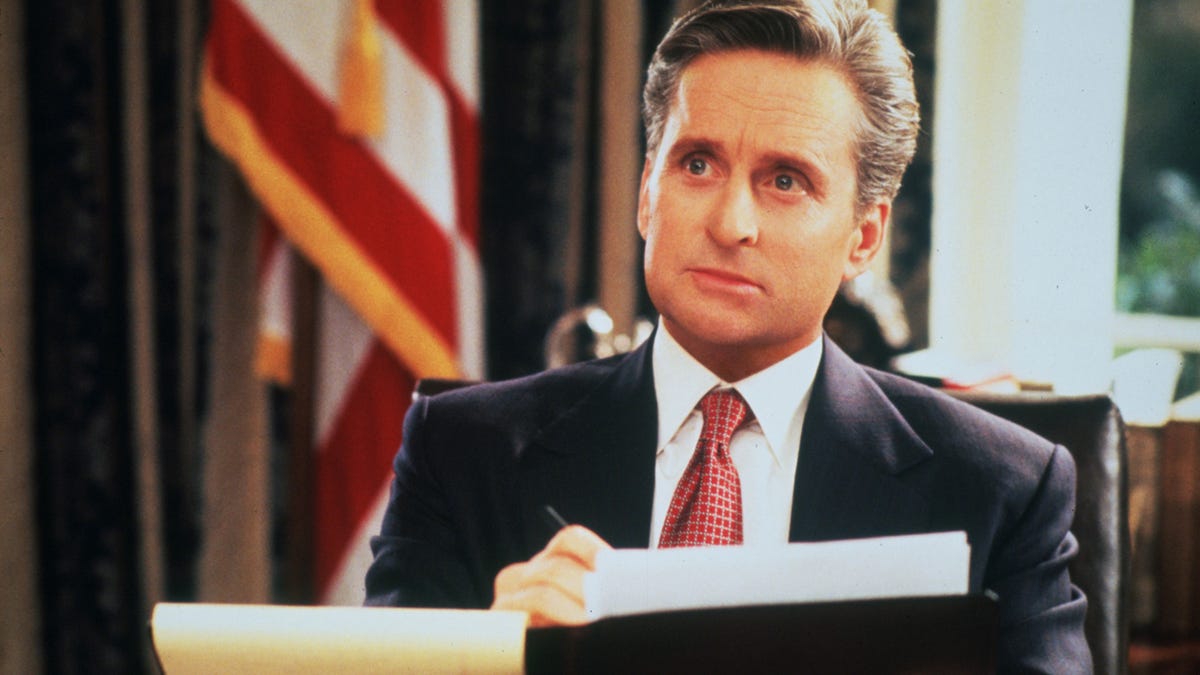
Taken solely on its own merits, The American President is a charming, witty romantic comedy which makes some shrewd (liberal-tinged) comments about American politics. But no-one is ever going to take The American President on its own merits. Because this Sorkin-scripted bundle of joy is so clearly a dry-run for The West Wing, it’s hard to watch it without spotting the roots of it here: everything from shared characters to scraps of dialogue. Perhaps only M*A*S*H stands with this film as so dwarfed by its spin-off.

President Andrew Shepherd (Michael Douglas) is a widower, raising his daughter Lucy (Shawna Waldron). Heading into the third year of his first term, he’s got a domestic agenda dominated by his new crime bill (although Shepherd won’t risk increasing gun controls). Charming, articulate and passionate – he’s also lonely. But his life changes when he falls for environmental lobbyist Sydney Ellen Wade (Annette Bening), their courtship seeing them fumble through “boy-meets-girl” when boy just happens to be the most powerful man in the world. Will the President’s popularity survive him dating someone outspoken and passionate? Or will it be a tool for his Republican rival Senator Bob Rumson (Richard Dreyfuss) to hit him on everything from family values to patriotism?

It’s impossible not to enjoy The American President. Sorkin’s playful, articulate and smart dialogue is of course an absolute triumph. The cast are extremely well-chosen. Few actors look as damn Presidential as Michael Douglas, not to mention carrying with them an air of impassioned authority and commanding bonhomie. Annette Bening is spot-on as exactly the sort of feisty and intelligent woman that would attract a liberal minded President, but turn off pundits and regular people. Martin Sheen was obviously so comfortable with Sorkin’s dialogue style that promotion to the President seemed inevitable (seriously it’s very odd watching the film and seeing Sheen not being treated like the President!). Michael J Fox’s entire career was revitalised by Sorkin tapping into the frantic, fast-paced comic energy that is the actor’s forte.

Rob Reiner’s direction is fresh, relaxed and perfectly complements the dialogue. We get a few West Wing style walk-and-talks (does this make Reiner the inventor of it?). The film superbly balances romantic comedy with serious political discussion on military intervention and proportional response (“the least Presidential thing I do”), the environment and gun control. It also gets a neat idea of the shady, and dirty, business of generating votes in the House – and the deals that need to be done to secure legislation. Reiner gets great stuff from the actors (Sorkin didn’t question his casting, since so many of them ended up in The West Wing) and keeps the momentum up beautifully.

The film has a lovely Capra-esque feel to it. Sorkin is even witty enough to lean on this by having Sydney discuss Capra openly with a White House security guard – also a lovely moment to establish Sydney’s genuineness and openness, as compared to the jaded I-don’t-care attitude of her colleague. There is a real feel in it – and of course this optimism carries across to The West Wing – that good people in the right place can change the world. That decency and compassion can trump (so to speak) the cynicism of Washington insiders. (The idea appeals to everyone – what is Donald Trump but a nightmare version of a plain-speaking man in Washington who says what he thinks?).

Balanced with some lovely comedy, it works extremely well. Along with the debate, Sorkin has a great feeling for the absurdity of the Leader of the Free World trying to work out how he can behave like a regular Joe and ask a girl out on a date. Simple ideas, from sending flowers to the etiquette of having someone stay over, are laced with difficulties. The film gets a wonderful sense of how the public eye can unjustly tear people apart – all drummed up by Dreyfuss’ eminently hissable villain.

There is some great chemistry between Douglas and Bening. Douglas is at possibly his most charming and authoritative here, effortlessly selling the lightness but also the powerfully effective speeches Sorkin crafts for him (his final press conference speech that effectively closes the film is a barnstormer). Bening, as well as being perfectly cast, walks a neat line between serious professional and girlish crush, that comes across extremely well.

It’s hard though, for all the film’s romantic charm, not to look at it through the filter of The West Wing. It’s both a first pass, and a historical curiosity. Sorkin recycled many of the ideas touched upon here (most noticeably Sheen’s President would spend an entire episode discussing proportional responses) and also expanded several characters. Douglas’ teacher turned President, widely read and with a liberal outlook, is a clear forerunner of Bartlett. Sheen himself plays a character who is all but Leo. Fox plays a character combining elements of Josh and Toby. Anna Deavere Smith is a CJ without those distinctive touches Allison Janney bought to the role. Names, plot developments, concepts are all recycled. Stylistic flourishes in the writing match.

The American President isn’t as good as The West Wing of course – few things are. But as a boiled down, Hollywood version with a romantic twist, it’s still pretty damn good.

The Last Hurrah (1958)

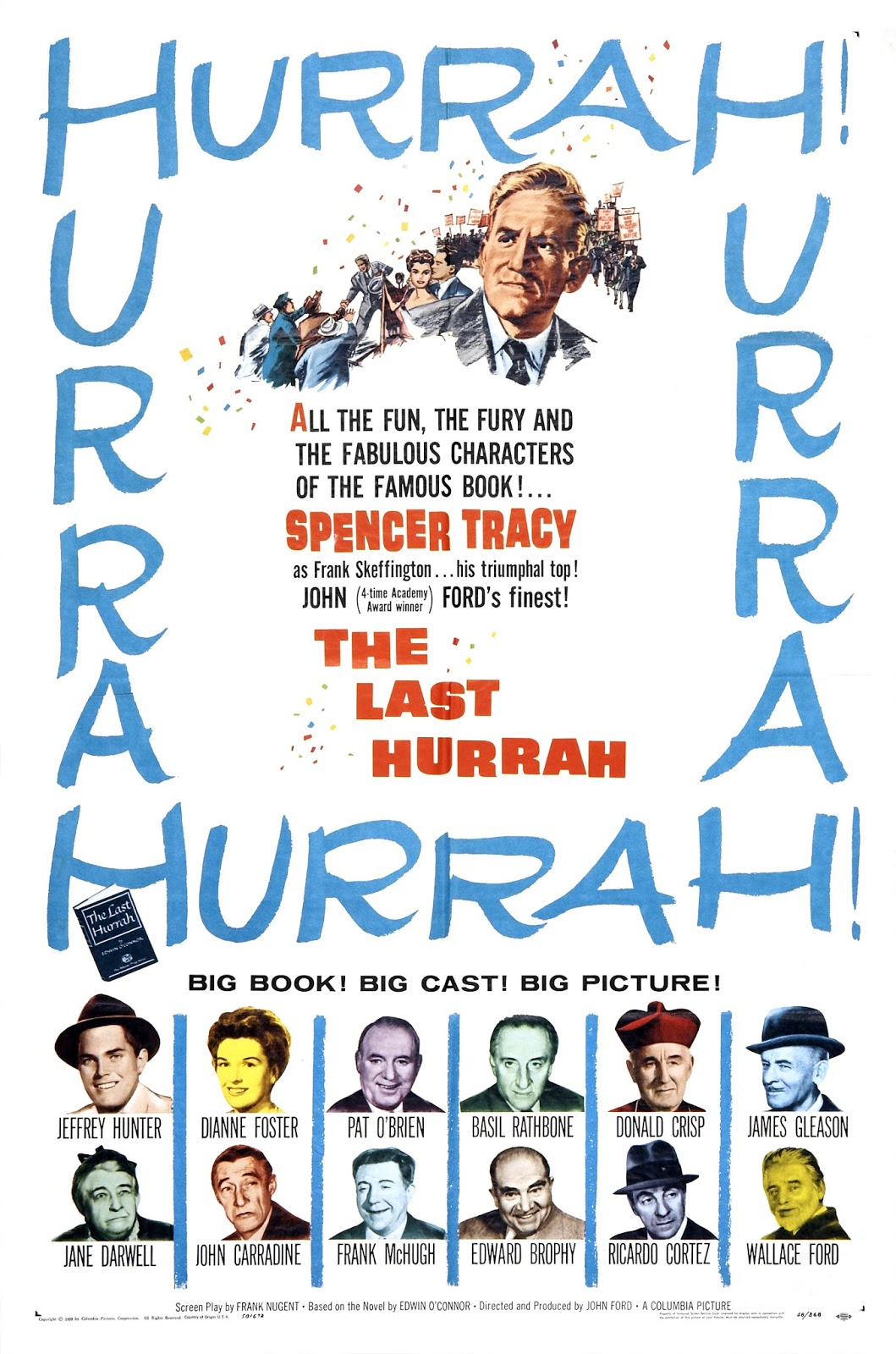
Spencer Tracy runs for office in John Ford’s toothless satire The Last Hurrah

Director: John Ford

Cast: Spencer Tracy (Major Frank Skeffington), Jeffrey Hunter (Adam Caulfield), Dianne Foster (Maeve Caulfield), Pat O’Brien (John Gorman), Basil Rathbone (Norman Cass), Donald Crisp (Cardinal Martin Burke), James Gleason (“Cuke” Gillen), Edward Brophy (“Ditto” Boland), John Carradine (Amos Force), Willis Bouchey (Roger Sugrue), Ricardo Cortez (Sam Weinberg), Wallace Ford (Charles J Hennessey), Basil Ruysdael (Bishop Gardner)

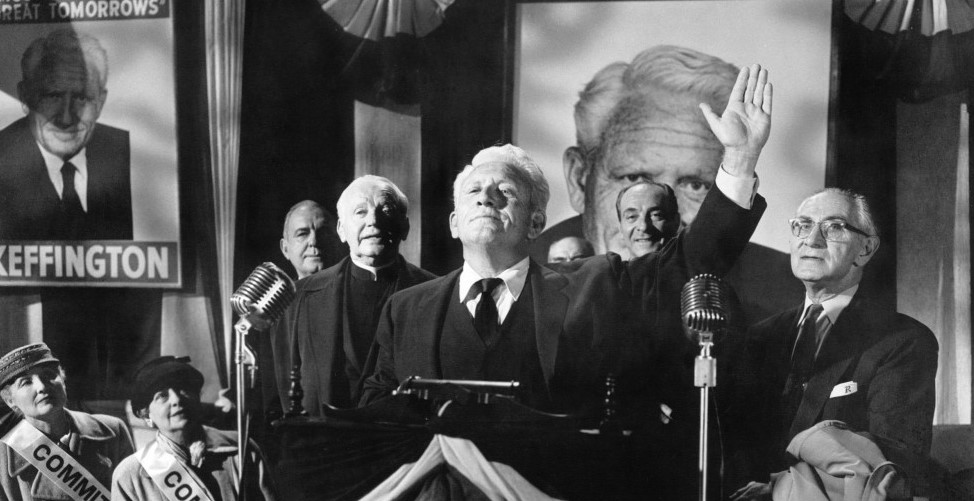
Mayor Frank Skeffington (Spencer Tracy) is running for a fifth term of a “New England city”. Skeffington’s roots lie in the town sprawling Irish population, and has successfully played the game of machine politics all his life. He’s alienated the members of the towns traditional elite – who can trace their ancestors all the way back to the Mayflower – but he’s loved by the regular people of the city. But is Skeffington going to find himself out of touch with a political world starting to embrace populism and the power of television?

John Ford’s adaptation of a hit novel by Edwin O’Connor, is one of his rare “present day” pictures. But it’s a bit of a busted flush. What should have been an exploration of a tipping point in American politics, totally fails to successfully land any of the points it could make. It’s a film that doesn’t understand the Kennedy-esque world America was moments away from embracing, and looks with such ridiculously excessive sentimentality at old-school politics it manages to tell us nothing about the corruption and dirty deals of this sort of machine politics. Effectively it’s a film that takes two long hours to tell us almost nothing at all. 

The film adores two things – and it’s not a surprise in a Ford film – the past and the Irish. Anything from yesteryear is covered in a halo, with the parade of old-school Hollywood character actors from the Ford rep company taking it in turns to denounce and condemn anything and anyone less than 40 years old. Every young person in the film is either a feckless idiot – Skeffington and Cass’ sons are a playboy and an embarrassing moron – or, like Jeffrey Hunter’s Adam Caulfield (Skeffington’s nephew covering the election for the local paper) is there merely to provide doe-eyed adoration. 

As for the Irish, the film loves the grace and charm of this old immigrant community. Skeffington’s Irish political machine is sanitised beyond belief. In the real world these sort of organisations operated on a system of back room deals, intimidation and careful arrangements to deliver set quotas of votes on polling day. Sure many of these politicians also delivered a number of social reforms – as Skeffington does – but any suggestion that any of Skeffington’s dealings could ever be described as dirty are roundly dismissed. Here it’s all about what Skeffington could do for other people, and no mention of the endemic corruption in many politicians like this. Instead Skeffington is presented with nothing but rose-tinted sentimentalism, a respectful widower, a kind man, whose actions are often more about other people than politics.

Former Boston mayor James Michael Curley – who Skeffington was clearly based on – was imprisoned for corruption. No chance of that happening to Skeffington who only uses intimidation and back-street savvy to fight the causes of orphans and widows (literally) and takes nothing at all from the public purse (although he still lives in a lovely big home). By contrast his elite opponents are the sort of scowling, greedy, penny-counters you might find in a Frank Capra film, shameless bankers and newspaper types who care nothing for truth and justice and only their own selfish needs.

Perhaps that’s why Skeffington’s opponent McCluskey (an early Kennedy substitute with his perfect family life, war record and lack of actual accomplishments) is portrayed as such an empty suit, a mindless, grinning yes-man who has nothing to say and no goals to meet. Ford’s contempt for him – and for the new word of television – drips off the screen. The TV shot we see McCluskey shooting is a farcical mess, poorly shot, edited and delivered with stilted artificiality by McCluskey and his tongue-tied wife. Not only is it not particularly funny, the presentation of this just shows how out of touch Ford was with modern America. Two years after this, Kennedy would win an election largely off the back of his ability to present a dynamic image on TV. Skeffington even crumbles in the election due to his traditional, press-the-flesh campaign not competing effectively with TV slots. How can that look even remotely convincing when Ford shows his rival has no mastery of the new media at all? That in fact he’s worse at making TV than Skeffington proves to be?

What exactly was Ford going for? By failing to criticise anything at all about the old-school politics and pouring loathing on the new politics, he ends up saying very little at all. Skeffington is a twinkly angel, but we never understand why so many in the church and the city oppose him – other than the fact I guess that he is Irish. Donald Crisp’s cardinal promises at one point near the end to reveal why he always opposed Skeffington – only to be hushed. If anything bad ever happened, Ford ain’t telling us making this one of the most dishonest of his tributes to Old America.

None of this is to criticise much of the acting, which is great. Spencer Tracy dominates the film with his accustomed skill and charisma, his Skeffington both a twinkly charmer and a practised flesh-presser who manages to subtly pitch and adjust his character depending on his audience and whose physicality helps to assert his dominance in every scene. Pat O’Brien does fine work as his fixer and Basil Rathbone is suitably sinister as a his principle financial opponent. Ford also puts together some memorable shots – especially a long walk Skeffington takes past a victory parade – and scenes, but the film is an empty mess. And, with its extended final twenty minute coda, goes on way too long.

The Candidate (1972)

Robert Redford as a political puppet in The Candidate

Director: Michael Ritchie

Cast: Robert Redford (Bill McKay), Peter Boyle (Marvin Lucas), Melvyn Douglas (Former Governor John J McKay), Don Porter (Senator Crocker Jarmon), Allen Garfield (Howard Klein), Karen Carlson (Nancy McKay), Quinn Redeker (Rich Jenkin), Michael Lerner (Paul Corliss), Kenneth Tobey (Floyd J Starkey)

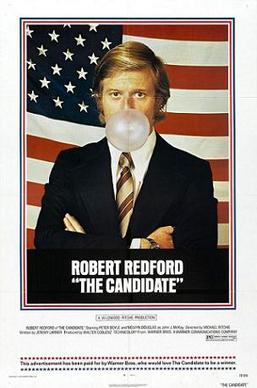
Bill McKay (Robert Redford) has it all – the looks, the charm, the ideals, and he’s the son of former California governor John McKay (Melvyn Douglas). Who else could stand a chance as the Democratic candidate against long-time incumbent Senator Crocker Jarmon (Don Porter)? McKay is reluctant to run – but he’s promised by Marvin Lucas (Peter Boyle), election specialist, that he has no chance of winning so sure, he can say whatever he wants. But Lucas has another plan, to turn the good-looking, charismatic McKay into his ideal candidate – workshopped, bland, generic and with as wide (and shallow) an appeal as possible. And as the election goes on, McKay turns from not caring, to not wanting to get humiliated, to wanting to win. What price idealism in a political game like this one?

Today, The Candidate looks considerably less fresh and inventive than it seemed in 1972. Back then it caught the wave of an America becoming increasingly disillusioned with its leaders and elections. Then, the idea of mass media manipulating focus-grouped candidates into something pliable, bland and uncontroversial to appeal to as many people as possible, seemed revelatory. Today, when even the optimistic The West Wing chronicles how even the good guys are obsessed with being on message and putting together political ideas into simple, repeatable soundbites with image as everything, The Candidate hardly looks ground breaking.

It won an Oscar for its screenplay, but it looks behind the times now – or even telling us only what we know already. So politics is all about image? Well big news there. In its Faustus-like structure, with McKay being corrupted away from his initial principles into the sort of cookie-cutter candidate focus group organisers dream of, it should be compelling. It isn’t really, part of the problem being that, even with his ideals, McKay is not really an interesting character.

He’s a character that can almost be defined as “looks like Robert Redford”. That’s what makes him appealing – the script spends no time at all on establishing any political or social ideas in McKay early-on beyond a vague wish to “do good” with his low-key law consultancy representing only the poorest. There is a half-hearted attempt to add some daddy issues, with the son determined to never become the principle-free politician his father (a blithely uncaring Melvyn Douglas) is. But these don’t really come into shape. Perhaps that’s the point? What makes McKay so appealing to Lucas from the start is he looks like a Kennedy, but has no real personality or ideas of his own.

He is, basically, a weak person who is quickly shuttled from place to place, told what to say and what to do and willingly converted one step at a time into an even greater non-entity. McKay clings to the idea of his political videos being about an idea, but quickly accepts “ideas don’t work” in these short pieces and allows them to be turned into puff pieces praising his youth and vigour. The film does get some fun out of the emptiness of campaigning – the slogan “McKay: The Better Way” means nothing at all – not to mention McKay becoming so dependent taking direction he can’t even do a broadcast without asking if his jacket should be buttoned or unbuttoned. But it lacks a real oomph.

Perhaps that’s because the film doesn’t really have a plot or characters as such. Every person in the film is there to fill an objective, no more and no less. Even Lucas, the arch manipulator, is little more than a cipher to represent spin doctors (years before the term was coined) for whom the competition and battle is all that matters and principles count for nothing. Ritchie shoots the film with a sort of sub-Altmanesque observational style with overlapping dialogue, but never really immerses the viewer in the quick-moving world of politics, instead serving up a series of mediocre images and scenes that serve as sketches or statements (Campaign ads are empty! Politicians are pre-packaged! They don’’t answer questions!) that eventually become a bit wearing.

Without this sense of narrative, events drift by and character developments just seem to happen with no logic. Redford supplies no real character to the part, unable to convey a sense of growing corruption and ambition in his performance. So when McKay starts doing things – like the mistress he takes during the course of the campaign – it just feels like the film has a nihilistic loathing for politicians rather than the ability to make any actual points that carry weight. 

It’s a disappointment as this is a good idea, and could have really worked if the writers and directors had allowed the film to have some heart alongside its cold cynicism, or even had allowed some clear story to play alongside. Instead we simply watch McKay becoming even more empty and artificial – taking part in a debate with his rival on air, in which he skilfully never answers a single question but parrots quotes from his briefings – only addressing at the very end that all this leaves us with politicians good at winning elections but with no idea about how to run the country. While it is one of the first films of its type, you feel it has long since been surpassed.

Primary Colors (1998)

John Travolta and Emma Thompson are definitely not the Clintons in Primary Colors

Director: Mike Nichols

Cast: John Travolta (Governor Jack Stanton), Emma Thompson (Susan Stanton), Adrian Lester (Henry Burton), Billy Bob Thornton (Richard Jemmons), Kathy Bates (Libby Holden), Larry Hagman (Governor Fred Picker), Stacy Edwards (Jennifer Rodgers), Maura Tierney (Daisy Green), Diane Ladd (Mamma Stanton), Paul Guilfoyle (Howard Ferguson), Kevin Cooney (Senator Lawrence Harris), Rebecca Walker (March Cunningham), Allison Janney (Miss Walsh), Mykelti Williamson (Dewayne Smith)

In 1998, America was engrossed in what seemed like a never-ending series of scandals around Bill Clinton, with Clinton facing impeachment. The news was filled with Clinton-Lewinsky Scandal catch-ups seemingly non-stop. Surely in the middle of that, a film that charted earlier scandals about Slick Willie would be a hit? Well Primary Colors proved that wrong. A thinly veiled portrait of the Clinton run for the White House, based on a novel written by Joe Klein who followed the Clintons on the campaign, it tanked at the box office. Possibly due to audiences having Clinton-fatigue – but also perhaps because it’s a stodgy, overlong and slightly too pleased-with-itself piece of Hollywood political commentary.

The film sticks pretty close to real-life timelines. John Travolta is Arkansas Governor Jack Stanton (Travolta does a consistent impersonation of Bill Clinton both vocally and physically during the whole film), who’s running for the Democratic Presidential nomination, supported by his (perhaps) smarter, ambitious wife Susan (Emma Thompson, doing a neat embodiment of Hillary without impersonation). Eager young black political operator Henry Burton (Adrian Lester) is recruited to help run the campaign – and finds himself increasingly drawn into the secrets of the Stantons, not least Jack’s persistent infidelities that seem to go hand-in-hand with his empathy and genuine passion for helping people. As scandal builds on scandal, the campaign to run for President becomes ever more unseemly.

Primary Colors asks questions that, to be honest, are pretty familiar to anyone who has ever seen a Hollywood film about politics. We’re presented with a Clinton-Stanton who wants to help America to re-educate itself in a modern world, who weeps with emotion when hearing a man recount his struggles with literacy (a fine cameo from Mykelti Williamson), who wants to rebuild America’s economy and build opportunities for all. And at the same time, he can’t keep it in his pants, is quite happy to dodge as much as possible the consequences of his actions, and is blithely disinterested in the impact his infidelities have on other people. Essentially the film wants to ask: at what point does a man’s personal behaviour and morals start to outweigh his good intentions?

It just takes a long time to ask it. A very long time. Primary Colors is a film that could easily be half an hour shorter, and you would miss very little. It’s a stodgy, overlong, smug drama that takes a gleeful delight in how clever it’s being making a film about the Clintons that-isn’t-about-them. It’s weakened as well by using an overly familiar device of putting a naïve and well-meaning audience surrogate character at its centre. We’ve seen this growth of disillusionment before, but Adrian Lester (in a break out role) fails to make Henry Burton a really interesting character – he’s little more than a cipher that we can project our views onto, and Lester is too reserved an actor to make him a character we can effectively invest in as a person. Instead he becomes a largely passive observer that more interesting characters revolve around.

Those characters being largely the Stantons themselves. John Travolta does a very good impersonation of Clinton, but he offers very little insight into the sort of person Clinton is, his motivations or his feelings. Like the character, the role is all performance and you never get a sense of how genuine his goals are and how much ambition is his main driver. As scandals pile up, Travolta is great at capturing Clinton’s sense of hurt that anyone would question his morals (even as his actions display his fundamental lack of them), but the role is short on depth. 

Emma Thompson gets less to play with as Hillary. In fact, she disappears from the second half of the film, after an affair plotline between her and Lester was cut completely from the film (something that makes certain scenes, where actors are clearly responding to this non-existent plotline, amusing to watch). But she manages to make the role something a little more than impersonation, delivering a whipper-sharp, ambitious woman who has buried her resentments about her husband’s betrayals under a wish to achieve a higher goal.

The rest of the cast deliver decent performances, but the stand-out is Kathy Bates as a long-time Stanton friend turned political fixer, who sees her idealisation of the Stantons turn to bitter disillusionment. Bates at first seems to be delivering another of her custom-made “larger than life” roles, but as the stuff hits the fan she layers it with a real emotional depth and complexity. It’s a caricature role that she turns into something real, a woman who feels genuine pain at seeing her deeply held political convictions and ideals being slowly disregarded by her heroes.

But then we get her point. Don’t we all feel a bit like that when we think back about Bill Clinton? The more we learn about his affairs and sexual scandals – and the more that #MeToo develops our understanding of how powerful men can abuse their power to take advantage of star-struck young women – the less sympathetic he seems. The film too suffers from some really out-of-date views of male sexuality. Billy Bob Thornton’s political fixer exposes himself early on in the film to a female worker, but this is shrugged off as “banter”, as opposed to a criminal offence – and the film largely avoids giving any air time to Stanton’s principal victim, the teenage daughter of a black restauranter whom he may or may not have impregnated. Stanton uses his power to gain sexual favours – one of his earliest acts is casually picking up a gawky English teacher who’s giving him a guided tour of her school (a funny cameo from Allison Janney) – but this is largely categorised as a personal weakness that doesn’t impact his suitability for the Presidency, something that feels more and more uncomfortable.

However, Primary Colors’ real problem is that it is overlong and a little bit too pleased with its intricate reconstruction of semi-true events. Although there are funny lines and decent performances, the film lacks any real zip and it gives no real insight into modern politics (other than perhaps deploring the compromises politicians must make) or the Clintons themselves. Instead it settles for telling us things we already know at great length and making safe but empty points about modern America. Far from exploring a Faustian pact where we accept deep personal failings in politicians because we believe that, overall, they could be a force for good, instead Primary Colors is all about turning shades of grey into obvious clear-cut moral choices.

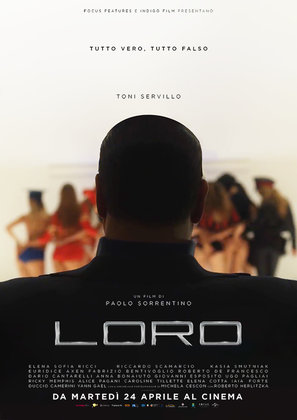
Loro (2018)

Toni Servillo stands out as Berlusconi in Sorrentino’s scattergun satire

Director: Paolo Sorrentino

Cast: Toni Servillo (Silvio Berlusconi/Ennio Doris), Elena Sofia Ricci (Veronica Laria), Riccardo Scamarcio (Sergio Morra), Kasia Smutniak (Kira), Euridice Axen (Tamara), Fabrizio Bentivoglio (Santino Recchia), Roberto De Francesco (Fabrizio Sala), Dario Cantarelli (Paolo Spagnolo)

No one films decadence like Paolo Sorrentino. Many of his films have gone overboard to demonstrate Italy’s shallowness, corruption and greed. Loro feels like the subject he has been building towards his entire career: the heart of the whirlwind himself, Silvio Berlusconi. Sorrentino’s film is about Berlusconi, but it’s as much about the Italy he has created and the impact on Italians themselves. Its title translates as “Them” – and the film juggles with the idea of which “them” it’s referring too.

The film follows the career of Berlusconi from 2006 to 2009, as a he deals with the aftermath of losing power and the boredom of having very little to do in his palatial mansion. All around him – like flies around honey – the newly rich try everything to gain Berlusconi’s attention, throwing lavish prostitute-and-drugs parties. But what does Berlusconi want? Is it more of the same, is it a return to power, is it a chance to do good, is it a chance to make amends, is it a return to the spotlight? Who is Berlusconi?

Sorrentino’s film follows his usual style, and makes full use of his dynamic and electric directorial style. Boy this guy loves to keep the camera on the move, and he combines it with some snappily filmic editing that creates a series of scenes that fit sharply together. Sorrentino really can cut the hell out of a picture, and his style lends itself perfectly to depicting the extreme hedonism at the centre of the lives of many people whom he makes films about. His fast cut editing style, dynamic camerawork and use of modern music stringing it all together make for a perfect visual language for the shallowness he sees in large parts of modern Italy. But this approach doesn’t always engage the viewer, leaving them watching the technique instead – and that’s arguably what happens here.

A large chunk of the first half of the film centres around Riccardo Scamarcio’s Sergio Morra, a fictional “businessman” from Southern Italy who uses attractive women and drugs to land lucrative government contracts from ageing officials. Just in case we are in any doubt, it’s made clear very quickly that Morra is unbelievably shallow, venal, corrupt and interested only on what he can take from his country. His life is one of unalloyed selfishness, centred around drug-fuelled orgies (filmed very well by Sorrentino of course!). Morra builds a partnership with Berlusconi’s fading mistress (extremely well played with more than a hint of tragedy by Kasia Smutniak) focused solely on getting as close as possible to power. Almost all of the first 45 minutes (and yes that is too long!) is centred around establishing Morra’s vileness and his empty world. It’s as clear a portrait of modern Italy captured in one man as you can wish for, but its constant unpleasantness and prolonged sex and drugs with little plot gets more than a little wearying after a while. We get it Paolo!

But Sorrentino wants to make a clear point here: Berlusconi’s Italy has given rise to people like this, people who have an interest only in what they can take from the country, people who think being able to throw the most lavish party, having the most money, making the loudest noise makes them “better” than regular people. It’s these people interpreting the image of Berlusconi as giving them a green light for greed. When we promote puffed up egotists and fun-lovers as our leaders, then grasping venal imbeciles like Morra with no sense of morality or decency see that as an invitation to join them at the top table. 

After this introduction to Morra, when we finally meet Berlusconi himself it’s surprising how different he seems. Yes he’s a casual, shallow, rather grandiose figure – but in the hands of Toni Servillo, Sorrentino’s regular collaborator, he’s a more complex person than you might expect. Bored and a little depressed at home, Berlusconi also sees himself as far more than just a party animal turned politician. He’s a man, for all his shallowness and greed, who needs to believe that he is there for the good of the people. But what the film doesn’t quite do is “nail” him – perhaps because he is unnailable – but the film doesn’t feel like it lands a true blow. Or even makes a really clear point about the presidency of this man. Sorrentino’s anger is in every frame, but I’m not sure he really puts together a convincing – or completely engaging – argument about this.

Servillo’s performance as Berlusconi is the true highlight of the film, a complex mystery of a man who wants to be decent, but not enough to change or to actually carry out selfless acts. Sorrentino sees him as a salesman at heart – the salesman who sold himself as the corrupted answer to all Italy’s problems – and the film’s highlight is probably a sequence when Berlusconi girds his tired salesman’s loins to cold-call a random ageing woman, plucked from the phone book, to flog her a flat in an apartment block he hasn’t even started to build yet. It’s a neat capturing of what energises this man behind the fixed smile – and a sign as well of how little reality matters to this peddler of dreams. You can see why business partner Ennio Doris (played also by Servillo, making Doris a neat facet of Berlusconi’s own personality) pushes him to get back to selling and blagging to rebuild his confidence.

Sorrentino grounds most of the film in the growing disillusionment of Berlusconi’s wife Veronica, expertly played by Elena Sofia Ricci. Smart, quick-witted but too ready for too long to sacrifice her principles for the comfort of marriage to the loaded Silvio, Veronica becomes, if not exactly a conscience, at the very least a voice for sanity in Berlusconi’s world. In a film where the majority of the characters are gilded fronts like Berlusconi or soulless obscenities like Morra, she is the closest thing we have to a decent person. 

Veronica’s growing sense of discomfort at the “me-first”, power and money above everything world that Berlusconi has created draws the viewer’s attention to the other “them” the film deals with. Yes, we have the party-loving elite here, but the other them are the people we hardly see – the regular Italians, the ordinary citizens. These intrude rarely into the film, but tellingly they dominate the final sequences of the film which deal with the aftermath of the L’Aquila earthquake. As firefighters rest from their labours in the ruined city – including saving a statue of Jesus Christ from a ruined church – the camera pans across their exhausted, sweaty faces staring wearily, while the word “Loro” remains on screen. 

It’s in that final shot that Sorrentino’s film really seems to land. Because amongst all this partying and greed which has dominated – and often exhausted the viewer – we are finally reminded that the people really paying the price are the regular people, whose needs are not monitored, who are readily and easily forgotten. Sorrentino’s film may drift too often in really making a point or feeling like it nails Berlusconi. But when it makes points like this it really works.

Vice (2018)

Christian Bale slaps on the make-up as Dick Cheney in Vice

Director: Adam McKay

Cast: Christian Bale (Dick Cheney), Amy Adams (Lynne Cheney), Steve Carell (Donald Rumsfield), Sam Rockwell (George W Bush), Alison Pill (Mary Cheney), Lily Rabe (Liz Cheney), Jesse Plemons (Kurt), Tyler Perry (Colin Powell), Justin Kirk (Scooter Libby), LisaGay Hamilton (Condoleezza Rice), Eddie Marsan (Paul Wolfowitz), Bill Camp (Gerald Ford), Don McManus (David Addington)

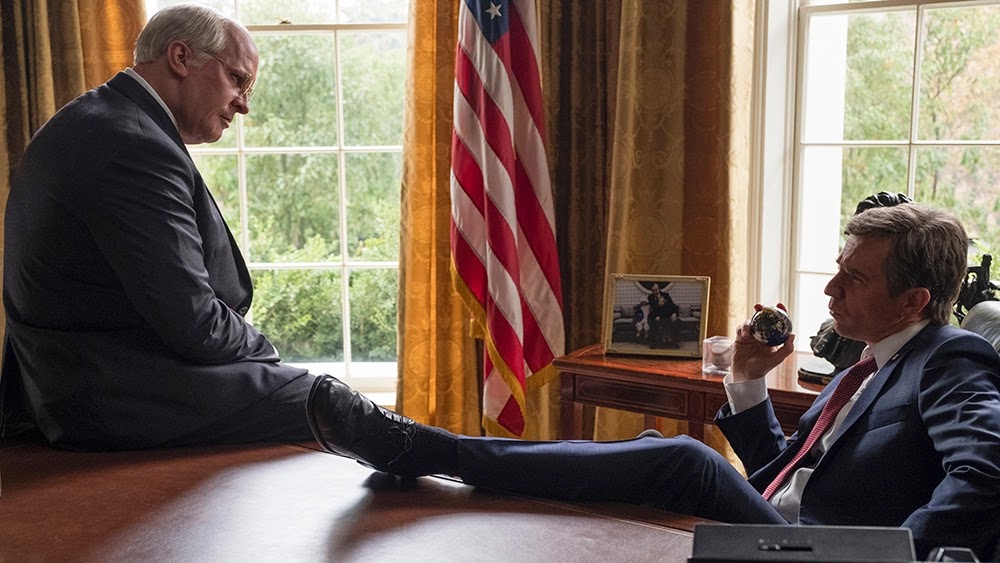
There is a film to be made about the turmoil of the Bush presidency. It’s not this film. Adam McKay’s flashy, clumsy, cartoonish, smug, tedious, overlong, arrogant and polemical film quickly outstays its welcome, drowning any legitimate ideas and theories it has under a wave of high-minded, angry shouting at the viewer, frequently mistaking flash and bombast for actual political insight and producing the sort of heavy-handed, angry political commentary that wouldn’t look out of place in a cheap student review. And flipping heck I’m on the liberal left!

Anyway, the film follows the career of Dick Cheney (Christian Bale under an impressive pile of make-up) from his early wash-out days. Told by his wife Lynne (Amy Adams) to buck his ideas up or lose her, Cheney becomes an intern for Congressman Donald Rumsfeld (Steve Carell), rising through the ranks due to his ruthless efficiency and loyalty, becoming Chief of Staff under Ford and Secretary of Defence under Bush. So he’s a natural choice for the inexperienced George W Bush (Sam Rockwell) to balance the presidential ticket. In return, though, Cheney wants control over a few areas – energy, foreign policy, defence etc. etc. – that the lazy Bush has no interest in overseeing. So a quiet, backroom politician changes the office of the Vice President to become the most powerful man in the world. Boo hiss.

McKay’s intention with this film is to reveal the hollowness, greed and utter lack of integrity in its subject. Well he never lets us forget this aim – I don’t think I’ve ever seen a film that so openly hated its lead character, which so completely refused to see any redeeming qualities in him whatsoever. Christ, even Downfall took a few minutes to show Hitler was generally kind to those who worked for him. The film is so unrelenting in its loathing for Cheney that it starts to feel like a being shouted out for over two hours by an “it’s the end of the world” fanatic on a street corner. This does not make for good entertainment.

The film has no subtlety whatsoever. Not for a single second does it even consider the remote possibility that anyone in the Republican party might, perhaps, just maybe, even if it was only some of the time, believe that they were doing something for a principled reason, even if it was a principle those on the left don’t agree with. Instead, all the characters are shown as selfish, greedy and corrupt, using ideology solely to gain power and then using power only to enrich themselves. It’s the sort of lazy political views that turn people off liberals – the idea that anyone who doesn’t share a liberal viewpoint is by definition evil. Some of us grew out of this kneejerk assumption that everyone who doesn’t agree with us is self-serving and cruel. Not McKay. 

On top of which, McKay’s film is made with the overt flash and brio that is the hallmark of the hack director using the tools of cinema with no understanding of their proper use. Wonky camerawork, cutting between timelines, throwing in newsreel footage, breaking the fourth wall, using strange camera angles, chucking in cameo actors to amusingly comment on events (Alfred Molina and Naomi Watts principally) and editing it with flash don’t make you a great director. They make you someone who has seen a lot of films and lot of techniques, but has no understanding of how to use them to craft an overall effect, instead thinking that if you throw all of them at the wall at once, you’ll be a master craftsman.

The film is full of studenty bits of invention that must have seemed oh-so-clever on paper in McKay’s script. Forty minutes in, with Cheney’s career looking over with the end of the Bush presidency, McKay starts running the credits – only to snap back into the film with the fateful phone call from Dubya. It’s clever and raises a quick chuckle, but doesn’t add anything to a sense of turning point in Cheney’s life. It’s followed by a clumsy metaphor of moments being like tea cups balanced on top of each other (inevitably these are later shown tumbling down) to represent how key moments of history build on each other. The real nadir is a moment when Dick and Lynne fall back into cod-Shakespearean dialogue in the bedroom as they discuss a possible vice presidency. ‘We don’t have Shakespeare’s psychologically insightful dialogue’ (I paraphrase) says the voiceover, before this skin-crawling hand-in-mouth sequence that shows McKay knows as much about Shakespeare as he does subtle political commentary.

Ah yes the voiceover. Perhaps not knowing how to marshall his childish political points in actual scenes and dialogue, McKay uses a voiceover from Jesse Plemons’ ground-forces marine to spell out as bluntly and crudely as possible the basic and trivial points it wants to make. The damn film already feels like being hectored by a crank, so why not make it feel even more like a polemic by having a character bitterly explain why everything is wicked and evil at you? The narration bores – and joins the general feeling of the rest of the film, that it goes on forever and ever and ever and never, ever, ever says something really interesting or revealing.

The performances are a mixed bag. Bale gives a decent turn as Cheney, capturing his mannerisms and conveying a sense of dark ambition, but it’s a role he could play standing on his head. Amy Adams turns Lynne into a Lady Macbeth, in a reheat of her performance from Paul Thomas Anderson’s The Master. Every other performance is a crude cartoon – Carell’s Rumsfeld a putty-faced joke, Sam Rockwell’s Bush (an impossibly generous Oscar nomination) a cartoonish buffoon. Everyone else coasts through it, patting themselves on the back.

There is an argument to be made that Cheney’s legacy is far from good, and it’s certain that we are paying a heavy price for interventions in Iraq. Many of the policies were less than savoury and left a less than positive benefit. But this film hammers these points home with all the charm of a ranting, drunk politics student who has read one book and watched a lot of YouTube videos. With McKay’s soulless, clumsy, look-at-me direction layered on top, this is a flat out terrible film. Save yourself what feels like much more than its two hour run time. In fact I’ll summarise it for you: CHENEY IS EVIL AND HORRIBLE AND HE (LITERALLY) HAS NO HEART. There you go. You don’t need to see it now.

If… (1968)

Malcolm McDowell as contemptuous bitter student Mick Travis in counter-culture classic If…

Director: Lindsay Anderson

Cast: Malcolm McDowell (Mick Travis), Richard Warwick (Wallace), David Wood (Johnny), Christine Noonan (The Girl), Robert Swann (Rowntree), Peter Jeffrey (Headmaster), Arthur Lowe (Mr Kemp), Mona Washbourne (Matron), Ben Aris (John Thomas), Robin Askwith (Keating), Robin Davis (Machin), Rupert Webster (Bobby Phillips), Geoffrey Chater (Chaplain), Anthony Nicholls (General Denson), Graham Crowden (History Master)

Lindsay Anderson’s If…emerged in the late 1960s, at a time of furious counter-culture reaction to the establishment. Only a few months before its release, Paris had been torn by student riots against everything from the government to class discrimination, which had sparked over a month of protests and strikes that consumed every part of society. If… was released in the midst of the aftermath to this event – and managed to capture the mood of Europe with an astonishing prescience.

In an unnamed English public school, “College House” is run by the senior prefects (“Whips”) who impose a harsh discipline upon the rest of the students. The head of house (Arthur Lowe) is an easily manipulated weakling, the school headmaster (Peter Jeffrey) is a well-meaning but distant figure, most of the staff are either bizarre, creepy, disinterested or all three. Mick Travis (Malcolm McDowell) and his friends Wallace (Richard Warwick) and Johnny (David Wood) are three persecuted lower sixth formers, who (particularly Mick) have a burning resentment for the structures and traditions for the school: a resentment that slowly builds towards outright rebellion.

Lindsay Anderson’s background was Cheltenham College followed by Oxford. Only someone so thoroughly grounded in the background of private education as that could surely have produced a public school film as furious as this one. The entire film is like a kick in the teeth. Anderson understands the cruel traditions and oppressive rules of public schools completely, and the entire film is awash with moments like this that govern school life. There is not a single, solitary moment where there appear to be any positives at all in the life at the school, or any educational benefits (the school is proudly focused on turning out “gentlemen”). 

Anderson shoots all this with a careful eye for the surreal and flights of fancy. Much has been made about the black and white sequences that pepper the film. The natural light in the chapel caused the colour stock to be over-exposed, forcing Anderson to shoot the scenes there in black and white. However, Anderson loved the effect, and filled the film with scenes shot in monochrome to unsettle the audience and make them question the nature of what they are seeing. And that’s something you need to do with If…, as the film walks a fine tightrope between what is real and what is imagination.

While the film starts off grounded in a reality of cruelty and traditions, as it progresses it develops into something unusual and perverse. An extended sequence where Travis and Johnny skip school and head into town, steal a motorbike, drive to a country café and Travis seduces a Girl (Christine Noonan) becomes ever-more hyper real. Is the Girl even real? The speed of her seduction certainly seems to owe more to the boys’ adolescent fantasies of attractive women than any reality. In fact, the use of Noonan’s character (as sex object) is both a dated moment and an expression of the boys’ immaturity and fantastical longings.

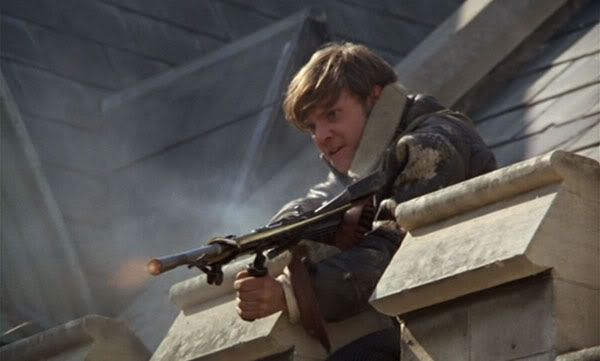
The film is building of course towards the final act of rebellion: a firearms-laden shoot-out after the rebel boys discover a secret cache of automatic weapons on campus (this is in itself unlikely) and then proceed to machine gun visiting dignitaries and their oppressors from the roof of the school, who in turn return fire with their own machine guns. How much of this is real and how much is a flight of fancy from the students and from the film makers? It’s unclear – there is no consistency in the filming of this sequence. When does reality in the film start to cross over to fantasy? There are plenty of moments where this could be happening.

It comes down to the title of the film. If – is this Kiplingesque title suggesting the possibility of such things happening, or such things coming to pass in certain situations, rather than an actual reality? Anderson’s fury at the ghastliness of the class system in this country, and the institutions that promote it (the army, politicians and the church get the same short shrift) suggest a fantasy of bringing the whole system down in a violent outburst. It’s a fantasy, initially grounded in reality, that suggests a poetic realism with lashings of the surreal (most famously the reveal of the schools bullying and vile chaplain as living in a large drawer of a desk in the Headmaster’s office).

The film’s fury and counter-culture joy has the perfect lead actor in Malcolm McDowell, whose simmering, edgy anger as an actor, and chippy rage with a sneering sense of defiance, are perfect for Travis. I’m not sure if McDowell ever topped this first performance, one where he burns through every frame and brilliantly seems to embody every single cog in the system that wanted to thumb its nose at the boss (to mix some metaphors). Anderson and McDowell are clearly working in perfect sync in this film (they collaborated three more times on spiritual sequels). It’s a beautiful performance of simmering resentment and fury at the hypocrisy around him.

The film’s exploration of the injustice of the school doesn’t feel outdated at all. The brutality of fagging and caning plays is like a darkly twisted version of Tom Brown’s Schooldays. Robert Swann is particularly good as leading Whip Rowntree, a hypocritical patrician, and memorable sequences capture the eccentric inadequacy of the teaching, the drilling of school rules into new students (brainwashing them into continuing the pattern in the future) and the arbitrary cruelty of the Whips. Peter Jeffrey’s liberal but distant and ineffective Headmaster is a perfect Thomas Arnold parody, a man with grand ideas but no knowledge of the actual school he is running, who claims to understand the boys but knows nothing about them.

However, interestingly, it’s the rebellion itself that seems rather dated today. In the 1960s, it was easier to whole-heartedly invest our sympathies in the counter-culture rebellion of Mick and his friends – but it’s harder today, with our climate of school shootings in America (there was one the day before I watched this film), to root for our heroes carrying out an indiscriminate shooting, for all the vileness of the institutions Travis is taking on. Of course this sequence is shot with a surreal eye (and I’m not sure any of it is meant to be an expression of something that is literally true, just spiritually true), but it’s a little uncomfortable today.

But at the time, this gut punch of a picture by Anderson wouldn’t have been troubled by these doubts. It’s a brilliantly directed film, that burns with a genuine fury against the institutions it is addressing. There is virtually nothing sentimental or kind about the film – it’s entirely about kicking against the tracks. Nothing in the school is redeemable or decent, everything is corrupt and twisted. It’s a sneering, burning, angry shout of a movie that manages to avoid preaching to the audience and instead presents its hellish vision of class in this country with a witty grace. If… is a film that perfectly captures the mood of the time and understands the “small world” culture of public schools like few others: it’s an essential classic.