

Terrifying, compelling and gripping it-could-happen drama about the madness of nuclear war
Director: Kathryn Bigelow
Cast: Rebecca Ferguson (Captain Olivia Walker), Idris Elba (President), Gabriel Basso (Deputy NSA Jake Baerington), Jared Harris (Secretary Baker), Tracy Letts (General Anthony Brady), Anthony Ramos (Major Daniel Gonzalez), Moses Ingram (Cathy Rogers), Jonah Hauer-King (Lt Commander Robert Reeves), Greta Lee (Ana Park), Jason Clarke (Admiral Mark Miller), Malachi Beasley (SCPO William Davis), Brian Tee (SAIC Ken Cho), Renée Elise Goldsberry (First Lady), Kaitlyn Dever (Caroline Baker)
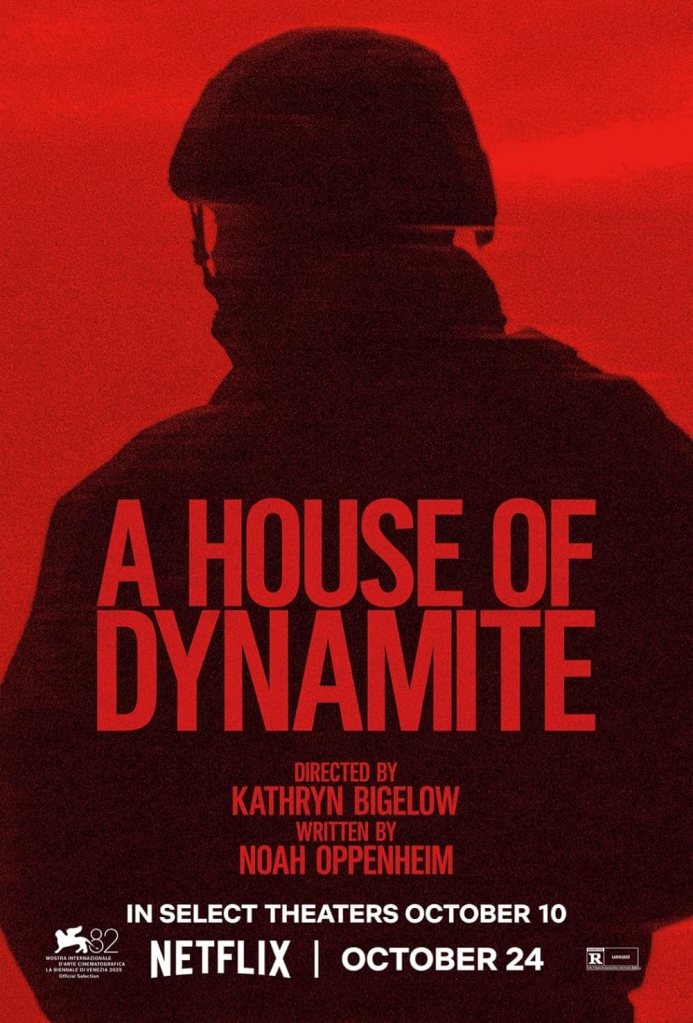
“That’s what $50 billion buys us? A fucking coin toss?” the Secretary of Defence (Jared Harris) plaintively wails as he discovers yet another weakness in the USA’s defence infrastructure. It’s one of many grim realisations filling A House of Dynamite, a relentlessly horrifying look at what might actually happen if a nuclear missile was launched at the United States: and how, in less time than it takes to watch an episode of Friends, the US President (Idris Elba) can go from shooting hoops at a charity event to flicking through menu-style list of world-ending options, being told he has a three minute window to make a decision that could be final for all of us. House of Dynamite makes clear to us all: the fate of the whole world effectively rests on a series of coin tosses we have no influence over.
Bigelow’s intense, brilliantly shot and edited film, plays out the same eighteen-minute scenario from different perspectives. A glitch in the USA’s satellite network misses the launch of an ICBM, somewhere off the coast of Asia, heading for Chicago. Disbelief and panic swiftly sets in at every level of the US administration. Anti-missile defence systems miss (that’s the coin toss, as we’re told it only has a 61% success rate in tests). A decision needs to be taken whether to follow policy and launch a counter-attack before the nuke hits. It plays out from three primary perspectives: Captain Olivia Walker (Rebecca Ferguson), senior officer on duty in the Situation Room; Jake Baerington (Gabriel Basso), deputy NSA covering for his under-anaesthetic boss, begging Russia to stand-down their forces as the US goes to DEFCON1; and finally the President (Elba), out-of-his-depth in a nightmare where he feels powerless and totally unprepared.
Powerless and unprepared become the guiding feelings in US defence, as people slowly release the best cast scenario is only losing 10 million people in Chicago and their worst (most likely) case is everyone dying in a nuclear conflagration. Bigelow’s film, shot with the hand-held intensity of a combat film, grabs you with a vice like grip as it plays out this nuclear nightmare. A House of Dynamite only ever gives us the same information as the fictional administration trying to make impossible choices. Like them we never find out who launched the missile, if it’s the first of a wave or even if it’s fully armed ICBM. All we know is the strike on Chicago quickly becomes inevitable and, with that fact, the world as we know it is over. Bigelow’s film (although it is not as clear in its clarification of US launch policy as it could be) places the system (which offers few choices and no alternatives) as the antagonist.
It also makes clear that nuclear war can happen at a time totally not of our choosing. Here it unfolds on a regular morning. The President is at an inconsequential publicity event, reduced to dialling into a world-shaking video call from a mobile: and he’s barely a month into his administration. The National Security advisor is in an operating studio and his unknown assistant is reduced into running through gridlocked traffic to get into the office. A designated FEMA expert (Moses Ingram) has just been appointed and at first believes the whole thing is a drill. The NSA North Korea expert (Greta Lee) is at a Gettysburg reconstruction with her young son. The Situation Room is undergoing maintenance and the Premiers of Russia and China can’t be raised on the phone.
A House of Dynamite doesn’t land cheap shots: it’s portrait of the members of the administration and the US defence infrastructure stresses their level-headedness and professionalism. Indeed, their competence makes the complete lack of control they have all the more alarming. Tracy Lett’s STRATCOM General keeps a professional level-headedness, even as he dutiful advises sticking to a nuclear policy which will effectively end the world. Rebecca Ferguson’s composed, calm and collected Naval captain finds herself increasingly aghast but only allows herself a few moments of tears after a goodbye phone call to her husband, clutching a toy dinosaur gift from her son. Anthony Ramos’ missile base commander reassures his staff this is what they have trained for: right up until the point where their interceptor missile misses and he slips into near catatonic shock as he realises that life’s training was for nothing.
Politicians are similarly portrayed as decent, but fundamentally unprepared for the situation. Idris Elba’s suave president looks every inch the confident leader, but it’s revealed he’s uncertain, hesitant, terrified of looking weak and his skills of schmoozing the public utterly useless for this situation. Jared Harris’ Defence secretary is only marginally more on-top of his brief (he reveals the nuclear war briefing is less than half an hour because it was seen as so unlikely to happen) and, for all his competence, becomes increasingly distracted at the thought of his estranged daughter (Kaitlyn Dever) facing death in Chicago. Gabriel Basso’s Deputy NSA seems at first absurd, but grows in statue as he desperately tries to salvage global survival.

Bigelow’s film makes clear this is a lose-lose situation. It’s a film about the constricting pressure of panic. Panic leaves assured professionals weeping or vomiting. Superpowers plan world-ending retaliation out of fear that they might be wiped out before they get a chance to fire their nukes. The President becomes overwhelmed, asking the junior aide carrying the nuclear football (Jonah Hauer-King) what he should do. (Hauer-King’s character, acknowledging the way the War Book looks like a nightmare menu, wryly confesses he calls the world-ending options rare, medium and well-done). The Deputy NSA tries everything, including begging, to get Russia to stand down, only for them to refusing to do so until US meet Russia’s own un-meetable conditions.
What we are left with is the realisation that there is no winner here. Many viewers, I feel are missing the point. Who fired the missile, who (or if) America hits back, if Chicago goes up in inferno or not, is not the point. Just firing the starting trigger in this race means you lose, because when the nuclear buttons is pressed by anyone there is no turning back, no way of unringing that bell. This is the chilling message of Bigelow’s compelling film – made all the more chilling as she finds so much humanity in the people forced to make these terrible calls.
What we end up with is a different type of coin toss: one man, in most cases with almost no preparation what-so-ever, making a decision that could go either way on virtually no conclusive information at all, in an impossibly small window, about whether to risk ending the world or not. What A House of Dynamite makes clear is that’s all nuclear deterrent really is: a coin toss for individuals who feel they have to always call heads. That’s possibly the most terrifying about it.

















 Movie Musings