Tag: Richard Basehart

Decision Before Dawn (1951)

Decision Before Dawn (1951)

Tense war drama finds sympathy for the enemy, in an over-looked war film

Director: Anatole Litvak

Cast: Richard Basehart (Lt Dick Rennick), Gary Merrill (Colonel Devlin), Oskar Werner (Corporal Karl Maurer “Happy”), Hans Christian Blech (Sgt Rudolf Barth “Tiger”), Hildegard Knef (Hilde), Wilfried Seyferth (Henitz Scholtz), Dominique Blanchar (Monique), OE Hasse (Oberst von Ecker), Helene Thimig (Paula Scheider)
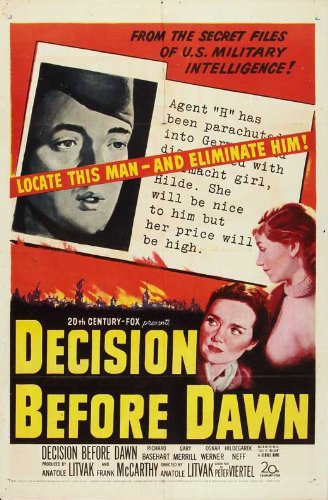
Decision Before Dawn tends to be remembered – if it is remembered – as an aberration in Hollywood history, one of the few films to receive only one nomination other than its Best Picture nod – with that nod generally put down to excessive Fox executive lobbying. I’d heard it described as a ‘fairly standard World War II film’ and expected it to be pretty disposable. But I guess I should have looked into things more: no less a director than Stanley Kubrick called it a hidden gem, claiming to have seen it five times. After a viewing, it’s hard not to think he might be right.

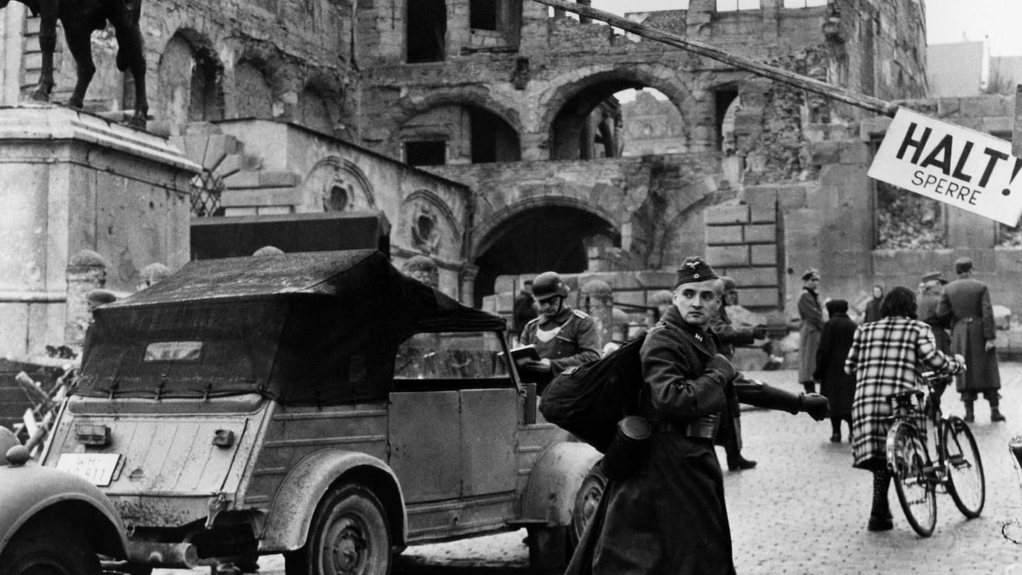
It’s a real, peeled-from-the-headlines tale. Shot entirely on location in Germany, in the very cities its characters are travelling through, still the bombed-out wreckage sites they were in 1944. With the assistance of (what was still then) the Occupying Powers, Fox and Anatole Litvak (himself a one-time refugee from the Nazis) recreated, to an astonishingly convincing degree, war-torn Germany six months before the death of Hitler, on locations littered with Germany military equipment. Everything in Decision Before Dawn feels astonishingly real because it largely is. When “Happy” tumbles through a bombed-out theatre or walks through bedraggled factories and grand houses converted to military bases, that’s the real thing.

Alongside this visceral sense of realism, is a surprisingly mature message. Helped by the presence of several German ex-pats, Decision Before Dawn casts a sympathetic eye over the Germans at a time when most of viewers would probably echo the initial sentiments of Richard Basehart’s scornful Lt Rennick: ‘they’re all just Krauts’. Rennick’s is part of an intelligence unit, tasked with ‘flipping’ German POWs and sending them back into Germany. Their two latest recruits couldn’t be more different: cynical Sgt Barth aka Tiger (Hans Christian Blech) motivated by earning a quick buck and thoughtful Corporal Maurer aka Happy (Oskar Werner) who believes Germany can only be saved when the madness of Nazism is defeated.

It’s Happy we follow when, after his recruitment, he is parachuted back into Germany and instructed to find the location of the XXth Panzer corp, while Rennick and Barth land further West to locate, and arrange the surrender of, a Wehrmacht Army Unit. Decision Before Dawn has already spent its opening act humanising erstwhile opponents via Happy. Happy is honest and principled with a strong sense of morality. He won’t lie to please his captors but he also won’t countenance the blind loyalty or bitter cynicism of his fellow prisoners. He is brave enough to save his country by ‘betraying’ it.

And it’s through Happy’s eyes we also see Germany. Many of his fellow POWs have no real love for Nazism; far from slathering fanatics, they are just guys knuckling down, wanting to stay alive. Behind-the-lines in Germany, the people Happy meets on his journey are striking in their everyday ordinariness. Decision Before Dawn’s most compelling sequences follow this ‘Pilgrim’s Progress’ through the Reich, where episodic encounters mix with moments of panic and terror as a Gestapo net draws tighter.

The only two true believers he encounters are a glasses-wearing (it still loves some of the cliches) relentless Gestapo officer, and a Hitler Youth kid who still swallows true loyalty to the Fuhrer because he doesn’t know anything else. The others, by and large, are ordinary people trapped in a nightmare, trying to carry on. From a senior officer who reluctantly executes a deserter days before he knows the army will surrender to a depressed widow trying to make a living turning tricks. They are among a parade of regular citizens who, other than that fact they are commuting through a war zone, could be no different from Americans in their everyday concerns.

This places much of the film’s success on the shoulders of Oskar Werner, making his English-language debut. Werner, himself a deserter opposed to Nazism, brings the role a quiet, deeply affecting sincerity, expertly breathing life into a man who lives by his own firm moral code. ‘Happy’ deplores the taking of life but will do so if there is a reason: that won’t involve poisoning a colonel or standing by during the lynching of a POW by his fellow prisoners, but he will turn a gun on a direct threat. Werner makes him a thoughtful, compassionate man while giving him a strong streak (a Werner speciality) of in-built martyrdom, that a feeling he is too strait-laced and honourable for this world.

By making our hero a German – and the character we follow for almost the whole movie (despite Basehart’s top billing) – Decision Before Dawn is invites it’s American audience to emphasise with the enemy. To learn, alongside Rennick, that they are not ‘all Krauts’ so that we and Rennick can both be appalled by the unfairness when a Corporal mutters this at the film’s. That’s quite a thing for an American film, a few years after the war. By giving us handsomely staged spectacle centred around a man most of the audience were primed to expect to turn traitor, rogue or coward is no mean feat.

Of course, not every German can be good. The other potential recruits (one of them a young Klaus Kinski) are not a promising bunch and ‘Tiger’ (a fine, weasily performance by Hans Christian Blech) is betrayed as selfish, cowardly and perfectly happy to sacrifice anyone and everyone around him to ensure his safety. Litvak’s film does acknowledge it’s easier for the Americans to relax their feelings for the Germans than many of the other nations of Europe. Dominique Blanchar’s OSS officer makes it perfectly clear that, while she likes ‘Happy’, she’s still a long way from every imagining a relationship with a German of any sort.

Decision Before Dawn is well-directed, Litvak easing expert tension behind-the-lines and wonderfully shot among the ruins of Germany. Its final resolution may seem a little pat and obvious – and Basehart’s Rennick is such a terminally dull character I can only assume a host of more famous actors turned it down – but there is a lot of rich, fascinating tension and excitement here. Putting it frankly, Decision Before Dawn is a very pleasant surprise: a unique and mature war film that deserves far more recognition.

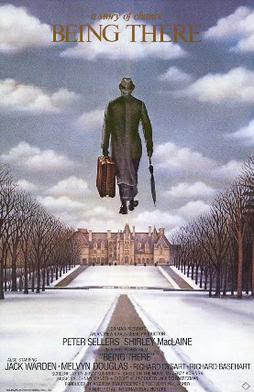
Being There (1979)

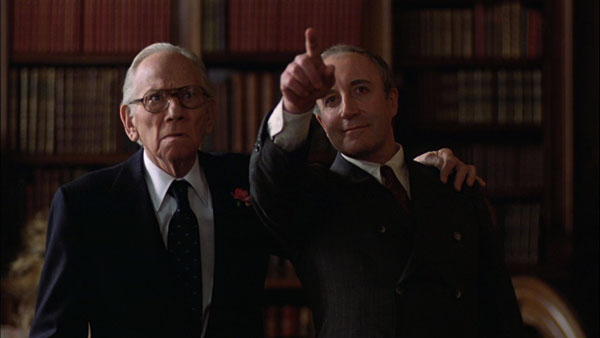
Peter Sellers is a void in the satirical Being There

Director: Hal Ashby

Cast: Peter Sellers (Chance, the gardener/Chauncey Gardiner), Shirley MacLaine (Eve Rand), Melvyn Douglas (Ben Rand), Richard Dysart (Dr Robert Allenby), Jack Warden (The President), Richard Basehart (Ambassador Vladimir Skrapinov), David Clennon (Thomas Franklin), Fran Brill (Sally Hayes), Ruth Attaway (Louise)

In movies honesty and simplicity often hide a deeper truth – a more pure view of the world, unaffected by cynicism. Being There takes these ideas and inverts them. What if we were so desperate to see a higher meaning in the words of the unaffected, that we kidded ourselves that even their blandest utterances carried deep meaning. It’s the central idea of Being There, proving again that a delusion only works when those affected are also those most invested in sustaining it.

Chance (Peter Sellers) is a child-like innocent. He works in the garden of “the old man” (implied to be his father). He has never in his life left the confines of his self-contained home. He can’t read, he can’t write. His meals are prepared for him by the old man’s staff. Apart from gardening his only other interest is television – and even that is a mute, hypnotic interest with Chance meekly watching anything screened in front of him. When the old man passes away, Chance (of whom there is no record at all) is asked to leave the house by the old man’s lawyers. He finds himself in a modern 1970s world, but still dressed (and with the manners) of a 1930s gentleman.

Accidentally hit by the chauffer driven car of Eve (Shirley MacLaine), the younger wife of wealthy businessman Ben Rand (Melvyn Douglas), Chance (his name mistakenly overheard as Chancey Gardiner) finds himself in the home of Ben where his manners, dress and polite comments about gardening are interpreted as being deep, intellectual musings on society and the economy. In a few days Chance is advising the President (Jack Warden) and his opinion is being solicited by the media. Will anyone notice that Chance is a harmless but basically empty man?

Being There is not just a hilarious satire of the capacity of the rich and powerful to persuade themselves of things. It’s also a satire on the Capraesque notion of the innocent seeing a truth that the rest of us can’t see. It throws in more than enough social commentary on the edges as well – Chance is revered because he looks right: well-dressed, courtly manners, softly spoken, polite and above all white. The film gets a few pointed blows in on this that look more and more central to the film the older it gets. Seeing Chance’s earnest musings on gardening being interpreted as deeply meaningful economic commentary on the television, the woman who bought him up in the old man’s house – a black servant Louise – announces “It’s for sure a white man’s world in America. Look here: I raised that boy since he was the size of a piss-ant… Shortchanged by the Lord, and dumb as a jackass. Look at him now! Yes, sir, all you’ve gotta be is white in America, to get whatever you want.”

And she’s right. Interpreted by the rich, white, entitled men of America as one of their own, it never occurs to them that Chance might be something else. And his statements carry such bland emptiness – precisely because Chance is merely stating genuine gardening tips – that it becomes easy to invest them with whatever depth they like, because they have no depth themselves. While in Capra, Chance would stumble upon some of the corruption at the top or make these people rethink their lives, here he drifts through, barely understanding what is happening around him, allowing these powerful men to interpret him as something that reassures them about their own lives.

In the 1970s the film was seen as a satire on the television generation. But watching it today – despite Chance’s mute, unengaged smile while watching TV – this isn’t about a mindless cabbage potato being seen as a sage. He’s a completely empty vessel that can have meanings poured into him – and then can all stick because not for a single second is Chance trying to get anything out of it. He would be as happy returned to the street as he is in the palaces of the mighty.

The film works due to the success of Peter Seller’s performance. Seller’s had pitched long and hard for the role: he had always believed himself a void beneath the mad-hat comic personas he had inhabited, and believed himself uniquely placed to understand the neutrality of Chance. That’s what he brings here. It takes true skill to play a character as blank as this one. Chance never responds to the situation he is in – and seems to have no understanding at all of the situation. He’s completely genuine and honest – exactly what gives his comments weight to people, because he is not even remotely trying to add any weight to them – and meekly accepts all the things that happen to him. He is honest on every question he is asked – that his only interests are gardening and TV – and sits quietly, smiling, until finally saying or doing things he has frequently copied from TV.

Seller’s restrains himself utterly in the role and eventually his very tame, sweet blankness makes him endearing. The performance would fall apart if even for a split second there was a tip of hat or wink to the camera. There’s none of that. Compare Chance to say Forrest Gump. Gump is the quintessential example of the cliché man who really understands the world better than all of us. Chance is the reality, a simple man, harmless but incapable of really engaging with the world. In Hal Ashby’s skilled and restrained hands this becomes crucial to the awe he is treated with by the rich. He’s a mystery we get no answers to and someone we know as little about at the end as we did at the start. But yet Sellers is mesmeric.

Melvyn Douglas’ provides a superb (Oscar-winning) performance as Ben Rand. How much does Rand really believe in Chance? He’s charismatic, determined and driven – but also nearing the end of his life. Does he want to believe in his faith in Chance, because it makes him feel better? Is Chance almost a sort of advance satire of movements like scientology – faiths that make rich people feel better about themselves, because it affirms their views and place in the hierarchy? It’s possible – and why not when they can craft an idea of Chance that is far superior to their nervy (and literally impotent) President (Jack Warden in a smart little turn).

Ashby at time overplays his hand a little. The final image – a benign Chance literally walking on water on the Rand estate lake – is famous, but its meaning is unclear. Does it imply that Chance is some form of second coming? Or does the naïve and clueless Chance simply walk across water because he doesn’t understand that he can’t? I feel the latter myself – the idea of him being a Jesus figure is so out of keeping with the film, I see it as a final physical representation of his own lack of knowledge about the world. Some hated the final flourish (visually wonderfully done as it is) – although not as much as the bizarre outtake of Sellers cracking up that plays over the credit (Sellers in particular loathed this, believing it shattered the magic of his performance and cost him an Oscar).

Being There isn’t perfect – it’s too long and Shirley MacLaine gets rather a thankless part as the wife who becomes infatuated with Chance (more could perhaps have been got out of her seeing the truth of Chance, rather than being as arrogantly deluded as the rest). Moments have dated less well than others. But it’s got a sharp idea at its heart – and its satire of the rich, Hollywood sentimentality and society feels sharper every day. Rather fittingly as well the film has an autumnal quality about it in Ashby’s coldly reserved shooting: Sellers and Douglas both died shortly after its release, the book’s author Jerzy Kosinski would be plagued after its release with accusations of plagiarism and Ashby’s (after a drug fuelled but successful 1970s) career would collapse almost immediately after its release. But it’s a smart, mysterious, witty and profound film that gains greater meaning with age.

Moby Dick (1956)

Gregory Peck on a voyage of obsession as Ahab hunting Moby Dick

Director: John Huston

Cast: Gregory Peck (Captain Ahab), Richard Basehart (Ishmael), Leo Genn (Starbuck), Orson Welles (Father Mapple), Friedrich von Ledebur (Queequeg), James Robertson Justice (Captain Boomer), Harry Andrews (Stubb), Bernard Miles (The Manxman), Noel Purcell (Carpennter), Edric Connor (Daggoo), Meryn Johns (Pelog), Joseph Tomelty (Peter Coffin), Francis de Wolff (Captain Gardiner)

There might be fewer books that lend themselves less to being turned into a film than Herman Melville’s monumental Moby Dick. Perhaps the greatest of all American novels, its’ the story of New England whaler the Pequod’s Captain Ahab’s obsessive quest to kill Moby Dick, the great white whale that took his leg. But it’s also an intense intellectual and spiritual journey into the nature of humanity, which has thrown the book open to multiple interpretations, even more tempting with a book that defies explanation. Try capturing that on film.

John Huston’s Moby Dick is a noble attempt, more criticised at the time than it probably deserves, with the visual language of film unable to ever capture the metaphorical weight of the original novel. What Huston needed to do is to try and capture some of the spirit of the novel, bring its central story to life and make a film that ideally makes you want to search the book out. I would say Moby Dick succeeds on that score.

Reducing the monumental novel (often described as one of the great “unread” books in people’s homes) to under two hours, brings out the narrative, stressing the surface story as an adventure on the high seas, a doomed quest under an obsessive captain. The detail of the reconstruction of the whaling ship, its operations on the sea (including some graphic slaughter of some, fortunately, fake whales) and the atmosphere of the time is brilliantly reconstructed. The film is staffed by an extraordinary collection of actors, whose faces speak of lives led in salt-spray. 

So, starting with the idea that no film could ever capture the depth and richness of the book, Moby Dick is a decent, smart enough attempt. The key themes are there in strength. It captures obsession and the idea of the ship being a sort of microcosm of society, led astray by a leader who has his own passions at heart, over and above the well-being of the crew, but has enough magnetism to pull the crew with him nevertheless. 

Huston laboured long and hard to bring the film to life, in a wrestle with Melville. Even adapter Ray Bradbury claimed he had “never been able to read the damn thing”, with Huston and Bradbury clashing constantly during the writing process. It works, and Bradbury’s adaptation is beautifully done, but in a way John Huston himself was a sort of Ahab with the book as his whale. 

In fact you could argue – as many have – that Huston himself was the natural casting for Ahab (take a look at Chinatown to see what I mean). A charismatic raconteur, ruthless and fixated on his goals, that’s an Ahab we could buy into. Perhaps in that world, Orson Welles – here giving a neat little cameo that avoids bombast as Father Mapple – would have been the perfect director, marrying mastery of cinema with a wonderful understanding of transforming literature into film.

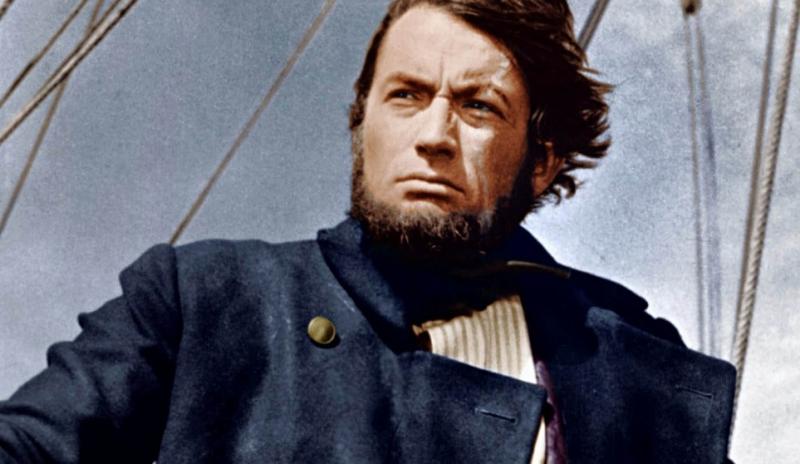
Gregory Peck is the Ahab we do get. At the time the casting was strongly criticised – people just couldn’t buy the straight-as-an-arrow Peck as the destructively bullying Ahab. Peck himself remained strongly critical of his performance here all his life. Separated from the time, Peck’s performance is stronger than you anticipate, capturing a gruff fixation and magnetic charisma that you can believe pulls people in. Peck may strain a little too hard for the elemental anger, but Peck’s Ahab has a bass richness, a sort of inverted Lincolnish (he even looks a little like Lincoln) self-righteousness that makes you believe he could rouse a ship to choose its own destruction. Peck also brings a spiritually dead look to Ahab, a man turned from hope to destruction. Huston teasingly keeps Ahab in reserve for almost a quarter of the film until his first appearance, allowing the build in the audience’s expectations.

The casting of the crew uses a fine selection of British and Irish actors (the film was shot in Ireland), with Harry Andrews particularly strong as jolly but non boat-rocking first mate Stubb. Leo Genn gets the meatiest material as Starbuck, a decent, working man with a firm sense of principle but who lacks any sense of the charisma needed to swing people to his point of view. The film bumps up Starbuck’s role, centralising his growing unease at Ahab’s madness, opportunities which Genn (nearly underplaying to contrast with Peck’s theatricality) works a treat. Richard Basehart – a good voice for narration but much less of a presence – gets a bit lost as Ishmael. There is an intriguing bit of casting – something that would never happen today – that sees Austrian aristocrat turned actor Friedrich von Ledebur play the Maori-inspired Queequeg, a visual disconnect that is more than a little distracting for a while.

Moby Dick is beautifully filmed and assembled, even if Huston throws in the odd obvious shot – sun beating down on the ship, a close up of the whale’s eye. It has a unique look – on the remastered blu-ray – with the image reflecting the faded, bleached look of whale prints (an effect achieved by superimposing a black-and-white negative over a colour one, draining most of the colours our), which gives it a great deal of visual interest. It’s never going to replace the book – but honestly what could? As an exploration of the ideas at its heart it’s wonderful – and a great prompt to pick it up – but with a marvellous sense of life on sea, a stirring score and a wonderful sense of intelligent construction it more than works.