
Tag: Robert Keith

Boomerang! (1947)

Boomerang! (1947)

Effective journalistic investigation into a murder case turns into engaging courtroom melodrama

Director: Elia Kazan

Cast: Dana Andrews (State’s Attorney Henry Harvey), Jane Wyatt (Madge Harvey), Lee J Cobb (Chief Harold Robinson), Cara Williams (Irene Nelson), Arthur Kennedy (John Waldron), Sam Levene (Dave Woods), Taylor Holmes (TM Wade), Robert Keith (‘Mac’ McCreery), Ed Begley (Paul Harris), Karl Malden (Lt White)
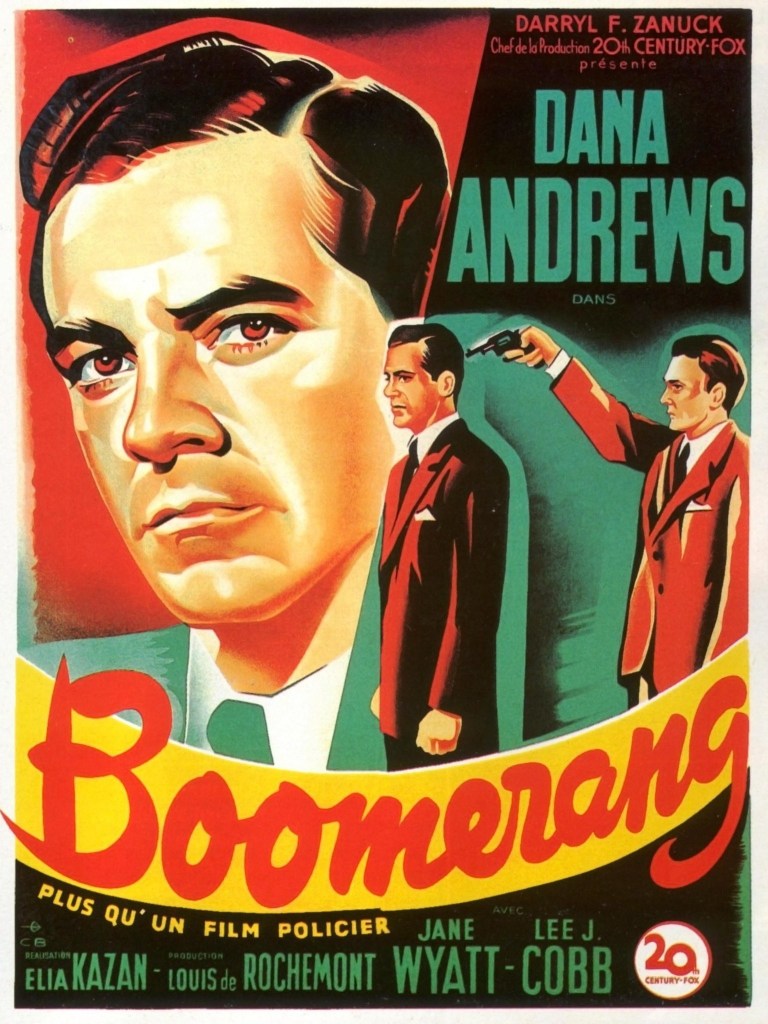
In Bridgeport, Connecticut, a popular priest is gunned down in the street, the killer escaping into the night. The police are baffled. The city turns against the reformist mayor’s administration. Then, after several weeks, there is a lead as twitchy ex-soldier John Waldron (Arthur Kennedy) is dragged in and, after hours-and-hours of interrogation without sleep, signs a confession. But who cares about small details like that, when everyone is sure the police has their man? But State’s Attorney Henry Harvey (Dana Andrews) has doubts – and no pressure from the public or officials will make him build a case against an innocent man.

Based on an actual 1924 murder case, Boomerang! is told with journalistic sharpness by Elia Kazan that smoothly moves from investigative into courtroom drama. Boomerang! was cited by Kazan as when he started to find his voice, establishing a style that would carry him to Oscar-winning success in On the Waterfront and beyond. Shot largely in location (though admittedly in a different Connecticut town than Bridgeport), it’s full of the immediacy of the streets, avoiding sets and forced studio locations. Kazan leans into the journalistic feel, with a voiceover explaining events and an earnest attempt throughout to make it feel like we are watching real events unfold.

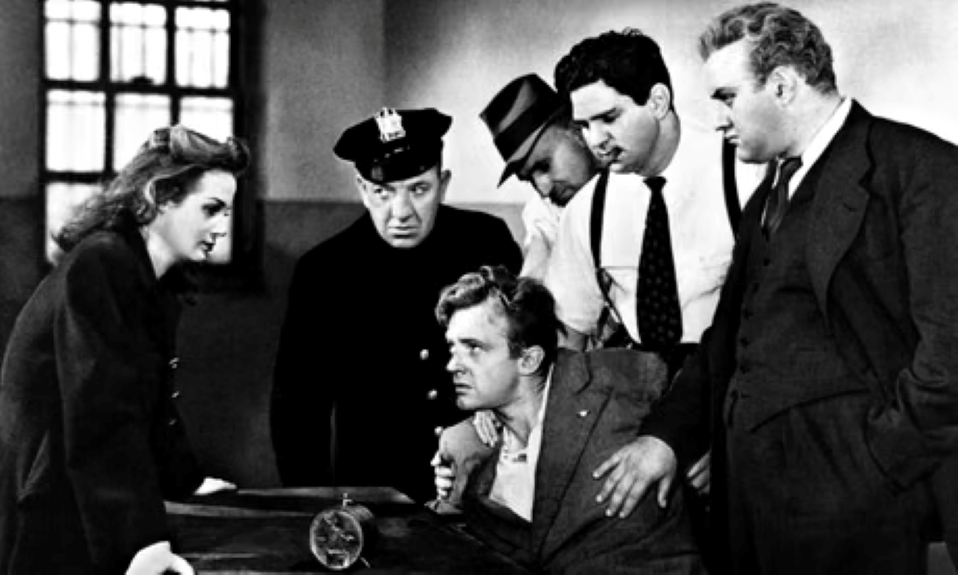
It captures people going about their everyday lives: gossiping over laundry, strolling down streets, pounding typewriters in press rooms, gathering in church and shops. This is a film designed to convey a full sense of a real world. That goes as well for reflecting the investigation, which is full of the visceral pounding of pavements and hustling of suspects into police cars as well as the interrogations of the worn-down Waldron, taking place in an inhospitable room where never-ending questions means Waldron’s head has to be literally picked up to continue answering the questions.

The observational strengths of the film’s opening eventually moves into something more straight-forwardly melodramatic, but Kazan’s documentary restraint tries it best to not make this shift too jarring. As Harvey’s doubts grow, he becomes under increasing pressure from officialdom, principally from Ed Begley’s sweaty Paul Harris (who is too noticeably dodgy from the start for his villainy to be anything like a surprise). This is before a series of courtroom dynamics that hue towards the sort of fireworks you find in larger-than-life films than the journalistic reserve Boomerang! starts with.

Which isn’t to say that these courtroom dynamics are not very well-handled, especially by the under-rated Dana Andrews, who brings just the right amount of humanity and dignity to an otherwise stiff-on-paper character of a crusading, too-good-to-be-true attorney. Andrews delivers the courtroom speeches, and the detailed breakdown of the flaws in the police case, with a real quiet passion – just as he brings a nice degree of moral outrage to the bullying attempts to silence him.

Boomerang! provides several opportunities for compelling character actors, many of whom went on to work again for Kazan to great success. Lee J Cobb’s bulldog fierceness is perfect for put-upon police Captain Robinson who lets his determination to prove he can crack the case compromise his judgement. Cobb gives Robinson a powerful sense of authority – there is a wonderful scene where he faces down a would-be lynch mob with little more than growling disapproval. There is also a lovely moment, where he lifts the sleeping Waldron and carries him into his bed with all the care of a loving father. He’s well backed by Karl Malden as an eager-to-please inexperienced cop.

Arthur Kennedy produces one of his expert portraits in weakness as Waldron, an embittered veteran who has found peace offers little more than failure. While never losing track of what makes Waldron suspicious, Kennedy finds a neat line in vulnerability and fear keeps him sympathetic. Opposite him, Cara Williams explodes with righteous fury as a former girlfriend who believes herself wronged, eager to see Waldron condemned. It’s a more interesting role than any other female role in the film, although Jane Wyatt finds some engaging warmth in the dull role of Andrews’ loyal wife.

Boomerang! at heart is a film about the barrel being fine, aside from a few rotten apples. The crime takes place after the old machine politics system has been cast aside by new politicians, not beholden to the system, willing to introduce reforms. And, by and large, they are shown to really mean it – even if, at one point, some express the view that it doesn’t matter if Waldron is guilty or innocent, since winning means the reformists can remain in power. But all the real sins are collected in the hands of Begley’s character: even the police are absolved, despite the fact we watch them essentially brow-beat a man into confessing (a sergeant even suggesting they rough him up a bit to speed things along, which makes you wonder what the system was like for people are not veterans the police captain feels sorry for).

Boomerang! pulls any punches of really exploring systemic flaws, even while it covers an innocent man being bum-rushed into a trial. But then it puts complete faith in the idea that the same system will turn around and do its job by ensuring he is completely absolved – with the only danger from corrupt elected officials, not the blindness of a potential system. It’s a factor Kazan (to be fair) felt the film made too many compromises on – and he’s right. It might tell a scare story, but Boomerang! is fundamentally a reassuring film that is sure everything will turn out right in the end.
Written on the Wind (1956)

Written on the Wind (1956)

Sirk’s melodrama packs in plenty of tight psychological observation among soap suds

Director: Douglas Sirk

Cast: Rock Hudson (Mitch Wayne), Lauren Bacall (Lucy Moore Hadley), Robert Stack (Kyle Hadley), Dorothy Malone (Marylee Hadley), Robert Keith (Jasper Hadley), Grant Williams (Biff Miley), Robert J. Wilke (Dan Willis), Edward Platt (Dr. Paul Cochrane), Harry Shannon (Hoak Wayne)

Money can’t buy you love. The oil-rich Hadleys live the high-life off the oil-empire built by patriarch Jasper Hadley (Robert Keith). Unfortunately, his children are both deeply unhappy and emotionally stunted. Kyle (Robert Stack) is an alcoholic playboy, Marylee (Dorothy Malone) a lonely woman who plays with other people’s lives to make herself feel better. Both are, in different ways, in love with sub-consciously resentful Mitch Wayne (Rock Hudson), the poor-boy childhood friend turned geologist who their father sees as the son he wishes he had. Mitch is in love with Lucy Moore (Lauren Bacall), an ambitious secretary at Hadley Oil – but Kyle also falls for her, marrying her. Marylee is in love with Mitch, who doesn’t feel the same. We already know from the film’s prologue all this is going to end with a bullet.

It makes for gorgeous entertainment in Douglas Sirk’s lusciously filmed melodrama, that helped lay out the template for the sort of soapy Dynasty-type TV monoliths that would follow years after. Sirk’s gift with this sort of material was to imbue it with just enough Tennessee Williams’ style psychological drama. Written on the Wind is awash with the glamour and beauty of wealth but, at the same time, demonstrates the immense psychological emptiness at the heart of the American Dream. What’s the point of all this luxury when those who have it are as deeply fucked up as the Hadleys are?

Their family is so wealthy the Texas town they live in is named after them and the run it like a private fiefdom, with the police running around like their errand boys. It’s not made them a jot happy. Both Maryann and Kyle are deeply aware of their own emptiness, rooted in the lack of attention (and love) from their father, a work-obsessed man who seems to have written his children off at an early age and invested far more time in training up Mitch like some sort of cuckoo-in-the-nest. Perhaps to try and win back their father’s love as much as to try and find meaning in their own, both of them want to possess Mitch: Maryann is destructively desperate to marry him, Kyle seems to want to become him and if one-way of doing that is by stealing the girl Mitch loves, all the better.

Wonderfully played by Robert Stack, overflowing with false confidence, jocularity and an utter, all-engulfing emptiness, Kyle talks endlessly about how Mitch is like a brother to him all while repeating as often as he can gently disparaging references to his poor-upbringing and dependence on the Hadley’s patronage. It’s coupled with his homoerotic (unspoken of course – it’s the fifties – but you can’t miss it!) obsession with Mitch. All of these confused, contradictory feelings wrap up in Stack’s (Oscar-nominated) performance, with the weak Kyle all too-readily believing Mitch might just be bedding his wife.

It’s an idea planted by Maryann, played with a scene-stealing bravado by Oscar-winner Dorothy Malone. Despite her vivacious energy and languidly casual confidence in establishing her pre-eminence over the newcomer Lucy, Maryann is a miserable, disappointed, deeply damaged soul, painfully bereft of any love and seeking meaning in casual couplings with a parade of gas attendants and hotel bellboys. Obsessively in love with Mitch, she dwells like Kyle on their childhood and the lost dreams of what might have been, but never was. This bubbles out over the course of Written on the Wind to an ever-more destructive Iago-like manipulation of the haplessly drunk Kyle, out of a mix of wanting everyone to be as miserable as she is and a desire to either own or destroy Mitch.

Malone and Stack triumph in these show-case roles, successfully building both frustration and sympathy in the audience. Opposite them, Hudson and Bacall (the stars!) play the more sensible, less interesting parts. Bacall’s strength and firmness balance rather nicely the contradictions in Lucy. A clear-eyed realist on meeting Kyle, attracted to the display of wealth while repulsed by his shallow, well-oiled, lothario routine, she never-the-less marries him, at least partly out of a desire to mother this fragile figure (she is genuinely moved by Kyle’s cockpit confessions of inadequacy and self-loathing while he flies her from New York to Miami for a date). From this Lucy confronts the psychological mess of the Hadley family with a stoic determination to make the best of things.

When does she start to develop feelings for Mitch? Mitch is clearly smitten on first sight, glancing fascinated at her legs while she stands behind a display board. But Sirk uses Rock Hudson’s similar stoic quality to great effect, turning Mitch into the epitome of duty, loyal enough to the Hadley family to bend over backwards to support the Kyle-Lucy marriage, all while clearly carrying an immense candle for Lucy. Saying that, part of the fun in Written on the Wind is wondering how much the patient Mitch is a conscious cuckoo, displaying all the intelligence, dedication and aptitude that Jasper so publicly lambasts his children for lacking (and whose fault is that?)

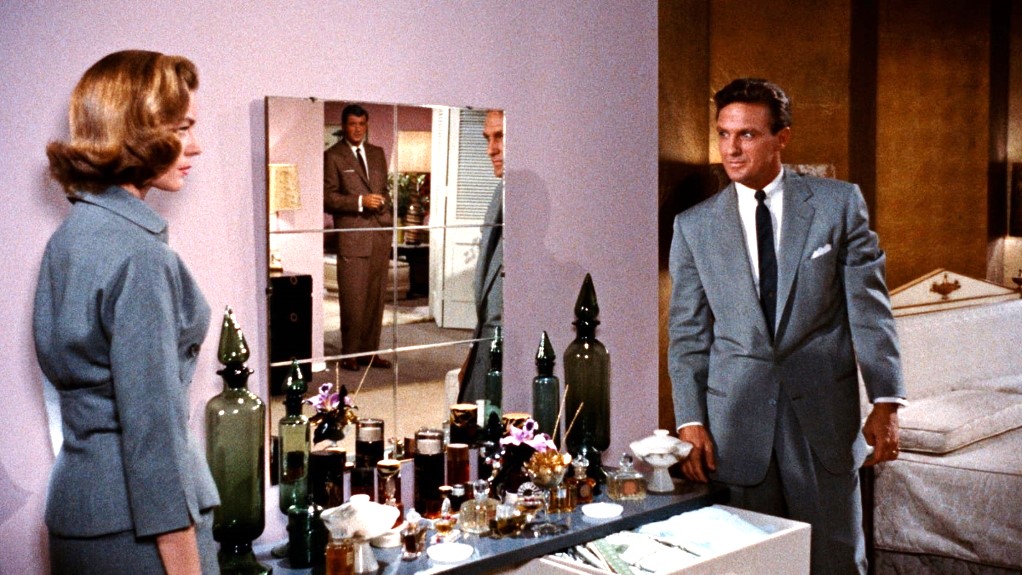
All these psychological soapy suds bubble superbly inside Sirk’s intricately constructed world. Every shot in Written on the Wind is perfectly constructed, splashes of primary colours dominating a world of pristine 50s class. Sirk frames the picture gorgeously, notably using mirrors effectively to place the characters in triangular patterns (Mitch at one point strikingly appearing in a mirror standing between Kyle and Lucy) or to suggest psychological truths (one shot angled to show Lucy brushing her hair in a mirror where we see a reflection of the reclining Maryann and don’t forget that marvellous closing shot of Dorothy subconsciously mirroring her father’s pose in the painting behind her while caressing a phallic model of an oil drill).

Sirk keeps events just the right side of melodramatic excess. A brilliantly staged sequence sees Maryann – dragged home from an assignation by the police – dance with a wild abandon in her bedroom while Jasper, horrified at realising how his disregard has warped Maryann, collapses to a heart-attack on the stairs. It’s a sequence that could be absurd but has just the right amount of reality to it, grounded as it is in Maryann’s self-loathing. Just as Kyle’s belief that impotence is going to consign him to being as much a failure in continuing the Hadley line as he is in everything else. Particularly since he’s constantly reminded of his inadequacy opposite the taller, smarter, better-at-everything Mitch who everyone else in the film openly seems to prefers to him.

It’s an extraordinary balance Sirk keeps, treating the characters with utter respect and affection while placing them in an over-the-top structure full of elaborate sets and overblown, melodramatic events and heightened feelings. Perhaps because Sirk never laughs at the concepts and content he’s created, we invest in both its truth and ridiculous entertainment quality. He does this while avoiding any touch of self-importance, never forgetting this is an old-fashioned melodrama. It makes Written on the Wind a hugely enjoyable, and surprisingly rich, character study mixed with plot-boiler.