Tag: Robert Morley

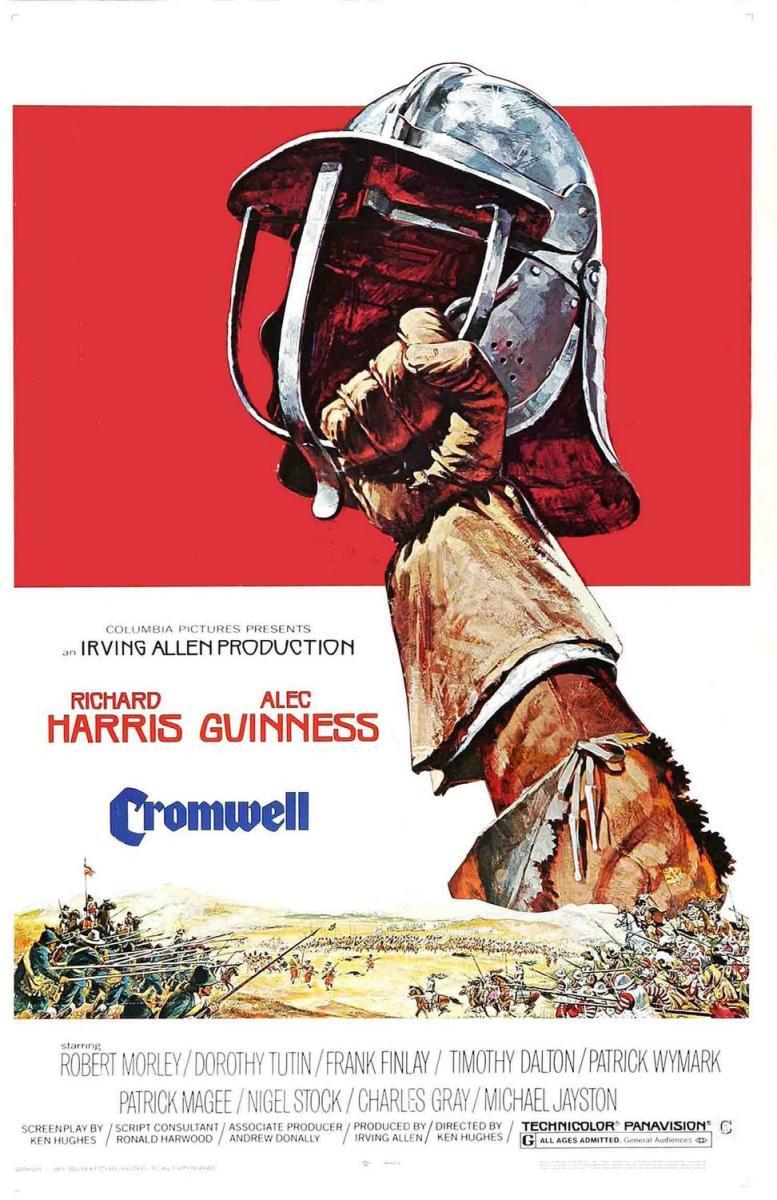
Cromwell (1970)

Cromwell image
Richard Harris let loose the revolution in Cromwell

Director: Ken Hughes

Cast: Richard Harris (Oliver Cromwell), Alec Guinness (King Charles I), Robert Morley (Earl of Manchester), Dorothy Tutin (Queen Henrietta Maria), Frank Finlay (John Carter), Timothy Dalton (Prince Rupert), Patrick Wymark (Earl of Strafford), Patrick Magee (Hugh Peters), Nigel Stock (Sir Edward Hyde), Charles Gray (Earl of Essex), Michael Jayston (Henry Ireton), Douglas Wilmer (Sir Thomas Fairfax), Geoffrey Keen (John Pym), Stratford Johns (President Bradshaw)
How much does history actually matter when you watch a historical film? We all know we aren’t watching a documentary don’t we? It’s worth bearing in mind when watching Cromwell a film which would probably be in the running for “least historically accurate film of all time”. But despite that, it’s entertaining and gets quite close to some of the spirit of the times – even if it changes most of the facts. It probably as well deserves notice for being one of the very few films to offer a sympathetic portrait of Oliver Cromwell – not a guy it’s easy to like.

It’s the 1640s, and England is a mess. Charles I (Alec Guinness) has been ruling the country directly, without involving Parliament, for over ten years. But now the money is gone and he needs Parliament to raise some more cash. Problem is, Parliament is more interested in pushing a defence of its own prerogatives rather than simply putting more money into the King’s pocket. Among the leaders of the Parliamentary campaign is Oliver Cromwell (Richard Harris), and he is not the man to take any false promises from the king. Before we know it, the country has tipped into civil war – and now it’s up to Cromwell to create a Parliamentarian army that is capable of defeating the King and bring democracy to the nation.

Ken Hughes film offers some plenty of scope and drama, even if is old-fashioned (even a little Victorian) in its Wrong-but-Wromantic Cavaliers and Right-but-Repulsive Roundheads (to mis-quote 1066 And All That). It’s a strange topic for a historical epic (it took years to get the funding) – but it looks fabulous and has a wonderful score that really embraces the religious music of the time.

What it gets right is the passion and the fire that people felt at the time for questions of politics and religion. The film frequently features heated debates (even if the dialogue is often more ticking boxes than inspired) that the actors invest with real force. Its view of events is of course truncated and at times simple (it is, after all, trying to cover around ten of the most tumultuous years in British history in about two hours), but it focuses on trying to get the spirit of things right.

A large part of this is Richard Harris’ firey performance in the lead role. There is, it has to be said, a cosmic irony in Cromwell, the least popular British leader in Irish history, winds up being played so sympathetically by one of the most famous Irish actors of all time. Sure, the real Cromwell would have hated being played by an Irishman and a Catholic (Cromwell was surprisingly inclusive at the time, but had no truck with either group). But then Cromwell would also have loved being portrayed as a mixture of George Washington and Cincinnatus (the Roman general who left his plough to assume supreme command when the nation needed him, only to retire again to obscurity). This Cromwell is bullheaded, but determined to do what’s best for the nation, with personal ambition not even a consideration. He’s the one true, selfless man in a revolution of violence.

In fact, Cromwell was sorely tempted by the eventual offer to be King (something he laughs off here). He also undoubtedly was touched heavily by ambition, while his attempt to turn the Protectorate into a hereditary office was a disaster that doomed the Republic (surely George Washington learned a few lessons from him). But, deep down, Cromwell was sincere – a guy who largely said, and did, what he meant. It’s that sense of morality that Harris gets very well here. And, while its easy to poke fun at those hoarse tirades Harris is frequently called on to deliver, this sort of intemperate ranting (laced with Biblical language and a strong sense of moral superiority) were pretty much central to Cromwell’s personality.

It makes for a very different hero, even if the film is determined to turn Cromwell into the only decent man in the Kingdom. Cromwell, in real life, never retreated from politics to return to his farm as he does in the latter part of the film (he actually spent this time on brutal campaign in Ireland, something the film mentions only vaguely in passing). But there is no doubt Cromwell would have believed he was the guy selected by providence to save the nation – and that idea the film channels very well. In fact, Cromwell gives you a pretty decent idea of what Cromwell might have been like – and a pretty accurate picture of who Cromwell wanted to be – even if the things it shows you only have a passing resemblance to what happened.

It’s a key directive throughout Ken Hughes’ film, which feels free to distort historical events willy-nilly (see more below). But there is a sort of truth in spirit, if not in fact – from the heated debate in Parliament, to the mixture of frantic panic and regimented order in the battles (one particularly good shot positions the camera under a charging horse, which makes a cavalry charge suddenly feel horrifyingly visceral). Sure it’s arranged into a much more simple black-and-white story, but it works.

A similar trick also works for its portrayal of Charles I. This is probably one of Guinness’ most over-looked performances. His Charles is a weak, indecisive man who confuses stubbornness and pride for moral strength. Softly spoken when calm, he collapses into heavily Scots accented rage when riled and his politeness is a only a shield for bitterness and vexation. He routinely shirks responsibility for his actions and spreads the blame around everyone but himself. Again, it might not all be accurate, but you can’t imagine this is far off from the actual King.

Historically though, so much of the film is wildly inaccurate. Many of these changes are done to increase the importance of Oliver Cromwell early in the Parliamentarian campaign. To scratch the surface: Cromwell – a minor figure until quite late into the war – was not one of the five members Charles marched to Parliament to arrest (neither was Henry Ireton). He certainly didn’t – and neither did anyone else – remain sitting when the troops arrived and set a motion in place protecting MPs. He never met the King before the war. Cromwell is later made C-in-C of the Parliamentarian army – an office actually given to Fairfax. The film’s depiction of the Battle of Naseby flips the numerical advantage exactly to favour Charles rather than Cromwell. Far from providing the key damning evidence at Charles’ trial, Hyde fled the country with Prince Charles.

But this is a fiction, rather than drama. Even if the facts it presents are largely nonsense, it gets a lovely sense of the divided loyalties and tensions that existed during this period. The performances are often quite broad – Robert Morley simpers and sneers as an opportunistic Manchester, Patrick Wymark growls and splutters as Strafford while Timothy Dalton goes way over the top as a foppish Prince Rupert – but some, such as Michael Jayston’s firebrand Ireton or Nigel Stock’s tortured Hyde (historical nonsense as his storyline is) are rather good.

And it’s hard not to like a film where the lead actor is going at it such great guns that you can actually hear his voice disappearing into a rasp. Cromwell doesn’t have much relation to the facts, but deep down it does seem to understand the man Cromwell wanted to be. And, on that level, it feels truthful and heartfelt – and that’s partly why it remains entertaining and why I remain rather fond of it.

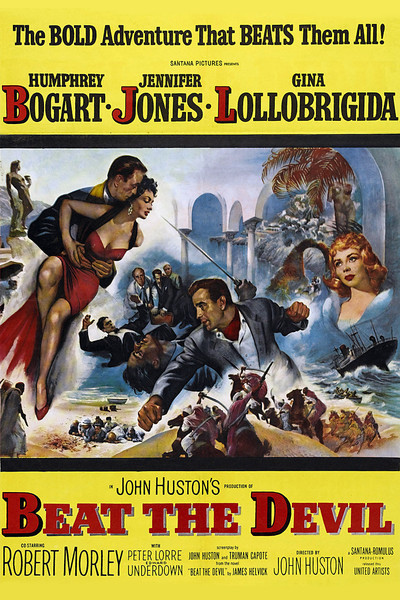
Beat the Devil (1953)

Jennifer Jones, Gina Lollobrigida and Humphrey Bogart in the tongue-in-cheek Beat the Devil

Director: John Huston

Cast: Humphrey Bogart (Billy Dannreuther), Jennifer Jones (Gwendolen Chelm), Gina Lollobrigida (Maria Dannreuther), Robert Morley (Peterson), Peter Lorre (Julius O’Hara), Edward Underdown (Harry Chelm), Ivor Barnard (Major Jack Ross), Marco Tulli (Ravello), Bernard Lee (Inspector Jack Clayton)

Beat the Devil is a curious beast. You could argue it was ahead of its time. Huston and Bogart had started out with the intention of making a straight crime mystery, a sort of Maltese Falcon in Europe. But when they arrived on location, obviously something in the weather got to them and Truman Capote flown in to help redraft the script on a daily basis to turn it into a sort of satirical comedy. For audiences expecting a hard-boiled crime mystery, it left heads scratched and cinema seats empty. Bogart lost a packet on the film – and later claimed to hate it – and it only existed in a badly cut-about version until it was restored in 2016.

The slightly surreal plot hardly really matters. A crowd of unusual people gather in a run-down port in a small Italian town, waiting to take the ship to East Africa. Gwendolen (Jennifer Jones) and Harry Chelm (Edward Underdown) are seemingly upper-class Brits (or are they?). American Billy Dannreuther (Humphrey Bogart) and his European wife Maria (Gina Lollobrigida) might also once have been something, but they sure ain’t now. Peterson (Robert Morley) and his associates the suspiciously un-Irish Julius O’Hara (Peter Lorre), rat-faced bully Major Jack Ross (Ivor Barnard) and nervous Ravello (Marco Tulli) are almost certainly all criminals on their way to a big score in Africa. Thrown together, this unlikely grouping end-up in a heady cocktail of betrayals, schemes, affairs and lies that spools out like a demented shaggy-dog story.

Beat the Devil is really more of an experience, a series of gags and light-hearted scenes played with a grin and a wink. Nothing in it is meant to be taken seriously, and this semi-surreal group of events becomes ever more absurd as it goes on. By the time the cast are abandoning a sinking ship, trudging up a beach to be captured by Arab officials who eventually allow them to row back to port where they find their ship didn’t actually sink…you really should just decide to go with the flow.

Instead the film is about shuffling up familiar tropes from hard-boiled noir with Oscar Wildeish farce. Certainly the Chelms seem to have wandered in from something totally different (not least since Gwendolen’s name is reminiscent of Importance of Being Earnest). Harry (a superbly stiff-upper lipped Edward Underdown) is a blithely unaware would-be English gentleman, pompously aware of his social class and blithely unaware that his wife seems to immediately start an affair with Billy. Gwendolen is the exact sort of character you might expect to see in Wilde, a dreamer tipping into fantasist, who blurts out things she shouldn’t and falls instantly in love with Billy. She’s also whipper-smart – more than capable of defeating Harry at chess without looking (“usually he’s a wonderful loser” she tells Billy, by way of apology for Harry’s strop).

Billy and Gwendolen embark on an immediate affair (although of course, in deference to the Hays Code, its just kept this-side-of-implicit). Mind you the film has a zingy wife-swop feel to it, since it’s pretty clear that Maria is far more interested in the British reserve of Harry (“Emotionally I’m English” she says before eulogising tea and crumpets) than she is in the ordinary-Joe cunning of her husband (although perhaps Harry is just as oblivious to this as everything else around him).

Billy is Bogart deliberately at his most Bogart-ish, channelling every grimy-but-smart dubious-hero the star ever played. Bogart plays the entire film with a grin on his face and delights in lines like “Fat Guys my best friend, and I will not betray him cheaply”. He also sparks delightfully with Jennifer Jones, who seems to having the time of her life as a character so flighty and unpredictable that even she looks like she hasn’t a clue what she is going to do (or feel) from one moment to the next.

The supporting cast of creeps and freaks Dannreuther is conspiring with to make a fortune (its something to do with land and uranium) similarly seem to have walked in from a side-ways Dashiel Hammett universe. For all their dirty deeds – and it seems Petersen had ordered a hit in the UK, although never for a minute would you believe this looking at Robert Morley’s puffed up bluster – they are a rather sweetly naïve and incompetent. Morley’s Petersen, a sort of galloping major, carries no real threat. Peter Lorre is very funny as a suspiciously German sounding Irishman (“Many Germans in Chile have come to be called O’Hara” he comments), prone to flights of verbal fancy and a chronic lack of focus. Ivor Barnard is as close as the film comes to threat as the aggressively incompetent Major Ross, a chippy bully who resents his shortness and eulogises Hitler at the drop of a hat. These heavies are each ridiculous figures.

And it makes sense, since the plot is a great inflated balloon of nonsense. There are chases, sinking ships that stay unsunk, a moment where two major characters are briefly believed dead, obsessive conversations about hot water bottles and reveals that puncture any sense of grandeur for each character. It’s the sort of aimless story you could imagine natural raconteurs like Huston and Capote finding absolutely delightful, and the whole film feels like a dramatization of a dinner-table anecdote.

Take it on those terms and its all rather good fun, even if it makes no sense. The cast look like they are having a whale of a time, and the total lack of seriousness about the whole enterprise generally makes it glide by with ease. Take a couple of drinks, sit back, don’t think about it too much and enjoy the jokes.

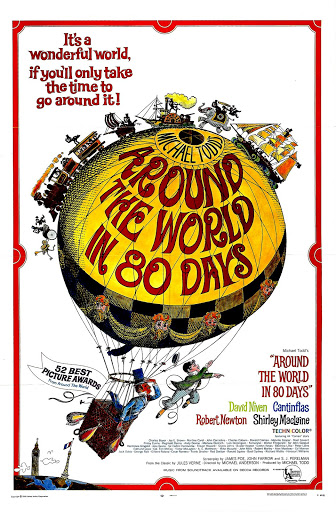
Around the World in Eighty Days (1956)

Around the world header
David Niven and Cantinflas head Around the World in Eight Days in this Oscar-winning epic

Director: Michael Anderson

Cast: David Niven (Phileas Fogg), Cantinflas (Passepartout), Shirley MacLaine (Princess Aouda), Robert Newton (Inspector Fix), Charles Boyer (Monsieur Gasse), Joe E. Brown (Stationmaster), John Carradine (Colonel Proctor), Charles Coburn (Steamship clerk), Ronald Colman (Railway official), Melville Cooper (Mr Talley), Noel Coward (Roland Hesketh-Baggott), Finlay Currie (Andrew Stuart), Marlene Dietrich (Hostess), Fernandel (Paris coachman), Hermione Gingold (Sporting lady #1), Cedric Hardwicke (Sir Francis Cromarty), John Gielgud (Foster), Trevor Howard (Denis Fallentin), Glynis Johns (Sporting lady #2), Evelyn Keyes (Paris flirt), Buster Keaton (Train conductor), Beatrice Lille (Revivalist), Peter Lorre (Steward), Victor McLaglen (SS Henrietta helmsman), John Mills (London coachman), Robert Morley (Gauthier Ralph), Jack Oakie (SS Henrietta captain), George Raft (Bouncer), Frank Sinatra (Piano player), Red Skelton (Drunk), Harcourt Williams (Hinshaw)

In the 1950s, cinema struggled to encourage people to come out of their homes and leave that picture box in the corner behind. Big technicolour panoramas and famous faces was what the movies could offer that TV couldn’t. This led to a trend in filmmaking that perhaps culminated in 1956 with Around the World in Eighty Days triumphing among one of the weakest Best Picture slates ever seen at the Oscars. Around the World had everything cinema knew it could do well: big, screen-filling shots of exotic locations filmed in gorgeous colour; and in almost every frame some sort of famous name the audience could have fun spotting. It’s perhaps more of a coffee table book mixed with a red carpet rather than a narrative film: entertaining, but overlong.

Faithfully following Jules Verne’s original novel (with added balloon trips), Phileas Fogg (David Niven) is a punctilious and precise Englishman of the old school, whose life is run like clockwork and whose only passion is whist. Nevertheless he accepts a challenge from his fellow members of the Reform Club (among them Trevor Howard, Robert Morley and Finlay Currie) to circumnavigate the globe in 80 days or less. Setting off with his manservant – the recently hired, accident prone Passeportout (Cantinflas) – Fogg races around the world, from Paris to Cairo to India to Hong Kong to Japan to San Francisco. Along the way he rescues Princess Aouda (Shirley Maclaine) from death by human sacrifice in India and has to confront the suspicions of Inspector Fix (Robert Newton) who is convinced that Fogg is responsible for a huge theft at the Bank of England. Can Fogg make it back to the Reform Club hall on time to win his bet?

Around the World was the brain-child of its producer Michael Todd. A noted Broadway producer, Todd had been looking to make a similar splash in the movies. Perhaps it’s no surprise that he decided the finest way to do this (after the mixed success of a movie version of Oklahoma) was to produce something that‘s pretty much akin to a massive Broadway variety show. Around the World – as you would expect – is an incredibly episodic film, seemingly designed to be broken down into a number of small sequences either to showcase the scene’s guest star or to provide comic opportunities for Cantinflas to display his Chaplinesque physical comedy.

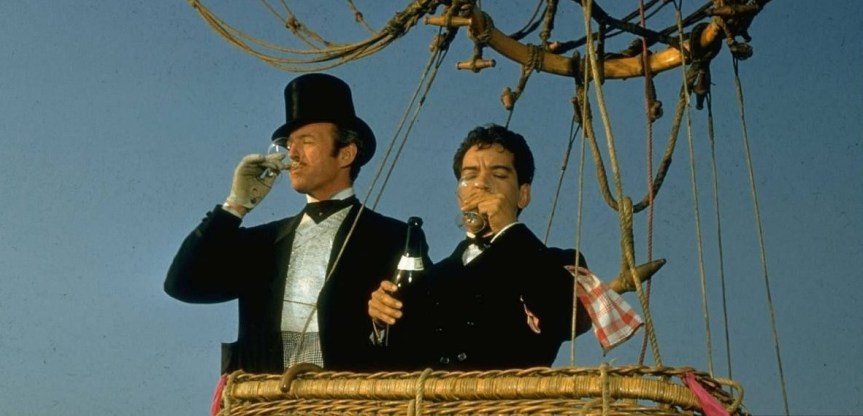
That and lots of opportunities for some lovely scenic photography. Nearly every major sequence is bridged with luscious photography capturing some exotic part of the world – from the coast of Asia to the Great American Plains. It’s pretty clear this is a major attraction of the film: come to the movies and see those parts of the world you’ve always dreamed of, just for the price of a movie ticket! Surely introduction of a hot air balloon to allow Fogg and Cantinflas to travel from Paris to Spain was purely to allow lovely aerial shots of the French countryside and chateaux. It’s the sort of film that proudly trumpeted in its publicity the number of locations (112 in 13 countries!), the vast number of extras (68,894!) and even the number of animals (15 elephants! 17 fighting bulls! 3,800 sheep!). It’s all about the scale.

That scale also carries across to the guest cameos. Between enjoying the scenic photography, viewers can have fun spotting cameos. Can that really be Noel Coward running that employment agency! The chap who owns the balloon, I’d swear that’s Charles Boyer! Wait that steward: that’s Peter Lorre! Good lord that’s Charles Coburn selling Fogg tickets for the steamer! Oh my, Buster Keaton is helping them to their seats on the train! Marlene Dietrich is running that saloon – and good grief that’s Frank Sinatra playing the piano! Most of the stars enter into the spirit of the thing, even if they frequently start their shots with backs to the camera, before turning to reveal their star-studded magnificence. Sadly time has faded some of the face recognition here, not helped by David Niven (perfectly cast as the urbane and profoundly English Fogg, so precise that his idea of romantic talk is to recount past games of whist) probably today being one of the most famous people in it.

Todd marshals all this with consummate showman skill. It’s handsome, very well mounted and generally entertaining – even if it is painfully long (it’s not quite told in real time, but can feel like it at points). The film is nominally directed by Michael Anderson. However, I think it’s pretty clear his job was effectively to point the camera at the things Michael Todd had lined up (be they location or stars) – Todd had already dismissed the original director, John Farrow, after a day’s shooting for not being sufficiently ”co-operative”. To be honest it’s fine as this is an entertainment bereft of personality, instead focused on being “more is more”.

Part of its extended runtime is due to the long comedic sequences given to Cantinflas. A charming performer – and possibly the most famous comedian in Latin-America at the time – Cantinflas can be seen doing everything from bicycle riding, to bull fighting (for a prolonged time), to gymnastics to horseback riding. (Far different from the unflappable and spotless English gentleman Niven is playing.) Your enjoyment of this may depend on how far your patience lasts. I’m not sure mine quite managed to last the course. Sadly one of Cantinflas’ greatest comedic weapons, his Spanish wordplay, was completely lost in translation.

There are some decent sections. The iconic balloon flight is well mounted and gives the most impressive images (the famously vertigo-suffering Niven was replaced by a double for much of this). Others, like the bullfight or an interminable parade in San Francisco go on forever. The casting of Shirley MacLaine as an Indian princess is an uncomfortable misstep (even at the time MacLaine felt she was painfully miscast), made worse by an offensive “human sacrifice” storyline – that got cut when the film was screened in India. Robert Newton though is very good value as the misguided but officious Inspector Fix.

Around the World in Eighty Days is grand, handsomely mounted entertainment. But to consider it as a Best Picture winner feels very strange. It’s not a lot more than an entertaining variety show, its plot impossibly slight (made to feel even more so by its vastly over-extended run time). While you can enjoy it in pieces, it finally goes on too long for its own good. Entertainingly slight as it is, it’s still one of the weakest Best Picture winners ever.

The African Queen (1951)

Katharine Hepburn and Humphrey Bogart on a sweaty romantic river cruise in The African Queen

Director: John Huston

Cast: Humphrey Bogart (Charlie Allnut), Katharine Hepburn (Rose Sayer), Robert Morley (Reverend Samuel Sayer), Peter Bull (Captain of the Königin Luise), Theodore Bikel (First Officer of the Königin Luise), Walter Gotell (Second Officer of the Königin Luise), Peter Swanwick (First Officer of Fore Shona)

John Huston’s The African Queen is a beloved classic – so much so its odd-couple romance in tropical climes has been endlessly ripped off and riffed on practically ever since it was made. It’s a gentle, enjoyable travelogue of a movie where (truthfully) not much happens, other than we sit back and watch two masters of cinema acting go through the paces with consummate skill.

In 1914 in German East Africa, missionary brother and sister Samuel (Robert Morley) and Rose Sayer (Katharine Hepburn) plough their lonely furrow bringing God’s word to the disinterested natives, their only contact with the outside world being drunken Charlie Allnut (Humphrey Bogart), captain of the steam ship The African Queen, who delivers their supplies. Their world is turned upside down when Charlie brings news of World War One. The Sayers plan to stay, until German soldiers burn down the mission and assault Samuel who swiftly dies of fever. Charlie agrees to take Rose out of danger on his steam boat – but on the dangerous journey Rose develops a plan to use The African Queen to sink a German gun boat preventing British access to Africa, and Charlie and Rose find themselves – much to their surprise – falling in love.

Truth be told, nothing happens in The African Queen that you will find remotely surprising if you’ve ever seen a film before. Not even in 1951 could anything in this film be said to be pushing the envelope or offering something different to hundreds of studio epics past. Two people who seem to have nothing in common come together only to find, by heck and by jiminy, they actually are perfect for each other. Obstacles are put in place for them to struggle against but eventually love (and our heroes) triumph over all. Hip hip hoorah! You can see why the picture is so widely loved – it’s in many ways totally unchallenging and familiar.

John Huston seems to know this and just sits back and allows the film to almost tell itself with a professional, unfussy precision. The African Queen is an extremely well made film, sumptuous to look at, and never overstaying its welcome. It’s been boiled down to its barest necessities, and as such it works extremely well. There’s nothing extraneous in there – heck the film only really has three characters and one of them dies in Act One. Huston’s demands to film the entire thing (more or less) on location in the Congo is totally validated by the immersive filth, sweat and heat that reeks off the picture and seems to have soaked into the skin of the actors. 

Huston also understood that the real gold here was the acting – and the chemistry – of his two beloved stars. Tales of the making of the film are legendary – Bogie brought along Bacall, who helped out on catering, Hepburn refused to join the Bogart/Huston drinking sessions and became the only one to get ill from drinking the water, all four became lifelong friends. The script originally demanded Allnut to be a chippy cockney and Rose to be a prim schoolmistress type. The parts were re-written, Allnut into a “Canadian” (yeah right) while Hepburn reimagined Rose as, by her own admission, a sort of Eleanor Roosevelt in the jungle.

But it works a treat because both stars are on fire in this vehicle. Bogart perfectly mixes drunken awkwardness and defensiveness with a roguish charm, and what grows into a sprightly delight at being taken seriously for the first time in his life. Allnut is besotted with Rose from early on – even if he can’t admit it – and his whole personality seems to flourish and grow from her attentions, while never losing that slight “little boy lost” air. Mind you, Rose is as clearly attracted to Allnut early on as he is to her – but with her ideas of standards she would never allow herself to explore those feelings except in extreme circumstances.

Hepburn is such a gifted actor that you always know Rose is a far more intelligent, interesting and dynamic character than the one we are introduced to playing piano at one of her brother’s interminable sermons. Shaking off – with Allnut’s help – her shock at his death, she swiftly displays a head-girlish determination and pluck,that extends from rolling up her sleeves to steer the boat to laying out a plan to torpedo a German gun boat. Far from domineering Allnut, she flourishes and grows just as he does from her attention, and Hepburn suggests worlds of feeling and engagement opening up in Rose that she has never considered possible before.

The chemistry between them is scintillating and extremely warm, while the burgeoning romance is very sweet. I love the gentle way they switch form formal address to “Rosie” and “Dear”, the first few times each with that gentle hesitation that half expects rejection and anger. The film is also surprisingly daring about its depiction of sex (it’s pretty clear Rose and Charlie get jiggy in the boat at least twice while cruising down the river). The film mixes this touching stuff with some generally winning comedy – Rose pouring away Charlie’s huge whisky reserve after a particularly drunken display early on is a highlight – that really plays off the odd-couple combination of the two of them. It also helps play into the sweetness of the romance: Charlie impersonating a hippo to a delightedly bemused Rose is also very sweet.

It’s obvious stuff really – and Huston intersperses a few too many shots of crocodiles and hippos, as if he was keen to hammer home that they actually went on location – and there isn’t much in the film to surprise you or that you might not expect. It’s really all about the success of the two stars working together – and their natural chemistry and warmth spills out of the screen. Really it’s Bogart and Hepburn just doing their thing – but when their thing is as good as is this, you can certainly sit and watch it for ages.