
Early talkie as flashes of interest here-and-there as it awkwardly adapts to sound
Director: Roland West
Cast: Chester Morris (Chick Williams), Harry Stubbs (Buck Buchanan), Mae Busch (Daisy Thomas), Eleanor Griffin (Joan Manning Williams), Regis Toomey (Danny McGann), Purnell Pratt (Sergeant Pete Manning), Irma Harrison (Toots)

After a long stretch, Chick Williams (Chester Morris) is finally out of the slammer – and he’s celebrating by getting married to Joan Manning (Eleanor Griffin), who just happens to be the daughter of Police Sergeant Pete Mannings (Purnell Pratt). But it’s all fine, because Chick is going straight. And when the police are convinced Chick killed a police officer during a bungled burglary, Joan is certain he didn’t. In fact, she can give him a cast iron alibi – they were at the theatre together and, even if the killing did happen when they were separated during the interval, he definitely didn’t do it. Or did he?
Alibi (an early nominee for Best Picture) is another classic example of both Hollywood adapting a melodramatic Broadway murder-drama hit to the screen and a silent film hurriedly (and sometimes awkwardly) retrofitted to sound. It makes it a strange beast, a hodgepodge of different acting styles with scenes ranging from dynamic and experimental camera movement with flashes of intriguing sound usage to painfully awkward dialogue scenes where most of the actors stand very still and enunciate very slowly and clearly to make sure the mics pick up every word.
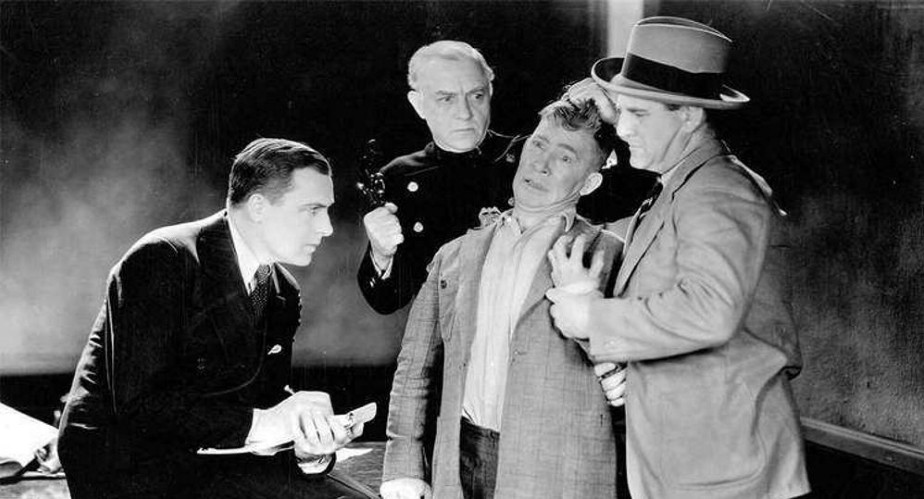
We get an explosion of sound at the start – films of this era knew audiences were gripped by such humdrum audio marvels as prisoners marching out of cells, bells ringing and police rhythmically tapping nightsticks against a wall. West does shoot this with quite a bit of interest – in particular the sudden appearance of the prisoners from behind a row of doors that swing shut. It’s handsomely designed by William Cameron Menzies and there are the odd moments of flair: a camera that tracks from a low-angle into the hotel Chick and his associates use for their base of operations; a stool pigeon crumbling into panic with a nightmare vision of his interrogator’s heads swirling around him; a drunk leaning in towards a massive bottle in close-up; shadows are cast behind doors; there are some dynamic fights and punches and an impressive rooftop flight.
But it’s mixed with some painfully stilted dialogue scenes, with most of the cast shown up in a bad light. Scenes involving Sergeant Manning and his police cronies seem to take hours as the actors trudge painfully slowly through the dialogue, their voices at time sounding like the film has been caught in a projector reel. You really notice the difference when the actors do something silently, their bodies moving with a swift confidence they lose as soon as they speak. Several actors – most notably Eleanor Griffin – still rely on tried-and-trusted silent reactions, signposting reactions they are also communicating with dialogue.
It stands out when the film does use dialogue well. The stool pigeon interrogation sees the interrogators repeat “Who killed O’Brien” and “Come on, come on” over and over again with an increasing rhythmic pace which really captures the mood of relentless interrogation. A scene involving a police switchboard sees a line of operators all speaking, but each sentence we catch forms a coherent narrative whole. There are some relatively ambitious song and dance numbers in Chick’s club. It’s just a shame so many of the core dialogue sequences are so dire.
Alibi does throw in a few decent twists here and there. Today we are not a jot surprised that Chick is in fact a villain, but the film manages to play its cards fairly close to its twist. That’s largely due to Chester Morris’ (an Oscar nominee) very effective performance, easily the finest in the film. Morris has the air of a cocky James Stewart, a false small-town bonhomie covering his greed and arrogance. He plays the humble suitor well – but his smug grin to Sergeant Manning when Joan reaffirms her complete faith in Chick is a great insight to who he is. He’s also a bully and, it transpires, a complete coward – Morris nails a great breakdown scene late in the film where his assurance disappears in a cloud of begging.
Morris is probably slightly better than much of the film deserves. He’s also luckier than Regis Toomey, whose ‘drunken acting’ as booze-hound criminal (truly some of the worst bits of alcoholic acting I’ve ever seen) is still not really excusable, even when you find out it’s a double bluff on his character’s part. (It’s so awful I’m amazed anyone is fooled). Toomey is also the centre of a death scene so ridiculously overblown, maudlin and sentimental it’s far more likely to illicit laughs than tears today as it stretches out over almost five minutes of screentime.
There is the odd intriguing idea in Alibi. It’s remarkable how critical of the police it is – even if it defaults to framing them as heroes in the end. Joan tells her father she could never marry the copper suitor he favours, because she believes cops to be corrupt bullies. An idea you can see partially borne out when our stool pigeon is made to put his fingerprints on a gun and threatened with judicial fake-self-defence murder unless he confesses. Bullets are fired freely at criminals, who left alone to be roughed up and threatened when arrested. It’s not exactly the most flattering view of law enforcement, who (despite reverting to heroes at the end) are constantly shown to be willing to bend the word of the law.
These moments of interest just about sustain it, added to Morris and West’s touches of flair. But it’s also got some painfully dated, awkward moments as Hollywood still struggled to stumble from silence to sound.
 Movie Musings