Tag: Ronald Colman

Arrowsmith (1931)

Arrowsmith (1931)

An uninspired prestige drama suddenly turns at the end into an intriguingly subversive drama

Director: John Ford

Cast: Ronald Colman (Dr Martin Arrowsmith), Helen Hayes (Leora Arrowsmith), Richard Bennett (Gustav Sondelius), A.E. Anson (Professor Max Gottlieb), Clarence Brooks (Dr Oliver Marchand), Alec B Francis (Twyford), Claude King (Dr Tubbs), Bert Roach (Bert Tozer), Myrna Loy (Mrs Joyce Lanyon), Russell Hopton (Terry Wickett), Lumsden Hare (Sir Robert Fairland)
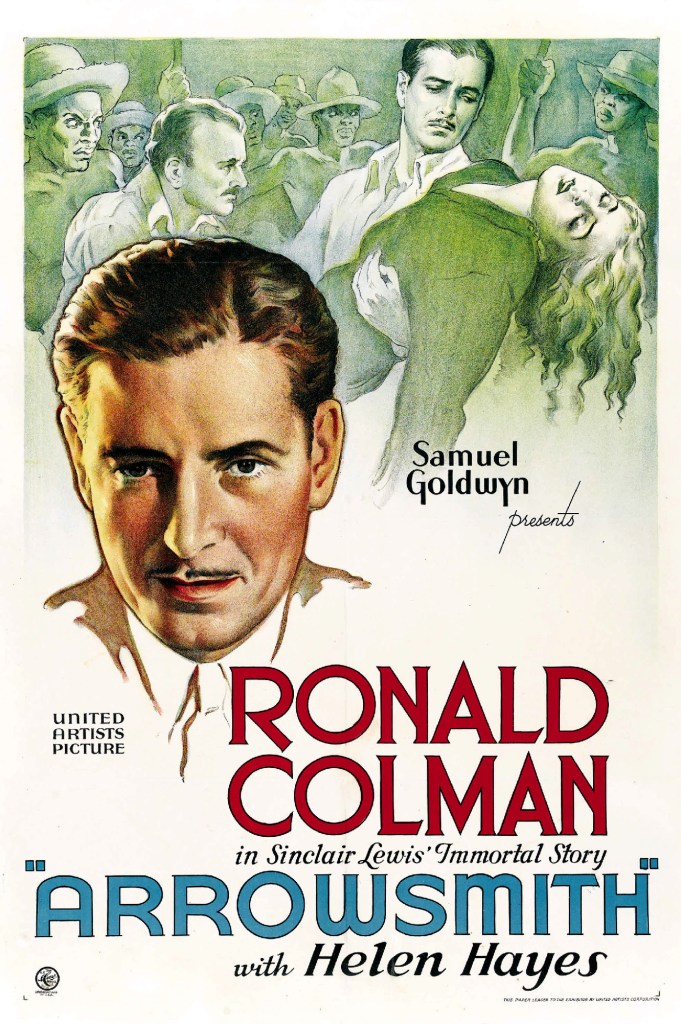
A neat trivia question: what was the first John Ford film nominated for Best Picture? Not many people remember Arrowsmith today – although, since Ford was ordered by producer Samuel Goldwyn to not touch a drop of the sauce while making it, we can be pretty sure he did. Adapted from a hulking Pulitzer-prize winning novel by Sinclair Lewis, it was the epitome of prestige Hollywood filmmaking. It’s a far from a perfect film, but it contains flashes of real beauty and genius – and presents one of the most surprising, subversive visions of infidelity you’ll see in 30’s Hollywood.

Martin Arrowsmith (Ronald Colman) is desperate to be a high-flyer. A scientist and doctor, he’s wants to make his mark – and his mentors such as noted bacteriologist Professor Gottlieb (A.E. Anson) and Swedish scientist Gustav Sondelius (Richard Bennett) think he can. But Arrowsmith postpones his dreams for a spontaneous marriage to Leora (Helen Hayes), before re-embracing science. When plague breaks out in the West Indies, the Arrowsmiths travel there, ordered to test a possible cure on the natives: half will receive the cure, the other a placebo. But temptation and tragedy will be Arrowsmith’s constant companion there.

Arrowsmith is very much a film of two halves (or, in terms of its run-time, two-thirds, one-third). To be honest, much of its first hour is frequently rushed, ponderous and dull, flatly filmed with the air of uninspiring prestige production. Watching it play, it’s hard to connect a film as flat, perfunctory and serviceable as this with Ford’s energy and flair. It’s not helped by the accelerated storytelling. Stuffing in as much of Lewis’s door-stop best-seller as it can (the first fifteen minutes cover as many events as whole movies often content themselves with), the plot barrels along so fast it can leave your head spinning. Scenes either feel like sketches from a larger whole or like narrative cul-de-sacs included to tick a box from the novel.

Arrowsmith feels like a compromised film. I suspect Goldwyn’s aim was to cover the book. But I feel Ford’s interest – if he had one in the film’s opening hour – was the Arrowsmith marriage. On the surface this is your standard loving-husband-supportive-wife pairing. But, underneath, there is a lot more going on here. Everything about their courtship and registry office marriage feels perfunctory. Arrowsmith treats his wife with a fondness that never tips into passion. When she suffers a miscarriage (which prevents her having children), he is sad but moves on remarkably quickly. At one point, Leona discusses the idea of leaving her preoccupied, distant husband who disappears for days on end (you feel she’s only half joking). Arrowsmith calls her ‘old girl’, which feels rather complacent and smug.

You suspect Ford might be hinting that, frankly, Arrowsmith is a self-important shit with grandiose ideas. It’s an idea the film can’t quite push – Ronald Colman’s undoubted charm smooths off Arrowsmith’s rough edges, even while he makes him self-righteous and pompous. But as Leona (Hayes is excellent in subtly suggesting this woman is much more lonely than she admits) watches her house jerry-rigged into a Frankenstein-laboratory (his atrociously poor safety measures will come back to haunt him later) or is left for days alone at home, it’s hard not to feel this is a more complex, strained relationship than the film can openly say.

These half-stated implications lead us into the film’s final act in the West Indies, which almost redeems the slightly confused mish-mash it proceeds. From the opening shot of this sequence – focused on Clarence Brooks’ doctor (notable for treating a Black character as an assured professional) with his patients sitting on a balcony, excluded from the conversation about their health going on down below – it’s impossible not to see Ford’s sympathy more openly lying with the West Indian villagers, whose health is of little interest to the white population and who even our nominal hero (reluctantly) uses as guinea pigs for his cure. This powers us through a half-hour sequence that is by far-and-away the most focused and interesting of the entire film.

This tragedy-laden sequence not only buzzes with an indignation of the unfairness of this system – in which our hero is a semi-reluctant participant – but unleashes the most beautiful, shadow-filled, expressionistic lighting in the film. Ford signposts moments of high emotion by casting people’s bodies in shadow. This mesmerising effect is used brilliantly, combined with shots deliberately echoing each other (most strikingly two contrasting shots of the Arrowsmith home, both framed at low angles with foreground chairs – the second laced with tragedy). Visual imagery reflects, not least the cutting between two cigarettes smoked by the Arrowsmith’s. There is a host of heart-rendering, inventive ideas in visual storytelling: at one point, Arrowsmith’s phone call with a sweating colleague goes dead – we cut to see a shot of the empty phone on the other end bathed in shadow, enough to tell us his interlocutor has literally died mid-call.

This shadow-filled sequence also powers the film’s most subtle moment: possibly the most under-the-wire depiction of infidelity seen in the movies. The original novel made clear Arrowsmith was serially unfaithful. Here, he meets Myrna Loy’s wealthy heiress, to whom he admits an immediate kinship. At night, wordlessly, Ford cuts back and forth between Loy preparing for bed and Colman sitting (bathed in shadow) smoking and possibly waiting. Wordlessly the cuts go back and forth – and then fades to black as we see a shadow approach the door of Colman’s bedroom. You can miss it entirely: but its clear they sleep together. (A late scene with Colman and Loy, with a lingering handhold, feels like proof positive). A late scene of Colman filled with manic energy, in this context feels powered more by guilt and shame.

It’s subtle because we know that in scenes of open emotion and dramatic import we’ve seen faces thrown into shadow. When its repeated here, in an otherwise inconsequential scene, we’re having visually communicated to us something the film can’t openly tell us: Arrowsmith is cheating on his wife. It’s the highlight of a compelling final act, full of drama, tragedy and beautiful filmmaking. When the film leaves the West Indies for its lab-set coda, it returns to flat film-making and sudden, jarring plot developments. But for this half-hour section, it’s a fascinating, oblique, challenging and rewarding film: one of the best short films buried in a large one you’ll see. Arrowsmith may not be a classic, but’s it’s a fascinating film.
Random Harvest (1942)

Random Harvest (1942)

Two superb leading performances hold together a romantic confection of a film

Director: Mervyn Le Roy

Cast: Ronald Colman (Charles Rainier/”Smithy”), Greer Garson (Paula Ridgeway/ “Margaret Hanson”), Philip Dorn (Dr. Jonathan Benet), Susan Peters (Kitty Chilcet), Henry Travers (Dr. Sims), Reginald Owen (Biffer), Bramwell Fletcher (Harrison), Rhys Williams (Sam), Una O’Connor (Tobacco Shopkeeper), Aubrey Mather (Sheldon), Margaret Wycherly (Mrs. Deventer), Arthur Margetson (Chetwynd Rainier), Melville Cooper (George Rainier), Alan Napier (Julian Rainier), Jill Esmond (Lydia Rainier)

Random Harvest is one of the most fondly remembered romances of Golden Age Hollywood – if you want yearning dedication bought to life, this is the film for you. It might also be one of the barmiest films ever made, stuffed with so many outlandish plot developments, hilarious logic gaps and hand-waved contrivances it would put a Netflix soap to shame. You can see why Syndey Pollack and Anthony Minghella eventually abandoned remakes: you can’t imagine a modern audience going with Random Harvest’s essential loopiness and not laughing somewhere along the line. Which is not to say it isn’t beautifully made and winningly bought to life at times.

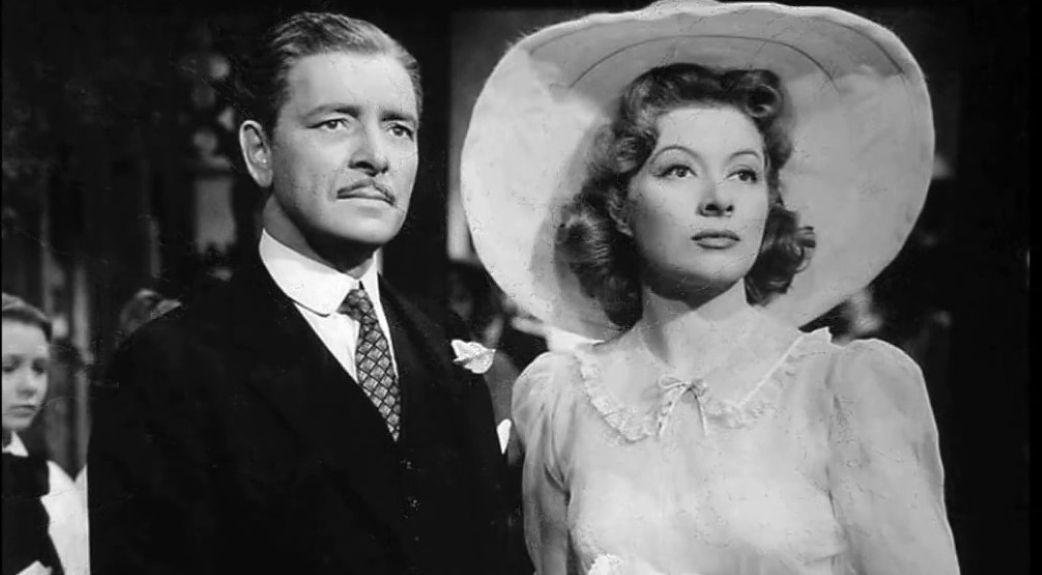
It’s the final days of World War One, and amnesic soldier “John Smith” (Ronald Colman) can’t remember anything about his life. On the final day of the war, he sneaks out of the asylum and runs into music hall performer Paula (Greer Garson). She takes a shine to “Smithy” and decides to save him. They run away to the country, fall in love, get married, have a baby, he starts to write, goes to Liverpool to start a journalism career… and gets hit by a cab. The collision restores his original memory – but also causes him to forget everything about Paula and his life as Smithy. Instead, he restarts his original life as industrial heir Charles Rainier, presumed dead by his family. While he lives this life for years, Paula takes a job as his secretary “Margaret”. Will he remember who she is?

It says a lot that that summary only scratches the surface of a plot that throws in the kitchen sink in attempting to ring as many tear-soaked tissues out of you as possible. Smithy and Paula carry out their little memory dance over the course of over twenty years. It’s the sort of a film where millionaire Charles only thinks about investigating what might have happened to him in Liverpool when nudged to do so after over a decade. Where the couple enter a ‘marriage of convenience’ as the memory-free Charles and fake Margaret. Where Charles’ owns a major factory in the town where our lovers first met, but neither (a) stepped foot there in 15 years (since the moment he does his memory starts to return) and (b) the heir to the town’s major employer wasn’t recognised by anyone while living in an asylum five minutes walk down the road.

Take it on the merits of logic and conventional narrative and Random Harvest crashes and burns. But this isn’t a film about those things. This is a classic weepie that stole the hearts of a war-torn nation in 1942 (it was the biggest hit of the year). Powered by two committed and emotional performances, if it hits you in the right mood its probably irresistible. The sort of long-term adversity that makes Romeo and Juliet’s look like a casual dalliance (so full of tragedy, the death of their son is literally a throwaway moment). It’s framed with a great, sensual beauty by Mervyn LeRoy and powered by an emotionally throbbing score by Herbert Stothart that’s just the right side of sickly.

Ronald Colman’s performance is quiet, measured and vulnerable (especially in his “Smithy” performance). From the start, he has eyes of hesitant, unknown sorrow and stumbles into a relationship with Paula like a new-born discovering life. Threads of his gentleness and excitability work their way into his Charles persona, tinged this time with the natural confidence of wealth. Nevertheless, Colman makes Charles a man who has dealt with unnerving amnesia by actively not thinking about it, carrying on a watch-chain the key to his “Smithy” home as a subconscious reminder. It’s a fine performance – so much so you can overlook he’s twenty-five years too old (the restored Charles forgoes returning to university, something that looks long gone for Colman).

Just as fine is Greer Garson, fully embracing an emotional roller-coaster as Paula. Introduced as a good-natured music hall singer (and Garson sings a high-kicking She’s Ma Daisy number in possibly the shortest skirt the Hays Code ever allowed), Garson’s warm and playful Paula is drawn towards “Smithy” in ways she almost can’t understand. But it’s a wonderfully different side for an actress so often associated with self-sacrificing wives and mothers: Paula is vivacious, forward and seizes the things she wants from life. It’s the second half – the patient, yearning desperation of “Margaret” hoping her husband will remember her – that leans more into her Mrs Miniver wheelhouse, but Garson mixes this with a real lingering, desperate sadness tinged with just enough hope that her husband might just recognise her.

Both performers overwhelmingly lift this otherwise (frankly) slightly contrived film into something rather sweet and endearing. It is, however, a film that would be even more so if it was shorter: the general morass of missed opportunities, misunderstandings and wrong ends of sticks being grasped would be easier to sustain over 90 than 120 minutes. It’s a rare film that covers so much ground over so much time that it’s lead character is declared dead twice.

The second declaration is Paula gaining that status for “Smithy”, dissolving their marriage and removing (you suspect for Hay’s Code reasons) the risk that Charles might accidentally commit bigamy by marrying his young niece. This is a lovely performance of youthful idealism and earnest devotion from Susan Peters (a tragic accident shortly after curtailed her promising career), and if the whole years-long subplot of the possibility of Charles marrying his besotted niece is a narrative cul-de-sac the overall film would be better without, it does at least mean we get the pleasure of Peters, performance captured forever.

But Random Harvest remains a pure romance: where no less than two women spend decades of their life in selfless, one-sided devotion for the lead and he still comes across as the sort of saintly man cheered by his own factory workers for sorting out a strike. The whole confection is a very fragile thing, but LeRoy carries this fully-loaded glass ornament with pure skill and the performances of Colman and Garson set the bar for classic Hollywood tragic romance. Minghella and Pollack were right – our cynical age can’t believe the nonsense – but on its own terms it still works.

Lost Horizon (1937)

Lost Horizon (1937)

Capra’s well-made Utopian dream lacks any of self-awareness of the flaws in its vision

Director: Frank Capra

Cast: Ronald Colman (Robert Conway), Jane Wyatt (Sondra), Edward Everett Horton (Alexander Lovett), John Howard (George Conway), Thomas Mitchell (Henry Barnard), Margo (Maria), Isabel Jewell (Gloria Stone), HB Warner (Chang), Sam Jaffe (High Lama)

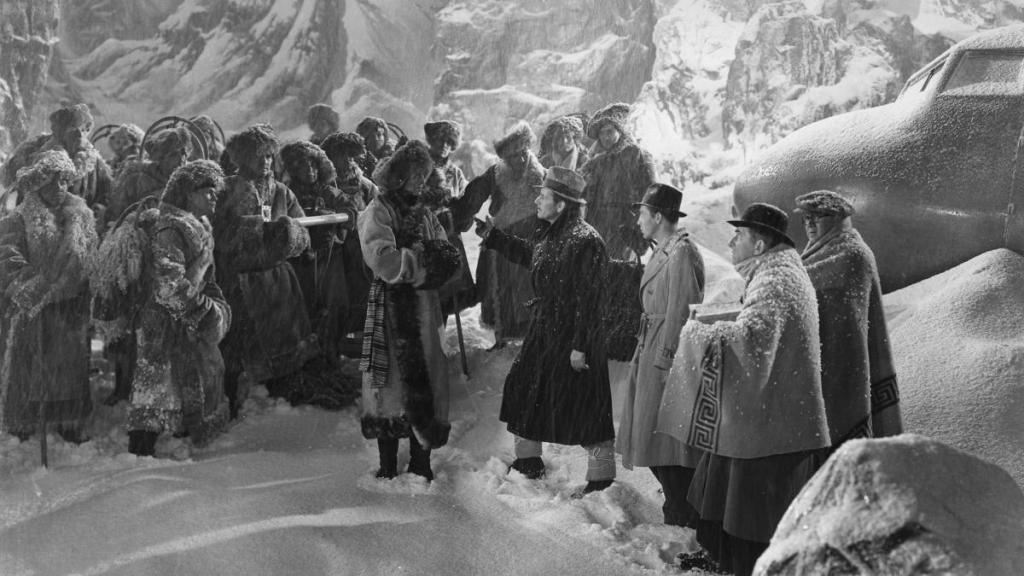
Life can be such a never-ending rat race, the idea of chucking in that relentless pursuit of fortune and glory can be really tempting. Fortunately, it turns out there is a place you can do that: Shangri-La, a halcyon Utopian community buried deep in the Himalayas. There the mountains give it a gloriously perfect climate and preserves its residents youth for potentially hundreds of years. It’s a paradise for legendary diplomat Robert Conway (Ronald Colman), one of a group of Westerners whose plane crashes near-by, all of them invited to make their lives there.

It’s easy to see why this appealed to Frank Capra – even if his real idea of Shangri-La was Small Town America – and he poured years (and millions of dollars) into this dream project (it also took years to make back the investment). Conway is part of a group of mostly British Westerners escaping revolution in China. In Shangri-La, he’s deeply drawn to the peaceful ideology outlined by their host Chang (HB Warner) and Shangri-La’s spiritual leader, the Great Lama (Sam Jaffe). Not to mention the charms of resident Sondra (Jane Wyatt). Problem is, his brother George (John Howard) is desperate to return home. What will Robert choose?

Lost Horizon has a lot to admire about it, in among the incredibly earnest force of its telling, devoid of any drop of cynicism or irony. This is like a 101 of what to expect from Capra? It’s a celebration of the glories of living a simple, pure life without ruthless ambition and realpolitik. It’s filmed on a highly impressive scale by Capra – the gargantuan sets certainly show where the money went. Striking sequences, like a seemingly never-ending torch-lit parade of the people of Shangri-La marching towards Chang’s opulent estate, are breathtaking.

It hosts a fine parade of actors: Colman is perfect as the debonair, world-weary Conway, Horton and Mitchell make their supporting comic double-act genuinely funny (Horton, in particular, litters the film with wonderful bits of comic business using everything from mirrors to jewellery boxes), HB Warner makes a series of infodump ideological sermons more engaging than they deserve and Isabel Jewell creates a great deal of charm in the blousy Gloria. Interestingly, perhaps the most compelling sequence of Lost Horizon occurs before they even arrive, as these characters feud and panic on a hijacked plane taking them in totally the wrong direction.

But there is often something a little too pure about Lost Horizon. Even as the film-making beautifully unspools, it’s hard not to notice that for a huge chunk of this long film very little really happens beyond slightly sanctimonious speechifying comparing ‘our’ civilisation with the peaceful life of Shangri-La. In fact, it’s easy (particularly in our more cynical age) to start feeling a bit twitchy. So earnestly perfect is everything there, with a simplistic and unchallenging view of kindness and brotherly love, it starts to feel like being continually slapped by a SparkNotes copy of Thomas More. Capra uses John Howard’s blowhard George, to put a counter-view – but fills him with such ambition and desire that we are of course never in danger of taking him seriously.

Graham Greene wrote of the film “nothing reveals men’s characters more than their Utopias” before observing the design of Shangri-La resembled nothing more or less than a luxurious Beverly Hills Estate. Rarely has a truer word been spoken: this mountainous paradise, with its carefully designed gardens, well-stocked libraries, grand ballrooms and lush woodland perfect for riding feels like a slice of affluent middle-class Western civilisation in the middle Tibet. It makes for an interesting window into the film today.

Because it’s hard not to see Shangri-La as less of a land of beautiful contentment, and more as a sort of colonialist wet dream. Scratch the surface and it’s a very hierarchical community. Literally at the top of the hill, living in upper-class harmony surrounded by art, books, comfy armchairs and fine dining are the elite (all bar one of them Westerners). At the bottom, in their huts, live the Tibetan natives happily continuing their traditional way of life, happy to live and work (unlike the Chinese revolutionaries who Conway and co flee in the film’s opening) in the shadow of their betters. A smarter film than Lost Horizon might have pointed out the irony that Shangi-La is just a colony where the natives haven’t yet embraced political self-determination – but I’m not sure if such an idea occurred to Capra.

As soon as this crossed my mind, I couldn’t help picking holes in the calamitous internal logic of the film. Shangri-La’s only contact with the outside world is via a group of Tibetan sherpas who trek up and down the mountain once a month bringing supplies from the outside world – presumably its them who have trooped up thousands of books (including the complete works of Robert Conway!), hundreds of mediocre paintings and roomfuls of rococo furniture. The kindly inhabitants of Shangi-La’s palace never considered overseeing the construction of basic plumbing and power generation for the natives living in the valley below them (though they somehow recruited contractors to supply those things to their house on the hill).

In fact, the whole of Shangri-La’s world is set up on maintaining a strict two-tier system that keeps people content by making sure they never think for themselves. (What passes for education, is a series of patronising missionary-style sing-alongs). Even more chilling, the Grand Lama (a softly spoken Sam Jaffe, under mountains of make-up) has dreams of Shangri-La rebuilding global civilisation after its inevitable destruction, the whole world adopting his simplistic ideology. He means well, but I couldn’t help be reminded of Dr Strangelove orgasmically rising from his chair at the thought of creating a fascist Utopia of sexual bliss under an Earth poisoned by nuclear radiation.

None of these ideas enter into Lost Horizon’s simplistic world-view. It sticks with saying what the world needs is to be crafted into a sort of country estate, a sort of Tibetan Downton Abbey, with everyone happy with their assigned place in the chain. Lost Horizon gets as close as it can to any form of social criticism when Conway bemoans 90 ‘whites’ were saved from that opening Chinese revolution while thousands of natives were left to die. But aside from that, is exactly what it says on the tin: there are no flaws in Shangi-La.

And maybe I’m being impossibly cynical. Lost Horizon is a lovely film to bathe in for a while – after all Capra, at his peak, couldn’t make a clanger if he tried. But there is a more complex story on the edges here. If Lost Horizon had showed us more of Conway’s Gulliver-Like return to civilisation, lost in a series of spinning newspaper headlines, it could have given us more of that. But Capra is no Thomas More or Jonathan Swift. The satirical and suppressive elements under a hierarchical Utopia are alien to his mindset. Lost Horizon is a reassuring promise founded on shaky ground indeed.

The Talk of the Town (1942)

The Talk of the Town (1942)

Overlooked but delightful comedy with three star actors at the absolutely charming top of their game

Director: George Cukor

Cast: Cary Grant (Leopold Dilg), Jean Arthur (Nora Shelley), Ronald Colman (Professor Michael Lightcap), Edgar Buchanan (Sam Yates), Glenda Farrell (Regina Bush), Charles Dingle (Andrew Holmes), Clyde Fillmore (Senator Boyd), Emma Dunn (Mrs Shelley), Rex Ingram (Tilney), Leonid Kinskey (Jan Pulaski)

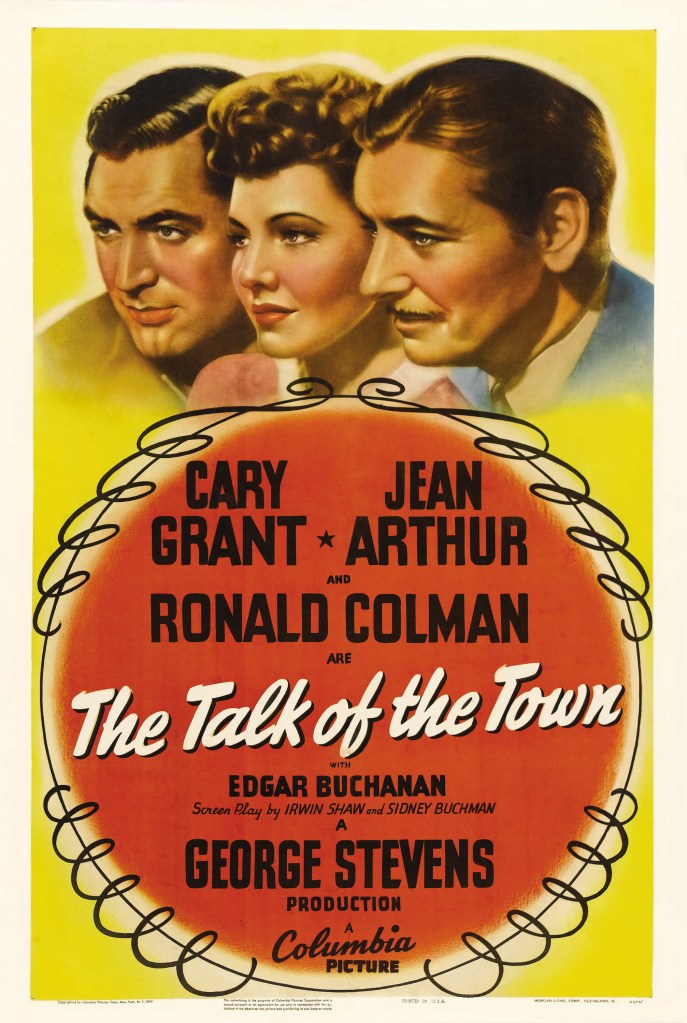
Leopold Dilg (Cary Grant) is in a heck of a fix. A passionate campaigner for worker rights, all fingers point straight at him when a local factory burns down leaving an unpopular foreman dead. Dilg rather than wait in the slammer for an inevitably (fatal) sentence, he escapes and find refuge in the country cottage of former schoolmate Nora Shelley (Jean Arthur). Problem is Nora has sublet her cottage to straight-as-a-die legal professor Michael Lightbody (Ronald Colman), in the running for the Supreme Court. With Dilg passing himself off as a gardener, can he and Nora convince the ultra-serious Lightbody there has been a miscarriage of justice?

The Talk of the Town is a hugely enjoyable comedy with more than a pinch of social commentary, that gives three charismatic stars tailor-made roles under the assured hand of a skilled director. It’s a great mix of genres: it opens like a dark thriller, segues into an odd-couple-house-share comedy via a romantic-love-triangle, transforms again into a slightly zany detecting comedy with road-trip vibes and wraps up as courtroom drama with a Capraesque speech and happy ending. The fact all this hangs masterfully together makes The Talk of the Town stand out as a consistently surprising and enjoyable comedy, full of zip and smart, funny lines.

Stevens choreographs the film superbly, specifically in its initial set-up where the three lead characters weave in and out of each other’s lives in the house. Initially Grant hides in the attic – signalling from a window his desire for food (an excellent running gag is the amount Grant’s character enthusiastically eats), with Arthur going to acrobatic lengths to hide his presence from Colman. You can imagine other films getting an entire hour out of this: The Talk of the Town is brave enough to shake-up this set-up within twenty minutes, as Grant nonchalantly wanders downstairs to introduce himself, quick thinkingly introduced as a gardener by an as-surprised-as-us Arthur.

It’s a surprise, but a perfect one – after all it would be hard easy to consider Colman’s character a head-in-the-clouds dullard if he had been fooled for long by Arthur’s increasingly unusual behaviour. And The Talk of the Town needs us to like and respect all three of these characters, to root for all of them. What better way, but to get them rooting for each other?

The odd houseshare comedy that takes over Talk of the Town is all about its principles effectively falling in love with each other (there is a thruple version of Talk of the Town waiting to be made). Grant learns to respect Colman’s self-effacing, shy wit. Colman learns to enjoy Grant’s instinctive intelligence. Both of them find deeper feelings growing for Arthur’s feisty Nora, just as she finds herself drawn to the charm, good nature and honesty of the other two. Talk of the Town becomes delightful as we watch the three of them eat meals together, play chess and chat about the law late into the night. Few films have shown as skilfully friendships organically growing.

The tension that takes over is whether outside forces will tear this friendship apart. Namely, if Colman finds out Grant’s identity will he swop from buying Borscht for his friend (sweetly, Colman remembers a throwaway comment about exactly how much he likes it) to being duty bound to shopping him to the cops? Grant and Arthur are aware of the danger: they’ve been drop-feeding references to the unsound accusations against Grant throughout, all while desperately making sure he never sees Grant’s mugshot photo in the papers (right up to pouring eggs over the front page) – the way Colman eventually finds this out is a beautifully done reveal.

All of this entirely relies on three actors at the top of their game. Grant seems, at first, an odd choice for a worker’s rights campaigner, but this is one of his lightest, most overlooked performances: wry, knowing and playful. Arthur is excellent as the electric centre of this love triangle, energetically torn between two very different men and terrifically determined under the occasionally scatty surface. Colman is dapper, upper-class charm to a T, but full of egalitarian charm and surprisingly willing to begin to question his own views in conversation with others.

Colman’s initial rigidity is represented – in a plot point that’s slightly on-the-nose (literally) – by his goatee, which he wears as a metaphorical shield between him and the world (it’s also another neat running gag, as it garners endless unflattering comments). When Colman inevitably shaves it off (a moment so overplayed, his trusted valet breaks down in tears at the sight) it’s a sign that he has accepted there is more to the law than just its letter. It plays into the film’s final shift, as Colman fills the final act with a passionate speech to silence a crowded courtroom ready for a judicial lynching (hilariously littered with direct quotes from his Grant’s character).

Much to my surprise, the social commentary and democratic praise never outweighs the comedy. The film gives space to earnest debate, but still has time for a madcap chase that ends with Colman hiding up a tree from police dogs. Stevens successfully mixes styles, from Fritz Lang thriller to Preston Sturges comedy to a mix of Hitchcock and Capra. Stevens fuses all these together perfectly, making a film funny, exciting when it needs to be, but always engaging with characters you really root for.

The Talk of the Town is overlooked but a very well-made treat and an exceptional showcase to three charismatic, hugely engaging actors. It marries comedy and social commentary extremely well (it even has a Black character in Rex Ingram’s wise valet whose race is incidental to his personality, quite a thing in the 40s) and bowls along with a huge sense of fun. It’s definitely worth seeking out.