
Tag: Sam Shepard

The Right Stuff (1983)

The Right Stuff (1983)

Patriotic heroism subtly retold as shrewd satire – no wonder the film bombed

Director: Philip Kaufman

Cast: Sam Shepard (Chuck Yeager), Scott Glenn (Alan Shepard), Ed Harris (John Glenn), Dennis Quaid (Gordon Cooper), Fred Ward (Gus Grissom), Barbara Hershey (Glennis Yeager), Kim Stanley (Pancho Barnes), Veronica Cartwright (Betty Grissom), Scott Paulin (Deke Slayton), Charles Frank (Scott Carpenter), Lance Henriksen (Wally Schirra), Donald Moffat (Lyndon B Johnson), Levon Helm (Jack Ridley), Mary Jo Deschanel (Annie Glenn), Scott Wilson (Scott Crossfield), Kathy Baker (Louise Shepard), David Clennon (Liaison man), Jeff Goldblum (Recruiter), Harry Shearer (Recruiter)
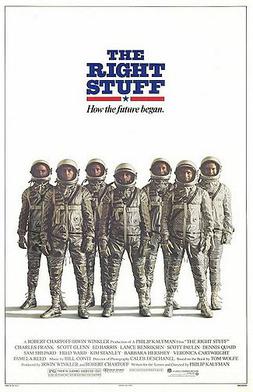
During the Cold War, the US and Russia had to fight with something – from proxy wars to chess, but most famously with Space: the competition to go further, faster and higher among the stars. The Right Stuff focuses on the Mercury Seven pilots at the centre of the US response to Soviet success including Alan Shepard (Scott Glenn), John Glenn (Ed Harris), Gus Grissom (Fred Ward) and Gordon Cooper (Dennis Quaid), a mix of the cocksure and the confident. But in a space programme where a monkey is an acceptable “pilot” for this human cannonball, do any of them have “the right stuff”? Could any of them match the skill of legendary test pilot Chuck Yeager (Sam Shepard) – one of the guys who scorned this astronaut programme for being “spam in a can”?

The Right Stuff, adapted from Tom Wolfe’s book, seemed destined to become a patriotic smash-hit. Despite its eight Oscar nominations (and four wins) it was, in fact, a catastrophic bomb. Perhaps that was because it subverted its patriotism so well. The Right Stuff is, in fact, a subtle, anti-heroic satire (told at huge length) masquerading as a patriotic yarn. It’s marketing avoided that meaning those most likely to enjoy didn’t go and see it, and those who went for that felt alienated. While largely respecting the astronauts, it suggests space race triumphalism was a sort of mass hysteria, with limited results, inflated into something mythic by political expediency, media spin and industrial might. Not the happy, flag-waving message Reaganite America expected or wanted.

Kaufman’s sympathy instead lies with an older, “truer” America. The Right Stuff is an intensely nostalgic film: but for a completely different time. It is in love with Frontier America, where men-were-men and the daring proved themselves in taming the frontier, in this case the sky itself. Our tamer is Chuck Yeager, played with a monosyllabic Gary-Cooper-charisma by Sam Shepard. Yeager is the last of the cowboys (even introduced riding a horse in the desert), taking to the skies like an old frontiersman hunting down that “demon” who lives at the sound barrier.

This is the sort of America The Right Stuff celebrates, and Yeager is the guy who has it. Unlike the Mercury programme, Yeager isn’t interested in showbiz and self-promotion (his reward for breaking the sound barrier? A free steak and a press embargo), just the quiet satisfaction of having done it. It’s the old, unflappable, quietly masculine confidence of a certain kind of American tradition and it’s totally out of step with the world the media is now celebrating with the astronauts. Instead, these effective passengers in the rocket will be hailed as the great pilots.

Kaufman’s film is a long, carefully disguised, quiet ridicule of many of the aspects of the Mercury programme. It’s conceived, in a darkened room, by a group of politicians so clumsy they can’t even work a projector. It’s head, Lyndon B Johnson (Donald Moffat on panto form) is a ludicrous figure, at one point reduced to an impotent tantrum in a car when he doesn’t get his way. The NASA recruiters are a comedy double act – Goldblum and Shearer sparking wonderfully off each other – who first suggest (in all seriousness) circus acrobats as pilots and then fail to identify Yuri Gargarin. The programme begins with a series of failed launches that travel tiny distances before exploding, culminating in one attempt ending with an impotent pop of the cap at the top of the rocket.

NASA is slightly ramshackle and clueless throughout. Far from the best and brightest, Kaufman is keen for us to remember that many of the scientists fought for the Germans in the war, that decisions were often made entirely based on what the Russians have just done, that the astronaut recruitment tests are a parade of bizarre physical tests because no one has a clue what to test for, and that the final seven selected aren’t even the best just the ones who persevered through the tests and (crucially) were small enough to fit in the capsule. That doesn’t stop the media – played by a San Francisco physical comedy troop – from turning them overnight from jobbing pilots to superstars.

The astronauts status is frequently punctured. Scott Glenn’s granite-faced Shepard is strapped into the cockpit for hours on his first flight, until finally he begs to pee (followed by a montage of coffee being slurped, hose pipes blasting and taps dripping) before being instructed to release his bladder into his suit, meaning he heads into space sitting in a puddle of his own piss. Dennis Quaid’s cocksure Cooper has an over-inflated idea of his skills and is prone to dumb, blow-hard statements (arriving at Yeager’s Air Force base he non-ironically states he’ll soon have his picture up on the deceased pilot’s memorial wall). Fred Ward’s Gus Grissom is a slightly sleazy chancer – controversially The Right Stuff presents him as panicking on re-entry from his first mission, blowing his hatch and sinking his ship, something he categorically denied (and was later proved not to have done).

Even John Glenn, played with a sincerity and decency by Ed Harris (if this had been a hit, Harris’ career of playing hard-heard would have been totally different), is subtly lampooned. So straight-laced he literally can’t swear (his attempt to say ‘fuck’ never gets past a strained Ffff), he’s introduced via a ludicrous TV quiz show and his square-jawed morals frequently tip into puritan self-importance. Undergoing physical tests, Kaufman even cuts from his grimacing face to a grinning chimp on the same test (and who will beat him into space). Compared to Yeager, who can correct a plane on a desperate nose dive and beat the skies into submission (and has the only outright heroic refrain in Bill Conti’s Oscar-winning score), none of them have that right stuff.

Do they get it? In a way: but their triumph is establishing their character, not their skills. Kaufman uses Yeager to point us towards this (his seal of approval is vital for the film): after Grissom’s debacle, he defends him in the bar and praises their courage in essentially sitting on top of a massive bomb.
Tellingly, the astronauts’ most courageous moment in the film isn’t in the cockpit at all: it’s Glenn supporting his stammering wife’s refusal to go on air with LBJ, despite the pressure from NASA bigwigs – and the other astronauts uniting in fury when Glenn is threatened with being dumped from the next flight. The others become more noble through maturing and casting aside fame’s temptations.
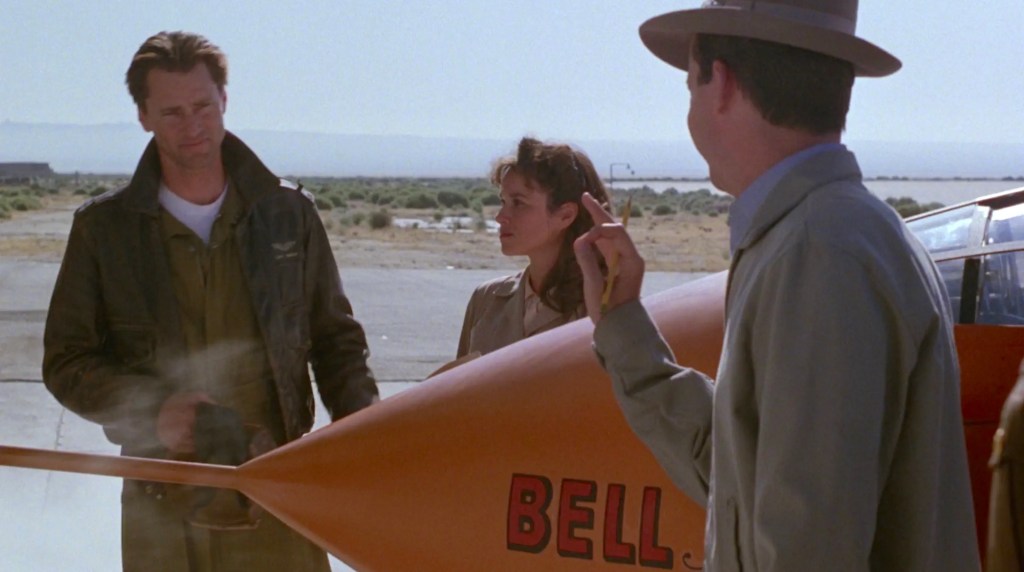
In a way they prove their spurs, even if Kaufman’s film makes clear none of them can match Yeager’s traditional values. The film ends with Yeager, maverick to the last, undertaking an unauthorised test flight in a desperate attempt to keep funding for his jet programme going. Even with this final flight – dressed in a bastardised version of a space suit – Yeager shows he’s not lost it, a man so undeniably superhuman in his American resilience that even a bit of fire won’t slow him down.

The Right Stuff celebrates Yeager, but he’s the B-story – and the film frames him as a forgotten figure, left behind by a world obsessed with the bright and shiny. The Right Stuff has to centre the astronauts but it doesn’t focus on the missions (which, apart from Glenn’s, barely receive any screen time – certainly not compared to the time given to Yeager’s flights) or the glory, only quietly implies there was a slight air of pointlessness about the whole thing – that the space race was perhaps just a dick-waggling competition between superpowers. It makes for interesting – if overlong – viewing, but as punch-the-air entertainment, no sir. No wonder it bombed.

Black Hawk Down (2001)

Black Hawk Down (2001)

Ridley Scott’s immersive combat film is politically simple but one of the great combat films

Director: Ridley Scott

Cast: Josh Hartnett (SSG Matt Eversmann), Ewan McGregor (SPC John Grimes), Eric Bana (SFC Norm ‘Hoot’ Gibson), Tom Sizemore (LTC Danny McKnight), Sam Shepard (General William F Garrison), Ron Eldard (CWO4 Michael Durant), William Fichtner (SFC Jeff Sanderson), Jeremy Piven (SW4 Clifton Wolcott), Ewen Bremner (SPC Shawn Nelson), Gabriel Casseus (SPC Mike Kurth), Hugh Dancy (SFC KURT Schmid), Jason Isaacs (CPT Mike Steele), Tom Hardy (SPC Lance Twombly), Orlando Bloom (PFC Todd Blackburn), Nikolaj Coster-Waldau (MSG Gary Gordon), Johnny Strong (SFC Randy Shughart)

On 4 October 1993, the US won a pyrrhic victory supporting UN efforts to prevent genocide in the Somalian Civil War. A mission in Mogadishu to capture the lieutenants of rebel leader Mohamed Farrah Aidid collapsed into a desperate overnight street battle as Aidid’s forces rose up en masse (up to 4,000 of them) in an attempt to cut off and wipe out the c. 160 US troops.

Although the majority escaped, it was one of the most costly American operations since Vietnam, with the loss of 18 dead and 73 wounded and two Black Hawk helicopters shot down. As many as 2,000 Somalians were also killed. Pictures of the bodies of American soldiers dragged through the streets by Somalian rebels led to a major realignment of US foreign policy, with a reluctance to join future peace keeping operations (most notably the Rwandan genocide).

This is bought to the screen in a virtuoso directorial achievement by Ridley Scott, one of the most immersive and gripping war films ever made. Black Hawk Down doesn’t shirk on an inch of the war experience. Combat is loud, sudden, all-consuming and a barrage on the senses. It’s scary, confusing and always unforgiving. Mud, blood and dirt are flung into a camera that runs through streets alongside the soldiers, embedded with them under siege. The slightest lack of focus or mistake is punished by horrific injury or death. The battle is a nightmare of confusion and desperate improvisation in which neither side (especially the Americans) really knows what’s going on.

It’s not surprising they don’t. The film expertly demonstrates how a multi-approach plan (helicopters delivering ground forces, an armed convoy to collect prisoners) was effectively a rashly planned house of cards, which collapsed when the hornet’s nest of an uncontrolled city, crammed with thousands of potential hostiles, roadblocks and a prepared and dedicated enemy (willing to suffer a level of loss the Americans were not) was unleashed. Ground forces are stranded, helicopters shot down, the exposed convoy becomes a slow-moving hospital, all under constant fire in a dusty, urban centre where every single civilian could be a enemy combatant.

Scott shoots and edits this with pulse-pounding intensity, aided by the dizzying camera work of Sławomir Idziak and the high-octane cutting of Pietro Scalia, whose work grips you by the throat and never lets go. It’s a “grunt’s-eye” view of the war, that puts the viewer very much in the trenches with the soldiers. We pretty much join them running through gauntlets of bullets, ducking into foxholes and desperately trying to stay alive. Scott’s work is outstanding here, a brilliant depiction of the chaos of battle in which events are both intimidatingly out of control but also crystal clear to the audience, assembled with a never-lets-up energy leaving the viewer tense and breathless.

As Eric Bana’s fiercely professional Hoot says “it’s about the man next to you”. That’s very much what Black Hawk Down is about. There’s very little context about the American operation in Somalia, the Somalian people, the impact on long-term American politics…  The film believes the whys and wherefores are less important than protecting the lives of your colleagues.

Argument has raged about whether Black Hawk Down is pro-war or not. I’m not convinced it is. Can a film which shows soldiers maimed, disfigured and literally torn in two, really be a celebration of war? But, what it clearly is, is pro-the American fighting man. The training and expertise of these soldiers – trained to make every shot count and keep their cool in terrifying situations – is crucial to their survival. (The scattergun indiscipline of the Somalian rebels is noticeable by comparison – and it’s fair to note that Black Hawk Down gives very little focus to the Somalians at all, other than as a faceless hostile mass).

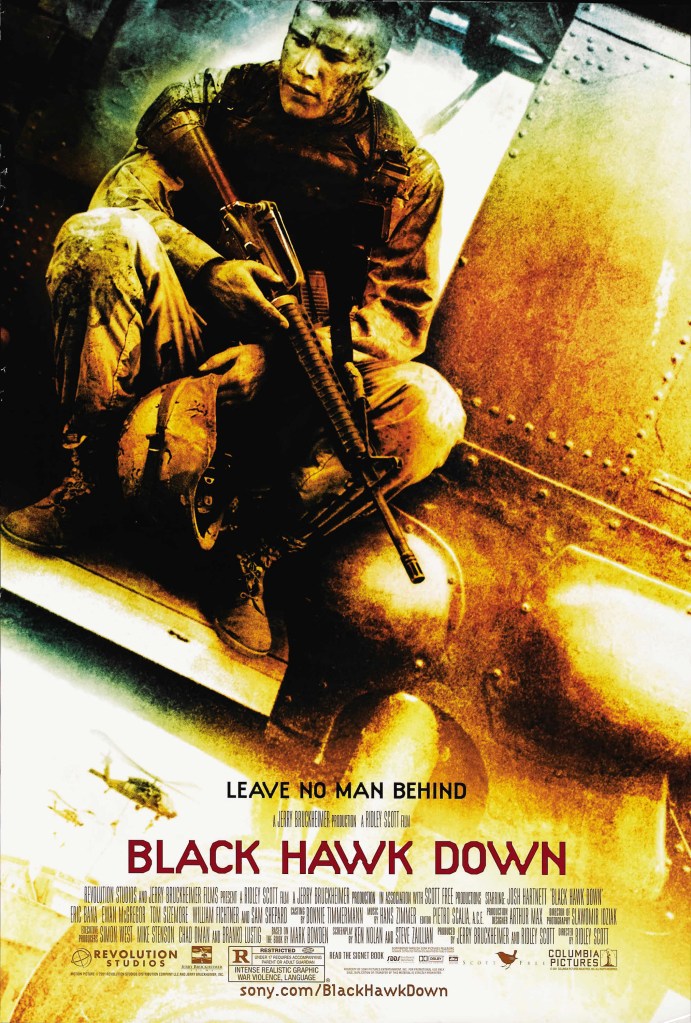
The film is in awe of the soldiers’ willingness to sacrifice themselves for each other: the dramatization of Gary Gordon and Randy Shughart’s request to be dropped in to provide some sort of cover to one of the downed Black Hawk pilots (a request they know is a suicide mission) exemplifies “leave no man behind” bravery. Black Hawk Down is a tribute to soldiers.

Interestingly though, that also means it’s a film where characters are more important for what they do rather than who they are. We learn very little personal information about any of them. Hartnett’s newly-promoted SSG has sympathy for the Somali people and is nervous about his first command mission. McGregor’s admin officer is unsettled by his first field operation. Sizemore and Isaacs are professional officers, executing orders to the best of their ability; Fichtner and Bana experienced Rangers, samurai trained to adapt and improvise. But their personalities are only hooks to hang their deeds on. Each melts into the large cast as needed. Black Hawk Down is the triumph of the unit – be that fighting together or some member volunteering to die to help protect others.

It is fair to argue the film should have done more to contextualise events. Black Hawk Down focuses so much on celebrating the bravery of soldiers, it skips any political impact: it’s not made clear in the end captions that the US effectively withdrew from its peace-keeping responsibilities for years afterwards (only shocked back into it by 9/11). It never mentions the UN were slow to respond as they had been caught in an almost identical disaster a few weeks before (a lesson the US didn’t bother to learn from). It never mentions the cost of non-intervention in places like Rwanda. It never explores how these events – and American complacency, not least in the committed-but-unengaged soldiers – were a step toward a terrorist world that would culminate in 9/11.

Scott was aiming to make an immersive film. Perhaps his work on films like Body of Lies (and even Kingdom of Heaven) later was about adding more shading and depth to his presentation of world affairs (and critique of American policy). But, in its intent, Black Hawk Down is a triumph, one of the most unrelenting and compelling combat films ever made. You can argue it turns the Somalis into bogey men fighters – but it’s trying (rightly or wrongly) to be a representation of a single military action, from a single side’s perspective. And there is no doubt this is one of Scott’s finest achievements – and one of the great war films.

Midnight Special (2016)

Michael Shannon is the loyal dad in Midnight Special

Director: Jeff Nichols

Cast: Michael Shannon (Roy Tomlin), Joel Edgerton (Lucas), Kirsten Dunst (Sarah Tomlin), Adam Driver (Paul Sevier), Jaeden Lieberher (Alton), Sam Shepard (Pastor Calvin Meyer), Bill Camp (Doak), Scott Haze (Levi), Paul Sparks (Agent Miller)

At some point around its original release, someone attached the label “Spielberg-esque” to Midnight Special. I suppose this may be due to its father-son central relationship and its rough similarities to Close Encounters. But it’s a label that does the film no favours. JJ Abrahms would create a Spielberg-esque film, but Jeff Nichols? Pull the other one. Instead Jeff Nichols creates a sci-fi film that wilfully avoids explanations and turns its back as often as it can on any sentimentalism. It’s more like James Cameron crossed with existential philosophy. It certainly won’t be offering up easy entertainment.

Roy Tomlin (Michael Shannon) is on the run from the law with his son Alton (Jaeden Lieberher), helped only by his friend Lucas (Joel Edgerton). Alton has mysterious powers – glowing eyes, elements of telekinesis and the ability to intercept electrical signals – that have made him a target for everyone from the government to a cult that has kept him under lock and key for years, believing he holds the key to surviving the inevitable apocalypse. Alton has an aversion to sunlight which means our heroes can only travel at night, heading towards a secret location, trying to stay one step ahead of the dangerous figures following them.

Nichols film is almost too elliptical for its own good. But then I think this is partly Nicholls point. He’s looking to subvert a few expectations here. To create a sci-fi, other-world chase movie that’s wrapped itself up in enigmas. Sadly, I think to have enigmas like this become truly engaging, you need to form a connection with the film itself – and Midnight Special fails too much here.

It keeps its cards extremely close to its chest – it only begins to dive into any sort of explanation about what’s going on over halfway into the film, and even then this is kept vague and undefined. There is virtually no exploration given of most of the characters of their backstory, bar a few key points. It’s a chase movie which frequently slows down to a crawl. It’s a science fiction film that’s largely confined to the ‘real’ world. It’s a father-and-son on the run film, which separates these two characters for a large chunk of its runtime. All this makes it very difficult to form an emotional attachment with, in the way you do with, say, Close Encounters or The Terminator (both of which leave traces in this film’s DNA).

Not that I think Nicholls will mind, as this is an attempt to do something different, more of an existential musing on humanity. Its unfortunate that this was exploration of personal regrets and tragedies against a backdrop of earth-shattering sci-fi revelations was done more absorbingly in Arrivalamong others. Compared to that, Nicholls film seems almost a little too pleased with its deep (and in the end slightly empty) mysteries and its opaque characters, many of them defined more by actions and plot functions rather than personality traits.

There’s strong work from Shannon as a father desperate to do the right thing and Lieberher as young boy who becomes calmer and more in control as the film progresses. But we never quite learn enough – or understand enough – about either of them to really invest in their fates.

And without that investment, its hard to worry in the same way about what might happen to them – or to really care about the revelations they are seeking to discover by the films conclusion. The film could counterbalance this if the ideas behind it were fascinating enough. But I am not sure they are. It touches upon questions of faith, parental love, destiny and human nature – but it studies them like they were under a microscope. Ideas are there to be excavated from it, but that doesn’t always make for great story-telling. Take the cult: there are fascinating ideas about the honesty (and pervasions) of faith, contrasting this perhaps with the overwhelming faith the father has in his son’s fate. The film introduces this – and then doesn’t really give it any depth.

It’s a problem all across the film. It’s partly a meditation on human progress and enlightenment – but the film never makes a compelling case or intellectual argument about it. Again there’s some great opportunities here, not least with Adam Driver’s fine performance as a sceptic turning believer – but it even that plotline eventually gets reduced to simply allowing someone to move from A to B for plot purposes. The film – for all the skill it’s made with and the obvious talent of Nicholls – is cold and distant.

And a cold and distant film is eventually going to get that reaction from a lot of its audience. Those who can see its merits, but never engage with it – or care about it – enough to really seek it out.