Tag: Screwball comedy

His Girl Friday (1940)

His Girl Friday header
Rosalind Russell and Cary Grant bicker and spar in His Girl Friday, one of the all-time classics I’ve never quite clicked with

Director: Howard Hawks

Cast: Cary Grant (Walter Burns), Rosalind Russell (Hildy Johnson), Ralph Bellamy (Bruce Baldwin), Gene Lockhart (Sheriff Hartwell), Porter Hall (Murphy), Ernest Truex (Bensinger), Cliff Edwards (Endicott), Clarence Kolb (The Mayor), Roscoe Karns (McCue), Frank Jenks (Wilson), Regis Toomey (Sanders), Abner Biberman (Louie), Frank Orth (Duffy), John Qualen (Earl Williams), Helen Mack (Mollie Mallot)
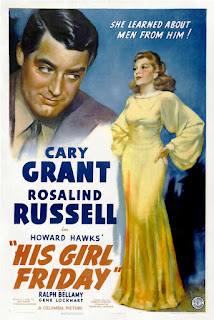
There’s always one film classic that the world and his dog love to bits, but every time you watch it you just don’t get it. That classic for me is His Girl Friday. I’m not sure many films have appeared more than this one on film buffs’ lists of Top Ten Movies of All Time, but while I admire its many, many qualities, every time I’ve watched it – and it’s at least three now – I just don’t love it. More to the point I don’t find it funny (I know, I know I can practically hear your jaws hitting the floor), neither do I engage with or root for its lead characters (please don’t hit me).  I admire a lot of things about this film and how it is made. And I chuckle from time to time when I watch it. But for some reason even I’m not sure of, I’ve got no click with this film. Compared to The Awful Truth or The Lady Eve or The Philadelphia Story (all films this bears a lot of comparison with) I just don’t feel it.

It’s an adaptation of Ben Hecht and Charles MacArthur’s play The Front Page. In quite a modern touch, one of its lead characters is gender flipped. In the play, a newspaper editor tries to persuade his star reporter not to quit the game: in His Girl Friday the star reporter not only becomes a woman but, don’t you know it, the ex-wife of the editor, about to walk out (in more ways than one) to marry her dull fiancé. Cary Grant (who else?) is the fast-talking editor Walter Burns, Rosalind Russell the fast-talking star reporter Hildy Johnson. In fact, everyone is fast-talking, in the film that holds the world record for dialogue speed. Can Burns persuade Hildy to hold off leaving with fiancée Bruce Baldwin (Ralph Bellamy – sportingly playing up to his dull reputation) for one more day so she can cover the story of strangely naïve convict Earl Williams (John Qualen)? Let the madness ensue.

Let’s focus on all the good stuff first. Not least because my general lack of connection to a film loved by all and sundry is so personal, it almost defies analysis. Hawks was, rumour has it, won round to the idea of gender-swapping Hildy by hosting a read-through of the play at a dinner party with a shortage of people, meaning Hildy was read by a woman. That opened up a host of ideas around combining this with the classic re-marriage genre and bang away we go. It is, needless to say, a brilliant idea and adds such a spark to every single interaction between the two characters that it distinctly improves the play (later productions have often carried the idea – and the dialogue – across from this film).

On top of this, Hawks wanted to make this the fastest talking comedy film ever made. And boy does he succeed at that. The dialogue of this film is delivered with such rat-a-tat speed that clock watchers report it hits a rate of over 300 words a minute (try reading that many words out in one minute to see how fast that is). It gives the film a ferocious manic energy and thunder-cracker momentum and keeps the punchlines coming fast. It also needs gifted actors, which it sure-as-hell gets here. Grant possibly hits his comedic peak here, managing to still remain suave, cool and collected, even as he’s ripping through words and shifting verbal goalposts at dazzling speed. This is also Russell’s career highlight, embodying the image of the sort of spunky, arch and no-nonsense professional woman of screwball comedy that all others (even Hepburn) are measured against.

They race through a film that makes excellent use of long-takes, intelligent single-shot camera moves and careful, intelligent editing to highlight the electric speed of the zany dialogue. In particular, Hawks makes a brilliant motif of telephones (those old candlestick phones), which characters are forever hurling instructions down, using as escape tools from awkward moments and juggling conversations with (either from multiple phones or between the phone and people in the room). They are used for short, sharp, punchy lines – and it fits a film that is all momentum and short-hand. The ultra-smart, quotable banter, littered with one-liners, is the ultimate epitome of the popular style of dialogue at the time, which favoured this style over the speeches and deeper content that was seen as more of the preserve of theatre.

Walter and Hildy in this version also become the epitome of “the screwball couple”. The divorced partners who of course still love each other, largely because they recognise that no-one else will share their insane energy and obsession. Not to mention that fighting and feuding with their intellectual equal is a million times sexier (and better foreplay) than a thousand dinners at home with someone average will ever be. Ralph Bellamy does good work here (essentially, like Grant, repeating his role from The Awful Truth) as that dull, trusting man – the only one in the film who vaguely resembles a human being and therefore, obviously, the character the audience likes the least (who goes to the cinema to see someone like themselves on the screen, eh?)

There is so much right about His Girl Friday. The actors are sublime, the dialogue delivered perfectly, Hawks’ direction is pin-point in its mix of old-Hollywood classicism, and it’s very well shot. So why don’t I like it more? It’s that most personal feeling: I just don’t find it funny enough. Maybe that’s because I need to connect with characters more – and I don’t connect with Hildy and Walter. In some ways I don’t even like them. His Girl Friday is frequently an unapologetically cruel film: Hildy and Walter treat several people like crap, largely for their own amusement or as collateral damage in their own war of foreplay. At one point a desperate, lonely woman attempts suicide (she jumps out of a damn window falling a couple of floors) – Hildy and Walter are joking about it in seconds. They are cold, self-obsessed people and for all their superficial charm, there isn’t any touch of warmth to them at all. They are very artificial people in an artificial world. In all, I don’t really like them and I find it hard to careor want them back together (other than recognising that they deserve each other).

Believe me, I understand some comedy is cruel, I don’t have a problem with that. But I don’t think His Girl Friday realises it’s that kind of film. The Awful Truth has a very similar plot – but that had its characters recognise their own faults and also gave us reasons to care for them as human beings. His Girl Friday doesn’t do either of those things, meaning I laughed a lot in The Awful Truth and not so much in His Girl Friday.

Can you still bear to read on after such blasphemy? But there you go. Everyone has that stone-cold classic that they just can’t get on board with. This film is mine. I respect so much about it, but it neither tickles my funny bone nor makes me feel welcomed. I find it a cold and cruelly minded film, that looks down on people with scorn – from Bruce to criminal Earl Williams and most especially to his distraught girlfriend Molly – and invites us to do the same. It wants us to love the popular kids in the class and join them in spitting paper balls at the losers. This doesn’t do it for me. I know everyone loves it. Hell, I know I’m probably wrong. But I just don’t love His Girl Friday.

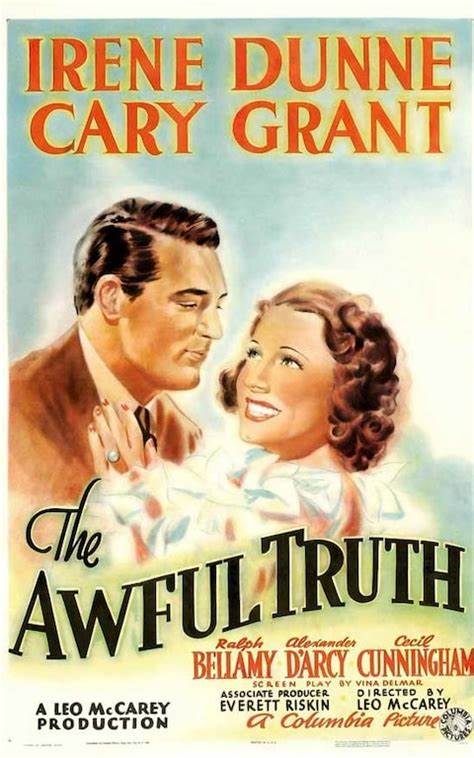
The Awful Truth (1937)

Irene Dunne and Cary Grant flex their comic muscles to outstanding effect in The Awful Truth

Director: Leo McCarey

Cast: Irene Dunne (Lucy Warriner), Cary Grant (Jerry Warriner), Ralph Bellamy (Dan Leeson), Alexander D’Arcy (Armand Duvalle), Cecil Cunningham (Aunt Patsy), Molly Lamont (Babara Vance), Esther Dale (Mrs Leeson), Joyce Compton (Dixie Belle Lee), Robert Allen (Frank Randall), Robert Warwick (Mr Vance), Mary Forbes (Mrs Vance), Skippy (Mr Smith)

Lucy (Irene Dunne) and Johnny (Cary Grant) Warriner divorce because both of them are constitutionally incapable of being faithful. But yet, they also pretty much can’t stand the idea of the other being with anyone else. Can they face The Awful Truth that they are, in fact, perfect for each other? This is a feuding husband and wife who enjoy the horrified looks on the faces of other people as much as they enjoy seeing how far they can push each other.

When winning the Oscar for Best Director for this film, Leo McCarey believed he actually deserved it for his more serious melodrama about the struggles of the elderly, Make Way for Tomorrow. While Make Way for Tomorrow might well be a more serious work, and not the souffle of The Awful Truth, I’m pretty sure far fewer people over the past 80 odd years have found revisiting it such a delight as going back into The Awful Truth. Perhaps the eponymous truth for McCarey was that we are never the best judges of our own work.

The Awful Truth is possibly the best, funniest, remarriage comedy ever made. It was pulled together almost from nothing onset. Nominally an adaptation of a play by Arthur Richman, McCarey effectively dumped almost the entire plot and instead largely improvised the film and its plot on set as he went, throwing in jokes, plot developments and bits of business depending on what worked with the actors on the day. Producer Harry Cohn would arrive on set to find McCarey plinking on a piano, swopping stories and coming up with ideas for what they would shoot that day. From this the director would decide on the structure of the scene, the jokes and most of the dialogue. No wonder Cohn was pulling his hair out.

Sounds like chaos right? The stars certainly thought so. Grant was terrified. Prior to this a reliable Studio actor, used to being given the lines and standing where he was told. Finding out here that McCarey wanted something loose and improvisational, at first he was all at sea – even offering instead to buy himself out of the film. But McCarey saw something in him: in fact what he saw was “Cary Grant”. The Awful Truth is the moment the Grant we all know came to be: sophisticated, arch and a masterfully relaxed light comedian (rumour has it, at least partly based on McCarey himself). From hating the experience, Grant suddenly realised it was inspired. The same went for his co-stars: Dunne, Bellamy and the rest all excitedly contributed their own ideas and business into what became one of the greatest comedies of all time.

The Awful Truth is frequently laugh-out loud funny, a perfect combination of witty lines delivered with pin-point perfection. Many of the best lines fall to Irene Dunne’s Lucy, from denying an affair with her latest beau (“That’s right Armand. No one could ever accuse you of being a great lover. That is, I mean to say…”), to archly responding to Jerry’s “I know how I’d feel if I was sitting her with a girl and her husband walked in” with a “I’ll bet you do”. Grant though gets plenty of his own – “The car broke down? People stopped believe that one before cars started breaking down.” – and only he could make “I only just met her” a laugh-out loud moment. Nearly every scene has a perfect bon mot, brilliantly delivered.

McCarey’s direction also adds hugely to the comic effect. The Awful Truth is so smooth, polished and assured you can overlook how skilfully and brilliantly it’s been put together to accentuate the comic effect. From cuts that reinforce or set up gags, to characters entering and leaving at the edges of frames at the perfect moment for a laugh, the entire film is a masterclass in how to shoot and frame comic business. The film is a triumph of reaction shots: watch Grant, Dunne and Bellamy respond to the appalling singing of Jerry’s new girlfriend Dixie Bell (Lucy: “I guess it was easier for her to change her name than her whole family to change theirs”). Best of all a superb sequence where we hear Jerry and Armand fight off screen (with crashes aplenty) while Lucy attempts to maintain a banal ‘nothing to see here’ conversation with Daniel and his mother.

The entire film is a triumph of comic set-pieces, with Grant and Dunne sparking off each other like two whirligigs of static electricity. Both actors are absolutely sublime. Grant manages to make everything not only funny, but also effortlessly cool and his archness and confidence are hilarious. Dunne throws herself comedy with a full-blooded commitment and a total willingness to look silly. Like Grant, she also has the ability to tip the wink to the camera and flag up just how ridiculous many of these situations are. Ralph Bellamy, on paper, has the dullest role as the straight man but as well as being winningly naïve, he also has two show-stopping moments, most strikingly his hilariously enthusiastic dancing (made even funnier by Dunne’s increasingly uncomfortable efforts to keep up with him).

It’s all wrapped up in a plot light as air, perfect for the jokes to latch themselves onto. You’ll laugh almost from the first, but you’ll also care about these two dotty eccentrics who are clearly perfect for each other. With Grant creating his entire screen persona in front of your eyes and Dunne absolutely radiantly hilarious, The Awful Truth will carry on entertaining the masses for decades to come. Hopefully McCarey doesn’t regret that Oscar decision too much.

The Lady Eve (1941)

Henry Fonda is bamboozled by Barbara Stanwyck in the delightful The Lady Eve

Director: Preston Sturges

Cast: Barbara Stanwyck (Jean Harrington), Henry Fonda (Charles Poncefort Pike), Charles Coburn (“Colonel” Harrington), Eugene Pallette (Horace Pike), William Demarest (Muggsy), Eric Blore (Sir Alfred McGlennan Keith), Melville Cooper (Gerald), Janet Beecher (Janet Pike)

In the 1940s, Preston Sturges hit a rich vein of form that led to him making some of the finest comedies in Hollywood history. Perhaps the greatest of that run of hits was the hilariously heartfelt The Lady Eve, a comedy that is as much a rich, twisted romance as it is a fast-paced screwball comedy of long cons and deception. Played to the hilt by a perfectly selected cast, Sturges’ dialogue zings in every scene, making this timeless entertainment.

Charles Poncefort Pike (Henry Fonda) is the young heir to a brewery fortune (the most famous brand being “The Ale That Won for Yale”). Naïve and shy, Charles is a passionate ophiologist (that’s snake-expert to you and me) who is just returning from a year-long expedition in the Amazon. On the cruise ship taking him back home, Charles is the target of every single woman on the boat – and also for a pair of expert con artists, Jean (Barbara Stanwyck) and her father “Colonel” Harrington (Charles Coburn). At first it’s his money they want, but Jean surprises herself by falling hard for Charles on the voyage – only to be stung when Charles coldly rejects her after learning the truth about her. So Jean decides on revenge, disguising herself as ex-pat aristocrat “Lady Eve” and proceeding to win over Charles’ upper-class New York family, and seduce Charles all over again.

Not a single opportunity for comedy is missed in Sturges fast-paced, beautifully done film. As well as some truly wonderful word-play and verbal comedy, the film is crammed with vintage sight gags (Charles’ struggles with an overly affectionate horse is a hilarious highlight) and keeps up a series of perfectly judged running gags (one of the best of which falls to William Demarest’s befuddled bruiser-turned-valet Muggsy). But the comedy works because it’s invested in characters who feel real – despite all the absurdity – and demonstrate real emotions alongside all the comic invention. It has a story that you care deeply about it, all while you are laughing your head off.

Because deep down this is a romance between two very unlikely people. Barbara Stanwyck radiates wit, intelligence and incredible sex appeal as Jean, a role that seems all surface but actually contains a huge amount of depth and shade. She may well be a sort of con-woman with a heart, but the creeping onset of love surprises (and almost confuses) her as much as it might throw off an audience. Not that that ever stops her from being (usually) two steps ahead of everyone around her, a nature that suits perfectly for her revenge act in the second half, where she aims to teach Charles a little humility. Stanwyck’s comic timing is perfect, but it’s the human heart she gives the character that works, and makes us warm to her.

It also makes a superb contrast with Henry Fonda as Charles. Riffing on his screen-image for upright purity (he’s Honest Abe for goodness sake!), Fonda creates a man who is sweet, honest, naïve – but also has an inverted sense of snobbery that comes from being convinced you are usually right. For all his innocence, Charles is surprisingly abrupt when he dismisses his romance from Jean, and his slightly priggish self-satisfaction is evident when he proudly presents his (feeble) card tricks to the card sharps he finds himself on board with. Fonda also proves himself a surprisingly deft physical comedian, a key running gag being Charles’ continual prat falls (a neat metaphor for him both figuratively and literally falling in love with Jean).

Together these two power a lightening-fast series of comic masterpiece scenes from Sturges. But the director is also confident enough to throw in other beats: a stationary single shot of Jean cradling Charles for several minutes (after a semi-pretend shock at discovering his pet snake) sizzles with sexuality. Later Stanwyck delivers Jean’s joy at finding love a heartfelt wonder, which she neatly inverts to heartbreak on her rejection. Her father, played with a delightful wryness by Charles Coburn, has no problem with fleecing people (although of course “Let us be crooked, but never common”) and delights in his ingenuity (cheating) with the cards, but he also has the humanity to warn his daughter about the sometimes unforgiving purity of decent folk.

And those decent folk are quite snobby. The second half of the film gets a gleeful energy from throwing the knowing Jean in amongst a group of upper-class rich snobs, who will believe anything that comes out of someone’s mouth with a British accent. It’s certainly been working for years for “Sir Alfred”, a conman sponger played with twinkling glee by Eric Blore. Jean’s almost deliberately ludicrous story (arrival on a submarine and a hilariously convoluted backstory) gets lapped up – and of course seduces Charles all over again. No wonder he keeps falling over.

The final act – with a deliciously funny final line that deserves to be more famous than it is – makes for a superb cap to what is a marvellously sparkling comedy. It also manages to avoid sentimentality or mawkishness – not a sudden surprise, considering it’s stuffed with people pretending to be what they are not. Sturges’ direction is sharp – even if visually he isn’t the most imaginative director in the world – but the main thing that gives this such zip is the dialogue and the acting. Stanwyck is simply sensational, Fonda just about perfect, and the whole thing is a delight. Surely one of the greatest classic Hollywood comedies of all time.

My Man Godfrey (1936)

Carole Lombard and William Powell flirt, fight and buttel in My Man Godfrey

Director: Gregory La Cava

Cast: William Powell (Godfrey), Carole Lombard (Irene Bullock), Alice Brady (Angelica Bullock), Gail Patrick (Cornelia Bullock), Jean Dixon (Molly), Eugene Pallette (Alexander Bullock), Alan Mowbray (Tommy Gray), Mischa Auer (Carlo), Pat Flaherty (Mike)

My Man Godfrey is one of the most beloved of all screwball comedies. It’s also the only film in history to be nominated in every acting category and the directing and writing categories at the Oscars and still not get nominated for Best Picture (proving comedy was devalued even then). Today it still carries a heck of a comedic wallop, splicing this in with an ever more acute and profound social commentary. It’s a gem of Golden Era Hollywood.

With New York in the midst of the Great Depression, affluent socialites the Bullock sisters – snob Cornelia (Gail Patrick) and ditzy, scatter-brained Irene (Carole Lombard) – are in hunt for a “forgotten man” so they can claim victory in their scavenger hunt. In a rubbish dump – turned home for the unemployed – they find the well-spoken Godfrey (William Powell). Godfrey is having none of the condescension of Cornelia, but finds the honesty and kindness of Irene more touching agrees to help her win the prize – whereupon he promptly admonishes the upper-class crowd at the Waldorf for their lack of concern for the working man. Ashamed, Irene offers him the job of Bullock family butler, which Godfrey accepts. But as he navigates the eccentric family, is Godfrey also hiding secrets of his own, secrets that suggest he is much more than he seems?

My Man Godfrey is a very funny film, centre-piecing the fast-paced comedic delivery of the era, the script never going more than a minute without a killer line or brilliant piece of comedic business. It’s helped as well by the casting, with every actor being perfectly selected for their roles, and each of them bringing their absolute A-game. Not least the partnership of Powell and Lombard – divorced in real life but still close – who spark off each other wonderfully and keep the will-they-won’t-they question beautifully balanced throughout the whole film. 

La Cava’s film – wonderfully directed with imagination and visual chutzpah – matches this up with an extremely neat, but not too preachy, line in social commentary. The self-obsessions and petty concerns of the Bullock family are frequently contrasted with the poverty and struggles of the working man, while the families’ lack of concern for the struggles of the vagrants and down-and-outs only a taxi ride away from their mansion home is striking. Godfrey frequently points up this lack of empathy in this ‘classless’ country (which is in fact defined by class), stressing he found more decency and kindness at the rubbish dump than he did in the palaces of the mighty. 

Sure Godfrey’s secret may well be that he is from loaded stock himself – but has given it all up in shame and self-disgust – but that only makes him all the better an observer of the whims of the rich treading on the poor. In fact My Man Godfrey could well be the film for today. The scavenger hunt dinner – a brilliantly directed, frenetic scene that looks years ahead of its time in its technical accomplishment – really captures this. The guests haw and shout over each other, clutching with an ironic glee their examples of poverty (from everyday objects to a goat to, of course. the ‘forgotten’ man, who has as much value as the goat to them). We get more of it at the posh clubs and cocktail parties the Bullock frequent, the guests (while not cruel) being as blasé and oblivious of their fortune as they are of the suffering in the rest of the city.

But that makes this sound like a civics lessons, whereas the film is first-and-foremost a comedy. It has a terrific performance from William Powell as Godfrey. Powell makes the part a mix of Jeeves and Wooster: the intelligence and calm of Jeeves with the warmth and tendency for scrapes of Wooster. Powell is brilliant at balancing the wry observer quality of Godfrey, while never sacrificing his warmer, generous soul. And also brilliantly suggests his wonderful judgement of situations and characters, without ever making him smug or a know-it-all. It’s a quite exquisite performance of unflappility covering emotional depth.

Lombard sparks off him very well as Irene, allowed to frequently head further over the top as Powell grounds Godfrey in normality (Lombard was a famously electric performer, and the outtakes reel for the film frequently show her screwing up her fast-paced dialogue with copious swear-words). Today the more ditzy Irene sometimes comes across as a more tiresome, less believable character – she is so obviously a narrative construction rather than someone who could be real that it becomes harder to connect with her (or to imagine Godfrey might find her attractive). But Lombard’s energy and drive carries the film through and the film highlights her electric qualities in several show-stopping scenes.

The entire Bullock household is in fact spot in, with gorgeous performances. Alice Brady (Oscar-nominated) is the quintessential disapproving society mother, archly self-obsessed. Eugene Pallette is wonderfully funny as the exasperated father of the household, barely able to understand either his family or his investments. Gail Patrick is a delight as Irene’s manipulative sister, proud and selfish. Mischa Auer (Oscar nominated surely off the bag of his extraordinary gorilla impersonation) is very funny as Angelica’s “protégé”, a preening, talent-free musician and freeloader who spends most of his scenes eating. Jean Dixon is smart and sassy as the maid Molly. There isn’t a bum note in this ensemble.

La Cava directs all this with great skill, framing the action with a beautiful sense of composition, pace and style. You know you are in save hands with the opening scene that show the credits appearing like neon bill boards during a slow, continuous tracking shot along the New York riverside. With dialogue that glides beautifully from humour to pathos, and delivery that creates comic archetypes that feel like real people, it’s a film that gets nearly everything right – which is why it’s still a classic today.

Sullivan's Travels (1941)


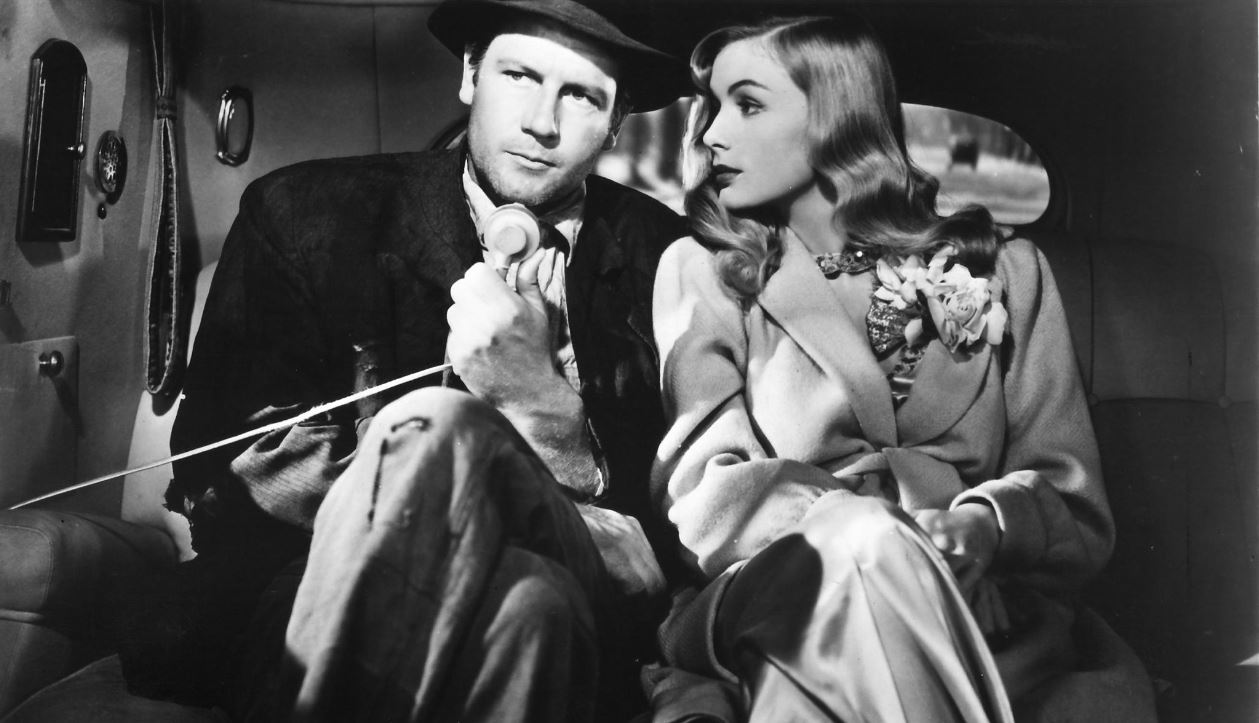
Joel McCrea and Veronica Lake go on a journey of discovery – with a lot of jokes

Director: Preston Sturges

Cast: Joel McCrea (John L. Sullivan), Veronica Lake (The Girl), Robert Warwick (Mr Lebrand), William Demarest (Mr Jonas), Franklin Pangborn (Mr Casalsis), Porter Hall (Mr Hadrian), Byron Foulger (Mr Johnny Valdelle), Robert Grieg (Burrows), Eric Blore (Sullivan’s Valet)

Sullivan: I’m going out on the road to find out what it’s like to be poor and needy, and then I’m going to make a picture about it. 
Burrows [his butler]: If you’ll permit me to say so sir, the subject is not an interesting one. The poor know all about poverty and only the morbid rich would find the topic glamourous.

Preston Sturges was one of Hollywood’s first writer-directors, a whip-sharp satirist. In Sullivan’s Travels he turned his guns firmly on Hollywood, satirising the industries self-importance. However, what he did so well was to counterbalance this with a genuinely insightful look at the urban poor and a celebration of the magic of the movies. The fact that he managed to cover this all in one movie – without making the film feel wildly inconsistent in tone – is quite some accomplishment.

John L. Sullivan (Joel McCrea) is a Hollywood director tired of making shallow crowd-pleasers. He wants to make a serious, social-issue film (called O Brother Where Art Thou?). When studio heads point out he knows nothing about the working man, Sullivan declares he will head to live the life of a drifter until he understands them. After several false starts, it isn’t until he meets a girl (Veronica Lake) that he starts to truly experience the life of the poor.

I’ve mentioned Sullivan’s Travels shifts in tone. In many ways, it’s a film that wants to have its cake and eat it – to be a satire of self-important move-making, and at the same time be an important movie. The extent to which it succeeds is a matter of taste: I can imagine plenty of people being thrown by the sudden shift in tone that kicks in for the final 40 minutes, after the slapstick and screwball comedy of the opening hour. But that’s partly the point. Sullivan’s Travels works because it puts all the objections you could make to a film “teaching” real people about their lives in that first hour – so you feel disarmed heading into the final half hour when the film does just this.

So that first hour first: it’s very funny. The scattergun satire of Hollywood folks is brilliantly done. The fast-paced dialogue of Sullivan and his studio bosses discussing his plans is wonderfully funny – how could you not like an exchange like this:

Sullivan: I want this picture to be a commentary on modern conditions. Stark realism. The problems that confront the average man!
Studio head #1: But with a little sex in it,
Sullivan: A little but I don’t want to stress it.

What’s sparkling about the exchanges is that Sullivan is just as out-of-touch and elitist as the suits, but with a higher degree of self-delusion. His attempts to head off onto the open road and live the life of the drifter are hilariously inept – his first sees him travelling with a “support team” (including a doctor, chef and media man); the second sees him accidentally return back to Hollywood. Sullivan wants to make a film about real people, but Sturges stresses he is as clueless and confused about the subject as any other rich Hollywood snob. The film has a glorious mixture of verbal acrobatics and slapstick pratfalls to demonstrate the comedy of this extraordinarily rich man (who at one point off-handedly runs through the features of his vast home) trying to relate at a distance to the poor.

It takes his meeting with Veronica Lake’s unnamed Girl for him to begin to understand the drifter’s life. Lake’s character remains unnamed, which is another joke on Hollywood – earlier Sullivan discusses women in films with the phrase “There’s always a girl in the picture”, so the plot shoe-horning a Girl in (without even naming her) as a sort of beggar Viola is, in itself, a neat parody of the structural conventions of Hollywood films. Anyway, it’s the introduction of this character that serves as Sullivan’s gateway into seeing what the world is like. Disguised as a boy (which allows plenty of neat gags in itself) the Girl takes Sullivan on a tour of shanty-towns and soup kitchens.

It’s here the tone of the film slowly shifts towards seriousness as we finally get to see the lives of paupers, in a film satirising a Hollywood director who wants to make a film about that subject. It’s wonderfully meta! Sturges shoots these scenes with tenderness and simplicity, without dialogue and scored only by gentle music. There are some small laughs on the way – but we never laugh at the poor and the overall impression is of the quiet dignity of these people just struggling to get by. It couldn’t seem further away from Sullivan’s privileged expectations. It’s quiet and it’s dignified.

Sullivan ends the film (for various reasons) as part of a chain-gang, and finally true suffering and gains the strength of character to acknowledge his own vanity. In one of the film’s most magical sequences, Sullivan watches a film with his fellow convicts and a poor black congregation. Unlike a sequence earlier where he watched a film with the urban middle class (hilariously then every possible breach of cinema etiquette is made, from crunching loud food to babies wailing) this audience are transported by the magic of a Walt Disney cartoon.

This sequence is justly famous, not only for its innocent charm, but also its ahead-of-its-time treatment of the black congregation. The congregation is open-hearted, intelligent and generous. There is a marvellous (and moving) rendition of Go Down Mosesand the black working class is contrasted with the dehumanising conditions of the chain gang. The whole sequence points out the underlying social injustice of America during this era. It’s wonderful – so well done you forget the film (in its jauntier first half) had a crude “white face” gag with its forelock-tugging black chef.

That’s the kind of film this is – a real mixture of genres, of views, of satire on social commentary mixed with real social commentary… Sturges throws almost everything at the wall here, and nearly all of it sticks. The underlying theme, if there is one, is the nature of class and privilege in America. Sullivan is well-off, from a rich background. He finds himself on a chain-gang when he is mistaken for the bums he is attempting to find out more about – but when he is revealed as a rich film director he is immediately released, despite still being guilty of the offence he was arrested for in the first place. In America, money talks and everyone else walks.

Sullivan’s Travels is probably not going to be everyone’s taste. Watching it, I missed the comedy of the first half during the more serious second half, cleverly done as the build of expectations was (how can you criticise the film, when the film is already criticising itself successfully?). Sure parts of it are dated, but it contains so many different types of film-making (screwball wit, Chaplin-esque pratfalls, animation, social realism, melodrama, romantic comedy) it’s almost a film school essay. It also manages to make its changes of tone throughout feel like natural developments.

All this and I’ve hardly mentioned the performances. The cast is full of brilliant character players, all of whom get their moments to shine – Sturges cast from a pool of regular actors, and he was a superb judge of distinctive faces and unique vocal delivery. Veronica Lake is very good – endearing but also sharp and smart as the Girl – but the film is totally anchored by Joel McCrea’s superb, low-key, straight-forward performance which resists all temptations to wink at the camera. 

Sullivan’s Travels feels like a little known masterpiece – but it deserves being known better. It’s original, it’s funny, it’s moving, it’s clever and it’s packed full of great moments. It’s a wonderful example of old-school Hollywood looking harshly at itself – not only at its shallowness and formulaic nature, but also at its self-importance and self-satisfaction – but still acknowledging that the escapist pleasure it can give to people is valuable, that it can be a force for good, for all its faults. It tries to have its cake and eat it – but do you know what? It’s probably one of the very few films that pulls that off.