Tag: Sean Connery

Robin Hood: Prince of Thieves (1991)

Robin Hood: Prince of Thieves (1991)

I can’t lie: no matter how many faults it has, Costner’s Robin Hood epic is above all criticism for me

Director: Kevin Reynolds

Cast: Kevin Costner (Robin of Locksley), Morgan Freeman (Azeem), Mary Elizabeth Mastrantonio (Lady Marian), Christian Slater (Will Scarlett), Alan Rickman (Sheriff of Nottingham), Geraldine McEwan (Mortianna), Michael McShane (Friar Tuck), Brian Blessed (Lock Locksley), Michael Wincott (Guy of Gisborne), Nick Brimble (Little John), Harold Innocent (Bishop), Walter Sparrow (Duncan), Daniel Newman (Wulf), Daniel Peacock (Bull), Sean Connery (King Richard)

I find there’s a simple way of telling if someone is the same generation as me. Hum a few bars of Bryan Adam’s Everything I Do. Adopt an American accent and proclaim you are showing “English courage”. Rasp about cutting someone’s heart out with a spoon or calling off Christmas. Mime shooting a flame tipped arrow or say before carrying out anything complex that you’ve “seen it done many times…on horses.” All of which is to say, if you haven’t already guessed from this parade of in-jokes, that Robin Hood: Prince of Thieves is one of those films of my youth immune from criticism.

The second biggest box-office hit of 1991, having beaten a crowd of Robin Hood pictures to the screen, Prince of Thieves is, to be honest, a ridiculous cheese-fest of wildly inconsistent tone and acting styles, murkily shot and hurriedly plotted. It feels at times like what it is – a film rushed to the screen as quickly as possible to hit a deadline. I know truth be told, it’s a bit of a mess. But it doesn’t matter. I love it. If you, like me, saw this for the first time around 12 or 13 how could you not? For all its many flaws, it’s a massive, rollicking adventure. So, while my head tells me Errol Flynn is the finest Robin Hood on screen…my heart will always be with Costner’s oddly accented outlaw.

In 1194 Robin of Locksley (Kevin Costner) the son of a baron (Brian Blessed of all people!), is captured by the Moors on Crusade and escapes along with fellow prisoner Azeem (Morgan Freeman), who vows to repay his life debt to him. Together they arrive in England to find the land in urgent need of healing. The tyrannical Sheriff of Nottingham (Alan Rickman) plots to seize the throne and Robin is named an outlaw. He and Azeem find sanctuary in Sherwood Forest, where Robin becomes the leader of a band of outlaws. He robs the rich to give to the poor, romances Marian (Mary Elizabeth Mastrantonio), and fights to uphold justice.

All of this is played out in the very best blockbuster style, with logic frequently thrown out of the window in favour of excitement, jokes and gravity defying arrows. Kevin Reynolds was hired to direct to lure on board his fellow Kevin (and mate) Costner, then the biggest star in the world. Costner as the wealth-redistributing bandit is, in reality, as bizarre a piece of casting as Richard Gere playing Lancelot. Never the most confident with accents, rushed producers essentially told Costner told to not bother, concluding most moviegoers wouldn’t give a toss if Nottingham’s most-famous son spoke with a Californian twang. They were right. And to be honest, it’s part of the film’s crazy charm.

After all, the film plays fast and loose with everything else about England. This is the film where Robin arrives at the White Cliffs of Dover and announces it’s a day’s walk to Nottingham. That is, let me tell you, a very long day – particularly when you go via Hadrian’s Wall (which Costner then confidently tells us is but five miles from Nottingham). Any grasp of actual English history is completely irrelevant to a film set in a fantasy merrie-England, where the Bayeux Tapestry, Celtic warrior tribes, lords who dress like the KKK, witches and a King Richard who looks and sounds like Sean Connery (the real Richard was 38 and French) all co-exist.
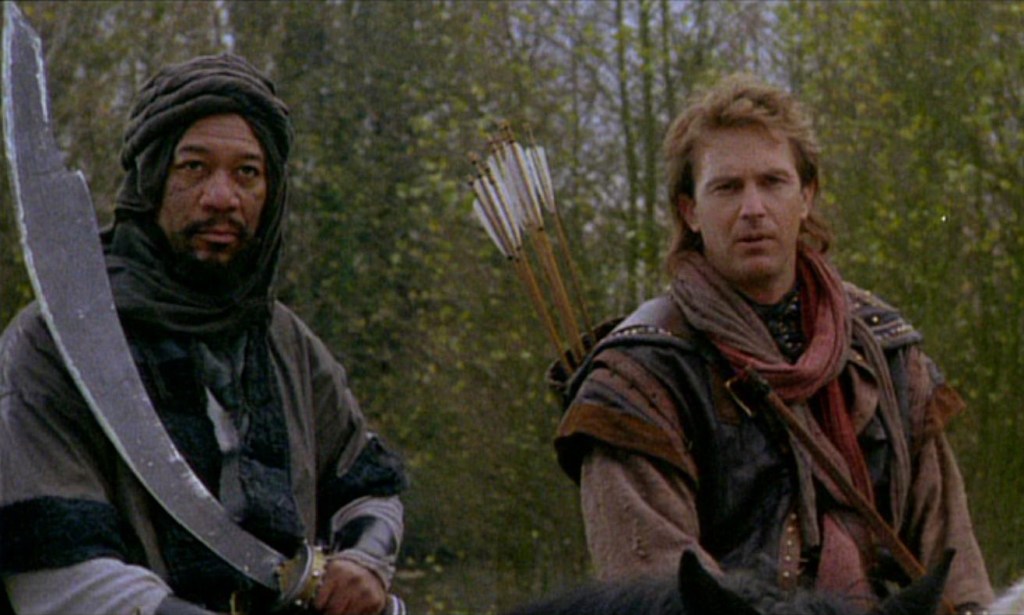
But who cares? Nothing in the film is meant to be taken seriously, and surely Reynolds and co reckoned we’d work that out when Costner – for whom five years in prison has made no impact on his film-star good-looks but left his fellow prisoners scrawny, wasted men of skin and bone – slams his hand down on an anvil and announces to a man preparing to cut his hand off “This is English courage!” in that Californian lilt. It’s not just him: accent-wise the film is all over the place. Christian Slater also makes no attempt at an accent while Mastrantonio’s is impeccable; the Merry Men come from all over the place, Mike McShane vaguely flattens his Canadian accent and Morgan Freeman goes all in on a Moorish accent. This all adds to the fun.

And what fun it is. Reynolds can shoot the hell out of an action set piece and if you don’t get a buzz from seeing Costner shoot a flaming arrow in slow-mo, firing another through a rope, or taking down rampaging Celts with them like they were heat-seeking missiles, there is something wrong with you. A flame-soaked battle in Sherwood is an action highlight – full of drama and terror – and the film’s closing grudge-match between Robin and the Sheriff a high-octane mano-a-mano sword fight.

It gains a huge amount from its impeccable score. Of course, we all remember Bryan Adam’s Everything I Do (it was number one for most of 1991). But the film’s real MVP is Michael Kamen, whose luscious, rousing score lifts even the film’s weakest moments to the heights of classic action adventure. The film’s opening number is a triumph of epic scene-setting. His work fills moments of triumph with joy, beautifully complements (and improves!) comedy and provides a genuinely moving romance theme that bolsters the chemistry between Costner and Mastrantonio’s strong-willed and independent Marian (even though film rules demand the woman introduced to us as something akin to a ninja ends the film a white-dressed damsel-in-distress).

The film’s other MVP is, of course, the late, great Alan Rickman. If you wonder why a generation of people worshipped Rickman, you need only look at his leave-nothing-in-the-dressing-room performance here. So reluctant to play another villain that he only agreed when given carte blanche to play the role however he wanted (including re-writing all his lines with the aid of friends Ruby Wax and Peter Barnes), Rickman delivers his second iconic villain after Gruber. He has a gleeful, OTT, pantomime glee, seething with frustrated impatience at his incompetent underlings but carrying more than enough genuine menace to be threatening. Every line he has – almost every single one – is laugh-out loud funny, either due to its grandiosity or Rickman’s utter commitment and darkly sexy energy (he also makes a beautiful double bill with Geraldine McEwan: two pros milking the film’s comic potential for all it is worth).

Rickman dominates the film – although of course, as he himself said, he had the far more fun and wilder part than Costner – and is central to many of its most iconic moments. What makes it work is Rickman is very serious about not taking the film very seriously: he’s not laughing at it or wanting us to know how superior he is to it: instead he throws himself with gusto into an all-action panto.

With this sort of thing, you can forgive the film’s wildly inconsistent tone (it ends with a prolonged semi-rape joke for goodness sake!), its at times forced attempt to suggest a community among a random collection of Brit character actors playing the merry men, or its meandering into some dark material. Morgan Freeman not only shows surprising action chops, he also gets a showcase for his mentor and comedic abilities. The resolution of the antagonistic relationship between Robin and Will Scarlett is surprisingly effective (it’s another note of the film’s bizarreness that we are meant to believe Costner and Slater both sprang from the Blessed loins) and those action set-pieces work.

The film wasn’t always a happy experience – Reynolds was forced to shoot it in ten weeks on no real prep and was locked out of the editing suite – but perhaps the rush helped create the boisterous adventure we end up with. Maybe years of study and research would just have been less fun. Who cares about dusty books when Robin and Marian can kiss at a misty riverside to the tune of Bryan Adams or Costner splits an arrow in two with another arrow at a thousand paces? Robin Hood: Prince of Thieves is a big, silly, action film full of flaws. And I wouldn’t change a frame of it.

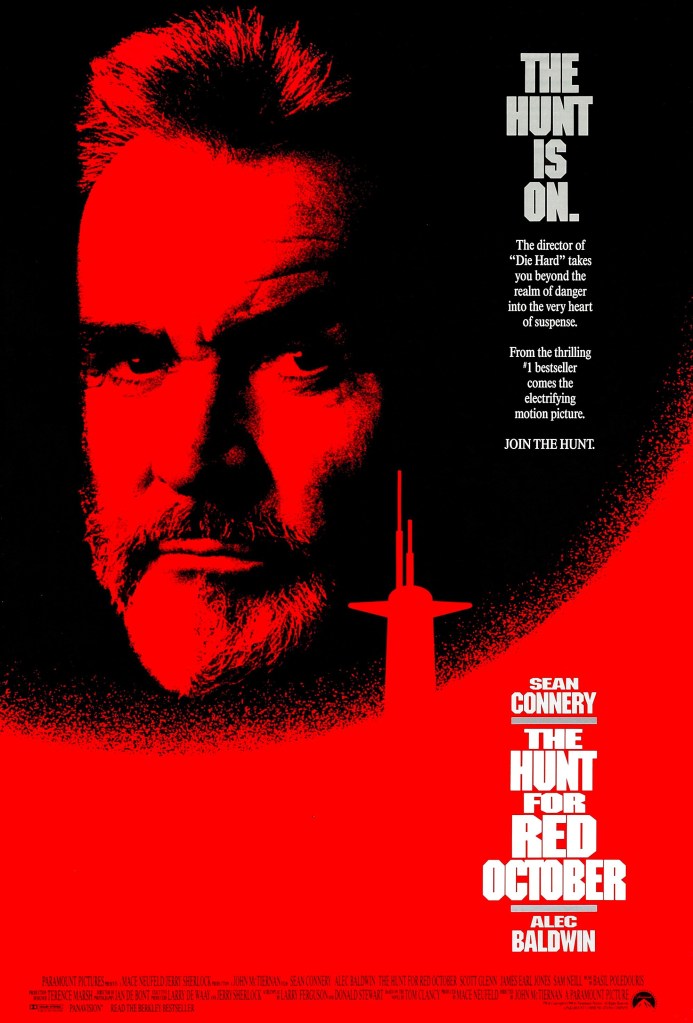
The Hunt for Red October (1990)

The Hunt for Red October (1990)

Shailing into Hishtory! The Hunt for Red October is the finest Tom Clancy adaptation made

Director: John McTiernan

Cast: Sean Connery (Captain Marko Ramius), Alec Baldwin (Jack Ryan), Joss Ackland (Ambassador Andrei Lysenko), Tim Curry (Dr Petrov), Peter Firth (Ivan Putin), Scott Glenn (Commander Burt Mancuso), James Earl Jones (Admiral James Greer), Jeffrey Jones (Skip Tyler), Richard Jordan (National Security Advisor Jeffrey Pelt), Sam Neill (Captain Vasily Borodin), Stellan Skarsgård (Captain Viktor Tupolev), Fred Dalton Thompson (Rear Admiral Joshua Painter), Courtenay B Vance (PO Jones)

“We shail into Hishtory!” It’s the film that launched a thousand Sean Connery impressions. Only Connery could get away with playing a Soviet submarine captain with the thickest Scottish accent this side of Lithuania. He only took the role – from Klaus Maria Brandauer – at short notice, but he’s a pivotal part of the film’s success. The Hunt for Red October is a superb film, the finest Tom Clancy adaptation ever made and one of the cornerstones of the submarine genre. It expertly mixes beats of conspiracy, espionage, naval adventure and even touches of comedy, into a superbly entertaining cocktail.

Connery is Captain Marko Ramius, the USSR’s finest naval captain, given command of The Red October on its maiden voyage. The Red October is equipped with a technical miracle: a “caterpillar drive” that uses a water powered engine to run silently, making it invisible to sonar. So why is the entire Russian fleet being scrambled to find and sink the submarine? Could it be, as the USSR tells the US, that Ramius has gone mad and plans a nuclear strike? Or is it, as CIA analyst Jack Ryan (Alec Baldwin) argues, because Ramius plans to defect and bring the technological marvel with him?

Of course, we know Connery plans to defect. After all, we’ve already seen him murder shifty political officer Ivan Putin (Peter Firth – to whom alphabetical billing is very kind) and tell his handpicked crew of officers, led by loyal second-in-command Borodin (Sam Neill, so dedicated to affecting a Russian accent it’s as if he felt he needed to do in on behalf of himself and Connery) that there is no turning back. The film’s expert tension – and it rachets it up with all the precision of a well-oiled machine – is working out how. How will Ramius evade the Russian fleet? How will he manage to arrange his defection without communicating with the US? And will he and Ryan – unknowingly working together – persuade the US not to blow The Red October out of the water?

With McTiernan, in his prime, at the helm it’s not a surprise the film is expertly assembled. The parallel plot lines are beautifully intercut. Our two heroes, Ramius and Ryan, face very different obstacles (dodging Soviet torpedoes vs patiently making his case to sceptical superiors mixed with risky long-range travels to far-flung US subs) but somehow seem to be building a bond before they even meet. Ryan is an expert on Ramius and his career, while his thoughtful, good-natured decency is exactly the sort of American Ramius tells his crew they need to meet (as opposed to “some sort of buckaroo” – a word Connery relishes).

McTiernan isn’t just an expert mechanic though. There are lovely touches of invention and magic here. The Hunt for Red October has possibly one of the finest transitions ever. Connery, Neill et al start the film speaking in Russian. Ramius meets with Firth’s Putin (great name) in his quarters to open their orders. The two chat briefly in Russian, then Putin reads from Ramius’ copy of the Book of Revelations. As Firth reads (in fluent, expertly accented Russian), McTiernan slowly zooms in on his lips until he reaches the word “Armageddon” (the same in both languages) – the camera then zooms out and both Firth and Connery continue the scene in English (Firth switching mid-shot from Russian to English without missing a beat). It’s a beautifully done transition, rightly a stand-out moment.

But then it’s a film full of them. Many rely on Connery’s performance, superb as Ramius (this was his career purple patch, where one effortlessly excellent performance followed another). Ramius has a grizzled sea-dog charm and a twinkle in his eye, but he’s also nursing a private grief and pain that motivates his defection. He can be demanding of his men, but also inspires loyalty – that “We Shail into Hishtory!” pep-talk speech is delivered perfectly (and McTiernan makes Soviet sailors singing the Soviet anthem a punch-the-air moment even though (a) we know they are technically the bad guys and (b) we know Ramius is lying through his teeth in his speech). But he is always a commander, Connery investing him with every inch of his movie star cool.

Ramius is also an interesting reflection, in a way, of Ryan. Played with a great deal of young-boy charm by Baldwin (and also wit, Baldwin dropping impersonations of other cast members into the film – including a stand-out Connery), Ryan is brave, determined but also slightly naïve and out-of-his-depth. But like Ramius he respects his “enemy”, is open to negotiation, thinks before he acts and wants to save lives. The two even share similar upbringings. The film triumphantly shows a desk man, spreading his wings and doing stuff he couldn’t imagine: the guy who tells an air hostess in an early scene he can’t sleep on flights due to fear of turbulence, will later have himself dropped into the sea from a perilous helicopter flight, steer a Russian sub and duke it out with the last Soviet hard-liner standing in The Red October’s missile room.

McTiernan shoots Ryan’s conversations like combat scenes: quick reversals and cross shots and even whip pans and zooms. It ratchets up the tension and drama in these sequences – and allows him to play it cooler in the sub shots which (with its more constrained set) where patient studies of tense faces follow sonar reports of the approach of torpedoes or enemy subs. Sound is a triumph in Red October – every ping or sonar shadow is sound edited to perfection, with much of its tension coming from their perfect rising intensity.

It builds towards a superb resolution as several plot threads come together in a dramatic face-off that gives us everything from sub v sub to gunfights, with tragedy and triumph all mixed in. It’s a perfect ending to a film that is a masterpiece of plotting and construction, acted to perfection by the whole cast (Connery and Baldwin, but also Jones, Neill, Glenn – perfect casting as a no-nonsense naval captain – and several reliable players in smaller roles). McTiernan directs with exceptional pace and excitement, it’s sharply scripted and technically without a fault – from its gleaming Soviet sub (with church like missile room) to brilliantly edited sound-design. It’s a joy every time I watch it.

Goldfinger (1964)

Goldfinger header
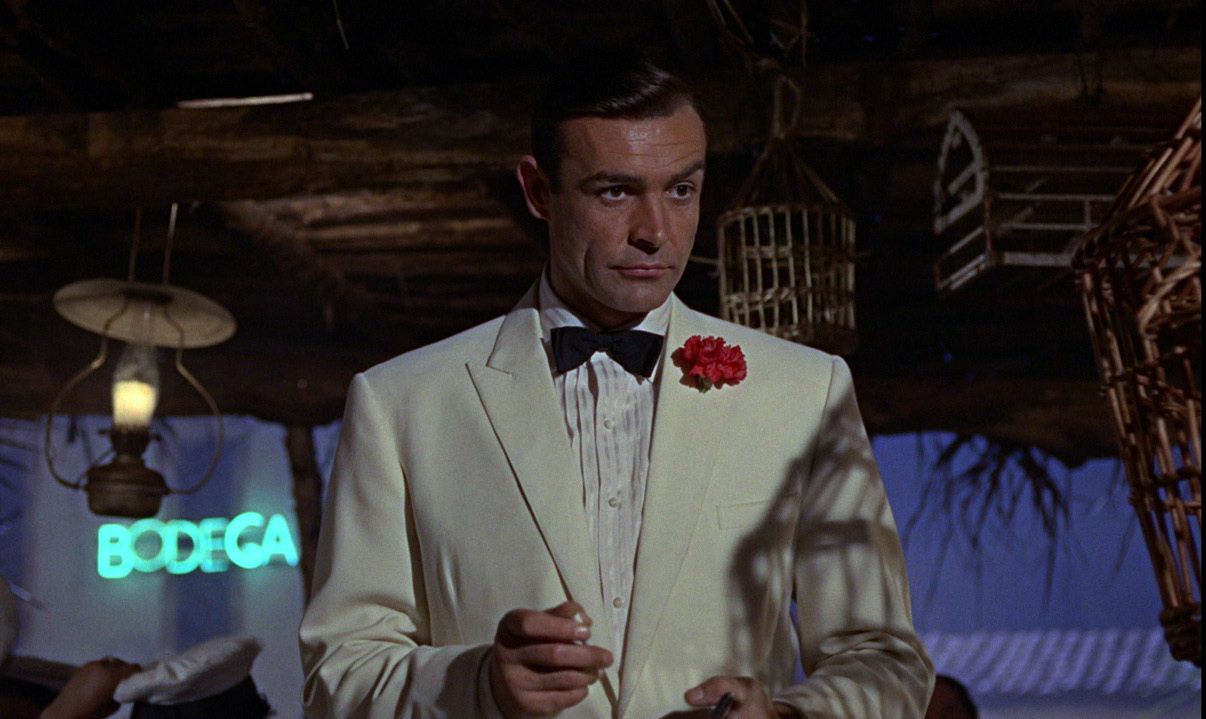
Sean Connery defines Bond forever in Goldfinger

Director: Guy Hamilton

Cast: Sean Connery (James Bond), Honor Blackman (Pussy Galore), Gert Fröbe (Auric Goldfinger), Shirley Eaton (Jill Masterson), Tani Mallet (Tilly Masterson), Harold Sakata (Oddjob), Bernard Lee (M), Martin Benson (Mr Solo), Cec Linder (Felix Leiter), Lois Maxwell (Miss Moneypenny), Desmond Llewelyn (Q), Burt Kwouk (Mr Ling), Richard Vernon (Colonel Smithers), Bill Nagy (Mr Midnight)

It took three films, but Goldfinger was when they got the James Bond formula spot-on. So spot-on, that all the James Bond films that followed would employ elements introduced here. This is where we got for the first-time: the pre-credits action sequence, Q, a gadget filled Aston Martin, a bizarre assassination tool, a villainous henchman with a bizarre skill, an outlandish scheme and Bond delaying being saved at the end for a few more moments of rumpy-pumpy. It’s Connery at the height of his powers, has a knock-out song, one brilliant sequence after another and marks the moment where Bond wisely severed any connection with the real world, like a laser slicing through gold towards our hero’s crotch.

On vacation in Miami, James Bond (Sean Connery) has a run in with Auric Goldfinger (Gert Fröbe), gold bullion millionaire and card cheat. During this his romance with Jill Masterson (Shirley Eaton) is cut short when she is killed by being covered completely in gold paint (a fatal case of the not-actually-real ailment “skin suffocation”) by Goldfinger’s silent steel-rimmed hatted manservant Oddjob (Harold Sakata). Bond is hungry for revenge when he is tasked by M (Bernard Lee) to find out how Goldfinger is smuggling Gold bullion. He finds out Goldfinger has an even more fiendish plan in the works, involving Chinese agents, a nasty gas, an all-female flying circus headed by Pussy Galore (Honor Blackman) and the US gold reserve at Fort Knox.

Goldfinger was a massive hit and pretty much lands somewhere near the top of any poll of the greatest ever Bond films. That’s because it’s just a massive explosion of cool fun. It’s exciting, funny, perfectly paced and has one scene after another that are so perfect, Bond films for the next fifty years would more-or-less repeat them again and again (taking it even further, A View to a Kill is virtually a remake of Goldfinger and even Quantum of Solace has a homage to death-by-gold-paint). Goldfinger takes place in a heightened reality of thrills and spills – unlike From Russia with Love or Dr No there is not even the slightest pretence espionage might work something like this – and barrels along with such pace and momentum it becomes a thrill ride you don’t want to get off.

The plot is actually rather close to Fleming’s original. Goldfinger’s plan has been tweaked, but the film still finds time for the classic “Bond takes on the cheating villain at a gentleman’s sport”, with Bond duelling with Goldfinger in a round of match-play golf (I like to think this is where Connery’s real-life obsession with the sport began, cunningly swopping the cheating Goldfinger’s ball on the final hole for default victory). But the film adds a playful, tongue-firmly-in-cheek quality. It manages to mix thrills with not taking itself too seriously, becoming a grandly entertaining thrill ride.

The re-working of the elements of the novel for the screen created an indelible template for Bond. Oddjob became a walking icon, his shadow instantly recognisable, invulnerable with a killing method – a steel rimmed hat he throws with Olympian accuracy – that’s a perfect mix of just-about plausible and utterly ridiculous. And also, of course, perfect to playfully imitate a home. What you can’t imitate is bombing around hill roads in a gadget-stuffed Aston Martin, but you can dream. The car chase is not only a show case for cool driving, it also lets you see each of the super-cool enhancements introduced by Q one-after-another (a pattern the series would follow time and again whenever a gadget-stuffed car appeared) and hammers home Bond’s super-cool confidence.

Connery was of course perfect for conveying that. In Goldfingerhe was still interested, clearly enjoying some of the best quips he got as well as just enough acting challenges – from Bond’s sad regret at anger at the death of no less than two Mastersons, to his terror at the prospect of being unmanned by a laser. That sequence has of course gone down in film history – from the striking image to the classic exchange “You expect me to talk?” “No Mr Bond I expect you to die!” – but a lot of it is sold from Connery’s desperate search for the right words to turn that machine off. Connery is cool but still just about vulnerable, cunning, smart and witty but also human. Who wouldn’t want to be so unshakeably cool that he can emerge from a wet suit (with a model seagull on his head!) unzip to reveal a tux, light a nonchalant cigarette while a factory explodes behind him, seduce a woman and then off a killer with a bathtub and a heater (“Shocking!”) – and that’s just the first five minutes!

Every scene in Goldfinger is a doozy. The playful cool of Bond outsmarting Goldfinger in Miami then getting his comeuppance (Connery is so cool in the film btw you forget that Bond is such a staunch conservative, he cheekily disparages the Beatles – that other icon of Swinging Sixties Brit Cool – to Jill as casually as he offs villains). That golf game in Kent (capped by a decapitated statue). Hillside driving with Tilly (with extra dodged bullets). Late night gadget-filled car chase. The first meeting with Pussy Galore (“I must be dreaming…”). Goldfinger’s briefing (his offing of all the attendants makes the whole thing even more funny, since its clearly just Goldfinger enjoying a bit of showing off). Bond dragging a nuclear bomb around an epic Fort Knox set. Oddjob surviving everything but a million volts. Goldfinger earning his wings in the film’s climax. It’s all terrific.

And it all works because it’s got the balance spot-on between cartoon and reality. You can see it come together in Ken Adam’s set for Fort Knox: the inside was all made up (no one would stack gold that high!) but people believed it was the real thing, because it felt like the Fort Knox we shouldhave. Goldfinger is a scowlingly wicked villain, with a little kid’s delight in his own naughtiness. Honor Blackman doesn’t appear until the film is halfway through, but is an assured, forceful, brilliant presence, more than a match for Bond (we’ll gloss over the slightly dated way Bond seems to ‘convert’ her from implied Lesbianism to – well perhaps bisexuality). The briefing sequence with a grumpy, unimpressed Q was so good Desmond Llewelyn would essentially repeat it another 13 times (only OMHSS and Live and Let Die would skip the “Now pay attention 007” sequence between this and TWINE). All of this has the bright, primary colour fun of a rollicking graphic novel.

You can watch Goldfinger about a million times – and anyone who has written a Bond film probably has, it was such a template for the next seventeen films that followed – and it would still thrill, excite and entertain you. Connery’s interest after this went downhill, and the magic wasn’t always recaptured – but this when Bond went from being a cool spy to a cultural phenomenon. Bond became the box-office franchise that would dominate cinemas for decades, the ultimate spy caper that others would be compared to. Goldfinger mixed silliness and seriousness perfectly, thrills and laughs, action and comedy. It’s a superb and hugely influential film. It’s one of the Best Bonds ever: it clearly has the Midas touch.

Highlander (1986)

Highlander header
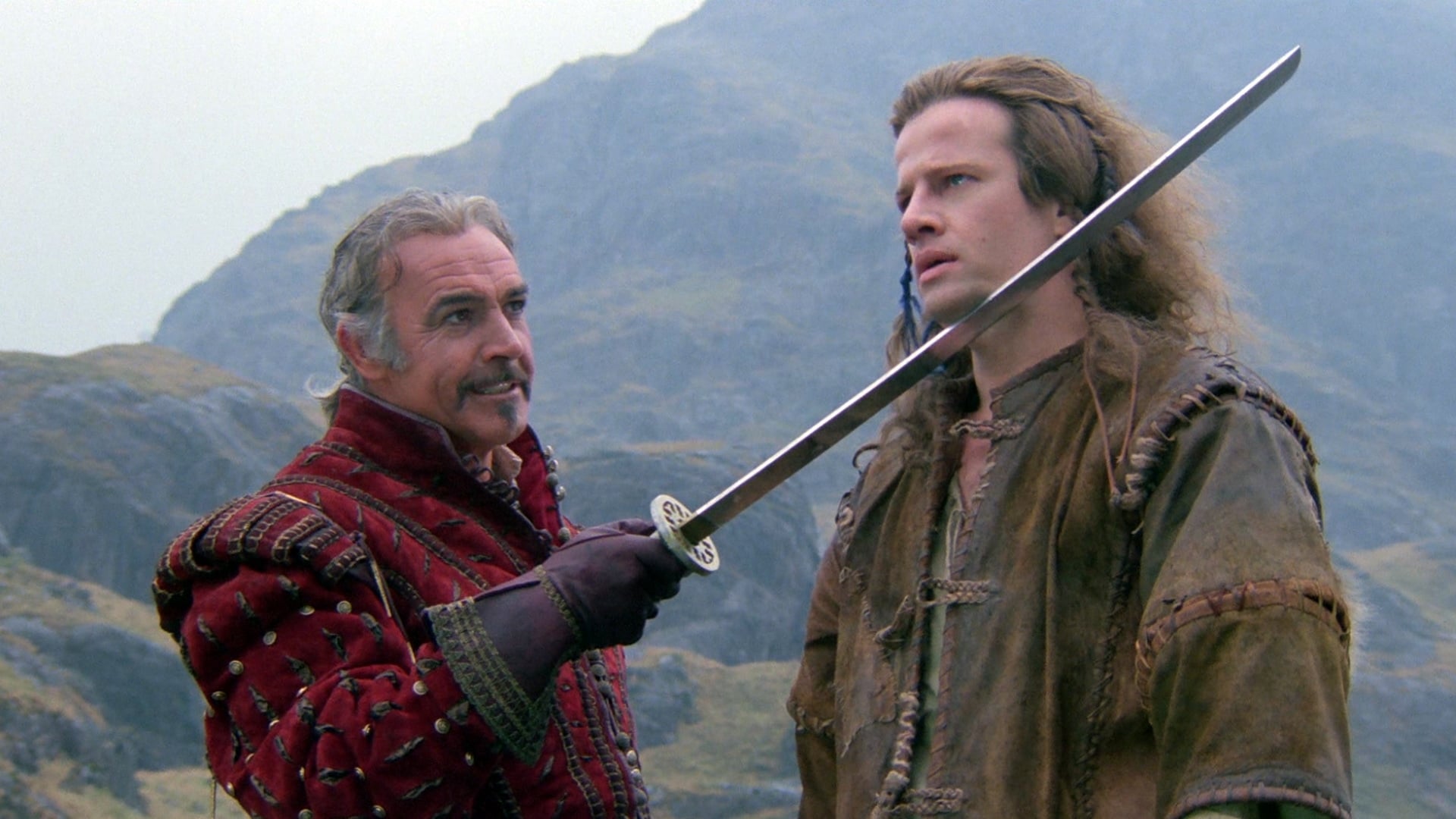
Sean Connery plays a Scottish Spaniard and Christopher Lambert a French sounding Scot in cult classic Highlander

Director: Russell Mulcahy

Cast: Christopher Lambert (Connor MacLeod), Sean Connery (Juan Sanchez-Villalobos Ramirez), Clancy Brown (The Kurgan), Roxanne Hart (Brenda Wyatt), Beatie Edney (Heather MacLeod), Alan North (Lt Frank Morgan), Jon Polito (Detective Walter Bedsoe), Shelia Gish (Rachel Ellenstein)

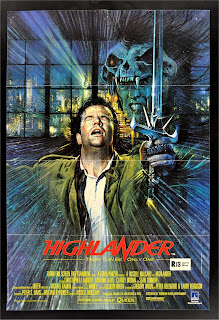
“There can be only one!”. It’s a neat, simple idea and lies at the heart of a cult science-fiction film crammed with them. There is a lot to chuckle at in Highlander. From the air of cheesy cheapness to the Accent Olympics (A Belgian plays a Scot. The world’s most famous Scotsman plays a Spaniard. Brits play Americans. An American plays an Ancient Eastern Barbarian.) But Highlander had huge impact – and was revived countless of times since – because there’s a kind of magic (see what I did there?) to this sci-fi fantasy about immortals struggling over centuries to emerge as the winner of a secret-but-deadly competition. There are so many intriguing ideas and possibilities here, you could make hundreds of adventures in this world (and they have) and still have new areas to explore. The film bombed on its first release in America (look at the poster – is it any wonder? How awful is that?) but it’s had a huge afterlife.

Our hero is Connor MacLeod (Christopher Lambert) who takes part in a lethal sword fight in the car park of Madison Square Gardens in 1985. Turns our Connor was born in the early 1500s, part of a Scottish tribe and was slain by immortal warrior The Kurgan (Clancy Brown). Discovering to his amazement – and his tribe’s horror – that he makes a full recovery from a mortal wound, MacLeod was exiled. He is found and mentored by Ramirez (Sean Connery) who informs him that they are both immortals, destined to join all other immortals in a competition from which there can be only one survivor. The competition will culminate in “The Gathering”, with the winner being given “The Prize”, a mystic power. Turns out 1985’s New York is the scene of the Gathering – and MacLeod and the Kurgan are destined to be the last men standing in the competition.

Perhaps the big thing that makes Highlander such a success is it becomes clear that everyone involved in it seemed to have a whale of a time. Queen were commissioned to write one song for the film: they wrote an album. Mulcahy, Lambert and other members of the cast and crew chipped in their own money to film extra scenes between MacLeod and his adopted daughter. Connery was at his jovial best on the five days he spent filming (Ramirez was to be the only character other than Bond he played twice, in the terrible sequel). All this investment off-camera pays-off in a film frequently rough and ready but also intriguing and enjoyable.

Sure, it’s no masterpiece. It’s very much of its time, with a distinctive 80s vibe and in many ways only scratches the surface of its potential: I’d have loved to see more of MacLeod during the ages, and other Immortals he had interacted with. (We get a confrontation in World War II and a comic duel in Georgian England, where MacLeod repeatedly survives deadly sword thrusts). Our nemesis, the Kurgan, is a frequently overblown and ridiculous character (for all the energy Clancy Brown plays him with) who isn’t quite interesting enough. Lambert is a slightly wooden performer (he learned English for the role – learning it with a Scottish accent was a tough task). Many of the sword fights (with the exception of the final duel) are high-school-play in their hack-and-slash simplicity.

But it doesn’t really matter too much, because Mulcahy shoots the hell out of the picture. Working with a tiny budget, he still manages to give every scene something distinctive to see and an edge in its delivery. The film frequently punches above its weight in its set pieces and with the surprisingly gritty action. Mulcahy has a great eye for the seedy underbelly of New York, just as he does for the Highlands of Scotland. He also handles the romance surprisingly well – both MacLeod’s wife in 16th century Scotland and his love interest in modern New York (including a surprisingly tender love scene) are engaging and complement each other (no mean trick).

Also, the idea is absolute solid gold, and for all that it’s sometimes buried in a cheesy 80s Euro-actioner, Mulcahy still gives the entire thing a sort of mystic force. The tragedy of someone living centuries – watching everyone they love grow old and die around them – is very affectingly done. The different personalities and backgrounds of the immortals are striking and the hints dropped about their involvement in past events intriguing. The concept of immortals growing stronger from beheading other immortals is intriguing and adds a fascinating subtext to every conversation between two of them. The Game itself has an ancient-legend sort of strength, the entire film’s concept having all the revisitable interest of a popular children’s story or a classic slice of mythology.

It looks handsome, and while the actual plot is often predictable and straight-forward, the richness of the backstories and the history carries real impact. Connery is great in a neat cameo – one of his first “mentor” roles (he’s only in it for about 15 minutes, but lifts the entire enterprise with his charisma). The Queen soundtrack is a knockout. Sure, some moments – such as Lambert all too obviously lifted on wires – look as cheap as they probably were, but the entire film is made with a burst of energy and a feeling of enjoyment and love that you have to have a hard heart not to care for it a little bit.

The Longest Day (1962)

John Wayne leads the charge on The Longest Day

Director: Ken Annakin, Andrew Marton, Bernhard Wicki

Cast: John Wayne (Lt Col Benjambin Vandervoot), Henry Fonda (General Theodore Roosevelt Jnr), Robert Mitchum (General Norman Cota), Richard Burton (FO David Campbell), Eddie Albert (Col Lloyd Thompson), Sean Connery (Pvt Flanagan), Curd Jurgens (General Gunther Blumentritt), Richard Todd (Maj John Howard), Peter Lawford (Brig Lord Lovat), Rod Steiger (Lt Com Joseph Witherow Jnr), Irina Demick (Jeanine Boitard), Gert Frobe (Pvt “Coffee Pot”), Edmond O’Brien (General Raymond Barton), Kenneth More (Capt Colin Maud), Robert Ryan (Gen James Gavin), Red Buttons (Pvt John Steele), Christian Marquand (Cpt Philippe Kieffer), Jean-Louis Barrault (Fr Louis Rolland), Arletty (Mdm Barrault), Paul Hartmann (Field Marshall Gerd von Rundstedt), Werner Hinz (Field Marshall Erwin Rommel), Wolfgang Priess (General Max Premsel), Peter van Eyck (Lt Col Karl Williams Ocker)

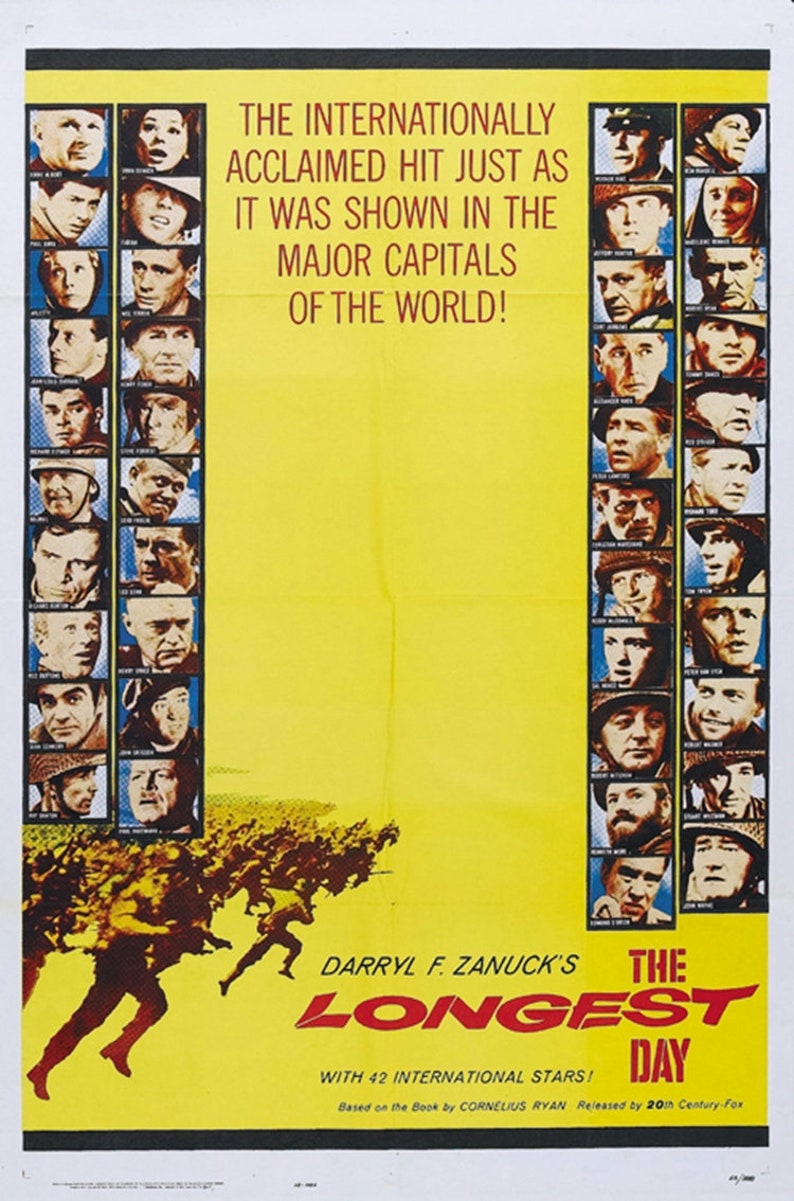
Darryl F Zanuck wanted to make the War Film to end all War Films. So, what better way than to restage D-Day itself, with a cast (as the poster brags) of 42 International Stars, playing out almost in real-time. It’s a grand ‘mock-documentary’ shot in black-and-white (so that actual war footage can be integrated into the film) and aims to show the perspectives of the four main combatants (the Americans, the British, the French and the Germans – with all their scenes played in their respective languages). Adapted from a definitive D-Day book by Cornelius Ryan, it makes for huge, now slightly old-fashioned, Sunday afternoon fun and one of the most iconic second world war films.

To make his dream come true, Zanuck left no stone unturned. Pretty much every single part is played by a ‘name’ actor (although, rather like Around the World in 80 Days, time has left some of them less recognisable than others) no matter how small the role. And I mean no matter how small. Many of the actors appear in no more than one or two scenes. Steiger chips in a brief speech as a Naval officer. Burton has two scenes as an RAF officer, one of the last of the “Few”. Fonda contributes a few minutes of heroism as Theodore Roosevelt Jnr. Robert Ryan briefs The Duke as General Gavin. Jean Servais makes a grand speech as a French Admiral. Gert Frobe doesn’t even speak as a (what else?) bullying German soldier. This parade of stars does though does mean you pay a lot more attention to every single part and it makes it a lot easier to keep track of who’s who.

It’s certainly a ‘producer’s’ film. Zanuck held complete creative control, splitting the directorial duties between three hired hands. Annakin directed all the British and French scenes (and most of the American ‘briefing room’ scenes). Martan, an experienced second unit director, was hired to shoot most of the battle sequences. Wicki looked after the German sequences. With the brief being to replicate the documentary style of actual footage, naturally this basically led to a film that doesn’t have the feel of being ‘authored’ (in the way, say, Saving Private Ryan does), but it’s functional shooting style and design does make it fairly easy to follow.

And it needs to be easy to follow, as this is a very long film indeed – and with the cast frequently changing from scene to scene, can become overwhelming. The quick changes of location – and the lack of time spent with any single character – often means it’s hard to connect to strongly to any of the individual characters. Most of the more prominent characters gain their personality solely from the actors playing them: so I don’t really know what the real Colonel Vandervoot is like, but I know his character here is basically ‘John Wayne’.

The more prominent roles in the script rely on these personality parts. Wayne probably has the largest individual role as the Paratrooper commander who breaks his ankle on landing, but doesn’t let that slow him down from hitting his objective. (Wayne also gets a great little speech, the sort of thing much missed in Ryan, where he praises Brit fortitude under the Blitz, which is a lovely moment of Allied brotherhood). Mitchum gets the juiciest action as General Cota, the highest-ranking soldier on Omaha Beach, who leads the first break out. At the other end of the ranking, Red Buttons brings charm and heartfelt emotion to the most memorable sequence as Pvt John Steele, the paratrooper who landed on top of the church spire at Sainte-Mère-Église, deafened by bells and forced to watch the rest of his platoon slaughtered on landing.

The scale is really what it’s all about. The recreation of the D-Day landings is stunning (the first boats, though, don’t hit the beaches until well over two hours into the film), and its genuinely hard to tell the difference between what is recreated and what is actual war footage. The film doesn’t shirk from showing the cost of war, or the slaughter on that beach (although of course, it looks reserved compared to Ryan). But the combat and operations elsewhere are also perfectly recreated. Richard Todd is very good as Major John Howard, in an expert reconstruction of the seizing of the Orne Bridges near Caen (in real life, Todd himself was one of the commandos serving under Howard and even has a scene where Todd as Howard talks to another actor as Todd).

These battle sequences make for compelling viewing. Slightly less so is the long build-up of the Allies to the attack. There are many, many scenes in various briefing rooms and for every delight (such as Jack Hedley’s briefing around “Rupert” a model paratrooper, dropped as a distraction) there are po-faced actors staring into the middle distance and discussing how important everything is. By far and away the most interesting content in the first half is less the Allies (waiting to leave) than the Germans (trying to work out how and where the Allies will arrive). These scenes feature a range of German officers, from the quietly resigned to die-hard, head-in-the-sand Fascists, and revolve around a series of fascinating debates on where, when or even if at all the Allied attack will come. With a cast of excellent German actors – Jurgens, Preiss, Hartmann, Hinz and Wolfgang Buttner are particularly fine – these scenes stand out as they present a perspective we don’t often get to explore. (Even though the film squarely accepts the German military view that the defeat was all Hitler’s fault and the army was completely blameless of any of the crimes of Nazism.)

After the slow-build, the explosion of tension and action is done really effectively. Sure, the film is long and episodic, but the ever-changing locations do frequently help with the pace. The film’s documentary style also lends it a great deal of authority that a more ‘fictional’ film would not have. After all, pretty much everyone in the film is ‘real’ and while the film could be seen as a collection of D-Day anecdotes, strange moments – such as a platoon of Germans and Americans passing each other on opposite sides of a low wall without noticing each other – have the ring of truth. The script was doctored by a host of major novelists and playwright (including Noel Coward) to brush it up, but really this is a producer’s triumph.

And it is a triumph for Zanuck. Everything he sought to do, he accomplished here – and the doubts that he could pull it off were moved as wrong, as those who doubted whether the Allied plan to cross the Channel would work. Hugely impressive in its staging, detailed in its recreation and with a cast of stars and top actors giving every scene a fresh bit of life, this makes for one of the all-time classic war films.

Thunderball (1965)

The most memorable moment of Thunderball – and it happens in the first few minutes

Director: Terence Young

Cast: Sean Connery (James Bond), Claudine Auger (Domino), Adolfo Celi (Emilio Largo), Luciana Paluzzi (Fiona Volpe), Rik Van Nutter (Felix Leiter), Guy Doleman (Count Lippe), Molly Peters (Patricia Fearing), Martine Beswick (Paula Caplan), Bernard Lee (M), Desmond Llewelyn (Q), Lois Maxwell (Miss Moneypenny), Roland Culver (Home Secretary), Paul Stassino (Francois Derval/Angelo Palazzi)

By 1965 no one bigger than James Bond – and the films had to reflect that. Thunderball had more money spent on it than all the previous Bond films put together. I suppose you can see that on the screen, but it doesn’t change the fact I’ve always found Thunderball one of the most meh of all Bond films. I always fail to get really engaged in it, and it’s stuffed with the sort of high-blown set-pieces where it feels the producers were so pleased at the possibility of doing something, they never stopped to think if there was an actual reason to do it.

Thunderball’s plot is the first example of what would become a pretty standard Bond trope: the swiping of nuclear missiles by criminals to hold the world to ransom (the principle would be repeated again in You Only Live Twice, Spy Who Loved Me and Moonraker). In this case it’s Spectre agent Emilio Largo (Adolfo Celi), who steals a British nuke-carrying jet and demands £100 million ransom to return it. All the 00 agents are scrambled, but of course James Bond (Sean Connery) has the only lead – helped by the fact he was staying at the same health farm where the hijacker was being surgically altered to replace the jet’s pilot. Bond heads to the Bahamas to follow his lead, the pilot’s sister Domino (Claudine Auger) – only to find out she’s Largo’s girl! Will Bond get those missiles in time and dodge sharks, heavies, red-headed femme fatales and deadly street parades?

Well of course. After all, Nobody Does It Better. Thunderball is big, expensive and has several high-octane fights. But it’s also strangely slow and ponderous, takes ages to get started and has the distinct whiff of everyone going through the motions. Compared to Goldfinger and From Russia with Love there is a noticeable lack of spark and wit. All the invention seems to have gone into some of the gadgets – look Bond has a jet pack! – and none into the script which presents a series of plug-and-play characters and a plot set-up that lacks any real sense of quirk.

It also doesn’t help that what feels like vast reams of the film are filmed underwater. The producers were obviously thrilled by the invention of underwater cameras, so were eager to throw as many action sequences down there as possible. Problem is an underwater action sequence is devoid of sound and, due to the breathing apparatus, it’s nearly impossible to see anyone’s face. All this makes for some slow-paced action sequences where it’s rather hard to tell what’s going on and who is on what side.

The score tries to compensate for this by hammering up the musical intensity. Everything in the film is trying desperately to tell you this is thrilling, but you eventually realise all you are really watching are a group of wet-suit clad stuntmen moving slowly around trying to hit each other. All this in a silence only broken by the occasional ‘dead’ character floating away in a burst of despairing oxygen bubbles. Nothing that happens underwater in Thunderball sticks in the mind, for all the money spend on it.

But that’s kind of the case for the whole film. It’s a huge spectacle, but also one of the hardest Bonds to recall. The opening sequence is overshadowed by Bond’s brief escape via jet pack (where does he get it from? How does he find the time to put it on when he’s being chased? Don’t ask) but is still a witty bit of fun as Bond works out that the widow at the Spectre agent’s funeral he’s observing, is in fact the widow in disguise. But the film from here takes a very long time to get going again, with Bond pottering around a health farm. The investigation into the missiles is cursory even by Bond standards, and the only sequence that really stands out is Bond limping bleeding through a street party and using the femme fatale as a human shield.

It’s all very competently, if rather lifelessly, directed and looks great. The sight of Largo’s boat splitting into two and one part zooming away is still impressive. Sharks get a healthy workout – sharks in Bond films are always about twenty seconds away from ripping people apart. But it’s all got an air of duty about it. Its a massive box-ticking exercise. It doesn’t even have a proper ending: Bond and Domino are literally air-lifted away without a word a few seconds after Largo’s death, as if the scriptwriters hit their page count and didn’t bother putting anything else down (future films would not miss up the chance for a bit of double entendre laced shagging while waiting for rescue).

Sean Connery looks like he might have had enough (this was his fourth Bond film in about four years), heading towards the autopilot that would become even more pronounced in You Only Live Twice. There are sparks of the old cheek and charm – and he does the final fight scene with a physical viciousness that I don’t think he displayed in any other film – but his mind is elsewhere. Not much comes from the rest of the cast, almost exclusively made up of European actors all-too-clearly dubbed. Largo is the most non-descript Bond villain on record, Domino a character so forgettable the scriptwriters don’t even remember to have Bond sleep with her. Luciana Paluzzi makes the best impression as the femme fatale Fiona Volpe (although she later claimed she was never taken seriously as an actress again).

Thunderball is reasonably entertaining, but it’s the most missable background playing of all the Bond films. There is nothing in here that really stands out, no moment that dominates the clip shows, nothing that you can put your finger on that makes it really unique. It’s not even terrible like some of the other films. It’s dominated by dull underwater sequences and has a cast of largely forgettable characters. It’s a film made to order but with no love.

Zardoz (1974)

Yes Sean Connery actually wears this in Zardoz

Director: John Boorman

Cast: Sean Connery (Zed), Charlotte Rampling (Consuella), Sara Kestelman (May), Niall Buggy (Arthur Frayn/Zardoz), John Alderton (Friend), Sally Anne Newton (Avalow), Bosco Hogan (George Saden)

Be warned. When a director is given the money to make any film he wants – with total creative control and no interference from anyone else – you’ve got a 50/50 chance of either getting a work of genius or a piece of pap. In the case of John Boorman’s Zardoz you definitely get the latter. Zardoz is possibly one of the most bizarre, misguided, surreal and finally plain bad films you’ll see, like a walking advert for the most pretentious and terrible outreaches of science fiction. 

It’s the year 2293, and the world is a post-apocalyptic wasteland. The “Brutes” live in the wastelands, growing food for the “Eternals” – immortal figures, leading a luxurious but empty, pointless existence on a series of country estates protected from the outside world by forcefields, their lives governed by a super computer. In the middle are the “Exterminators”, who control (i.e. kill and enslave) the Brutes and worship “Zardoz”, a giant flying head sent by the Eternals. Until, one day, Exterminator Zed (Sean Connery) sneaks his way into Zardoz and finds himself in the world of the Eternals and starts to lead them to question the point of their interminable immortality.

Zardoz looks overwhelmingly silly, and is often filmed and edited with such high-flown, empty surrealness, that it’s almost impossible to take seriously from the start. It looks so bizarre – with its terrible costumes, camp playing and overly designed look and feel – that it’s hard not to suppress a snigger. This is made worse by the shallow, pretentious and obvious social satire forced upon on once you start to concentrate on the dialogue.

It’s also one of those films that mistakes an incoherent, poorly explained plot – in which characters frequently change sides, motivations and aims at the drop of a hat – for a sort of mystical profoundity. The influence of The Prisoner is very strongly felt, from its commune-like setting to our “hero” being trapped in a stylised world where he is trying to work out the rules. But while The Prisoner manages, more or less, to suggest some sort of deeper meaning behind all the stylistic self-indulgence and pleased-with-itself babble, Zardoz just manages to be unengaging and heavily self-indulgent. 

You don’t need a philosophy major to work out the social commentary being made in a world where the richest exploit the rest of the population to live a life of ease and content. Nor is it a surprise to find that this sort of life without challenges, continuing forever, has led to stagnated and lazy lives where everything (even, to the film’s shock, sex – although of course the muscular Connery fixes that) has lost all meaning. Frankly this world takes off-cuts of several, far better and smarter films, and remixes them together into a turgid mess.

And it looks so silly. The entire design of the film constantly shoots it in the foot. How could you take Sean Connery seriously in that costume? The Eternals wear the sort of Greek-influenced hedonistic costumes that you would expect to see on a second-rate episode of Star Trek. The film frequently uses stylistic decisions that look absurd – and try too hard – from the hand gestures used to show the Eternals’ mind control (looking like a partial lift from the Macarena) to the bizarre sequences where Zed’s memory is searched using an projector, frequently using surrealist images mixed with physical theatre that frankly looks more than a little bit silly.

Sean Connery goes at this all with a respectful commitment, even if the character isn’t particularly engaging, and is hard to relate to since most of his memories seem to revolve around rape and murder. As if recognising this, there is a late plot turn where we find out that Zed is far more than he appears. But rather than making this intriguing, it makes virtually all his actions earlier in the film incoherent. But then it’s not as if that’s a problem: Charlotte Ramping, Sara Kestelman and John Alderton as the leading Eternals swop views, sides and opinions virtually scene to scene. Rampling in particular goes between plotting Zed’s death to becoming his acolyte in one conversation. For some this might be a sort of poetry. But really it’s crap.

In amongst all the nonsense, the film has a seedy, porny view of women. The Eternals seem to walk around – perhaps because they are so indifferent to sex – virtually in the buff. Connery has sex (eventually) with most of the female cast, as well as groping several others. Boobs frequently appear in shot. In one moment so bizarre it must be a joke, Zed’s sexual drive (so alien to the Eternals) is even explored by showing him some pornographic images (including some naked women mud wrestling) to see if it gets his rocks off (sadly for them, he shows much more – visible – interest in Rampling than the images they are showing). 

It all finally comes to an end in an orgy of violence intercut with images that comment on rebirth in a way that is supposed to be (no doubt) an intellectual comment on the balance between love and death – but actually is just another clumsy, empty excuse for a bit more sex and violence (and plenty of nudity). But then since the film has long since stopped making any sense (with scenes including Connery dressed as a bride, chasing himself through a hall of mirrors and briefly gaining the power to turn back time and protect others from violence with “his aura”) that it hardly seems to matter. The film had a seriously damaging impact on the careers of both Boorman (who makes a good job of the opening scene and then sees the whole film slide down a silly, indulgent and pointless mess) and Connery. Not a surprise. It’s terrible.

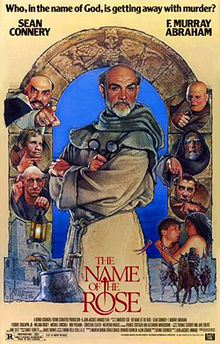
The Name of the Rose (1986)

Sean Connery taps into his inner Sherlock Holmes in The Name of the Rose

Director: Jean-Jacques Annaud

Cast: Sean Connery (William of Baskerville), F. Murray Abraham (Bernardo Gui), Christian Slater (Adso of Melk), Michael Lonsdale (The Abbot), Helmut Qualtinger (Remigio de Varagine), Elya Baskin (Severinus), Volker Prechtel (Malachia), Feodor Chaliapin Jnr (Jorge), William Hickey (Ubertino de Casale), Michael Habeck (Berengar), Urs Althaus (Venantius), Valentina Vargas (The Girl), Ron Perlman (Salvatore)

Umberto Eco’s erudite medieval murder-mystery was about the wonderful power of books, as much as murder mayhem in a medieval abbey. A surprise bestseller, the story is a perfect mix of intellectual playfulness and Agatha Christie whodunit, with suspects left, right and centre and bodies piling up faster than you can count. Jean-Jacques Annaud fought for years to bring the book to the screen, and his vision of it might well sacrifice much of the depth of the original (it even cheekily refers to itself as a “palimpsest” of the original novel – something reused but still bearing traces of the original) but brings enough to the table to have its own life.

In 1327, monks and high churchmen assemble at a Benedictine abbey in Northern Italy, famed for its voluminous library. However, all is not well at the Abbey with one monk already dead in mysterious circumstances, and soon many others join him in death, each of the later victims with mysteriously blackened fingers and tongues. The Abbot (Michael Lonsdale) asks renowned Franciscan monk William of Baskerville (Sean Connery) to investigate – and his efforts will reveal the dark truths at the heart of the abbey and place him and his novice Adso (Christian Slater) on a collision course with Inquisitor Bernardo Gui (F. Murray Abraham) who sees not a human hand, but the hand of Satan, in the murders.

Annaud’s film perfectly captures the mud and grime of the medieval world, with its murky visuals of the cold and damp in a building like this in winter. To be fair, the film is helped in its sense of oppressive medievalism by its frequently choppy editing and less-than-obvious camera angles (at times making it hard to tell what is happening), while James Horner’s score may hit its notes hard at points, but does sound like a successful pastiche of choral music of the time and creates an ominous air.

Annaud searched far-and-wide for his ideal cast to populate the monastery – and he seems to have assembled actors based on the closeness of their resemblance to Holbein, Bosch and Brugel grotesques. The monks are a distinctive set of oddball weirdos, often pale of face (non-more so than obese albino Beringar, whose effete campness tips a little uncomfortably into homophobia today), with oddly tonsued facial hair, and prominent facial features. To be honest it makes the movie-stardom of Connery (and Slater) stand out even more, as practically the only members of the cast who don’t look like they could audition for the Addams family. Ron Perlman in particular labours under such carefully applied make-up, matched with a faultlessly committed performance of physical and verbal childishness mixed with animal instinct, it was a shock to find out from other films that he was not hideously deformed!

William of Baskerville, as imagined by Eco, was a mix of William of Occam (him of Occam’s razor) and Sherlock Holmes (hence the Baskerville) – the book even matched almost word for word, Watson’s first description of Holmes from A Study with Scarlet with Adso’s first description of William. (Adso himself is also basically W-atso-n). The film is at its strongest when focused in William’s deductions, his lightening intellectualism and his ability to bring even the smallest fact or note to bear in order to shape a conclusion. The film front-and-centres William’s investigation over and above the other themes of the book (around faith, books and intellectual freedom), but this works for the requirements of a film’s narrative.

t also helps that William is played by Sean Connery in one of his finest performances. Heading into the film, Connery’s career was in a seemingly terminal decline (indeed the Great Scotsman was seen as such box-office poison, a Hollywood Studio pulled their funding after he was cast). Connery had to work hard to persuade Annaud – but thank god he did, as he plays on his fatherly and intellectual strengths here. In real life a committed autodidact, Connery perfectly captures the curiosity and love-of-learning of William, and also invests him with a profound moral sense, shaded by his guilt at past failings and playful understanding of how the moments when we fail to live up to expectations do not mean we are damned. It’s one of Connery’s finest performance – and unarguably changed his career, as he headed into a five year purple patch of increasingly impressive performances. 

Connery’s compelling performance is the real meat of the film, and he creates a character who feels warm, rounded and a perfect mix of contemporary and of-the-period. He’s also well supported by a young Christian Slater as his sidekick novice, who also gets a surprisingly raunchy sex scene. It’s unfortunate the rest of the cast don’t get as much to play with. The rest of the monks are oddballs, or drift out of the film as the plot requires (Michael Lonsdale’s abbot simply disappears, despite hints of a darker role in the plot early in the film).

In particular F Murray Abraham devours most of the impressive set as a lip-smackingly cruel inquisitor who delights in handing out the judgement of God. The film repositions him as a hissable villain, and reduces his impact accordingly, including placing him in an “you’re off the case William!” role. The final, murkily done sequence (featuring fires, heretics punished and a couple of nasty accidents) does tip into the sort of Grand Guignol gothicness that the book itself more or less avoids. But then it’s part of the general boiling down of the novel – making it that palimpsest – and also part of Annaud’s Euro-epic style, with its melting pot of accents and touches of clumsy editing and filming.

The balance of the original novel between ideas and sensation gets more or lost in sensation here – indeed the book that all this murderous behaviour is all about gets rushed over and its impact poorly explained, as are the motives of the eventual killer – but it all still kind of works because it looks more or less perfect and because of that Connery performance. Annaud was probably not quite the director to successfully marry the two parts of the book – and his direction is adequate in many places rather than inspired, with too many awkward handbrake turns – but this is still a film I have enjoyed many times over and will do so again.

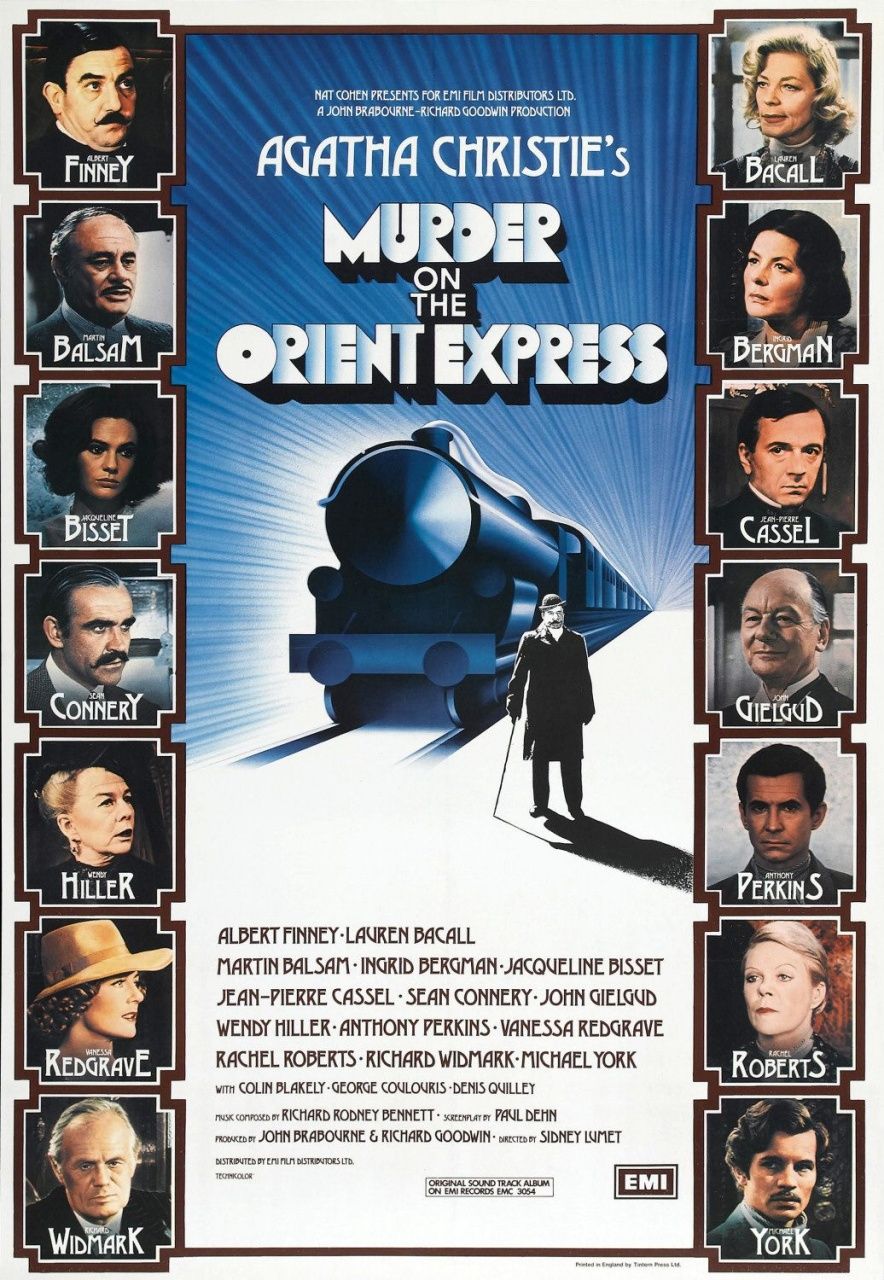
Murder on the Orient Express (1974)

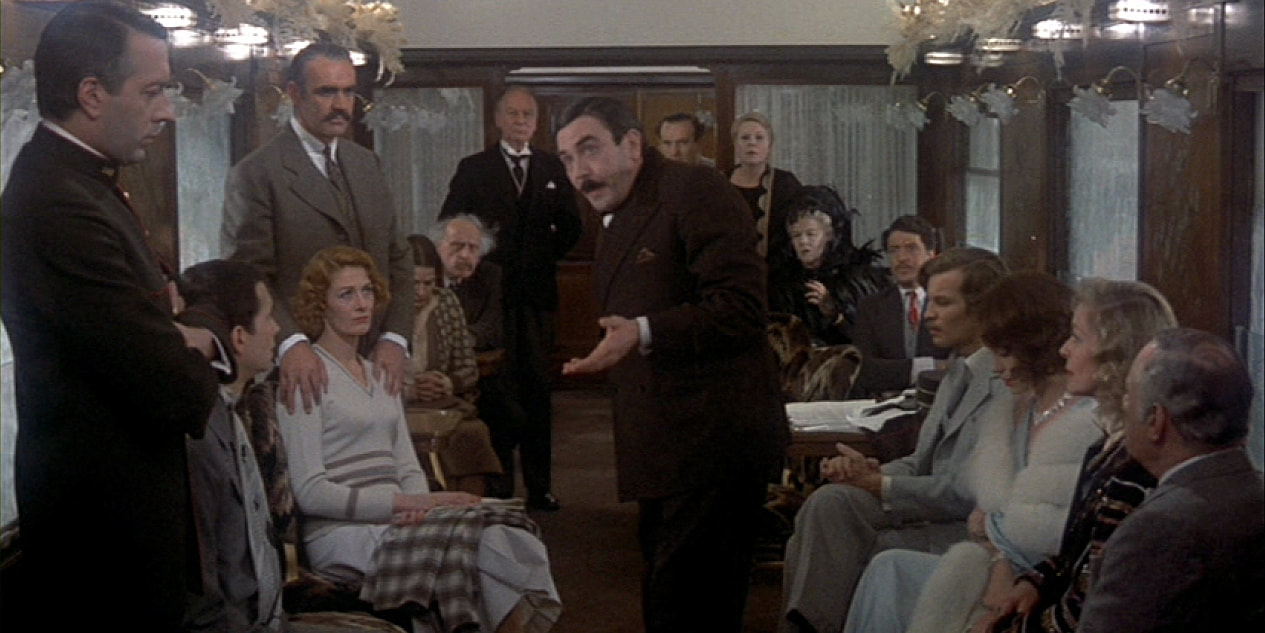
Albert Finney interrogates an all-star cast in Murder on the Orient Express

Director: Sidney Lumet

Cast: Albert Finney (Hercule Poirot), Lauren Bacall (Linda Arden), Martin Balsam (Signor Bianchi), Ingrid Bergman (Greta Ohlsson), Jacqueline Bisset (Countess Helena Andrenyi), Jean-Pierre Cassel (Pierre Paul Michel), Sean Connery (Colonel John Arbuthnot), John Gielgud (Edward Beddoes), Wendy Hiller (Princess Natalia Dragomiroff), Anthony Perkins (Hector McQueen), Vanessa Redgrave (Mary Debenham), Rachel Roberts (Hildegarde Schmidt), Richard Widmark (Ratchett), Michael York (Count Rudolf Andrenyi), Colin Blakely (Cyrus Hardman), George Coulouris (Dr Constantine), Denis Quilley (Antonio Foscarelli)

If there was a film that set the template for our expectations for an Agatha Christie adaptation, it was probably this one. A big starry cast. Luscious period detail. An engrossing plot with clues and double meanings in every corner. A healthy mix of the OTT and the chilling. Marshalled by Sidney Lumet, almost certainly the best director to take on a Christie mystery ever, this film was a massive hit then and remains a hugely enjoyable, rewarding treat now, the sort of masterclass in quality film-making and bravura acting that is guaranteed to leave a smile on your face.

You surely must know the plot by now right? Hercule Poirot (Albert Finney) returning from a successful case in the East hitches a ride on the Orient Express on the way home. During the journey he is asked by American businessman Ratchett (Richard Widmark) if he would take up the role of his bodyguard after threats against his life. Poirot turns him down – and sure enough the next morning Ratchett turns up dead in his compartment, with no less than a dozen knife wounds in his chest. With the train stranded in a snow drift, the killer must be one of the other twelve passengers in the carriage. And so the case begins…

Sidney Lumet’s superb, classy piece of murder mystery is a triumph of design and style. The train looks superb, the period detail is perfect, the costumes are luscious. But what Lumet brings to it all underneath all this Sunday afternoon splendour is a genuine sense of chilling menace. Helped a great deal by Richard Rodney Bennett’s haunting musical cues, this film never lets the viewer forget that the heartless destruction of an entire family is at the root of the crime itself, or that the desires for revenge we find in ourselves can take us to dark places. 

Lumet’s film opens with a brilliantly constructed series of newspaper stills, establishing the horrors of the Daisy Armstrong case that underpins the mystery, the kidnapping and murder of a young child (based on the Lindbergh kidnapping) that led to tragic consequences for an entire family. This chillingly sad and tragic back story is echoed throughout the film, and immediately establishes the stakes for all involved.

So we spend the film then trying to work out how all the suspects might fit it into this story. Lumet’s concept of bringing together an all-star cast was a brilliant idea, not only giving each of the suspects a quickly established personality (partly inspired by the actor’s body of work), but also assembling a group of such talented actors that they can sketch out a character within a few moments. Lumet’s first recruit for the cast was his old collaborator Sean Connery – and the agreement of Connery to take on a supporting role brought a host of actors to follow. It all adds to the fun, an enjoyable star-spotting exercise, and also an amusing game of watching sometime wildly competing acting styles.

Connery plays Arbuthnot with a stiff-upper lip English reserve, but then you also have a wonderfully arch (and very funny) John Gielgud, a dementedly twitchy Anthony Perkins (McQueen seems to have been adapted into a junior brother of Norman Bates), a show-boatingly larger-than-life Lauren Bacall (great fun), a Germanic stern Rachel Roberts and an inscrutable Vanessa Redgrave. That’s just a few of a terrific collection of actors, and arguably only Wendy Hiller’s overly imperious Princess Dragamiroff is a bit of a miss.

Lumet’s strength in depth allowed him to push his actors into demanding places – complex set-ups and, most especially, a series of long takes in his often confined performance spaces. The highlight – in fact it won her an Oscar – is Ingrid Bergman’s five-minute (practically only) scene where the camera slowly rotates around her across five minutes as she tells her story. Bergman’s shy, nervy, gentle and timid missionary comes across as achingly vulnerable. Bergman had been offered the larger role taken by Wendy Hillier, but wisely turned it down for this show-stopping moment.

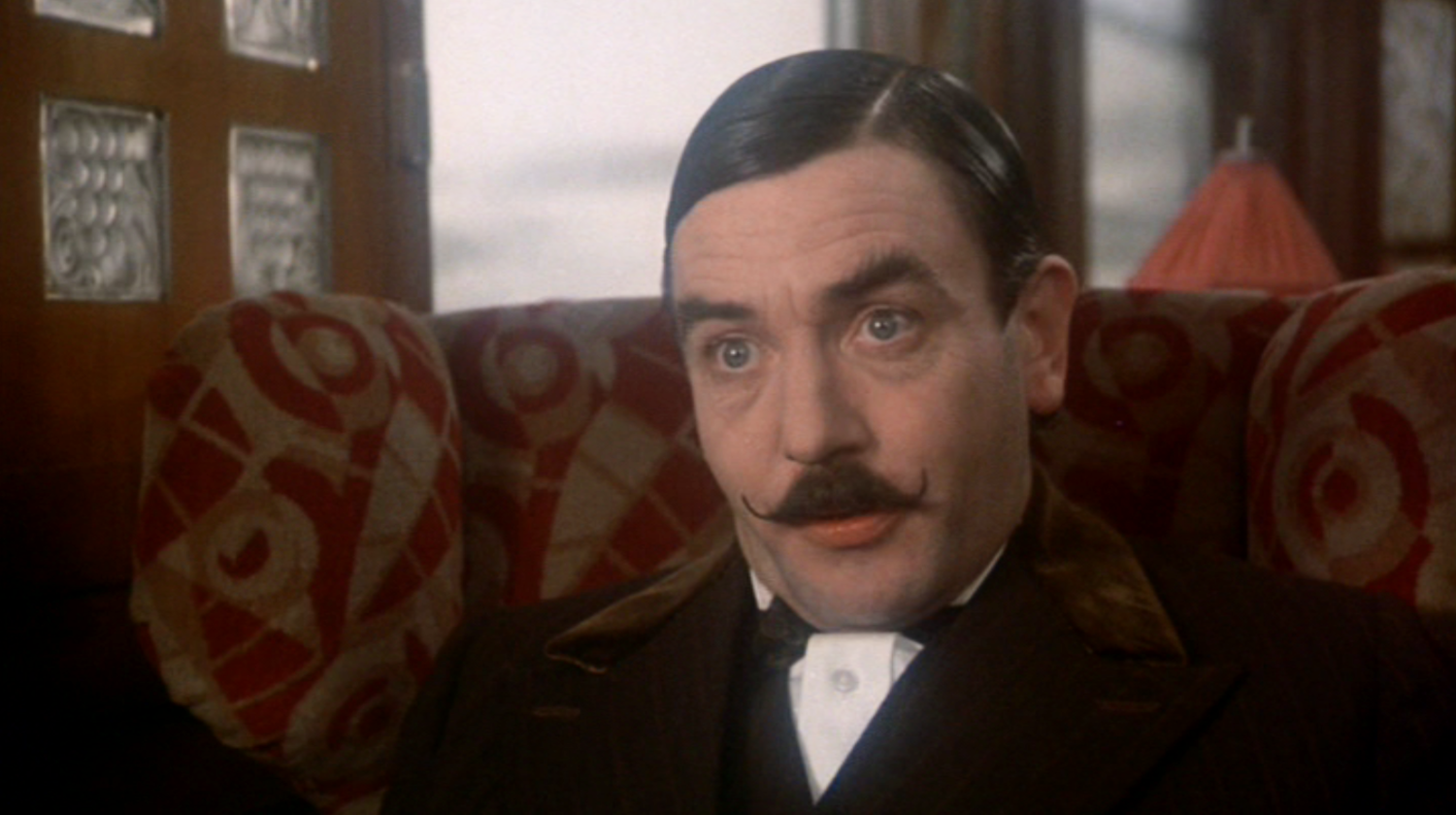
The advantage of having such accomplished actors was most clear in the burden placed on Finney as Poirot. Watching it now – familiar as we are with decades of David Suchet’s definitive performance – it’s easy to see Finney’s performance as a little too much. Covered with make-up and a fat-suit, his shoulders hunched around his neck, his hair plastered down with grease and his accent frequently heading way out over the top, Finney certainly leaves very little in the dressing room. His Poirot is an amiable showman, a man willing to adjust his personality and approach from suspect to suspect, but in the end a man with a well-being arrogance and a deep sense of personal morality as well as a profound sense of humanity.

Finney was a surprising Oscar nominee for Best Actor, but he almost certainly owed this to his final speech, an almost thirty-minute tour-de-force. Lumet, operating in small confines, determined that the best way of getting the most dramatic energy from the speech was to use long takes, elegant camera moves, and the minimum of cutting – to let Poirot cast his spell over the audience as much as he does over the suspect. As such Finney – in a tiny, crowded, set – performed the complete monologue several times (each time apparently flawlessly) so that the camera could be positioned in each point in the confined set at a time. The result is seen in the final sequence, which uses dizzying long takes and careful camera moves to draw us brilliantly into the reveals that come thick and fast.

Finney’s performance is magnetic in its theatricality and commitment, and Lumet’s directing decisions throughout the sequence really help to make this sequence as effective as it is. Lumet’s peppers this sequence with a series of brief flashbacks to earlier in the film, which skilfully present snippets of the characters testimonies represented at different camera angles, which is both eerie and also throws a new light on the scenes we have already seen. For all that Finney is a bit much at times, you can’t help but enjoy this piece of showmanship.

The final resolution remains justly famous, and it largely owes a lot to this film. Agatha Christie even was favourable to the film (one of only two films of her work she liked, the other being Billy Wilder’s adaptation of Witness for the Prosecution) although (in words I presume heard by Kenneth Branagh) she bemoaned the smallness of Finney’s moustache. There have been several film and TV adaptations that have followed, but only David Suchet’s version has challenged it for the title of the best. With its gorgeous settings, imaginative direction and wonderful cast I never tire of watching it.

The Anderson Tapes (1971)

Sean Connery plans the perfect crime under the noses of the government in The Anderson Tapes

Director: Sidney Lumet

Cast: Sean Connery (John “Duke” Anderson), Dyan Cannon (Ingrid Everleigh), Martin Balsam (Tommy Haskins), Ralph Meeker (Captain Delaney), Alan King (Pat Angelo), Christopher Walken (The Kid), Val Avery (“Socks” Parelli), Dick Anthony Williams (Edward Spencer), Garrett Morris (Everson), Stan Gottleib (“Pop”)

Everywhere we go now we kind of know that we are being watched. There are cameras everywhere. Satellite links build into our cars. Heck we all carry everywhere we go a portable tracking and recording device that can be listened into. So the idea of surveillance being ever present wouldn’t be a surprise to us. But in 1971, the idea that the government could be listening all the time, at any time was something that couldn’t cross anyone’s mind. 

It certainly doesn’t occur to John “Duke” Anderson (Sean Connery) just out of chokey after a ten year stretch. He’s back into a world he hardly understands, but it doesn’t take longer than five minutes in the swanky apartment block of his girlfriend Ingrid (Dyan Cannon) for him to case the joint and plan to do it over – all the apartments at once. Putting a crew together, Duke plans to clean out all the whole block of all its valuable property in one go, with financial backing from the Mafia (who owe him for unspecified reasons). Problem is, Duke’s entire plan is being recorded and monitored by different government agencies from top to bottom who – even if they aren’t speaking to each other – are in position to wreck his plans the instant anyone puts the clues together…

The Anderson Tapes is part crime thriller, part black comedy caper. It generally plays it pretty light – with flashes of violence or danger – and throws in some satire on the surveillance age. The tapes in question are different levels of surveillance at every location Duke seems to stop at. His time in the apartment is recorded by a PI following his girlfriend. The feds bugging his mafia contacts. Most of his criminal gang are being watched by the cops. All this recording creates a load of trees which block the view of the forest. Not one of these agencies thinks about joining up their thinking, meaning the actual robbery comes as a complete surprise to all of them. It’s a neat satirical mark on the incompetence of administrative led organisations – when the robbery is finally being reported by a ham radio operator, the news almost doesn’t get through because of a refusal by the 911 operator to transfer a call without an agreement on who will pay the charges for the call.

In all this surveillance Duke is like a romantic hangover from a by-gone time. As played by Sean Connery he’s a romantic figure, like some sort of working-class Raffles, living by the principles of a gentleman thief. He abhors violence, gets on well with all races and creeds, respects his victims and protects them (so long as they don’t get in his way) and runs operations designed to be clean, quick and painless. He justifies his thievery with talk of how most of the property he nicks is just sitting pointlessly in safes, that the insurance will pay out and that in a way he’s giving a bit of excitement to bored middle-class people. Connery is rather good in this role, channelling this rogueishness and expertly maintaining Lumet’s light tone.

Lumet’s direction is competent, professional and assured. Lumet did not hold the film in high regard – it was one he did “for the money” – but he expertly constructs the film, keeps it tight and brings more than enough intriguing directorial flourishes to it. The action frequently pauses in the criminals conversation for a jump cut to the feds listening to the recordings, having paused the recordings themselves (the paused action even uses voiceover from the feds asking for confirmation of who they are listening to). Later, Lumet uses a similar device in the robbery interjecting flash forwards to the people in the apartment bloc being interviewed on site by the police, commenting on events we have often just seen while the aftermath plays out behind them, that throws in plenty of narrative curve balls and misdirects as the action pans out.

The film is dated in places. Quincy Jones’ score often uses a jarring series of electronic beeps that are meant to echo the surveillance of the piece, but actually sounds impossibly dated and jarring. An opening monologue of Connery on the thrill of safe cracking uncomfortably sounds like he is comparing it to non-consensual sex, Martin Balsam’s gang member is an impossibly limp-wristed antiques expert (although he is immediately believable as someone who wouldn’t be questioned surveying apartments for architectural improvements while he is actually casing the joint). There are other moments – but the film gets by because it never leans too hard on any of these attitudes. Indeed the apartment concierge, is depicted as inflatteringly racist and homophobic, in stark contrast to the multi-ethnic, un-prejudiced gang carrying out the robbery.

The Anderson Tapes is an enjoyable, is very 1970s, piece of work that has more than enough to entertain you. It has a clever structure and makes some sound points on surveillance which probably make it more relevant today than it even was then. Connery is very good in the lead role and there is some excellent support (Christopher Walken is strikingly charismatic in one of his first roles). It’s not in the first rank of its director’s films, but it’s still a very fine caper thriller.