Tag: Sebastian Stan

The Apprentice (2024)

The Apprentice (2024)

Heavy-handed anti-Trump message is made to almost work by two excellent performances

Director: Ali Abbasi

Cast: Sebastian Stan (Donald Trump), Jeremy Strong (Roy Cohn), Maria Bakalova (Ivana Trump), Martin Donovan (Fred Trump Snr), Catherine McNally (Mary Anne Trump), Charlie Carrick (Fred Trump Jnr), Ben Sullivan (Russell Eldridge), Mark Rendall (Roger Stone), Bruce Beaton (Andy Warhol)

No one has dominated recent global discussion more than Donald Trump. The Apprentice aims to expose how he was formed – inevitably, you can’t move for reviews referring to it as a Supervillain Origin Story – but really, it’s being sung for the choir and I’m not sure it really adds anything to the international conversation. I can’t imagine this film shifting the dial at all (which indeed it didn’t): if you hate Trump (and I am not a fan), it’s gonna confirm everything you think already and then some. If you are a supporter you’ll probably think it’s a shrill hatchet job. Both sides might well agree Abbasi’s film is a little hectoring.

Picking up in the late 70s, and running through the all-consuming Greed-is-Good Reaganite America, The Apprentice charts the friendship between up-and-coming would-be-property-mogul Trump (Sebastian Stan) and ruthless McCarthyite legend lawyer Roy Cohn (Jeremy Strong). Cohn takes Trump under this wing, teaching him his three rules for success (always attack, never apologise, always claim victory no matter what). Under this guidance, Trump becomes the figure of bombastic, selfish egotism we see today – while Cohn, afflicted with AIDS, shrinks under his protégé’s shadow.  

Watching The Apprentice I was reminded of Oliver Stone’s Nixon – and not in a good way. Stone is no supporter of Nixon, but his film is a surprisingly generous Greek Tragedy which plays fair with the 37th President, acknowledging his strengths as well as his chronic character flaws. The Apprentice abandons any attempt to do the same by the halfway point. Part of that may well be that Trump is an infinitely more shallow, less complex, less accomplished figure than Nixon. But if The Apprentice had dared to find anything a little deeper in Trump (his complex relationship with his family would have been good for this) it might have had more impact.

Instead, it’s a Faust story where the power balance shifts from Mephistopheles to Faust. At first Cohn is all powerful, tempting Trump with the power and influence to transform him from two-bit rent collector to king of the world. But the more confidence Trump gains, the more he dwarves Cohn. And the more Cohn is slowly eaten away by weakening powers and the AIDS he refuses to acknowledge he has, the smaller and more desperate he seems. It’s almost a succubus tale, with Trump draining Cohn so much he ends the film passing off his mentor’s mantras as his own invention.

The film’s most interesting section by far is it’s opening hour. It’s the only part that presents us with a Trump we don’t know already. In an excellent, Oscar-nominated, performance Sebastian Stan not only captures Trump’s mannerisms he also searches under the man’s shallow surface. Stan makes the young Trump bashful, eager-to-please, over-awed by power and nervous in high society. Seeing a naïve, fragile, uncertain Trump whose father doesn’t love him is genuinely interesting – especially since we all know the cast-iron certainty he has today. It could have done with more of this, trusting us to lay our knowledge of the man today on top.

The main factor that really lifts The Apprentice our two leads. Both Stan and Strong find an emotional depth and insight in their characters (while never absolving them) that makes them more three-dimensional than Abassi’s film wants to make them. Jeremy Strong is particularly superb (and also Oscar-nominated) as Cohn. Whipper-thin, tanned, his head aggressively jutting forward he resembles a sort of angry ferret. Strong brilliantly captures the vicious contradictions in Cohn – the Jewish antisemite, the gay homophobe – and his demonic, but Strong brilliantly unpeels Cohn’s weakness. Trump absorbs all Cohn’s vices (and then some), but none of his few virtues – personal loyalty, patriotism. Strong never makes Cohn sympathetic, but also displays his pain, unhappiness and possibly even guilt, as he realises this uncaring monster will even consume his creator. (Strong’s final scene of the dying Cohn confronting Trump’s indifference one last time is superbly played).

Abbasi’s film is well-made – the photography frequently degraded to appear like grainy camcorder footage – and its filmed with a handheld, pacey immediacy. It captures the excess Trump lives in, with its golden surfaces and more-is-more bling. All of this is aimed at exposing the future President as overwhelmingly self-occupied, amoral and cruel, interested only in himself and seeing morals. None of that is a major surprise and Abbasi is a little too delighted with pricking Trump’s fragile ego, portraying him as impotent, sniggering at his hair loss and weight gain (although this allows a neat gag, with Trump telling a doctor the body has a limited amount of energy so exercise is actually bad for you – something he refuses to accept is not true).

Trump’s treatment of Cohn is the tip of the iceberg of the depths of Trump’s personal behaviour the film gleefully shows. Trump’s penchant for self-aggrandising speeches, his kneejerk homophobia about AIDS (his fear of catching it by touch leads to him fumigating items Cohn has touched), his indifference about relationships (swindling his father and dropping his alcoholic brother) all get ample coverage. He pursues Ivana (a very good Maria Bakalova) with a passion then, having got her, treats her only as something he can brag about (particularly her ‘improved’ breasts), becomes jealous of her growing fame. It overplays its hand by dramatising the disputed rape of Ivana by Trump – a crime so serious you feel it should be beyond question and not be treated as part of a parade of personal faults, never to be referenced again.

But that’s because The Apprentice never knows when to stop. If it had the courage to expand its opening hour, to explore the malign effect of Cohn on this ambitious young man, with a coda showing the fall of Cohn in the shadow of the Trump we recognise – it would have been a more interesting film. Instead, it seems designed to hammer home a political agenda rather than provide drama or insight making it more heavy-handed and obvious than it needed to be. Aside from the two marvellous performances from Stan and Strong, there is actually very little really here.

Destroyer (2018)

Nicole Kidman goes way-against-type as a bend the rules cop in Destroyer

Director: Karyn Kusama

Cast: Nicole Kidman (Detective Erin Bell), Sebastian Stan (Chris), Toby Kebbell (Silas), Tatiana Maslany (Petra), Bradley Whitford (DiFranco), Jade Pettyjohn (Shelby Bell), Scoot McNairy (Ethan), Toby Huss (Gil Lawson)

There are few things that pique the interest of reviewers and viewers more than a celebrated Hollywood star going well against type, looking rough, playing tough and letting those shades of grey flow freely. That’s the cheap interest in Destroyer, Karyn Kusama’s engaging, well-made thriller which showcases the sort of way-against-type performance by Nicole Kidman that practically demands the poster scream “Kidman as you’ve never seen her before!”. Of course this all serves to obscure that Kidman is a damn fine actress and a committed performer, and she gives it everything in this grimy, underworld thriller of compromised cops and ruthless robbers.

Erin Bell (Nicole Kidman) is a detective with a shady past: an undercover operation with an FBI Agent Chris (Sebastian Stan) which went wrong 15 years ago. In the present day, the body of a John Doe in Los Angeles opens up links to this case from the past, causing Erin to start a rogue investigation into her old undercover days and the gang members she knew back in the day, specifically her long-held grudge against the psychopathic Silas (Toby Kebbell).

Destroyer gives us a familiar story – the cop with the dodgy past, gone to seed, playing against the rules, tired of life, with a shattered family background, investigating what could be one last case that has devastating links to the past – but presents it from a slightly new angle by making the protagonist a woman. This calls for a terrific performance from Nicole Kidman, who is bashed up, run down, grouchy, seedy and above all immensely damaged. Kidman’s skill at a performer is evident in every scene, creating a character who cannot escape from the burdens of her past, who rejects all help and who is unable to live with the burden of some sort of unspecified guilt.

Much has been made of Kidman’s roughed up, broken nosed, run down, alcoholic appearance (the film gets a lot of mileage over close ups of her ravaged, aged, alcoholic’s hands), but her commitment to the role transcends any deliberate slumming. She is completely believable as the sort of rough-and-tumble, rule breaking cop. The make-up also means that the flashback scenes to a 15-years younger Erin are immediately clear – and give us a clear indication of how far she has fallen since her more hopeful days.

The film is all about the burden of the past, and the film constantly flashes back and forth between the present day and Erin’s time undercover. The film carefully and slowly unveils the exact reasons for Erin’s guilt and why she has become the person she is, but the burden of it hangs over every scene in the present and is visible in Kidman’s eyes in every scene. It brings these themes to life extremely well and weaves an engaging story, even if everything in it seems like a collection of familiar events from other films.

In fact that is the film’s biggest weakness, right there. Many of the events, characters and themes in it feel like they have been plucked from a range of noir thrillers, thrown up into the air, and then reassembled into a new patchwork. As impressive as Kidman’s character is, it’s familiar to us from any number of hard-boiled cops past. The film’s structure – of Kidman going from contact to contact to get closer to Silas – basically allows for a series of actors to give performances that, for all their skill, end up feeling like a random collection of stock characters. None more so than Silas himself who, despite Toby Kebbell’s best efforts, is a totally forgettable rent-a-psycho. But then you can say the same for Tatiana Maslany’s aged junkie and, for all his slimy excellence in the role, Bradley Whitford’s sleazy money launderer. Other characters feel the same as well, from Kidman’s troubled teenage daughter, her would-be gangster boyfriend, Erin’s put upon ex-partner or her wearily understanding partner. These people all seem, to various degrees, to be stock caricatures rather than characters.

What really makes the film work is the dynamic, often hand-held, kinetic energy of Karyn Kusama’s direction. Jittery, immediate and very real, Kusama makes a number of these stock situations – from shoot outs to roughing up suspects – look at least new and exciting. The two main shoot outs in the film are extremely excitingly done and make for gripping set pieces, with the added originality of seeing the main players being women. 

But the film itself is just a little too obvious and stock for it to really stand by itself, for all the quality of the direction and the excellence of Kidman. There are some moments that work brilliantly with the unexpected twist of having a woman in the lead role and seeing Kidman throw herself into a gunfight with a heat-packing disregard for her own safety is all the more electric for it. But it’s still a little too predictable and familiar – for all the fact that there is a decent semi-twist towards the end that reveals not all is as we thought at the start – which perhaps doesn’t make it a film for all time.

I, Tonya (2017)

Margot Robbie triumphs as Tonya Harding in I, Tonya

Director:  Craig Gillespie

Cast: Margot Robbie (Tonya Harding), Sebastian Stan (Jeff Gillooly), Allison Janney (LaVona Golden), Julianne Nicholson (Diane Rawlinson), Bobby Carnavale (Martin Maddox), Paul Walter Hauser (Shawn Eckhardt), Caitlin Carver (Nancy Kerrigan), Bojana Novakovic (Dody Teachman)

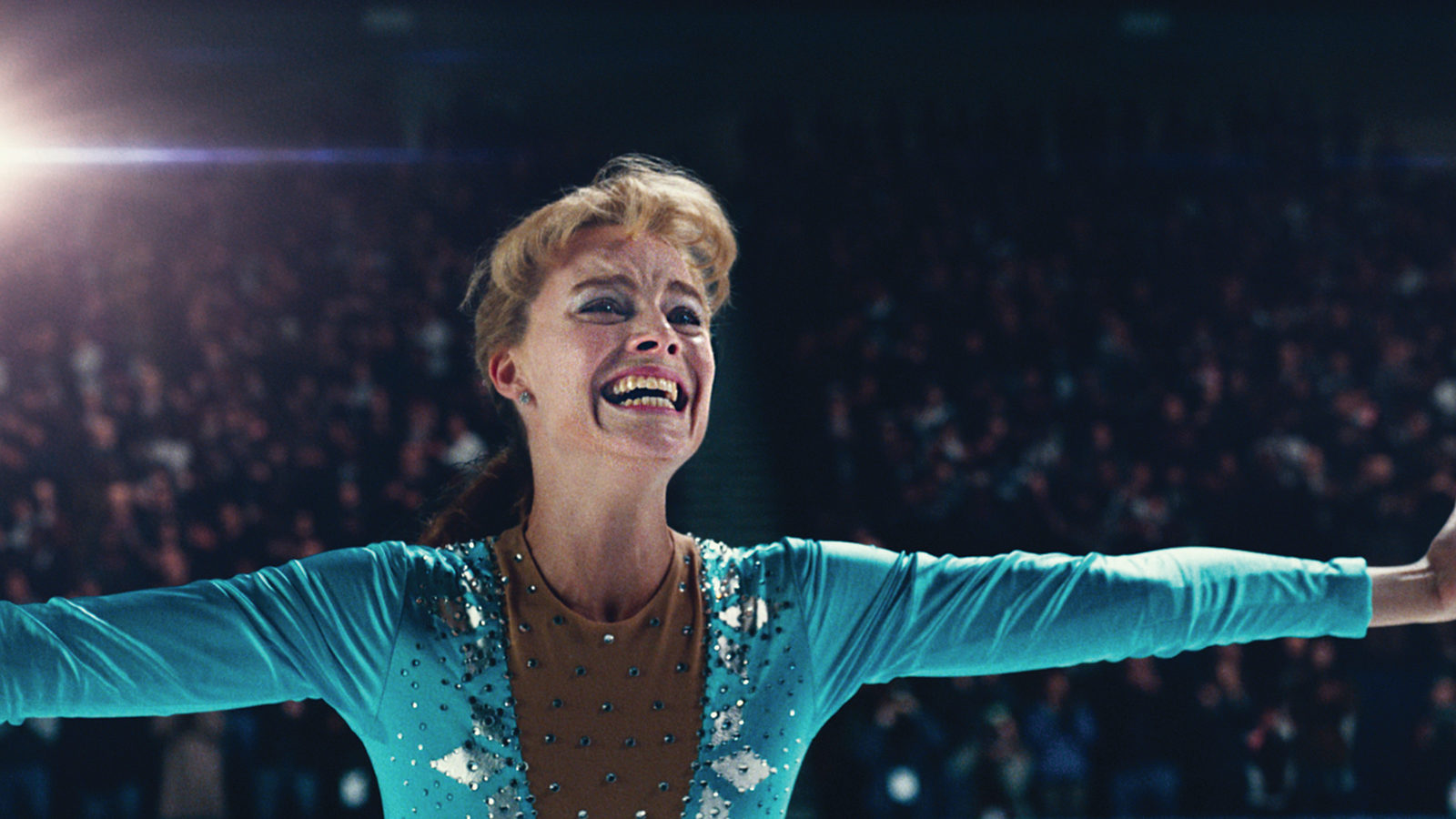
In 1994, Tonya Harding (Margot Robbie) is the bad-girl of ice skating. From a working-class Portland background, with a domineering mother (Allison Janney), she struggles to be accepted in the upper-class world of ice skating. After some success, including becoming the first American ice skater to complete two triple axel jumps, she constantly finds success undermined by her own failings and indiscipline, and the influence of her wastrel, abusive husband Jeff (Sebastian Stan). When competing with rival Nancy Kerrigan for a place on the 1994 Winter Olympic team, Tonya encourages her husband to send Kerrigan threatening letters to put her off. What happens instead is an attack on Kerrigan that breaks her knee – and the fallout will have devastating consequences.

I,Tonya is much more than a film about an attack on a rival skater. Tonya (in the film) complains that the event (which she claims to have had so little to do with) has overshadowed her whole life, but that’s not a mistake the film makes. The film is instead a brilliant deconstruction of class and media in America. Tonya struggles in the world of ice skating because she comes from a working-class, trailer-trash background. This leads her to grow up with several chips on her shoulder, aggressively acting out against judges and fellow competitors, because she wants to belong but never feels she does. In a country that likes to pride itself that it doesn’t have the sort of class system the UK has, it’s a striking commentary on how Tonya completely fails to escape the impact of her poor, violent background – and uses it as a justification and excuse for everything that happens to her in the film.

Her background also makes it every easy for the media to cast Tonya as a villain, first as the difficult punk of ice skating, later as the Machiavellian arch schemer of a vile plot. The worst part of this is – like the reality stars of the 00s who would follow her – Tonya feels she needs to keep playing a role in order to “stay in the public eye”. In turn, the media – largely embodied here by Bobby Cannavale’s delighted media commentator, who gleefully recounts every key moment of the film in a smug series of talking head interviews – keeps the pressure on, puffing her up into whatever it requires her to be to fill a 24 hours news cycle. It’s surely no accident that the film ends with camera moving away from Jeff’s house, while news of OJ Simpson’s arrest plays on the television.

And why does Tonya fit herself into this role? Because, the film suggests, she is a victim who has confusingly absorbed her victim status into her personal relationships and self-value. Treated appallingly be her domineering mother, and hit constantly by her worthless husband, Tonya clearly believes that she is personally of very little worth. If she is so used to being an angry, raging punchbag at home, is it any wonder that she settles into that role publically? To the extent that, throughout, Tonya constantly sidelines or pushes away the more supportive people around her, like Julianne Nicholson’s (who is very good) dedicated coach.

The film handles this range of complex psychological and social themes with aplomb. In a neat touch, the film acknowledges that the events of its narrative are so controversial that everyone in it has a different view. The film is framed through a series of talking head interviews with the leading players (played by the actors) twenty years on. Each of them tells a contradictory version of the story and around the “incident”. The film, bravely, gives some weight to all these viewpoints. It’s brilliantly handled, as we see certain scenes from the perspectives of different characters, which makes them much easier to relate to. Gillespie also has a lot of fun with the film leaning on the fourth wall – frequently characters turn to the camera mid-scene for a few words of commentary, sometimes to stress a point, other times to deny the thing we have just watched ever happened. 

The eclectic and dynamic storytelling works an absolute treat, and Gillespie gets the tone absolutely right. While dealing with serious themes, the film is also blissfully funny. Much of the fourth wall humour is brilliant. While taking the characters seriously, the film is also written with a real dark wit. And (once you remind yourself that Kerrigan’s career was not seriously affected by the attack), the build up to the scheme itself, and the feeble cover up, is hilarious. Everyone in the chain of events is stupider than the person above them. Tonya is no genius, her weak husband is a clumsy fool, his friend Shawn an idiotic fantasist, the men hired to attack Kerrigan almost unbelievably stupid. The inevitable crumbling of the plot is hilarious in its disintegration.

It works as well because of the strength of the acting. Margot Robbie is superb as Tonya. She fills her performance with empathy for Tonya, but never lets her off the hook – Tonya never takes responsibility at any point for anything she does. Robbie gets the balance just right between the “little girl looking for love” vulnerability of Tonya, mixed with the bitterness and rage that always lurks just below the surface. She acutely understands the messed up psychology of someone who has been treated badly by everyone around her, and then finds it impossible to form a healthy relationship with the world.

On Oscar-winning form, Allison Janney rips into the sort of part that must have (rightly) looked like a total gift on the page. It’s a scene-stealing role: Harding’s mother is a foul-mouthed bully whose every other line is a zinging put down or resentment-filled burst of cruelty. Janney, however, keeps the part real: there is always a sense that somewhere in there, she genuinely feels she is doing what’s best for her daughter, even if her methods are completely misguided. Sebastian Stan is equally good as Tonya’s weak-willed, not-too-smart husband and Paul Walter Hauser is hilarious (as well as a remarkable physical match) as Shawn. 

I, Tonya is a very smart, very funny piece of social satire mixed with tragedy. While being very funny, it’s also sad and rather moving. It has some terrific acting in it and is directed with confident, but not overly flashy, aplomb by Gillespie. As a commentary on the media it’s well judged, and as a look at the impact of class at America it feels fresher than ever.

The Martian (2015)

Matt Damon is Lost in Space in The Martian

Director: Ridley Scott

Cast: Matt Damon (Mark Watney), Jessica Chastain (Commander Melissa Lewis), Jeff Daniels (Teddy Sanders), Kristen Wiig (Annie Montrose), Chiwetel Ejiofor (Vincent Kapoor), Sean Bean (Mitch Henderson), Michael Peña (Major Rick Martinez), Kate Mara (Beth Johansson), Sebastian Stan (Dr Chris Beck), Aksel Hennie (Dr Alex Vogel), Mackenzie Davis (Mindy Park), Donald Glover (Rich Purnell), Benedict Wong (Bruce Ng)

Imagine being abandoned somewhere really difficult to get out of. Now how about being abandoned somewhere where it’s literally impossible to escape? Well you can’t get much more impossible than Mars, a place so bloody difficult it doesn’t even supply you with such luxuries as oxygen, water or food. But that’s exactly what happens to astronaut Mark Watney.

Part of the first manned mission to Mars, Watney (Matt Damon) is struck by debris and presumed killed after a storm forces the crew to abandon their planet. With no one on Earth aware he is alive, Watney faces huge difficulties: the next Mars mission isn’t for four years, and will land over 2,000 miles away. He has only enough food for at best a couple of years, and his Mars Rover can only travel 70 miles before it needs to be recharged. Fortunately, Watney (as well as being incredibly inventive) is a botanist – and works out a complex improvised farm in the base to grow potatoes (the only potential crop he has) as well beginning to modify the Rover to drive to the next mission site in four years. But things change when NASA (after holding his funeral) spot his movements via satellite – and now the race is on to organise a rescue mission.

The Martian perfectly works out what we find appealing about survivor stories: a charming, easy to relate to, protagonist who inspires with his never-ending MacGyver-ish invention. The best sequences by far focus on this, as Watney uses whatever he has available, from radioactive waste to his own shit, to try and save his life. There is something hugely compelling about seeing such inspiration in the face of adversity – perhaps because you want to believe “heck that’s what I would do…”

The first half of the film is crammed with these moments, made even more enjoyable by Watney’s off-the-wall, amusing commentary on events via video diary. Watney never succumbs to despair but instead constantly puts as positive as possible a spin on his situation, aware that opening the door to despair is the road to the end. A lot of this works so well because of Matt Damon’s terrific performance in the lead role. It’s no easy thing basically holding the screen entirely by yourself, but Damon does an amazing job here. He’s not just funny and engaging, but he also subtly touches on deep inner feelings of isolation and loneliness.

Scott understands all this and shoots most of the sequences with Watney with a low-key, calm but technically assured simplicity. He lets the action here largely speak for itself, and shows a better ear for comedy than I think many people thought him capable of. He also uses Watney’s “suit cam” and the video diary format to constantly shake up the visuals and allow us to see Watney’s actions and decisions from different perspectives. His mastery of the sweeping epic comes into its own when the camera swoops over Martian panoramas, making the hostile red planet look unbelievably beautiful. 

It’s easy to see why NASA supported this film so strongly, as the organisation comes out of this impossibly well. This is essentially a fictionalised retelling of Apollo 13, with the astronauts surviving above, while the ingenious techies below work miracles to first communicate with, and then devise a rescue mission, for Watney. The film is deeply in love with NASA – despite some personality clashes, the NASA characters are all shown to be highly intelligent, compassionate people. Even “the suit”, Director Sanders (played with a square jawed patience by Jeff Daniels), is basically a humanitarian who wants to preserve human life (and is cool enough to have a brilliant Lord of the Rings gag).

Despite this, the struggles of the various bigwigs at NASA to save Watney are slightly less interesting than the opening half of the film based around Watney’s struggles to survive. Perhaps because, well done as it is, we’ve seen this sort of stuff before, done better – not least in Apollo 13 – and partly because what NASA is trying to do is not quite clearly explained in layman’s terms. Think of the simple brilliance of Apollo 13 when the engineers need to create a filter using only what the astronauts have on the ship: it’s easy to understand, clear, brilliant and gripping. Comparative scenes in this film just don’t land as quickly.

The film also struggles as events and twists in the midway part of the movie lead to Watney losing a lot his agency. Since most of the film’s unique enjoyment is seeing Watney conquer his environment, and gain mastery of the rotten hand that fate has dealt him, as soon as that element is removed and Watney turns into more of a man in distress, the film struggles to maintain its unique interest. It makes the second half of the film more conventional (Damon is noticeably in this much less, considering how much he dominates the first half) and also ends up comparing unfavourably with other, better films (sorry I mean Apollo 13 again…)

But The Martian is crammed with good lines, fine jokes and some good performances – even if some of the characters seem a bit sketchily drawn. Benedict Wong is very good as NASA’s top techno bod. Chiwetel Ejiofor and Sean Bean do well as the most clearly sympathetic senior NASA bods. Up in space, the rest of the crew are very lightly sketched, but Jessica Chastain gives a fine sense of authority to the Mission Commander. But make no mistake this is Damon’s movie – and he dominates both the audience’s interest and the film’s.

The Martian is a very well made, intelligent crowd-pleaser. It’s not a classic – and it’s slightly in the shadow of better movies – but it’s brilliantly put together and hugely engaging. The second half of the story is less compelling and more conventional than the first, but there is more than enough invention and enjoyment there for you to want to come back and see it again.

Captain America: Civil War (2016)

Captain America and Iron Man stand-off in overblown Captain America: Civil War

Director: Anthony and Joe Russo

Cast: Chris Evans (Steve Rogers), Robert Downey Jnr (Tony Stark), Scarlett Johansson (Natasha Romanoff), Sebastian Stan (Bucky Barnes), Anthony Mackie (Sam Wilson), Don Cheadle (James Rhodes), Jeremy Renner (Clint Barton), Chadwick Boseman (T’Challa), Paul Bettany (Vision), Elizabeth Olsen (Wanda Maximoff), Paul Rudd (Scott Lang), Emily VanCamp (Sharon Carter), Tom Holland (Peter Parker), Frank Grillo (Crossbones), William Hurt (Thaddeus “Thunderbolt” Ross), Daniel Brühl (Helmet Zemo), Martin Freeman (Everett K Ross), Marisa Tomei (May Parker), John Kani (T’Chaka), John Slattery (Howard Stark), Hope Davis (Maria Stark), Alfre Woodward (Mariah Dillard)

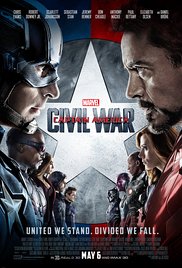
Captain America: Civil War is another explosive entry in the MCU, and is even more stuffed than usual, with nearly all our Avengers thrown into the mix – with the added twist that they fight each other! Yup it’s time for another playground argument: “If X fought Y, which one would win?!” That’s the main thrust of Captain America: Civil War, but it’s actually a distraction from the real plot. The much hyped fight at the airport (and the build-up to it) is a rather dull hour in the middle that distracts from a richer, more interesting film.

There is dissent in the ranks of the Avengers. The UN wants them to sign the “Zukovian Accords” – an agreement that they will work only under the direction of the UN. For Tony Stark (Robert Downey Jnr) this legal framework for their actions is essential – but Steve Rogers (Chris Evans) argues that the Avengers need to have the freedom to go where they are needed, not only where they are told. In this tense situation, a bombing in Vienna is swiftly blamed on Roger’s old friend Bucky Barnes (Sebastian Stan), who has become the brain-washed killer The Winter Soldier. In disagreement with Stark about the Accords and determined to protect Bucky, Steve quickly finds himself on a collision course with Tony.

The central idea here is actually fairly interesting: are superheroes people with a higher duty or just a group of vigilantes? Should they follow the direction of politicians – or be free to go where they are needed, when they are needed? How much accountability should they hold? If, in saving the world, dozens of civilians should die in the aftermath, is that acceptable or not? These are the ideas that lie under the arguments that the characters – principally Captain America and Iron Man – have. 

The first 40 minutes set this up nicely: an operation goes wrong, people are killed and the Avengers are confronted with footage of the collateral destruction they have caused while saving the world. But these ideas get left behind as the film gets caught up with pushing our characters into an artificial-feeling battle so destructive that an entire airport gets trashed by the “let’s cool our actions” team while trying to stop the “we should be independent” faction.

It would have been really nice to have these ideas explored in more depth, rather than a few moments here and there. Essentially, the film hires Alfre Woodard to deliver a top-notch performance as a mother whose son was Avengers collateral damage, to convince Tony things need to change, and leaves it at that. Steve’s counter-argument gets laid out swiftly – though he strangely makes no reference to the fact that the previous film saw a very similar “government organisation” revealed as the source of all evil in the Marvel world. It’s quick beats like this that set up this collision – but only Tony and Steve get any chance to express any form of developed views (in a few very well acted scenes). The motivations of the rest of the Avengers seem under-developed.

But that’s the problem with Captain America: Civil War: it’s seriously overstuffed. With some of these plots and characters removed, we could have actually had a very rich, thematic story.

The whole “Zukovia Accords” plot also has to constantly juggle for space with leftover “Winter Soldier” plotline from the previous two films. Truth be told, the latter is the more interesting, dealing with actual emotions, friendships and loyalties – chiefly the bond between Bucky and Steve (very well illustrated in a few brief, well played scenes). It’s this dilemma of whether Bucky can be held responsible for things he did under mind control that becomes the film’s key question. This plot line works far more effectively as it basically involves only three of the characters and feels like it has genuine things at stake, in a way I just can’t feel about the forced “civil war” angle. 

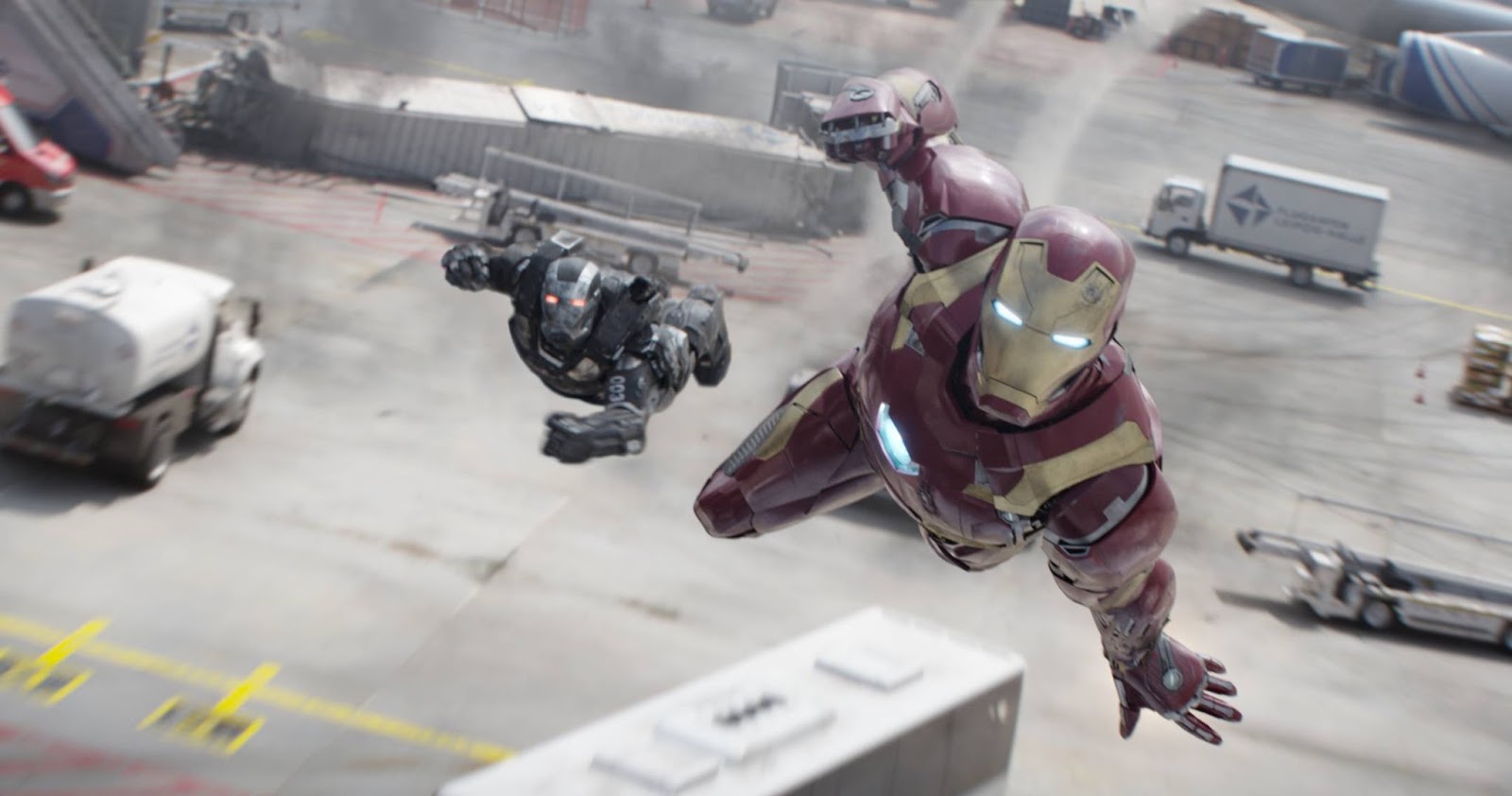
But it’s that civil war angle that the film is being sold on – and it’s what the middle section of the film is given over to. The big, airport-wrecking battle between the two sides is well shot, has good special effects and throws in plenty of neat one-liners. But what it completely lacks is any sort of dramatic tension or any stakes. As our heroes indestructibly bounce around while swapping light banter you never feel that this battle really amounts to anything. The sides don’t seem that far apart, or really that different – in fact the whole thing feels like playground horseplay.

The big battle is even undermined by the fact that we’ve already seen our heroes fight each other at least twice already in small combinations – and in all these cases, bodies are thrown about mercilessly but no one suffers more than a few scratches. Even after a character falls hundreds of feet to the ground, he’s later shown as basically being absolutely fine. The big battle is supposed to be the exciting showpiece, but it’s basically just big filler. A load of noise, where nothing really happens and no-one really feels at any risk, with no real consequences (all the emotional consequences emerge from the smaller scale final confrontation which would be unchanged if this airport fight was removed).

The film only really recovers again once that fight is benched, and we wind up with three of our heroes squaring off over very personal issues. This also brings to the fore the Daniel Brühl’s fascinating character, a very different type of villain: someone whom the film plays a neat game of misdirection with. The film reveals one of its themes as revenge, and how much it can dominate or twist our lives. This is given voice through a wonderfully written and played scene between Brühl and Boseman (very dynamic as the future Black Panther, dealing with grief over the murder of his father).

That scene gives an insight into the film’s real strengths: the small moments. The bits where the overblown fighting can be put to one side and we can see these characters (and the very good actors who inhabit them) talk. Moments like this carry more humanity, interest and tension than a thousand sequences of a giant Ant-man. In these moments, Downey Jnr and Evans are both terrific. Evans was born to play this part, making Rogers adamantine in his decency and nobility without being wearing, and also demonstrating an increasing streak of an old-soul who is tired of listening to other people and wants to make his own choices. Downey Jnr increasingly makes Stark a man hiding resentments, fears and doubts under a veneer of cool. Several other excellent performances also burst around the margins of the film (I’d single out Mackie who is excellent as the loyal Sam).

It’s just a shame Captain America: Civil War wastes some strong material in the prolonged set-up – and then enactment – of its superhero feud. Enjoyable as it can be to see this sort of stuff from time to time, after a while it’s tedious to watch invulnerable people taking pot shots at each other with no discernible impact. A single conversation with stakes – with a doubt about whether a friendship will hold or not – has more tension and excitement than a hundred sequences of heroes hitting each other. There is a more interesting story here – but between the action and the obligatory set-ups for future Black Panther and Spiderman movies (excellent as Boseman and Holland are in these roles) it doesn’t quite reach its potential.

Black Swan (2010)


Natalie Portman in the intense world of ballet in Aronofsky’s crazy masterpiece Black Swan

Director:  Darren Aronofsky

Cast: Natalie Portman (Nina Sayers), Mila Kunis (Lily), Vincent Cassel (Thomas Leroy), Barbara Hershey (Erica Sayers), Winona Ryder (Beth MacIntyre), Benjamin Millepied (David Moreau), Ksenia Solo (Veronica), Kristina Anapau (Galina), Janet Montgomery (Madeline), Sebastian Stan (Andrew)

Something about ballet just makes people think of obsession. Many dancers criticised Black Swan for perpetuating myths about the dangerous psychology, the quest for perfection, the personal life imbalance connected with the all-consuming art ballet seems to be. It’s hard not to agree with them – but that doesn’t mean Black Swan isn’t unsettling, creepy and hypnotic film-making. 

Nina Sayers (Natalie Portman) is an obsessive member of the New York Ballet, focused on achieving perfection and lives a sheltered, barely adult life at home, dominated by her mother Erica (Barbara Hershey). With the forced retirement of company lead Beth McIntyre (Winona Ryder), Diagheliv-style director Thomas Leroy (Vincent Cassel) selects Nina to play the dual role lead of white and black swan in Swan Lake. Leroy feels she is perfect for the innocent white swan, but needs to work on the sensual black swan. Increasingly feeling the pressure of playing the role under the demanding Leroy – and growing increasingly preoccupied with her understudy Lily (Mila Kunis) – Nina’s fragile psyche begins to fracture.

Black Swan is a mesmerising mixture of psychological drama, melodrama, Cronenberg-style body horror, unreliable narration and immersion into a pressure-cooker world. It’s often difficult to watch, sometimes maddeningly over-blown, and overly tricksy in its intense visual style. But despite that, it’s actually compellingly watchable, an audacious tight-rope walk between style and substance that constantly feels like it’s going to get lost in its extremes but never does.

Aronofsky’s camera flies and whirls like the ballet dancers he is recording, and he creates a wonderfully dark spin on The Red Shoes. What I found particularly fascinating watching the film again after many years is how unreliable and imprecise so much of the story is. Told completely from the perspective of Nina – a woman subject to delusions, chronic social insecurity and an increasingly split psyche – it becomes clear that a lot of what we see may not be as clear-cut as we think. 

This most obviously affects our perception of Mila Kunis’ rival (or is she?) dancer Lily. How many of the interactions we see are actually happening, and how many are fantasies? With Lily becoming an alternative physical form for Nina’s projection of her own “black swan” persona (several times, Lily’s face morphs and shifts into Nina’s), we have to question virtually every appearance we see of her – and interpret her personality from the prejudiced, fearful view seen by Nina. Similarly, Barbara Hershey’s domineering mother (while undoubtedly controlling) is perhaps not the monster we see. She’s clearly 100% right in her fears for Nina’s sanity. How much of her behaviour is possessive jealousy and how much is it a protective parent who knows her daughter is a danger to herself?

Then of course we have Nina herself. Natalie Portman won every award going for her performance here, a tour de force of bravura dementedness mixed with vulnerability. Nina is a character who we only slowly realise as the film progresses is not the innocent, childlike waif she first appears, but has a much darker, more complex personality. Her “black swan” side – the darker, sexual side of her personality she is encouraged to explore – slowly expresses itself more and more as a physically. Portman clearly demonstrates the differences between the two sides of Nina’s personality. Her increasing desperation, isolation and insecurity are very effective – and the moments where she allows the “black swan” persona to control her actions are riveting.

Aronofsky explores Nina’s unbalanced mind with moments of pure body horror – although it’s grand guignol ickyness like this that probably pushed some people too far. It ties into most of the film being (quite possibly) a series of Nina’s vivid fantasies. Ballet wounds become increasingly magnified – from a broken toe nail early on, to Nina obsessively picking and scratching any wound. In one impossible to watch moment she obsessively picks off a long strip of skin from a finger wound (fortunately revealed immediately after to be fantasy). Beginning to believe she is growing wings, she obsessively scratches her back and has visions of swan flesh morphing over her body. At one point she fantasies her legs breaking into swan legs. In between this are bouts of sexual exploration – both solo and with partners – that seem increasingly unnerving. 

Aronofsky’s ballet world is one of meticulous work and back-stabbing brutality. An early sequence covers Nina’s almost ritualistic preparations of her ballet shoes. The troupe, far from supportive, seems to be ripe for bitchy debate and rivalry (although of course some of this may well be Nina’s unhinged perception). Winona Ryder has a neat cameo as a former star dancer, ruthlessly dumped for being too old. Vincent Cassel’s director is at best a domineering bully and at worst a position-abusing horndog, depending on how reliable Nina’s perspective is. It’s the setting of a melodrama, and Aronofsky has expertly mixed a Silence of the Lambs style psycho-drama and The Fly style horror.

Portman holds the film together brilliantly under Aronofsky’s distinctive direction. It’s not going to be for everyone – but Aronofsky understands ballet if nothing else, shoots it brilliantly, and when we finally see Nina fully transformed as the Black Swan dancing the final performance, the energy and controlling focus of her performance, and its beauty, really comes across (even to a ballet ignoramus like me).

Black Swan is such an off-the-wall mix of styles, and so out there in some of its visuals, story developments and characterisations, that it’s not going to please everyone. In fact, catch this on the wrong day and you’ll hate this film (and probably really, really, really hate it). But catch it at the right time and it will stick with you. But whatever your view of its gothic style and content, you’ll admire Portman’s performance, respect the craft with which it has been made, and enjoy several fine performances from Cassel, Hershey and Kunis among others. It’s weird. Very weird. But that’s not necessarily a bad thing.