
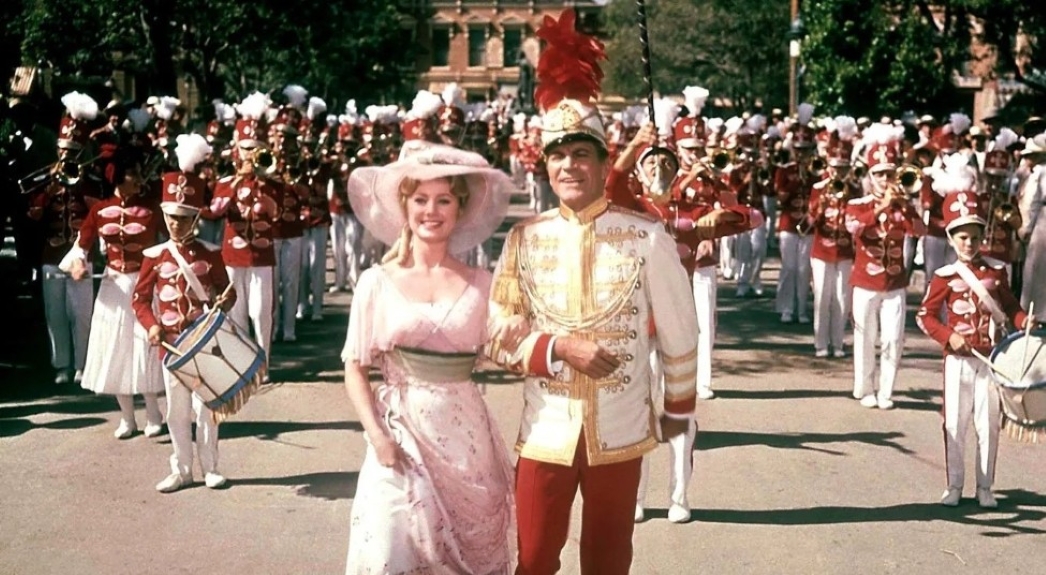
Tag: Shirley Jones

The Music Man (1962)

The Music Man (1962)

A star-turn and some good songs can’t quite make a shallow, over-long musical really work

Director: Morton DaCosta

Cast: Robert Preston (Harold Hill), Shirley Jones (Marian Paroo), Buddy Hackett (Marcellus Washburn), Hermione Gingold (Eulalie Mackechnie Shinn), Paul Ford (Mayor George Shinn), Pert Kelton (Mrs Paroo), The Buffalo Bills (The School Board), Timmy Everett (Tommy Djilas), Susan Luckey (Zaneeta Shinn), Ron Howard (Winthorp Paroo)

The Music Man is an ever-popular Broadway smash, the sort of charming, light, fun-filled musical with some good songs that makes it undemanding fun. It doesn’t, honestly, gain anything on screen – in fact, if anything, it’s fundamental lightness and lack of emotional or thematic substance gets rather exposed. The movie version may be ridiculously over-extended and frequently feel more like a slightly up-market filming of the Broadway production, but it’s still got some fine songs the best of them delivered with absolute aplomb by Robert Preston, masterfully recreating the Broadway role he had played nearly a thousand times already.

Preston plays Henry Hill, who arrives in the town of River City in Iowa in 1912 determined to sell instruments and uniforms to form a children’s band. Or at least that’s what he says he’s here to do: he’s actually a con man, whose plan is to sell the concept to the town, get them to invest, pass himself off as a music professor and then skip town with their money. Inciting a moral panic over a new Pool club opening in the town corrupting the kids (it will be ragtime next!), he wins them over. But it’s not all easy-sailing: librarian Marian Paroo (Shirley Jones) suspects Hill is not who he says he is. To try and protect his scheme, Hill aims to seduce her. But will this relationship actually help him find a conscience?

It’s a feel-good Hollywood musical so… I’ll leave you to guess. The Music Man is an odd musical. In many ways, you can see it as a slice of nostalgia, with its gentle 1910s setting and portrait of small-town America as a gentle, easy-going place where everybody knows everybody else, nobody locks their doors and the most dangerous thing is a pool table. But, at the same time, The Music Man frequently portrays its townspeople as staggeringly gullible (no one doubts Hill’s ‘imagination’ method of learning – don’t practice, just imagine you can play an instrument and you can!) and very hostile to outsiders (Hill receives the coldest, most suspicious of welcomes when he first gets off the train, even before he has announced any plan). Then, when he is exposed, their plan to tar-and-feather him sounds dangerously close to a lynching.

Put frankly, I have no idea what The Music Man is trying to say about small-town life or really anything else, seeming to want to have its cake and eat it by making the townspeople both a joke and an idealist past we can aspire to. Each of the characters is, in any case, a reassuring cliché. From Shirley Jones’ librarian (a mousy, but independently-minded intellectual who has never been kissed) to her mother (a blowsy, loud-mouthed Irish-woman who just wants a good man for her daughter), to the Mayor (a puffed-up, self-important idiot) and his wife (an attention-seeking moralist grande dame) to its sweetly love-struck teens, every character more or less feels like a stock figure carefully placed for comic or emotional impact.

It also rather fudges the semi-redemption arc it feels like its aiming for with Hill. He brings back memories of Elmer Gantry (the presence of Shirley Jones – here cast to type as the sweet, virginial mark rather than an infuriated floozy – also helps with this), and you can see a certain similarity between that shameless opportunist and this egotistical showman determined to make an immoral buck. The Music Man, I think, wants to show Hill’s conscious growing as he gets closer to the townspeople: it’s slightly under-mined by the fact it continually plays the townspeople as jokes and Hill’s character has no real depth (he remains, more or less throughout, a friendly, amoral opportunist).

As such, it needs a surprisingly sudden pivot to give some genuineness to Hill (a few minutes before changing his mind, he’s literally joking about not leaving town until he’s earned the fruits of his seduction campaign by bedding Marian). The fact that this even vaguely works is largely due to Preston. In fact, almost anything that works is due to Preston. He had a Broadway triumph with the role, and Da Costa (director of the stage production) and writer Meredith Wilson insisted he got the role over preferred choices Bing Crosby, James Cagney and (most inexplicably) Cary Grant. And it’s great they did, because Preston is triumphant: magnetic, charismatic, funny and delivering the film’s best numbers with an energetic, sublime aplomb. His comic timing is perfect and he successfully makes a persistently lying, opportunistic shit immensely likeable.

He also nails the best songs. The Music Man may be slightly fudged in its themes and its exploration of its central character, but it does have some very striking, catchy musical numbers. ‘Ya Got Trouble’ (essentially an energetically sung, word-heavy, fast-paced monologue) is funny and brilliantly performed by Preston. Similarly, ‘Seventy-Six Trombones’ is a show-stopper from Preston and he brings real lyrical charm to ‘Gary, Indiana’. There are further fine numbers, from the inventive ‘Rock Island’ that opens the film (sung in imitation of a steam train) and ‘Shipoopi’ a high-kicking dance number.

This is all filmed with a decent competence but very little flair. Da Costa essentially re-creates his stage production with very little of the sort of dynamism and flair someone like Stanley Donen had. Da Costa also doesn’t accelerate the pace – the light plot stretches over a very long, two and a half hours (almost nothing really happens in the middle hour. Remove Preston from it and I’m not sure there would be enough there to hold anyone’s interest. In fact, with its shallow plot, lifting and shifting of an existing musical to a (more expensive) real location with no re-thinking of the material for a different medium and its over extended, epic run-time, you can sort of see in it the DNA that would go on to become some of the mega-flop musicals that would weigh down the studios in a few years. The Music Man was a smash hit (probably because when it works, it is fun) but many of those that followed would not be.

And, as a side note, I was stunned to find out, that this beat West Side Story to the Tony Award for Best Musical.
Elmer Gantry (1960)

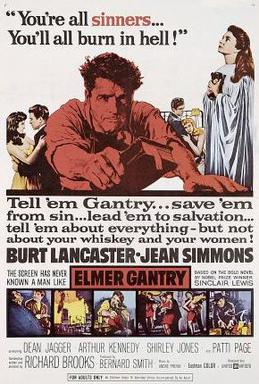
Elmer Gantry (1960)

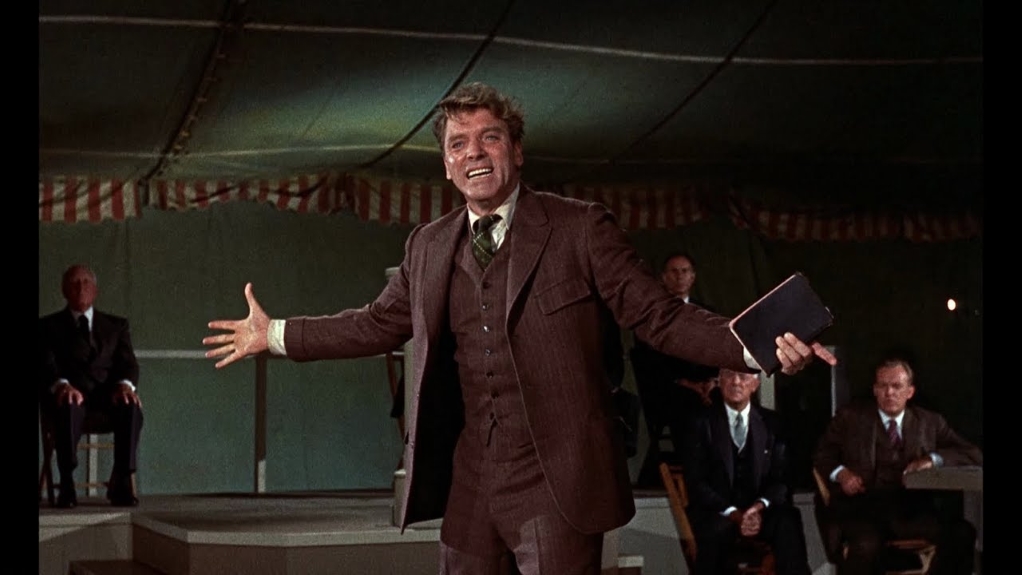
Burt Lancaster gives a magnetic, Oscar-winning, performance in this entertaining plot-boiler

irector: Richard Brooks

Cast: Burt Lancaster (Elmer Gantry), Jean Simmons (Sister Sharon Falconer), Arthur Kennedy (Jim Lefferts), Dean Jagger (William L. Morgan), Shirley Jones (Lulu Bains), Patti Page (Sister Rachel), Edward Andrews (George F Babbitt), John McIntire (Rev John Pengilly), Hugh Marlowe (Rev Philip Garrison), Joe Maross (Pete)

Elmer Gantry (Burt Lancaster) has the patter down perfectly. He can charm, wheedle and turn a phrase to set the whole room alight with laughter. He wants success but the big break never comes, perhaps because he’s selling two-bit vacuum cleaners rather than something people really want. Elmer is smart and works out, when everyone is afraid of dying, it’s a captive market for salvation. With his seminary background, he’s a natural preacher and inveigles himself into the revivalist roadshow of Sister Sharon Falconer (Jean Simmons) which his force of personality shifts into a fire-and-brimstone exhibition of frenzied religious passion – just the sort of thing that gets the punters back into the church. But when the roadshow moves to the big city, will Gantry’s young affair with priest’s-daughter-turned-prostitute Lulu Baines (Shirley Jones) come back to bite him?

Elmer Gantry was seen as controversial and even outlandish at the time of its release – so much so a lengthy pre-credits opening crawl distances it from all those decent servants of the Lord who were worried it was tarring them with the same brush. But with TV evangelists raking in the cash and travelling preachers whipping crowds up into wild-eyed ecstasy, Elmer Gantry doesn’t seem so outlandish these days. Richard Brooks film adapts the middle-act only of Sinclair Lewis’ sharply satirical novel, and while it does smooth down the rough edges and offer touches of redemption for its charismatically selfish hero, it’s still a very entertaining plot-boiler with a well-delivered message and subtle character development.

Above all though it’s a defining star-vehicle for a perfectly cast, Oscar-winning, Burt Lancaster. Elmer Gantry plays to all his strengths: charismatic, larger-than-life and charming, overflowing with boundless energy and nimble, physical grace. Lancaster’s intense eyes and excitable grin burns through the screen and he’s totally believable as the sort of rogue everyone knows is a rogue but give him a pass because he’s so likeable. And he nails the magnetic charisma of fire-and-brimstone preaching, full of self-aggrandising comments about his own holy conversion from salesman to man of God. It helps that Lancaster’s physical prowess (at one point he does a body slide down the full length of the aisle mid-sermon) really helps build Gantry’s magnetic presence.

Elmer Gantry superpower isn’t that he’s shameless – he looks suitably guilty when calling his mother on Christmas day to explain, once again, he isn’t coming home – but that he can compartmentalise and forget shame so quickly. He manipulates and uses people with such charm they either don’t notice or don’t care – from charming clients on Christmas Eve with dirty stories to plugging Sister Sharon’s naïve assistant Sister Ruth (Patti Page) for details on Sharon’s life that he will then use to get his foot in the door of her roadshow. Even cynical journalist Jim Lefferts (Arthur Kennedy, warming up for effectively the same role in Lawrence of Arabia), who knows he’s a complete bastard, still finds him a great guy to hang out with.

But the truth is Gantry corrupts everything he touches. It happens by degrees, pushed along with winning arguments and eager ‘I’m just trying to help’ excitability, but its inevitable. Before he arrives, Sister Sharon’s roadshow is a dry but heartfelt and earnest mission focused on winning converts. Under Gantry’s influence it becomes religious entertainment. Because Gantry knows people need to have their passions stirred to really invest in something, and mesmerising patter is a huge part of that. Lancaster’s delivery of these showpiece sermons drip with eye-catching, inspiring passion – even when we know he’s a hypocritical bullshit artist who probably doesn’t truly believe word he’s saying, but sure does believe it in the moment. When even we feel stirred by it, is it a surprise his audiences start to get whipped into a frenzy, barking at devils and clawing across the floor to be saved by Gantry’s touch?

Sister Sharon’s manager and sponsor William Morgan (Dean Jagger skilfully playing a character who is far more susceptible to manipulation than he thinks) might have his doubts, but it works. Elmer Gantry takes a satirical swing at the Church as the reverends of the town of Zenith swiftly put aside any doubts (other than straight-shooter Garrison, inevitably played by Hugh Marlowe) and bring Sister Sharon’s Gantry-inspired roadshow into the big city to help drag more punters (and it’s quite clear that they see congregations as customers for religion) into their church. Elmer Gantry gets some subtle blows in on the commercialisation of the Church, even if it is careful to largely distance it as a whole from the tactics of Gantry.

Gantry’s corruption also touches Sister Sharon herself. Well-played by Jean Simmons, Sharon is earnest but surprisingly steely but as she lets a little of Gantry’s shallowness into her roadshow, so she starts to compromise on the very qualities that made her stand-out. From entering into a ‘good-cop-bad-cop’ performance for sinners to opening her heart to Gantry’s persistent seduction, Sharon becomes a portrait of corruption by degrees. Brooks’ film also implies in its dark finale that she has allowed herself to absorb Gantry’s spin that she could be a vessel of holy power, which puts her life at deadly risk.

Elmer Gantry is overlong and perhaps relies a little too much on Lancaster’s charisma – it fair to say when he is off-screen it’s energy lags. Its satiric edge is sometimes blunted by focusing on Gantry as the disease rather than a symptom of a church struggling to survive in a secular age. The introduction of Lulu Baines – an Oscar-winning Shirley Jones, playing against type as a bitter floozy – is a little late in-the-day and while her performance is solid enough, the character is more of a cipher in a plot-required final act conundrum than a fully-formed character.

But when the film focuses on Gantry, it’s a fascinating character study. How much does he believe in the things he says? Does he feel shame? How ambitious is he? When he says he loves Sharon, does he? Or does he feel everything he says in the moment, but it never sticks? Either way, it’s at the heart of Burt Lancaster’s compelling, charismatic performance which juggles a mountain of contradictions but never loses the sense of the shallow selfishness that lies behind the charm.