
Tag: Morton DaCosta

Auntie Mame (1958)

Auntie Mame (1958)

A star turn is the main (only?) attraction of this stage-bound, episodic movie

Director: Morton DaCosta

Cast: Rosalind Russell (Mame Dennis), Forrest Tucker (Beauregard Burnside), Coral Browne (Vera Charles), Fred Clark (Dwight Babcock), Roger Smith (Patrick Dennis), Patric Knowles (Lindsay Woolsey), Peggy Cass (Agnes Gooch), Jan Handzlik (Young Patrick Dennis), Joanna Barnes (Gloria Upson), Pippa Scott (Pegeen Ryan), Lee Patrick (Doris Upson), Willard Waterman (Claude Upson), Robin Hughes (Brian O’Bannion)
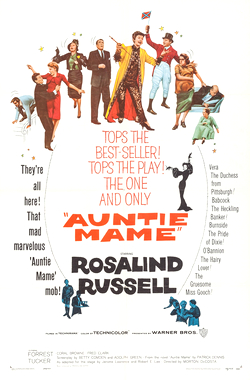
Adapted from a semi-autobiographical series of novels by Patrick Dennis, Auntie Mame must be nearly unique as it went from novel to theatre to film back to theatre as a musical and then back to film as a film musical. Why? Well probably because the slight, episodic mix of high society comedy, farce and eccentric energy has a knock-out lead role for a star. A lead role Rosalind Russell grabbed, purchasing the rights, starring on Broadway and making sure she got the film (despite Bette Davis’ interest, leading to a neat gag in the film where Davis is circling a film of Mame’s autobiography).

There isn’t really a plot as such in Auntie Mame, more a series of vignettes and short stories held together by the larger-than-life force of the characters. None of them are larger of life than Auntie Mame (Rosalind Russell), a free-spirited bohemian society grande dame, with a good-natured love for the down-trodden, independent and unfortunate and a loathing for snobs. She adopts young orphaned nephew Patrick Dennis (Jan Handzlik growing up into Roger Smith), who becomes her partner in bohemian adventure over the next few years, which sees the Wall Street Crash wipe out her fortune, a marriage to millionaire Beauregard (Forrest Tucker) restore it, the writing of her memoirs and Patrick’s engagement to the ghastly Gloria (Joanna Barnes) whose family is the epitome of the casual snobbery and prejudice Mame despises.

Auntie Mame is directed by its original Broadway director Morton DaCosta, making his film debut. DaCosta clearly decided there was very little reason to change anything when he switched medium. Auntie Mame is visually flat, shot in a persistent medium-shot to soak up the impressive set and ends each ‘act’ with a blackened screen and spot light on Rosalind Russell. Nearly every element of the staging and blocking feels like it has been pulled over from Broadway – even visits to Paris, Egypt and the Matehorn are done on almost deliberately unconvincing backscreens. That also goes for several of the performances, many of which feel very much aimed at the back row of the stalls.

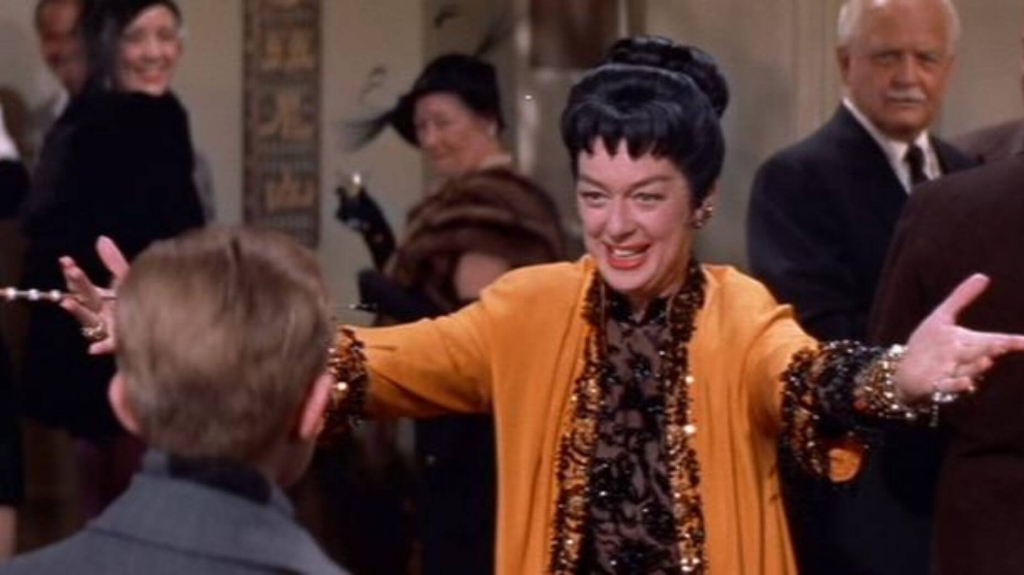
I suppose you could say that applies to Russell, but the fact of the matter is pretty much the only thing that makes Auntie Mame memorable at all is Russell’s deliciously over-the-top comedic performance. Sweeping into the film down the broad spiralled staircase of her apartment – the visual centre of large chunks of the film – Russell grabs the film by the scruff of the neck and doesn’t let go. She savours every syllable of Mame’s gloriously arch dialogue, delighting in her sweeping control of the room and good-natured bantering with the horde of eccentrics and oddballs gathered under her societal wings. Russell is very funny, constantly refusing to play the game of dull conformity but determined to enjoy every moment she can since “Life is a banquet, and most poor suckers are starving to death”.

It’s a character who could become very wearing, if Russell didn’t find a lot of decency in Mame. She’s true to her word, honest and loyal. After her initial shock at becoming a guardian, she constantly works to give the same values to Dennis (in her eccentric way). Even when bankrupt, it’s clear she only considers marriage to Forrest Tucker’s smitten millionaire because she genuinely loves him. She treats her loyal retainers like family, opens her door to people others would slam it into and is rightly disgusted by the not-even-hidden antisemitism of Gloria’s appalling parents. Russell repeatedly finds moments to show us that, under her crazy exterior, she has a heart of gold.

And Auntie Mame gives Russell several comic set-pieces. My favourite of these by far is Mame’s short-lived spell as a switchboard operator for a long-windedly named New York law firm, a sequence Russell nails with increasing physical discombobulation of moving random wires for socket to socket while mangling the law firm name into an ever more random collection of syllables.

There are other fine comic turns – Mame’s disastrous Broadway debut opposite best friend Vera Charles (Coral Browne, biting chunks out of the scenario in a Tallulah Bankhead parody) or her equally accident-prone reluctant foxhunt on Beauregard’s estate – in a film that’s largely made up of individual skits and short stories.

But without Russell, there isn’t much to Auntie Mame. The sets and production are impressively grand, with Mame’s apartment redecorated in a different style for every ‘act’ (from fake Chinese chic, to Victorian, Twenties and garish Postmodern). But it’s theatrical not filmic style. Which is the case for some performances as well. Coral Browne leaves nothing in the dressing room. Peggy Cass joined Russell on the Oscar nomination list as Agnes, Mame’s dowdy, weepy secretary, but it’s a very broad performance that feels overpowering on screen. Robin Hughes is similarly a bit much as a freeloading Irish poet. Those who don’t careen over the top, are left feeling a bit flat (possibly there is so little oxygen left), with Smith, Barnes and Scott particularly flat.

Which brings us back to what Auntie Mame is: a star vehicle. And it worked: Russell got an Oscar nomination (probably just missing out on a win) and relaunched her career. It’s striking no one else had a similar boost – Cass and DaCosta film careers finished in the blink of an eye – and Auntie Mame offers almost nothing memorable at all that doesn’t involve her. There is charm and a few laughs, but it’s a very middlebrow movie.
The Music Man (1962)

The Music Man (1962)

A star-turn and some good songs can’t quite make a shallow, over-long musical really work

Director: Morton DaCosta

Cast: Robert Preston (Harold Hill), Shirley Jones (Marian Paroo), Buddy Hackett (Marcellus Washburn), Hermione Gingold (Eulalie Mackechnie Shinn), Paul Ford (Mayor George Shinn), Pert Kelton (Mrs Paroo), The Buffalo Bills (The School Board), Timmy Everett (Tommy Djilas), Susan Luckey (Zaneeta Shinn), Ron Howard (Winthorp Paroo)

The Music Man is an ever-popular Broadway smash, the sort of charming, light, fun-filled musical with some good songs that makes it undemanding fun. It doesn’t, honestly, gain anything on screen – in fact, if anything, it’s fundamental lightness and lack of emotional or thematic substance gets rather exposed. The movie version may be ridiculously over-extended and frequently feel more like a slightly up-market filming of the Broadway production, but it’s still got some fine songs the best of them delivered with absolute aplomb by Robert Preston, masterfully recreating the Broadway role he had played nearly a thousand times already.

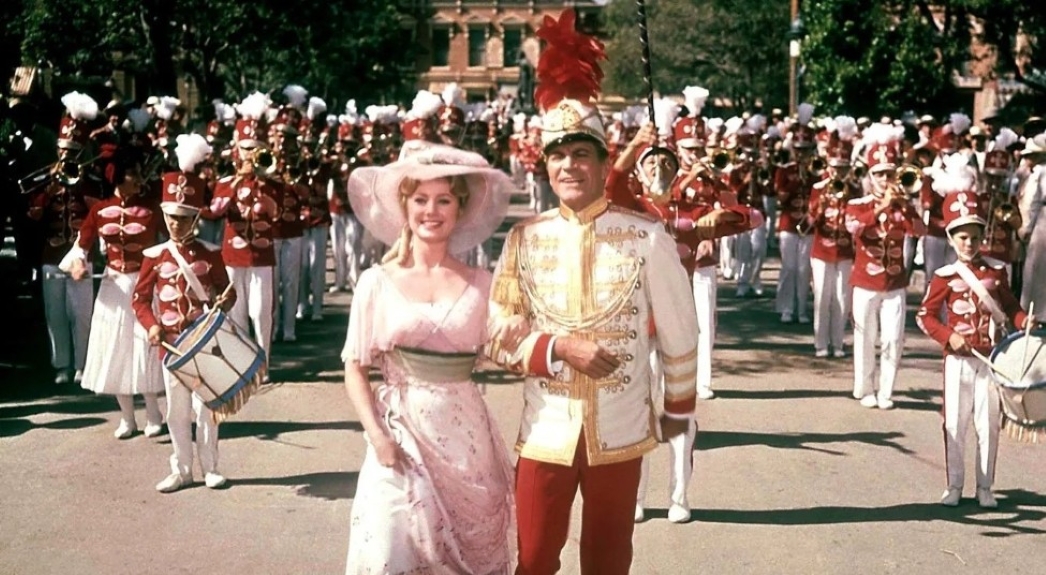
Preston plays Henry Hill, who arrives in the town of River City in Iowa in 1912 determined to sell instruments and uniforms to form a children’s band. Or at least that’s what he says he’s here to do: he’s actually a con man, whose plan is to sell the concept to the town, get them to invest, pass himself off as a music professor and then skip town with their money. Inciting a moral panic over a new Pool club opening in the town corrupting the kids (it will be ragtime next!), he wins them over. But it’s not all easy-sailing: librarian Marian Paroo (Shirley Jones) suspects Hill is not who he says he is. To try and protect his scheme, Hill aims to seduce her. But will this relationship actually help him find a conscience?

It’s a feel-good Hollywood musical so… I’ll leave you to guess. The Music Man is an odd musical. In many ways, you can see it as a slice of nostalgia, with its gentle 1910s setting and portrait of small-town America as a gentle, easy-going place where everybody knows everybody else, nobody locks their doors and the most dangerous thing is a pool table. But, at the same time, The Music Man frequently portrays its townspeople as staggeringly gullible (no one doubts Hill’s ‘imagination’ method of learning – don’t practice, just imagine you can play an instrument and you can!) and very hostile to outsiders (Hill receives the coldest, most suspicious of welcomes when he first gets off the train, even before he has announced any plan). Then, when he is exposed, their plan to tar-and-feather him sounds dangerously close to a lynching.

Put frankly, I have no idea what The Music Man is trying to say about small-town life or really anything else, seeming to want to have its cake and eat it by making the townspeople both a joke and an idealist past we can aspire to. Each of the characters is, in any case, a reassuring cliché. From Shirley Jones’ librarian (a mousy, but independently-minded intellectual who has never been kissed) to her mother (a blowsy, loud-mouthed Irish-woman who just wants a good man for her daughter), to the Mayor (a puffed-up, self-important idiot) and his wife (an attention-seeking moralist grande dame) to its sweetly love-struck teens, every character more or less feels like a stock figure carefully placed for comic or emotional impact.

It also rather fudges the semi-redemption arc it feels like its aiming for with Hill. He brings back memories of Elmer Gantry (the presence of Shirley Jones – here cast to type as the sweet, virginial mark rather than an infuriated floozy – also helps with this), and you can see a certain similarity between that shameless opportunist and this egotistical showman determined to make an immoral buck. The Music Man, I think, wants to show Hill’s conscious growing as he gets closer to the townspeople: it’s slightly under-mined by the fact it continually plays the townspeople as jokes and Hill’s character has no real depth (he remains, more or less throughout, a friendly, amoral opportunist).

As such, it needs a surprisingly sudden pivot to give some genuineness to Hill (a few minutes before changing his mind, he’s literally joking about not leaving town until he’s earned the fruits of his seduction campaign by bedding Marian). The fact that this even vaguely works is largely due to Preston. In fact, almost anything that works is due to Preston. He had a Broadway triumph with the role, and Da Costa (director of the stage production) and writer Meredith Wilson insisted he got the role over preferred choices Bing Crosby, James Cagney and (most inexplicably) Cary Grant. And it’s great they did, because Preston is triumphant: magnetic, charismatic, funny and delivering the film’s best numbers with an energetic, sublime aplomb. His comic timing is perfect and he successfully makes a persistently lying, opportunistic shit immensely likeable.

He also nails the best songs. The Music Man may be slightly fudged in its themes and its exploration of its central character, but it does have some very striking, catchy musical numbers. ‘Ya Got Trouble’ (essentially an energetically sung, word-heavy, fast-paced monologue) is funny and brilliantly performed by Preston. Similarly, ‘Seventy-Six Trombones’ is a show-stopper from Preston and he brings real lyrical charm to ‘Gary, Indiana’. There are further fine numbers, from the inventive ‘Rock Island’ that opens the film (sung in imitation of a steam train) and ‘Shipoopi’ a high-kicking dance number.

This is all filmed with a decent competence but very little flair. Da Costa essentially re-creates his stage production with very little of the sort of dynamism and flair someone like Stanley Donen had. Da Costa also doesn’t accelerate the pace – the light plot stretches over a very long, two and a half hours (almost nothing really happens in the middle hour). Remove Preston from it and I’m not sure there would be enough there to hold anyone’s interest. In fact, with its shallow plot, lifting and shifting of an existing musical to a (more expensive) real location with no re-thinking of the material for a different medium and its over extended, epic run-time, you can sort of see in it the DNA that would go on to become some of the mega-flop musicals that would weigh down the studios in a few years. The Music Man was a smash hit (probably because when it works, it is fun) but many of those that followed would not be.

And, as a side note, I was stunned to find out, that this beat West Side Story to the Tony Award for Best Musical.