
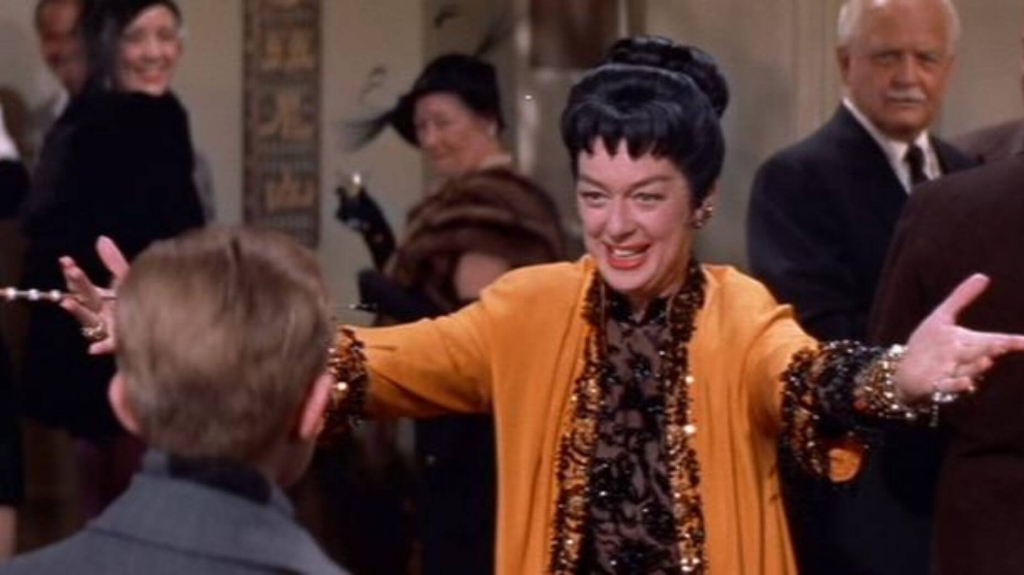
A star turn is the main (only?) attraction of this stage-bound, episodic movie
Director: Morton DaCosta
Cast: Rosalind Russell (Mame Dennis), Forrest Tucker (Beauregard Burnside), Coral Browne (Vera Charles), Fred Clark (Dwight Babcock), Roger Smith (Patrick Dennis), Patric Knowles (Lindsay Woolsey), Peggy Cass (Agnes Gooch), Jan Handzlik (Young Patrick Dennis), Joanna Barnes (Gloria Upson), Pippa Scott (Pegeen Ryan), Lee Patrick (Doris Upson), Willard Waterman (Claude Upson), Robin Hughes (Brian O’Bannion)
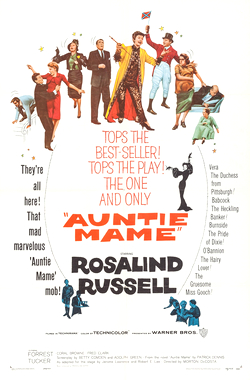
Adapted from a semi-autobiographical series of novels by Patrick Dennis, Auntie Mame must be nearly unique as it went from novel to theatre to film back to theatre as a musical and then back to film as a film musical. Why? Well probably because the slight, episodic mix of high society comedy, farce and eccentric energy has a knock-out lead role for a star. A lead role Rosalind Russell grabbed, purchasing the rights, starring on Broadway and making sure she got the film (despite Bette Davis’ interest, leading to a neat gag in the film where Davis is circling a film of Mame’s autobiography).
There isn’t really a plot as such in Auntie Mame, more a series of vignettes and short stories held together by the larger-than-life force of the characters. None of them are larger of life than Auntie Mame (Rosalind Russell), a free-spirited bohemian society grande dame, with a good-natured love for the down-trodden, independent and unfortunate and a loathing for snobs. She adopts young orphaned nephew Patrick Dennis (Jan Handzlik growing up into Roger Smith), who becomes her partner in bohemian adventure over the next few years, which sees the Wall Street Crash wipe out her fortune, a marriage to millionaire Beauregard (Forrest Tucker) restore it, the writing of her memoirs and Patrick’s engagement to the ghastly Gloria (Joanna Barnes) whose family is the epitome of the casual snobbery and prejudice Mame despises.
Auntie Mame is directed by its original Broadway director Morton DaCosta, making his film debut. DaCosta clearly decided there was very little reason to change anything when he switched medium. Auntie Mame is visually flat, shot in a persistent medium-shot to soak up the impressive set and ends each ‘act’ with a blackened screen and spot light on Rosalind Russell. Nearly every element of the staging and blocking feels like it has been pulled over from Broadway – even visits to Paris, Egypt and the Matehorn are done on almost deliberately unconvincing backscreens. That also goes for several of the performances, many of which feel very much aimed at the back row of the stalls.
I suppose you could say that applies to Russell, but the fact of the matter is pretty much the only thing that makes Auntie Mame memorable at all is Russell’s deliciously over-the-top comedic performance. Sweeping into the film down the broad spiralled staircase of her apartment – the visual centre of large chunks of the film – Russell grabs the film by the scruff of the neck and doesn’t let go. She savours every syllable of Mame’s gloriously arch dialogue, delighting in her sweeping control of the room and good-natured bantering with the horde of eccentrics and oddballs gathered under her societal wings. Russell is very funny, constantly refusing to play the game of dull conformity but determined to enjoy every moment she can since “Life is a banquet, and most poor suckers are starving to death”.
It’s a character who could become very wearing, if Russell didn’t find a lot of decency in Mame. She’s true to her word, honest and loyal. After her initial shock at becoming a guardian, she constantly works to give the same values to Dennis (in her eccentric way). Even when bankrupt, it’s clear she only considers marriage to Forrest Tucker’s smitten millionaire because she genuinely loves him. She treats her loyal retainers like family, opens her door to people others would slam it into and is rightly disgusted by the not-even-hidden antisemitism of Gloria’s appalling parents. Russell repeatedly finds moments to show us that, under her crazy exterior, she has a heart of gold.
And Auntie Mame gives Russell several comic set-pieces. My favourite of these by far is Mame’s short-lived spell as a switchboard operator for a long-windedly named New York law firm, a sequence Russell nails with increasing physical discombobulation of moving random wires for socket to socket while mangling the law firm name into an ever more random collection of syllables.
There are other fine comic turns – Mame’s disastrous Broadway debut opposite best friend Vera Charles (Coral Browne, biting chunks out of the scenario in a Tallulah Bankhead parody) or her equally accident-prone reluctant foxhunt on Beauregard’s estate – in a film that’s largely made up of individual skits and short stories.
But without Russell, there isn’t much to Auntie Mame. The sets and production are impressively grand, with Mame’s apartment redecorated in a different style for every ‘act’ (from fake Chinese chic, to Victorian, Twenties and garish Postmodern). But it’s theatrical not filmic style. Which is the case for some performances as well. Coral Browne leaves nothing in the dressing room. Peggy Cass joined Russell on the Oscar nomination list as Agnes, Mame’s dowdy, weepy secretary, but it’s a very broad performance that feels overpowering on screen. Robin Hughes is similarly a bit much as a freeloading Irish poet. Those who don’t careen over the top, are left feeling a bit flat (possibly there is so little oxygen left), with Smith, Barnes and Scott particularly flat.
Which brings us back to what Auntie Mame is: a star vehicle. And it worked: Russell got an Oscar nomination (probably just missing out on a win) and relaunched her career. It’s striking no one else had a similar boost – Cass and DaCosta film careers finished in the blink of an eye – and Auntie Mame offers almost nothing memorable at all that doesn’t involve her. There is charm and a few laughs, but it’s a very middlebrow movie.

