Tag: Stephen Lang

Manhunter (1986)

Manhunter (1986)

Mann’s visually striking thriller doesn’t have quite the dark subversiveness it needs but is an unsettling thriller

Director: Michael Mann

Cast: William Petersen (Will Graham), Kim Griest (Molly Graham), Dennis Farina (Jack Crawford), Brian Cox (Dr Hannival Lecktor), Joan Allen (Reba McClane), Tom Noonan (Francis Dollarhyde), Stephen Lang (Freddy Lounds)

Before The Silence of the Lambs, there was an earlier attempt to bring the twisted world of Thomas Harris’ gothic thrillers to the screen. Michael Mann’s Manhunter has grown in reputation since its release, along with an increased regard for the visually stylised and cold modernism of Mann’s work. Truthfully, Manhunter lacks the Hitchcockian dark wit, and is far less effective at exploring the dark links between investigator and psychopath, than Silence of the Lambs. But it remains an intriguing – and often disturbing – curiosity.

FBI profiler Will Graham (William Petersen) is called out from extended leave by Agent Jack Crawford (Dennis Farina) to investigate chilling serial killer, the Tooth Fairy. The killer breaks into family homes and brutally murders the occupants, leaving bite marks and broken mirrors behind. Graham has an empathetic gift for understanding the mindset of killers, something he used to capture cannibalistic serial killer Hannibal Lecktor (Brian Cox), now imprisoned in a mental institute. Graham’s quest to catch the Tooth Fairy leads to him becoming ever more obsessive, including reconnecting with Lecktor to help profile the killer. Meanwhile the Tooth Fairy, Francis Dollarhyde (Tom Noonan), a lonely photo developer obsessed with William Blake’s Red Dragon and desperate to ‘become’ something greater begins his first meaningful relationship with blind colleague, Reba (Joan Allen).

Manhunter is set in a crisp, modernist world of clean, soulless buildings, glass fronted houses and offices and precise, featureless rooms. Mann and cinematographer Dante Spinnotti film everything with a series of tinges – strong, cool blues, drained out and striking whites, murky greens. All is designed to give the film a deliberately forensic feeling, like we watching something play out in a crime lab. It fits with a film that is fascinated with the procedures of investigating and profiling and delights in the intuitive, deductive leaps Graham makes.

Mann’s film attempts to draw parallels between Graham and Dollarhyde, both men uncomfortably in touch with their darkest, twisted impulses. As Hannibal Lecktor observes, Graham can so completely inhabit the interior world of killers, because he secretly longs for the buzz of killing himself. That’s easy to see in William Petersen’s focused, intense performance. Reluctantly dragged back in, Graham is noticeably unphased by the horrific crime scenes he witnesses (however much he is furious at the loss of life) and becomes ever more fixed and lean as the hunt continues, increasingly more-and-more like the obsessive prey-hunting psychopath he is investigating.

In doing so he sidelines his family – even putting them in danger – and increasingly cuts off human connections to feed his laser-focused quest. This contrasts him with Dollarhyde, a damaged, isolated and self-loathing man who flirts with the last vestiges of humanity. A man who sees nothing in himself that anyone could love, Dollarhyde becomes as giddy as a schoolboy when Reba sees him as a kind, attractive and decent man. Behind his eyes, Tom Noonan shows a quiet struggle between the obsessive monster, driven to destroy, and a man considering changing his path. This intriguing contrast between the family-man who leaves tem to hunt killers and the killer who flirts with settling down is a thread you wish the film had more patience to explore among its neon-lit, filtered style.

But Mann doesn’t quite have the patience to draw these threads together. Perhaps not helped by, skilled and intelligent as Noonan’s performance is, always presented Dollarhyde as an imposing, Frankenstein-monster style heavy rather than someone we invited to feel the sort of twisted empathy for that the film needs. We should be feeling something of what Graham says when he talks about feeling pity for the abused child and disgust for the twisted killer that child grew up to be. We never truly do.

Perhaps that’s partly because Dollarhyde is a character the film can never build up the same interest in, as it does with the looming shadow of Hannibal Lecktor (the spelling was unique to this film). Appearing only in three scenes, Lecktor dominates the film. Basing his performance on Scottish serial killer Peter Manuel, Cox brings the part a chillingly studied delight at his own intelligence with an air of quiet politeness which only vaguely masks his malice and cruelty. A ghost of a smile is behind every cruel, hurtful word and action he carries out and his every action is motivated only by a desire to harm. It’s a mesmerically terrifying, low-key performance that overwhelms the film.

It contributes to the film’s second half never really matching the first. As Lecktor recedes and Graham focuses on the Tooth Fairy, the lack of personal connection between hunter and hunted (and the film’s unease to draw too distinctive a comparison between them) makes the final hunt less compelling ironically than when the Tooth Fairy was an unknown, unseen adversary. Noonan’s most effective scene is his terrifyingly soft-spoken interrogation of smart-aleck reporter Freddy Lounds (a braggart Stephen Lang), but the film isn’t brave enough to give him enough potential humanity to make the character really interesting – or the Satanic charisma that Lecktor has.

Manhunter culminates in a disappointingly run-of-the-mill shootout (edited with a curiously ham-fisted jaggedness) and an unsatisfactory Graham family reunion that feels like it hasn’t got the energy or desire to explore any of the lasting impact the darkness we’ve discovered in our lead character would surely have. Manhunter not only changes the title of Harris’ book (there was fear that Red Dragon was too easy to mistake as a martial arts film), but it also benches the emotional and psychological obsession of Dollarhyde (even the character’s famous tattoos don’t appear in the film). It becomes a strikingly shot, intriguingly fast-paced thriller which doesn’t manage to make the psychological complexities its striving for either as fascinating or unsettling as it should. It has plenty to haunt you – its creepy POV home-invasion opening is nightmare-inducing – but Harris was better served by Lambs mix of playful dark-horror and focus on acute psychological insight.

Avatar: The Way of Water (2022)

Avatar: The Way of Water (2022)

Cameron’s film makes a huge splash despite its soggy plotted, flooded run-time

Director: James Cameron

Cast: Sam Worthington (Jake Sully), Zoe Saldaña (Neytiri), Sigourney Weaver (Kiri Sully), Stephen Lang (Colonel Miles Quaritch), Kate Winslet (Ronal), Cliff Curtis (Tonowari), Jamie Flatters (Neteyam Sully), Britain Dalton (Lo’ak Sully), Timothy Jo-Li Bliss (Tuk Sully), Jack Champion (Spider), Bailey Bass (Reya), Filip Geljo (Aonung), Duane Evans Jr (Rotxo), Edie Falco (General Frances Ardmore), Brendan Cowell (Captain Scoresby), Jermaine Clement (Dr Ian Garvin)

After thirteen years it finally arrived. The sequel to a film that seemed to leave no cultural impact, Avatar. People were convinced it would flop. But they say that about all Cameron films. And, if anyone should have learned anything from Terminator 2, Titanic and Avatar it was don’t bet against Cameron. If Avatar 2’s purpose was to make an awful lot of money, it has succeeded in every level. If its purpose was to make a strong and entertaining film… I’m not so sure.

About the same amount of time has passed on Pandora and Sully (Sam Worthington) and Neytiri (Zoe Saldaña) have raised a family of four children, including Kiri (Sigourney Weaver) born from the avatar of their friend Grace. They have also raised Quaritch’s son ‘Spider’ (Jack Champion) among them. Then the humans return… a bloody war begins, with Sully leading a guerrilla campaign. The company resurrects Colonel Quaritch (Stephen Lang) as a Na’vi super soldier to fight on their own terms. After Spider is captured, Sully and his family flee to live among the Metkayina, a sea-living tribe. But they can’t escape the war and its dangers.

As Avatar: The Way of Water is garlanded with praise and Oscars nominations, I feel like we are all part of a wide conspiracy of silence. So desperate are so many to keep viewers handing over their cash at the box office, that a film completely designed to be seen on the big screen (and this really is) is being praised to the skies by some as a masterpiece. It is not. It’s not even the best Avatar film. Instead, Avatar 2 is a visually impressive but hellishly long, predictable re-tread of the first film that stuffs the eyes with CGI wonders but leaves not a jot for the heart.

I was reminded part way through the overlong runtime that Cameron once made imaginative, thrilling sequels that completely reset the table. Aliens reinvented a haunted house horror movie as a pulsating action film. Terminator 2 turned a chase story into ramped up family story that mused on destiny. Avatar 2… basically tells exactly the same story, but with a familiar generational family conflict storyline and lots of water. It has the same environmental messages and anti-corporation vibe. When this lands, it works. A whale hunt is shot in terrifying detail, a giant mother whale creature brutally trapped and eviscerated for a small cannister of fluid extracted from its brain. This is also probably the most effective sequence and the one that moved me the most.

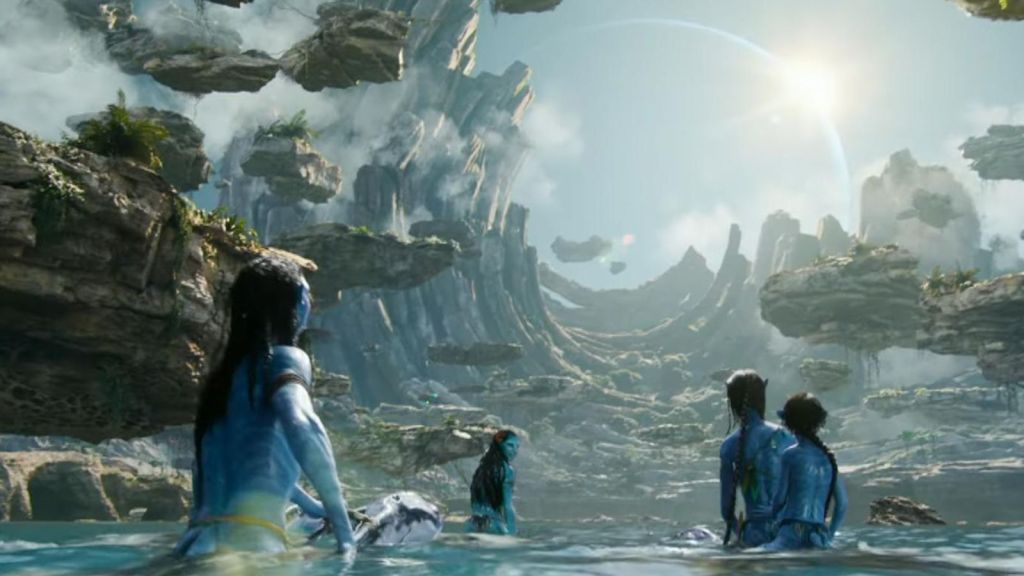
The effects do look impressive. There is no denying that, and the motion capture that turns the actors in blue giants is totally convincing. These Na’vi look and feel like flesh and blood beings. The visual imagination that creates this world, with its sweeping vistas and eclipse-kissed sky not to mention the myriad exotic creatures that populate it are stunning. If Avatar 2 deserves praise it’s for that. Pretty much every single frame looks like it cost a million dollars.

Unfortunately, it often also has a sheen of unreality. I became desperate for something real to appear on screen. But when only one character out of ten is not an effect, you don’t get much of that. On top of which the decision to film in slick, blur-free 48 frames per second means everything glides across the screen with the perfect-focused quality of a videogame. Don’t know what I mean? Try looking at things around you while moving your head at moderate speed. What do you see? Blur. Blur is real. The perfect focus of this world clues you up in every second that nothing in it is real.

The lack of reality eventually starts to remind you of The Phantom Menace. In fact, the only thing really separating this from that disaster is that James Cameron is a master director of epic, visual cinema. The film-making here, as a technical exercise , is beyond reproach. And few directors shoot action scenes with as much skill and raw excitement as Cameron. I can’t fault anything about that, even while I struggled to care as they dragged out over a huge chunk of time.

But Cameron’s weakness as always been the writing. He is a flat and unimaginative writer of dialogue – the Na’vi dialogue is awful flicking from ponderous (“We Sully’s stick together. That is our greatest weakness. And our greatest strength!”) to painfully bad (the number of “Bros” and “Dudes” from the Na’vi teenagers is fist-bitingly awkward, like your Dad trying to be down with the kids).

That’s not mentioning the fact that it’s so similar to the first film. The earth people return, war starts and eventually our heroes travel to a new part of Pandora where, just like Jake in the first film, they go through a training montage to learn the “way of the water”. This takes up most of the middle act. That’s not forgetting the huge number of themes and characters reshuffled and represented.  We build towards a clash very similar to the first film at the end. Nothing here feels fresh, everything feels like a retread. Our villain is resurrected as a Na’vi but, despite almost being defined by his racism in the first film, he doesn’t bat an eyelid at this.

There is a vague attempt to transfer Sully’s “torn between two cultures” storyline to Spider. But this character remains terminally under-developed and the film’s attempt to explore the father-son dynamic between him and Quaritch is so rushed, you wonder if Cameron was interested (odd since it’s crucial to the final act). Instead, we get a huge amount of generational clash in the Sully family, with Jake butting heads with his second son who struggles with being “the spare” (oddly appropriate right now), a hot head who gets everyone in trouble. These play out with a reassuring predictability, so much so that if I asked you to guess the fates of those involved you probably could.

There are bizarre logic gaps. Quaritch and his soldiers have been resurrected to destroy the Na’vi resistance – but instantly drop this for a personal vendetta against Sully (no one seems to care about the resistance after the first half an hour). When Spider is captured, Sully and gang don’t give a damn or even consider rescuing him. Sully doesn’t want to put the forest Na’vi in danger by staying – but doesn’t care about moving that danger to the water people.

Above all it’s frankly hellishly long, fully of trivial culture clash stuff and just the fact that the people in at are giant and blue or that it looks fabulous doesn’t make it good. Instead, Avatar 2 is a re-tread that feels like its treading water, spinning plates and repeating rather than reinventing. I’d rather watch the original again which, while it wasn’t inspiring, at least felt new.

Avatar (2009)

Avatar (2009)

Cameron’s monster-hit is an exciting slide of traditional story-telling, that had less cultural impact than you might expect

Director: James Cameron

Cast: Sam Worthington (Jake Sully), Zoë Saldana (Neytiri), Stephen Lang (Colonel Miles Quaritch), Sigourney Weaver (Dr Grace Augustine), Michelle Rodriguez (Trudy Chacón), Giovanni Ribisi (Parker Selfridge), Joel David Moore (Dr Norm Spellman), CCH Pounder (Mo’at), Wes Studi (Eytukan), Laz Alonzo (Tsu-tey), Dileep Rao (Dr Max Patel)

Why is Avatar so easy to mock? It’s the second biggest box office hit ever (Cameron holds slots two and three with this and Titanic:only Avengers: Endgame grossed more). But its cultural impact feels wide but not deep. As FOUR more Avatar films start to arrive from 2022, the question remains: why has no-one really talked about Avatar since 2009?

Perhaps it’s because there isn’t really much new or unique in Avatar, beyond the magic of its visuals and the magnificent showmanship of Cameron. For all the striking blue design of the aliens, their story was too reminiscent of too many other things. The script lacked punch, distinctive lines and unique characters. There was little to quote and few truly original pivotal moments that could be embraced by our cultural memory. Narratively and structurally, it’s all a little too safe, predictable and conventional.

 Avatar partly became a “must see” cinematic event, because it was the film that finally nailed 3D. Maybe it is the best 3D film ever made. I don’t know, I’ve only ever seen it in 2D. To be very fair, Cameron doesn’t fill the film with crappy shots of things pointing at the camera. Instead, concentrating on telling a cracking (if predictable) story and filling the screen with beautiful, imaginative imagery that works in any dimension.

Avatar’s imagery is so striking because it’s set on the magical alien world of Pandora. In 2154, with Earth’s resources depleted, mankind has struck out into the stars – and Pandora is a rich seam of an insanely valuable mineral called unobtanium (chuckles presumably intended). Pandora is a carefully balanced biosphere, peopled by exotic animals and 10-foot, blue-skinned natives called the Na’vi. Pandora’s atmosphere is poisonous to humans, so scientists – led by Dr Grace Augustine (Sigourney Weaver) – use Na’vi “avatars”, operated by genetically matched humans, to explore. The mission is carefully balanced between science and financial exploitation by a sinister corporation, backed by mercenary army, led by the fanatical Colonel Quaritch (Stephen Lang).

Into this magical set-up drops paraplegic ex-marine Jake Sully (Sam Worthington), taking the place of his dead scientist brother because he is a genetic match for a freshly grown Na’vi avatar. With this warrior background, Jake is welcomed by the Na’vi, becoming an ambassador to the people. But Jake’s loyalties split as he finds a purpose in Na’vi life he has long since lost on Earth – and as he falls in love with Na’vi warrior Neytiri (Zoë Saldana). When the company decide to destroy the Na’vi’s home to gain access to the rich unobtanium deposits beneath, which side will Jake back?

It’s not hard to guess. At heart, Avatar fits very neatly into a series of Dances with Wolves-esque films, in which a wounded and lost (white) soldier finds a spiritual peace and solace with a native people, eventually rising up to fight for their rights against his own people. Avatar also finds roots in The Mission, with the scientists as the missionaries fighting alongside the natives (although with much better results), the conclusion of Return of the Jedi and Cruise’s The Last Samurai. Not to mention more than a few stylistic and plot echoes from Cameron’s own Aliens (you can even hear them at several points in Horner’s score), from technology (those stomping war suits) and cocky marines lost in a world they don’t understand (except this time, we love to see them killed off).

Avatar doesn’t challenge you, presenting its humble message of environmentalism and peaceful co-existence within a familiar framework where military forces and corporations are very bad and enlightened missionaries and Indigenous people are good. It entertains because it’s told with such skill. Cameron, while never the greatest screenwriter in the world, knows how to marshal his clichés and standard narrative tricks into something exciting and involving.

It also helps that the stock characters he creates a played with such forceful engagement by the actors. Stephen Lang is a growlingly hateable racist, delighting in the prospect of genocide, while Giovanni Ribisi’s corporate boss is a snivelling opportunist who couldn’t care less about the impacts of his actions. Opposite them, Sigourney Weaver gives huge weight to a fairly standard irritated-boss-turned-mentor role as the head scientist, Sully’s bridge to learning the Na’vi way. As Sully, Sam Worthington is not the most charismatic performer but he has an earnest intensity and emotional honesty that helps us invest in his pre-Pandora misery and his growing love of his adopted home.

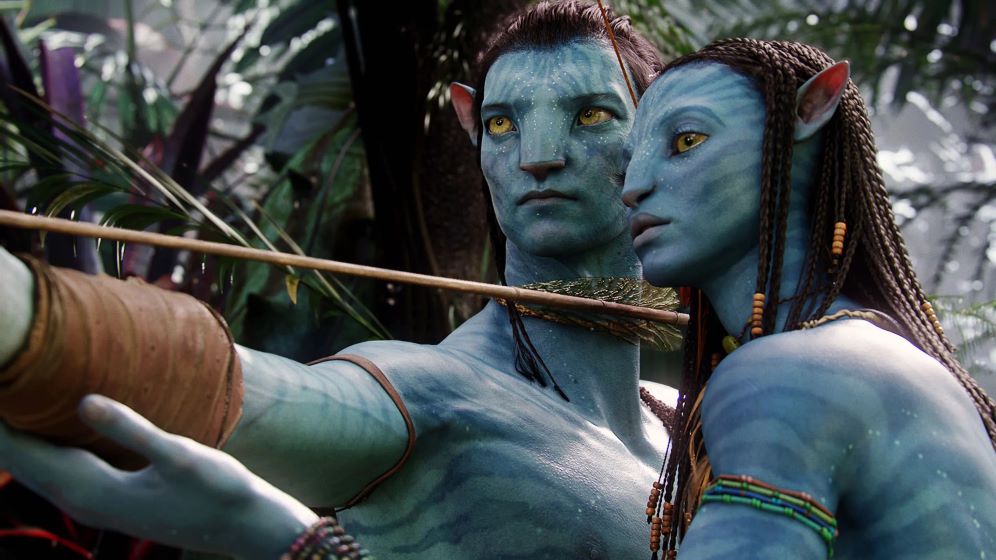
Cameron’s greatest achievement though is the vision he creates for the Na’vi. All are played by actors using cutting-edge (and still impressive now) motion capture. Cameron builds a whole world for these people: a language, belief system, culture and bond with the environment. Sure, it’s heavily inspired by Indigenous American culture, but it feels real. Its bought to the screen with grace and tenderness and gains a huge amount from Zoë Saldana’s committed and emotionally open performance as Neytiri. Cameron so successfully builds a bond between audience and the Na’vi that you feel your heart wrench to see mankind tear their beautiful world apart.

It’s that emotional connection Cameron successfully builds that helps make the film work. After all we’ve all seen effects stuffed films before, but they don’t all become monster hits. And if the film was a dog, all the 3D magic in the world wouldn’t have helped. Few directors have as much skill with threading emotional bonds within the epic as Cameron. He shoots Avatar with a stunning majesty, carefully placed shots and graceful, almost traditional, editing help to build a sense of magic and wonder around the awe-inspiring alien vista. Avatar has a lot of action, but it never feels like just an action film: it’s a relationship drama, inspired by the beauty of its setting, with action in it.

More people have mocked Avatar with comparisons to the visually and thematically similar Fern Gully: The Last Rainforest than have actually seen Fern Gully. Narratively it does little new or unique and offers very little surprises. But its visuals are stunning and Cameron’s superb direction knows how to engage you. Clichés last because they carry a sort of truth: Avatar uses these truths to help you invest in a gripping, if conventional, story. But it’s also why its impact over time has been so slight – there aren’t any new ideas for viewers to tie themselves to and almost nothing that stands out as a unique cultural reference point – even if the conventional plot helped make it a short-term monster hit. But it’s also why it still makes for enjoyable rewatching.

Public Enemies (2009)

Johnny Depp rides into action as John Dillinger in Michael Mann’s underwhelming Public Enemies

Director: Michael Mann

Cast: Johnny Depp (John Dillinger), Christian Bale (FBI Special Agent Melvin Purvis), Marion Cotillard (Billie Frechette), Billy Crudup (J Edgar Hoover), Stephen Dorff (Homar van Meter), Stephen Lang (Agent Charles Winstead), Stephen Graham (Baby Face Nelson), Jason Clarke (Red Hamilton), David Wenham (Harry Pierpont), Spencer Garrett (Tommy Carroll), Christian Stolte (Charles Makley), Giovanni Ribisi (Alvin Karpis), Bill Camp (Frank Nitti), Branka Katic (Anna Sage)

Michael Mann has an affinity for crime films. With Heat as one of his calling cards, Public Enemies is his attempt to do the same in the classic prohibition and bank robbery era of the 1920s. The guys going head-to-head this time?  John Dillinger (Johnny Depp), coolest robber there is, an icon of the criminal classes, and Melvin Purvis (Christian Bale) rigid and committed FBI agent. Public Enemies however fails to match Heat, falling part way between history lesson and action thriller. Covering the last few years of Dillinger’s life, and the rise of the FBI, it’s a cold, strangely uninvolving film mixed with a few stand out action scenes where tommy guns go blazing.

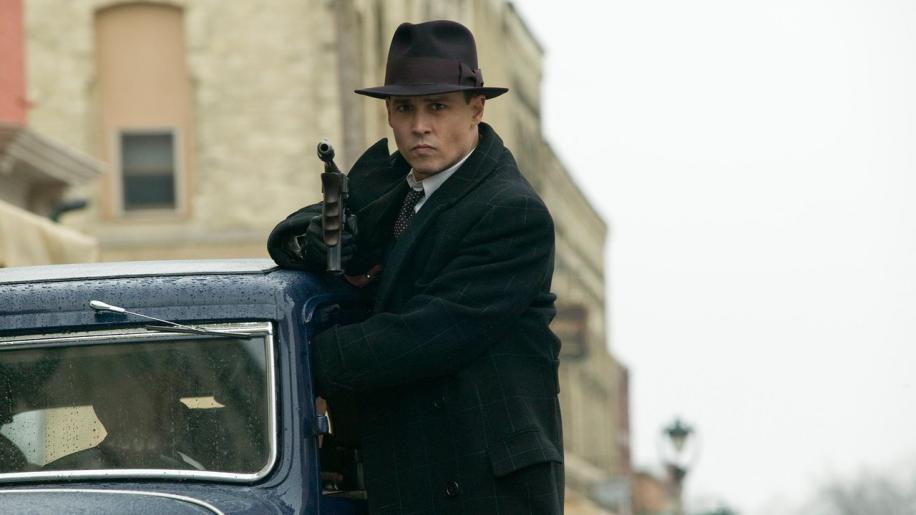
One of the first things it impossible to miss about the film is Mann’s decision to shoot the film using HD video cameras. The advantages of this is it gives much of the film an immediacy and modern look that throws the viewer into the middle of the action and makes this at times look and feel like a piece of news reel footage rather than a period piece. The camera choice allows Mann to put the camera right into the action, capturing every detail at a fast pace. The film has the look at times of a genuine documentary, and removing the richness of film also gives it the air of being caught on a phone, like some of this was some sort of found footage. Or rather, a phone that has been handled by a gifted cinematographer for perfect framing.

The downside of the choice of HD camera is that it makes the film at times look rather like a behind-the-scenes DVD documentary, with its untextured shadows and lack of lighting. Frankly at points it makes the film look bizarrely a little bit dull in places, or unusually unprofessional. Personally, I feel the benefits it gives in immediacy are cancelled out by this. But that’s just me.

Away from Mann’s shooting style – and his usual high octane skill of cutting and assembling action scenes – the film showpieces a strange lack of insight into its characters or any real developments of their hinterland. This is particularly so in the case of Purvis who never comes to life either in the film’s staging of him, or in Bale’s firm jawed, muted performance. When the final film caption throws up news of his later resignation and years later possible suicide it doesn’t make you question things you have seen in the film or feel like a logical progression: it just doesn’t tally up at all. 

The film does get some material out of how both sides play the media game. Purvis is a reluctant but fairly skilled player. His boss J Edgar Hoover (rather well played by Billy Crudup in one of the films best performances) is obsessed with spinning the nascent FBI to the media – half his scenes are bookended by press conferences – and his primary motivation is to exhibit himself to the media as the only logical choice for leading the FBI and the essentialness that it gains the powers it needs. Similarly, Dillinger and his fellow criminals delight in their media profile and do their damnedest to build up images of themselves as Robin Hoods (without the giving to the poor of course).

This is captured in Johnny Depp’s charismatic performance as Dillinger, a brooding, intense figure who would like to see himself as a sort of poet of the underworld. Dillinger talks about the banks money being their only interest and is frequently charming with an edge with regular people. He prefers bloodless robberies as they are cleaner and demonstrates a genuine sense of romantic openness with his girlfriend Billie. However, he is no angel. While he does not use violence as a first resort, he has no hesitation about using it as a second and will happily put bystanders at risk and rough up bank staff to get what he wants. He talks of escaping, but it’s clear that the game is an addiction for him and the danger is enjoyable – he takes an illicit thrill at one point of sitting in a cinema while his mugshot appears on the screen, wondering if anyone will dare spot him.

Depp’s performance is the finest thing in the film, a subtle and intelligent tightrope walk that teases depths that are perhaps not there, and suggests sympathies and agendas he perhaps does not have. While the character remains unknowable, you sense a great complexity and conflict there somewhere. He’s helped by being given a great actress like Marion Cottilard to play off, who makes Billie much more than just a gangster’s moll.

There is potential in the film, but it never really comes to life. For all the exciting shoot outs and drama, none of its characters are engaging or really interesting. The rest of the supporting cast feel like pieces to be moved around the board – many disappear with no real trace – and their fates pre-ordained by the demands of the plot. It makes for a rather flat experience, full of style, but never making you invest in it.