Tag: Tracy Letts

A House of Dynamite (2025)

A House of Dynamite (2025)

Terrifying, compelling and gripping it-could-happen drama about the madness of nuclear war

Director: Kathryn Bigelow

Cast: Rebecca Ferguson (Captain Olivia Walker), Idris Elba (President), Gabriel Basso (Deputy NSA Jake Baerington), Jared Harris (Secretary Baker), Tracy Letts (General Anthony Brady), Anthony Ramos (Major Daniel Gonzalez), Moses Ingram (Cathy Rogers), Jonah Hauer-King (Lt Commander Robert Reeves), Greta Lee (Ana Park), Jason Clarke (Admiral Mark Miller), Malachi Beasley (SCPO William Davis), Brian Tee (SAIC Ken Cho), Renée Elise Goldsberry (First Lady), Kaitlyn Dever (Caroline Baker)
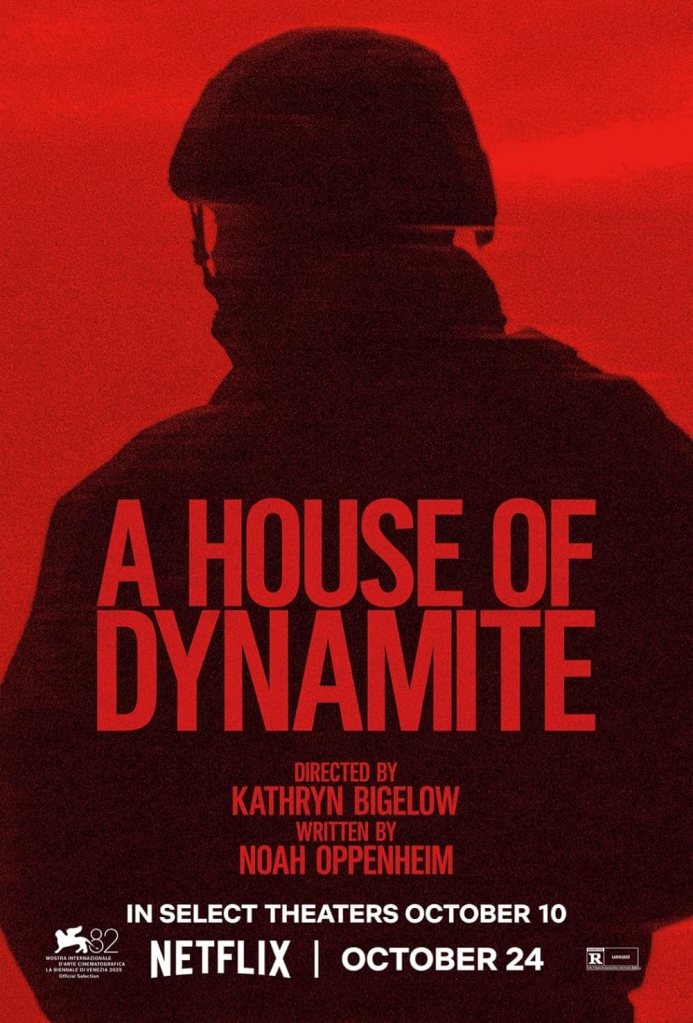
“That’s what $50 billion buys us? A fucking coin toss?” the Secretary of Defence (Jared Harris) plaintively wails as he discovers yet another weakness in the USA’s defence infrastructure. It’s one of many grim realisations filling A House of Dynamite, a relentlessly horrifying look at what might actually happen if a nuclear missile was launched at the United States: and how, in less time than it takes to watch an episode of Friends, the US President (Idris Elba) can go from shooting hoops at a charity event to flicking through menu-style list of world-ending options, being told he has a three minute window to make a decision that could be final for all of us. House of Dynamite makes clear to us all: the fate of the whole world effectively rests on a series of coin tosses we have no influence over.

Bigelow’s intense, brilliantly shot and edited film, plays out the same eighteen-minute scenario from different perspectives. A glitch in the USA’s satellite network misses the launch of an ICBM, somewhere off the coast of Asia, heading for Chicago. Disbelief and panic swiftly sets in at every level of the US administration. Anti-missile defence systems miss (that’s the coin toss, as we’re told it only has a 61% success rate in tests). A decision needs to be taken whether to follow policy and launch a counter-attack before the nuke hits. It plays out from three primary perspectives: Captain Olivia Walker (Rebecca Ferguson), senior officer on duty in the Situation Room; Jake Baerington (Gabriel Basso), deputy NSA covering for his under-anaesthetic boss, begging Russia to stand-down their forces as the US goes to DEFCON1; and finally the President (Elba), out-of-his-depth in a nightmare where he feels powerless and totally unprepared.

Powerless and unprepared become the guiding feelings in US defence, as people slowly release the best cast scenario is only losing 10 million people in Chicago and their worst (most likely) case is everyone dying in a nuclear conflagration. Bigelow’s film, shot with the hand-held intensity of a combat film, grabs you with a vice like grip as it plays out this nuclear nightmare. A House of Dynamite only ever gives us the same information as the fictional administration trying to make impossible choices. Like them we never find out who launched the missile, if it’s the first of a wave or even if it’s fully armed ICBM. All we know is the strike on Chicago quickly becomes inevitable and, with that fact, the world as we know it is over. Bigelow’s film (although it is not as clear in its clarification of US launch policy as it could be) places the system (which offers few choices and no alternatives) as the antagonist.

It also makes clear that nuclear war can happen at a time totally not of our choosing. Here it unfolds on a regular morning. The President is at an inconsequential publicity event, reduced to dialling into a world-shaking video call from a mobile: and he’s barely a month into his administration. The National Security advisor is in an operating studio and his unknown assistant is reduced into running through gridlocked traffic to get into the office. A designated FEMA expert (Moses Ingram) has just been appointed and at first believes the whole thing is a drill. The NSA North Korea expert (Greta Lee) is at a Gettysburg reconstruction with her young son. The Situation Room is undergoing maintenance and the Premiers of Russia and China can’t be raised on the phone.

A House of Dynamite doesn’t land cheap shots: it’s portrait of the members of the administration and the US defence infrastructure stresses their level-headedness and professionalism. Indeed, their competence makes the complete lack of control they have all the more alarming. Tracy Lett’s STRATCOM General keeps a professional level-headedness, even as he dutiful advises sticking to a nuclear policy which will effectively end the world. Rebecca Ferguson’s composed, calm and collected Naval captain finds herself increasingly aghast but only allows herself a few moments of tears after a goodbye phone call to her husband, clutching a toy dinosaur gift from her son. Anthony Ramos’ missile base commander reassures his staff this is what they have trained for: right up until the point where their interceptor missile misses and he slips into near catatonic shock as he realises that life’s training was for nothing.

Politicians are similarly portrayed as decent, but fundamentally unprepared for the situation. Idris Elba’s suave president looks every inch the confident leader, but it’s revealed he’s uncertain, hesitant, terrified of looking weak and his skills of schmoozing the public utterly useless for this situation. Jared Harris’ Defence secretary is only marginally more on-top of his brief (he reveals the nuclear war briefing is less than half an hour because it was seen as so unlikely to happen) and, for all his competence, becomes increasingly distracted at the thought of his estranged daughter (Kaitlyn Dever) facing death in Chicago. Gabriel Basso’s Deputy NSA seems at first absurd, but grows in statue as he desperately tries to salvage global survival.

Bigelow’s film makes clear this is a lose-lose situation. It’s a film about the constricting pressure of panic. Panic leaves assured professionals weeping or vomiting. Superpowers plan world-ending retaliation out of fear that they might be wiped out before they get a chance to fire their nukes. The President becomes overwhelmed, asking the junior aide carrying the nuclear football (Jonah Hauer-King) what he should do. (Hauer-King’s character, acknowledging the way the War Book looks like a nightmare menu, wryly confesses he calls the world-ending options rare, medium and well-done). The Deputy NSA tries everything, including begging, to get Russia to stand down, only for them to refusing to do so until US meet Russia’s own un-meetable conditions.

What we are left with is the realisation that there is no winner here. Many viewers, I feel are missing the point. Who fired the missile, who (or if) America hits back, if Chicago goes up in inferno or not, is not the point. Just firing the starting trigger in this race means you lose, because when the nuclear buttons is pressed by anyone there is no turning back, no way of unringing that bell. This is the chilling message of Bigelow’s compelling film – made all the more chilling as she finds so much humanity in the people forced to make these terrible calls.

What we end up with is a different type of coin toss: one man, in most cases with almost no preparation what-so-ever, making a decision that could go either way on virtually no conclusive information at all, in an impossibly small window, about whether to risk ending the world or not. What A House of Dynamite makes clear is that’s all nuclear deterrent really is: a coin toss for individuals who feel they have to always call heads. That’s possibly the most terrifying about it.
The Big Short (2015)

The Big Short (2015)

An all-star cast juggle dollars, acronyms and lots of shouting in McKay’s smart but heartless film

Director: Adam McKay

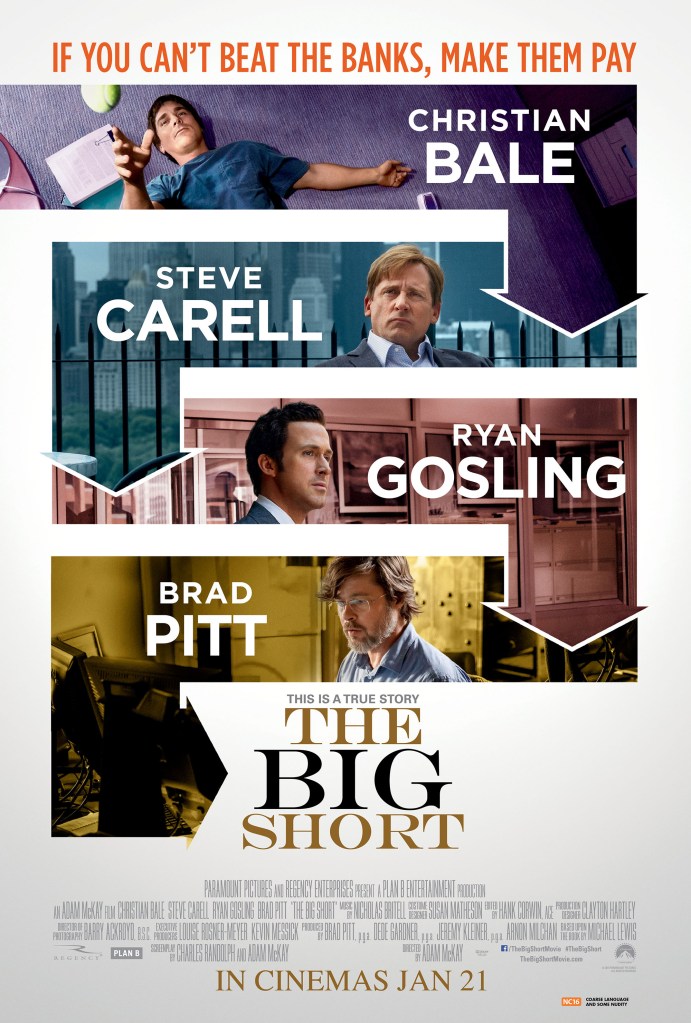
Cast: Christian Bale (Michael Burry), Steve Carell (Mark Baum), Ryan Gosling (Jared Vennett), Brad Pitt (Ben Rickert), John Magure (Charlie Geller), Finn Wittrock (Jamie Shipley), Hamish Linklater (Porter Collins), Rafe Spall (Danny Moses), Jeremy Strong (Vinny Daniel), Marisa Tomei (Cynthia Baum), Tracy Letts (Lawrence Fields), Melissa Leo (Georgia Hale), Karen Gillan (Evie)

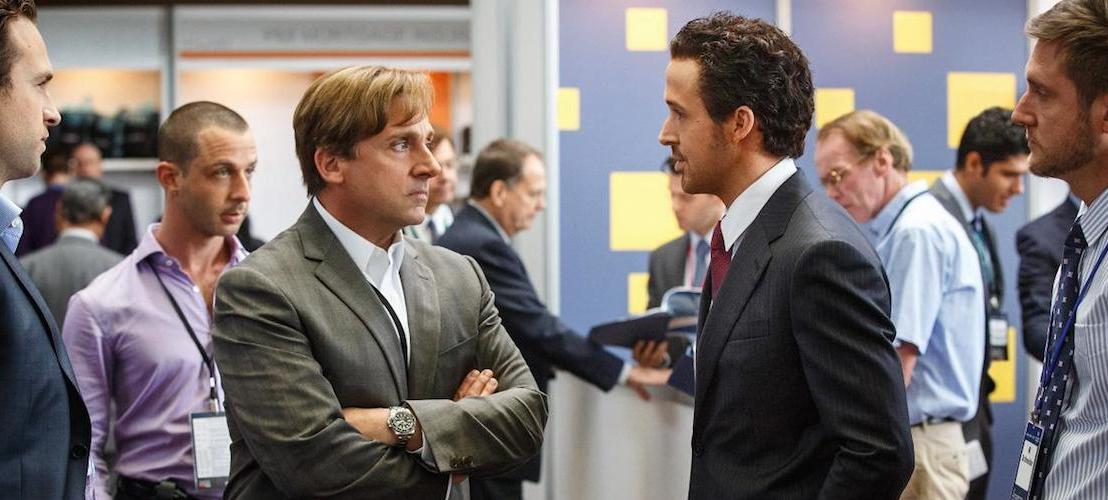
We all experienced the financial crisis of 2007 but very few of us actually understood it: above all, perhaps, what the hell actually happened and why. That’s what McKay’s film – somewhere between drama, satire, black comedy and tongue-in-cheek infomercial – tries to resolve. Adapting a book by leading financial journalist Michael Lewis, The Big Short charts the whys and wherefores of the collapse, by focusing on the money men who saw the signs of the impending crash and bet against the booming economy.

Those men (and they are all men of course) are played by a series of actors enjoying themselves thoroughly playing larger-than-life characters who it’s never entirely clear if we are supposed to empathise with, sympathise with, cheer on or stand aghast at while they make fortunes from the ruin of others. I’m not sure the film does either though.

Christian Bale is the eccentric hedge fund manager whose analysis predicts the crash and takes eye-watering investment charges that will pay off thousands of times over when the crash comes. Ryan Gosling is a banking executive who understands that analysis and robs in Steve Carrell’s hedge fund manager to similarly invest to cash in (Carrell’s character, for all his misanthropic oddness is the only one truly outraged at the corruption in the system that will lead to the collapse). Brad Pitt is the retired trader roped in for “one more job” by young traders Finn Wittrock and John Magure to make their own bets against the house. They too will eventually realise the huge impact this will have on people – but are powerless to get anyone to listen as they try and warn against the pending disaster.

McKay’s film, with its tightly-controlled but surprisingly effective off-the-cuff feel (it’s stuffed with neatly edited jokes, straight to camera addresses and a constant running commentary from the characters on the accuracy – or otherwise –  of outlandish moments), may sometimes have the air of a slightly smug student film, but what it does well is explain the financials. If you were unsure about what CDOs, AAA ratings, Quants, credit default swops and sup-prime mortgage were before the start, you’ll have a much better idea later. Neat inventions describe this: from narration, to graphics, to Jenga blocks to famous people (Margot Robbie, Anthony Bourdain and Selena Gomez among others) popping up to glamorously put things in other contexts.

The Big Short does this sort of thing rather well. Sure, it’s got a “lads” feeling to it – there is no “for the girls” equivalent to Margot Robbie in a bath explaining sub-prime mortgages – and the entire dialogue and pace of the film has a frat-house wildness that I suppose does reflect the tone of many of these financial institutions, which were little better than sausage parties. But it presents its ideas nicely and has some good jokes. The verité style McKay goes for is more studied than it natural – and it’s hard not to escape the feeling that the film is very, very pleased with itself, so much so that it’s not a surprise both his follow-up films the dreadful Vice and the shrill Don’t Look Up double down to various degrees on the slightly smug, self-satisfied liberalism here that sees those in power as corrupt, greedy, fools or all three and everyone else as innocent victims.

Where the film is less certain is exactly how it feels about its central characters. In other words, it doesn’t always turn the same critical eye on these people profiting from a disaster that will lead to millions losing their homes (the millions are represented by a single immigrant family). Brad Pitt may reprove his young charges from celebrating gains that will be the losses of millions of others. Steve Carrell gets several lines berating the callous, short-sighted greed of the banks. Christian Bale’s character is appalled by the “you scratch my back, I’ll scratch yours” relationship between banks, investment ratings agencies and insurance companies, all working together to keep artificial profits up. But the film still wants us to celebrate as these plucky outsiders and weirdoes clean out the house and carry home cartloads of cash while the casino burns down.

Basically, the film is all good fun but gives us little to actually care about. It’s highly influenced by the gonzo macho representation of this world Martin Scorsese’s The Wolf of Wall Street gave us, but far less skilled than that film in presenting its players as the childish, amoral vacuums they are. Furthermore, it does far less to really look at the impact of what it’s doing: in fact, it spends so long delighting in how it tells the story, it doesn’t show us what happens. It dwells at the end on abandoned trading floors and closed banks, like the fall of the Roman Empire, but finds no time at any point to hear from a real person who lost their home.

Perhaps because the real impacts are too depressing – and would have made it impossible to feel the triumphal buzz the film wants from seeing its heroes vindicated and the smug assholes we’ve seen from the banks get egg on their face. It might have felt a lot less funny if we had seen even a closing montage of the real victims and the human impact.

It’s where The Big Short falls down and why it feels in the end like a student film made on a huge budget. It nods its head at real mature themes but actually isn’t really interested in them at all.

Little Women (2019)

March Sisters: Assemble! For Greta Gerwig’s superlative adaptation of Little Women

Director: Greta Gerwig

Cast: Saoirse Ronan (Jo March), Emma Watson (Meg March), Florence Pugh (Amy March), Eliza Scanlen (Beth March), Laura Dern (Marmee March), Timothée Chalamet (Laurie), Meryl Streep (Aunt March), Tracy Letts (Mr Dashwood), Bob Odenkirk (Father March), James Norton (John Brooke), Louis Garrel (Professor Friedrich Bhaer), Chris Cooper (Mr Laurence)

Spoilers: Such as they are but discussion of the film’s ending (or rather Greta Gerwig’s interpretation of it) can be found herein…

There are few novels as well beloved as Louisa May Alcott’s Little Women. So much so – and so successful have been the numerable adaptations, not least Gillian Armstrong’s 1994 version – that it’s hard to see what a new adaptation could bring to the story that hasn’t been covered before. A new window on the story is triumphantly found though in Greta Gerwig’s fresh and vibrant adaptation, blessed with some terrific performances, and telling its own very distinctive version of the story.

Gerwig’s version crucially starts off in the sisters’ adult lives: Jo (Saoirse Ronan) in New York struggling to make it as a writer, while Meg (Emma Watson) nurses the ill Beth (Eliza Scanlon) back home with Marmee (Laura Dern), and Amy (Florence Pugh) encounters their childhood friend Laurie (Timothée Chalamet) in Paris. This is intercut with the story of their growing up in Massachusetts, with the past story line eventually catching up with the present day. 

If that sounds like it should make the story hard to follow, don’t worry – this is astonishingly confident work from Gerwig, wonderfully directed with zest, fire and imagination (making her exclusion from the Best Director list at the Oscars even more inexplicable – chalk that up I guess to sexism against pictures about “girls” and the fact it’s not as overtly flashy as the rest of this year’s nominees). This takes a familiar book, and fires it up with all the energy of independent, modern cinema, creating something that feels hugely fresh and dynamic. The cross cutting between the two timelines work beautifully – not only is it always perfectly clear, but it also makes for some wonderful contrasts between events in the past and present. None less than the recovery of Beth from TB being followed (with an almost shot-by-shot echo in its filming) by the reactions to Beth’s death. Inventions like this add even greater depth and meaning to the moments and hammer home some terrific emotional high points. 

Gerwig’s style throughout the film invests the story with a great energy, particularly in creating the warm bohemian attitude of the March family. This really feels like a family – conversations between them are fast, people talk relaxedly over each other, the chemistry is completely real, and the camera captures in its movement the warmth and energy of these characters who are completely comfortable in each other’s presence. It’s no surprise that Laurie is taken so quickly with this family, or wants to be part of it. Gerwig invests the family with a dynamic, excited sense of freedom and urgency. Helped by the warm glow that the childhood sections of the film are shot with, these scenes hum with a glorious sense of familial warmth and excitement. 

The camera often moves with careful, but perfectly planned, movement through scenes, mixed in with moments of fast movement – following Jo through streets, or the playful exuberance of Jo and Laurie’s first meeting (and dance) at a society ball. It’s a vibe that carries across to the performances, anchored by Saoirse Ronan’s fabulous performance as Jo. Fervent, intelligent, idealistic but also stubborn, prickly and difficult, Ronan’s Jo carries large chunks of the film, with the character skilfully mixed in with elements of Louisa May Alcott. Ronan most impressively suggests a warmth and familial love for Laurie at all times, that never (on her side) tips into a real romantic feeling. She also has superb chemistry in any case with the excellent Timothée Chalamet, who is just about perfect as a dreamy, but quietly conventional in his way, Laurie.

Gerwig’s primary rejig – and a reflection of the new structure she is chosen – is to allow more screen time to Amy, usually the least popular of the four sisters. She’s also helped by a sensational performance by the Oscar-nominated Florence Pugh as Amy, who not only plays a character perfectly from her mid-teens to her early twenties, but also invests the character with huge amounts of light and shade. The film gives a great deal of time to Amy’s time in Paris – her frustration with living in Jo’s shadow, her longing for her own artistic career (and recognition of her conventional talent – brilliantly established by a wordless glance Pugh gives an impressionist painting compared to her own literal effort) and her own romantic feelings and dreams. Cross cutting this with her past actions – her more temperamental and less sympathetic moments (burning Jo’s book!) that have pained generations – gives the audience far more sympathy and understanding for her. Pugh is also pretty much flawless in the film.

There are a host of superb performances though, with Watson capturing the duller sense of conventional duty in Meg, but spicing it with a sad regret for chances lost; Laura Dern is wonderfully warm as Marmee, but mixes in a loneliness and isolation below the surface; Chris Cooper and Meryl Streep sparkle in cameos. There is barely a false step in the case.

All the action eventually boils towards the ending – and Gerwig’s bravest and most unconventional decisions, in subtly adjusting the final conclusion of the story. At first it seems that the cross cutting of the story has short changed heavily the Bhaer-Jo relationship (Bhaer appears only in the first half an hour of the film and the end), as it cannot lean too heavily on romance when many in the audience will still be expecting a Jo-Laurie match up. 

But Gerwig actually uses this as a skilful deconstruction of the novel. Always feeling that Alcott desired Jo to be a single author – but inserted the marriage to Bhaer at the end to help sell the book – Gerwig effectively has Jo do the same thing. At a crucial moment in the final scenes, we cut to Jo negotiating with her publisher (a droll cameo by Tracey Letts), who insists on a happy ending. Cue a “movie style” chase to intercept a departing Bhaer (shot with the golden hue of the past, while Jo’s meeting with the publisher has the colder colours of the present). Our final shot shows Jo watching her book being printed, cross cut with a golden hued vision of “Jo’s” school with husband in tow. 

It’s a genius little touch, as it’s subtle enough to allow viewers to take the happy ending as it appears in the surface, but smart and clever enough to make the movie unique and different from the other versions (and that ending from the 1994 version is hard to top!). It may undermine the final relationship – and offend those who like the idea of Jo deciding she wants something different than she at first thought – but in its freshness it can’t be challenged. It also makes for a film from Gerwig that is both fresh and exciting and also bracingly and thrillingly in love with Alcott and her work.

Ford v Ferrari (Le Mans '66) (2019)

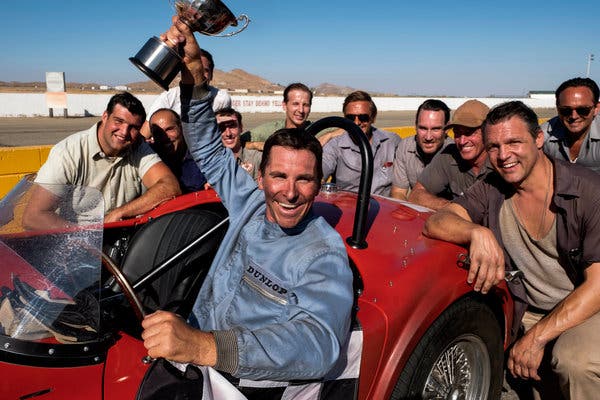
Christian Bale as maverick driver Ken Miles in the functional but fun Ford v Ferrari

Director: James Mangold

Cast: Matt Damon (Caroll Shelby), Christian Bale (Ken Miles), Jon Bernthal (Lee Iacocca), Caitriona Balfe (Mollie Miles), Tracy Letts (Henry Ford II), Josh Lucas (Leo Beebe), Noah Jupe (Peter Miles), Remo Girone (Enzo Ferrari), Ray McKinnon (Phil Remington), JJ Feild (Roy Lunn), Jack McMullen (Charlie Agapiou)

There are few more exhilarating things than going really, really damn fast. It’s a primal glee that James Mangold’s racing film Ford v Ferrari (or Le Mans ’66 as it seems to be known over here) taps into, roaring with exciting, fast-paced energy lashed onto a good old buddy movie as two plucky underdogs get the chance to overturn the champs and claim the title. It’s the story of any number of sports movies, but it still works here. It ain’t broke, after all.

It’s the early 1960s and the sales of the Ford Company are down: the baby boomers don’t want to be driving the dull, safe cars of their parents. They want something super sexy. Despite his hesitation Henry Ford II (Tracy Letts) is persuaded the best way to get that sexy image is to get a racing car – and if he can’t buy Enzo Ferrari’s (Remo Girone) company, then by hell he’ll spend whatever it takes to give Ford the best racing team in the world. Targeting the Le Mans 24 hour race, he recruits retired-driver-turned-designer Caroll Shelby (Matt Damon) to mastermind building a car – and Shelby recruits demanding, prickly, maverick Brit driver Ken Miles (Christian Bale) to help him design it and then drive the thing. But what to do when Miles’ blunt plain-speaking and individuality looks like it won’t make him the best spokesman for selling Ford cars?

On the surface Ford v Ferrari is pretty much your standard Sports film. Two teams, an underdog and a champion, a pair of mavericks who think outside the box, the struggle for success – met with initial failure before victory – all told through a familiar structure of brothers-in-arms, obstructing suits, supportive wives at home and plenty of carefully detailed expert recreation of sporting events. It’s a collection of familiar ingredients, but very well mixed together by Mangold (one of Hollywood’s finest middle-rank directors, a sort of heir to Lumet).

The real twist however is that the rivalry is not really about Ford and Ferrari. In fact the film might have been better titled Ford vs Ford. Because the main thing standing in the way of Shelby and Miles isn’t Ferrari – with whom they actually have a rivalry built on mutual respect – but with the bottom-line, sales-first suits who are backing them. It’s a parallel with everything where sales and the buck count more than anything, but you feel Mangold might well have related it most to Hollywood producers. What is Ken Miles, but the genius auteur director who the money-men just won’t trust to churn out the mass-market product they need to lift the share price? Henry Ford (very drily played by Tracy Letts) may have one visceral moment of excitement when placed in the passenger seat of a fast car – but fundamentally he doesn’t give a damn about the sport at all, except how it could help him shift a few more Mustangs.

Shelby and Miles’ struggles are not with the car, the engineering problems or Ferrari – they’re with the Ford VPS (in particular Josh Lucas’ incomparably smarmy Leo Beebe, a corporate man to his fingertips who probably bleeds stock tips) who want a product they can sell, far more than a product that can win. Obstacles are constantly thrown towards Shelby and Miles from their bosses – everything from engine design to race strategy receives a series of notes, comments and instructions from the Ford hierarchy. The choice of driver is most important of all – and they don’t want the demanding Ken Miles behind the wheel of their car. Because mavericks like that don’t sell Mustangs.

As Miles, Christian Bale gives a performance of pure enjoyment. Juggling a version of his own natural accent (which sounds odd – part cockney, part scouse – but works brilliantly) Bale gives the part just the right amount of that peculiar chippy Britishness, that resentment of people in authority, that hostile reaction to the stench of bullshit. Driven, determined but totally unwilling to suffer fools – exhibited almost immediately with him dressing down a prat who isn’t a good enough driver to handle the sports car he’s purchased – Miles is clearly never going to be the company man Ford wants. But with his passion for “that perfect lap”, his determination to work night and day to achieve that and – in a nice change – his warmth for his family and equal decision making with his wife (a slightly thankless part for Catriona Balfe) he’s a character you quickly take to your heart. It’s a great, charisma-led performance from Bale, who also gets nearly all the best lines.

It does suck a bit of the oxygen from Damon, who plays the straight-man as Shelby who is just as passionate but can (just about) speak Corporatese. With a Texan drawl, Damon does the legwork of the movie extremely generously, quietly driving many of the scenes and handling much of the more emotional arc of the movie. The two actors form a superb chemistry – peaking with a hilarious fight scene, your chance to see Batman clobber Jason Bourne with a loaf of bread (both actors, famous for muscular fight scenes, clearly enjoy a fight scene straight out of Bridget Jones). It’s a bromance that really works – and carries at certain points a genuine emotional force.

Mangold packages this material perfectly – and the racing sequences are brilliantly done, engrossing, speaker-shaking displays of racing, fabulously edited. The film itself is probably too long, and the sections away from the race track are sometimes so familiar in their structure and tone that they sometimes drag a little bit, as if the fierce momentum of the racing scenes can’t carry across to the rest of the film. But with fine performances and expert handling, this is certainly a number you’ll be happy to test drive.

Lady Bird (2017)

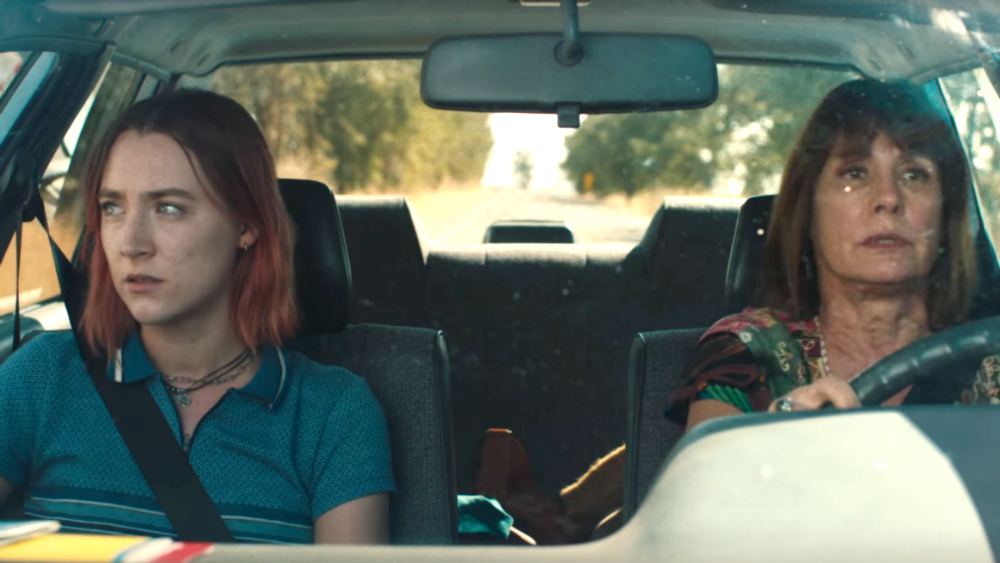
Saoirse Ronan and Laurie Metcalfe are mother and daughter with more in common than they think in Lady Bird

Director: Greta Gerwig

Cast: Saoirse Ronan (Christine “Lady Bird” McPherson), Laurie Metcalfe (Marion McPherson), Tracy Letts (Larry McPherson), Lucas Hedges (Danny O’Neill), Timothée Chalamet (Kyle Scheible), Beanie Feldstein (Julie Steffans), Lois Smith (Sister Sarah Joan), Stephen McKinley Henderson (Father Leviatch)

In Sacramento, California, in 2002 Christine “Lady Bird” McPherson (Saoirse Ronan) is a self-consciously assured teenager, constantly pushing to define herself as new and original, down to giving herself a new name (“Lady Bird”) and playfully enjoys pushing against the limits of what is acceptable at her Catholic school. She however butts heads with her mother Marion (Laurie Metcalfe), a hard-working nurse, supporting the family as her husband Larry (Tracy Letts) is unemployed and out-of-step skills-wise with the jobs market. Mother and daughter though are strikingly similar people, independent minded but with a streak of loving kindness.

It’s the relationship between these two characters that is the heart of Gerwig’s gently made coming-of-age (of a sort) drama. The key scenes that power the film are both the clashes and moments of fun between these two. There are feuds and angry words – but they often sit-by-side with a loving regard and a shared world perspective. Gerwig gets superb performances from both actors, with Ronan every inch the difficult teenager, full of promise but overwhelming with arrogance and mistakes that constantly hurt those around her. Metcalf is equally good as a woman weighed down with cares, who constantly makes time for others – and therefore finds her daughter’s lapses into selfishness all the more infuriating as they fly in the face of everything she values in life.

The film opens with a fight between these two that just seems to capture the moment. After a long drive to a perspective college, they finish an audiobook of The Grapes of Wrath both overcome with emotion from the stories end. Seconds after it finishes, Lady Bird goes to turn the radio on, her mother asks for a moment of reflection – and we are off from a shared emotional experience into a mother-daughter row. Setting the tone of how many of these will go – and the characters they display in the film – Lady Bird impulsively throws herself out of the car when she feels she is unable to come up with a decent comeback to a point. It’s a plaster cast she will wear for a large part of the film – and an example of the impulsive addiction to terrible decisions that seems to be constantly on the edge of ruining her friendships and chances.

A lot of this material is, to be honest, pretty standard stuff for movies of this genre. And Lady Bird herself is at times a rather irritating and even annoying lead character, one who seems to be constantly hurting people around her with very little regard for their feelings and seems to be continually forgiven regardless. Her treatment of her best friend Julie (a fine performance of endearing sweetness by Beanie Feldstein) sees her drop her and then pick her back up again with a suddenness that feels like it has missed the hurt and pain she has caused.

But then other parts work so well because the script approaches them with a quirky eye for a good joke and a sharp line. There are some very fine jokes among the script, a high point being a PE teacher turned drama director who directs his plays in the exact way he would plan out a football game. Little moments of character observation and behavioural ticks often strike home and frequently raise a smile.

But it also carries across the same observational honesty to less savoury attitudes of being a teenager. The selfishness, the feuding. Lady Bird’s sexual awakening of course happens with a self-obsessed arrogant would-be-poet aiming at a higher plane of intelligence (played with an assured arrogance by Timothée Chalamet). Lady Bird’s striving to constantly to be more or have more than she has always feels very teenager – life can’t just be what she has, she must need or be destined for greater things, or to improve in some way, to make it to the college she wants, to find some deeper meaning, to live a life that expands beyond her horizons and make her stand out.

But, the film suggests, she actually seems destined to become someone more like her mother –decent, kind, gentle, perhaps with a greater artistic calling, but fundamentally a thoughtful person. One early boyfriend – very well played by Lucas Hedges – who is revealed as unsuitable in a way not-at-all surprising when you consider he is the lead actor of the school drama group – is someone she accepts and comforts with a complete emotional openness. Her father’s travails in the job market is something she feels great empathy for. When returning to the company of her friend Julie, she is warm, caring and full of energetic affection.

It makes for a gentle and engaging film – perhaps nothing you haven’t really seen before, but presented with a lot of assurance and freshness by Gerwig, who is a director with an eye for the moving moment (a scene where Tracy Lett’s father sees his son go-up for the same job as him – a job for which the son is more qualified – is unmatched in its sad mix of acceptance and pride) and more than a taste for the eccentric comedy that brings spark to the drama. Powered by two excellent performances by Ronan and Metcalfe, Lady Bird may, like many teenagers, be difficult to like sometimes but has lots of promise.

The Post (2017)

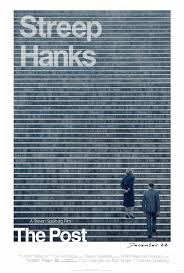
Hanks and Streep bust Watergate in advance in Spielberg’s too dry The Post

Director: Steven Spielberg

Cast: Meryl Streep (Katharine Graham), Tom Hanks (Ben Bradlee), Sarah Paulson (Tony Bradlee), Bob Odenkirk (Ben Bagdikian), Tracy Letts (Fritz Beebe), Bradley Whitford (Arthur Parsons), Bruce Greenwood (Robert McNamara), Matthew Rhys (Daniel Ellsberg), Alison Brie (Lally Graham), Carrie Coon (Meg Greenfield), Jesse Plemons (Roger Clark), David Cross (Howard Simons), Michael Stuhlbarg (AM Rosenthal)

There are few things newspaper journalists like more than old-fashioned films about the glory days of the press, showing journalists to be uniformly noble, upstanding, seekers of truth. There are few things Hollywood likes more than films the feature Streep and Hanks and/or are directed by Spielberg. As such, it’s not really a surprise that The Post received laudatory reviews, or that it crept into the Best Picture list of 2017 (it only got one other nomination, inevitably for Streep).

The film covers the Washington Post’s decision in 1971 to publish details from the Pentagon Papers, originally leaked to the New York Timesby former Defence Department official Daniel Ellsberg (Matthew Rhys). The papers detail the American government’s deceptive public messages on Vietnam, a war they knew to be unwinnable for almost ten years. The Nixon administration has blocked publication in the New York Times, but when the Post gets the same papers, owner and publisher Katharine Graham (Meryl Streep) and editor Ben Bradlee (Tom Hanks) have a difficult decision to make – suppress the truth or publish and face crippling legal penalties that could destroy the business.

The Post is quite similar in some ways to Spielberg’s far more successful Lincoln – a po-faced history lesson, told with panache, but essentially a dry civics lesson which draws some neat, but a little too on point, parallels with current events. Certainly it’s clear whom we are meant to be thinking of when the camera shows a shadowy Nixon in long shot from outside the White House, ranting into a phone in the Oval office late at night (admittedly, in a nice touch, the film uses the actual audio from Nixon’s Oval Office recordings). The parallels between press freedom and the spin of politics (or the charges of Fake News flung at any story the powers that be don’t like) are pretty clear. They are also pretty obvious.

Part of the film’s problem is that, unlike All the President’s Men (where the story covers full investigative journalism and Woodward and Bernstein need to piece the story together against the odds), this film hands everything to the journalists on a plate. It doesn’t even try to put a puzzle or some form of mystery before the viewers. Instead, the history is painstakingly (and drily) explained to give us the context, then each stage of the Post getting the papers is shown in simple and rather undramatic steps. There isn’t a sense – despite Bob Odenkirk’s deputy editor doing a bit of legwork – that the Post needed to work that hard to land the story. Crikey, you can see why The Times (who really did the crack the story) were a bit pissed at the film stealing their glory.

Once the papers are in the Post’s hands, the story almost immediately jumps to one night in which the papers are read and the board and the journalists squabble over whether they can legally publish or not. After that we get a swift coda where everything turns out fine, backs are slapped and the Supreme Court says it’s all good. There just isn’t quite enough drama. In fact we feel like we are watching a footnote, rather than the real story, which seems to be happening on the margins (for starters, the scandal of government lies on Vietnam, how The New York Times broke the story, and the Watergate break-in, a recreation of which rather clumsily closes the picture).

And I get that the film is trying to tell a story about how important a free press is and, yes, it’s great – but despite having a number of characters talk at length about this, I’m not sure what the film really tells us that we don’t already know. Instead it moves methodically but swiftly through events, carefully telling us what happened but never turning it into a really compelling story. Pizzazz for its own sake is not a strength, but a little more oomph in delivery here might have helped.

Alongside this, the film also wants to make points about the struggle of a woman in a man’s world and the institutional sexism (that probably hasn’t changed that much) of many boardrooms. Meryl Streep’s Katharine Graham – having inherited the company after the suicide of her husband – is a brow-beaten woman struggling to impose herself in a room of men whom she feels inferior to. Even this plotline though feels slightly rushed – we have Graham cowering in a boardroom meeting and struggling with paperwork, next thing we know she hesitantly makes the call to publish and is facing down her chief opponent (Bradley Whitford, rolling out another of his arrogant men of privilege). It’s all a bit rushed, perfunctory and all as expected – and Streep can clearly play this sort of role standing on her head.

But then the whole film has this slight comfort job feeling about it – everyone clearly invested in the story and the importance of the film’s points, but clearly without being challenged by the content. By the end of the film we’re are awash with clichés, from newspaper print rolling through old machines, to Graham walking through a crowd of admiring women outside the Supreme Court. The interesting and well assembled cast don’t get enough to do, with many of them feeling slightly wasted, not least Sarah Paulson in a thankless role as “the wife”.

The Post wants to be a big, world-changing film that talks about our modern age. Instead it’s a very middle brow, middle of the road history lesson that flatters to deceive, entertaining enough just about, but immediately forgettable.