Tag: Tyler Perry

Don’t Look Up (2021)

Don’t Look Up (2021)

A host of stars tell us the world us coming to an end in this self-satisfied film

Director: Adam McKay

Cast: Leonardo DiCaprio (Dr Randall Mindy), Jennifer Lawrence (Kate Diabiasky), Rob Morgan (Dr Teddy Oglethorpe), Meryl Streep (President Janie Orlean), Cate Blanchett (Brie Evantree), Jonah Hill (Jason Orlean), Mark Rylance (Peter Isherwell), Tyler Perry (Jack Bremmer), Timothée Chalamet (Yule), Ron Perlman (Colonel Benedict Drask), Ariana Grande (Riley Bina), Scott Mescudi (DJ Chello), Himesh Patel (Philip Kaj), Melanie Lynsky (June Mindy), Michael Chiklis (Dan Pawketty)
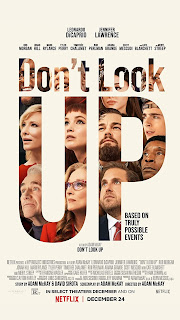
Climate Change. It’s the impending disaster where we stick our head in the sand and pretend it’s not incoming. Governments have been told for decades our carefree use of fossil fuels and slicing down of rainforests will have a cataclysmic impact. But it’s always easiest for governments and people to just say “nah” and not let those thoughts get in the way of our everyday lives. Adam McKay’s satire Don’t Look Now takes these trends of indifference, disbelief and denial climate scientists have faced their whole careers and reapplies them to a comet-hits-the-Earth disaster movie.

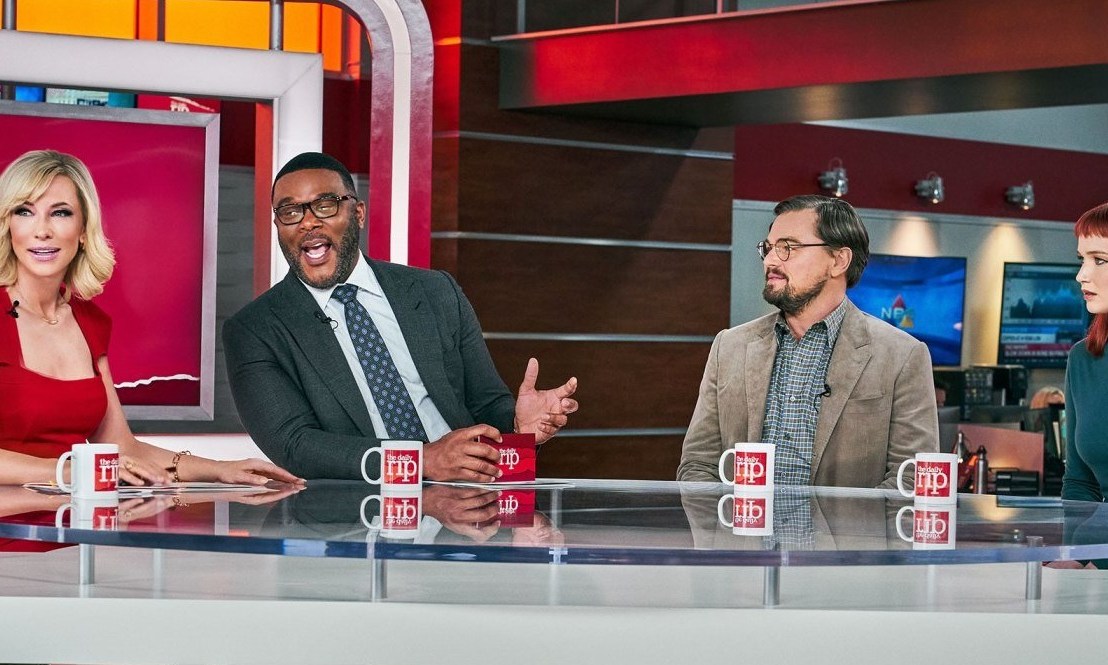
So, when Michigan State University astronomers Dr Randall Mindy (Leonardo DiCaprio) and Kate Diabiasky (Jennifer Lawrence) spot a hunk of ruck the size of Everest on a collision course with the Earth they are met with a chorus of… yawns, memes and flat-out denials. The Trumpian President (Meryl Streep) is only interested in her donors, the mid-terms and dodging the fall-out from a host of scandals. The media – represented by Fox News style anchors Brie Evantree (Cate Blanchett) and Jack Bremmer (Tyler Perry) – aren’t interested in a story they can’t process down into a feel-good social media meme. And even when people start to listen, plans to destroy the comet are benched in favour of a wildly risky scheme, dreamed up by Steve Jobs/Elon Musk style tech billionaire Peter Isherwell (Mark Rylance) to mine the rare ores it contains for money. What could go wrong?

I can see what Adam McKay is aiming for here, to create a sort of Dr Strangelove for climate change, where the great and the good we are counting on to get us through a crisis, turn out to be the blinkered morons who end up causing it. There are moments where it sort-of hits on a rich mixture of farce and genuine anger. Moments where first Kate then Mindy – thelatter with lashings of Howard Beale – melt down on National TV, apoplectic at the comet-denying indifference of millions of people stand out as both hilarious and also compelling.

But, like a lot of McKay’s would-be satirical attacks over the last year, on finance and politics, the message sometimes fails to land because of the heavy-handed, self-satisfied, smug tone of the delivery. Don’t Look Up frequently isn’t very funny – and yes I know it ends with the world being destroyed due to everyone’s indifference and incompetence – and it ladles most of the blame on obvious targets. It’s takedown of Trump – here represented by Meryl Streep – is basic, it hits open goals with the agenda-driven bias of American news reporters and takes pot-shots at messianic tech billionaires. A real punch would perhaps have focused in more on how all the mindless, unfocused greed and ambition of these people is fed by the bland, social media focused, sound-bite obsessed shallowness of the masses. But Don’t Look Up remains focused on the big people.

So focused in fact that, even in this satire, only America has the wherewithal to launch a mission against the comet. A joint Russian, Chinese and Indian mission fails to get off the ground and other world leaders are noticeable by their absence. We never really spend time with any normal people. While much of the blame does lie with governments not taking a lead, we do live in a world where normal people are radicalised by reading about nonsensical mush like QAnon through chat rooms. Imagine a satire that looked at how ordinary people can be made to believe wild theories rather than the evidence of their own eyes as a comet heads towards Earth? Instead Don’t Look Up wants to stick with something vaguely comforting – that there are big, selfish, elites running us who act out of greed and stupidity and they carry all the danger (and the blame).

Where the film is strongest is the doubt and nonsense thrown at scientists. Mindy and Diabasky are first ignored by the administration because they aren’t Ivy League. Attempting to leak their findings on the TV, they are overshadowed by an on-air-proposal of a celebrity DJ to his singer girlfriend and when they hit the news, the only takeaway is that Mindy is ‘cute’, while Diabasky is a freaky angry woman, ranting about the world ending (she’s a meme in minutes). At every point the science is questioned or put on the same level as gut feelings and political agendas. Even their campaign to encourage the world to “Just Look Up” to see the impending catastrophe is countered by the President’s “Don’t Look Up” campaign that persuades millions of people the comet isn’t real.

Really rule by social media and the dumbing down of humanity should be the main target here. A comet isn’t even a great metaphor for climate change – which is gradual, can’t be just blown up and needs to be prevented by society making changes to the way we live. In some ways, by replacing climate change with a comet, even the film is acknowledging its not sexy or exciting enough – and that it doesn’t want to turn its critical fire on millions of people who would rather turn the heating up or drive to the corner shop rather than push to make changes in their lives.

So, it’s easier and simple for McKay to create a cartoon freak show of easy targets and bash them rather than tackle the underlying causes of climate change – that our world and its population wants to have its cake and eat it, and governments for generations have been too focused on the here and now to ever worry about the years to come. So funny as it can be to see Streep Trump it up, or Rylance channel his softness into insanity, or Hill play another of his mindless frat boys turned power brokers, the film doesn’t feel like it really goes for the real causes of climate change: our own culture. It takes hits at our social media simpleness, but not at our short sightedness.

McKay does at least direct without much of the fourth-wall leaning flashiness of his earlier works, and there are committed – if not exactly stretching – performances from Lawrence (whose characters checks out in despair at the shallowness) and DiCaprio (who is seduced by fame, power and Blanchett into becoming an apologetic mouthpiece for the administration). But Don’t Look Up is a little too pleased with itself, a little too focused on easy targets and doesn’t do enough to spread the blame wider. It stills see many of us as victims or mislead – when really we are as to blame a everyone else.

Vice (2018)

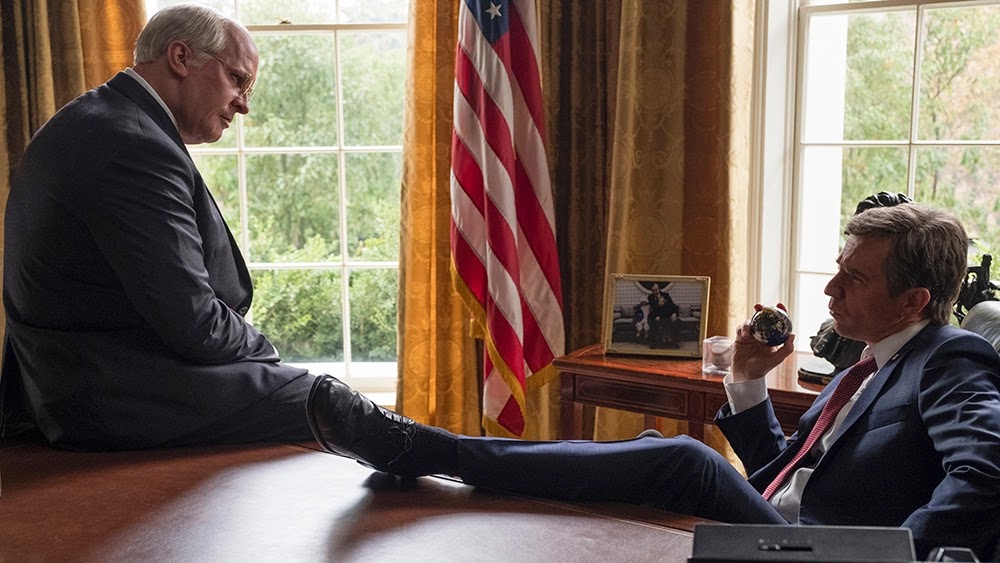
Christian Bale slaps on the make-up as Dick Cheney in Vice

Director: Adam McKay

Cast: Christian Bale (Dick Cheney), Amy Adams (Lynne Cheney), Steve Carell (Donald Rumsfield), Sam Rockwell (George W Bush), Alison Pill (Mary Cheney), Lily Rabe (Liz Cheney), Jesse Plemons (Kurt), Tyler Perry (Colin Powell), Justin Kirk (Scooter Libby), LisaGay Hamilton (Condoleezza Rice), Eddie Marsan (Paul Wolfowitz), Bill Camp (Gerald Ford), Don McManus (David Addington)

There is a film to be made about the turmoil of the Bush presidency. It’s not this film. Adam McKay’s flashy, clumsy, cartoonish, smug, tedious, overlong, arrogant and polemical film quickly outstays its welcome, drowning any legitimate ideas and theories it has under a wave of high-minded, angry shouting at the viewer, frequently mistaking flash and bombast for actual political insight and producing the sort of heavy-handed, angry political commentary that wouldn’t look out of place in a cheap student review. And flipping heck I’m on the liberal left!

Anyway, the film follows the career of Dick Cheney (Christian Bale under an impressive pile of make-up) from his early wash-out days. Told by his wife Lynne (Amy Adams) to buck his ideas up or lose her, Cheney becomes an intern for Congressman Donald Rumsfeld (Steve Carell), rising through the ranks due to his ruthless efficiency and loyalty, becoming Chief of Staff under Ford and Secretary of Defence under Bush. So he’s a natural choice for the inexperienced George W Bush (Sam Rockwell) to balance the presidential ticket. In return, though, Cheney wants control over a few areas – energy, foreign policy, defence etc. etc. – that the lazy Bush has no interest in overseeing. So a quiet, backroom politician changes the office of the Vice President to become the most powerful man in the world. Boo hiss.

McKay’s intention with this film is to reveal the hollowness, greed and utter lack of integrity in its subject. Well he never lets us forget this aim – I don’t think I’ve ever seen a film that so openly hated its lead character, which so completely refused to see any redeeming qualities in him whatsoever. Christ, even Downfall took a few minutes to show Hitler was generally kind to those who worked for him. The film is so unrelenting in its loathing for Cheney that it starts to feel like a being shouted out for over two hours by an “it’s the end of the world” fanatic on a street corner. This does not make for good entertainment.

The film has no subtlety whatsoever. Not for a single second does it even consider the remote possibility that anyone in the Republican party might, perhaps, just maybe, even if it was only some of the time, believe that they were doing something for a principled reason, even if it was a principle those on the left don’t agree with. Instead, all the characters are shown as selfish, greedy and corrupt, using ideology solely to gain power and then using power only to enrich themselves. It’s the sort of lazy political views that turn people off liberals – the idea that anyone who doesn’t share a liberal viewpoint is by definition evil. Some of us grew out of this kneejerk assumption that everyone who doesn’t agree with us is self-serving and cruel. Not McKay. 

On top of which, McKay’s film is made with the overt flash and brio that is the hallmark of the hack director using the tools of cinema with no understanding of their proper use. Wonky camerawork, cutting between timelines, throwing in newsreel footage, breaking the fourth wall, using strange camera angles, chucking in cameo actors to amusingly comment on events (Alfred Molina and Naomi Watts principally) and editing it with flash don’t make you a great director. They make you someone who has seen a lot of films and lot of techniques, but has no understanding of how to use them to craft an overall effect, instead thinking that if you throw all of them at the wall at once, you’ll be a master craftsman.

The film is full of studenty bits of invention that must have seemed oh-so-clever on paper in McKay’s script. Forty minutes in, with Cheney’s career looking over with the end of the Bush presidency, McKay starts running the credits – only to snap back into the film with the fateful phone call from Dubya. It’s clever and raises a quick chuckle, but doesn’t add anything to a sense of turning point in Cheney’s life. It’s followed by a clumsy metaphor of moments being like tea cups balanced on top of each other (inevitably these are later shown tumbling down) to represent how key moments of history build on each other. The real nadir is a moment when Dick and Lynne fall back into cod-Shakespearean dialogue in the bedroom as they discuss a possible vice presidency. ‘We don’t have Shakespeare’s psychologically insightful dialogue’ (I paraphrase) says the voiceover, before this skin-crawling hand-in-mouth sequence that shows McKay knows as much about Shakespeare as he does subtle political commentary.

Ah yes the voiceover. Perhaps not knowing how to marshall his childish political points in actual scenes and dialogue, McKay uses a voiceover from Jesse Plemons’ ground-forces marine to spell out as bluntly and crudely as possible the basic and trivial points it wants to make. The damn film already feels like being hectored by a crank, so why not make it feel even more like a polemic by having a character bitterly explain why everything is wicked and evil at you? The narration bores – and joins the general feeling of the rest of the film, that it goes on forever and ever and ever and never, ever, ever says something really interesting or revealing.

The performances are a mixed bag. Bale gives a decent turn as Cheney, capturing his mannerisms and conveying a sense of dark ambition, but it’s a role he could play standing on his head. Amy Adams turns Lynne into a Lady Macbeth, in a reheat of her performance from Paul Thomas Anderson’s The Master. Every other performance is a crude cartoon – Carell’s Rumsfeld a putty-faced joke, Sam Rockwell’s Bush (an impossibly generous Oscar nomination) a cartoonish buffoon. Everyone else coasts through it, patting themselves on the back.

There is an argument to be made that Cheney’s legacy is far from good, and it’s certain that we are paying a heavy price for interventions in Iraq. Many of the policies were less than savoury and left a less than positive benefit. But this film hammers these points home with all the charm of a ranting, drunk politics student who has read one book and watched a lot of YouTube videos. With McKay’s soulless, clumsy, look-at-me direction layered on top, this is a flat out terrible film. Save yourself what feels like much more than its two hour run time. In fact I’ll summarise it for you: CHENEY IS EVIL AND HORRIBLE AND HE (LITERALLY) HAS NO HEART. There you go. You don’t need to see it now.

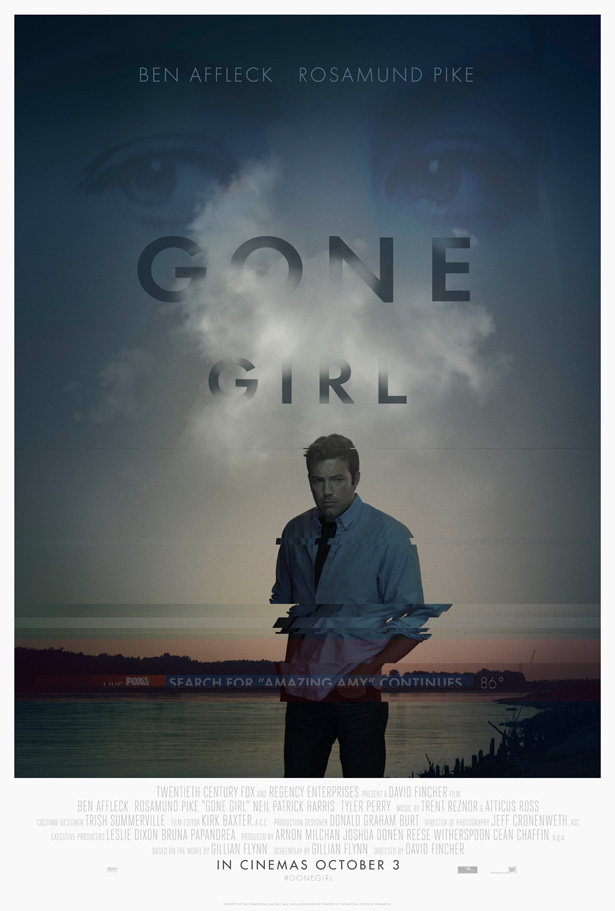
Gone Girl (2014)

Rosamund Pike is the Gone Girl leaving husband Ben Affleck in a difficult mess

Director: David Fincher

Cast: Ben Affleck (Nick Dunne), Rosamund Pike (Amy Elliott Dunne), Neil Patrick Harris (Desi Collings), Tyler Perry (Tanner Bolt), Carrie Coon (Margo Dunne), Kim Dickens (Detective Rhonda Boney), Patrick Fugit (Officer James Gilpin), Missi Pyle (Ellen Abbott), Emily Ratajkowski (Andie Fitzgerald), Casey Wilson (Noelle Hawthorne), Lola Kirke (Greta), Boyd Holbrook (Jeff), Sela Ward (Sharon Schieber), Lisa Banes (Marybeth Elliott), David Clennon (Rand Elliott)

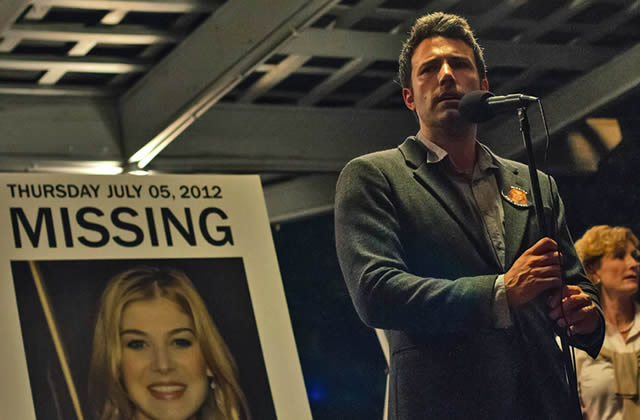
In our modern media age, we’ve got massive expectations for how people are meant to behave. With so much of our perception of life filtered through the internet and films we’ve seen, we are reassured when we see behaviours we expect to see, and disconcerted when we see those we haven’t been trained to see. Not distraught enough at your wife going missing? Well you must have done it then!

That’s the problem that faces Nick Dunne (Ben Affleck) in this chilling, intricate adaptation of Gillian Flynn’s best-selling book. Nick’s wife Amy (Rosamund Pike) goes missing in mysterious circumstances, possibly a kidnap, possibly a kidnapping gone wrong. The case becomes a media sensation, but the problem is Nick just isn’t expressive enough, won’t play the role of weeping husband. Instead he’s calm, distant and polite. So naturally rumour swirls that he did it – particularly after more and more manufactured evidence rears up to suggest he might have done. But does Amy have darker secrets than anyone might even suspect? Well to say any more would be a spoiler.

Fincher’s film is a tour-de-force of deliberately cold, polished looking perfection – which is designed to reflect back the surface perfection of the Dunnes’ deeply flawed marriage. Fincher’s film is in many ways a jet black social satire, using its almost outlandish shocks and twists to involve the audience in that “oh-no-they-didn’t!” way, in the same way that the Dunne media story fascinates the people in the movie.

“What have we done to each other?” Nick asks in voiceover early in the film, and it’s the question the film tackles obliquely: how much of the flashbacks to the relationship we see between Amy and Nick is real and how much springs from unreliable narration from Amy’s diary? Two handsome people living the American dream, but how much of it is an invented or projected narrative? Is their whole life a performance they are living for themselves and for others? Poor old Amy is even already semi-fictionalised person, a parents using her life as inspiration for a beloved children’s book character Amazing Amy.

So when Amy goes missing, the strain on Nick is very different from what you might expect. Rather than being consumed with grief, he feels wearied and dutiful about continuing a performance of a marriage which has long since ended. Nick’s actually too honest for this world – he won’t put on a show of how he is supposed to feel, he can only try not to make too much of a show of what he really feels. The mystery that builds around his and Amy’s marriage is born in this blunt honesty, of someone who won’t be what people want him to be. Of course that doesn’t stop Nick from being selfish or even a whiner.

Fincher mixes this intelligent commentary on society with, to be honest, the sort of bizarre extremism and bunny-boiling antics that make you unsurprised to hear he was inspired by Paul Verhoeven while making the film. It’s a film that shifts gears notably in the second half to become an increasingly gothic horror-thriller. A lot of this is powered also by Rosamund Pike’s excellent performance as Amy, a woman who seems almost completely cryptically unknowable, whose whole life has been a performance, and for whom taking on a series of roles and personalities is clearly not a challenge. Needless to say the person she turns out to be, and what she is capable of, is completely different from what the film leads you to expect.

It’s no surprise that a relationship featuring a person like Amy could go as south as the Dunnes’ has, but then Nick is hardly a saint either. Ben Affleck is just about perfect casting as a sort of All-American charmer gone to seed, a prickly fellow who wants privacy but also partly grows to enjoy the drama that surrounds him, once he works out the game he is playing. Fincher’s deliberately distant, smoothly clean-surfaced film frames modern day aesthetic perfection all round this seemingly dream couple.

The whole film is a nightmare vision of a love match gone wrong, of the after-effects of a beautiful story that has spiralled out into disappointment and everyday mundane life. And that struggle to keep the romance going in the familiar is at least something many of us can understand right? So it’s enjoyable to see that matched up with the freaky, semi-gothic blood and guts the film serves up in the second half, and the almost surreal Grand Guignol plot developments that power that half of the film (shot and scripted by Fincher and Flynn with a brilliant mixture of tension, horror and black comic delight at its extremity).

Like many Fincher films, there are several delightful performances. Pike is a revelation in a gift of a role, Affleck very good channelling his life lived in the spotlight. Carrie Coon is a stand-out as Nick’s exasperated, down-to-earth and loving twin sister. Kim Dickens is authorative and questioning as the police detective investigating the case, and Tyler Perry assured and cool as a hot-shot lawyer. Playing way against type, Neil Patrick Harris is pretty unforgettable as a slightly self-satisfied rich kid still holding a candle for Amy after all these years.

But the main success of the film is the whipper-sharp coldness of its execution, the cool tension Fincher ekes out of every moment, and the violent, Vertigo-ish obsession he gets out of every moment. Gone Girl works because it’s at first a chilling what-if story of a man in a media storm, which becomes a sort of black comedy so extreme that it pulls a delighted audience in to gasp at audacious characters getting away with outrageous things. As a black comic thriller it’s delightful.rela