
Tag: Vanessa Redgrave

The Butler (2013)


Forest Whitaker takes on a lifetime of service, as the Civil Rights movement meets Downton Abbey

Director: Lee Daniels

Cast: Forest Whitaker (Cecil Gaines), Oprah Winfrey (Gloria Gaines), David Oyelowo (Louis Gaines), Cuba Gooding Jnr (Carter Wilson), Lenny Kravitz (James Holloway), Colman Domingo (Freddie Fallows), Yaya DeCosta (Carol Hammie), Terrence Howard (Howard), Adriane Lenox (Gina), Elijah Kelley (Charlie Gaines), Clarence Williams III (Maynard), John Cusack (Richard Nixon), Jane Fonda (Nancy Reagan), James Marsden (John F. Kennedy), Vanessa Redgrave (Annabeth Westfall), Alan Rickman (Ronald Reagan), Liev Schreiber (Lyndon B. Johnson), Robin Williams (Dwight D Eisenhower)
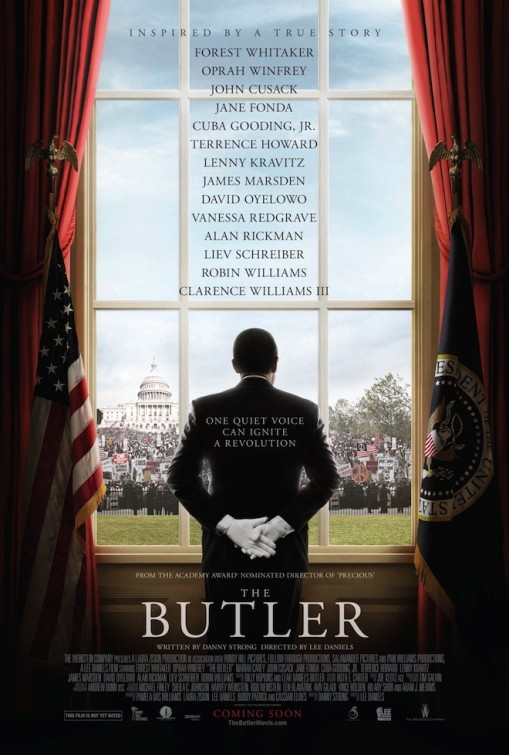
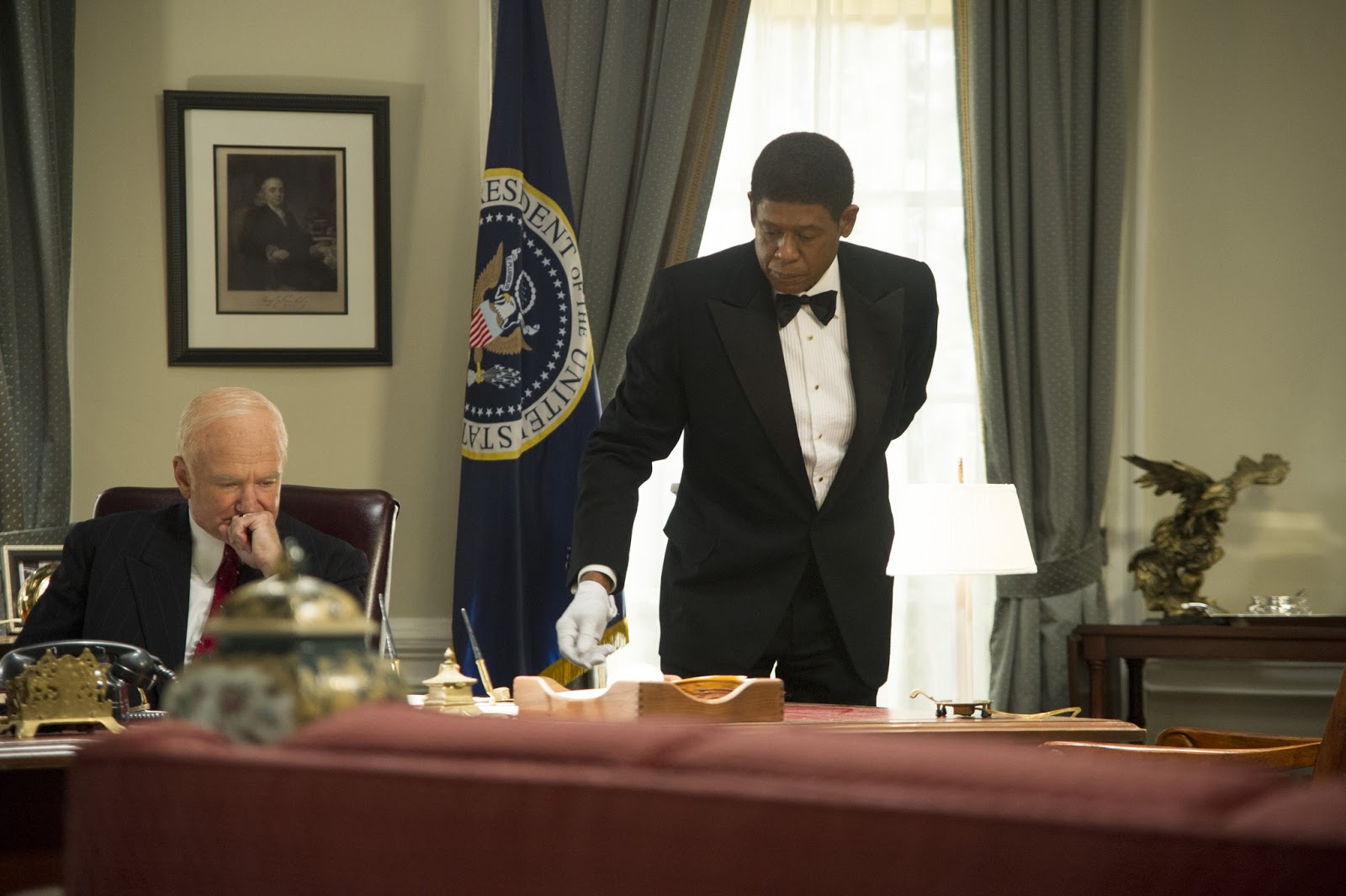
Cecil Gaines (Forest Whitaker) grows up on a plantation in the South; after his mother is raped and his father killed by the son of the house, the family matriarch (Vanessa Redgrave) takes him on as a house servant as a token gesture of regret. His training here sets him on the path to working in a succession of increasingly wealthy hotels and, finally, the White House. Over 30 years, he serves the Presidents in office, never involving himself or commenting on policy, proud of his service to his country. This often puts him in conflict with his Civil Rights activist son Louis (David Oyelowo), with his wife Gloria (Oprah Winfrey) stuck in the middle.

This is the sort of film that feels designed to win awards. It’s based on a vague true story (it changes nearly all the events of course) and it’s about a big subject. It’s got big name actors doing acting. It aims at big themes. What it actually is, is a film that misses its marks. It’s a film that spends time with big themes but has nothing to say about them, or in fact anything interesting to say full stop. It assumes that the historical context will do the work, and leaves it at that. Instead, it settles for trite sentimentality and cliché, personal stories played on a stage that makes those stories seem slight and inconsequential rather than giving them reflective depth.

The biggest problem about the film, leaving aside its heavy-handed sentimentality and mundane predictable storytelling, is that all the way through it feels like we are following the wrong story. It’s such a vibrant and exciting period of history, so full of events, passion and struggle: and instead we follow the story of Cecil, essentially a bland passive character who achieves very little and influences even less. There are vague references to leading “the regular life” and how working in domestic service is like some sort of subversive act to demonstrate the education and hard-working possibilities of the minority, but to be honest it never really convinces.

The film promises that Cecil was a man who had a profound impact on the people he served – but this doesn’t come across at all. Instead, the parade of star turns playing US Presidents are there it seems for little more than box office: we see them speaking about Civil Rights issues or planning policy, but we get very little sense of Cecil having any bond with them. The cameos instead become a rather distracting parade, as if the film was worried (perhaps rightly) that Cecil’s story was so slight and bland that they needed the historical all-stars to drum up any interest in it. It doesn’t help that the cameos are mixed – Rickman, Schreiber and Marsden do okay with cardboard cut-out expressions, but Cusack in particular seems horribly miscast. A braver film would have kept these pointless camoes in the background and focused the narrative on Cecil and his colleagues below stairs, and their struggles to gain equal payment with their white colleagues. This film is seduced by the famous events and names it spends the rest of the time backing away from.

The performance at the centre is also difficult to engage with. Forest Whitaker is such an extreme, grand guignol actor that it’s almost sad to see him squeeze himself into a dull jobsworth such as Cecil. Whitaker seems so determined to play it down that he mumbles inaudibly at great length (it’s genuinely really difficult to understand what he is saying half the time), slouching and buttoning himself into Cecil’s character. It doesn’t come across as a great piece of character creation, more a case of miscasting. Oprah Winfrey does well as his wife, although her character is utterly inconsistent: at times a drunk depressive, at others level-headed and calm. The link of either of these characters to the hardships of life as a Black American or their role in racial politics is murkily unclear.

The star turn of the film – and virtually all its interesting content – is from David Oyelowo, who ages convincingly through the film from idealist to activist to elder statesman. His story also intersects with the actual historical events that are taking place in America and he is an active participant – unlike Cecil the passive viewer, just as likely to switch the TV off as follow the news. Often I found myself wishing the film could follow his character rather than Whitaker’s.

That’s the problem with the film: what point is it trying to make? The film seems to want to honour Cecil’s service in the White house – but the film is a slow journey towards Cecil’s sudden revelation that maybe his son’s campaigning for Civil Rights was the right thing to do. This flies in the face of the film’s tribute to Cecil’s decades of quiet, unjudging service: the film can’t make up its mind whether it wants to salute Cecil for being an unjudging, dedicated servant to a long line of Presidents, or for having the courage to take a political stance towards the end. It’s having its cake and eating it. It’s this shallow lack of stance that finally makes it an empty and rather dull viewing experience.

Howards End (1992)


Emma Thompson and Anthony Hopkins discover marriage is never an easy business

Director: James Ivory

Cast: Helena Bonham Carter (Helen Schlegel), Anthony Hopkins (Henry Wilcox), Vanessa Redgrave (Ruth Wilcox), Emma Thompson (Margaret Schlegel), James Wilby (Charles Wilcox), Samuel West (Leonard Bast), Nicolas Duffett (Jacky Bast), Jemma Redgrave (Evie Wilcox), Susie Lindeman (Dolly Wilcox), Prunella Scales (Aunt Juley), Joseph Bennett (Paul Wilcox), Adrian Ross Magenty (Tibby Schlegel)

From the mid-1980s to the late-1990s, Merchant-Ivory was the by-word for a certain type of film-making: intelligent and sensitive adaptations of books, with fine British actors in wonderful costumes. It was a perfect brand. And it probably reached its peak with this masterful adaptation of EM Foster’s precise, tragi-comic analysis of class in Britain.

Set in Edwardian England, the film focuses on three very different families: the Wilcoxes, grown wealthy off the back of the Empire, who have purchased large chunks of the houses and lands of the former aristocratic elite; the Schlegels, an upper middle-class family of intellectuals; and the Basts, a lower middle class couple trying to improve their lot. Ruth Wilcox (Vanessa Redgrave) befriends Margaret Schlegel (Emma Thompson) in the last few months of her life and, on impulse, leaves Howards End, her beloved family home, to Margaret when she passes away. With the agreement of his children, her husband Henry (Anthony Hopkins) destroys the note, but later falls in love with and marries Margaret. Meanwhile, Margaret’s sister Helen (Helena Bonham Carter) struggles to help improve the lot of thoughtful, well-read insurance clerk Leonard Bast (Samuel West) – with disastrous results.

The film balances these varying plot lines with great skill. It weaves in both well-judged social commentary and a shrewd and subtle analysis of the way perceptions of morality (and the consequences of people’s actions) alter dramatically depending on the class and sex of the person perpetuating the societal offence. Helped by Ruth Prawer Jhabvala’s masterful (and Oscar winning) screenplay, Ivory’s direction balances this acute scrutiny with an emotional and deeply involving story, staffed with characters whose dignities and flaws are humanly observed. Ivory and Jhabvala demonstrate a masterful understanding of the way we build stories about our own lives and create the people we want ourselves to be – and how this can be influenced by the results of our actions.

These self-images people create of themselves in the film are invariably more noble than the people they transpire to be. Of all the characters, arguably only Leonard Bast follows up on his intentions and consistently delivers on his word. It’s a tribute to Samuel West’s wonderful performance as Bast, as well as the film’s control, that Bast is both a tragic victim and also at times an almost painfully pathetic character, a striver whose every attempt to improve his lot ends in disaster (the film also sticks to Forster’s darkly comic fate for Bast).

While the Basts constantly pay a heavy price for every action, the Wilcoxes and Schlegels largely avoid paying any price for their mistakes until the end. Indeed, Henry Wilcox seems barely able to understand that his past love affair with a young woman left him with a certain moral responsibility for her fate after he broke the affair off. In a brilliant series of short scenes (with fades to black between each section of the conversation) we see him painfully confess the story to Margaret; the fades perfectly capture the mood of a broken up and difficult emotional moment for both characters.

The film perfectly understands the hypocrisy of the upper classes. Wilcox is a man of complete certainty and off-hand confidence, making sweeping statements with complete authority, who has no empathy with the lower classes: “The poor are poor. One is sorry for them, but there it is”, he blithely tells the Schlegels. His son Charles (a smackable James Wilby) is a spoilt and selfish snob with only contempt for anyone lower than him on the social ladder. Helen’s later fall from grace (in its way a manipulation of those dependent on her) is met with a condemnation Wilcox never imagines should never attach to his own actions. The whole film is a brilliant tapestry of these contrasts and flaws.

Emma Thompson won an Oscar for her work here, and she does a wonderful job as the emotional heart and conscience of the film, essentially our eyes into the events of the story. Intelligent and with a deep sense of morality, Margaret is also a woman who is willing to make compromises when she judges there is the need. Her decisions are not always correct or justifiable, but Thompson makes her struggle between her need to do the right thing and her desire to find happiness with her husband constantly understandable. In addition to this, Thompson is a radiant and engaging presence, allowing a character verging at times on being a matronly fusspot to always be someone we care deeply about.

She’s matched by a complex and thoughtful performance by Hopkins as Henry Wilcox. Hopkins has a brilliant understanding of the essential moral emptiness of Henry, based not on any malice or cruelty but on a genuine belief that some rules can be applied differently to him because his position and his own self-image reassure him that he is a good man. One of the film’s main subplots is the journey of Henry to understanding his actions have had consequences – and that these consequences reflect on him. Hopkins handles the growing awareness of this with brilliant sensitivity – his late emotional collapse is a masterclass in low-key, elegant, but deeply moving, acting. It’s also a tribute to the film’s mastery that Wilcox (despite basically being a cold, thoughtless snob) remains a character we relate to, understand and forgive.

Sex bubbles under in this Edwardian world. Henry’s sexual history is a crucial turning point. Helen’s freer attitude to love first brings the Wilcoxes and Schlegels together and then later leads to disastrous consequences with Bast. Tied directly in with the class issues in the film, Charles (James Wilby) is determined later to defend her honour, despite Helen having no wish for him to do so. There is even a hint of sexual feeling in Ruth Wilcox’s sudden friendship with Margaret. Alongside this run themes of the slow and deliberate way relationships develop: Margaret and Henry’s relationship takes the whole course of the film to reach a proper understanding, while Helen (and Helena Bonham Carter is wonderful here as a faintly skittish well meaning do-gooder) and Bast’s friendship shifts and changes throughout the course of the film without either really understanding the other.

Howards End’s complexity is of course in large part due to EM Forster’s original source novel, and his insight as a commentator on Edwardian England and its morals. But to capture so much of the air of the novel in this film, and to bring the story so richly to life, is an enormous tribute to the mastery of Ivory and Jhabvala’s work here and to the excellent work of the cast. The production values are exceptional of course and the film is told with pace, zip and feeling. If there was a high point for the costume drama this (and their follow up picture, The Remains of the Day) was it. Merchant-Ivory would never hit these heights again.