Tag: Vicky Krieps

Corsage (2022)

Corsage (2022)

The perils of a life married into royalty are as tricky for some 150 years ago as they are today

Director: Marie Kreutzer

Cast: Vicky Krieps (Empress Elizabeth), Florian Teichtmeister (Emperor Franz Joseph I), Katharine Lorenz (Countess Marie Festetics), Jeanne Werner (Ida Ferenczy), Manuel Rubey (King Ludwig II), Finnegan Oldfield (Louis de Prince), Aaron Friesz (Prince Rudolf), Rosa Hajjaj (Valerie), Lily Marie Tschörtner (Queen Maria Sophie), Colin Morgan (George “Bay” Middleton)

Known to the world as Sisi, there are few more troubled figures in the history of European royalty than Empress Elizabeth of Austria. Locked into a largely loveless marriage with Emperor Franz Joseph, she struggled with the expectations of her position. She suffered from an eating disorder in an obsession to reduce her waist size, exercising vigorously every day. She was an international icon, formed strong bonds with the Hungarian people, helping integrate them into the Austro-Hungarian empire and her later life was touched with tragedy (including her son killing himself in a murder-suicide pact with his lover) before her assassination.

Only touches of this dynamic story make it into this curious film, that focuses on one facet of her personality at the cost of exploring others. Focusing on the years 1877-78, Elizabeth (Vicky Krieps) is strapped into ever tighter corsets, struggles with “representing” Austria, attempts several love affairs that end in rejection, smothers her youngest child Valerie (Rosa Hajjaj) with affection and is prescribed a new “wonder drug” (heroin) to ease her nerves. While her family despair, she starts to groom her lady-in-waiting Marie (Katherine Lorenz) to stand-in for her at public events.

From a British perspective, pretty clear parallels are drawn between Elizabeth and that icon of 20th century monarchy Princess Diana. Like Diana, Elizabeth’s personal struggles are misunderstood and unsupported by her royal network. An intelligent, passionate woman, Elizabeth stifles under conditions that require her to do and say as little as possible. Her dull, formal husband (Florean Teichtmeister, refreshingly decent and befuddled as the Emperor) merely needs her to wave at events, nothing more. She finds this increasingly oppressive and constrictive.

Kreutzer’s film is a stylish presentation of Elizabeth as a sort of Royal rebel. Drenched in lavender – even the cigarettes she chainsmokes are lavender – Elizabeth takes every opportunity she can to leave the palace, avoids “smile and wave” events and behaves with unpredictability at social events (she’s as likely to laugh and flirt as storm out giving the room the finger). Her fainting could be due to her incredibly tight corsets – or it could just be a way of causing mischief. The system around her simply doesn’t know how to react to someone who doesn’t know herself what she really wants.

Corsage is most engaged with this analysis of undiagnosed depression, at a time when the condition was largely utterly unknown. We can see Elizabeth is mired in misery, but to others she’s merely a self-indulgent, difficult, un-co-operative woman. Shot with a candle-lit intimacy and drained out colours, the film presents the world much as Elizabeth (it suggests) may have seen it. Dark, oppressive and domineering.

Kreutser bravely avoids making her completely sympathetic. The film doesn’t shirk in showing how selfish and self-obsessed she can be. She can’t tell her maids apart (even Franz Joseph is more clued up on their names), bans loyal lady-in-waiting Marie from marrying as she needs her too much and drags her daughter through endless reluctant excursions (including a pre-sunrise horse ride) because she’s more interested in moulding her than listening to her.

Vicky Krieps embodies this prickly personality with huge skill. There are flashes of the sort of person Elizabeth could be. She frolics playfully for an early film camera in the countryside and comes flirtingly to life with two potential lovers, an English riding instructor “Bay” (played with bashful charm by Colin Morgan) and the man closest to being a kindred spirit King Ludwig II of Bavaria (an ebullient Manuel Rubey). Sadly, Bay is far too cautious to become the Empress’ lover (even when she turns up at his room dressed in little more than her corsage) and Ludwig far too gay (much as he values her friendship).

Krieps performance is full of empathy for her pain. She skilfully communicates her mixed feelings towards her genuinely decent-but-dull husband (Franz Joseph, the sort of man who peels off his fake sideburns and stores them carefully in a box). But also makes her demanding, sullen and frequently rude and overbearing. She lashes out at and banishes from her presence those who ‘betray’ her.

Elizabeth’s status is compared with those in the mental health hospitals she took such an interest in.  There women are bound to their beds or dunked in freezing baths to cure them of their lustful desires) and the war wounded. It’s a reminder that things could be a lot worse. But it’s also a reminder of the film’s singular focus, away from the other facets of this woman’s personality. There is no real reference to her efforts to support the Hungarian people, her most successful attempt to break out of the confines of her role. It’s part of the film’s sometimes myopic view of its subject.

Kreutzer’s film is full of style. But it’s sometimes hard to see to what purpose. Much of the music the characters listen to is anachronistic modern pop (performed by period instruments). Locations have been deliberately chosen for their ramshackle, faded appearance, no attempt made to return them to the grandeur they would had at the time. Elizabeth takes dips in a very modern pool and the film closes on a cruise liner that wouldn’t look out of place today. Semi-surreal moments pop-up, such as Elizabeth towering in a small-scale room that may-or-may-not be either a giant doll’s house or a visual representation of her state of mind. But they never quite coalesce into a whole or carry a clear purpose, beyond design flourish.

I think part of this is because the film delves into Elizabeth’s depression but offers little in way of acute analysis as to why she felt like this. With most of the interesting events of her life kept out of the film, we effectively drop into a few years of depression without a wider context of her interests or passions. Elizabeth becomes someone the film defines largely by her position, much as her depressing life did, leaving her remaining a somewhat puzzling enigma.

It culminates in a genuinely confusing, alternate history scenario that I was mystified what the film intended to me to feel about. Does it end on a note of tragedy or triumph? I’ve no idea – and the coda with Krieps dancing confuses me further. It’s a befuddling ending for a stylish film (with a great central performance) but which is often one-note. Eventually you feel you effectively learned everything it had to say after the first few minutes, and its happiness to settle for repetition and style over a more searching study eventually makes it disappointing.

Phantom Thread (2017)


Vicky Krieps and Daniel Day-Lewis play dangerous games in Paul Thomas Anderson’s fascinating film about control, Phantom Thread

Director: Paul Thomas Anderson

Cast: Daniel Day-Lewis (Reynolds Woodcock), Vicky Krieps (Alma Elson), Lelsey Manville (Cyril Woodcock), Camilla Rutherford (Johanna), Gina McKee (Countess Henrietta Harding), Brian Gleeson (Dr Robert Hardy), Harriet Sansom Harris (Barbara Rose), Lujza Richter (Princess Mona Braganza), Judy Davis (Lady Balitmore), Philip Franks (Peter Martin)

The last time Paul Thomas Anderson and Daniel Day-Lewis worked together, we got a true masterpiece in There Will Be Blood. Phantom Thread couldn’t be much more different. In place of rolling plains, oil, and Day-Lewis as a monstrously larger-than-life alpha male, we get confined rooms, handsome dresses and Day-Lewis as a pernickety, obsessive, creepy dressmaker. But Phantom Thread may also be just as intriguing, thought-provoking and memorable in its way as There Will Be Blood.

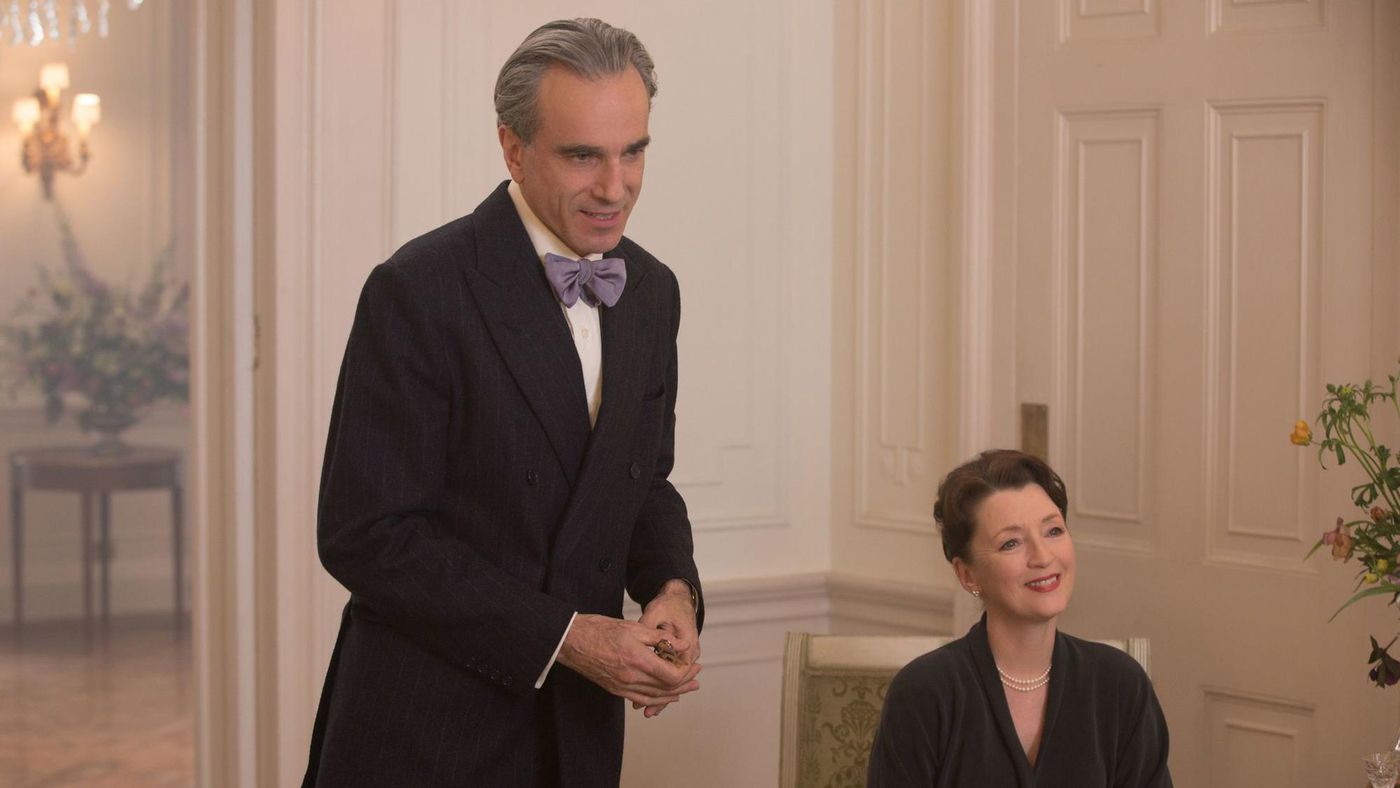
Reynolds Woodcock (Daniel Day-Lewis) is a leading couturier in 1950s London, whose fashions are highly sought after by the rich and famous. He lives and works with his sister Cyril (Lesley Manville), who dominates his life – and dispatches his various muses as their use comes to an end. On a break near the coast, Reynolds meets Alma (Vicky Krieps), a hotel waitress whom he takes back to London as his latest muse. At first Alma seems to be merely the tool of this fashion Svengali – but Alma has her own desires that quickly spark conflict in the House of Woodcock.

Paul Thomas Anderson’s film has lashings of Daphne du Maurier, Powell and Pressburger (it’s more than a little reminiscent of The Red Shoes) and a slickly inverted Pygmalion. It’s a film that slowly emerges as being about control and the way power relationships can shift and transform. Reynolds at first seems a twisted Henry Higgins: his muses come and go (and, it’s implied, fail to live up to his mother) – he becomes tired of them, and his sister, business partner, factotum and part-time mother-figure Cyril dismisses them when they have served their purpose. 

Reynolds and Alma’s first meeting is one of creepy control. He asks her to memorise his order, wipes her lipstick away so he can “see her” and, in a late night “living mannequin” sequence, dresses her in a series of fabrics and clothes, and offers dispassionate comment about her body. What’s interesting in this sequence though, is that Alma only becomes uncomfortable when Cyril arrives and joins Reynolds in the process. It’s a hint of the developments that will emerge over the course of the film: Alma doesn’t want to share Reynolds.

That’s the tension the film explores from thereon: Reynolds seems to have all the power, but Alma pushes against this to forge her own position as something more than a muse. The film has an acute understanding of the psychology of power in human relationships, which is more than reminiscent of Rebecca: the exact motivations of the characters remain unclear (sometimes even to themselves) until late in the film. The film veers into My Cousin Rachel territory – while giving us a totally unexpected series of emotional developments that spin out of this, which shock but make perfect sense.

That’s because Paul Thomas Anderson has made a sharply observant film about human fallibility and our desire to understand our place in the hierarchies around us, and the unusual paths to contentment that we can find. Like The Red Shoes, it also feels like a film that really understands the psychology of Svengali figures, and adds a Freudian bent to it. Reynolds is looking for a mother to take the place of his own and he is drawn to muses who remind him of her, but who constantly fail to replace her. It’s in the weakness that Reynolds’ perfectionism drives him away from, that he is capable of finding love and happiness.

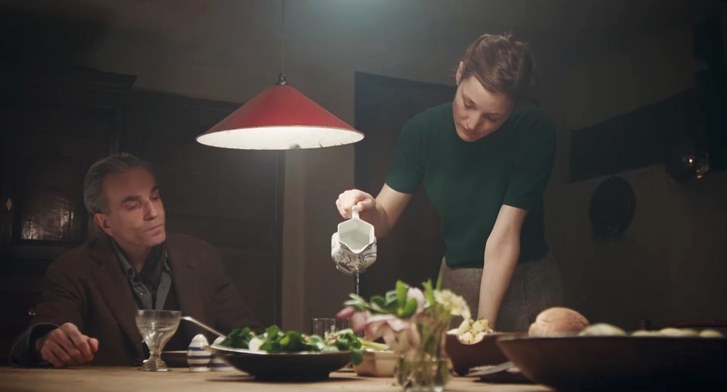
So the film becomes a series of wonderfully low-key power shifts, many of them revolving around meals. It’s established early that Reynolds demands very precise conditions for his breakfasts – most importantly silence; in every breakfast scene that follows, everything from the loudness of the crunching to the amount of scrapping of jam on toast tells you who is in control. 

Because just as Reynolds wants to craft Alma to take on the perfect muse position for his dressmaking – so Alma wants to craft Reynolds into the perfect combination of high-achieving genius whose success she can vicariously enjoy, and a man who needs her emotionally. Anderson’s brilliant, bitter and waspy screenplay shows the different steps both characters dance through to achieve this. Alma’s solution, and its psychological impact, is brilliantly du Maurier; it’s out there, but makes perfect sense.

Visually the film is beautifully crafted. Anderson shoots a lot of the film with a combination of slow prowling shots, and cameras held at close-up or medium shots that regularly place the actors close to the camera. It means that we always feel like we are right in the middle of the action – looking over the shoulders of actors, or seeing their faces loom into the camera. It obviously creates a claustrophobic feeling, but also one of real intimacy – it’s like the camera is dressing the characters, the same way Reynolds does. But Anderson’s choices pull you closer into the action, and get you really thinking about the psychology of the characters you are watching.

And Anderson wants you to get into the psychology here, because he has cast three actors at the top of their game in this tight-character study. Day-Lewis is of course superb, as a character unnervingly precise and cool – his voice is a perfect combination of icy preciseness, and trembling emotional confusion. Reynolds is in many ways a child – his every whim must be followed, he explodes in foul-mouthed (hilarious) fury at any deviation from his procedures. But he’s also an emotionally stunted man who has never got over the loss of his mother, capable of strong sexual feelings and a yearning for closeness. It’s a subtle, controlled, low-key performance.

But Day-Lewis’ retirement has stolen a lot of the attention from Vicky Krieps, who is sensational as Alma. In many ways, she is the real protagonist of the story. Alma is at first our entry into the story – but we quickly learn we know or understand very little about her. She comes from somewhere in Europe, she may well be Jewish, but Krieps makes her hard to define. Unusual and impossible to understand, Krieps makes her a fascinating character. She emerges as a determined, strong-willed, manipulative figure, looking to have a firm place in her partner’s life – she’s both a toy that bites back, and a woman who will settle for no compromise in what she wants. It’s a fascinating performance. 

Lesley Manville rounds out the cast as the waspish Cyril, deliciously spitting out some cruel lines. Manville is terrific, and Cyril sits in an unusual place in the Woodcock house, partly catering to Reynolds’ demands, partly controlling and positioning him. This makes a perfect foil both for Reynolds’ demanding requirements for a mother, and for Alma’s desire to bring Reynolds under her own influence.

Anderson’s film is a beautiful, fantastically scored, wonderfully acted, intriguing character study, and an insightful exploration of emotional and sexual control and the traps we built for ourselves and for others. It’s a film where every scene is open to interpretation, where both the past and the future seem to haunt events and every resolution leaves questions. It’s a brilliant psychological study that rewards endless thinking, analysis – and I’m sure repeat viewings. I think this one could run and run.