Tag: Vincente Minnelli

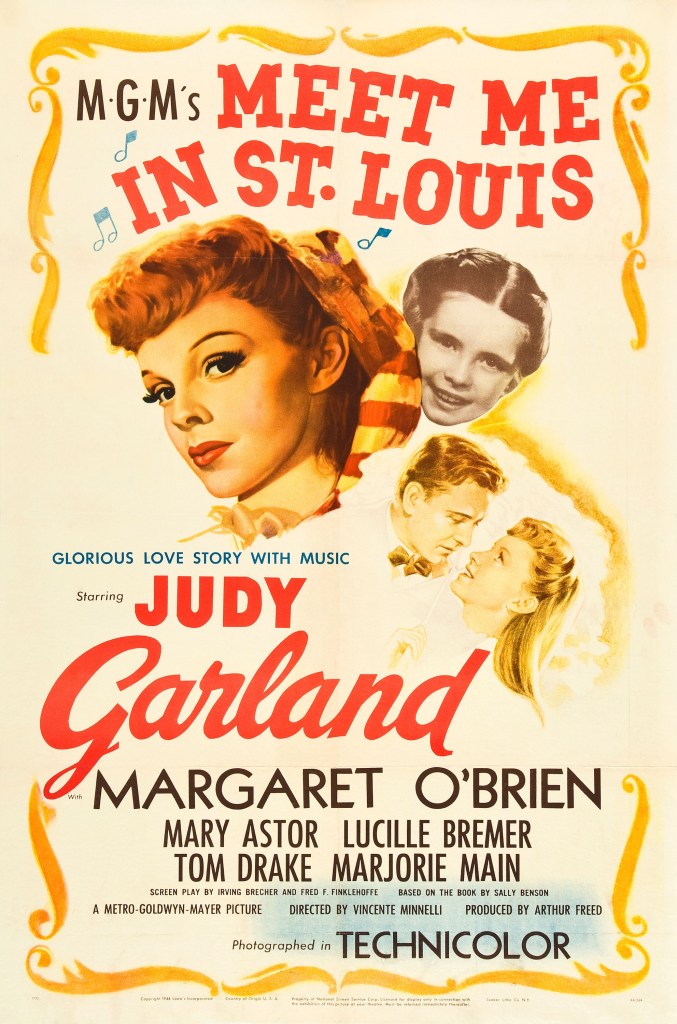
Meet Me in St Louis (1944)

Meet Me in St Louis (1944)

Technicolour musical delight in this unashamedly nostalgic and feel-good Minnelli musicial

Director: Vincente Minnelli

Cast: Judy Garland (Esther Smith), Margaret O’Brien (“Tootie” Smith), Mary Astor (Mrs Anna Smith), Lucille Bremer (Rose Smith), Leon Ames (Mr Alonzo Smith), Tom Drake (John Truett), Marjorie Main (Katie), Harry Davenport (Grandpa), June Lockhart (Lucille Ballard), Henry H Daniels Jnr (Lon Smith Jnr), Joan Carroll (Agnes Smith), Hugh Marlowe (Colonel Darly), Robert Sully (Warren Sheffield), Chil Wills (Mr Neely)

“There’s no place like home” is the message lying behind two of Judy Garland’s most iconic films. While it might be at the heart of Wizard of Oz, that longing may be even stronger in Meet Me in St Louis. From the Arthur Freed production stable, this technicolour delight is relentlessly gentle and optimistic. It went down a delight in a year when so many Americans dreamed of the end of a war that had separated families and kept soldiers from their home and remains a delightful paean to a lost America (that perhaps never even was).

Set, of course, in St Louis in 1904 during the build-up to the World’s Fair (the gleam of the electric lights turning at the exhibition are the film’s final shot), Meet Me in St Louis follows the lives and loves of the Smith family. Patriarch Alonzo Smith (Leon Ames) is a lawyer (or something, the film doesn’t trouble itself too much), his wife Anna (Mary Astor) a devoted home maker. They have four daughters: Rose (Lucille Bremer) hopes for a proposal from Warren Sheffield (Robert Sully), youngest children Agnes (Joan Carroll) and especially “Tootie” (Margaret O’Brien) are perpetually in trouble and Esther (Judy Garland) is just starting to make eyes at next door neighbour John Truett (Tom Drake). But their contented life could all turn upside down when father announces they will be moving to New York. Surely, they can’t leave St Louis behind?

In many ways Meet Me in St Louis is an inverse The Magnificent Ambersons. While Welles’ film brilliantly charted the decline of a family of wealthy snobs (the Ambersons would certainly recognise the Smiths as equals) with technology an intruder, upending everything they understand about the world, Meet Me in St Louis is a gloriously entertaining celebration of nostalgia with new technology either a source of jokes (scrambled long-distance calls, jolly cable-car songs) or wonder (that closing light-show). Both have stylistic comparisons: from their use of title cards to their fluid camera showcasing sumptuous sets and costumes. But only one of them is about cheering you up.

Meet Me in St Louis only barely has a plot, so concentrated is it on charm and whimsy (father’s announcement, which introduces the real drama, arrives over half-way through). Adapted from a series of short stories by Sally Benson, it’s an episodic film built around events – parties, cable-car rides, a Halloween adventure and a Christmas Eve ball – with a few threaded plotlines of flirtation, principally between Esther and John. Freed sprinkles in a series of songs from his collected rights holdings (including the title song) with a few additional tunes from writers Hugh Martin and Ralph Blane, the most notable being The Trolley Song (a ludicrously catchy-number you can’t get out of your head) and the iconic Have Yourself a Merry Little Christmas (although their original far more depressing lyrics were hurriedly re-written).

These last two are performed with astonishing bravura by Judy Garland in possibly her finest hour (until A Star is Born). Garland’s singing is almost effortlessly graceful and beautiful, and she matches it with a very warm, feisty and engaging performance. Esther lands perfectly between two stools: she can be rebellious, impatient and judgemental but also caring, sensible and forgiving. Garland is reassuringly collected, funny and luminous through-out – so much so it’s striking to read what a nightmare the shoot was, with the star frequently absent as she succumbed to the mental and physical ailments that would plague the rest of her life.

Part of the success of her performance was the closeness that developed between her and Minnelli – the first director to really treat her as an adult and collaborator (they started an affair during the film). Minnelli, in only his third film and first in colour, directs with the assurance and visual beauty of an accomplished pro. Meet Me in St Louis was his first Freed musical and it might just be his best. The sumptuousness of the visuals and design were to a large part due to him – you can see the influence this had on the later work of Visconti among others, particularly the ballroom scene – and Minnelli worked labouriously with the actors to build a sense of family between them.

This pays off in spades throughout the film, where the close chemistry between the actors only helps create a nostalgic glow for happy days gone by. Ames and Astor have a relaxed ease of a long-married couples, while the four sisters interact with each other with an easy, unstudied naturalness – sharing chairs, food from their plates and time together with an unfussy ease. In particular Minnelli helped guide Margaret O’Brien to the one of the most delightful child performances on screen: the Halloween sequence, where “Tootie” confronts a scary neighbour is a masterclass of childish excitement and fear, matched later by O’Brien’s affecting distraught tears at the prospect of leaving St Louis.

Minnelli shoots the film with a technical confidence and imagination that quickly makes you forget it’s simple plot. That Halloween sequence is an eerie wonder, shot with a low-angled, tracking shot unease that leaves a haunting impression. He and cinematographer George J Folsey deigned a gorgeous gaslight dimming sequence as Esther and John go through her house dimming the lights, the camera moving in a single, complex, take up-and-around them while Folsey adjusts the set light in sync. Later there is a brilliant shot that seems to pass through a window to lead us straight into the ball, which seems years ahead of its time in its technical accomplishment. The ‘Trolley Song’s sequence uses framing and costumes perfectly to turn a cable car into something that feels as large as a small theatre. It’s an exceptionally well-made film.

You could argue certainly that it is a conservative and unchallenging film. It’s a celebration of small-time life, an argument for staying where you are and embracing the status quo. It never crosses its mind to consider that it’s a lot easier to do that if you have a huge house and servants. Not a moment of anger or serious disagreement is allowed to enter the picture. Everyone is unendingly nice all the time. But does that matter? Sometimes you need a film like a warm hug. And, when you do, don’t you want it also to be a masterclass in filmmaking with a star like Garland at the top of her game? Of course you do.

The Band Wagon (1953)

The Band Wagon (1953)

The delights of putting on a show come to life in a hugely enjoyable Freed musical

Director: Vincente Minnelli

Cast: Fred Astaire (Tony Hunter), Cyd Charisse (Gabrielle Gerard), Oscar Levant (Lester Marton), Nanette Fabray (Lily Marton), Jack Buchanan (Jeffrey Cordova), James Mitchell (Paul Byrd), Robert Gist (Hal Benton), Ava Gardner (Herself)

Tony Hunter (Fred Astaire) has a glorious career behind him. Famed for top-hat-and-tails dance numbers (hang on, this is ringing some bells…), he can now ride the train unknown and contemplates retirement. But he leaps at the chance to perform on Broadway with a new script by husband-and-wife writing team Lester (Oscar Levant) and Lily Marton (Nanette Fabray) – themselves self-parodies of non-married writing team Betty Comden and Adolph Green. He’ll co-star with ballet dancing sensation Gabrielle Gerard (Cyd Charisse) and the show will be produced, directed and co-star British impresario Jeffrey Cordova (Jack Buchanan). Problem is Jeffrey wants to turn their light musical into a heavy-handed, over-produced Faust drama. Will audiences say ‘That’s Entertainment’ or will they prefer the musical? And will Tony and Gabrielle’s mutual hostility turn to love?

If you have any doubt about the answer to either of those questions, then I have to ask “where have you been and have you never seen a movie before?” The Band Wagon is the Arthur Freed machine at its peak. You get the sense that, by this point, it really was as smooth as getting the guys back together and throwing on a show. It’s what lies behind the immense charm of the film: for the majority of its run-time it’s basically people who really know what they are talking about chronicling the backstage friendships and rivalries, technical hiccups and clashes of vision when passionate, talented people get together to put on a show.

In fact, everything in The Band Wagon wants you to relax and to make sure you don’t worry or be anxious that everything isn’t going to turn out okay. It’s kind, decent and zeroes in on the glorious camaraderie of theatre. For starters, Tony Hunter is a thoroughly good-egg. Played with glorious charm and a wonderful light-tough by Astaire, he’s patient, relaxed about his declining fame and a very willing collaborator. His (very gentle) arguments with Gabrielle are based around their mutual intimidation at each other. He always feels like a regular Joe who has become a star but would be just as happy in the chorus line.

Around Astaire, a bank of cool, calm talent is called on. Minnelli was already an absolute pro at pulling spectacles like this together and The Band Wagon mixes together the deceptive simplicity of his compositional eye with a host of wonderfully designed sets. The script is full of great gags and beautiful one-liners and, while the story is effectively a remix of elements from half-a-dozen Freed movies prior to this one, it demonstrates aptly that if ain’t broke, don’t fix it. The bright and breezy fun stretches over the good-natured kindness of the script. There are no real villains: Jeffrey is over-ambitious and a touch pretentious, but when push comes to shove he does what’s best for the show. Even Gabrielle’s choreographer boyfriend is an honest professional whose main offence (other than not being Fred Astaire) is being snobby rather than mean.

The Band Wagon gets a great deal of comic mileage out of the over-blown ideas of Jeffrey Cordova. Hilariously played by Jack Buchanan with a burst-out-of-the box enthusiasm, his conversation is full of grandiose bombast, spraying ideas around and re-shaping everything in the play to match his own impressions of high art. A gentle egotist – the poster for his Broadway production of Oedipus Rex credits him no less than four times (producer, director, adapter and star) and Sophocles not at all – he is the sort of force-of-nature who wins over backers for the production by acting out the entire play in a drawing room, playing all the parts and supplying the sound effects.

The production he shapes allows Minnelli to gently parody some of the excesses of his own productions. The set is a hydraulic nightmare, with multiple platforms rising up and down from scene to scene. Needless to say, at the tech rehearsal, this turns into an obstacle course that leaves Jeffrey dangling from the ceiling by a microphone cord. At one point in rehearsal, Tony and Gabrielle have to perform a ballet (he as Faust) while endless pyrotechnics explode around them, constantly forcing them to jump out of the way. Every inch of the dialogue is re-written and (in one hilarious rehearsal scene) Tony is pushed into performing a mundane scene with ridiculous over-emphasis.

Parallel to this, we have of course the romance. Rather sportingly, the age difference between Tony and Gabrielle is not only acknowledged, it becomes a focus of their initial discomfort. Comdon and Green script a particularly juicy exchange between the two, that riffs on the subject culminating in Gabrielle bluntly telling Tony he should audition her grandmother as co-lead because “She’d be just about right for you”. Astaire actually takes a great deal of good-natured ribbing here for being past it and over-the-hill (“times have changed and you have not changed with them” Jeffrey tells him in the height of misguided enthusiasm), but there is a charming decency as he declares himself not Nijinsky or Brando but “Mrs Hunter’s little boy, song and dance man”.

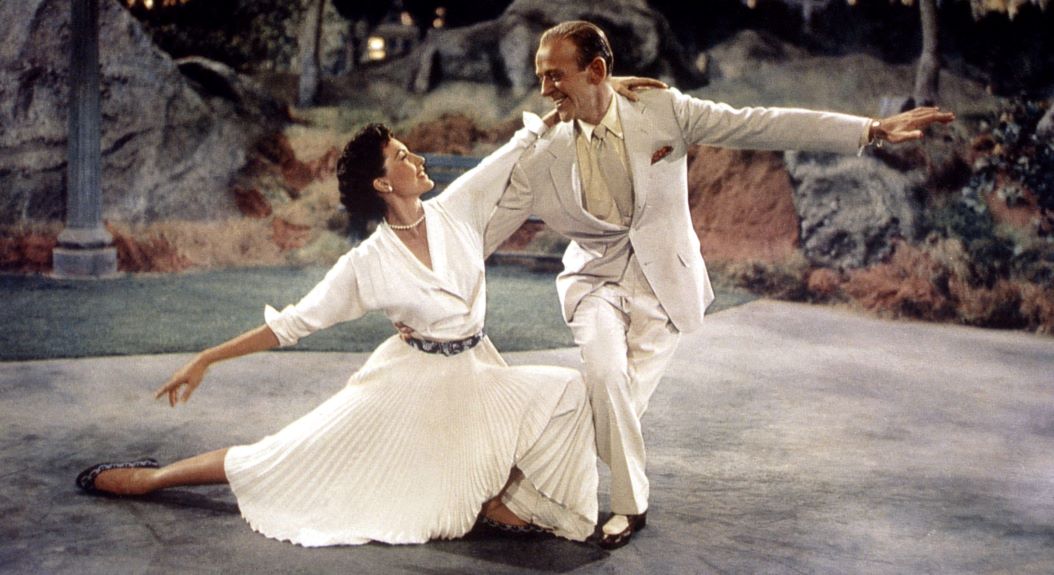
And that he is. Astaire and Charisse get several show-stopping numbers, the finest being a graceful, gorgeous balletic number in the park as they ice finally melts between them, a perfect, beautifully choreographed number that sees their bodies in perfect unison. The dancing is of course flawless throughout: Astaire early tap number on getting his shoes shined is charming and when we see snippets of their professional work on stage it’s deeply impressive.

If The Band Wagon has a flaw, it is that the last twenty minutes – which shows snippets of the final show being staged across the country – has a bitty, disjointed quality to it. It’s very hard not to notice that the plot has been completed and what we are left with are a series of non-too-catchy numbers and non-too-memorable set-pieces (except for the sight of Astaire, Fabray and Buchanan as adult babies which to be honest I wish I could forget). The final film-noir spoof ballet that ends the ‘show within the show’ (and God knows what that show, a bizarre, disjointed cabaret night as far as I can see is even about) is well-staged but lacks spark.

But The Band Wagon is still enjoyable, charming and above all fun – and if you can watch it without a smile breaking across your face (particularly if you love the theatre) then there is something wrong with you.

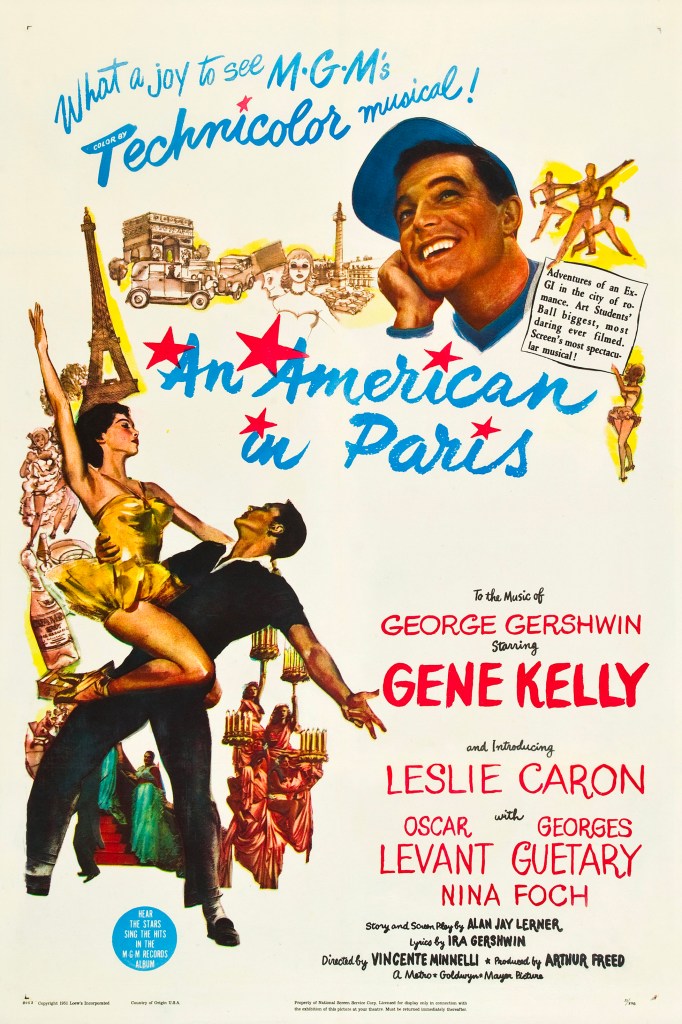
An American in Paris (1951)

An American in Paris (1951)

Romance, love and a lot of dancing in this charming Best Picture winning musical

Director: Vincente Minnelli

Cast: Gene Kelly (Jerry Mulligan), Leslie Caron (Lise Bouvier), Oscar Levant (Adam Cook), Georges Guétary (Henri Baurel), Nina Foch (Milo Roberts), Eugene Borden (Georges Mattieu)

“This is Paris. And I’m an American who lives here!” Those are almost the first words you hear in this charming but light and frothy Best Picture winner. They are pretty much an indicator of the loosely constructed, lightly plotted film that unspools. With the rights to the back catalogue of Gershwin, a story was swiftly thrown together to give us a reason to watch Gene Kelly and friends dance and sing their way through them. Tapping into a post-war romanticism about the delights of Old Europe, An American in Paris is a hugely entertaining technicolour delight that blew audiences away.

That American is Jerry Mulligan (Gene Kelly), an ex-GI hanging around in Paris to try and make his dreams of being an artist like Renoir and Toulouse-Lautrec come true (one glance at his paintings is enough to know he has no chance). His best friend is fellow ex-pat, ageing ‘child prodigy’ pianist Adam (Oscar Levant). Adam’s friend is Henri (Georges Guétary), a famous French singer (and war hero!). Henri is engaged to Lise (Leslie Caron), who meets Jerry by chance, neither knowing who the other is. Doncha-know-it Jerry and Lise fall in love. All this while Milo (Nina Foch), a wealthy would-be patron, longs to make Jerry her companion. How will these romantic complexities play out?

The story is by Alan Jay Lerner, but it can’t have taken him more than a long afternoon to come up with it: two friends unknowingly love the same woman, which will she choose? There is the odd sparkling piece of dialogue, but really this is a showcase for three things: Gershwin, Kelly’s dancing and Paris. Pretty much in that order, since the film is almost completely shot on a Studio backlot  (there are some brief second unit shots of the actual locations). Kelly objected at first to the lack of location shooting (“Ever tried dancing on cobble stones?” a producer pointed out), but actually it works for a film that is basically a fantasia on the city of romance, at points literally taking place in dream-like Parisian streets.

Constructed on a huge set (with some ingenious technical effects to expand the heights of the buildings, like Jerry’s apartment) the film is basically one delightful dance sequence after another, shot with a technicolour richness by Minnelli. We get introduced to our three male leads – Jerry, Adam and Henri – in overlapping voiceover, their faces unseen, as the camera roams over their Parisian locale. (We also get a neat repetition three times of the same joke as a camera settles on someone who nearly fits their description only to be told “no that’s not me”).

From there they meet each other and burst into a richly dynamic all-singing, all-dancing rendition of By Strauss in a classic Parisian café, that uses every prop going.  (It later gets mirrored with an equally amusing ‘S Wonderful where, unknowingly, Jerry and Henri sing of their love for the same woman, while a stressed Adam who knows the truth puffs seemingly a whole pack of cigarettes at once). Not to be out down, as Henri describes his fiancée to the boys, we see Caron perform a series of ballet steps each of them styled differently to reflect the different facets of her personality.

Kelly took on much of the choreography work and the film is a tribute to his grace. The man could move like almost no one else. One of the best bits of choreography in the film isn’t even a musical number: after his introduction Jerry gets out of bed in his tiny apartment and, with a stunningly witty musical grace, rearranges all the furniture from ‘night-time’ (bed) to ‘day-time’ (table and chairs). It’s just about a perfect bit of physical choreography, one of my favourite in the movies and at least as beautiful in its way (if not more so than) Jerry and Lise ballet stepping to Love is Here to Stay under a Parisian bridge. Not to complain about this number, which is a hugely influential routine of two dancers moving increasingly in rhythm with each other, shot with a luscious romantic beauty by Minnelli.

The numbers are so good, you give a pass to the fact that Jerry behaves like a bit of shit. His paintings are hilariously – and I believe intentionally – third-rate rubbish (he’d barely manage to land a job as a postcard painter), so its clear his aspirations to art are a fantasy. It’s also clear that Milo can’t seriously be interested him as an artistic prospect, as opposed to a bed one. Jerry of course knows this, but he still blows hard and cold on her with a slightly shabby selfishness. He’ll take her money for an apartment and whisk her away to a masked ball when he’s feeling low. But he’ll also flirt shamelessly with Lise right in front of Milo and her friends, and then act with a churlish “what’s the problem” harshness in the car with a tear-stained Milo on the way home.

I’m not sure how sorry the film wants us to feel for Milo, but one look at Nina Foch’s fragile face and her wobbling voice a few seconds away from tears as she deals with humiliation from her possible-boyfriend, always puts me on her side (at least at that moment). Jerry is borderline stalker in his pursuit of Lise, chasing her down in the café he has been bought to by Milo (after spending large chunks of the evening starring uncomfortably at Lise), dragging her into a dance and then pestering her later at her workplace into a late night meal. Just as well she loves him. Honestly if Kelly wasn’t so charming, you’d give Jerry a slap. Or a restraining order.

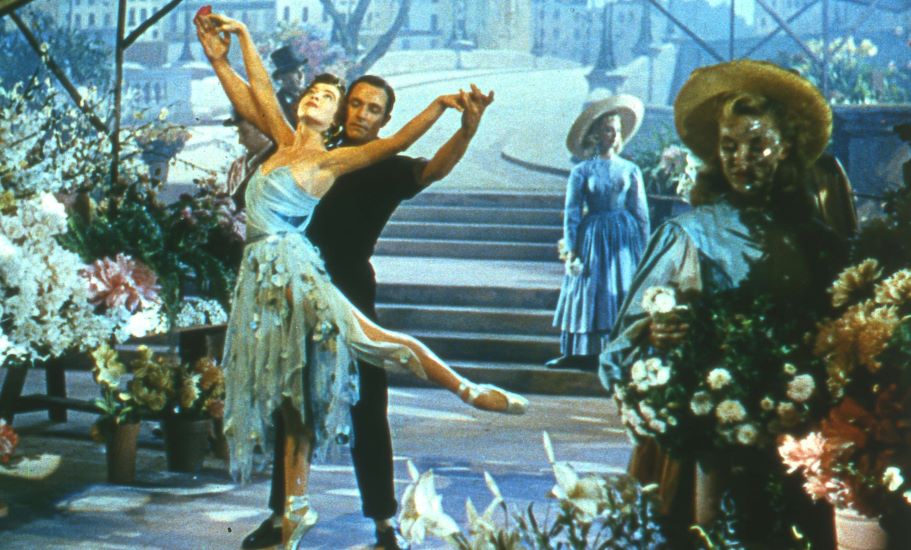
An American in Paris saves its final flourish for its last act: a seventeen minute ballet, taking place in a mix Jerry’s memories and wishes after it seems he and Lise will be kept apart for ever. Choreographed by Kelly, there isn’t anything else really like this in the movies (until La La Land stole the idea). Minnelli and Kelly sit in the ballet in a deliberately artificial Paris, essentially Jerry’s paintings bought to life and mixed with those of his artist heroes. This sequence is at times a little indulgent (some reviewers have unkindly compared Kelly’s desire to dance a ballet to a clown gracing us with his Hamlet) but it’s beauty and dynamism means it rewards investing in it.

Because Kelly and Caron (who is admittedly incredibly raw here as an actor) are wonderful dancers and the choreography here showcases them to perfection. Partially retelling the events of the film, partially telling its own romantic fantasia of a couple bought together and pulled apart, it’s a perfect mixture of several dancing styles and emotions and looks stunning, in its hyper-realistic design.

It makes for a unique ending to a classic musical that gets a bit overlooked – possibly because of the brilliance of Singin’ In the Rain that followed a year later, but was a flop compared to this mega-hit – but is an explosion of superb musical entertainment. Sure, the story is slight – only Nina Foch gets anything approach a hard-hitting role – but the joy is grand. Kelly is charm itself, Levant and Guétary very good in roles that riff on their personas and the whole thing will have you tapping toes and clicking fingers.

Gigi (1958)

Louis Jourdan forms an unusual romance with Leslie Caron’s Gigi

Director: Vincente Minnelli

Cast: Leslie Caron (Gigi), Louis Jourdan (Gaston Lachaille), Maurice Chevalier (Honoré), Hermione Gingold (Madame Alvarez “Mamita”), Eva Gabor (Liane d’Exelmans), Jacques Bergerac (Sandomir), Isabel Jeans (Aunt Alicia), John Abbott (Manuel)

In 1958 Gigi was littered with Oscars, winning all nine of its nominations to become one of the most successful films at the ceremony ever. It’s bizarre considering this is a run-of-the-mill musical with all the production values you would expect from an Arthur Freed production, but not really anything special compared to several other films from the same stable. It’s one of those moments when you remember Singin’ in the Rain didn’t even get nominated for Best Picture

Anyway, based on a book by Collette, Gigi deserved some sort of award for sneaking under the Hays code a story about a young girl training to be a courtesan, and the heartless playboy her family want her to seduce. Leslie Caron is Gigi, while the man who she has a sisterly affection for is Gaston (Louis Jourdan), the man around town bored with all the artificiality around him. Both Gigi and Gaston are heavily guided by their mentors: in Gigi’s case her grandmother, famed former courtesan Madame Alvarez (Hermione Gingold), in Gaston’s his uncle Honoré (Maurice Chevalier) a charming old rake. Everyone wants the two of them to become lovers, but do Gigi and Gaston want the sort of relationship of convenience their mentors expect?

That the film exists at all is a triumph of careful negotiation between Freed and the Hays Code, not usually open to films about high-class prostitutes and their marks. It does make for an occasional bit of confusion from the viewer – and a truncated plot as key ideas are circuited around (or over) – but also marvellous scenes, well written by Alan Jay Lerner, where Madame Alvarez and her sister (and courtesan trainer) Aunt Alicia (Isabel Jeans) discuss Gigi having “matured” to the correct age to become Gaston’s mistress by using unfinished sentences and raised eyebrows.

It makes for a slightly odd viewing experience today, especially with our far more enlightened views of the role women can have in society. The film mines comic material out of Gaston’s jilting of an unfaithful mistress (including Honoré toasting him for having driven the poor girl to attempted suicide after her public humiliation), while the comedic training sequences as Alicia attempts to turn Gigi into every man’s dream of the perfect mistress carries more than a whiff of exploitation today. But the film comes from a different r time, where such matters wouldn’t have occurred to either audiences or film makers.

Theres is a similar vibe in the film’s now most notorious sequence (and its opening) as Maurice Chevalier’s Honoré introduces the film and its world by crooning “Thank Heaven For Little Girls”. It’s a great catchy song (wonderfully delivered by Chevalier) but its lyrics thankful that “little girls get/Bigger every day”, matched with the septuagenarian Chevalier leering at a group of schoolgirls playing in the park, carry more than a whiff of the paedophile today. 

While you could say that this is all part of Minelli and Lerner’s intentions – that under the elaborate design of the film, there runs an undercurrent of selfish men carelessly using women for their own entertainment and many women enabling and encouraging this – it’s presented with such lightness, froth and charm that any potential darkness underneath it gets lost all together. Instead, its charming outer confection tends to obscure the difficult morals under the surface and prevents the viewer from engaging with them.

And the film’s design is what it’s really about. The first major musical to be shot largely on location – compare to An American in Paris which recreated the city of romance on a sound stage – its camera work is fairly reserved and focused on admiring the sets and locations more than providing a bit more to really engage the eye with. The design is impressive, mixing art nouveau and Cecil Beaton’s elaborate style, and the sets and costume (all Oscar-winning of course) really impress, even if the opulence ends up becoming overwhelming, not least with the overpowering reds that fill Gigi’s rooms. Minelli’s love of opulence and art ends up crushing the film.

That design also overwhelms the character. It’s telling that among its nine nominations, not a single one was for acting. Leslie Caron and Louis Jourdan do perfectly acceptable jobs, but their characters are not particularly interesting. Surprisingly for a musical – one starring Leslie Caron! – there is no dancing either. The film really misses the presence of people like Gene Kelly, the kind of leading man or woman who could carry a film on charisma. The real charisma comes from Chevalier (the one surprise to miss an Oscar nomination), who is so perfect as Honoré, so charming and dry (and who delivers his songs so well) that the film flags dramatically when he is absent (which he is for much of the final act). But the film misses a real heart.

It makes for a film that looks good, but is more a triumph of style and ingenious storytelling than it is storytelling with impact. Its Oscar win is perhaps a tribute to its faultless opulence and big budget spectacle. Because, boiled down to it, it’s a film with a story that hinges slightly on things that aren’t exactly tasteful revolving around people who aren’t very interesting. It has some good songs and moments from the Alan Jay Lerner script, but there is a reason this Best Picture winner has stuck in the collective memory so little, despite its record-breaking haul.