Tag: Wendy Hiller

Separate Tables (1958)

Separate Tables (1958)

Guilt and shame under the politeness in this stagy and almost-very-brave Rattigan adaptation

Director: Delbert Mann

Cast: Rita Hayworth (Anne Shankland), Deborah Kerr (Sibyl Railton-Bell), David Niven (Major David Angus Pollock), Burt Lancaster (John Malcolm), Wendy Hiller (Pat Cooper), Gladys Cooper (Mrs Maud Railton-Bell), Cathleen Nesbitt (Lady Gladys Matheson), Felix Aylmer (Mr Fowler), Rod Taylor (Charles), Audrey Dalton (Jean), May Hallett (Miss Meacham), Priscilla Morgan (Doreen)

Bournemouth’s Hotel Beauregard offers comfortable rooms and separate tables for dining. No wonder it’s popular with a host of regulars and out-of-town guests. But at each of those separate tables, drama lurks. Unflappable Pat Cooper (Wendy Hiller) manages the hotel and is secretly engaged to John Malcolm (Burt Lancaster), a down-on-his luck writer a little too fond of a pint in The Feathers. Their secret relationship is thrown into jeopardy when John’s ex-wife Anne (Rita Hayworth) arrives from New York, keen to get John back. Meanwhile, Major Pollock (David Niven) hides a secret behind his “hail-fellow-well-met” exterior, one which will threaten his place in the hotel and friendship with mousey Sibyl (Deborah Kerr) – a woman firmly under the thumb of her domineering mother (and resident bully) Mrs Railton-Bell (Gladys Cooper).

Delbert Mann’s film merges two Terence Rattigan one-act plays into a single, respectable piece of middle-brow Masterpiece Theatre viewing, which Mann subsequently effectively disowned (even after its seven Oscar nominations) after losing control of both editing and scoring to producer Lancaster. (Mann, quite rightly, loathed the hilariously out-of-place Vic Damone crooner number “Separate Tables” that opened the film.) Mann had already replaced Laurence Olivier, who dropped out after Lancaster’s company felt the film needed two American stars to make it box-office (handily they chose Lancaster himself and his business partner’s fiancée Rita Hayworth).

Lancaster and Hayworth are incidentally the weak points in the cast, their Americanness hopelessly out of step with Rattigan’s extremely English style and setting. Both actors are all too clearly straining to “stretch themselves” in unlikely roles, giving the film a slight air of self-indulgence. (Hillier later archly stated her best scene from the original was handed to Hayworth, while Lancaster recut the film to move up his first entrance.) The will-they-won’t-they tug-of-war between the two of them is Separate Tables’ least interesting beat and it’s to the film’s detriment that it, and these two awkwardly miscast actors, dominate so much of the film’s middle section.

They were already playing the dullest half of Rattigan’s double bill. Rattigan’s passion, and by far the film’s most electric moments – even if they only really constitute just under a half the runtime – revolve around the scandal of Major Pollock. Pollock, it is swiftly revealed, is not only prone to exaggerate his class, schooling and military career (his knowledge of alleged alma mata Sandhurst and the classics is revealed to be sketchy at best) but also carries a secret criminal conviction for harassing young women in a cinema.

While such harassment is of course recognised as beyond the pale today, it’s very clear in Separate Tables that Pollock’s misdeeds are standing in for a crime that literally “dare not speak its name”. Rattigan was one of Britain’s most prominent closeted homosexuals and his original intention had been for the Major’s crime to be fumbled cottaging. In the 50s it was unspeakable for the lead to be a sympathetic frightened homosexual so, in what looks bizarre today, it was far more acceptable to make him a timid sexual molester. However, the subtext is very clear, unspoken but obvious. One only has to hear the tragic Major sadly say “I’m made in a certain way and I can’t change it” and talk about his shame and loneliness to hear all too clearly what’s really being talked about here. Isn’t the Major’s pretence about being “the Major” just another expression of the double life a gay man had to lead in 1950s Britain?

This sensitive and daring plot is blessed with a wonderfully judged, Oscar-winning performance by David Niven (dominating the film, despite being on screen for a little over 20 minutes – the shortest Best Actor winning performance on record). Niven had made a career of playing the sort of suave, debonair military-types Pollock dreams of being – so there might not have been an actor alive more ready to puncture that persona. Recognising a role tailor-made for him, Niven peels away the Major’s layers to reveal a shy, sensitive, frightened man, desperate for friendship and acceptance. His heart-breaking confession scene (clearly a coded coming out) is beautifully played, while the closing scene with its hope of acceptance gains hugely from Niven’s stiff-upper-lip trembling with concealed emotion.

Niven’s performance – (Oscar-in-hand he rarely felt the need to stretch himself as an actor again) – centres the film’s most dramatic and engaging content. The campaign against the Major is led by Mrs Railton-Bell, superbly played by Gladys Cooper as the sort of moral-crusader who needs to cast out others to maintain her own ram-rod self-perception of virtue. Cooper uses icy contempt and overwhelming moral conviction to browbeat the rest of the guests in a sort of kangaroo court into blackballing the Major, a neat encapsulation not only of the power of the loudest voice but how readily decent people reluctantly acquiesce to it to avoid trouble.

Her control has also crushed her daughter’s spirit. Deborah Kerr’s performance is a little mannered: Kerr works very hard to embody a mousey, dumpy, frumpy spinster and make sure we can see she’s doing it. But she works beautifully with Niven and her meekness means there is real impact when the mouse finally (inevitably) roars. The rest of the guests are a fine parade of reliable British character actors: Felix Aylmer reassuringly fair and May Hallett particularly delightful as a no-nonsense woman who doesn’t give a damn what people think and trusts her own judgement.

Linking all plots together, Wendy Hiller won the film’s other Oscar as the hotel manager. Hiller was born to play decent matrons, bastions of respectable fair play who reluctantly but stoically bear personal sacrifices as their own crosses. She’s a natural with Rattigan’s dialogue and brings the best out of Lancaster, as well as providing all the drama (and sympathy) in the film’s other plotline as a surprisingly noble “other woman”.

Separate Tables is a middle-brow slice of theatre filmed with assurance. But when it focuses on Major Pollock it touches on something far more daring and much more moving than anything else it reaches for. Here is true low-key, English tragedy: under a clear subtext, we see the horror of a man who pretends all his life to be something he is not and the terrible judgements from others when he is exposed. It’s that which gives Separate Tables its true impact.
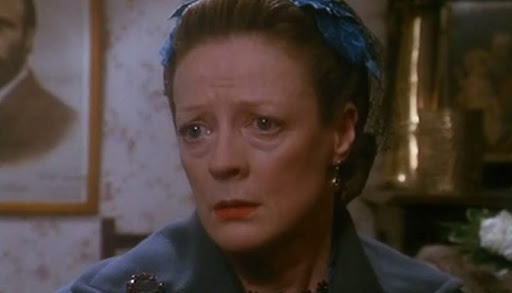
The Lonely Passion of Judith Hearne (1987)

Maggie Smith excels in stately literary drama The Lonely Passion of Judith Hearne

Director: Jack Clayton

Cast: Maggie Smith (Judith Hearne), Bob Hoskins (James Madden), Wendy Hiller (Aunt D’Arcy), Marie Kean (Mrs Rice), Ian McNeice (Bernard Rice), Prunella Scales (Moira O’Neill), Alan Devlin (Father Quigley), Rudi Davies (Mary)

Judith Hearne (Maggie Smith) is a lonely, frustrated Irish spinster who never found her place in the world. Arriving at her new lodgings in Dublin, Judith leaves behind her a whiff of scandal and a slight air of being someone you don’t want in your home. However, while her superior manner may not fool everyone, it’s enough to spark the interest of chancer James Madden (Bob Hoskins) brother of Judith’s lodger Mrs Rice (Marie Kean) – who is not remotely fooled by Judith’s pretence at upper-class gentility. While Judith wonders if romantic love may, after all, finally be round the corner for her with Madden, Madden himself wonders if the starting investment for his next dream is in his grasp.

Jack Clayton’s adaptation of Brian Moore’s novel is a stately passion project. An adaptation that Clayton had worked for years to bring to screen, it’s a quiet and respectful picture that moves with a graceful serenity over its runtime, covering emotional territory but never quite sparking into life. Clayton’s adaptation of the book is precise and perfect in nearly every way, with the film very true to Moore’s style and his ability to capture the domestic tragedy of small-scale, disappointed lives. But it’s not quite a film that hums with inspiration.

What inspiration it has is bound up with Maggie Smith’s superb (BAFTA winning) performance in the lead role as Judith herself. This is surely some of Smith’s finest work on screen, perfectly capturing every beat of this character study. Judith Hearne is a woman who relies on her upper-class background – her airs and manners – to cover up the facts of her poverty and, even more importantly, her chronic alcoholism. Couple this with her self-loathing, her confused attitudes towards God and her (barely consciously aware) mixed feelings for her deceased aunt (Wendy Hiller in imperious form in flashbacks) and she is a woman reeking of disappointment, depression and oppression as much as she does the booze she knocks back.

Smith’s performance progresses throughout the film, from a veneer of assurance to an increasingly poignant and tough to watch collapse into starkly raw emotional disintegration. Desperate in ways she hardly understands for emotional (and physical) content for another, she’s almost touchingly over-enthusiastic when offered the olive branch of friendship of a man, and the self-loathing and loneliness that channel her collapse into brutal alcohol-driven meltdowns show Smith holding nothing back but never once heading over the top. Smith totally understands how to get the balance between quiet tragedy and emotional force, constantly balancing the two expertly. 

It’s her performance that is a triumph of small moments that build over time to carry emotional force, from her careful arrangement of a room to her confused slightly timid eagerness to please when in conversation with Madden. Smith’s superb in the role, never anything less than real her eyes little windows to the depths of sadness in her soul.

It’s a shame that the rest of the film doesn’t quite measure up to her and that, despite the force of her performance, the film never quite manages to capture the overall impact of domestic tragedy that the film needs in order to be something more than just a gracefully filmed package around a superb central performance.

Too many other plot directions end up in cul-de-sacs or never get explored. Madden’s frustrated sexual feelings – and his eventual assault on housemaid Mary (a decent performance by Rudi Davies) are simply never explored any further. Bob Hoskins gets short-changed with a character that doesn’t really go anywhere and whose darker side is demonstrated but then never referenced again. The film gives such force to the damage of Judith’s alcoholism and depression that her struggles with the church never quite gain the force they need. This is despite some sterling work from Alan Devlin as a bullying but empty churchman, not interested in hearing about problems that can’t be solved with doggerel and dogma.

The finest subplots feature Ian McNeice is superb as the bloated wastrel son of the landlady, a spoiled, lazy former student claiming to be working on the next great Irish poem (a work he estimates will take him at least another 5 years), but largely spends his time swanning around the house causing problem and sniping arrogantly at the residents. Marie Kean is also fine as the arch landlady who sees through all deceptions, other than her son’s.

It’s a shame that the film itself – for all the excellence of Clayton’s work – doesn’t quite come together into a really coherent package. What it kind of misses is perhaps the sort of sharp, knowing observation and dry wit that Alan Bennett bought to so many similar small-scale stories of wasted lives in Talking Heads. The film is on a grander scale than those, but somehow carries both less weight and less insight than an average Bennett monologue. Smith is superb – possibly a career best – but the film itself is more something to be admired than remembered.

Murder on the Orient Express (1974)

Albert Finney interrogates an all-star cast in Murder on the Orient Express

Director: Sidney Lumet

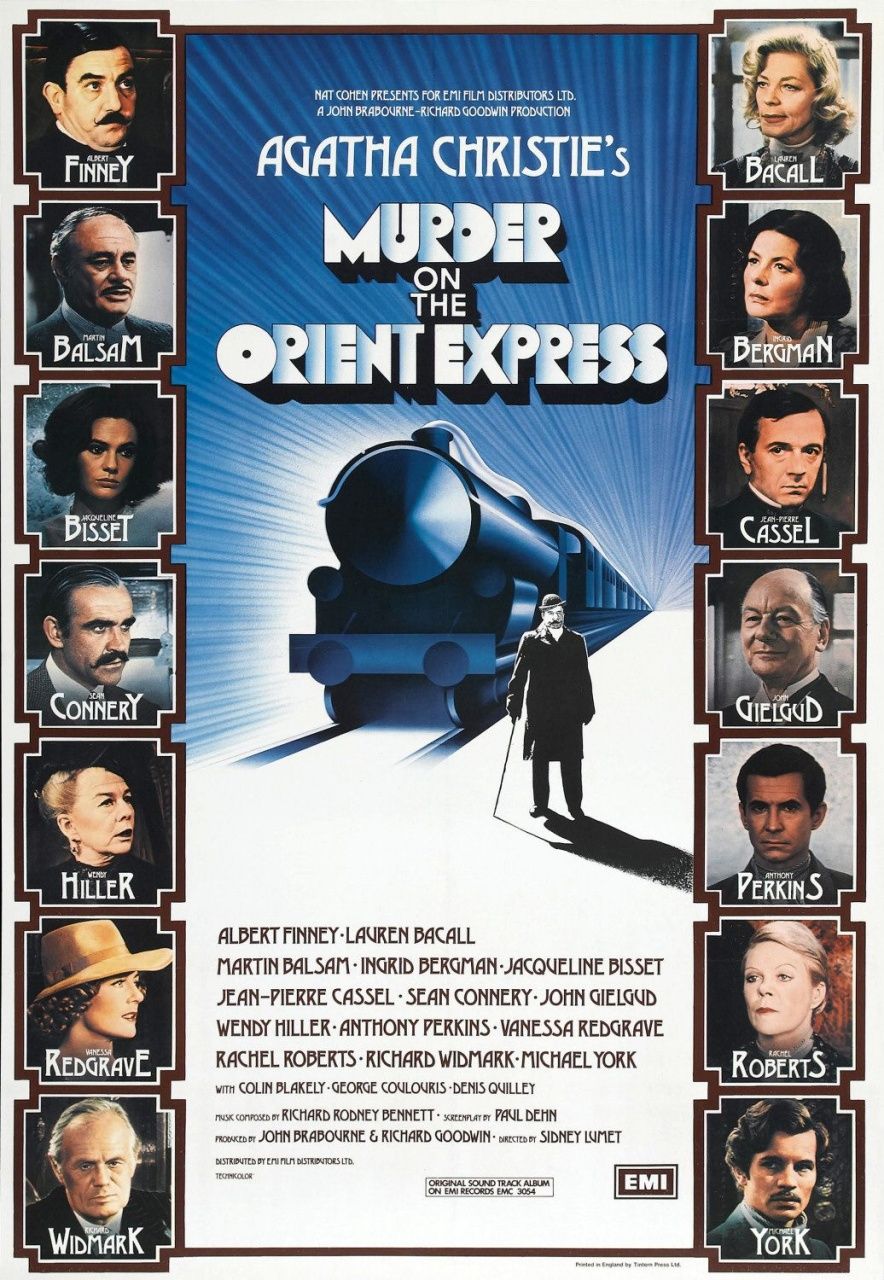
Cast: Albert Finney (Hercule Poirot), Lauren Bacall (Linda Arden), Martin Balsam (Signor Bianchi), Ingrid Bergman (Greta Ohlsson), Jacqueline Bisset (Countess Helena Andrenyi), Jean-Pierre Cassel (Pierre Paul Michel), Sean Connery (Colonel John Arbuthnot), John Gielgud (Edward Beddoes), Wendy Hiller (Princess Natalia Dragomiroff), Anthony Perkins (Hector McQueen), Vanessa Redgrave (Mary Debenham), Rachel Roberts (Hildegarde Schmidt), Richard Widmark (Ratchett), Michael York (Count Rudolf Andrenyi), Colin Blakely (Cyrus Hardman), George Coulouris (Dr Constantine), Denis Quilley (Antonio Foscarelli)

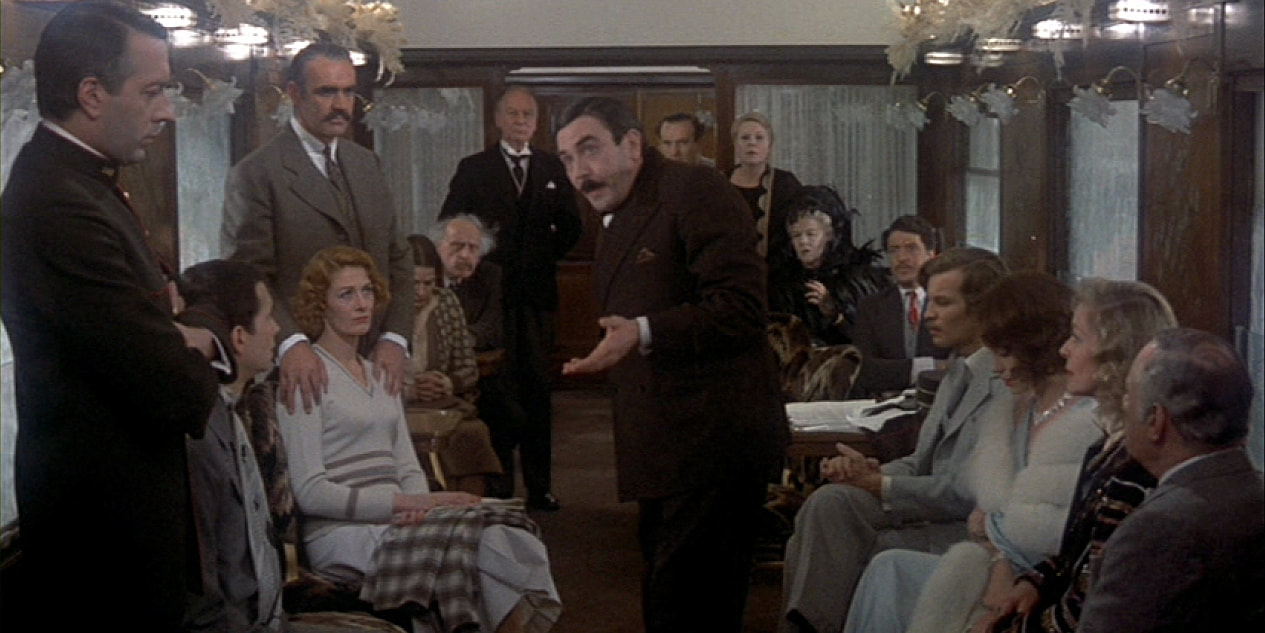
If there was a film that set the template for our expectations for an Agatha Christie adaptation, it was probably this one. A big starry cast. Luscious period detail. An engrossing plot with clues and double meanings in every corner. A healthy mix of the OTT and the chilling. Marshalled by Sidney Lumet, almost certainly the best director to take on a Christie mystery ever, this film was a massive hit then and remains a hugely enjoyable, rewarding treat now, the sort of masterclass in quality film-making and bravura acting that is guaranteed to leave a smile on your face.

You surely must know the plot by now right? Hercule Poirot (Albert Finney) returning from a successful case in the East hitches a ride on the Orient Express on the way home. During the journey he is asked by American businessman Ratchett (Richard Widmark) if he would take up the role of his bodyguard after threats against his life. Poirot turns him down – and sure enough the next morning Ratchett turns up dead in his compartment, with no less than a dozen knife wounds in his chest. With the train stranded in a snow drift, the killer must be one of the other twelve passengers in the carriage. And so the case begins…

Sidney Lumet’s superb, classy piece of murder mystery is a triumph of design and style. The train looks superb, the period detail is perfect, the costumes are luscious. But what Lumet brings to it all underneath all this Sunday afternoon splendour is a genuine sense of chilling menace. Helped a great deal by Richard Rodney Bennett’s haunting musical cues, this film never lets the viewer forget that the heartless destruction of an entire family is at the root of the crime itself, or that the desires for revenge we find in ourselves can take us to dark places. 

Lumet’s film opens with a brilliantly constructed series of newspaper stills, establishing the horrors of the Daisy Armstrong case that underpins the mystery, the kidnapping and murder of a young child (based on the Lindbergh kidnapping) that led to tragic consequences for an entire family. This chillingly sad and tragic back story is echoed throughout the film, and immediately establishes the stakes for all involved.

So we spend the film then trying to work out how all the suspects might fit it into this story. Lumet’s concept of bringing together an all-star cast was a brilliant idea, not only giving each of the suspects a quickly established personality (partly inspired by the actor’s body of work), but also assembling a group of such talented actors that they can sketch out a character within a few moments. Lumet’s first recruit for the cast was his old collaborator Sean Connery – and the agreement of Connery to take on a supporting role brought a host of actors to follow. It all adds to the fun, an enjoyable star-spotting exercise, and also an amusing game of watching sometime wildly competing acting styles.

Connery plays Arbuthnot with a stiff-upper lip English reserve, but then you also have a wonderfully arch (and very funny) John Gielgud, a dementedly twitchy Anthony Perkins (McQueen seems to have been adapted into a junior brother of Norman Bates), a show-boatingly larger-than-life Lauren Bacall (great fun), a Germanic stern Rachel Roberts and an inscrutable Vanessa Redgrave. That’s just a few of a terrific collection of actors, and arguably only Wendy Hiller’s overly imperious Princess Dragamiroff is a bit of a miss.

Lumet’s strength in depth allowed him to push his actors into demanding places – complex set-ups and, most especially, a series of long takes in his often confined performance spaces. The highlight – in fact it won her an Oscar – is Ingrid Bergman’s five-minute (practically only) scene where the camera slowly rotates around her across five minutes as she tells her story. Bergman’s shy, nervy, gentle and timid missionary comes across as achingly vulnerable. Bergman had been offered the larger role taken by Wendy Hillier, but wisely turned it down for this show-stopping moment.

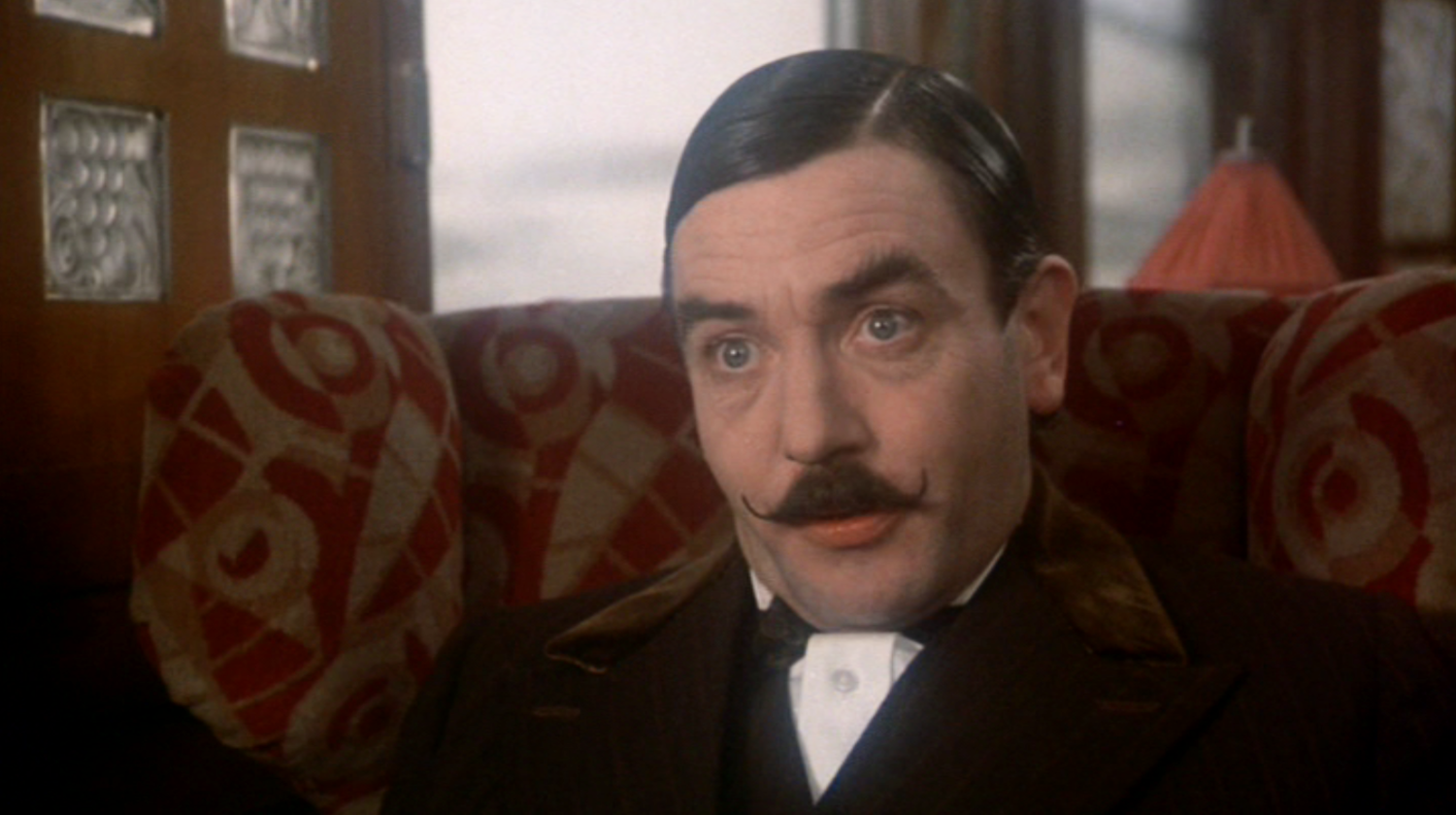
The advantage of having such accomplished actors was most clear in the burden placed on Finney as Poirot. Watching it now – familiar as we are with decades of David Suchet’s definitive performance – it’s easy to see Finney’s performance as a little too much. Covered with make-up and a fat-suit, his shoulders hunched around his neck, his hair plastered down with grease and his accent frequently heading way out over the top, Finney certainly leaves very little in the dressing room. His Poirot is an amiable showman, a man willing to adjust his personality and approach from suspect to suspect, but in the end a man with a well-being arrogance and a deep sense of personal morality as well as a profound sense of humanity.

Finney was a surprising Oscar nominee for Best Actor, but he almost certainly owed this to his final speech, an almost thirty-minute tour-de-force. Lumet, operating in small confines, determined that the best way of getting the most dramatic energy from the speech was to use long takes, elegant camera moves, and the minimum of cutting – to let Poirot cast his spell over the audience as much as he does over the suspect. As such Finney – in a tiny, crowded, set – performed the complete monologue several times (each time apparently flawlessly) so that the camera could be positioned in each point in the confined set at a time. The result is seen in the final sequence, which uses dizzying long takes and careful camera moves to draw us brilliantly into the reveals that come thick and fast.

Finney’s performance is magnetic in its theatricality and commitment, and Lumet’s directing decisions throughout the sequence really help to make this sequence as effective as it is. Lumet’s peppers this sequence with a series of brief flashbacks to earlier in the film, which skilfully present snippets of the characters testimonies represented at different camera angles, which is both eerie and also throws a new light on the scenes we have already seen. For all that Finney is a bit much at times, you can’t help but enjoy this piece of showmanship.

The final resolution remains justly famous, and it largely owes a lot to this film. Agatha Christie even was favourable to the film (one of only two films of her work she liked, the other being Billy Wilder’s adaptation of Witness for the Prosecution) although (in words I presume heard by Kenneth Branagh) she bemoaned the smallness of Finney’s moustache. There have been several film and TV adaptations that have followed, but only David Suchet’s version has challenged it for the title of the best. With its gorgeous settings, imaginative direction and wonderful cast I never tire of watching it.

Pygmalion (1938)

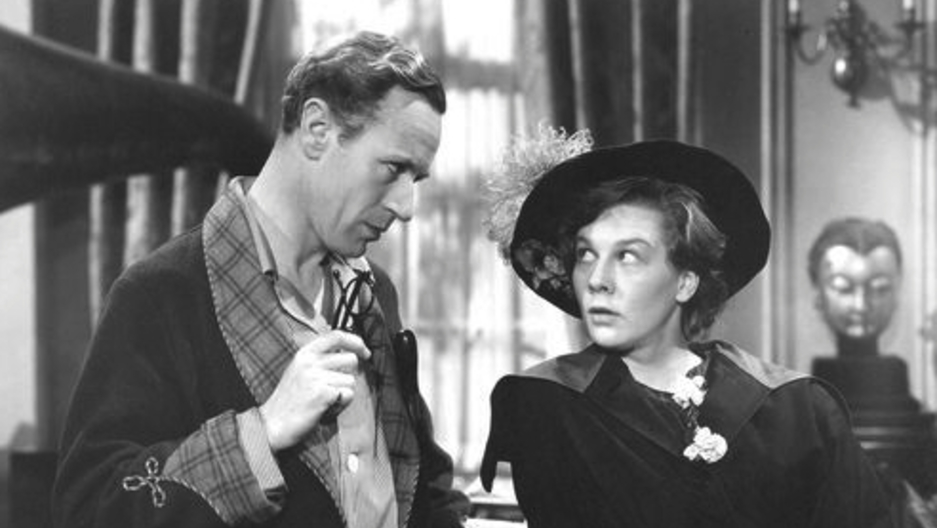
Leslie Howard and Wendy Hiller excel in Bernard Shaw’s own adaptation of Pygmalion

Director: Anthony Asquith, Leslie Howard

Cast: Leslie Howard (Professor Henry Higgins), Wendy Hiller (Eliza Doolittle), Wilfrid Lawson (Alfred Doolittle), Marie Lohr (Mrs Higgins), Scott Sunderland (Colonel George Pickering), Jean Cadell (Mrs Pearce), David Tree (Freddy Eynsford-Hill), Everley Gregg (Mrs Eynsford-Hill)

“It’s an insult for them to offer me an honour, as if they have ever heard of me – and it’s very likely they never have. They might as well send some honour to George [VI] for being King of England.” That was George Bernard Shaw’s reaction when he heard that he had won Best Adapted Screenplay at the Oscars. Now that’s a reaction that would have burned Twitter up today. Mind you Shaw wasn’t adverse to taking the film world’s money for bringing Pygmalion to the screen – and also means he is one half of a nifty pub quiz question (who is the only other person to win BOTH an Oscar and the Nobel Prize for literature?).

Pygmalion, always one of Shaw’s most popular plays, seemed a logical choice to begin for producer Gabriel Pascal’s dream of bringing a cannon of the playwright’s complete work to the cinema screens. Shaw agreed – so long as he had was on board as the screenwriter and with a personal supervision of the adaptation. He missed a trick by not insisting on creative control. Shaw re-wrote and restructured much of the play for the screen – and it’s this screenplay that forms the basis of My Fair Lady. So closely so, that it’s the most familiar version of the play – and so close does the dialogue cut that you end up wondering where the songs are.

Anthony Asquith was bought on board as the director, and Shaw oversaw the assembly of the cast. Leslie Howard was cast over Shaw’s original choice, Charles Laughton, and also given a co-director credit (although there are some disagreements about what this meant, with some claiming it was basically some on-set notes to actors). Asquith was a director with a gift for opening out literary adaptations onto the big screen, and he succeeds here in capturing much of the atmosphere and mood of Shaw’s comedy of manners. There was also a young whippersnapper called David Lean on hand to direct the montage sequences that showed Eliza’s training.

Leslie Howard was a major matinee idol, but also an accomplished stage actor – and both qualities come to the fore here in what is surely the best Higgins captured on screen (with apologies to Rex Harrison). His Higgins is a rough-edged, somewhat scruffy, eccentric who speaks before he thinks, treats everything with an absent-minded, off-the-cuff bluntness and is almost professionally rude. He’s never straight-forwardly charming, indeed sometimes he’s outright cruel and bullying, but there is a professorial lack of harm to him that makes him reassuringly British and decent. And he gives the final act a real sense of vulnerability and emotional repression that is vital.

If Leslie Howard makes a very good Higgins, I do think there is very little doubt that Wendy Hiller is the definitive Eliza Doolittle. Handpicked by Shaw, she is superb here. Her Eliza has all the fragility, worry and working-class chippiness you expect, but Hiller laces it with such a real streak of humanity that you end up deeply investing in her. Her flourishing sense of personality, of her growing strength of personality and feelings of independence dominate much of the final act of the play, and Hiller mixes it with notes of genuine hurt and sadness about the dismissive treatment she is receiving from Higgins. It’s a performance overflowing with nuance and pain – and the moment when a pained Eliza responds with a pained dignity when Higgins suggests she marry someone else that “we sold flowers….we did not sell ourselves” is a truly wonderful moment.

But this is also a very well made, cinematic movie with some really outstandingly funny sequences. The scene where Eliza – newly trained to talk “proper”, but with no idea about what makes for decent polite conversation – regales a dinner party in earnestly, perfectly accented English about her belief that “they done [that] old woman in” at great length is hilariously funny, as is Howard’s wryily amused response. There is also equal comic mileage to be got from Wilfrid Lawson’s very funny performance as Eliza’s selfish, street-smart father, the dustbinman with the mind of philosopher. 

Asquith’s film is very well shot and assembled, helped a great deal by this inventively made and very structured montage sequences contributed by Lean (who also edited the film). It’s done with real snap, and Asquith’s camera movements and invention of framing dwarf’s the far more staid and flat production of My Fair Lady that would win many Oscars 25 years later. He knows when to go for low, static shots – particularly in those moments when Eliza realises she is just a toy for Higgins – and also close-ups and one-two shots that give even greater energy and dynamism to Shaw’s wonderful dialogue (again the final argument sequence benefits hugely from this).

Shaw didn’t go for creative control, so he failed to prevent the happy ending that was added to his play, as Eliza returns to Higgins (after seeming to leave to marry Freddy), and the Professor continues his pretence of indifference – which thanks to Howard’s excellent performance earlier we know is just that. To be honest, even with the performances of the leads, Eliza’s devotion to Higgins still seems to come from left-field (just as it does in the musical) and there isn’t much in the way of romantic chemistry between them. But it works for many people, even if it never works for me (or Shaw).

Pygmalion is a fine film, far superior to My Fair Lady (better made, better acted, better written, funnier, smarter, more moving and more heartwarming). It deserves to live a life outside of its shadow.

And that other Nobel and Oscar winner? Why Bob Dylan of course.

The Elephant Man (1980)

John Hurt is sublime as the tragic John Merrick in The Elephant Man

Director: David Lynch

Cast: John Hurt (John Merrick), Anthony Hopkins (Dr Frederick Treves), Anne Bancroft (Madge Kendal), John Gielgud (Francis Carr-Gomm), Wendy Huller (Mrs Mothershead), Freddie Jones (Bytes), Dexter Fletcher (Bytes’ boy), Michael Elphick (Jim the porter), Hannah Gordon (Ann Treves), Helen Ryan (Princess Alexandra), John Standing (Dr Fox)

In the late 19th century, society was swept up in the story of a circus show freak, Joseph Merrick (renamed John here, as per Frederick Treves’ memoirs), saved from a life as a circus exhibit by Treves (a doctor at the London Hospital). Treves introduced him into society and formed a close friendship with him. Merrick died young (27) but his life became a sort of byword for struggling for dignity. The Elephant Man follows this journey.

John Hurt plays Merrick, with Anthony Hopkins as Treves, and the film is a pretty accurate reconstruction of the major events of Merrick’s life. The Elephant Man must have seemed like a strange proposition at the time. Produced by Mel Brooks! Directed by bizarro director David Lynch! About a man grotesquely deformed by nature! But what emerges put those doubts to shame, because this is a beautiful and emotional piece of film-making, guaranteed to put a tear in your eye. It’s an extraordinary and moving film, it’s almost impossible not to love.

In a career made up of playing characters who undergo enormous suffering, it’s fitting that one of John Hurt’s most famous performance sees him utterly unrecognisable under a mountain of make-up. (Acting in this was no fun either – Hurt worked alternate days to deal with the discomfort and stress, telling his wife “They’ve finally found a way to make me hate acting”). But what Hurt does here is extraordinary: under this mountain of make-up, the humanity, sweetness and tenderness of Merrick sings out. He’s a character you feel a total empathy for, with Hurt making him almost a gentle child, an innocent who learns to value himself and his own humanity. It’s mesmeric stuff.

Lynch’s film is all about the place Merrick holds in the world – and it’s not sure shy of showing it is one of exploitation and display. Sure, the circus life for Merrick is horrible under Freddie Jones’ freak-masker (Jones is magnificent here, alternating between weaselly, conniving, vulnerable, self-pitying and loathsome). But he’s plucked from this lower-class hell not for reasons of charity or loving care, but (initially) so that Treves can display him at medical conferences.

Even after demonstrating his sensitivity and artistic richness, Merrick is still rammed into a different treadwheel of society curiosity. Paraded before the rich and famous, his freakish appearance combined with his gentle, otherworldly, politeness and kindness becomes a new show in itself – something Treves himself (in a wonderfully played scene of introspection from Hopkins) slowly comes to realise. Alongside this, Merrick is still seen as fair-game by Elphick’s brutish night porter: if the hoi polloi can watch the freak, why can’t he parade him in front of working class customers at night? All this is intensely moving.

Does Merrick even realise that he is (in some ways) still a freak show, even while he collects photos of his new friends? The film is deliberately unclear: although it is clear that the (eventual) genuine friendship of Treves does lead Merrick to value himself as something more. The famous anguished cry (simply brilliantly played by Hurt) of “I am not an animal. I am a human being” after Merrick is chased into a train station bathroom by a crowd of scared and disgusted passengers is goose-bump inducing in both its sadness and its newfound moral force. From this point on, Merrick makes decisions for himself (for good or ill).

Lynch’s film walks a delicate balance around Merrick’s character and how much his life was a question of being exploited. Although the film does at times shoot Merrick with the slow reveal coyness of a monster movie, it never fails to regard him (and almost demand we do the same) with the utmost sympathy. In many ways, it shoots Merrick the same way people first seem him – a sense of shock followed by a growing appreciation that there is much more to see there than you might first suspect. 

That’s what works so well about Lynch’s inspired direction here – this is a sensitive, haunting and poetic film that wrings untold levels of sadness from Merrick’s life. Lynch reins in his more arty leanings very effectively. In fact, once you get over the film’s bizarre opening of Merrick’s mother being attacked (sexually assaulted?) by an elephant, the film relaxes into a classical style mixed with Lynch’s chilling eeriness and his games with time and mood (the timeline is particularly hard to work out in this film), while his sensitive handling of the macabre is perfect for this film’s storyline. While it’s easy to see this as the least “authored” of Lynch’s film, it’s possibly one of his finest and sets the groundwork for some of his later works, exploring humanity in the bizarre.

He’s helped as well by Freddie Francis’ simply beautiful black-and-white photography which brilliantly captures both the grime and the shine of Victorian London, with an inky darkness. Francis also embraces some of Lynch’s expressionistic style, and shoots the film with a real atmospheric sensitivity. It’s about perfect – and Lynch brings the outsider’s view to London that sees the entire city with a brand new eye. 

There are some sublime performances. Anthony Hopkins’ Treves is a masterclass in contrasted desires. He’s the sort of guy who can grab Merrick like a collector, but still shed a tear when he first sees him. Watching him slowly realise that he has used Merrick just as Bytes has done – within the confines of his Victorian paternalism – and grow to love him as a father does his son (feelings of course never expressed in words) is extraordinary. In the less flashy role, Hopkins powers a lot of the feelings of sadness the audience feel. Alongside him, a host of British legends do brilliant work, particularly Gielgud and Hiller as authority figures who slowly reveal themselves to have huge depths of compassion and understanding.

And what you end up with is a marvellous film. Brilliantly made, wonderfully filmed and hugely emotional with powerful, heartfelt performances from Hurt and Hopkins among many others. It’s extremely beautiful, and stirs the emotions wonderfully. You would struggle to get to the end of the film and not feel overcome with the final few moments, its sadness and the sense of regret. It’s possibly the most heartfelt of Lynch’s films – and also the one I enjoy the most.

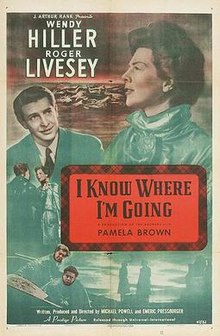
I Know Where I'm Going! (1945)


Roger Livesey and Wendy Hiller prove opposites can attract in Powell and Pressburger’s marvellous I Know Where I’m Going!

Director: Michael Powell, Emeric Pressburger

Cast: Wendy Hiller (Joan Webster), Roger Livesey (Torquil MacNeil), Pamela Brown (Catriona), Finlay Currie (Ruairidh Mhor), George Craney (Mr Webster), Nancy Price (Mrs Crozier), Catherine Lacey (Mrs Robinson), Jean Cadall (Postmistress), John Laurie (John Campbell), Valentine Dyall (Mr Robinson)

Joan Webster (Wendy Hiller) is a young middle-class woman with ambitious aims who has worked to secure a marriage to a wealthy, much older, industrialist. En route to the wedding in Scotland, she gets stranded on the Isle of Mull by a storm. There, she finds a world of very different values and principles than her own. She also finds herself thrown together with naval officer Torquil MacNeil (Roger Livesey) a man trying to return home for leave. Trapped on the island for days, Joan and Torquil find themselves romantically drawn together – however much Joan tries to avoid it.

Powell and Pressburger’s films all have a sense of filmic magic to them. They are the sort of films it’s very easy to fall in love with, and swear by. I Know Where I’m Going falls into that model extremely well – a dreamy romance in a stunning looking Scottish island, full of engaging characters and beautifully filmed. It’s a seemingly simple romance story, but it feels like a deep and engaging fable – it’s a film that shows how throwing a little uncertainty into a life can be a good thing.

Because Joan Webster categorically knows where she is going. The film’s entire build-up centres around her ambition and overwhelming focus. She literally dreams about marrying the engineering firm (yup that’s right, the firm itself not the man). She pushes her father into putting together a detailed itinerary for her entire journey. She seems to have no self-doubt whatsoever. So the magic of the film is that, deep down, it’s a about a woman realising that the place she has spent her whole life going, isn’t in fact where she wants to go. And the audience can see right away that she wants something else – much quicker than her!

This works because Powell and Pressburger get the romantic feeling of the island and its people so spot on. It’s very easy to get this Monarch of the Glen style Scottish idyll stuff feeling wearing and tedious. But somehow, it just sort of clicks. We don’t get the islanders’ charm and love of the simple life rammed down our throats, we just see how they behave and their simple contentment – and of course we have it compared all the time with Joan’s ruthless ambition. This combines really well with Powell and Pressburger’s lyrical style, their semi-magical romantic camera shots making the island seem hugely attractive (even when it is lashed with wind and rain).

By contrast our brief impression of the world outside Scotland seems cold and mechanical. It’s all offices, impersonal train booths, and besuited chaps giving stiff-collared responses. In a neat piece of cross cutting, one businessman even appears as if he has train steam puffing out of his top hat, like some human train. But we have hints that Joan has more romance under her skin than she would like to admit: as the train moves into Scotland (the film makes no real attempt at realism for its train shots) Joan dreams of the landscape they move through like some sort of tartan vision, with hills made of patchwork quilts. It’s one lovely image.

Then we have the arrival on the island – it’s got a charming, breezy openness about it. Out first introduction to Pamela Brown’s radiant Catriona is on a rainy hill with a pair of wolf hounds, before she bursts into a room (low angle cameras make her look even more romantic). Could the contrast with the mechanism of the rest of the world be more precisely made? There is a charming lack of interest in worldly affairs – the people are “not poor, they just haven’t got any money” – and what could be tiresome scenes set in ceilidhs and the like actually carry a lot of charm with them. Compare the vibrancy the islanders greet life with with the distant coldness of the wedding guests staying there – which group looks like the people you would like to spend time with?

The other thing that really works is the romantic relationship between Joan and Torquil doesn’t feel forced, or jump through too many clichéd hoops and feels organic and natural. The actors have fantastic chemistry, and the film playfully places them in a number of situations that drives this unspoken interest. It’s got more than a touch of screwball comedy about it – two people trapped together, one of them with mounting frustration – despite not really, as such, having a plot. 

Wendy Hiller is superb as Joan Webster – she brings a Katherine Hepburnish quality to the role: a determined, modern woman, a control freak in a situation where she has no power at all and hating every minute of it. What really works though is her own lack of self-knowledge. It’s clear to the viewer (and most of the characters) she is developing a deep attraction to Torquil, but Hiller makes it clear that Joan is completely unaware consciously of this. It’s a marvellous performance, totally relatable and hugely endearing, despite Joan’s ruthless certainty, because it’s always subtly puncturing that certainty with doubt.

Roger Livesey makes a perfect countpoint as Torquil. It’s a perfect role for him – a twinkly people-person, old-fashioned but not a stiff-upper lip cold-fish, who has dedicated his life to service, but can still enjoy himself. He also, in a way that many men in films of the time don’t, wears his feelings close to the surface. It’s clear he is in love with Joan from an early point, and every beat of his body language indicates this. At the ceilidh he can barely take his eyes from her – while his body language subtly (but not possessively) indicates his interest. He has an old-fashioned, casual, scruffy charm to him that never gets wearing. He’s also superb.

You’ve got a beautiful romance at the centre, with two characters it’s very difficult not to end up caring a great deal for. Beautifully acted – Pamela Brown is marvellous and Finlay Currie suitably gruff – it’s a film that feels distinctive, that makes charm and playfulness never feel wearing. Not much happens, but it’s beautiful, very sweet and extremely charming. You warm to these characters, and Powell and Pressburger create a world that feels incredibly attractive. There is some fine film-making here – from imaginative dream sequences, to intelligent visual choices that quietly influenced anyone making a film about the romance of the simple life. A little known treat.

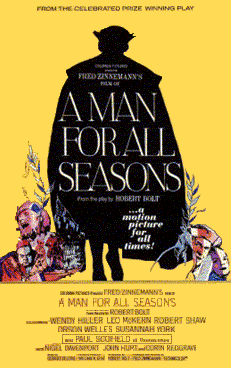
A Man For All Seasons (1966)


Paul Scofield ways up a difficult demand from a not-so merry monarch

Director: Fred Zinnemann

Cast: Paul Scofield (Sir Thomas More), Wendy Hiller (Alice More), Robert Shaw (Henry VIII), Orson Welles (Cardinal Wolsey), Leo McKern (Thomas Cromwell), Susannah York (Margaret More), Nigel Davenport (Duke of Norfolk), John Hurt (Richard Rich), Corin Redgrave (William Roper), Colin Blakely (Matthew)

Writing these film reviews is sometimes harder when it’s a film you know so well. I was probably in my very early teens when I first saw this and I’ve seen it dozens of times since. I know all the scenes, all the beats, and I love it. This is a brilliant film, and its depth, richness and intelligence are ingrained. It’s a wonderfully written, played and directed piece that transforms a historical event from a history lesson into an endlessly relevant and affecting parable.

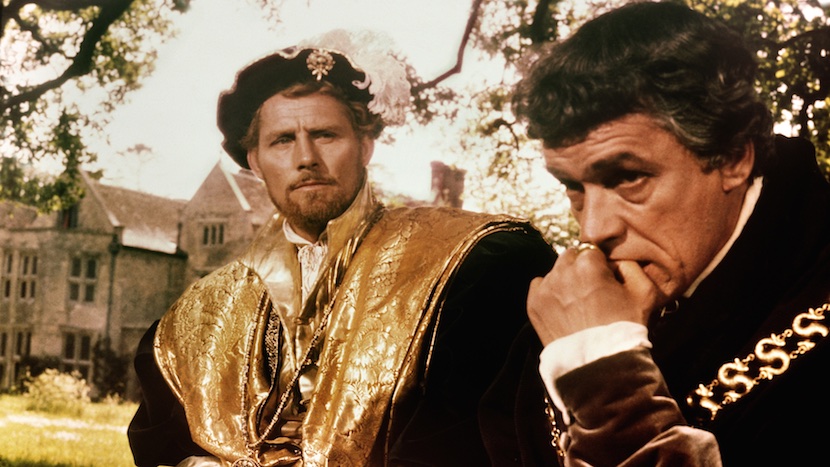
Paul Scofield (simply becoming the man) is Sir Thomas More. With Queen Catherine unable to bear Henry VIII (Robert Shaw) a son, wheels are in motion to ditch the Queen and marry the king to Anne Boleyn (a split second cameo from an unpaid Vanessa Redgrave, making you believe in a moment Anne could split a kingdom). More, however, can’t agree to the divorce – his faith in the Catholic church is non-negotiable, and the church won’t recognise the marriage. So while the rest of the kingdom falls in line, More is arrested and takes refuge in his complete silence – having never spoken of his reasons, he can never be tried for them.

Re-watching this masterful film for the first time in a few years on a newly released, fully restored Blu-ray, I was immediately reminded what a thoughtful, interesting and enjoyable film it is. Having read the play again, I genuinely think (and I’m not alone) Bolt’s script is superior to the original. Several changes have been made, most notably the removal of the “Common Man”, a theatrical device whereby one actor played all the smaller working class roles, while delivering a commentary on the action. It’s a very theatrical device, which Bolt believed wouldn’t work on screen, but its removal also purifies the story, tightens the focus and allows us to focus on More. The commentary on More’s conflicted character is instead provided by Paul Scofield’s superlative performance in close-up. Bolt also removed much of the political background, making the film more of a parable of conscience rather than a “history play”.

The film is a beautiful celebration of old-fashioned Hollywood film making. Fred Zinnemann is sometimes forgotten today, extremely unfairly for a man with a hugely impressive back catalogue. A Man for All Seasons was perfect for a director whose best work saw one man stand alone against a system – be that at Pearl Harbour or the Wild West. Zinnemann was an “actor’s director”, and draws out a series of impressive performances. But his often simple set-ups never feel staged.

He and John Box (production designer) understand the power of claustrophobia, of life and death conversations in small rooms – from Wolsey’s imposing red office that seems an extension of his personality, to Cromwell’s poky office and More’s cell, the sense of being trapped builds throughout the film. By contrast, the final courtroom’s spaciousness only underlines the fact that it’s a fix. Throughout the film looks wonderful and its spare score is a beautiful Tudor-style series of compositions that carry a perfect pitched of awe and doom. It’s so beautiful (and often overlooked) I’ve put a link to the opening here.

 In fact, Zinnermann constructs the film throughout with wonderful beats and telling shots. The first appearance of Henry VIII, his head obstructing the sun, More blinking looking up, is one of the best visual impressions you’ll see of the Icarus nature of the Tudor court. A beautiful cut takes us from More (in a windswept garden, a lovely commentary on the turbulence of his life) wondering if he can find a way to sign the oath, to a shot of the view from behind his prison bars – pages and pages of story told to us in one simple cut. Later, from the same position, we’ll see a whole year pass by in a few moments – simple, unfussy, very effective. The film is packed with small, subtle moments like this that never intrude by themselves, but build to create the effect of the film wonderfully.

And this is a great film, there’s no doubt about that. The story is surprisingly simple, but Bolt and Zinnermann make it feel truly universal: the man against the state, the individual standing for what he believes is right despite all the pressure bought to bear against him. It’s a timeless parable and could be applied to virtually any time or place you could name. It’s also extremely well written: nearly every other line is memorable, the speeches are extraordinary. Every moment of reflection and observation sounds (and is) universal in its application. Its straightforwardness also helps make the story very moving, and it successfully carries out the trick of telling a movie about a saint while making him a living, breathing man we can relate to.

Of course, a large part of its success is due to Paul Scofield’s performance in the lead role. Honed after years of performing the role, it’s again almost hard to talk about individually as Scofield is so central to the film; talking about its success is in many ways to talk about Scofield’s success. Scofield’s performance is one where the actor disappears and the character remains: his More is totally real. You feel throughout not only his dignity and wisdom and his sharply defined sense of private and public morality – but also his warmness, his wit, his benevolent regard for people and those around him. He’s a caring master and friend – but not a push-over; and is adamantine in his decisions. Scofield is also able to show the contradictions of the man: a private man who cannot give up the lure of the limelight. Every beat of the performance is brilliantly observed, a list of highlights would fill a book. He carries the entire film from start to finish and never lets it slip for a second.

He’s helped by some wonderful support (and it’s a testimony to his generosity as an actor that he cedes the screen several times). Robert Shaw’s Henry VIII is a scene stealing tour-de-force. It’s up there with Robert Duvall’s Kilgore as cameos that wrench control of the movie. He’s on-screen for about 12 minutes, but he perfectly captures Henry’s charisma and his childish temper and fury. He’s intelligent (but not that intelligent – I love his sulky response when he is quickly bested by Margaret More in knowledge of Latin) and friendly but not that friendly – the sort of man who literally rips flowers from a tree to show someone how beautiful they are: destruction and excitement combined in one moment. You totally believe that this is a man who could shatter a country in a fit of pique.

Wendy Hillier also deserves notice for what might be the trickiest role in the film as Lady Alice, a woman who lives happily in the shadow of her husband. Ill-educated and lacking any understanding of her husband, it’s a part that could be almost yokel like. But Hillier brings it a world of dignity and fiery defiance, and she brings a completely convincing fury to Alice as she rails against  injustice. The final scene between her and More is a masterclass from both of simple, uncomplicated love that has held two people with very little in common together for a lifetime.

There is literally not a bad performance in this film. Every actor is perfectly cast and completely understands their roles. Nigel Davenport masterfully portrays the pride and dimness that lies under Norfolk’s bluff domineering persona. John Hurt nails Rich’s weakness, selfishness and greed and layers it with a convincing note of underlying self-loathing: a star marking performance. Orson Welles seems to have prepared his whole life for the bloated, corrupt Wolsey. Leo McKern (the only other cast member from the original production) invests Cromwell with a low viciousness and a deadly political savvy that is based exclusively on realpolitik and devoid of decency. Susannah York, Corin Redgrave and Colin Blakely all also excel.

Historically, the character of More has faced far more criticism and scepticism recently. Several historians have bought attention to More’s rigid Inquisition-like Catholicism and his willingness to execute heretics; Hilary Mantel’s equally brilliant Wolf Hall was partly written as a response to Bolt’s presentations of More and Cromwell, lauding the latter at the expense of the former.

But these controversies are not what this film is about – and it’s never trying to be a history lesson. It presents its version of the story on its own terms (very little is ever leaned about the “King’s Great Matter” or the reasons for it) – instead, like The Crucible, it turns a historical event into a deeply moving and profound parable. In doing this it transcends being a simple recounting of events, and instead becomes an independent work of art. Historical accuracy is of no relevance to the audience when viewing Henry IV Part 1: it is of no matter here either, and is something the film never claims. And it’s all the better for it. Still one of my all-time favourites.