Tag: Westerns

High Noon (1952)

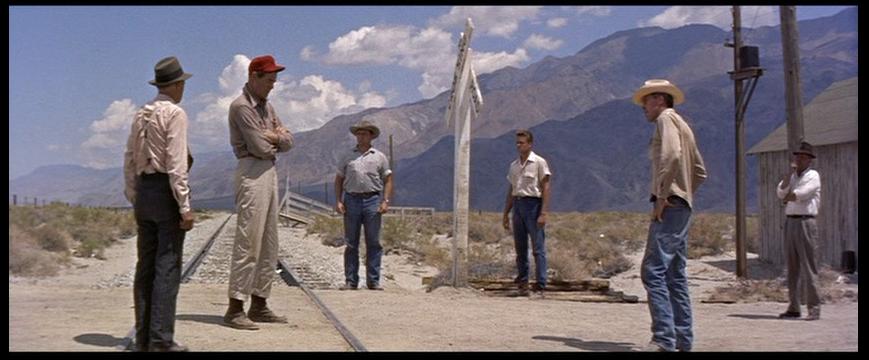
Gary Cooper stands alone in High Noon

Director: Fred Zinnemann

Cast: Gary Cooper (Marshal Will Kane), Grace Kelly (Amy Fowler Kane), Thomas Mitchell (Mayor Jonas Henderson), Lloyd Bridges (Deputy Marshal Harvey Pell), Katy Jurado (Helen Ramirez), Otto Kruger (Judge Percy Mettrick), Lon Chaney Jny (Marshal Martin Howe), Eve McVeagh (Mildred Fuller), Harry Morgan (Sam Fuller), Morgan Farley (Minister Mahin), Ian MacDonald (Frank Miller), Lee Van Cleef (Jack Colby)

It’s 10:35 am on the day of the wedding of retiring Marshal Will Kane (Gary Cooper) to Quaker Amy Fowler (Grace Kelly). It should be the happiest day of his life – but events are interrupted by news that Frank Miller (Ian MacDonald), a killer Kane put away, has been released and will arrive on the midday train with his gang to kill Kane. Kane’s first instinct – and the town’s – is for Kane to flee the town: but Kane doesn’t want to spend his life looking over his shoulder, and besides his friends and colleagues in the town will stand with him right? He decides to make his stand – to the outrage of his pacifist wife – only to find one-by-one the citizens of the town excuse themselves from helping Kane. After all, who wants to die?

Playing out like a Western 24, Kane has got a little under 90 minutes to put together a posse to give himself a fighting chance against these hardened killers. Zinnemann’s film is full of carefully placed shots of clocks that hammer home the ominous approach of Kane’s seemingly inevitable death. In a brilliant use of contrasts, Kane walks with growing desperation in virtually every shot through the increasingly abandoned town, mixed with clever cut-backs to the Miller gang waiting patiently at the train station (with deep focus shots of the train lines stretching on forever) for Miller to arrive and kick off the killing. Using a wonderful combination of low-angles, tracking shots and one superb crane shot that pulls out and away to show Kane stranded alone in the abandoned town, Zinnemann’s film stresses Kane’s isolation, anxiety and growing desperation.

Because Kane is scared. And why shouldn’t he be? He’s past-his-best and over-the-hill, a long-serving hero on his last day in the job, outmatched by his opponent. Why on earth wouldn’t he be desperate for help? John Wayne and Howard Hawks hated the film, loathed its perceived anti-American-spirit and, most of all, couldn’t stand the idea of a Western hero being scared and desperate for help. They even made a twist on the film, Rio Bravo, where Wayne played a marshal turning down any and all help in order to do what a man needs to do alone. For them that was a Western hero, and this self-doubting, anxious pussy Kane – the man even cries at one point! – was an abomination.

Cooper seemed to be no-one’s choice for the film – Heston, Brando, Fonda, Douglas, Clift and Lancaster all turned it down – but scooped the Oscar as Kane. Then 51, his obvious age and vulnerability – at one point Lloyd Bridges almost beats the crap out of him – make him feel even more at risk from this threat. In a performance devoid of vanity – other than perhaps Kane landing the radiant (and thirty years younger) Grace Kelly as his wife – Cooper is sweaty, nervous, twitchy and a mix of All-American duty and genuine nerves, resentment and terror at what feels almost certain to be his end. Kane knows why he must do it, but to Wayne’s disgust, he still doesn’t like it.

Carl Foreman, the screenwriter, was to be pulled before the House of Un-American Activities for his communist sympathies. And the entire film is pretty clearly a commentary on the McCarthyite era, specifically the abandonment of those pulled before the house by those who seemed to be their friends. Like the blacklisted Hollywood writers and actors, Kane opens the film with admirers and friends all of whom eulogise his greatness and decency: and all of them turn their back on him as the chips go crumbling down.

Most of the film is given over to Kane desperately going from ally to ally, only to find that he is offered only platitudes, excuses and outright cowardice. His deputy demands a recommendation for Kane’s job, and chucks in his star when Kane refuses. Old friends hide in their houses and refuse to come out when Kane comes calling. Lon Chaney Jnr’s retired marshal pleads illness. The judge rides straight out of town and suggests Kane does the same. At a town meeting in the church, the voices calling to help Kane are few and far between, and Mayor Thomas Mitchell praises Kane to the skies, before concluding the town would be better off if he could ride away and not come back. The one man who volunteers backs down when he finds out no one else has volunteered, and the only person eager to fight is a 14 year old boy. 

So much for loyalty and the American way. When the chips are down, words mean nothing and it’s the actions that show the man. Customers in the saloon talk about how life wasn’t that bad when the Millers ruled the town (to show how wrong this is, literally their first action when riding into town is to steal something from a milliners). Others moan that all this law enforcement from Kane has actually made business a bit worse for the town. Why do the hard thing, why make the stand, when it’s so much easier to just look down, keep quiet and let the just suffer while your life ticks on.

Cooper’s Kane is masterfully low-key, subtle, using only the slightest gestures to show deep-rooted, only barely hidden resentment and bitterness, covering fear. What he’s doing he’d give anything not to do, but he sees no choice. There is no other Western where the hero writes a will, and quietly weeps with his head on his hands on his desk. There is no other Western where the hero spends so long trying to make a manly task easier to do. There is no other Western where the self-serving cowardice and hypocrisy of the townsfolk are more blatant. No wonder Cooper – in the final insult for Wayne – drops his tin star in the dirt at the film’s end, as the townsfolk rush out to congratulate him on winning the duel. This is a film that looks at America as it really is – and many people didn’t like that one little bit.

Zinnemann’s direction is spot on, a perfect blend of tension build and technical mastery, mixed with superb dialogue from Carl Foreman. Not a word or shot is wasted, and every single character and event is carefully sketched in, established and build up with no effort at all. Cooper is superb, Grace Kelly just as good in a thankless role as the humourless Quaker wife who struggles with her life-long principles against her love for her husband. Beautifully filmed, with a wonderful score with Dimitri Tiomkin, High Noon is a classic for a reason, a masterpiece of slow-build and enlightened social commentary.

McCabe and Mrs Miller (1971)

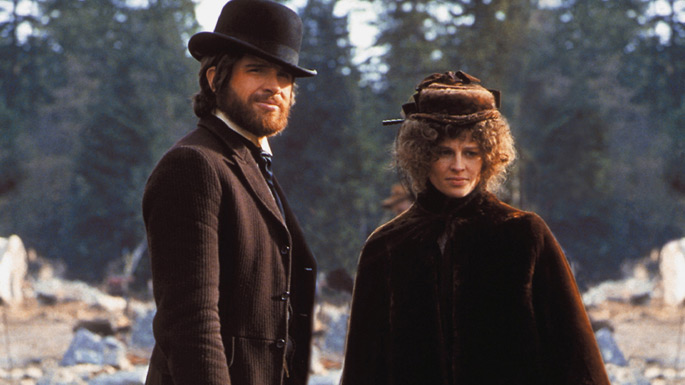
Warren Beatty and Julie Christie fail to conquer the Wild West in Altman’s revisionist Western McCabe and Mrs Miller

Director: Robert Altman

Cast: Warren Beatty (John McCabe), Julie Christie (Constance Miller), RenéAuberjonois (Sheehan), Michael Murphy (Eugen Sears), Antony Holland (Ernest Hollander), Bert Ramsen (Bart Coyle), Shelley Duvall (Ida Coyle), Keith Carradine (Cowboy), Hugh Millais (Butler), Corey Fischer (Reverend Elliot), William Devane (Clement Samuels), John Schuck (Smalley)

The Western is such a familiar genre of Hollywood film-making that you can be pretty familiar with nearly all the concepts that  it contains – from the stranger in town through to the final shoot-out. All these familiar tropes were just challenges though for a film-maker like Robert Altman: how do we make a Western that features all these, but then completely twists and subverts it all into something that also feels like a product of the 1970s rather than the 1870s? Well Altman runs with all this in McCabe and Mrs Miller, his successful anti-Western.

In Washington State in 1902, John McCabe (Warren Beatty), a conman and card sharp, rides into Presbyterian Church, a town so small it’s named after its only prominent building. McCabe’s skills at cards quickly make him rich, and as the town’s mining fortunes grow so do his. He sets up a gaming and cat house in the town. Constance Miller (Julie Christie) is a cockney opium addict with experience of running whorehouses and she quickly partners with McCabe, promising that she can raise his profits tenfold. All goes swimmingly – until big business heads into town and makes an offer to buy out McCabe’s holdings (and the whole town) for redevelopment. When McCabe says no he quickly finds himself in over his head.

Altman’s film combines all the techniques that he had been experimenting with throughout his career into a perfect storm of Altmanesque technique. He and Vilmos Zsigmond, his skilled cinematographer, deliberately “flashed” the film to slightly over-expose it, giving the picture a slight sepia hue like a series of old photos. The camera leisurely roves around like curious spectator to the film, letting itself catch moments of interest here and there – sometimes refusing to focus on events that feel, by rights, that they should be centre of the film. It gives the film a real lived in feeling, while also making it look slightly like a historical record of true events. Either way, as the cold hits Washington State, it looks beautiful – candle-lit interiors mixed with coldly blue exteriors of snow and ice-covered surroundings.

But those visuals are as nothing compared to Altman’s experiment with sound. Sticking rigidly to the script was hardly ever Altman’s way and it’s certainly not here. In rehearsals, the actors felt free to experiment with and rework a script that had already been through the hands of several writers. Altman kept this loose, free-flowing, improvisational tone in the final film. As the camera roves round, so does the microphone, picking up snatches of conversation here and there – sometimes giving us a mixture of conversations from which we need to pick out what to listen to. In addition to that, most of the actors deliberately mumble their lines – or happily deliver them from mouths clutching cigars or chewing food. Anarchic is almost the right word for it – Altman doesn’t want to tell you what to listen to, and is more interested in getting across the atmosphere of the scene rather than the facts and figures. It takes some time to get used to – and at points is highly frustrating – but it creates its own mood. 
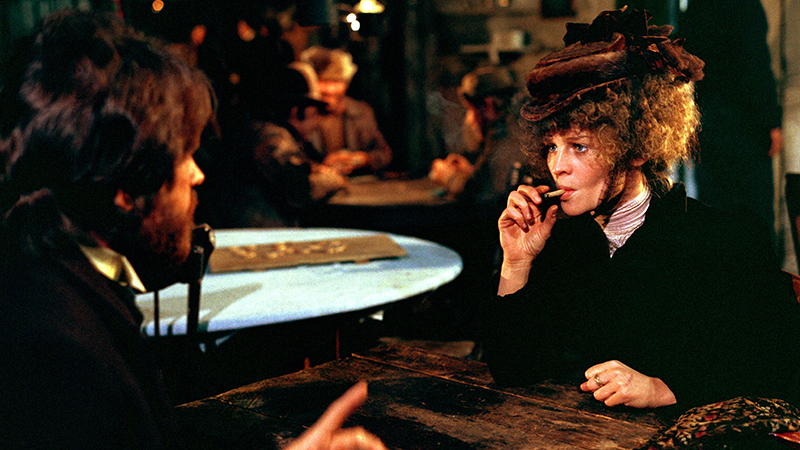
And this mood is very different from what you might expect from a Western. There is a distinct lack of glamour here. This world of Presbyterian Church is dirty, grimy and lacking in any moral fibre or real sense of right and wrong. The church itself is respected but largely ignored by the citizens, who are far more interested in drinking, screwing and gambling. When violence occurs it is ignored as much as possible or – as in the final shoot-out that ends the film – it happens around people so wrapped up in their own concerns (from domestics, to a large fire) that they barely notice it happening. Needless to say, for those in the fire fight, there are no rules to be played by at all. People are shot in the back, shoot down innocent bystanders, and play by no rules whatsoever, stalking and shooting opportunistically.

McCabe is a perfect hero for this very different kind of Western. As played by Beatty, he is a cocksure coward nowhere near as clever, confident or controlled as he thinks he is. Arriving in the town, he seems like the height of glamour in his bearskin coat, and he swiftly masters the simple townsfolk with his tall tales and charisma. However, the more people who intrude on this world, the more quickly it emerges that McCabe has very little clue about what is going on, is easily cowed and has only the barest understanding of how the world works. Meeting with a lawyer, one scene later he is parroting a (completely misunderstood) version of the law that he has heard from there. Meeting with the “muscle” from the corporation, he deflates like a balloon, desperately making offers hand over foot. Beatty is very good as this puffed up coward, confused and constantly living a front but out of his depth in the world.

Julie Christie’s Mrs Miller is far more worldly than him, immediately able to recognise the dangers and understanding exactly the sort of men McCabe is dealing with. Mrs Miller’s opium habit is a quietly understated obsession, one the other characters seem unaware of, but which the viewer alone seems to know about. It raises questions of course – is this meant to imply perhaps some of what we see is a drug induced fantasy? But it doesn’t impact otherwise the relationship she develops with McCabe, part meeting of partners, part a protective relationship with Miller guiding McCabe.
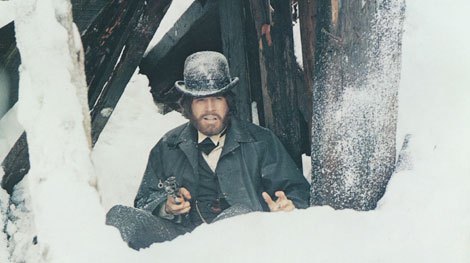
The rest of the cast is stuffed with a series of Altman regulars, all of whom deliver fine performances. The stand-out is Hugh Millais, an English writer making his acting debut, who is simply sublime as the articulate and ruthless chief heavy sent by the company to intimidate McCabe.

For the film itself, your enjoyment of it is largely going to be affected by how easily you plug into its style of storytelling. There is very little story for much of the first half of the film, instead events continue in a loose and undisciplined style, but the second half delivers a more focused story of ambition pushed too far, and culminates in an impressively filmed ruthless shoot out. It is perhaps more of a film that is about the atmosphere and the style than the story, but as a redeveloped Western that carries across the style of the grimy 1970s it works extremely well. At first I thought I would never get into it, but by the end I found myself wrapped up in the story it was telling. Visually and performance-wise it’s superb. Altman is an acquired taste, but acquire it and you will be richly rewarded. 

Coda: Much like The Long Goodbye I watched this film about a week ago at time of posting and I find myself thinking over several sequences in it again and again with ever more admiration. When watching it I felt it had been over promoted by critics. Now I increasingly think it might be something very special indeed.

Bad Day at Black Rock (1956)

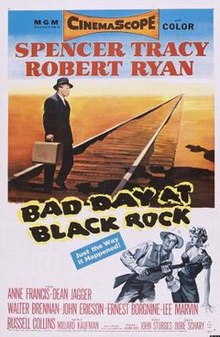
Spencer Tracy is the only just man in town, in brilliant modern Western Bad Day at Black Rock

Director: John Sturges

Cast: Spencer Tracy (John J Macreedy), Robert Ryan (Reno Smith), Anne Francis (Liz Wirth), Dean Jagger (Sheriff Tim Horn), Walter Brennan (Doc Viele), John Ericson (Pete Wirth), Ernest Borgnine (Coley Trimble), Lee Marvin (Hector David), Russell Collins (Mr Hastings), Walter Sande (Sam)

A man walks into a town. It’s a dust bowl town, looks like it’s just one street with a few buildings. The natives sit warily outside the bar and treat the stranger with suspicion. Trigger fingers are itchy. Is it the Wild West? No it’s 1945, but the new guy in town is about to find out just how unfriendly the American West can be. Just as well that, despite only having one hand, he’s more than capable of looking after himself.

Spencer Tracy, perfect as a man of rigid principles and certainties who won’t waver in the face of any intimidation, is our no-nonsense hero Macreedy. Arriving in town, he’s looking for Japanese-American farmer Komoko, father of a deceased colleague from the war, but no one wants to talk about where he is or what happened to him. Sheriff Horn (Dean Jagger) is an alcoholic who doesn’t want to know anything, the local doctor (Walter Brennan) doesn’t want to get involved and hotel clerk Pete (John Ericson) doesn’t want to give Macreedy a home. Macreedy is tailed on arrival by a couple of intimidating heavies (Ernest Borgnine and Lee Marvin – the go-to guys at the time for these sort of roles), and quickly works out the town is run by local businessman Reno Smith (Robert Ryan) – and any secrets it holds ain’t coming out easy.

Bad Day at Black Rock is a classic western, set in a time when the world of the West had been left far behind. American culture has a romantic longing for rural, small-town America, and the heroic past of the pioneers of the old West. Bad Day inverts a lot of this mythology: this America is horribly corrupt, unspeakably racist and hiding no end of dirty linen in its cupboards. In fact, small-town America is horrible, while the man from the big city represents all that is good – that in itself is quite a surprise turnaround from what you might expect from Hollywood.

In many ways it’s a very simple, very gripping, film. Macreedy’s arrival in the town sparks guilty consciences and sets the town bully, Reno Smith, into a quiet, panicked breakdown. We know watching it roughly where the film is likely to go. However, what Sturges does well is to invest this with so much attention. Huge chunks of the film involve both Macreedy and the men of the town, tensely trying to work out what is going on, or watching and waiting to see what opportunities there will be. It’s a film packed with moments of waiting or characters sitting and watching, talking around subjects rather than tackling the big questions they want to ask. It sounds slow but it actually builds up an extraordinary amount of danger and feeling of danger.

It’s a drama that works on the slow burn while also being a very short, snappily paced film. The best part of the first half-hour of the film is the careful establishing of the atmosphere, the relationships between the different characters, and the politics of this Western town. In the middle of this we have Macreedy, the man of mystery whom we know nothing about, who never seems to rise to the unfriendly intimidation he meets from every corner. You know that all this tension is going to erupt into something serious – but the film constantly leaves you guessing exactly how it will pan out and keeps you surprised about who ends up on which side.

You couldn’t get a better actor for this role than Spencer Tracy. There is something so rigidly determined about Tracy in this film, so adamantine and determined – the sort of man who operates in rights and wrongs, who even in this world of intimidation and terror tries to play by some sort of rules for as long as he possibly can. What’s so great about Tracy in this film is that he seems like both a stranger in black and a disappointed dad, with the people in the town constantly letting him down. The film also teases us for a long time – we suspect throughout that Macreedy is more dangerous and more capable of looking after himself than he appears. (It was Tracy who insisted, by the way, that Macreedy be made one-armed, as he thought it could give Macreedy an interesting vulnerability to overcome). 

The film makes us wait for its three action set-pieces: a car chase, a bar fight and a shoot-out. But it’s perfect in its patience, because violence always seems like it could burst out at any time. Marvin and Borgnine as the obvious heavies do great work as different types of overt muscle. Robert Ryan as the corrupt guy who really runs the town is especially good as a man who seems, under his dominance, to only just be holding onto his self-control, going to great lengths to prevent himself getting into trouble. It’s a point that Macreedy himself makes – deep down, Smith doesn’t have the guts to do his dirty work alone, and gets his strength from controlling others. All this delicate mixture of guilt and fear that bubbles under the surface of Smith is apparent in Ryan’s excellent performance.

But then no-one in the town is in control. Dean Jagger’s moral weakling sheriff is a drunk and a pathetic loser. Walter Brennan’s (very good) doctor wants to do the right thing, but lacks the guts to do it. John Ericsen’s hotel clerk knows he’s in the wrong, but isn’t brave enough to stand his ground. Their lack of control is in fact the root of the problem – Macreedy would never have suspected there were any dark secrets to uncover in the town if the people there hadn’t treated him with such overt suspicion. Sturges captures this perfectly (even if I think the Cinemascope width of shot isn’t perfect for a film that gets so much play out of claustrophobia and suspicion).

Politically the film is pretty simple – racism ain’t good you know – but as an example of brilliantly assembled Western tension and moral righteousness, mixed with a bit of action, adventure and claustrophobia, it works really well. Brilliantly directed, and very well written as a piece of expressive theatre, this is terrific with some wonderful performances. And front and centre is Spencer Tracy as the ultimate man in black, a man with moral certainty and courage, whom it’s impossible not to admire.

The Ox Bow Incident (1943)

Henry Fonda tries to change the fate of a lynching, in gripping social-issue drama The Ox Bow Incident

Director: William A Wellman

Cast: Henry Fonda (Gil Carter), Dana Andrews (Donald Martin), Harry Morgan (Art Croft), Frank Conroy (Major Tetley), Harry Davenport (Davies), Anthony Quinn (Juan Martinez), Francis Ford (Alva Hardwicke), William Eythe (Gerald Tetley), Mary Beth Hughes (Rose Swanson), Jane Darwell (Ma Grier), Marc Lawrence (Jeff Farnley), Paul Hurst (Monty Smith)

Spoilers: Can’t quite believe I am saying this about a film that is over 60 years old – but I’m going to give away the whole plot here. Because you can’t really talk about the film without it. It’s a film that’s well worth watching not knowing what is going to happen, so you are warned!

We all like to believe that, when push comes to shove, we live in a civilised world. That when the chips are down, we would behave nobly and stand for what was right. The Ox Bow Incident is a challenging western, because it defiantly says the opposite. The world is a cruel and judgemental place – and sometimes good people are ineffective, regular people panic and lash out and decent people pay the price.

Gil Carter (Henry Fonda) and Art Croft (Harry Morgan) ride into town. Cattle rustlers are plaguing the town and a popular rancher has been gunned down outside his home. With the sheriff absent and the judge ineffective, the townspeople take justice into their own hands. Led by a faux-Civil War major Tetley (Frank Conroy) and aggrieved friend of the dead rancher Jeff Farnley (Marc Lawrence), they form a posse and ride out to lynch the three suspects (Dana Andrews, Anthony Quinn and Francis Ford). Carter and Croft follow, reluctant, but worried that if they protest too much suspicion will fall on them.

The Ox Bow Incident is a film you keep expecting to make a veering turn towards positivity – you keep expecting it to suddenly draw breath and for everything to turn out okay. Instead, it’s a grim insight into how mob mentality can drive people into sudden and cruel actions. It’s equally a testimony to how ineffective protest and principles can be in the face of anger and revenge. It’s a Western that feels years ahead of its time – there is no romanticism here, just grim everyday life.

In many ways it’s a po-faced and serious morality tale, and revolves around one long scene where the lynch victims are tried by mob justice, plead for their lives, are given a brief respite to say their prayers, protests from a few men are swept aside, and then they are strung up. Every time the viewer starts to think righteousness will slow things down, the certainty of the mob stops decency from taking hold. It’s a slippery slope towards the deaths of men we find out almost immediately afterwards were completely innocent.

The Ox Bow Incident is a film that preaches – and it feels very stagy, a feeling increased by the obviousness of its sets and the intense chamber feeling of the limited locations and scenes. But it works, because it’s so brilliantly put together and so grippingly involving. Wellman’s film is trimmed to the bone, the writing is very strong with Lamar Trotti’s script bristling with moral outrage at humanity’s weakness and fear. It’s a story of injustice and mob rage – and it works because it manages to tell a compelling story while also dealing with universal themes.

Henry Fonda listed this as one of his few early performances he felt was good. Fonda is often remembered as the archetype of American justice, so it’s fascinating here to see how ineffective and compromised Carter is. Carter knows what they are doing is wrong – but he lacks the decisiveness, strength of will or character to persuade people. In fact, his main contributions are quiet comments, or sniping from the wings of the action. 

It’s an inversion almost of Twelve Angry Men’s juror #7 – Carter can’t lead us to justice, because he’s a bit too afraid, a bit too weak, a bit too compromised. At the end, as he reads Martin’s final heartfelt and forgiving letter (beautifully filmed by Wellman with Croft’s hat obscuring Carter’s eyes while he reads, a shot that has multiple symbolic meanings), he projects not moral force but the shame and guilt of a man who, when it came down to it, didn’t have the determination to do what was right. It’s a perfect comment on what a writer may have felt was happening all over in 1943.

The real advocate of justice is Harry Davenport’s humane shop-keeper – but he can’t persuade anyone (Davenport is excellent). Instead, all the big personalities are leading the lynch mob, from Frank Conroy’s bullying Major, who just wants to see the action and stamp his domination on others, to Jan Darwell’s vile honking old woman excited by the killing, to Marc Lawrence’s just plain angry Farnley. Everyone who knows what they are doing is wrong – like Tetley’s weak-willed son (well played by William Eythe) – are just too weak, scared or uncharismatic to do much more than vainly protest. Their regular joe victims (all three actors are excellent as in turn, decent, old and confused and suspiciously alien) don’t stand a chance.

The Ox Bow Incident is a perfect little morality tale, crammed with brilliant performances and moments. It even has the guts (for the time) to reference that most lynchings didn’t have white victims, and introduces a sympathetic black honorary padre who is equally powerless. It’s a film that really feels like it came from an era when the world was going to hell in a handbasket, but it speaks to all ages. Because our fear and readiness to attack – and punish – those people we see as different hasn’t gone away. It’s chilling to think that the world hasn’t changed and this story could just as easily be transposed – with no changes – to half a dozen locations around our world today.

Charley Varrick (1973)

Walter Matthau schemes a caper in crime thriller Charley Varrick

Director: Don Siegel

Cast: Walter Matthau (Charley Varrick), Joe Don Baker (Molly), Andy Robinson (Harman Sullivan), John Vernon (Maynard Boyle), Sheree North (Jewell Everettt), Felicia Farr (Sybil Fort), Norman Fell (Garfinkle), Woodrow Parfrey (Harold Young), William Schallert (Sheriff Horton), Jacqueline Scott (Nadine), Tom Tully (Tom), Benson Fong (Honest John)

Don Siegel was perhaps the ultimate professional director, who took on any scripts that came his way, producing polished, professional films. In the later part of his career, he finally received some of the freedom to start shooting his quality B-movies on A-movie style budgets. Charley Varrick was the first film he made after his box-office smash Dirty Harry, and Siegel received more time and space to deliver a film that mixed action and drama with an elaborate, almost meditative, mystery.

Charley Varrick (Walter Matthau) is a former stunt pilot, whose small crop-dusting business is a front for carrying out small-scale robberies. A bank robbery in Tres Cruces, New Mexico goes horribly wrong – Varrick’s wife Nadine (Jacqueline Scott) is killed and he and his partner Harman Sullivan (Andy Robinson) find the small job they had anticipated is actually holding a huge amount of mafia money. Varrick knows the mafia won’t rest until they get the money back – and he is right, as bank president Maynard Boyle (John Vernon) has no choice but to call in ruthless hitman Molly (Joe Don Baker) to get the money back and kill those who stole it.

Charley Varrickwas also known by Don Siegel as The Last of the Independents – and that kinda fits its tone. Varrick is a small-scale operator who has chosen crime because he’s been squeezed out of the crop-dusting business by the corporations. He’s operating a crime gang that follows a series of carefully planned robberies, aimed at stealing humble amounts: enough to be a nuisance rather than cause a genuine scandal. He’s a small-time operator, proud of who is, who doesn’t want to hit the big time but to excel as the big fish in the small pond.

The whole film reflects this personality: the film is deliberately set in a quiet American town in the mid-West – the opening credits are played over everyday scenes of small-town life. Every location is slightly run-down and unimpressive. Those wrapped up in the crime are regular Joes – on both sides of the law – and the values and principles are those of mid-west America. Even Molly the hitman – while clearly ruthless and capable of extreme violence and full of disdain of those he meets – has a drawling, cowboy quality to him. 

Part of Siegel’s point is that into all this explodes a story of crime, murder and violence that all spins out of money (doesn’t it always?). The mystery element is the audience wondering how Varrick is going to get out of this with both cash and life intact. What Siegel does really well is effectively make Varrick an unreliable narrator. Despite the fact we follow him around in the film, we are never really told what he is thinking or why he does things. Only at the end of the film are all the threads of the actions he has carried out pulled together – a real lightbulb “ah ha!” moment – and the real purpose of what he has been doing is revealed.

To make a character who plays their cards so close to their chest work, you need an actor who is effortlessly charming. The film gets this in Walter Matthau. Matthau, with his hang-dog Droopy-face is hardly anyone’s first idea of a ruthless bank robber (surely part of the film’s point!) but his winning charm and kindly-Uncle quality, as well as the eye of assured cool that Matthau gives him, really make you root for him. In fact it works so well that you actually forget how ruthless Varrick in this film: from moving on swiftly from his wife’s death, to ruthlessly sacrificing several people in his quest for self-preservation. In other hands, Varrick wouldn’t half come across as a copper-bottomed shit. 

Instead, his plan of misdirection, clues pointing towards the wrong thing, and carefully juggled parallel attempts to escape (his unrevealed real plan, and the clumsy surface plan that the audience knows must be a bluff) really works to keep you engaged and entertained. Siegel is purposefully pulling the wool over your eyes in virtually every scene – and he has Varrick basically tell us he’s doing this – but there are few things that audiences like more than a magic trick. We want Varrick to pull a rabbit out of the hat at the end – to surprise us all with how clever he’s been (and to reward those who have worked out part of what he is doing).

Siegel mixes this with a surprising number of quiet, even soulful moments that mix the thoughtful with some black comedy. From Varrick’s tender kissing of his dead wife – right before he professionally carries on with their plan to burn the get-away car they escaped in (this time with his wife’s body inside it) – to a secret meeting/interrogation/intimidation of timid bank manager Harold Young (a twitchy Woodrow Parfey) by smooth big-city bank manager Boyle (a superbly cold John Vernon, nowhere near as assured and secure as he thinks he is) in a cow-filled field, these scenes are about character as much as they are about plot.

Siegel mixes this with moments of pure action and drama. The opening bank robbery is surprisingly violent, considering the gentle introduction to the film – and our “heroes” are amazingly ruthless towards those that stand in their way. Joe Don Baker’s chillingly amoral Molly hands out beatings as easily as he does slightly goofy Western smirks (a beat down of Harman is particularly brutal). Varrick is quietly ruthless and the film ends with a dynamic chase scene in a scrapyard, quite unlike anything you have ever seen.

Charley Varrick epitomises the sort of 1970s film that studios and Hollywood looked down on at the time, but inspired the filmmakers today far more than some of the Oscar winning gumph that got praised. Parts of it are dated – women in the film are either love interests or whores, and both Molly and Charley (Walter Matthau is no one’s idea of a lothario) bed compliant, impressed women in the film with an off-hand carelessness. But the core and heart of the film is in its cool, calculated confidence mixed with a sense of Western soul. With a terrific performance by Matthau, this is a fine example of independent film-making.

Dances with Wolves (1990)

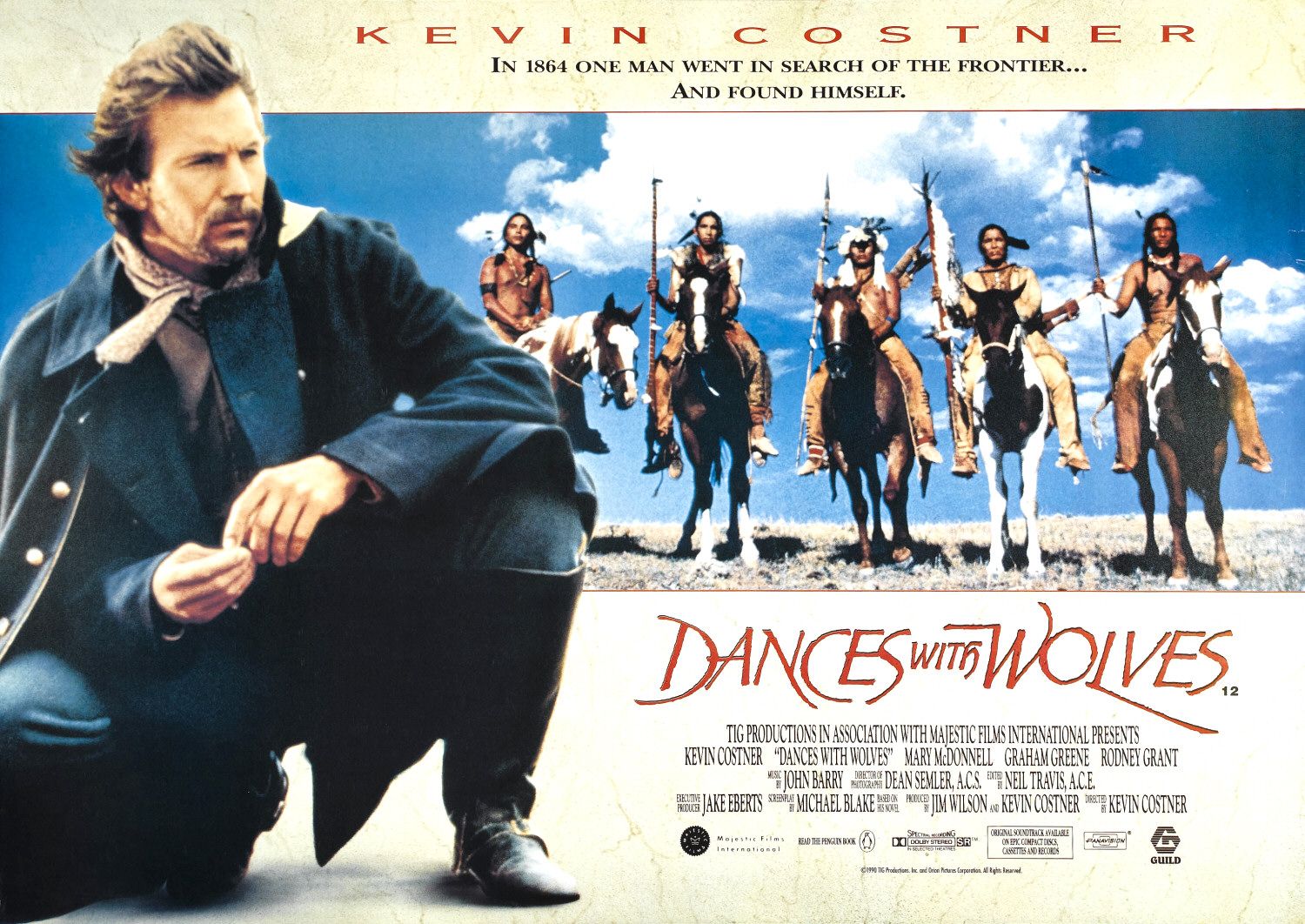
Kevin Costner finds his inner peace in Dances with Wolves

Director: Kevin Costner

Cast: Kevin Costner (John Dunbar/Dances With Wolves), Mary McDonnell (Stands With A Fist), Graham Greene (Kicking Bird), Rodney A. Grant (Wind In His Hair), Floyd Red Crow Westerman (Chief Ten Bears), Tantoo Cardinal (Black Shawl), Jimmy Herman (Stone Calf), Nathan Lee Chasing His Horse (Smiles A Lot), Michael Spears (Otter), Charles Rocket (Lt Elgin), Robert Pastorelli (Timmins), Tom Everett (Sgt Pepper), Wes Studi (Toughest Pawnee), Maury Chaykin (Major Fambrough)

At the end of the 1980s, Kevin Costner was the biggest film star in the world, with a string of hits behind him. So he did what Hollywood stars before and since have done: cashed in all his chips and made the film he had to make. It would be long, it would be mostly in a foreign language, it would have no stars (other than himself) and – most poisonous of all at the time – it would be a Western. When the funding started to dry up, Costner even paid for the overtime out of his own pocket. Not for no reason was the project dubbed “Kevin’s Gate” by the sceptical media, eagerly expecting Hollywood’s golden boy to land on his face.

How wrong they were. Dances with Wolves not only made almost 20 times its budget at the box office, it changed many Americans’ perceptions of Native Americans – oh yes and it also won seven Oscars, including Best Director for Costner and Best Picture. Costner plays Lt. John Dunbar, a civil war veteran who (after an act of suicidal death-seeking foolishness to avoid having his leg amputated) chooses a posting to an abandoned fort in the middle of Sioux country. Forgotten by the army, Dunbar forages alone and comes to the attention of the Sioux. At first cautious around each other, Dunbar eventually befriends healing man Kicking Bird (Graham Greene) and finds himself cautiously welcomed into the Sioux tribe as a guest, finding love with Stands With A Fist (Mary McDonnell), a white woman raised by the Sioux. He begins to find the Sioux as kindred spirits.

Costner’s film is an expansive, heartfelt poem, a film in love with sweeping vistas and with an endearing, humanitarian view of the world, beautifully shot by Dean Semler and helped immensely by a wonderful, swelling lyrical score by John Barry – one of the best scores you are likely to hear. Costner dispels any doubts about his abilities to direct by throwing himself into a truly epic canvas – and some of the ideas here are reminiscent of Lean, in their beautiful use of the American plains. Within this large canvas, Costner tells an actually fairly simple, but also sweetly touching, story of the disillusioned man who finds himself in the wilderness.

If there is a flaw with Dances with Wolves it is that its story is so traditional and (in many ways) predictable. It’s understandable that the story introduces a white man to be our surrogate when encountering the Sioux. But it’s hard to shake the feeling of all that all-too familiar trope, the White Saviour. The primary good the Sioux serve in the film is to help Dunbar discover himself, to come to peace with himself. In turn, it’s Dunbar who increasingly becomes the tribe’s protector – helping them to find the buffalo, giving them guns and leading the defence against a Pawnee tribe attack, increasingly recognised as a “celebrity” in the tribe.

On top of that, Dunbar’s love interest becomes the only other prominent white character in the film. Again I understand that the film needed someone who was able to serve as a cultural and language bridge between Dunbar and the Sioux. But could there not have been some sort of narrative invention to make this female character a Sioux who had learned some English? It seems as if the film can only go so far – and showing a multi-racial relationship was probably that. Saying that, McDonnell is very good as the gentle Stands With A Fist, but it feels like a cop-out.

Costner’s own central performance gives everything the film requires. It’s a fairly simple role: the disillusioned soldier finding inner peace. The film plays very much into the attraction of the “noble savage” – the simplicity and honesty of the Sioux lifestyle being so much purer than the corruption of the “modern” world (needless to say, nearly all the white men in the film are truly awful people). But Costner brings his considerable charm to bear, delivering many of his lines with that slightly cocksure, shy grin he uses so well. The film suffers from its narration being delivered by Costner’s flat and unmodulated voice, but he’s perfectly fine in the role.

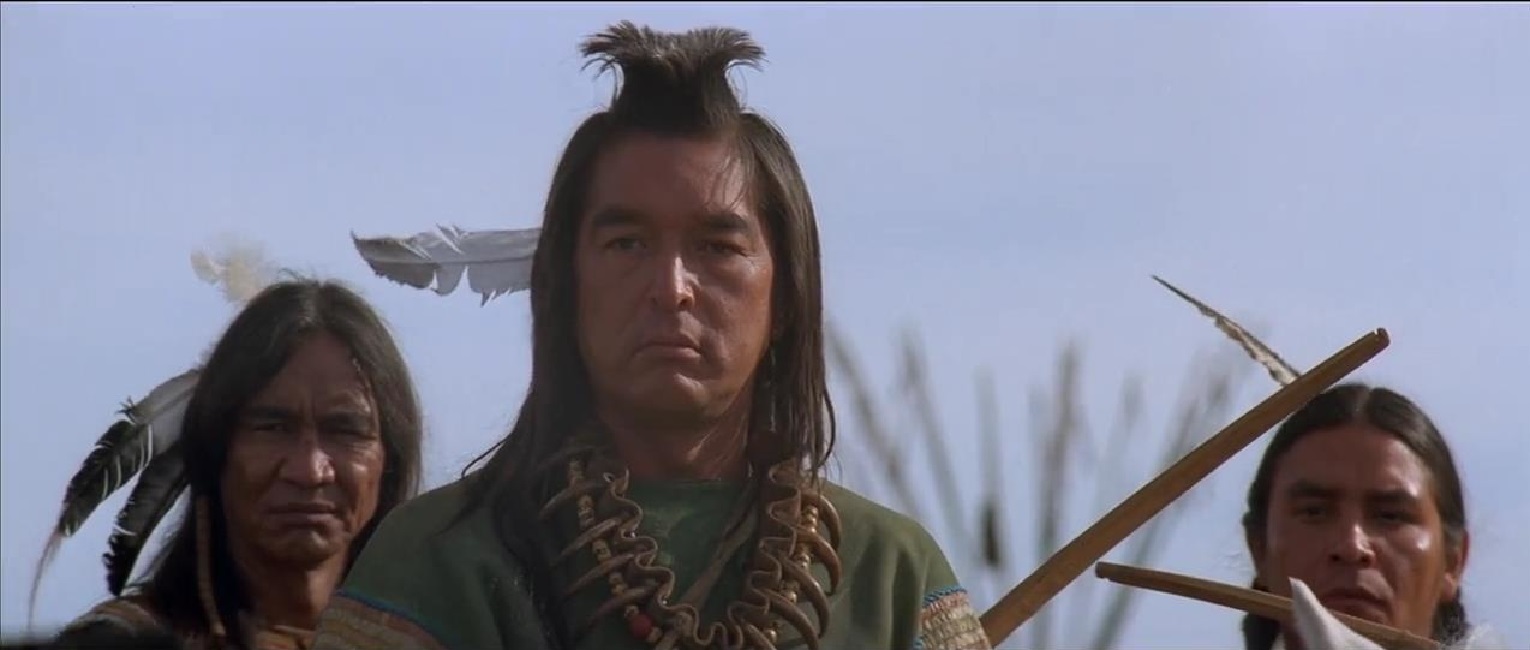
He plays it with an entirely straight honesty – and, for all its faults, this honesty makes the film work. The film goes overboard to humanise and provide empathy for the Sioux, as if wanting to correct generations of films that have cast Native Americans as dangerous savages. The Sioux are humane, generous, welcoming and dignified. Graham Greene has to carry much of this as medicine man Kicking Bird, and he gives a stirring, sympathetic performance, with equally fine performances from Rodney A. Grant and Tantoo Cardinal in particular.

The film delivers all its tropes and traditional structure with a straightforward, heart-warming simplicity – it really means that you go with the picture, and find yourself as drawn to the Sioux lifestyle as Dunbar is. Also, for all the criticism of the film’s narrative, it shouldn’t be forgotten what a warm reception it had from Native American groups, delighted to see their ancestors presented in such an empathetic light (the Sioux Nation later adopted Costner). And the film sensitively and brilliantly stages this way of life, with a series of beautifully done vignettes ranging from marriage to simple cooking and spending time around the fire.

The most stunningly filmed of these is the buffalo hunt, a soaring marvel of camera work, editing and horseback adventure. The film doesn’t let you forget the sequence before either, where the Sioux come across a series of buffalo killed for their hides by white hunters – in comparison to the complete use of the carcass (and limited numbers killed) by the Sioux. The buffalo hunt sequence is an exciting triumph – it’s probably responsible for several of the technical Oscars the film received – and it’s a tribute to Costner’s mastery of the visuals of the American West (even if, rumour has it, chunks of it were actually filmed by Kevin Reynolds).

Dances with Wolves is a very heartfelt and honest film – and its sincerity means it kind of gets away with its obvious flaws (and its great length). Costner wanted to make an important film and he does to a certain extent – but one which wears its importance fairly lightly, and makes a series of enriching humanitarian arguments that carry real weight. It’s in many ways an extremely accomplished retelling of a familiar story. But I found myself genuinely moved by the story it wanted to tell, and the questions it asks of its audiences. Is it a great film? Probably not, but it is a good one.

Three Billboards Outside Ebbing, Missouri (2017)


Frances McDormand is looking for justice in Martin McDonagh’s razor sharp Three Billboards Outside Ebbing, Missouri

Director: Martin McDonagh

Cast: Frances McDormand (Mildred Hayes), Woody Harrelson (Sheriff Bill Willoughby), Sam Rockwell (Officer Jason Dixon), John Hawkes (Charlie Hayes), Peter Dinklage (James), Abbie Cornish (Anne Willoughby), Lucas Hedges (Robbie Hayes), Željko Ivanek (Sergeant Cedric Connolly), Caleb Landy Jones (Red Welby), Clarke Peters (Abercrombie), Samara Weaving (Penelope), Kerry Condon (Pamela), Darrell Britt-Gibson (Jerome), Amanda Warren (Denise), Kathryn Newton (Angela Hayes)

How do we deal with grief? What might it drive us to do? How does it make us behave – and what sort of person can it make us become? Martin McDonagh’s superbly scripted and directed, brilliantly acted film explores these themes in intriguing and compelling depth, consistently surprising the audience, not only with unexpected plot developments, but also wonderfully complex characters, whose personalities and decisions feel as distanced from convention as you can get.

Mildred Hayes (Frances McDormand) is a grieving mother, who feels let-down by the police and justice system as they have failed to locate and arrest the rapist who murdered her daughter. She hires three large billboards on a quiet road out of her town in Ebbing, and places on each of them a stark message: “Raped while dying”, “And still no arrests?” and “How come, Chief Willoughby?”. The billboards lead to Sherriff Bill Willoughby (Woody Harrelson) doing what he can to re-open the case – a case with no real evidence or leads. But the local community – many of whom adore Willoughby – are increasingly angered by the billboards, not least Willoughby’s semi-protégé, controversial red-neckish officer Joe Dixon (Sam Rockwell). The billboards lead to increasingly violent disagreement in the small community – and surprising allegiances developing.

McDonagh’s black comedy-drama balances immense sadness and searing rage with jet-black humour. McDonagh’s distinctive (and often foul-mouthed) style runs through the entire film. It’s a film that not only defies real categorisation, it also defies expectations. You would expect this film to be a commentary on a heart-rending grieving mother struggling against an indifferent, incompetent, racist (or all three) legal system. Perhaps even a film that will build towards a sort of “whodunit” murder mystery. All these expectations are constantly turned upon their head. Any obvious, traditional narrative development – and lord the film plays with this throughout its runtime – is diverted. You never know where the film is going – and you would certainly never have guessed its conclusion from the opening. 

Our expectations are immediately inverted when Woody Harrelson’s Sheriff meets with Frances McDormand’s mother in the opening moments. We expect him to be indifferent, annoyed or bitter – instead he’s liberal, concerned, sympathetic and hurt, while understanding why Mildred has done what she has done. Mildred, who we expect to be moved by, whose pain we expect to empathise with – instead she’s burning with fury and resentment, is amazingly confrontational and unyielding, and her ideas for investigating the crime border on the ruthlessly right-wing. Far from the predictable drama you might expect, you are thrown into something unusual – and real.

The storyline continues throughout in this vein – McDonagh never takes the expected route, but constantly pushes towards something unexpected. His trademark spikey dialogue throws you off balance – this is surely one of the few films where you’ll see a son affectionately call his mother “an old c**t”, or a happily married, middle-class couple address each other with a stunning, loving crudity. Pay-offs to plot developments are confidently unorthodox, and devoid of the expected sentimentality. The murder mystery element of the story is played with in a unique way: even the crime itself remains unexplored and unexplained, with only a few grim photos and a few hints dropped in dialogue as to what happened.

Instead, the film focuses on how grief and upheaval affects a community. All of the characters deal with a profound personal loss over the course of the story, and the impact of this on them leads not just to anger and rage, but also in some a profound reassessment of their life and choices. It’s a film that looks at the struggle we have to control the narratives of our own lives, to not be a victim but instead to give the things that have happened to us meaning and importance. Each character wants to find a way to make the things that have happen to them have meaning, and to find a sense of closure. It asks what can and can’t we forgive, and how far do we need to take actions to find a sense of closure. The film’s open-ended conclusion both points towards suggested answers to these questions, while at the same time offering few.

Frances McDormand gives a compelling performance in the lead role, as a domineering, strong-willed woman who resolutely refuses to be a victim, but wants revenge. Burning with a simmering rage at the world, and quick to respond with aggression and even violence, McDormand never allows the character to become fully sympathetic, but constantly challenges us. It’s the sharpest-edged grieving mother you’ll see on film, as full of prejudice and judgemental behaviour as she is pain and guilt. She attacks each scene like a bull in a china shop, and Mildred Hayes is a smart, ruthless woman who takes no prisoners.

The part was written especially for McDormand, as was that of Joe Dixon for Sam Rockwell. Rockwell, one of those eminently reliable supporting actors, gives an extraordinary powder-keg performance as an on-the-surface dumb, racist bully with poor impulse control, who is barely able to hide a vulnerable mummy’s-boy complex and a strangely touching sense of loyalty. Rockwell is dynamite in each scene, but constantly gives us interesting and varied line-readings, changing our perceptions of his character with each scene. 

To briefly address a controversy that has arisen about the film.  McDonagh has explored extremes like this in the past – his work in the past has humanised murderers, child-killers, terrorists and executioners, while not excusing their actions. The film has courted controversy by refusing to condemn Dixon’s racism, or for not ‘punishing’ the character enough, but it instead asks us to understand why Dixon has done or said the things he says – and to empathise with the pain, despair and anger in his own life. Is Dixon a racist? He’s a product of his time and place, I’d say he’s really just very angry, without understanding why, and without having the emotional intelligence to deal with it. He might have done unpleasant things – in the film doesn’t dodge this – but it asks us to question why he might have done this, rather than paint him as a demon.

Equally brilliant (perhaps one of his greatest performances) is Woody Harrelson as the surprisingly liberal, good-natured, patient and humane Sherriff Willoughby. Surely no one could expect the authority figure in a film of this nature to be the most sympathetic and likeable character in the film, the one with perhaps the most moving personal story. Harrelson is simply superb in the part, and his gentle, lingering regret hangs over the film.

But the whole cast is marvellous. Hawkes is a deeply troubled and pained man hiding it under anger and mid-life crisis. Dinklage is a sad eyed, lonely man. Cornish sports a slightly unusual accent but is warmly loving and very normal as Willoughby’s wife. Hedges is impressive as Mildred’s son, whose life is made increasingly difficult by his mother’s unwillingness to compromise. Landy Jones is excellent as the empathetic billboard manager, too good for this town. Peters brings a reassuring air of authority and dignity to the film. With the dialogue a gift for actors, there isn’t a weak performance in the film.

McDonagh’s fine, simple direction adds a Western-style sweep to the action and allows the story to speak for itself, working with the actors to bring out some brilliant, unique characterisations. It’s an intelligent and thought-provoking film, that constantly pushes you in unexpected directions and asks intriguing and challenging questions about profound issues, especially grief. Despite this, it’s a laugh-out-loud black comedy, that will move you and which has the courage to leave many of its plot issues open-ended and true-to-life. It asks questions, but it also acknowledges that life doesn’t give us answers. It also reminds us that we can never judge people from our initial impressions or expectations.

The Westerner (1940)

The Westerner (1940)

Entertaining but unspectacular Western fun as odd-couple friends turn rivals

Director: William Wyler

Cast: Gary Cooper (Cole Harden), Walter Brennan (Judge Roy Bean), Doris Davenport (Jane Ellen Matthews), Fred Stone (Caliphet Mathews), Forrest Tucker (Wade Harper), Paul Hurst (Chickenfoot), Chill Wills (Southeast), Lilian Bond (Lillie Langtry), Dana Andrews (Hod Johnson)

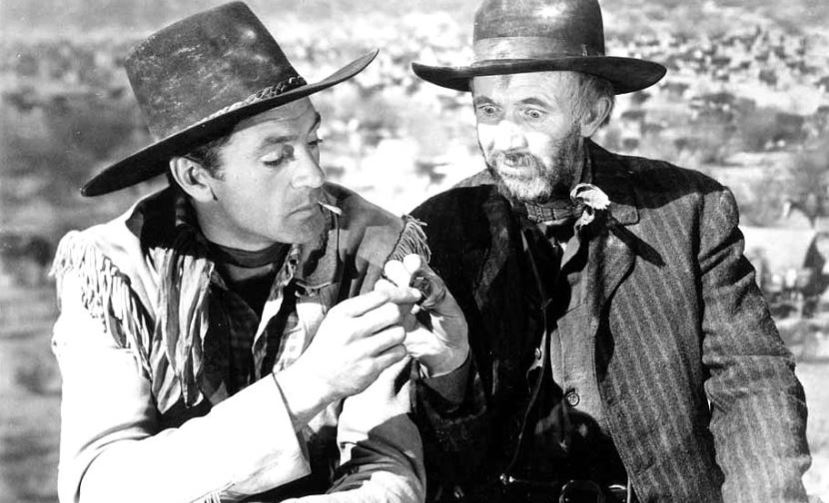
In 1882, Cole Harden (Gary Cooper) arrives in the town of Vinegaroon in Texas. The town is ruled by “Judge” Roy Bean (Walter Brennan), a corrupt, self-proclaimed justice of the land, who collects unfair fines and hands out “suspended sentences” (i.e. hangings). Nearly hanged, Harden escapes by peddling a story of his (fake) friendship with Lillie Langtry, the obsessive focus of Bean’s love. Over time the two men find themselves drawn to each other, forming a friendship – which is challenged by Bean’s favouring the violent cattle ranchers over the homesteaders.

The Westerner is a well-constructed, decent old-style Western that doesn’t do anything particularly radical – as if those making it needed a bit of downtime between more demanding projects, so put together something quite enjoyable to fill their time. It’s nominally a film about the clash between cowboys and homesteaders, but this plotline actually gets very little play – and is pretty unclear.

What it really is, is a sort of romance between Harden and Bean. They are two people surprisingly drawn together, who have a similar outlook on the world, and share a very natural and immediate bond. They have very real chemistry. In fact their chemistry is so strong there is barely room for anyone else to get a look in. 

So the film is a sort of bromance tragedy, because of course it’s clear that they will end up on opposite sides. Because Bean has principles of control which Harden cannot allow to stand. Because the same instincts that lead Bean to champion the cowboys, are the same ones that lead Harden to champion the homesteaders. Both men think that they are basically in the right. The main difference between them is probably that, if push comes to shove, Bean would rather win than be right, while Harden is more concerned with meeting his moral standards than anything else.

Wyler brings all this together with professional crispness, shooting the action and more chamber-piece moments with skill. He draws a real playfulness from Brennan and Cooper – could many other directors have thought about including a scene where Cooper wakes up slightly confused in a bed with Brennan’s arm around him after a night of drinking? Confrontations throughout the film have a playful edge to them, even when guns are on the table. Even the final gun fight between the two has a reluctant edge to it, as if this was a game with a few more consequences than normal. 

The bond between Bean and Harden is so strong, and so central to the film, that the relationship between Harden and Jane Ellen Mathews never quite clicks into gear. There is a charming scene where Cooper (with an honest flirtatiousness) cuts a lock of Jane Ellen’s hair – but the film isn’t really interested in this relationship. It feels like it exists for plot and scripting reasons – that the writers felt a romantic plot was needed, and wanted to give Harden a very clear personal motivation above and beyond his sense of justice. Doris Davenport is fine as Jane Ellen, but it’s not a performance you really remember.

Gary Cooper is rather good as Cole Harden, despite his reluctance to do the film. Cooper identified that Brennan had the best role and the best lines, and felt that he would actually be playing the support rather than the lead. Contractual obligation got him into the film. And it’s a good thing, as Cooper is actually very good. He has a light comedic touch which you don’t often associate with him, which he matches with his upright honesty and unflinching decency. But there is a playful grin behind his eyes throughout, and you get a real sense of his conflicting loyalties.

But Cooper was right – Judge Roy Bean is the role in this film, and Walter Brennan (who won his third supporting actor Oscar in five years for this) is quite simply terrific. His Bean is a wily, slightly crooked, maverick bully with a warped sense of personal justice – but he’s also a charming, rather sweet old man with a tough streak. The script gives a lot of focus to Bean’s obsessive love for the actress Lillie Langtry, which not only humanises him, but turns someone who we first see carrying out a ruthless judicial murder into some sort of teenage, love-struck rogue. That’s the genius here – Bean could be awful, but actually we (like Harden) end up loving him. Brennan’s effortlessly charismatic performance is central here – he is terrific in the role.

Take away these performances though and you probably only have flashes here and there of class alongside. Scenes are well constructed, and the entire film is very well filmed by the great Gregg Toland, but it’s very much a solid piece of professional work rather than a great classic. Brennan is brilliant and Cooper impressive, but not much more of the rest of the film really settles into the memory.

Hell or High Water (2016)


Chris Pine and Ben Foster carry out a series of personally motivated bank robberies in Hell or High Water

Director: David Mackenzie

Cast: Jeff Bridges (Marcus Hamilton), Chris Pine (Toby Howard), Ben Foster (Tanner Howard), Gil Birmingham (Alberto Parker), Marin Ireland (Debbie Howard), Katy Mixon (Elsie), Kevin Rakin (Billy Rayburn)

In West Texas, two brothers – divorced father Toby Howard (Chris Pine) and his ex-con brother Tanner (Ben Foster) – carry out a series of early morning raids on branches of the Texas Midlands Bank. Their robberies are investigated by Texas Ranger Marcus Hamilton (Jeff Bridges) working his last case before retirement, and his partner Alberto Parker (Gil Birmingham). The brothers however are motivated by more than just a desire for money – and these motivations drive them to ever more desperate and dangerous actions.

Hell or High Water is a fine piece of skilled professional film-making. The story is tightly scripted, and Mackenzie’s direction marries up a modern outlook with the style of a classic John Ford western. But, for me, it reaches for a thematic richness that isn’t quite there. It’s in the same territory as No Country for Old Men but it never achieves that film’s complexity. It creates characters we care about, and the story keeps us gripped, but it lacks that certain extra dimension that profoundly moves us. It tries to tell itself (and us) that it’s a profound exploration of themes around life and death, but it never really reaches these feelings – its grasp is less than its reach.

But it’s still a hugely enjoyable and impressive movie. Mackenzie’s direction is superb, detailed and smooth, and he is able to bring to life both the drama and the action. The story has an old school heist quality, with our gangsters sort of proto-Robin Hoods, naïve enough for us to invest in their actions, but dangerous enough for us to understand why events spin outside their control. Sheridan’s script is full of punchy lines and genuine emotional weight. The plot line gets a bit bogged down in the ins and outs of the reasons why our ‘heroes’ are doing what they are doing, but there is an emotional truth to it that really works.

The film also creates a wonderful sense of Texas as a land that seems to have only just moved on from the Wild West. Everyone in the film seems to be either packing heat or wearing a Stetson (or both). Genuine cowboys guide cattle across a road. The rangers have an old school gruffness about them, staking out banks from across the road in saloon bars that don’t seem to have moved on from the days of Wyatt Earp. At the slightest sign of danger, ordinary people reach for their guns and start shooting. Everything takes place in dusty countries, or rural feeling towns. I can barely remember seeing a computer or mobile phone. The whole film feels slightly out of step with the modern world.

It also draws some very fine performances from its actors. Chris Pine may never have been better than as reluctant bank robber Toby. Toby is a classic western outsider, a man who is working to protect his family and preserve their future – often by dangerous means – but accepts that this family life he is building has no place for him in it. Pine brings the part a finely judged sadness, a sense of a man without a place in the world. Ben Foster is equally good as his firecracker brother, a damaged anarchist at heart whose love of impulsive danger will have fatal consequences.

The heart of the movie though is Jeff Bridges’ ranger, a marvellous portrait of gruff-old school machismo. Bridges invests this role throughout with a humane decency, an anger at the distress and violence. His friendship with his partner Alberto (a touching Gil Birmingham) provides much of the affectionate heart of the movie, their good natured joshing and banter a continual source of humour. Bridges’ world-weary, out-of-time quality matches perfectly with the timeless mood of the movie. It’s a beautifully judged, simple, unshowy performance.

It’s a beautifully judged combination of crime and family thriller, while its ability to balance the old-school feeling and aesthetic of West Texas with a punchy modern-feeling tale of the greed of bankers, works extremely well. It’s got a dark Butch Cassidy feeling to it, and the film’s focus is tightly kept on the four leads, allowing the audiences understanding of them to grow and develop. By the conclusion of the film, your loyalties will be firmly divided between both the law and robbers, summed up best by a beautifully played elegiac final scene, laced with regret, sadness and tension.

But despite all this, it never quite breaks out of its pulpy roots to become something else in the way that No Country for Old Men manages to do. Wonderful character study as it is, it feels like a film that wants to make a broader, spiritual comment about the American way and modern masculinity. It doesn’t quite manage to do this. I don’t feel that this film really succeeds in suggesting it is about much more than what’s on the surface.

But that doesn’t matter so much, when the surface is so strong and as well directed, acted and written as this. If Hell or High Water is, at the end of the day, just a smart cops-and-robbers story, it’s certainly one that’s full of freshness and intelligence and grips your interest from start to finish. In a world where Hollywood churns out over-promoted average films, it stands out as something far more heartfelt, expertly crafted and hugely enjoyable.

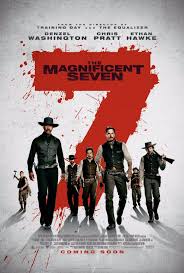
The Magnificent Seven (2016)


Denzel Washington leads his gang of seven wildly different souls to do battle for the little guy

Director: Antoine Fuqua

Cast: Denzel Washington (Sam Chisolm), Chris Pratt (Joshua Faraday), Ethan Hawke (Goodnight Robicheaux), Vincent D’Onofrio (Jack Horne), Byung-hun Lee (Billy Rocks), Manuel Garcia-Rulfo (Vasquez), Martin Sensmeier (Red Harvest), Haley Bennett (Emma Cullen), Peter Sarsgaard (Bartholomew Bogue), Luke Grimes (Teddy Q)

The Magnificent Seven is a much loved staple of BBC bank holiday weekend screenings. The original wasn’t a brilliant piece of film-making art, but it was a brilliant piece of film-making entertainment, and it had simple, wry, heartfelt (if sometimes on-the-nose) observations to make about the sacrifices the life of a gunslinger calls for. How does the remake measure up?

In 1879, the village of Rose Creek is besieged by would-be industrialist Bartholomew Brogue (Peter Sarsgaard), who orders the villagers to leave as he plans to expand the local mine. Newly widowed Emma Cullen (Haley Bennett) sets out to recruit gunslingers to help protect the town. Warrant Officer Sam Chisolm (Denzel Washington) is her first recruit, and he helps her to gather six others from drunken cardsharp Joshua Faraday (Chris Pratt) to legendary sharpshooter Goodnight Robicheaux (Ethan Hawke). But the battle to protect the village will lead to many good men six feet under before our heroes can have the chance to prevail…

One thing’s for sure. In 60 years’ time they won’t be playing this film every bank holiday weekend. That doesn’t mean this is a bad film, it’s just quite an average one. It’s decently done, has several good scenes and even one or two witty lines in among a fairly routine script, but there is very little imagination or inspiration behind this. It’s got a decent cast of actors, but you always feel they are lifting average material rather than working with the good stuff. While the original film combined a sense of boyhood heroics and some iconic performances with some exploration of the emptiness of the life of a gunslinger and the attraction of a normal life, this film manages to deliver much less on all these counts.

So first the good parts. Much of the gun-toting action is very well done. The first shootout as our heroes arrive in the town is terrific (see link below), full of thrilling beats and rewindable moments. To be honest, it’s the best moment of the film, and as close as it comes to capturing the excitement of old-school gunslinging action. The final battle scene is decent, but offers generally more of the same with additional (no spoilers to say) sacrifice. Even without the inspirations of the original film, many of the character beats will be familiar to the watching audience. I successfully predicted which of the cowboys would survive early in the film, and only one death is near to a surprise. It’s well done, but it’s not got the filmmaking expertise of Kevin Costner’s Open Range, with its final small-band-against-an-army structure, nor that film’s intelligent and low-key analysis of the cost of violence.

It’s that lack of human insight that I think is one of the film’s principal weaknesses. The original had more to say about the damage a life of violence can inflict on people, and the longing even the most hardened man of the world can find for  the simple life – as well as the lengths they will go to in order to protect it. This film offers none of that. The motivations for the seven in joining are incredibly thin, almost after-thoughts. At least two members of the team simply turn-up, as if dropped from the sky. Team leader Chris has a “very personal” motivation, signposted from the very start, that serves to undermine much of the depths we seem to learn about his character during the film – as well as making him just another “man looking for revenge” architype.

On top of that, a serious trick is missed when setting this film near the end of the Western era. Already the time of these lawless gunslingers is coming to an end, and they have no place in the modern world. The villain is a sort of corporate bully, launching a hostile take-over of the village for his mining company. There is plenty of thematic material to mine here of these men taking a stand not only against the strong persecuting the weak, but also against the onrush of time that is leaving them behind. Now I’m not expecting the film to be a serious socio-economic discussion, but I’d like to watch a film that at least tips the hat to ideas like this (or any ideas at all) rather than just push through a well-filmed but-by-the-numbers remake.

Saying all this, it is pretty entertaining in an unchallenging way. It does make you want to go back and re-watch the original version (which was itself, to be fair, little more than a crowd pleaser). But that’s kind of all it is – and it doesn’t have any ambition to be more. But it’s a good watch and some of the updating ideas work very well. The multiracial composition of the seven works very well, and Haley Bennett as the “Eighth” member of the team, is a strongly written role that feels like a character rather than an accessory. Washington can do this role standing on his head, but brings his customary authority. Chris Pratt is at his Harrison Fordish charming best, particularly on the edge of bursting out into a childish grin, in gleeful excitement at being paid to play cowboys. Hawke is saddled with the thematic content as a gunslinger with PTSD, but makes a good fist of it. Much of the rest of the gang are a collection of moments rather than characters, but do their jobs well.

The Magnificent Seven, it seems too easy to say, isn’t magnificent. It’s an unambitious film without any real thinking or imagination in its conception. It seems scared of introducing anything too conceptual or thought-provoking in its setting or plot. It’s just about entertaining enough to survive while you are watching it, but its life is going to be little longer than the two hours you watch it, not the 60 years of its predecessor.