Author: Alistair Nunn

Sweet Smell of Success (1957)


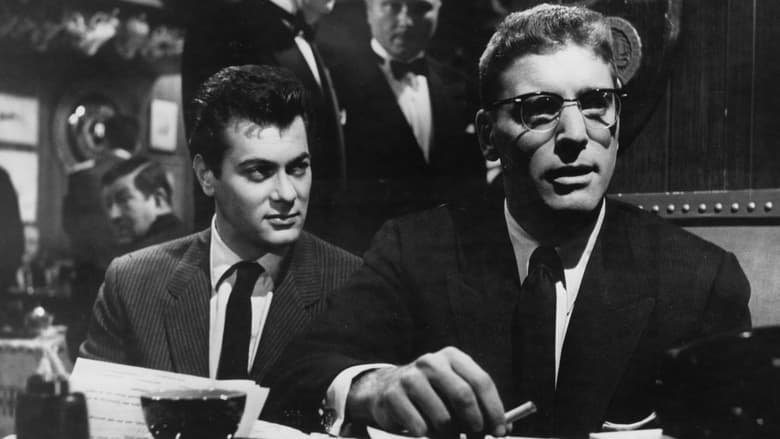
Tony Curtis and Burt Lancaster have no scruples and no morals in the dark exploration of American culture, Sweet Smell of Success

Director: Alexander Mackendrick

Cast: Burt Lancaster (JJ Hunsecker), Tony Curtis (Sidney Falco), Susan Harrison (Susan Hunsucker), Martin Milner (Steve Dallas), Sam Levene (Frank D’Angelo), Barbara Nichols (Rita), David White (Elwell), Jeff Donnell (Sally), Joe Frisco (Herbie Temple), Emilie Meyer (Lt Harry Kello)
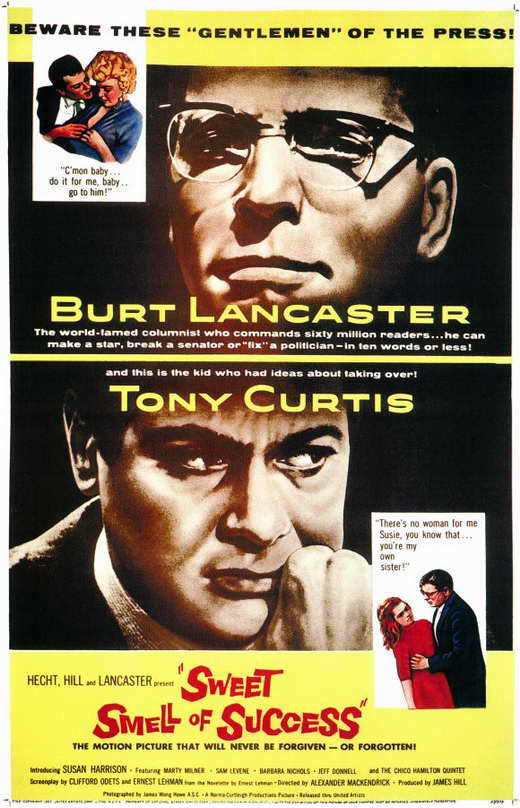
Is there a more cynical film in all the world than Sweet Smell of Success? Is it any wonder that the preview audiences, settling down to watch what they expected to be a Tony Curtis light comedy, went crazy? But Sweet Smell of Success is a film that captures the sweaty desperation of show-business, and the cut-throat ambitions of Manhattan. It’s a brutal, sharp, vicious black comedy, in which all our heroes are vile and everything can be bought and sold.

JJ Hunsecker (Burt Lancaster) is a newspaper columnist, so influential that the slightest mention in his column can make or break careers. He rules the New York politics and arts scene with a ruthless fist – and press agents like Sidney Falco (Tony Curtis) will do anything to get even the slightest sniff of a mention in the column. Hunsucker has a job for Falco: Hunsecker’s sister Susan (Susan Harrison) wants to marry jazz musician Steve Dallas (Martin Milner), and Hunsecker doesn’t approve – he wants the relationship finished. Falco may feel some qualms – but they don’t last long, and he’ll do anything he can to wreck the couple’s happiness.

Sweet Smell of Successis all about the grimy effort and lack of morals that sit under the surface of getting to that success. Because to achieve it in the big time you need to be as sinister, controlling and bullying as Hunsecker – and to try and get up there you need to be as conniving and weaselly as Falco. Both these characters are, in their own ways, almost totally reprehensible – and the film makes no attempt whatsoever to mitigate this. The film is appallingly ruthless and cynical, and its two lead characters are, to put it bluntly, complete shits and total bastards.

It’s a film that says the American Dream doesn’t even remotely exist in the way we like to think it can – that there is as much class and control in America as there ever was in the old world. And being decent and honest doesn’t get you anywhere – and sometimes even being conniving and doing whatever you’re told to do doesn’t either. It totally captures the bitter, cruel and imposing mood of New York high society at the time – unwelcoming, unfriendly, judgemental and brutal. For all its glamourous New York location, who on earth would look at this and say “I fancy a piece of that” – it’s the exact opposite of what American films often try to do.

This was Alexander Mackendrick’s first American film, and it’s perhaps his outsider’s eye that really helps the film to really go for it. Mackendrick’s Ealing films weren’t afraid to pull their punches – from the commentary on the corruption of big business in The Man in the White Suit to the dark comedy of The Ladykillers – and (working with genius cinematographer James Wong Howe) he creates one of the darkest (in every sense) film noirs ever. His camera prowls along the streets and he wonderfully captures both the bustle of New York clubs, and the menace of New York behind the glamour. He also shoots both Curtis and Lancaster in a way they never had been shot before – and both of them rise to the richness of the material to give possibly their finest performances.

Burt Lancaster’s Hunsecker is a total monster: a bully and a sadist, vicious and aloof. Lancaster’s stillness here really sells the part – he doesn’t move, everyone else does – and the film brilliantly uses his slightly patrician voice. Hunsecker’s cold, dead-eyed stare pierces through character and desperation, and the contempt he feels for Falco (and every other character) is there in every moment, from looks to subtle physical put-downs (even lighting a cigarette is a power play, laced with an almost sexual sense of control). He “loves this city” because he owns the place, lock stock and barrel. Hunsecker only has one weak point – his clearly incestuous love for his sister – but even that is just the excuse for more controlling, domineering behaviour in which people are only objects for his manipulation.

And no-one is more willing to be manipulated than Tony Curtis’ brilliantly sycophantic Sidney Falco. Hunsecker is vile, but Falco might be worse. Is there a less likeable lead in a movie? Falco has no principles, no morals, no conscious – he’s the worst sort of follower, the sort of kid who stands behind the bully and laughs loudest at every joke. On top of that, Curtis is incompetent and untrusted – the scene where he attempts to blackmail another columnist and is firmly smacked down is wonderful for its discomfort. Curtis is twitchy, desperate, always on the move and will do anything – from lying to planting evidence to openly pimping his secretary. Far from the “young man working his way up” that you might expect, he’s a ruthless, unprincipled opportunist, perhaps the best inverted presentation of American can-do ambition you’ll see on screen.

That’s where the film really works: the scenes between Hunsecker and Falco are simply marvellous: Hunsecker savouring every verbal blow and smooth smackdown – and Falco sitting, edgy and jittery, on the edge, laughing loudly to try and make sure he doesn’t become the target. The marvellous restaurant scenes – with Hunsecker barely able to bring himself to acknowledge Falco’s existence – are the film’s heartbeat: brutal battles where Hunsecker wins everything and lives are destroyed. “A man has just been sentenced to death” Falco gleefully points out – “You’re dead son. Get yourself buried” is Hunsecker’s smoother version.

Ah yes that dialogue. Written by Clifford Odets at incredibly short notice (pages were literally taken straight from the typewriter to the actors’ hands in front of the camera), this might be one of the sharpest, waspiest films ever written. So many quotable lines, with Curtis and Lancaster relishing every dynamic and scintillating one-liner that the script gives them (and there are many). “I’d hate to take a bite out of you. You’re a cookie full of arsenic” – who wouldn’t want dialogue like that? It’s a sensationally written film, and every scene offers a new delight.

It’s not perfect of course. Milton and Harrison are as lightweight and forgettable as Lancaster and Curtis are sensational, too strait-laced and conventional to really seize the interest. The second half of the movie is weaker than the first: the pay-off doesn’t quite match the build-up. Really a film that just followed Hunsecker and Falco about as they went about their daily work, without the sister plotline, might have been even more effective. But it’s probably a quibble on a film that works every time – and has such dense, wonderful dialogue you’ll want to wind back most of the scenes to watch them again. And those two lead performances: simply perfect.
Pride and Prejudice (2005)


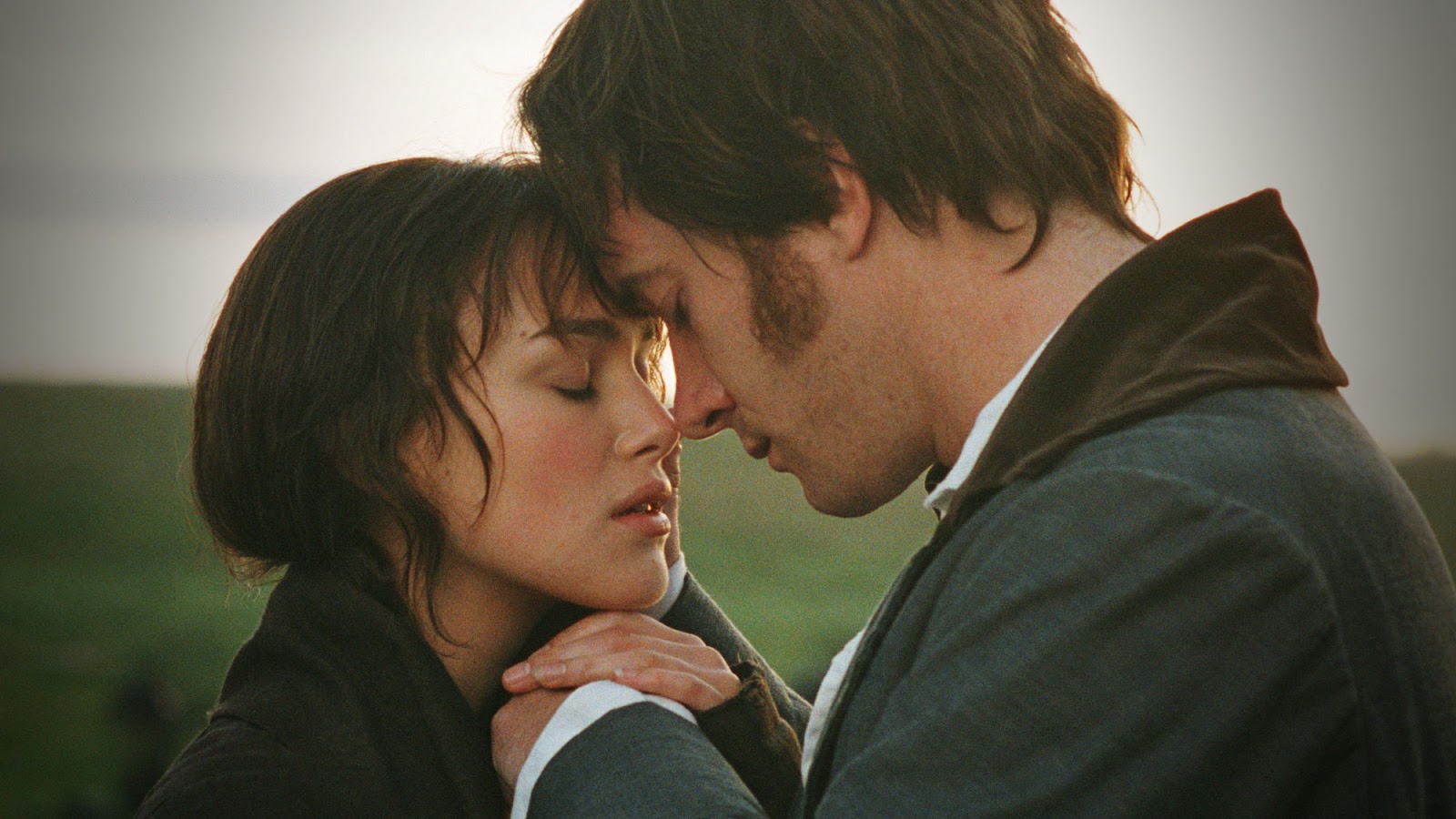
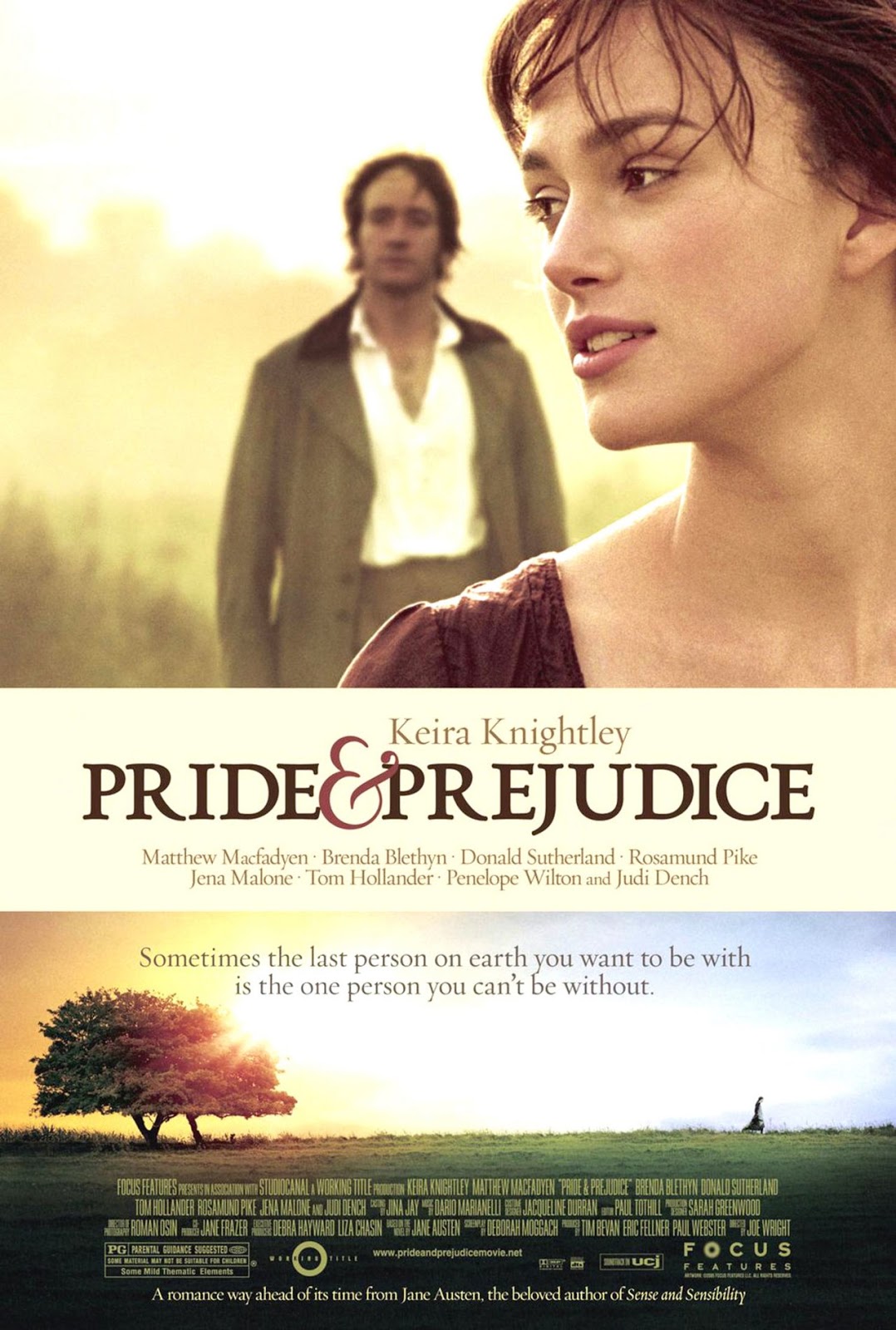
Keira Knightley and Matthew Macfadyen are drowned in the shadow of the BBC adaptation of Pride and Prejudice

Director: Joe Wright

Cast: Keira Knightley (Elizabeth Bennet), Matthew Macfadyen (Mr Darcy), Brenda Blethyn (Mrs Bennet), Donald Sutherland (Mr Bennet), Tom Hollander (Mr Collins), Rosamund Pike (Jane Bennet), Carey Mulligan (Kitty Bennet), Jena Malone (Lydia Bennet), Talulah Riley (Mary Bennet), Judi Dench (Lady Catherine de Bourgh), Simon Woods (Mr Bingley), Tamzin Merchant (Georgiana Darcy), Claudie Blakely (Charlotte Lucas), Kelly Reilly (Caroline Bingley), Rupert Friend (Mr Wickham), Penelope Wilton (Mrs Gardner), Peter Wight (Mr Gardiner)

I’ve written before about certain books having been adapted so successfully there feels very little point rolling out another. If ever an adaptation set this principle, it’s the 1995 BBC adaptation of Pride and Prejudice. Not only did it perfectly capture the spirit and style of the book, with perfect scripting and direction, but the two lead actors – Jennifer Ehle and especially Colin Firth – were simply perfect (for all his achievements, the first line of Firth’s obituary will forever be “Darcy Dies”.)

So Joe Wright and his team were already climbing a mountain when they announced plans to make a new adaptation of Jane Austen’s most beloved novel. What they’ve produced in the end is a well-made, handsomely mounted film full of visual invention – that has been pretty much rejected by nearly everyone I know who loves Austen. It’s a film that, in attempting to plough its own furlough, has ended up not really pleasing anyone: for the casual viewer it’s an entertaining but forgettable watch. For the Austen fan it’s just plain not right.

Structurally the film places Elizabeth’s relationship with Darcy slap bang at the centre, and has little to no interest in anything else. This leads to major themes and relationships being neglected or outright abandoned in some bizarre cut choices. The film wants to front-and-centre Lizzy’s increasing isolation – so Jane is dispatched from the film for almost over an hour. Even more oddly, Wickham is cut down to a few spare scenes – which makes her passionate sympathy for him and anger against Darcy make very little sense. All this isolation also means we never really understand the social implications and importance of marriage – in fact the whole thing is basically turned into a Cinderella romance: Rich Man Meets Poor Girl (And No One Else Matters). 

Which means a lot of the focus for the film lands on Keira Knightley. Is there a more controversial actor in film than Knightley? Oscar-nominated for the role, among my Austen-loving friends I have found only revulsion against her performance. She plays it with spirit but too much of a modern sensibility. She’s fine, but she’s just not convincing: she doesn’t look like her, she doesn’t have her warmth and wit and seems more like she’s wandered in from some sort of “flirty girls” comedy. Nothing really communicates the character’s intelligence and wit – and Knightley probably looks a little too modern for the whole thing to work. 

On top of that the film doesn’t want her to be too unsympathetic at any point, so dials down her judgemental nature, and also reduces any possibility of us judging her partiality for Wickham by mostly removing him from the film. However, this also removes many of the obstacles from the plot that stand in the way of romance.

Matthew MacFadyen does a decent job as “Nice Guy In A Period Drama”, but the character is just wrong for Darcy. Like Lizzy’s tendency to rush to judgement, Darcy’s apparent coldness and snobbery have been watered down to almost invisibility. His first announcement of love is so genuine, so gentle, so loving that you are amazed that Elizabeth dismisses him out of hand. It’s no surprise this Darcy turns out to be a decent bloke, the edges of the character have been completely shaved off. This puts a big old dent in the plot, reduces his character development, and ruins the impact of sweet later moments like Darcy’s uncertainty when the two meet at Pemberley. 

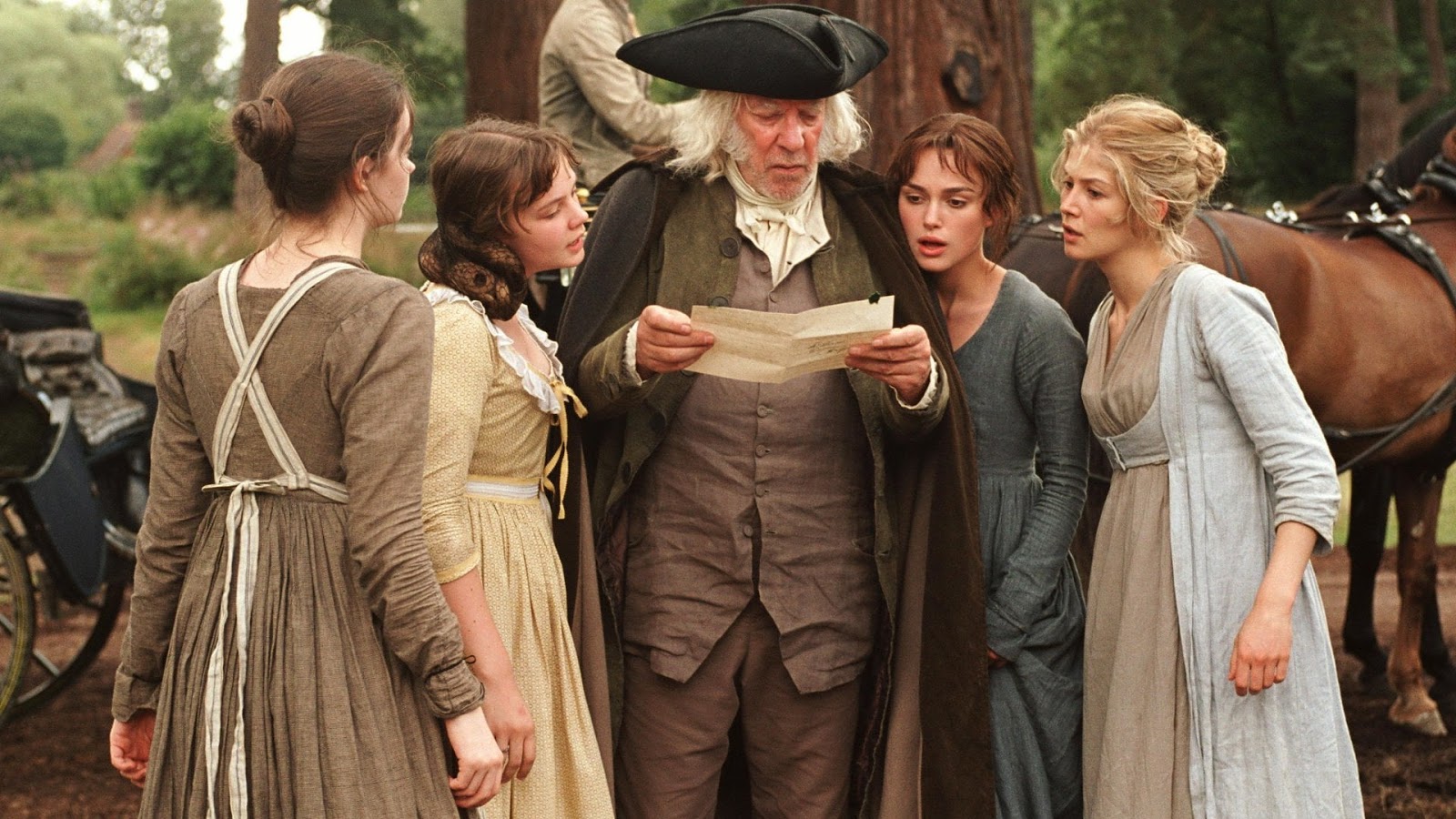
There are some good performances though. Tom Hollander is very funny as a social-climbing Mr Collins. Donald Sutherland gets so much warmth and twinkly good humour out of Mr Bennet that Wright even ends the film on him (another odd choice, but never mind). Judi Dench could play Lady Catherine standing on her head. Rosamund Pike is rather good as Jane – she totally feels right for the period. Brenda Blethyn largely manages to avoid turning Mrs Bennet into a complete stereotype. Saying that, Simon Woods portrays a version of Bingley so bumbling, tittering and awkward you are amazed either Jane or Darcy could be interested in him, let alone bear to spend time with him.

But then large chunks of the film feel odd. The screenplay works overtime to turn the film into a straight-forward star-crossed lovers story: so it’s Darcy and Elizabeth all the way, and the film is desperate to make them both likeable from the off. And if that means that, in a film called Pride and Prejudice, both the pride and the prejudice have to be junked to make sure even the stupidest audience member will like the hero and heroine, well that’s apparently a price worth paying. Lowering the Bennets’ social status as far as the film does, also turns the story into a full-on Cinderella territory. Darcy and Bingley are so posh an entire room falls silent when they walk in – in comparison the Bennets are so poor they share their house with pigs.

Ah yes the pigs. Why? The Bennets aren’t paupers. If they were, why would Collins want the place? Why would they be invited to the ball? Why would Bingley and Darcy even consider them as partners? Why would a family so aware of impressions have a home that is literallyfull of shit all the time? Why is Mr Bennet scruffy and unshaven – and why doesn’t anyone care? Who designed this? If the Bennets are so fixated on getting good marriages why do they literally live in a pig sty? It’s a visual idea that undermines the whole story.

I’m not joking. Here is a pig walking through the Bennet house.

It’s full of things like this that don’t feel right. The film junks most of the language of the original book, which makes it sound jarring (it even re-works Darcy’s first proposal: “in vain I have struggled, it will not do…” – large numbers of Austen lovers I know can recite those lines verbatim. This film apparently thought it could create a better version. It couldn’t). Large chunks of the film happen in the rain like some sort of version of Wuthering Heights. Why is that? Is it because professions of love in the rain are romantic in a Mills and Boonish sort of way? Or is it an echo back to Firth’s wet shirt?

Emma Thompson’s sublime adaptation of Sense and Sensibility demonstrated that it is completely possible to adapt an Austen novel into a two-hour film and still preserve the characters, relationships, major events and themes of the book, while also making a story that stands on its own two feet for non-Austen-ites. This film bungles its attempt to do the same. 

But there are things Wright gets right. The camera work and transitions are lovely. A long tracking shot that weaves in and around the ball early in the film, taking in every single character is not only a technical marvel but really gets across a feeling of what these hectic and bustling social events are like. There is a beautiful time transition at Longbourn, as Elizabeth rotates on a screen and the camera takes on a POV shot, showing the seasons changing each time the camera revolves around through 180 degrees. The cinematography is luscious and Wright – his first film – shows he was more than ready for the step-up from TV.

It’s just a shame that the film they made doesn’t quite work. It doesn’t capture the sense of the book. It doesn’t capture the sense of the characters. It makes bizarre and just plain wrong choices. It’s a decent film, but it is not a good adaptation of the novel. And that’s a major problem, because if you are going to adapt something as widely loved and revered as this, you better bloody well understand the novel – and I don’t think enough people here did. It’s told with a sweeping romantic style – but they are adapting the perception of Pride and Prejudice rather than the actual story. The chemistry and romance aren’t there: the film even ends with an odd sequence of Sutherland and Knightley, probably because there was better chemistry between these two than the two leads. It’s a film that basically doesn’t work at all.

Hugo (2011)


Martin Scorsese’s Hugo: a kids film in name only

Director: Martin Scorsese

Cast: Asa Butterfield (Hugo Cabret), Chloë Grace Moretz (Isabelle), Ben Kingsley (Papa Georges), Sacha Baron Cohen (Inspector Gustave Dasté), Ray Winstone (Claude Cabret), Emily Mortimer (Lisette), Jude Law (Mr Cabret), Helen McCrory (Mama Jeanne), Michael Stuhlbarg (René Tabard), Christopher Lee (Monsieur Labisse), Frances de la Tour (Madame Emilie), Richard Griffiths (Monsieur Frick)

Martin Scorsese isn’t exactly the first name you think of when your mind turns to directors of children’s films. So perhaps it makes sense that, in Hugo, he directed a children’s film aimed at virtually anyone except children. A huge box-office flop, Hugo was garlanded with awards and critics’ acclaim – but I’d be amazed if you find any child with a DVD of it. It’s a film made by a passionate lover of cinema, aimed at lovers of cinema, which just happens to have a child at the centre of it. 

Hugo Cabret (Asa Butterfield) is an orphan, living in the Paris train station fixing the clocks, and attempting to fix a curious automaton which his late father (Jude Law) had taken from the Paris museum to repair. After being caught by Monsieur Georges (Ben Kingsley) stealing parts from his toy shop in the station, Hugo must earn back his confiscated notebook on the workings of the automaton. Hugo starts a friendship with Georges’ god-daughter Isabelle (Chloë Grace Moretz), and together they begin to investigate the mysterious past of Papa Georges – and his connection with the early days of cinema.

Any understanding of what makes a good film for children is missing here. It’s not exciting, it’s not engrossing, it’s not particularly fun, it doesn’t place the child (really) at the heart, and most importantly it doesn’t have a story children can relate to. The characters spend a lot of time talking about the glorious adventure they’re on – but none of the excitement translates to the screen. Instead the action creeps forward uncertainly, with the motivations of Hugo himself unclear. There are half hearted attempts to aim at a universal fear children can relate to – losing your parents and searching for new ones – but the film doesn’t run with it. 

Its real interest is the power of the movies. So Hugo’s story gets lost halfway through the film, as Scorsese focuses in on the redemption of famed cinema auteur and pioneer Georges Méliès. The children’s adventure is nothing more than visiting a library to find out who Méliès was – after that, they are effectively superfluous to the story. Details about Hugo’s relationship with his father, or with his distant uncle, are completely dropped – and the automaton that seemed like it held the key to Hugo’s purpose, becomes a MacGuffin. It’s a film about a giant of cinema, made by a giant of cinema.

So let’s put aside the marketing of this film as children’s film. The only element of the film that feels remotely like it is part of some sort of kids’ flick is Sacha Baron Cohen’s slapstick, funny-accented railway inspector – and as such Cohen’s hammy mugging sticks out like a tiresome sore thumb. The rest of the film is what you would expect from a cinema enthusiast making a film about the movies – a glorious, loving recreation of old silent movies and the methods of making them, shot and told with a sprinkling of movie magic. 

The film looks wonderful. The cinematography is gorgeous, the production design astounding. It’s beautifully made and has a light and enchanting score. Scorsese goes all out to homage the shots and set-ups of old silent movies. In fact the film only really comes to life in its second half, where flashbacks show the methods Méliès used to make his films. The recreation of scenes from these old classics is brilliantly done – and Scorsese’s designers delight in filling the screen with the sort of colour that you couldn’t find in the original. The photography also goes out of its way to give these scenes the sort of colour tinted look that the hand-painted prints of old movies had. Even the editing is designed as much as possible to replicate these old films.

Truly, these sequences are delightful – and Scorsese’s joy in making them is evident in the camerawork, and the emotional force he gives to Méliès’ story (helped as well by Ben Kingsley’s sensitive underplaying as the depressed genius). It’s just a shame that he couldn’t get as engaged with the first part of the film. Hugo’s story is largely dramatically inert – in fact the whole plotline around Hugo feels like a hook on which to hang the second half of the film. As if Scorsese couldn’t make the second part of the film without making the first. 

That’s why this film doesn’t work for children, but works better for film-loving adults. The ins and outs of Hugo’s early story just aren’t that interesting – and we aren’t given any real reason to relate to Hugo or to feel any empathy for his journey (whatever that might be). In fact the film stretches this plot line long past any actual content – already I’m struggling to remember exactly what happened in the first hour of the film. This is no comment on the performances of Butterfield or Moritz, who are both very good (even if Moritz is saddled with sub-Hermione Grainger character traits). While it always looks great, it never really finds the heart to get us engaged with Hugo.

So Hugo is a film for cinema-fanatics. Scorsese directs with great invention – but it’s all too clear where his heart is: and that’s why the film failed so spectacularly as a kids’ film. Compare this to Toy Story 3say, and it’s clear which one most children are going to want to watch. However, if you want to see Scorsese make a charming film about his passions, one that is overlong but looks gorgeous, that playfully recreates the silent cinema era, even while its narrative is basically pretty dramatically inert, you’ll love it. There are moments in this film to treasure – it’s just not really for kids. Just because Scorsese made a film without someone’s head in a vice or zipped into a bodybag, doesn’t suddenly mean he’s going to find a new audience.

Othello (1995)

Laurence Fishburne falls foul of Kenneth Branagh’s schemes in this traditional but decent Othello adaptation

Director: Oliver Parker

Cast: Laurence Fishburne (Othello), Irène Jacob (Desdemona), Kenneth Branagh (Iago), Nathaniel Parker (Cassio), Michael Maloney (Roderigo), Anna Patrick (Emilia), Nicholas Farrell (Montano), Indra Ové (Bianca), Michael Sheen (Lodovico), Gabriele Ferzetti (Duke of Venice), Pierre Vaneck (Brabantio)

Othello is perhaps one of the most famous tales of betrayal and jealousy ever written. And yet Shakespeare’s tale of the noble general who descends into murder when convinced by his trusted ensign Iago that his wife is unfaithful, hasn’t often been made into a film. This is probably because its lead role requires a black actor and – for depressing historical reasons – most films aren’t considered good investments without a famous white actor in the lead (of course this has also been the case on stage). So we’ve had blacked-up performances from Orson Welles, Laurence Olivier and Anthony Hopkins – but this was the first proper adaptation of the play with a black actor in the lead role.

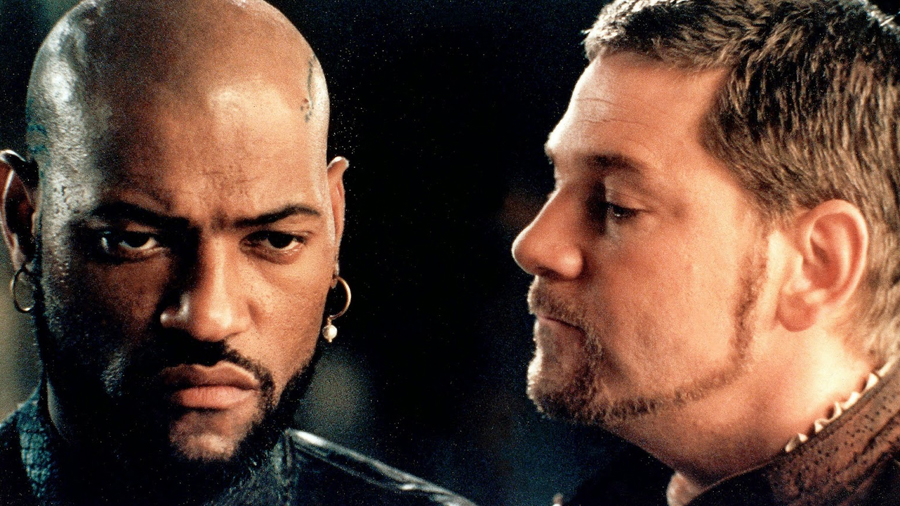
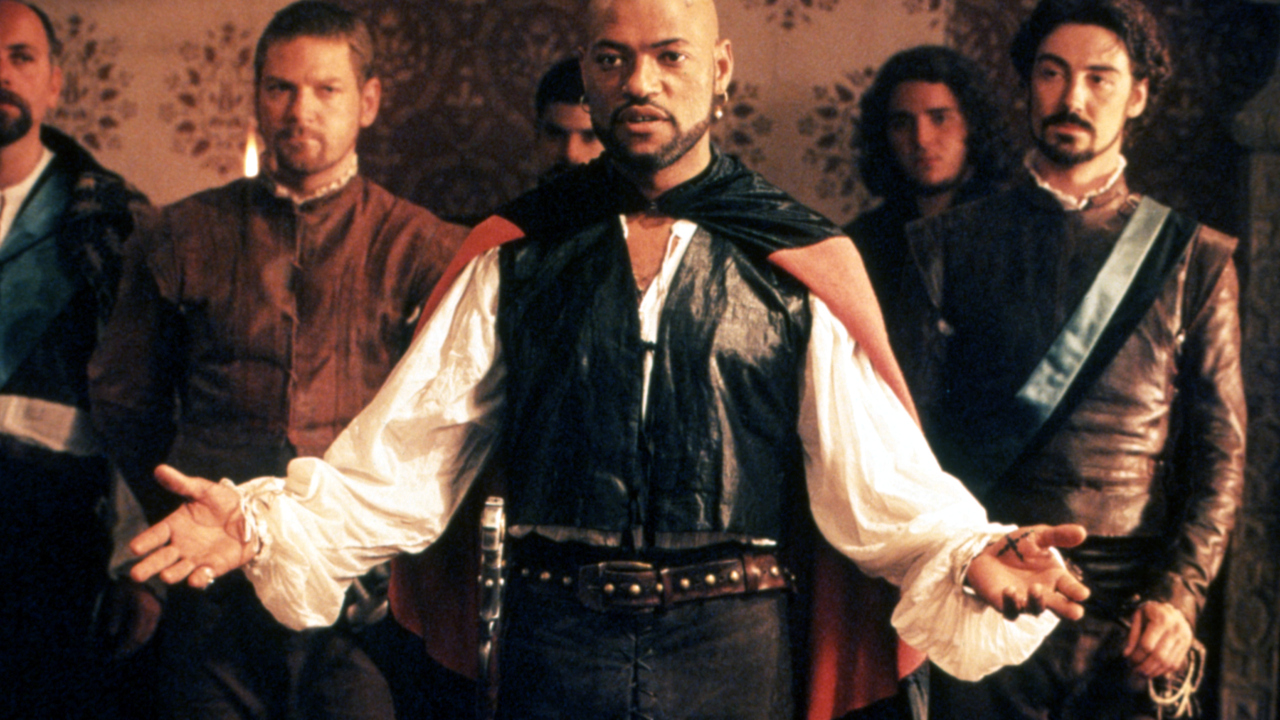
As the two leads, Laurence Fishburne and Irène Jacob are a mixed bag. Fishbourne has all the dignity and statue of the great general, and he brings a muscular physicality to the role which really works. He has a wonderful timbre to his voice and he handles the disintegration very well. He does sometimes feel a little hidebound by the language – treating the dialogue with a little too much reverence – but he’s the most believable Moorish general (for many reasons…) you’ve seen on screen so far. Jacob has greater difficulties – although many of these I think are due to this being her first film in English (talk about jumping in at the deep end) – and attempts to make Desdemona a free-spirit don’t really work that well.

Oliver Parker claimed he wanted to cast actors who weren’t associated with Shakespeare. Bizarre then that his cast is rounded out by Kenneth Branagh, the actor perhaps more associated with Shakespeare than anyone else alive. But then I guess when you can get Branagh in your movie, you aren’t going to say no. And it’s great he did, because this might just be one of Branagh’s finest Shakespearean performances: as if not also directing the thing (although many people mistakenly think he did!) freed him up to just focus on his performance. (It’s unfortunate for the other two leads that Branagh’s skill with both Shakespearean dialogue and performing it for the movies also serves to point up Fishburne’s more traditional take and Jacob’s discomfort.)

His Iago is superb, and he plays the part just right, never tipping the wink during his scenes with various characters, but playing Iago totally straight and completely genuine. He appears to be a decent, kind, lovely guy to everyone: it’s only in those asides to the camera that we see his real self, although even here he treats us with just as much charm. His Iago is the sort of guy you’d go for a drink with – and then be shocked to hear he had smilingly bad mouthed you to all your friends. Branagh also adds a homosexual undertone to the film, his Iago having incredibly mixed, repressed feelings about Othello: he seems genuinely moved when Othello makes him his lieutenant and a half twitch of regret crosses his face when the general dies.

Not that it stops him from being a bastard the rest of the time – and Parker does a very neat line in bringing the pivotal seduction of Othello to life on camera. On stage, Iago’s entrapment of Othello is a single, poison-dripping conversation – here, taking advantage of what you can do with film and editing, Parker spreads it over three locations: first a training-ground skirmish outside (where Othello bests Iago), then a sort of armoury changing room (where the outside is still visible), then finally a dungeon. As each lie gets more seductive, so Othello is literally dragged deeper and deeper into the castle. Then we get a neat flip: when he’s fully sold on Desdemona’s treachery, and begins raging and storming, we end up on huge open beaches or castle battlements, as if Othello has been reborn into a larger, refocused world.

This device smoothe out one of the problems with the original play – rather than Iago turning Othello against his supposedly beloved wife during one chat, the cuts from location to location (and different times of day) give the impression of a prolonged disintegration. Othello begins to get the first lines of each section, giving the impression that he has been dwelling on these lies in the interim, and that he is now the one bringing the subject back up, unable to stop prodding at it. It’s makes for a more convincing (and modern) psychological portrait of the corrosive triumph of jealousy than can be achieved in a traditional stage version.

The film has moments of invention – at one point Iago pours poison into Roderigo’s ear while they lie under a wagon where a couple are noisily rutting – and it does some really interesting stuff as mentioned with the “seduction” of Othello. Parker also throws in some expected cinematic tricks – so we get moments of Othello fantasising over Cassio and Desdemona together. But Parker’s not the most unique or challenging director, and he mostly shoots the film with a traditional straight forwardness, using a very traditional setting and editing style.

The film has other problems, too. Othello and Desdemona don’t have much chemistry between them, and Fishburne’s emotionally distant performance makes Othello harder to root for. Maybe this is just Branagh unbalancing the film – his Iago is so compelling, it throws off the film. Parker tries to make Desdemona a stronger character, but this doesn’t always work. Jacob’s slightly awkward tension with Shakespeare is part of this, but we also get the confusion of a Desdemona who fights for her life at the film’s conclusion and then strokes her husband’s head with affection as she dies.

Other performances don’t quite work. Michael Maloney is too overblown as Roderigo – though this Shakespearean wimp does at least get to genuinely threaten Iago and is slightly more convincing for the series of fights Iago puts him up to. Between them, the script editor and Anna Patrick turn Emilia, one of the play’s most intriguing characters, into a blank – she barely has a line in the first hour, and those she does have are delivered pretty blandly. Nathaniel Parker, though, is pretty good as Cassio (incidentally, Parker is of course the director’s brother, and Anna Patrick is the director’s sister-in-law – it’s a home movie!).

The main problem? As the play heats up to the final confrontations, the film slows right down. It’s hard to believe – as we enter Act 5 of the play – that there could still be half an hour of the film left, so snappy have the first four acts been. But the film dawdles and drags over the finishing line – and all the chase scenes of a desperately fleeing Iago can’t save it. For a film which has trimmed the play quite successfully into something sleek and fast-paced, it’s a shame that it drops all this for a wordy and over-played final half hour.

Of course Parker throws in decent moments: I like Cassio slipping Othello the knife he’ll use to kill himself. I really like Iago crawling his way on the bed loaded with dead characters, as if to try and force himself back into their story. The symbolism has been overplayed – and the image of two bodies buried at sea, water trails entwining, has been signposted far too often earlier – but these small moments work, even while the rest of the film’s conclusion drags. And maybe that’s because you don’t really care that much about Othello – he’s never seemed like a character easy to empathise with. And without that, the film can never completely work.

Phantom Thread (2017)


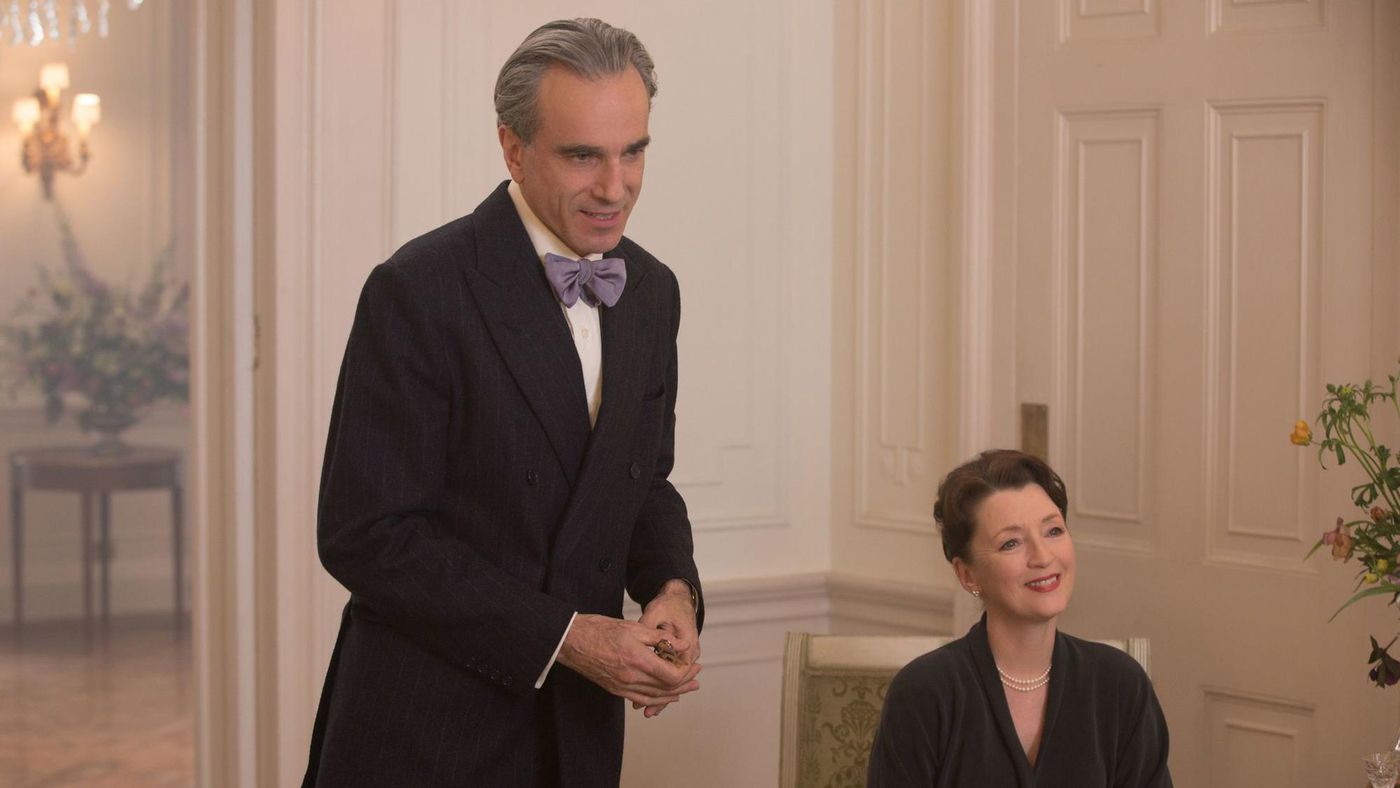
Vicky Krieps and Daniel Day-Lewis play dangerous games in Paul Thomas Anderson’s fascinating film about control, Phantom Thread

Director: Paul Thomas Anderson

Cast: Daniel Day-Lewis (Reynolds Woodcock), Vicky Krieps (Alma Elson), Lelsey Manville (Cyril Woodcock), Camilla Rutherford (Johanna), Gina McKee (Countess Henrietta Harding), Brian Gleeson (Dr Robert Hardy), Harriet Sansom Harris (Barbara Rose), Lujza Richter (Princess Mona Braganza), Judy Davis (Lady Balitmore), Philip Franks (Peter Martin)

The last time Paul Thomas Anderson and Daniel Day-Lewis worked together, we got a true masterpiece in There Will Be Blood. Phantom Thread couldn’t be much more different. In place of rolling plains, oil, and Day-Lewis as a monstrously larger-than-life alpha male, we get confined rooms, handsome dresses and Day-Lewis as a pernickety, obsessive, creepy dressmaker. But Phantom Thread may also be just as intriguing, thought-provoking and memorable in its way as There Will Be Blood.

Reynolds Woodcock (Daniel Day-Lewis) is a leading couturier in 1950s London, whose fashions are highly sought after by the rich and famous. He lives and works with his sister Cyril (Lesley Manville), who dominates his life – and dispatches his various muses as their use comes to an end. On a break near the coast, Reynolds meets Alma (Vicky Krieps), a hotel waitress whom he takes back to London as his latest muse. At first Alma seems to be merely the tool of this fashion Svengali – but Alma has her own desires that quickly spark conflict in the House of Woodcock.

Paul Thomas Anderson’s film has lashings of Daphne du Maurier, Powell and Pressburger (it’s more than a little reminiscent of The Red Shoes) and a slickly inverted Pygmalion. It’s a film that slowly emerges as being about control and the way power relationships can shift and transform. Reynolds at first seems a twisted Henry Higgins: his muses come and go (and, it’s implied, fail to live up to his mother) – he becomes tired of them, and his sister, business partner, factotum and part-time mother-figure Cyril dismisses them when they have served their purpose. 

Reynolds and Alma’s first meeting is one of creepy control. He asks her to memorise his order, wipes her lipstick away so he can “see her” and, in a late night “living mannequin” sequence, dresses her in a series of fabrics and clothes, and offers dispassionate comment about her body. What’s interesting in this sequence though, is that Alma only becomes uncomfortable when Cyril arrives and joins Reynolds in the process. It’s a hint of the developments that will emerge over the course of the film: Alma doesn’t want to share Reynolds.

That’s the tension the film explores from thereon: Reynolds seems to have all the power, but Alma pushes against this to forge her own position as something more than a muse. The film has an acute understanding of the psychology of power in human relationships, which is more than reminiscent of Rebecca: the exact motivations of the characters remain unclear (sometimes even to themselves) until late in the film. The film veers into My Cousin Rachel territory – while giving us a totally unexpected series of emotional developments that spin out of this, which shock but make perfect sense.

That’s because Paul Thomas Anderson has made a sharply observant film about human fallibility and our desire to understand our place in the hierarchies around us, and the unusual paths to contentment that we can find. Like The Red Shoes, it also feels like a film that really understands the psychology of Svengali figures, and adds a Freudian bent to it. Reynolds is looking for a mother to take the place of his own and he is drawn to muses who remind him of her, but who constantly fail to replace her. It’s in the weakness that Reynolds’ perfectionism drives him away from, that he is capable of finding love and happiness.

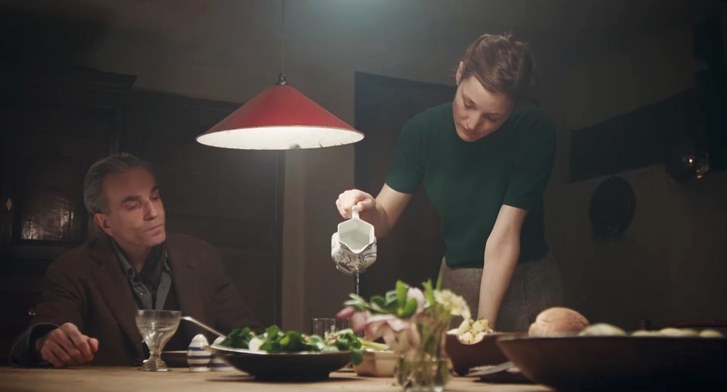
So the film becomes a series of wonderfully low-key power shifts, many of them revolving around meals. It’s established early that Reynolds demands very precise conditions for his breakfasts – most importantly silence; in every breakfast scene that follows, everything from the loudness of the crunching to the amount of scrapping of jam on toast tells you who is in control. 

Because just as Reynolds wants to craft Alma to take on the perfect muse position for his dressmaking – so Alma wants to craft Reynolds into the perfect combination of high-achieving genius whose success she can vicariously enjoy, and a man who needs her emotionally. Anderson’s brilliant, bitter and waspy screenplay shows the different steps both characters dance through to achieve this. Alma’s solution, and its psychological impact, is brilliantly du Maurier; it’s out there, but makes perfect sense.

Visually the film is beautifully crafted. Anderson shoots a lot of the film with a combination of slow prowling shots, and cameras held at close-up or medium shots that regularly place the actors close to the camera. It means that we always feel like we are right in the middle of the action – looking over the shoulders of actors, or seeing their faces loom into the camera. It obviously creates a claustrophobic feeling, but also one of real intimacy – it’s like the camera is dressing the characters, the same way Reynolds does. But Anderson’s choices pull you closer into the action, and get you really thinking about the psychology of the characters you are watching.

And Anderson wants you to get into the psychology here, because he has cast three actors at the top of their game in this tight-character study. Day-Lewis is of course superb, as a character unnervingly precise and cool – his voice is a perfect combination of icy preciseness, and trembling emotional confusion. Reynolds is in many ways a child – his every whim must be followed, he explodes in foul-mouthed (hilarious) fury at any deviation from his procedures. But he’s also an emotionally stunted man who has never got over the loss of his mother, capable of strong sexual feelings and a yearning for closeness. It’s a subtle, controlled, low-key performance.

But Day-Lewis’ retirement has stolen a lot of the attention from Vicky Krieps, who is sensational as Alma. In many ways, she is the real protagonist of the story. Alma is at first our entry into the story – but we quickly learn we know or understand very little about her. She comes from somewhere in Europe, she may well be Jewish, but Krieps makes her hard to define. Unusual and impossible to understand, Krieps makes her a fascinating character. She emerges as a determined, strong-willed, manipulative figure, looking to have a firm place in her partner’s life – she’s both a toy that bites back, and a woman who will settle for no compromise in what she wants. It’s a fascinating performance. 

Lesley Manville rounds out the cast as the waspish Cyril, deliciously spitting out some cruel lines. Manville is terrific, and Cyril sits in an unusual place in the Woodcock house, partly catering to Reynolds’ demands, partly controlling and positioning him. This makes a perfect foil both for Reynolds’ demanding requirements for a mother, and for Alma’s desire to bring Reynolds under her own influence.

Anderson’s film is a beautiful, fantastically scored, wonderfully acted, intriguing character study, and an insightful exploration of emotional and sexual control and the traps we built for ourselves and for others. It’s a film where every scene is open to interpretation, where both the past and the future seem to haunt events and every resolution leaves questions. It’s a brilliant psychological study that rewards endless thinking, analysis – and I’m sure repeat viewings. I think this one could run and run.

Midnight Run (1988)


Robert De Niro and Charles Grodin go on the road in terrific buddy-movie action comedy Midnight Run

Director: Martin Brest

Cast: Robert De Niro (Jack Walsh), Charles Grodin (Jonathan “The Duke” Mardukas), Yaphet Kotto (Special Agent Alonzo Mosely), John Ashton (Marvin Dorfler), Dennis Farina (Jimmy Serrano), Joe Pantoliano (Eddie Moscone), Richard Foronjy (Tony), Robert Miranda (Joey), Jack Kehoe (Jerry Geisler), Wendy Phillips (Gail), Danielle DuClos (Denise Walsh), Philip Baker Hall (Sidney)

There are few comic set-ups you can get better mileage from than an “odd couple” – they meet, they argue, they grow closer, they fight again, they reconcile. It’s a standard formula. Midnight Run throws this together with a road trip formula (two people have to get from A to B but via every other letter of the alphabet). Really it should be hugely predictable. But Midnight Run is well written, very well acted and hugely fun – it manages to feel both light and frothy, but also sufficiently real and dangerous. It’s a great comic movie.

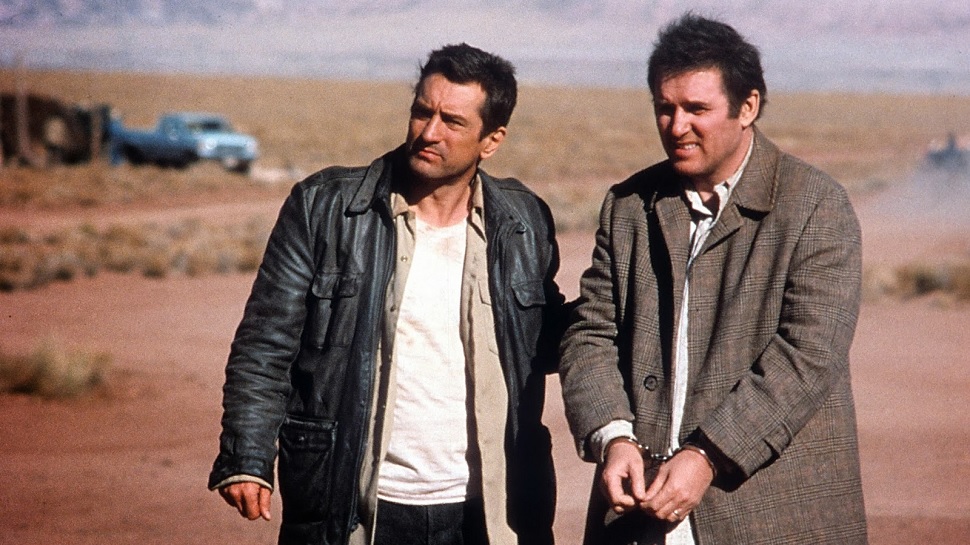
Jack Walsh (Robert De Niro) is a down-on-his-luck bounty hunter. Having been run out of the Chicago police force years ago for not taking a bribe, he’s skilled at his job but fundamentally unlucky and disenchanted. He’s looking for one big job to get him out: and it comes when mob accountant Jonathan “The Duke” Mardukas (Charles Grodin) skips bail. Hired by bail bondsman Eddie Moscone (Joe Pantoliano), Walsh has four days to find the Duke bring him back to LA before his bail is forfeit – manage it and he’ll get a cool $100k. But the Duke has stolen millions from the mob – so they want him dead, the FBI want him to testify, rival bounty hunters want to take him in – it’s all working out into a very long week for Walsh.

I really enjoyed Midnight Run when I first watched it years ago – and it’s been years since I’ve seen it – so it’s a delight to find it is as good as I remember. In fact, if anything, I think it might be better. It’s very funny – without anyone playing the material for overt or obvious laughs – but it’s also got a lot of soul. It never loses sight of the characters at its heart, in particular the loneliness, sadness and regret at the heart of Walsh, who presents a chip-on-his-shoulder stance to the world, to hide a decent and honourable man who can’t believe his principles are rewarded.

De Niro took on Midnight Run because he wanted to try comedy (he had just played Satan and Al Capone, so probably had earned a rest). Walsh is probably one of his best comedic performances, because he treats it with the investment he gave his greatest roles. He makes Walsh a real person – and he’s willing to downplay the comedy. He doesn’t mug or play to the camera (as he has more recently), he just plays the role with a slight wryness, a touch of lightness from the actor, while the role itself is kept real. His increasing frustration and world-weary resignation matches up perfectly with the hint of sadness he keeps under the surface. It’s a very effective performance.

It helps as well that De Niro allows Charles Grodin to carry the bulk of the comedy. Grodin was cast over the wishes of the studio – but it was an inspired move as the chemistry between the two actors is fantastic. They play off each other brilliantly, Grodin the more worldly, urbane and dry accountant, opposite the stressed out Walsh. Grodin is very funny, and very genuine – and he’s as whippersmart as the Duke himself, constantly keeping us on our toes as to when the Duke is telling the truth, and when he is pulling the wool over our (and Walsh’s) eyes. 

The film throws these two into a series of increasingly hilarious events – from a panic-attack on a plane, to a sneaky piece of con-man work in a back-district town – but mixes it up with genuine moments where the two open up to each other (there is a wonderful scene where Walsh, under the Duke’s gentle probing, final opens up about his past). Each of these moments is wonderfully played, and works so well because the two actors have a genuine connection between them. Both lift the other: Grodin clearly helps De Niro relax and loosen up, De Niro encourages Grodin to bring a greater depth to his acting than ever before.

The contrivances and competing parties they take on also throw in plenty of fun problems. My recording from the BBC from years ago was somewhat sanitised, so it’s a surprise to hear how many times De Niro uses the f-word in this film! Martin Brest films all this with a controlled restraint – perhaps a little too much control (Yaphet Kotto has talked of his misery of performing endless takes of even the simplest scenes). But the dangers Walsh has to take on walk just the right line between feeling real, and feeling comedic.

So we have a sinister gang-boss (played with lip-smacking relish by Dennis Farina), but his underlings on the ground are realistic-feeling, but non-too-bright gangsters (sharp enough to keep track of Walsh, dull enough to constantly say the dumbest things). The Feds are led by a tensely wound-up Yaphet Kotto, but the comedy comes from his cold stares at his underlings, who are prone to state the obvious. John Ashton is good value as a rival bounty hunter, a regular joe not-as-smart-as-he-thinks, but more than smart enough to win the odd hand. Joe Pantoliano gives possibly one of his most Pantoliano-performances of weasily whininess as Walsh’s bail bondsman boss.

Midnight Run rattles along brilliantly. It’s hugely entertaining, with a series of surprisingly high-blown action set-pieces (all met with a dry reaction from the Duke – “I’m sure we’re completely safe” when a pursing gun-laden helicopter temporarily drops out of view – and in turn a furious “Will you shut the fuck up!” from Walsh). Martin Brest gets the balance just right between comedy and drama, and creates a very funny movie where you end up caring a great deal for the characters. It’s a road-movie, buddy comedy that feels fresh and really works because it manages not to feel like it’s trying too hard. And of course it has a great closing scene – and one of my favourite end-lines to a movie ever: “Looks like I’m walking”. Check it out. You’ll like it.

Jurassic World (2015)


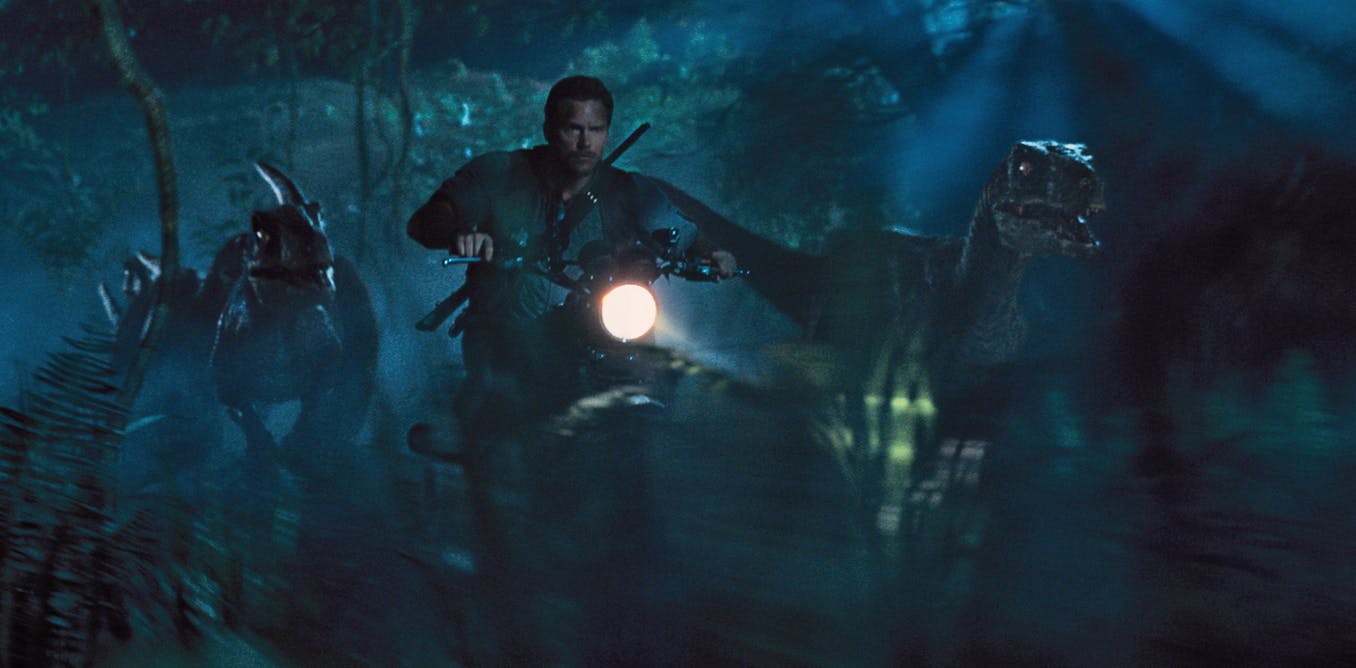
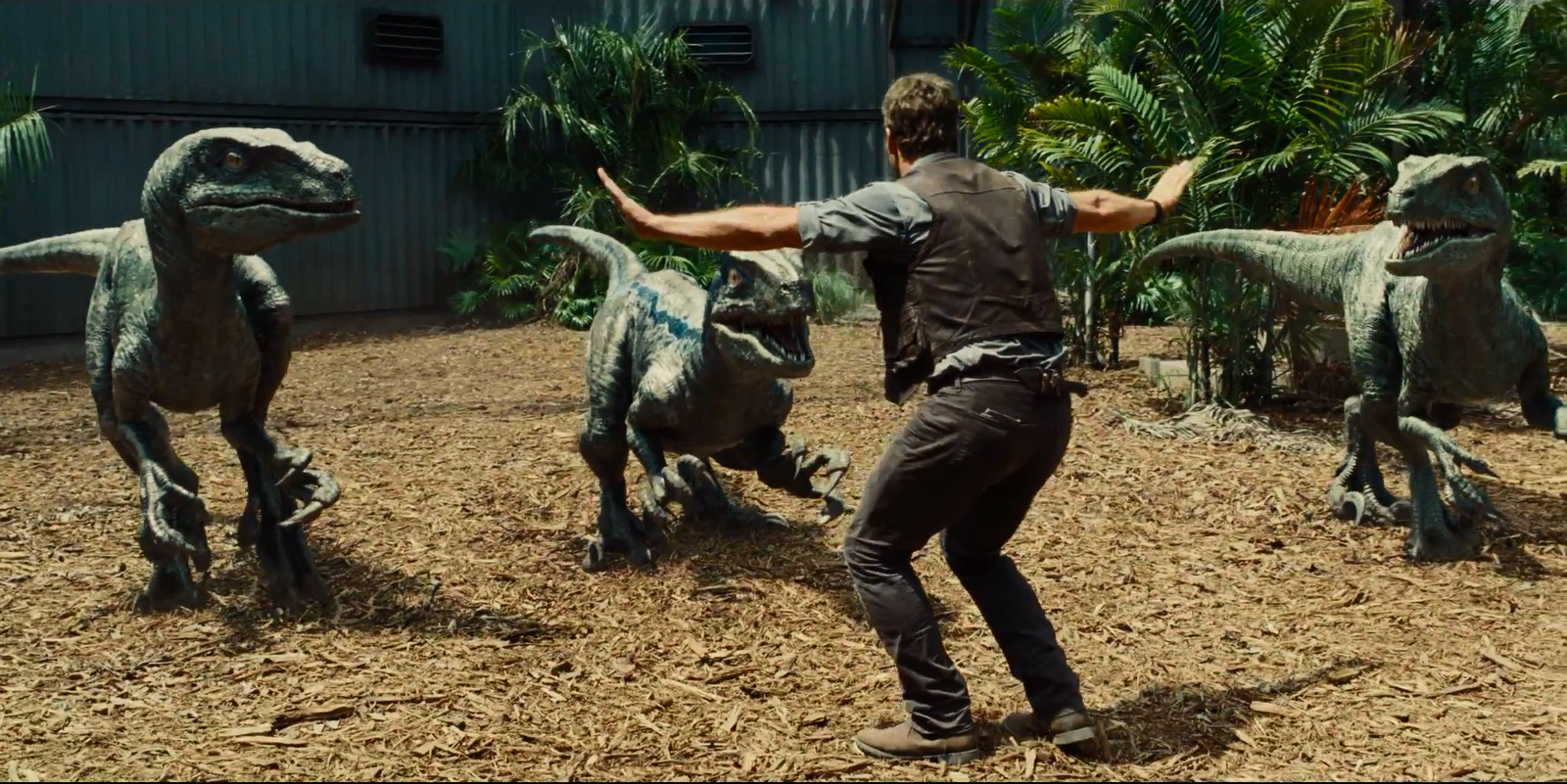
Chris Pratt rides into action with a pack of velociraptors – it could only be Jurassic World

Director: Colin Trevorrow

Cast: Chris Pratt (Owen Grady), Bryce Dallas Howard (Claire Dearing), Vincent D’Onofrio (Vic Hoskins), Ty Simpkins (Gray Mitchell), Nick Robinson (Zach Mitchell). Omar Sy (Barry), BD Wong (Dr Henry Wu), Irrfan Khan (Simon Masrani), Jake Johnson (Lowery Cruthers), Lauren Lapkus (Vivian), Katie McGrath (Zara), Judy Greer (Karen Mitchell), Andy Buckley (Scott Mitchell)

When I was younger, the most exciting film ever was Jurassic Park. Imagine the thrill of a 12-year-old who loved dinosaurs, seeing these mighty beasts on the big screen. I collected all the stickers, and read the books (not the same as the movie – boo) and everything. In this (but nothing else) I seem to be quite similar to Chris Pratt, who described Jurassic Park as “his Star Wars”. So it’s nice to think I have a kindred spirit in this hugely entertaining, exciting and fun spin-off.

Set in the modern day, the old site of Jurassic Park has been turned into a hugely successful theme park, entertaining hundreds of thousands of guests a year. Two brothers, Gray (Ty Simpkins) and Zach (Nick Robinson) visit the park, where their aunt Claire Dearing (Bryce Dallas Howard) is the operations manager. The park has plans to launch its new attraction – a genetically engineered super dinosaur called Indominus Rex. Owen Grady (Chris Pratt), a former Navy Seal who has been working on training the park’s velociraptors to obey commands, is called in to consult on the animal – only for it to escape and to begin to unleash bloody havoc on the island.

The sheer joy of Jurassic World is its familiarity and its freshness. The escape of the Indominus – and the rampage of chaos that follows – is of course completely expected, but the film tells all this with enough wit and wry tongue-in-cheekness that it completely works. It’s a film that wants to entertain and to give you a fun night out in the cinema, but is also happy to present its action and thrills with an honest, old-fashioned joy. It’s even willing to show a bit of restraint – the opening 20-30 minutes of the film largely set out what an amazing place to visit Jurassic World would be.

That’s the trick to the film – it reintroduces that sense of wonder. The film manages to feel very Spielbergian – the slow-build, the clash between the big corporations and the individualist who knows best, the kids as POV characters, the soaring visuals and delight in seeing these marvellous things brought to life – it’s all there. Trevorrow even thows in moments of genuine sadness (helped by the Williamesque score that riffs on the original theme) as the characters look out on a field of slaughtered dinosaurs from the Indominus. The film sets out to remind you why millions of people loved the first film, by letting the film-makers’ own love of that film shine through.

It’s also got quite a neat meta-twist on blockbuster films. The first 20 minutes has several conversations from the park’s suits about how just creating dinosaurs “isn’t exciting enough anymore” – the Indominus being created to make a dinosaur bigger, better, fiercer than ever before. Could this be any more blatant a comment on the arms race of blockbuster films? It’s also a neat continuation of ideas from the very first film: they were so pleased about being able to make something, they didn’t stop to think if they should.

But all this meta commentary (the park itself is an explosion of product placement, including actual Jurassic Park merchandise) doesn’t get in the way of a darn good yarn. And turning the Indominus into a deluxe killing machine – it’s so twisted by years in solitude it basically kills everything it sees – makes it the best villain the series may have had. Of course not only the Indominus chalks up kills – plenty of other dinos get a look in, and one character in particular gets a death scene so completely over-the-top you can’t help but laugh a little (if rather guiltily).

So you can see why rent-a-baddie Vic Hoskins from corporateville wants Owen Grady to send in his velociraptors to take it out. The series’ longstanding terror figures are reimagined here as hazy allies – and seeing Chris Pratt (respectfully) give them commands and pet them immediately establishes his cool credentials. Grady takes on the role of the man humble before nature – he stresses he doesn’t control the raptors, it’s a relationship of mutual respect – as well as being the sort of kick-ass alpha male that Harrison Ford would have played in his prime.

Pratt is pretty damn good in the film – the perfect guy to root for – and the velociraptor action is undeniably cool. Bryce Dallas Howard has a rather thankless part as his uptight love interest (and yes she wears those shoes for the whole film) but she does play the part with a certain wit. Simpkins and Robinson are very good as kids you end up rooting for rather than hating. Most of the rest of the cast fit neatly into deserving dino-fodder or otherwise (and by-and-large meet the expected fates), but Wong is good as a sinister Dr Wu, and Johnson and Lapkus give some good comic relief (including one laugh out loud moment) as technicians.

Jurassic World is such great fun from start to finish I can more or less overlook its flaws. Sure its dialogue is sometimes clunky. Sure logic often goes out of the window. Sure Iffran Khan’s character fluctuates so wildly (one minute he’s a “let’s just have fun” guy the next he’s a “bottom dollar is God” CEO) that you can tell it was probably changed in reshoots after feedback. D’Onofrio’s villain is so straight forward you’ve seen him dozens of times. The film is, at heart, an episodic series of clashes between Indominusand a range of adversaries.

But it doesn’t matter because it is a film that understands – and can speak – the language of movie magic. That can mix thrills with awe. That knows the key to your heart is not offering you bigger bangs, but in working hard to give you characters you care about. It’s a film made by people who loved the first movie but – and this is so rare – also understood what made the first film so good. And who can resist cheering the final few moments as a half-team of dinosaurs and humans take on the Indominus for final showdown? It’s a perfect Spielbergian rollercoaster ride and I’ve seen it dozens of times and I love it. It’s one of my ultimate guilty pleasures.

Harry Potter and the Deathly Hallows Part 1 (2010)

Harry and friends are on the run in the excellent Harry Potter and the Deathly Hallows Part 1

Director: David Yates

Cast: Daniel Radcliffe (Harry Potter), Rupert Grint (Ron Weasley), Emma Watson (Hermione Granger), Helena Bonham Carter (Bellatrix Lestrange), Robbie Coltrane (Rubeus Hagrid), Ralph Fiennes (Lord Voldemort), Michael Gambon (Albus Dumbledore), Brendan Gleeson (Mad-Eye Moody), Richard Griffiths (Vernon Dursley), John Hurt (Mr Ollivander), Rhys Ifans (Xenophilius Lovegood), Jason Isaacs (Lucius Malfoy), Bill Nighy (Rufus Scrimgeour), Alan Rickman (Severus Snape), Fiona Shaw (Petunia Dursley), Timothy Spall (Peter Pettigrew), Imelda Staunton (Dolores Umbridge), David Thewlis (Remus Lupin), Toby Jones (Dobby), Tom Felton (Draco Malfoy), Peter Mullan (Yaxley), Evanna Lynch (Luna Lovegood), Julie Walters (Molly Weasley), Mark Williams (Arthur Weasley), Bonnie Wright (Ginny Weasley), Helen McCrory (Narcissa Malfoy), George Harris (Kingsley Shacklebolt), Clémence Poésy (Fleur Delacour), Domhnall Gleeson (Bill Weasley), Warwick Davies (Griphook), Nick Moran (Scabior), Guy Henry (Pius Thicknesse), David O’Hara (Albert Runcorn), Sophie Thompson (Malfada Hopkirk), Steffan Rhodri (Reg Cattermole), Simon McBurney (Kreacher)

The final book of the Harry Potter series made its own slice of film history: it was the first time a book was adapted in two films to “get the whole story of the book across” (or to make double the box office cash – take your pick). There was scepticism about creating a film about the first half (or so) of The Deathly Hallows, as a large chunk revolves around our heroes walking around the countryside, confused, lost and adrift. Instead, Harry Potter and the Deathly Hallows Part 1 turns this material into one of the richest, most engaging and best films in the series. Any film that expands a throw-away reference from the books to Hermione removing her parents memories of her, into an affecting opening scene showing Emma Watson doing the same is really inventively playing with the original source material.

David Yates takes on his third Harry Potter film – and this is possibly the best he filmed. In fact, the whole film feels fresher and different – perhaps because it’s the only film to not have a single scene at Hogwarts. Instead our characters are out in the forest and on the run – and the film has completely different vibe, immediately lending it a uniqueness. Equally, it isn’t shy about pointing out our heroes are all-at-sea. Harry doesn’t really know what he is doing, or where to start with his self-imposed quest: and surely when Ron angrily asks why Dumbledore didn’t tell him more (or if Harry wasn’t even listening properly) he’s voicing some of the questions of the audience.

This film, more than any other, focuses on the relationship between the leading three characters. While getting an idea of their friendship and loyalty to each other, we also get a sense of the tensions and envy between them. Not least in Ron’s grudging acceptance that he is the number two. Rupert Grint has been slowly building under David Yates’ films from a comic relief character to an increasing (slightly surly) teenage insecurity and troubled sexual maturity. 

This really pays off in this film: Ron is bitter and jealous. These feelings might be exacerbated by the necklace the characters must take turns wearing, but it’s just bringing to the surface Ron’s darker feelings of inadequacy: and Yates even brings them to the screen in a necklace-induced vision of a naked (but artfully concealed in smoke!) Harry and Hermione alternately making out and rubbishing Ron. It’s a plot point that covers Ron overcoming his resentment and cementing his position in the gang. It’s very well done – and Rupert Grint is very good.

Equally good is the gently sad, mutually affectionate relationship between Harry and Hermione. Alone together for large chunks of the film, the characters’ bond is firmly established, the chemistry between the two actors never clearer. The film plays with the subplot it’s been suggesting for a while of a potential deeper relationship between Harry and Hermione: not least in its beautiful silent dancing sequence to Nick Cave in the tent (one of the best ever entirely invented scenes in the series) that is friendly, but with a hint of the possibility of something more – something the characters seem to consciously decide to bench. This sort of emotional reality is what makes the film really stand out. It turns the “camping trip” of the novel into something more profound and engrossing – I’d say this is the only sequence that really outdoes the books altogether in the entire series.

But of course there is still plenty of action, and humour, a highpoint for both being our heroes infiltrating the Ministry of Magic, disguised as ministry employees. Playing the adult disguises of our heroes brings out three hilarious and sharply observed physical performances from David O’Hara, Steffan Rhodri and Sophie Thompson. In fact, the film has a bit of a thing for disguises, from a disfigured Harry (who may or may not be recognised by Draco, in another piece of excellent acting from Tom Felton as a terminally out-of-his depth and terrified Malfoy), to the opening scenes featuring half the cast being disguised as Harry. Daniel Radcliffe excels in this sequence, playing versions of most of the young cast with real wit and skill.

Yates allows a creeping sense of imminent danger to hang over the whole picture, straight from the off. A “conference of baddies” at Malfoy manor shows us Voldemort (the ever sinister Ralph Fiennes) re-establishing his murderous villainy from the start – and also belittling and mocking poor Lucius Malfoy (a crushed Jason Isaacs). From there, via a gripping escape from Harry’s home, to a wedding scene that quickly collapses into a terrifying attack from Death Eaters, it’s a film full of excitement.

Yates shoots this with tension and edge. A sequence with Harry and company fleeing through the forest from snatchers is so well-done, so intense and immersive, that they used it for the poster. This sequence uses really interesting camera work and tracking shots – in fact the whole film is very well filmed and extremely well-paced. It’s also got an eye for the real nastiness of regimes like Voldemort’s: people like Umbridge (an increasingly Himmlerish Imelda Staunton) flourish, while bullying thugs like Yaxley (an intimidatingly excellent Peter Mullan) rule the roost.

Kloves script sets up a lot of the fascinating back-story from the novel, not only around Dumbledore but also the Deathly Hallows themselves (I’ll not mention for now that most of this build-up is fumbled in the last film). There is a beautiful animation sequence establishing the history of the Deathly Hallows, which is an artistic highlight. The slow unveiling and revealing of facts is wonderfully done – and rewards the patient viewer.

The film culminates in a final sequence at Malfoy manor that carries a great wallop of emotional torment and dread (first torture scene in a Potter movie for those interested…). Surprisingly a lot of this emotional force comes from Dobby the elf – irritating as he was in Chamber of Secrets, here he gets a few scenes that carry real emotional force. 

Harry Potter and the Deathly Hallows Part 1 is possibly the only Harry Potter film that is an actual improvement on its original source material (there I said it). I think it’s a brilliant film, a film which carries real emotional weight and has genuine things to say, not just about good and evil, but also about the sort of teenage angst and yearnings we’ve all had. The three leads are all excellent, and there is barely a bum note in the whole thing.

Darkest Hour (2017)


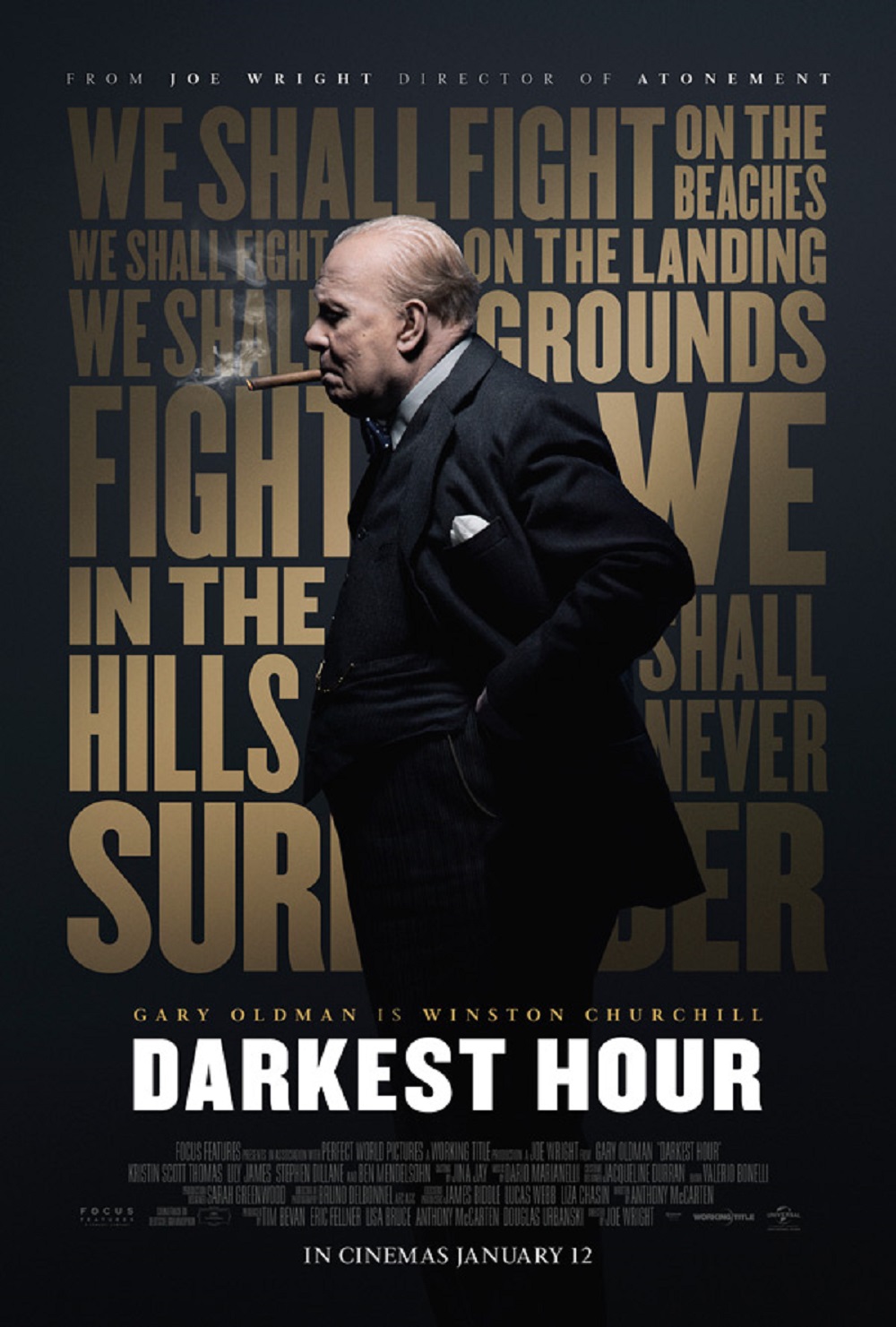
Gary Oldman, rather surprisingly, rather is Churchill during his Darkest Hour

Director: Joe Wright

Cast: Gary Oldman (Winston Churchill), Kristin Scott Thomas (Clementine Churchill), Lily James (Elizabeth Layton), Ben Mendelsohn (George VI), Stephen Dillane (Lord Halifax), Ronald Pickup (Neville Chamberlain), Samuel West (Anthony Eden), David Schofield (Clement Atlee), Malcolm Storry (General Ironside), Richard Lumsden (General Ismay), Joe Armstrong (John Evans), Adrian Rawlins (Air Chief Marshall Dowding), David Bamber (Vice-Admiral Ramsay)

One of my favourite ever TV series is Winston Churchill: The Wilderness Years, a chronicle of Churchill’s time out of government (basically 1929-1939). It covers the political clashes between Churchill and his rivals brilliantly, as well as giving us a real feeling for Churchill’s own personality and flaws and featured a brilliant performance from Robert Hardy. Darkest Hour takes off almost where that series ends – and I think it might just be a spiritual sequel. And, for all its flaws, I might even grow too really like it.

Joe Wright’s Darkest Hour is a beautifully filmed, imaginatively shot retelling of the crucial first month of Churchill’s premiership. Wright uses a great device of flashing the date up (in an imposing screen-filling font) as each day progresses. Apart from brief moments, the action rarely leaves Whitehall, with the focus kept tightly on the politics at home. Will Churchill win over the war cabinet to continue the war, or not? It revolves around dialogue shot with tension and excitement, and is structured key Churchill speeches: each carrying all the emotional impact you could expect and beautifully performed, with goose-bump effect by Gary Oldman.

Because yes, this film’s one piece of genuine excellence, and what it is really going to be remembered for, is the brilliance of Oldman’s performance. This is one of those transformative performances where the actor disappears. Of course it’s helped by the make-up, but there is more to it than that. The voice, the mannerisms, movement, emotion – as a complete recreation of the man it’s just about perfect. Whatever the film’s flaws, Oldman nails it. Sure it’s larger than life – but so was Churchill.

Oldman’s Churchill is irascible, demanding and temperamental – but he’s also warm and humane. In one beautiful moment he conducts a conversation with an un-encouraging Roosevelt, where his features seems to shrivel and shrink with despair, while his voice keeps up the optimism. Moments of gloom hit home, but there is also humour (and Oldman is actually rather funny in the lead role). There’s moments of pain, guilt and depression – it’s terrific.

However it does mean some of the other actors scarcely get a look in. Kristin Scott Thomas in particular gets a truly thankless part, no less than four times having to counsel a depressed Churchill with variations on “You’re a difficult but great man and your whole life has been leading to this moment” speeches. Lily James actually gets a more interesting part as Churchill’s admiring secretary, getting the chance to be frightened, awed, amused and frustrated with the Prime Minister – and she does it very well, even if her part is a standard audience surrogate figure.


The characters are neatly divided in the film: they are either pro- or anti-Churchill. The “pro” characters largely get saddled with standing around admiringly around the great man (Samuel West gets particularly short-changed as Eden becomes Churchill’s yes man). The “anti” characters mutter in corridors about how unpredictable and dangerous he is, how he could wreck the country etc. etc.

To be fair to the film, it does at least treat the doubts of Halifax (Stephen Dillane – all clipped repression, he’s excellent) and Chamberlain (Ronald Pickup – serpentine and tactical, although Chamberlain’s hold over the Tory party was nowhere near as great as this film suggests) as legitimate concerns. It does weight the dice in favour of Churchill, and we don’t get enough time to fully understand the reasons why peace with Hitler might have seemed reasonable in 1940 (tricky to get across to a modern audience so aware of Hitler’s status as evil incarnate). But Halifax’s stance that it was better to cut your losses than fight on to destruction is at least treated sympathetically, rather than making him a spineless weasel (as others have done).

The film really comes to life with the conflict between the Halifax-Chamberlain alliance and a (largely alone) Churchill. The cabinet war room clashes have a fire, energy and sense of drama to them that a lot of the rest of the film doesn’t always have. It sometimes drags and gets lost in filling the time with “quirky” moments with Churchill. There is a bit too much domesticity that feels irrelevant when we know the fate of the nation is at stake.

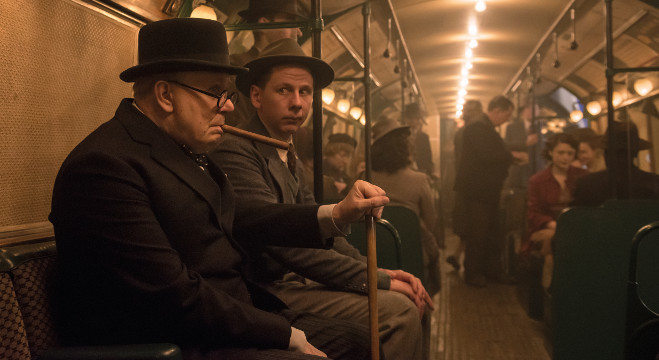
But then this is a sentimental film. Not only is it in love with Churchill (we see some blemishes, but his air of perfection goes unpunctured), but it uses devices that feelas you are watching them like sentimental film devices. None more so than Churchill bunking down on a tube train to exchange encouraging words with regular people and for them to tearfully recite poetry at each other. In fact it’s a testament to Oldman that he largely gets this hopelessly fake-feeling scene working at all.

Wright’s film makes a point later of demonstrating that – reporting back to the Tory party the results of this conversation – Churchill uses the names of the people he met, but completely replaces their words with his own. But it still gets itself bogged down in this sentimentality – including a teary end caption on Churchill being voted out of office. Every scene with Churchill and Clementine has a similar chocolate box feel, as does a late scene with George VI (who seems to flip on a sixpence between pro and anti-Churchill – although Ben Mendholsen is very good in the role).

Darkest Hour is an extremely well-made film. It’s told with a lot of energy – and it has a simply brilliant lead performance. Joe Wright finds new and interesting ways to shoot things: there are some great shots which frame Churchill in strips of light surrounded by imposing darkness. But its not brilliant. It will move you – but that is largely because it recreates actual real-life, moving events (who can listen to Churchill without goosebumps?). But it’s given us one of the greatest Churchill performances and it’s worth it for that if nothing else. And, for all its flaws, and the safeness of its storytelling, I actually quite liked it – and I think I could like it more and more as I re-watch it.

Excalibur (1981)


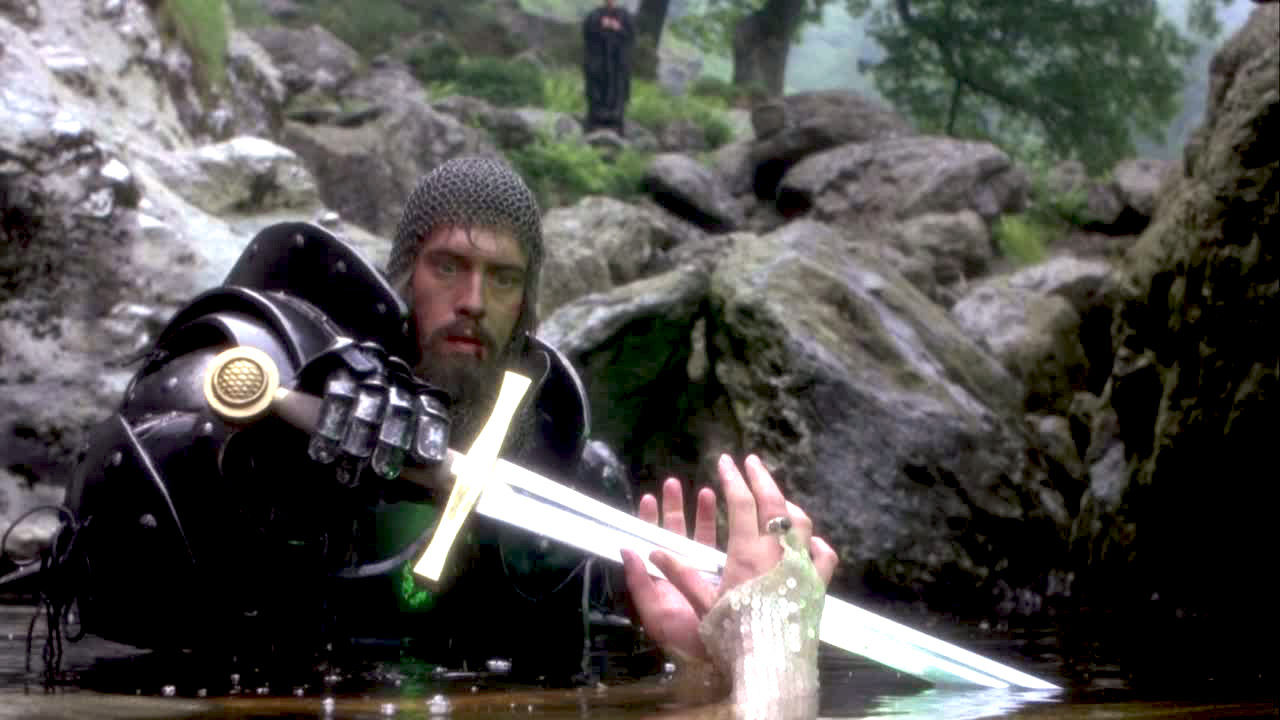
Nigel Terry gets a special gift in John Boorman’s crazily OTT Arthurian epic Excalibur

Director: John Boorman

Cast: Nigel Terry (King Arthur), Nicol Williamson (Merlin), Helen Mirren (Morgana Le Fay), Nicholas Clay (Sir Lancelot), Cherie Lunghi (Guenevere), Paul Geoffrey (Sir Perceval), Gabriel Byrne (King Uther Pendragon), Corin Redgrave (Duke of Cornwall), Patrick Stewart (King Leondegrance), Keith Buckley (Sir Uryens), Clive Swift (Sir Ector), Liam Neeson (Sir Gawain), Robert Addie (Mordred), Niall O’Brien (Sir Kay), Ciarán Hinds (King Lot), Charley Boorman (Young Mordred), Katrine Boorman (Igrayne)

John Boorman had wanted to make a film about King Arthur for over a decade, but it only came into being after his plans for an adaptation of The Lord of the Rings fell through (the suits were convinced the film couldn’t be a hit – good call). So, with a lot of prep work for Tolkien in place, Boorman moved a lot of his ideas for LOTR over to Excalibur. In doing so he created something probably truly unique – a bonkers version of the Arthurian legend, so consistently Wagnerian (often literally), high-falutin’ and overblown that it has a strange integrity in its operatic silliness.

The film begins with Arthur’s conception, a result of King Uther’s (Gabriel Byrne) lust for his ally’s wife, Igrayne (the director’s daughter Katrine). Merlin (Nicol Williamson) agrees to magically disguise Uther as Igrayne’s husband for one night, and in return spirits away the resulting child to be reared ignorant of his heritage. Years later, with a leaderless kingdom in chaos, Arthur (Nigel Terry) draws the magical sword Excalibur from the stone, and proves himself as king. He marries Guenevere (Cherie Lunghi) and brings Sir Lancelot (Nicholas Clay) to Camelot – oblivious of their love for each other. Slowly this love destroys the peace of the land – encouraged by the schemes of Arthur’s vengeful half-sister Morgana (Helen Mirren).

Excalibur is a film set in a completely heightened middle-ages dreamworld, as if it’s a series of drawings from an illustrated edition of King Arthur brought to life. The design of the film is dialled up to eleven: the armour the characters wear is ridiculously elaborate, shiny and eye catching. The characters never seem to take it off: Uther even has sex wearing it (poor Igrayne is completely naked – that can’t have been comfortable for her). Full armour is worn at meals, wedding, social events, everything: at the same time it’s brilliantly ineffective, punctured with ease by axes and spears.

The rest of the design of the film is equally overblown. Camelot seems to have been literally made from silver and gold. Lancelot kips in the forest and sleeps in the nude. Battle scenes are filmed on moody, misty nights, with horses and knights riding with insane riskiness at each other. Excalibur itself is almost impossibly shiny and unblemished and occasionally glows green. Everything has a high-artistic feel to it, like a Romantic painting. Nothing looks real – it uses a “rule of cool” aesthetic, anything that looks good from anything approaching medievalism is used.

The acting itself follows this operatic style. Half the dialogue is delivered shouting: Patrick Stewart in particular must have lost his voice while filming this one. Filmed in Ireland (it practically kickstarted the Irish film industry), many Irish actors got their first film break here, not least Gabriel Byrne (a furiously lusty Uther), Liam Neeson (a drunken oafish Gawain) and Ciarán Hinds (growling in the background). Each roars through their dialogue, perhaps none more so than Corin Redgrave who screams his with such flemmy passion it’s often hard to work out what exactly he’s saying. 

There are quieter moments from the three leads, even if all three of them don’t really have the charisma to impose themselves on sketchily drawn characters. Cherie Lunghi adopts an odd, part-time Irish accent as a bland Guenevere. Nicholas Clay is an upright Lancelot who simmers with guilt but is just a wee bit dull. Nigel Terry’s performance as Arthur (from young yokel to tortured king) gets better the more times I see it, but it lacks a certain star quality. But then in Boorman’s design, these three characters are just tools of fate rather than real characters – and the film has so much story to cover it often has very little time for character development.

The real stars of this film are Nicol Williamson and Helen Mirren. The two actors had a long-standing animosity – Boorman deliberately cast them to get an extra spark out of their scenes. But both actors seize their colourful characters – and have the time to add some depth to their bombastic, larger-than-life moments. Mirren gets to express bitterness and fury under simmering sexuality, as well as a genuine love for her son. Williamson is fantastic: playful, half nutty professor, half vengeful force of mystic power, he turns Merlin into an eccentric but somehow sinister old man. Williamson finds bizarro and unique line readings of even the simplest lines, stretching the material in the way only a really great actor can. He’s such an electric and interesting character, that he makes a performance that’s basically well over the top, hugely enjoyable and also even rather sweet.

As such, Williamson is perfect for Boorman’s overblown, crazy film. The score uses Wagner and Carmina Burana to great effect, and the closing moments are shot before a giant blood red sky. Boorman’s shiny, colourful world effectively melts down in the second half of the film into musty, moody greys: his concept of Arthur losing his way and the kingdom disintegrating works extremely well, and means we get a real sense of things falling apart. The Grail Quest is like a creepy fever dream – with knights we have known dying in gruesome ways, freezing in chapels or hanging in a tree with their corpses picked clean by crows (of course one crow eats an eye!). 

In many ways Excalibur is a very silly film: it’s hard to believe it was made six years after Monty Python and the Holy Grail, as much of its design and action is more than a little reminiscent of that film (it’s probably the only parody you could argue was made before the film it best sends-up). You probably need to see it at a certain age or enter into it with the right mindset for something that walks a difficult line between fairy tale and earthy campness. But I still love it.

Because Boorman really goes for it here. You know from the early sequence of Uther and Igrayne having sex against a background of actual fire, in full plate armour, intercut with a lingering death of Cornwall impaled on a series of spears in Uther’s camp (his death and Uther’s climax are of course cut together) what sort of film you are going to get. Everything is OTT. The drama leaves nothing behind, and Boorman wisely removes any sense of restraint from this telling of the legend. It looks gorgeous – even if dated moments like the Lady of the Lake are more likely to raise sniggers than not – and it really, really goes for it. Not many other films could get away with something so over-the-top and bizarre: but this sort of does.