Author: Alistair Nunn

Golda (2023)

Golda (2023)

Undramatic saga of Middle East history that fails to bring seismic events to life

Director: Guy Nattiv

Cast: Helen Mirren (Golda Meir), Camille Cottin (Lou Kaddar), Liev Schreiber (Henry Kissinger), Rami Heuberger (Moshe Dayan), Rotem Keinan (Zvi Zamir), Lior Ashkenazi (Lt General David Elazar), Dvir Benedek (Major General Eli Zeira), Ed Stoppard (Major General Benny Peled), Dominic Mafham (Lt General Haim Bar-Lev), Emma Davies (Miss Epstein), Ohad Knoller (Major General Ariel Sharon)

I’m sure you couldn’t have picked a worse time to release a film celebrating Israel’s fight against the Arab nations than November 2023. As the world looks on in horror at the latest cycle of violence engulfing Gaza, it hardly feels like the right time to kick back and cheer as Israeli forces fight for their country in the 1973 Yom Kippur War. But, even without that, Golda is fatally undermined by being a turgid, dull biopic where despite the volume of events little is made either engaging or interesting.

Golda Meir (Helen Mirren) is Prime Minister of Israel, managing the country’s military response after the combined forces of Egypt and Syria launch a surprise attack on the Golan Heights and Sinai. After intelligence failures leave Israel on the back foot, Meir must plan Israel’s counter-offensive, deal with the moral complexities of sacrificing soldiers, and work diplomatically to ensure the continued support of the US via Secretary of State Henry Kissinger (Liev Schreiber), all while dealing with cancer. All of this is told through the intermittent use of a framing device, where Meir is being interviewed by a 1974 committee investigating those intelligence failures.

Golda is obviously apeing Cuban Missile Crisis political thriller Thirteen Days, with its focus on a tight timeline, generals in cigarette-smoke-filled rooms making tough calls, and the dilemmas faced by an elected leader trying to ensure their country’s survival. Unfortunately, where Thirteen Days mixed history lesson with genuine drama, Golda just feels like it takes thirteen days to watch. How did they manage to make such a seismic conflict as dull as this?

There was a bit of controversy initially on casting the non-Jewish Helen Mirren. That can be largely forgotten, not least because Mirren is by some way the best thing in the film, gravelly and conveying the unbearable pressure on Meir. She even gets to show her human side, with sweet scenes with her loyal assistant (well played by Camille Cottin) and a plate of borsch and an offer for Henry Kissinger (a decent Liev Schreiber). Mirren is caked under various prosthetics but does a good job.

But the rest of the film is a dull mess with its flat, lifeless script singularly failing to add tension or drama. The film feels like a box-ticking exercise, from flat conversations on various troop movements to the casualty figures Meir dutifully records in her notebook. Only rarely does the film bring any of this viscerally to life (such as the increasingly crowded morgue Meir walks through to receive her cancer treatments). Events at the front are given no human face to draw us into the crackly reports coming in over radios, and there is little sense of characters having to debate and choose between different courses of action under huge pressure. Keeping the action contained within just a few indoor locations serves to make the film feel cheap rather than claustrophobic.

Our only glimpse of the front is to see Dayan fly over the Golan Heights (and promptly vomit in guilt). Discussions in briefing rooms get bogged down in establishing who someone is and what they are in charge of, rather than communicating the stakes. So, we get various uniform-clad actors spouting reams of geographical locations, division numbers and military statistics, accompanied by maps where the odd cigarette lighter stands in for various armies. Somehow, despite the volume of talking, its nearly impossible to understand any of this, so poorly is it communicated visually.

That’s before we get started on the film’s one-sided lack of historical context. A brief series of captions that opens the film runs down an Israeli-only perspective of the country’s history. The crucial background of the 1967 war – a pre-emptive strike by Israel that seized the land now being attacked in 1973 – is completely ignored. It’s never made clear that the Arab nations argued they had launched their attack in response to 1967, and no wider context is given.

This feels particularly awkward considering recent events (in late 2023) threw the conflicting narratives in the region even more into the limelight. Both Arabs and Israelis have legitimate cases. But a film that focuses on one side only and whose only Arab voice is a radio intercept of a Syrian gleefully celebrating the “death of the Zionists” hardly feels like it is making a mature and sensitive statement about the Middle East conflict.

It means the film’s final celebration that the war led to the peace agreement between Egypt and Israel – including the recognition of Israel by Egyptian Premier Sadat – rings hollow. Peace, as a topic, is never raised in the course of the film (so hardly feels like a thematically correct ending) and its celebration at the end feels like a fig leaf to suggest an “upbeat” ending, when 1973 was effectively just another round in a war that was to continue (with increasingly horrific impact on civilians on both side) for the rest of all our lifetimes so far.

Golda fails as drama, fails as history and fails as a film. It’s a mess.

The Flash (2023)

The Flash (2023)

The final death rattle of the DCU franchise, a terrible film fill of bad storytelling and lousy gags

Director: Andy Muschiette

Cast: Ezra Miller (Barry Allen/The Flash/Young Barry Allen/Evil Barry Allen), Michael Keaton (Bruce Wayne/Batman), Sasha Calle (Kara Zor-El/Supergirl), Michael Shannon (General Zod), Ron Livingston (Henry Allen), Maribel Verdú (Nora Allen), Kiersey Clemons (Iris West), Antji Traue (Faora-Ul), Ben Affleck (Bruce Wayne/Batman), Jeremy Irons (Alfred)

This is how it ends. Not with a zippy bang, but a stumbling fart. The Flash is, quite simply, one of the most dreadful, misguided messes you are likely to see: the final sad, rammed-together-by-committee piece of pandering from a franchise declared DOA before the film was even released. Could The Flash have worked if the DCEU had been a success? Its defenders might say yes, but let’s be honest: no. And not just because of Ezra Miller. Though God that didn’t help.

Anyway the plot. We meet Barry Allen/The Flash (Ezra Miller), fighting crime with the Justice League. Because the DCEU was in a rush (and never bothered to make an origins film allowing muggles to understand who the hell he is), after an action-packed opening we are basically rushed at dizzying speed through his backstory (the sort of thing Marvel, back in the day, would have spent two films building). Allen’s Dad (Ron Livingston) is in prison for the murder of his Mum (Maribel Verdú) though he’s innocent. Allen works out he can go back in time to change this. He does but then (naturally) ruins the past. He finds himself back in Man of Steel time which – we are hurriedly told – is the same time he got his powers. The grief that made Barry a hero in our timeline didn’t happen here so the Barry of this timeline is, to put it bluntly, a complete prick. He’s also changed lots of other fan-pleasing stuff, lost his powers, wiped most of the DCEU characters from history (no loss) and has to team up with a different Batman (Michael Keaton) to train his past self and save the world.

First and foremost – who thought it was a good idea to make a film that depends on this much knowledge of a character who has never had a film made about him before? Marvel’s Spiderman got away with jumping over the origins story because we’d already seen it twice. Joe Regular Public has no bloody idea who Barry Allen is. They aren’t ready to be introduced to his backstory like it’s established, famous stuff and watch it being twisted upon. Or watch a plot twist about the granting of its powers unfold at the same time as we are told when we event got them in the first place. It’s totally bizarre – it’s like the film is throwing in call-backs to films that never happened.

This sort of plot, watching our hero change the past, needs us to actually have lived through the past with that hero. To understand the emotional impact it’s had on him and to have watched him mature. Instead, we get all this stuff dumped on top of us and then watch a version of a character we don’t really know teach another version of that character how his powers work without us having been given any knowledge ourselves of how those powers work, meaning we are as ignorant as he is.

It doesn’t help that we’re given no reason to bond with Barry Allen – any of them. Firstly, let’s get the elephant out of the room. We now know what will prevent a Hollywood studio cancelling a troubled star: if they have invested $200 million on a film in which they appear in every single frame. Miller is sort of beyond toxic now: someone who has stolen, assaulted women, groomed minors, proclaimed themselves an Indigenous messiah and faced multiple arrests and restraining orders. If this film had cost $20 million it would never have been released. Hell, if it had cost $75 million like the tax-written-off Batgirl, it would have been spiked. But DC and Warner had too many eggs in the Ezra basket so hoped we might forget they were asking us to bond with a literal criminal.

Leaving that aside though: all iterations of Barry Allen seem pretty awful people. The first is selfish whiner with poor empathy. The second is an absolute douchebag, a character so irritating he manages to make the original look like a wise mentor. The third who pops up later is a 2D man-child. Nothing Barry does is engaging or sympathetic, but yet the film assumes we love him as much as those working on it clearly do.

This multiple iterations could have worked if we had seen Barry mature over multiple films and then gone back to meet the “initial” version of himself. It makes no impact when we have no bond with the character. The film assumes emotional connections with characters and totems that simply don’t exist. For example, Future Barry is furious Past Barry uses a cherished teddy bear (his dead mother’s last gift) as a dartboard target. That might mean something if we’d seen Barry carry this totem for a couple of films: The Flash has to give us all the information about the totem (including its existence) within thirty seconds. It’s a small example of the film’s topsy-turvy nonsense.

While sprinting to introduce a franchise, it also indulges in piles of fan-bait nostalgia. The most obvious is, of course, the return of Michael Keaton as Batman. Perhaps due to Miller’s toxic nature, the film played this angle up big time in its trailers. But it’s nostalgia that only really means something to people in their 40s and 50s and literally sod all to most of today’s audience. Every second Keaton appears on screen it “homages” the Burton pics – he can’t take a crap without hearing Elfman’s music, the visuals are littered with references and Keaton wearily says things like “let’s get nuts”. Keaton looks like he hates himself for saying yes to the (presumably) truckloads of money he was paid to be here.

He only doesn’t win “most disengaged actor” because we have a thinking-of-his-castle Jeremy Irons and Michael Shannon trotting through the film practically wearing a t-shirt saying “by contractual obligation”. Shannon centres a CGI filled smackdown that inevitably ends the film’s penultimate act, before the multiple Allens disappear to a CGI world of parallel universes and dead actors recreated by the power of special effects and the desire of deceased actor’s estates to earn a tasteless quick buck (there is something really tasteless about Christopher Reeve’s appearance in particular).

The CGI in this film, by the way, is some of the worst you are ever going to see in a tentpole release. Never mind the uncanny valley of its array of nostalgia cameos or the blurry, explosion in a paint-shop vision of alternate realities, crammed with utterly unconvincing CGI clones of its actors. Watch Barry’s rescue of babies from a collapsing hospital in act one – these are hellish figures of uncanny unreality, looking like nothing less than the spawn of Satan. Let them fall Barry, let them fall!

That’s before we even start on the crazy morality of this film. It’s idea that that past is sacrosanct and must never be changed fits it’s worship at the altar of nostalgia – after all it’s the film where a film from 1989 is treated like a holy text. It could have worked if the film had committed to its idea that we have to learn to let go of our grief and that heroes need moments of tragedy to set them on the path to greatness. But after witnessing all this, our Barry at the film’s end… changes the past AGAIN to save his Dad. Did he learn nothing? What kind of message is this?

But then this sort of muddled nonsense probably comes from the length of time the film gestated: it was in development for nearly a decade. So long, that its star became a toxic criminal, a separate TV-show about the Flash was developed, screened for eight seasons, adapted this very story and ended and the franchise this was meant to be part of died. The Flash emerges from this rubble as a catastrophic piece of contractual obligation. The death rattle of a franchise, which was released because its studio had invested so much in it, it was desperate to make something back. It’s a film no-one wanted to make, release or see. A test case for the nightmare modern franchise box-office film-making is.

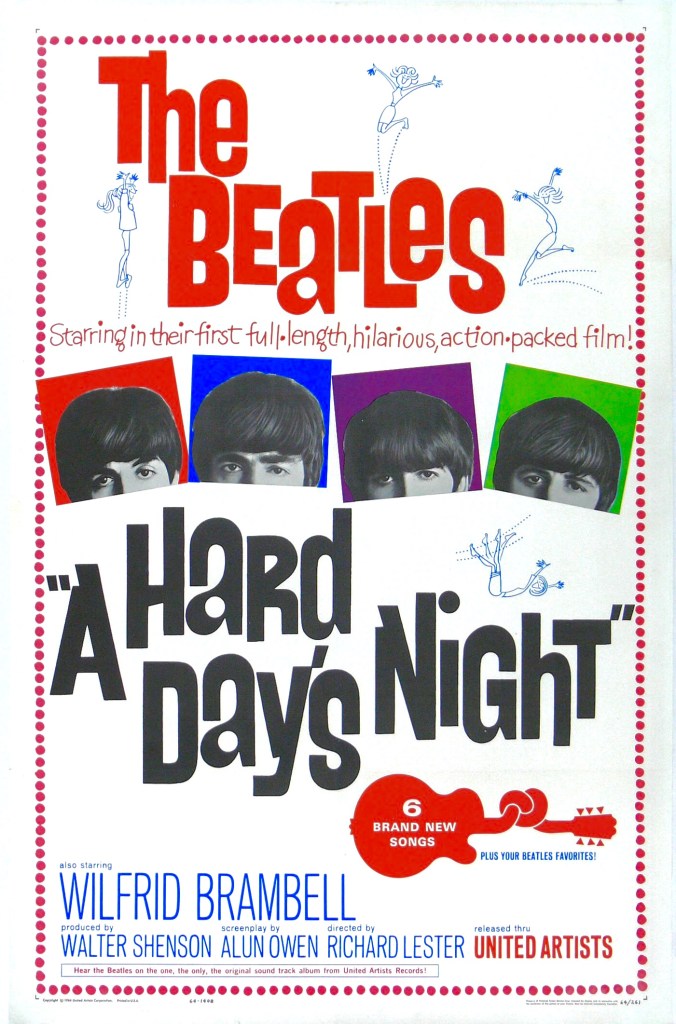
A Hard Day’s Night (1964)

A Hard Day’s Night (1964)

The Fab Four conquer the movies in this fast-paced and funny road movie

Director: Richard Lester

Cast: The Beatles, Wilfrid Brambell (John McCartney), Norman Rossington (Norm), John Junkin (Shake), Victor Spinetti (TV Director), Anna Quayle (Millie), Richard Vernon (Man on Train), Kenneth Haigh (Simon Marshall)

In 1964 they weren’t just the most popular music act: they basically were music. Everywhere they went they were met by crowds of screaming fans. They’d conquered America. They were no longer four lads from Liverpool: they were The Beatles. They were numbers 1-5 in the States, their last 11 songs had gone to number one, they were the most popular people on the planet. Of course, it was time for them to conquer the movies.

What’s striking is that A Hard Day’s Night could have been like any number of god-awful Elvis Presley films, with the King awkwardly playing a series of characters shoe-horned into plots based on songs. Richard Lester would do something different – and along the way he’d arguably invent the music video (when told he was the father of MTV, Lester famously asked for “a paternity test”) and the mockumentary all in one go. Lester placed the fab four into a day-in-the-life road movie, mixed with silent-comedy inspired capers and Marx Brothers style word play, in which they would play versions of their various personas in what basically amounted to a series of fly-on-the-wall sketches.

The film follows the gang in Paul’s (fictional) grandfather John (“Dirty old man” Steptoe’s Wilfrid Brimbell) complains move from “a train and a room and a car and a room and a room and a room”. (In a running gag lost on those not au fait with 60s British sitcoms, he is repeatedly called “clean”). In other words, we see the Fab Four shuttle to London, answer questions at a press conference, skive-off to prat about in a park then go through a series of rehearsals (with interruptions) before performing on TV and choppering off to their next appointment. It’s non-stop (even their night-off is filled with answering fan-mail – and pulling Grandad out of casino) work, work, work and any time outside is spent running from a mob of screaming fans. A Hard Day’s Night indeed.

Lester shoots this with an improvisational energy that feels like its run novelle vague through a kitchen-sink drama. He’s not averse to Keystone Kops style chases, sight gags and letting the camera bounce and jerk around with the actors. If things go wrong – ten seconds into the film George and Ringo fall over during a chase scene, get up and start running again while John laughs his head off – Lester just ran with it and kept it in. Everything feels like it has the casual, cool energy of just sticking the camera down and watching four relaxed, cool guys shoot the breeze.

It helps that he moulds four decent performances from a band that, let’s be honest, was never going to trouble the Oscars for their acting. Screenwriter Alun Owen – whose Oscar-nominated script is awash with pithy one-liners and gags – spent a couple of weeks with the boys and from that essentially scripted them four personas best matching their real-life attitudes. John becomes a cocksure smart-arse, with a quip for every corner. Paul an earnest, decent guy with a taste for wacky gags. George a shier, poetic type. Ringo the closest the band gets to a sad-sack loser, but also the most down-to-earth. Essentially, with these scripted “selves” the band were encouraged to relax and go where the mood takes them.

It works. Of course, it helps that the Beatles are (a) really cool and (b) totally relaxed with themselves, with Lester encouraging an atmosphere where the four feel less like they are acting and more like they are just being. There is an impressive naturalness about this film – really striking since it’s full of silly stuff, from the four hiding in a work tent to a car thief being roped in by the police to drive them through a chase – that means it catches you off guard. After a while you kick back and relax along with the people in it. That’s the sort of casual cool that’s impossibly hard work to pull off.

The musical sequences also feel spontaneous. When the Beatles bust out their kit and do a number on the train among the baggage it makes as much sense as them performing their stuff in the studio. It all stems from confidence – the sort of confidence that makes the group seem cheeky rather than cocky. There is a vein in A Hard Day’s Night of thumbing your noise at the posh, privileged world that was being gate-crashed by four working-class Scousers. It’s hard not to side with the Beatles when they tease Richard Vernon’s snobby city gent on the train (“I fought a war for you lot” he sniffs “Bet you wish you’d lost now” John snarks) or smirk at the deferential police eye these working class lads with suspicion.

What A Hard Day’s Night does best of all is make the Fab Four look like Four Normal Guys. They always look slightly dumbfounded by the pace of their life and the riotous reception from fans. They always seem like they’d be happier joking around or, as Ringo does when he bunks off for some time alone, wandering along chatting with people and dreamily watching the world go. They treat the media attention (and stupid questions) with straight-faced but ridiculous answers (“What do you call this haircut?” “Arthur”) and never feel or look like fame has corrupted them. Their manager Norm (a fine Norman Rossington) essentially treats them like four naughty schoolboys.

A Hard Day’s Night flies by in less than 90 minutes. It’s charm, wit and Lester’s sparkling imagery (the boys pratting around in the park did indeed inspire about a million MTV videos) and ability to shoot musical gigs in imaginative exciting ways makes it almost certainly the finest music-star film ever made – and inspired generations of comedies to comes. No wonder it made the Beatles number one at the Box Office and the Charts.

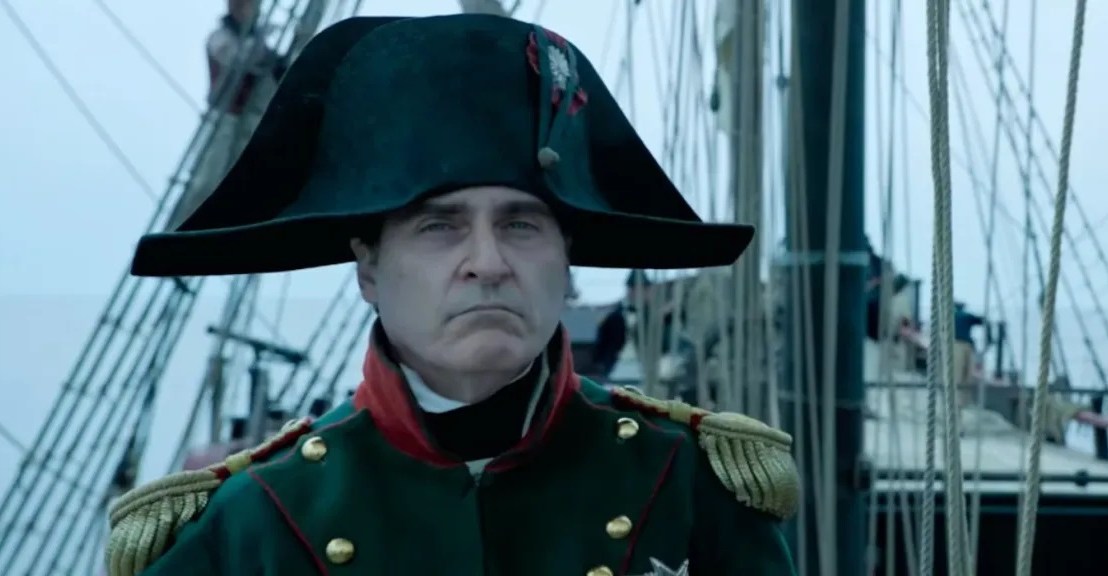
Napoleon (2023)

Napoleon (2023)

Scott’s epic of the most famous Frenchman of all time looks good but is empty at heart

Director: Ridley Scott

Cast: Joaquin Phoenix (Napoleon Bonaparte), Vanessa Kirby (Josephine Bonaparte), Tahar Rahim (Paul Barras), Ben Miles (Caulaincourt), Ludivine Sagnier (Thérésa Cabarrus), Matthew Needham (Lucien Bonaparte), Sinéad Cusack (Letizia Bonaparte), Édouard Philipponnat (Alexander I), Ian McNeice (Louis XVIII), Rupert Everett (Arthur Wellesley, Duke of Wellington), Paul Rhys (Talleyrand), Catherine Walker (Marie-Antoinette), Mark Bonnar (Jean-Andoche Junot)

Is Bonaparte cinema’s White Whale? Filmmakers have often tried and failed to bring this epic life – who else so dominated their era that’s its literally named after them? – to the screen. Abel Gance’s silent epic could only squeeze his early years into five-hours and the planned five sequels never materialised. Famously, Kubrick spent decades planning a Napoleon film (he had a veritable library of Napoleonic research) but could never deliver. Napoleon has popped up in films as wide ranging as Time Bandits and Waterloo, but the definitive film has never been made. Is Scott’s Napoleon it?

Napoleon takes a rather old-fashioned approach to the biopic. The fashion now is to focus on a single event that becomes a window into its subject’s life. Napoleon, in its two and a half hours, takes a far more cradle (or revolution) to grave approach. We join Napoleon Bonaparte (Joaquin Phoenix) as an anonymous artillery captain and leave him (via 13 Vendémiaire, Egypt, the 18 Brumaire coup, self-coronation, Austerlitz, Borodino, Moscow, St Elba, Waterloo and Helena) dying in exile. It’s as swift and pacey a run-down of his life and times as it sounds like, with the film’s main focus being on his complex, love-loath relationship with Josephine (Vanessa Kirby).

Scott’s film is a visual treat – don’t those uniform’s look gorgeous! – and it works best as a coffee-table book of the life-and-times of one of History’s most controversial figures. What it doesn’t work as is as film where you feel you gain any real understanding of what motivated Napoleon or where the charismatic energy that made millions of soldiers flock to him time-and-time again came from. Scott’s Napoleon emerges as a maladjusted, emotionally-stunted oddball, apt to glower and sulk who is never the master of events or people. It’s a revisionist view that doesn’t ring true.

It’s not helped by a surprisingly low-key performance by Joaquin Phoenix, bulked up and lumbering, playing up the “Corsican Brute” angle that so alienated the Emperors he negotiated with. Phoenix’s performance is all pout and emotionally inarticulate self-pity, with small flashes of domineering force that come across as childish sulks. But it’s never the performance of a man who looks like he could motivate a nation to march with him into a mincer (several times!). Nor a performance that brings a sense of the fierce-ambition of a man who wanted to control and reshape the world. It focuses instead on one small aspect of his personality and misses vast swathes of his rich, autodidact personality.

It doesn’t help that filtering Napoleon’s life through his relationship with his wife feels like a gossipy approach used because tackling Napoleon’s complex attitudes towards his Corsican ancestry, contradictory interests in instituting democratic systems in a dictatorship and desire to bring peace to Europe via a series of destructive wars would be too tricky. Instead, we get a Napoleon who plans his movements and campaigns to compensate for his sexual inadequacy at being cuckolded by his wife, rushes back from Egypt to confront his cheating wife and seemingly escapes from exile because he’s pissed at his wife flirting with the Tsar. It’s not helped that the most interesting mechanism in their relationship – she was older and more experienced than him, with two children already – is compromised by Vanessa Kirby clearly being far younger than Phoenix.

Saying that Kirby is good in the film, conveying a complex set of emotions towards a husband who sometimes amuses her but, just as often, repels her with his bullying possessiveness (not to mention his militaristic sexual technique). Napoleon uses their relationship as a constant frame to interpret events, not only as motivation but also as a narrative device, letters between them constantly updating us on events off-screen. But the film only lightly sketches what drew them together in the first place (basically his attraction and her use of her sexuality to win protection) and the film ends up stuck in the same cycle of fall-out followed by Napoleon’s desperation to possess her again.

The time given to sketching out the broad strokes of this relationship means we never get a sense of history behind events or where the qualities, that made Napoleon the guy who governed most of Europe, came from. Scott’s film is (which, with its stressing of the deaths caused in his wars, settles for an anti-Napoleon stance) plays up his negative qualities and gifts him few positive ones. Phoenix’ performance is almost perversely anti-charismatic: he never laughs, is constantly shown as a pompous windbag who only children are wowed by, loses all his raconteur charm and is frequently victim to events – be that panicking at his attempted coup (where he’s bailed out by his brother) or only at Austerlitz looking like he has any particular military skill.

Still the film bowls along, too fast to ever really engage with events. A host of strong British Actors pop-up (their character names and functions plastered on the screen), but their appearances and dialogue are often so truncated it’s hard to really understand why they are there. Julian Rhind-Tutt’s Sieyes pops up to announce he plans to seize power with Napoleon and is never heard of again. Ben Miles and Paul Rhys rush through exposition as Caulaincourt and Talleyrand. A host of actors playing Generals stand in the background and snatch lines when they can. There are a few inadvertently comic casting choices – I did snigger when former News Quiz host Miles Jupp pops up as Francis I.

This historical gallop means years frequently pass between scenes and we often get very little idea why developments are taking place: for example, Napoleon seems to become Emperor on the basis of a half-muttered suggestion from Talleyrand. Conquests of whole countries are skipped over in seconds. Josephine’s offspring appear as children and are next seen as adults. Other than them, no one ages at any point over the film’s near 20 year span, with Phoenix and Kirby in particular looking little different at the end as they did at the start. (The film also rewrites heavily the comparative ages of its two leads – Josephine was in fact several years older, partly why conceiving an heir became such a problem.)

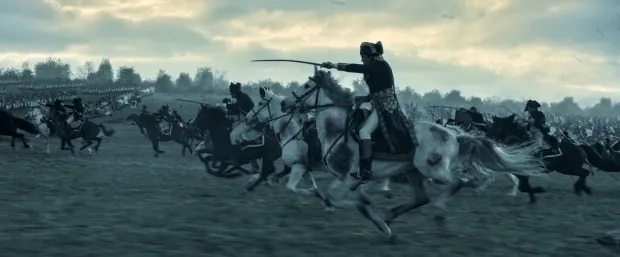
The battles are impressive though – even though they take up not quite as much screen time as you might think. The campaign in Egypt boils down to essentially a single cannon ball pot-shot at the Great Pyramid (never happened of course). Borodino is a cavalry charge. Austerlitz and Waterloo are the only battles that get real screen time, with both offering remixes of the actual history (Waterloo, incidentally, looks less impressive and smaller in scope than the Bondarchuk film managed). The photography is beautiful (as it is throughout) and the film doesn’t flinch on showing the impact of bullets and cannon balls. But it has no interest in understanding Napoleon’s actual strengths as a general (essentially, skilful movement of forces from a distance) substituting them with him leading not one but two cavalry charges – a suicidal risk he never took.

“At least it looks good” pretty much sums up the strengths and weaknesses of Napoleon. It’s enjoyable enough and buffs might enjoy the odd Historical Easter Eggs, but it never gets to the heart of understanding its subject and settles for a ticking off events and personalities rather than placing them into an informative context. You’d come out of this wondering how this guy got to where he was – and that makes you feel the film has failed to answer its implicit question in the tag line “He came from nothing. He conquered everything.” How, eh? How?

Caché (2005)

Caché (2005)

Haneke’s fascinating puzzle is a profound and challenging modern masterpiece

Director: Michael Haneke

Cast: Daniel Auteuil (Georges Laurent), Juliette Binoche (Anne Laurent), Maurice Bénichou (Majid), Lester Makedonsky (Pierrot Laurent), Walid Afkir (Majid’s son), Annie Girardot (Georges’s mother), Daniel Duval (Pierre), Bernard Le Coq (Georges’s boss), Nathalie Richard (Mathilde)

Is any film more aptly named than Caché? Haneke’s film keeps its cards so close to its chest, it’s entirely possible revelations remain hidden within it in plain sight. Caché famously ends with a final shot where a possibly crucial meeting between two people we’ve no reason to suspect know each other plays out in the frame so subtly many viewers miss it. It shows how Haneke’s work rewards careful, patient viewing (and Caché is partially about the power of watching and being watched), but also how unknowable the past can be. It’s a chilling and engrossing film that fascinates but never fully reveals itself.

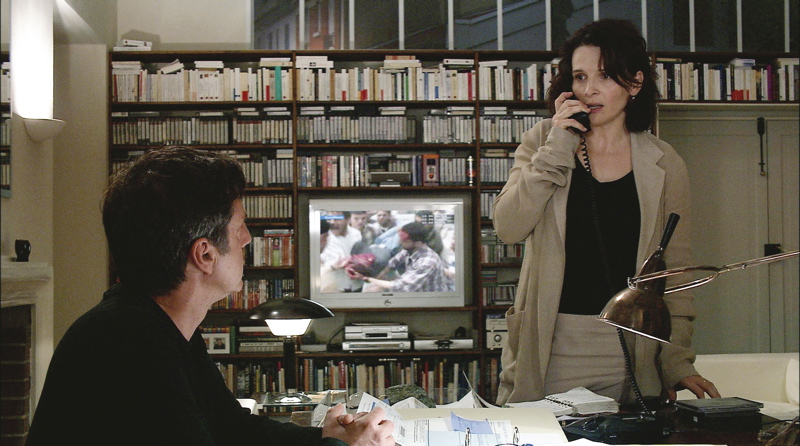
Georges Laurent (Daniel Auteuil) lives a life of success. A wealthy background, host of a successful TV literary debate show and living in an affluent suburb of Paris, he’s married to publisher Anne (Juliette Binoche) and father to young champion swimmer Pierrot (Lester Makedonsky). But there’s a serpent in his Garden of Eden. Georges and Anne are plagued by a stream of videos arriving at their house. These show long, static shots of their home and are accompanied by crude, graphic drawings. Someone is watching their house and the dread that this could escalate at any time is consuming them. But does Georges know more – do the messages chime with guilty memories in his past?

Haneke’s film is a multi-layered masterpiece, a haunting exploration (free of clear answers) into the things we prefer to forget, the hidden horrors we supress. It’s a film all about the shame and guilt buried amongst the everyday. Haneke even shoots the film on hi-definition video so that the surveillance footage of Georges and his home visually merges with the ‘real’ images of the couple. Within that, Caché starts to unpack the hinterland we hold as individuals (and, quite possibly as entire nations) of the guilts of our past that keep bubbling to the surface to bite us.

Caché is shot through with Haneke’s genius for menace and veiled threat. Can you imagine anything creepier than a camera set up outside your home, filming everything you do – but never knowing where it is? It’s an invasion of privacy that is insidious and covered in the additional menace that, at any time, it could escalate to something worse. The creeping, invasive tyranny of surveillance is in every inch of Caché, its omnipresence giving every interaction the feeling of being watched (something Haneke plays up – watch a man watching Anne when she sits in a café with a friend).

So gradually the book-lined world of the Laurents becomes a base under siege, a feeling amplified by Haneke’s mix of smooth camera movements adrift from establishing shots: constantly the camera glides through a space where we feel we neither truly understand the geography or are confident about the time. It’s accentuated by the window-free room the Laurents largely inhabit. In fact, their whole home feels window free, with curtains frequently drawn and rooms plunged into darkness, the family throwing up a shield to protect them from the outside world.

Or is it to cut them off from the unpleasant facts of life? It becomes clear Georges has built a world around himself, where he is the hero and all traces of the unpleasant or disreputable in his past have been dismissed to the dark recesses of memory, never to be accessed. Played with a bull-headed arrogance by Daniel Auteuil, under his assurance Georges is prickly and accusatory, liable to lash out verbally (and perhaps physically, considering the threat he carries in two key scenes). Auteuil masters in the little moments of startled panic and stress that cross Georges’ face, a man so used to a world that matches his needs, that anything questioning that is met with rejection.

It’s why he lies to Anne about his growing suspicions about the source of the tapes. The cartoons hint at a series of (deeply shameful) interactions, when he was a child in the 60s, with a young Algerian boy, Majid, who his parents considered adopting after the death of Majid’s parents. It was Georges lies that forced this boy out of his perfect farm-house into the cold-arms of the unfeeling French orphanage system. This is the original sin of Georges’ life, arguably the foundation of his success – a guilty secret that so haunts and disgusts him, even the slightest mention of it brings out the muscular aggression he otherwise keeps below the surface.

Of course, it’s hard not to see an echo of France’s colonial past. One of the things that works so well with Caché, is that this subtext is there without Haneke ever stressing it. Just as Georges’ lies forced Majid into a life of depression and misery, so France’s treatment of Algeria is the terrible shame the nation would rather forget. Majid’s parents died in a famously brutal stamping out of an Algerian protest in Paris in October 1961 (the deaths of over 200 people at the hands of French government forces only came to light decades later). The anger many show when presented with inconvenient, horrible past deeds (both personal and national), only feels more relevant today with our culture battles over history.

Georges sees himself as a victim of a vicious campaign. But, when Georges meets Majid, played with startling vulnerability by Maurice Bénichou, he seems light years away from the sort of man who could possibly be capable of such a campaign. Indeed, when a video of Georges encounter with Majid is widely shared, it is Georges (as even he admits) who appears the bully and aggressor. Majid has been demonised in Georges’ memory – in his nightmare he becomes an axe-wielding monster-child – but he’s an innocent, who had everything taken from him in a micro-colonialist coup carried out by a 6-year-old Georges. A coup the adult Georges has let himself forget, making him little different from France itself. (We are reminded the cycle continues, with constant background news footage of Iraq, ignored by the Laurents.)

The mistakes repeat themselves, but they don’t trouble the complacent middle-classes who benefit from them. Georges will even use his influence to have Majid and his son bundled into a police van. Of course it leads to an outburst that will shake this world up. Haneke’s films have always been realistic when it comes to the visceral horror of violence, and Caché contains an act of such shocking violence that it will leave the viewer as speechless and distressed as the witnesses.

And still the question hangs: who? It could be anyone. At one-point Georges storms out of his front door to confront the mystery video-sender, only to return to find a video wedged in the door. It’s literally impossible for this video to be placed without him seeing it done. Haneke is so uninterested in the whodunnit part that, perhaps, he’s implying the perpetrator is the director himself, using the mechanics of film-making to entrap the guilty parties. It fits with the coldly intellectual steel-trap part of Haneke’s mind, the part that uses films (like Funny Games) to tell off and preach. What other director would be more likely to set himself up as unseen antagonist in the film?

And does Georges learn anything? He will continue to confront characters who challenge his world view and dispatch (like nations) his guilt to the recesses of memory. His begrudging peace with his wife – a superbly restrained Juliette Binoche, increasingly resentful at her husband’s secrets – seems built on the shaky ground of their continuing mutual comfort. And suspicions linger over his son, an increasingly hostile figure who (just perhaps) is learning more about the flaws of his parents than they would be comfortable with.

Of course, this might all be open to interpretation from multiple angles. After all the film is called Caché. Haneke has hidden enough subtle implications in it that it can reward analysis from multiple angles. Shot with his characteristic discipline that suggests a dark, creeping fear behind every corner, it’s a masterclass in suggestion and paranoia. Brilliantly unsettling and constantly reworking itself before your eyes, it’s a masterpiece.

The Killer (2023)

The Killer (2023)

Fincher’s lean, spare film is a perfectly constructed thriller and an intriguing character study

Director: David Fincher

Cast: Michael Fassbender (The Killer), Tilda Swinton (The Expert), Charles Parnell (The Lawyer), Arliss Howard (The Client), Kerry O’Malley (Dolores), Sophie Charlotte (Magdala), Emiliano Pernia (Marcus), Gabriel Polanco (Leo), Sala Baker (The Brute)

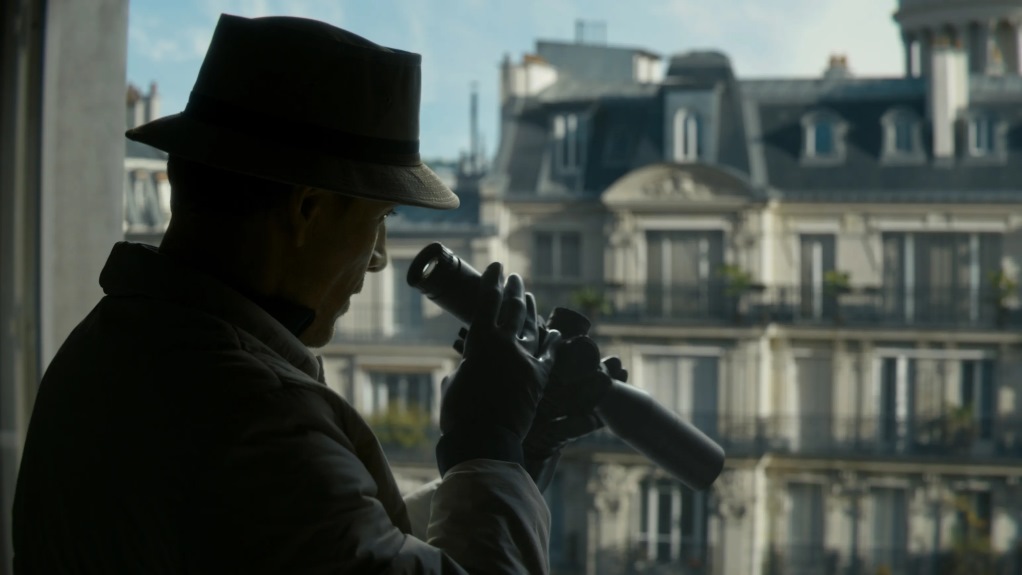
A man sits in monastic silence, starring out of a window at the best hotel in Paris that money can buy. He moves only to sleep, exercise with a monotonous rigour and consume a carefully calculated daily calorie amount from McDonalds. He wears gloves all the time, never moves from the sheeting he lays across surfaces and sometimes assembles and reassembles his rifle. He’s a nameless hitman for hire (Michael Fassbender) and a freak accident on this job will shatter his world of pristine order and leave him hunted by his employers and on a campaign of revenge to guarantee his safety.

The Killer is a lean, slimmed-down thriller full of Fincher’s love for procedure and detail, that delights in every beat of its detailed look at how a professional killer might go about his daily business. Be it lock-ups crammed with mountains of equipment, from guns to false number plates and endless zip-bound folders of fake IDs (all using character names from 70s and 80s TV shows) to the practised ease with which he penetrates even the the highest security building with an Amazon purchased card copier and light-fingered pick-pocketing. All of it assembled with Fincher’s pin-point precision and clockwork eye for detail.

On the surface, you might expect The Killer to be a sort of twist on Le Samouri, Melville’s look at a zen-like hitman. The Killer seems to fit much of the bill. Embodied with an athletic suppleness by Fassbender (his body seems to be almost elastic in the parade of physical stretches and exercises he performs, not to mention the fingertip press-ups he relentlessly pumps his whipper-thin body through). But Fincher gives us a seemingly never-ending insight into the Killer’s inner-mind, via a prolonged (near continuous) monologue of his inner thoughts, ideologies and mantras that dominate much of the film (the first twenty minutes plays out in near on-screen silence, just watching Fassbender and listening to his voiceover).

What’s fascinating is this interior monologue is only a shade away from a stream of corporate middle-management think. (It’s even implied the Killer was originally recruited while training as a lawyer). There are mantras with the air of an assassin’s version of positive thinking (“Stick to your plan. Anticipate, don’t improvise. Trust no one. Never yield an advantage. Fight only the battle you’re paid to fight.”) and passive-aggressive demands to hit a personal standard (“Forbid empathy. Empathy is weakness. Weakness is vulnerability.”). Far from the glamour of an unknowable force acting to a mystical code, this Killer sounds alarmingly similar to a self-doubting white-collar worker using Sun Tze to plan out his pitch meetings.

Beneath the sheen of Fincher’s beautifully dark film, is the suggestion we are watching a character study of a man perhaps only partially aware that his life, and his inner picture of who he is, is falling apart. For starters, despite his mantra of perfection and continued assurance of ‘every detail covered’ and ‘every angle anticipated’, our Killer makes a host of errors. Almost everything we see him do goes wrong in some-way: from that initial hit that takes out the wrong target, to stabbings that leave victims bleeding out faster than he intended, doses of knock-out drunks that are incorrectly calculated, house invasions that fail to surprise the victim… The mantra is clearly an ideal not quite a reality and the Killer’s greatest strength actually turns out to be his ability to improvise in unexpected circumstances.

In addition, for all he maintains he acts only professionally and things are never personal, the entire film chronicles a campaign of revenge in which he takes out a host of targets for personal reasons. The idea of the killer as a man separate from connections is already shattered from his obvious distress, returning to his home in the Dominican Republic after his botched hit, to find his girlfriend seriously assaulted and hospitalised. Michael Fassbender’s mastery of micro-features throughout the film, suggests waves of doubt and insecurity flooding behind the eyes of a man who has tried to master himself as an unfeeling violent limb of faceless masters.

As such, The Killer is a sort of pilgrim’s progress of a man discovering small, unexpected elements of himself while as impassively as possible knocking off anyone he considers a threat (effectively anyone who might know where he lives). No attempt is made in this to make the Killer entirely sympathetic – he ruthlessly kills at least one completely innocent person, and doesn’t hesitate to murder those he has identified, no matter how much he might sympathise with them.

But the monastic chill he aspires to is cracking. You can see it in his conversation with “The Expert” played with a mix of relish and resignation by Tilda Swinton. A professional killer like him, the Expert has not let this stand in the way of “a normal” life outside her trade. She’s married, is a popular regular at a posh restaurant and has achieved a level of compartmentalism the Killer can only dream of. Is the envy and self-doubt in his eyes as he listens to her emotionally articulate reflection on the life they have chosen?

Fincher’s film quietly explores this alongside some skilfully assembled sequences. In many ways the film mirrors its lead character: limber, dedicated, obsessive, executing its sequences with clockwork exactitude and following a fit-bit like a metronome. But it’s also a dark character study of a man (perhaps) realising how empty he has made himself, drowning out doubts with the music of The Smiths. Fassbender is the perfect actor for this, few matching his skill to be both blank and overflowing with suppressed emotion at the same time.

It makes The Killer a fascinating film, a Fincher film that feels at first like a minor work but offers more and more depths for reflection. On one level an auteur John Wick, which brilliantly outlines each trick of its expert lead character. On another level, a sort of dark character study of a man in the midst of an epic breakdown, falling back on mantras and mottos, processing his doubts and guilt through the only thing he really knows how to do: kill people.

Trading Places (1983)

Trading Places (1983)

Very 80s comedy, full of rude gags and the glories of money still funny in many places

Director: John Landis

Cast: Dan Aykroyd (Louis Winthorpe III), Eddie Murphy (Billy Ray Valentine), Ralph Bellamy (Randolph Duke), Don Ameche (Mortimer Duke), Denholm Elliott (Coleman), Jamie Lee Curtis (Ophelia), Paul Gleason (Clarence Beeks), Kristin Holby (Penelope Witherspoon), Jim Belushi (Harvey)

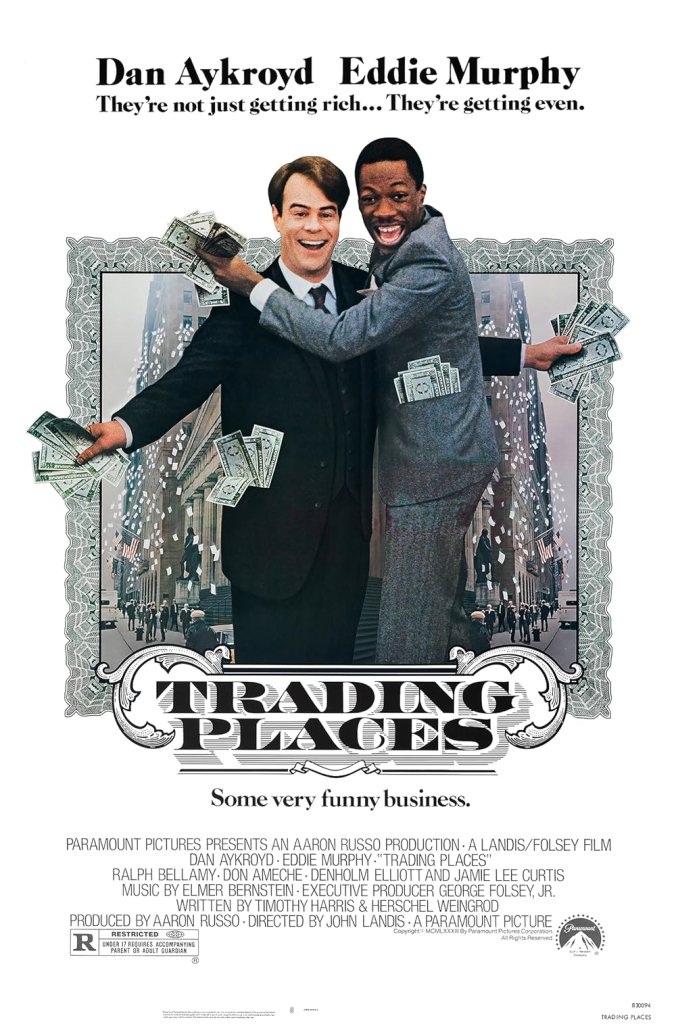
Louis Winthorpe III (Dan Aykroyd) has it all. A house in Philadelphia, glamourous fiancée and high-flying job as Managing Director at Duke & Duke, the leading blue-chip commodities brokers. Billy Ray Valentine (Eddie Murphy) has nothing: penniless, homeless, hustling on the Philly streets. But is their fate due to nature or nurture? Finding that out is the subject of a bet between heartless Duke brothers Randolph (Ralph Bellamy) and Mortimer (Don Ameche). They turn both men’s lives upside-down by swopping their positions – Louis will be disgraced and left with nothing and Billy Ray will get his house and job. Will they fall or rise? And what will they do when they find out their lives are the Duke’s playthings?

Trading Places was one of the big box-office smashes of 1983, a film that changed the lives of virtually the whole cast. It showed the world Aykroyd could carry a comedy without partner Jim Belushi, gave a second career to Bellamy and Ameche, led Curtis to say the role “changed her life” from just a scream queen and, perhaps most of all, turned Murphy into a mega-star. It’s still witty, fast-paced and funny today, even if in places it’s not always aged well.

Landis takes a screwball approach, unsettling the lives of two contrasting people and then throwing them into an unlikely revenge partnership. Trading Places is very strong on the contrasting world of rich and poor. The wood-lined, club-bound world of the Dukes is carefully staged, paintings of financial and political grandees staring down from walls as assured, masters-of-the-universe easily sachet around posh clubs and squash clubs, to the sound of Elmer Bernstein’s Mozart-inspired score. By contrast, the rough, litter-lined squalor of Philadelphia’s poorer neighbourhoods is unflinchingly shown with, under the comedy, the suggestion life is cheap and everyone is for sale.

Of course, a lot of the ensuing laughs come from seeing a rich person who has only known comfort thrown into this life of a tramp and vice versa. Ackroyd’s Winthorpe bristles with disbelief at his situation and the rich man’s blithe assurance that (any moment) someone will say there has been a terrible mistake carries a lot of comic force. Meanwhile, Murphy’s fast-talking Billy Ray assumes he is the subject of an elaborate prank (or perverted sex game) as stuffs the pockets of his first tailored suit with knick-knacks around the house the Duke’s assure him is now his. Hustler Billy Ray turns out, of course, to be well-suited to the blue-collar hustle of financial trading. He also finds himself, much to his surprise, increasingly interested in the culture and artworks around him.

Under all this, Trading Places has a surprisingly negative view of rich and poor. Louis posh friends and shallow fiancée are all status-obsessed snobs who turn on him in minutes when he is framed for theft, embezzlement and drug trafficking. The servants in their posh clubs – all, interestingly, Black men in a quiet statement on race that you still wish the film could take somewhere more interesting – are treated as little better than speaking items of furniture and there is a singular lack of interest or concern for anyone outside their social bubble. Playing fair, every working-class character we see (apart from Curtis and Murphy) is lazy, grasping and shallow, ignoring Billy Ray until they can get something from him, at which point they fall over each other to snatch freebies from his house.

Trading Places is, in many ways, a very 80s screwball. Money is the aim and reward here. Trading Places has respect only for aspirational characters who save and invest their money. (Curtis’ prostitute is marked out as savvy and decent because she has invested nearly $42k from her work in a nest-egg). The film culminates in a financial scam (playing out on the trading floor of the World Trading Centre) designed to reward our heroes with wealth and punish the villains with poverty. For all the film stares at the reality of poverty and riches, the implications and injustices of wealth are ignored, with money ultimately framed as a vindication.

But then, Trading Places is just a comedy so perhaps that’s reading a bit too much in it. There is a frat-house energy to Trading Places under its elaborate framing and a lot of its gags come from a rude, smutty cheek that sometimes goes too far (not least a punchline involving a villain being repeatedly raped by a randy gorilla). Murphy’s energy – every scene has the crackle of improvised wildness to it – is certainly dynamic (this is probably his funniest and – eventually – most likeable role) and while Aykroyd is a stiffer comic presence, he makes an effective contrast with Murphy.

The real stars here though are the four supporting actors. Bellamy and Ameche seize the opportunity to play the villains of the piece with an experienced gusto, brilliantly funny in scene-stealing turns. Outwardly debonair, the seemingly cudily Bellamy and prickly Ameche superbly reveal the greed and casual cruelty of these two heartless Scrooges. Elliot is also extremely funny, and the most likeable character, as a kind butler just about disguising his loathing of the Dukes. Curtis’ vivacity and charm makes a lot of an under-written “hooker with a heart of a Gold” trope – like her co-stars she seizes her chance with a fun role.

Some of Trading Places has of course not aged well. Jokes with gay slurs pop up a little too frequently. While the Duke’s use of racist language makes sense (after all they are vile people who see Billy Ray as nothing but a curious toy), it’s more of a shock to hear our nominal hero Louis do the same. Murphy’s improvised sexual harassing of a woman on the streets (ending with him screaming “bitch!” after her when she walks off) doesn’t look good. Curtis twice exposes her breasts for no reason. The film’s closing heist involves Aykroyd blacking up and affecting a Jamaican accent.

But, dubious as some of this is now (and while you can argue times have changed, surely even then some people would have been unsettled by this sort of stuff framed for good-old-belly laughs), Trading Places is still funny enough to be a pleasure. And, with the performances of Bellamy, Ameche, Elliot and Curtis we have four very good actors providing a humanity and professionalism to ground two wilder comedians. It’s easy to see why this was a hit.

The King and I (1956)

The King and I (1956)

Deliberately artificial adaptation, powered by star performers and sumptuous set-design

Director: Walter Lang

Cast: Deborah Kerr (Anna Leonowens), Yul Brynner (King Mongkut), Rita Moreno (Tuptim), Terry Saunders (Lady Thiang), Martin Benson (Kralahome), Rex Thompson (Louis Leonowens), Patrick Adiarte (Prince Chulalongkom), Carlos Rivas (Lun Tha), Alan Mowbray (Sir John Hay), Geoffrey Toone (Sir Edward Ramsey)

In its glistening, stagy exactness The King and I is the most traditional adaptation of Rodger and Hammerstein to hit the screen. A (questionably accurate) memoir by Anna Leonowens (Deborah Kerr) about her experiences as a tutor to the children of King Mongkut of Siam (Yul Brynner) in the 1860s, was repackaged by the musical hit-machine duo into a charming culture clash, with a garland of unspoken romance across the top. Anna wants to help the king improve and develop his kingdom – but also clashes with his ideas about his antiquated ideas and (above all) his treatment of concubine Tuptim (Rita Moreno), who is in love with servant Lun Tha (Carlos Rivas). Can the King and Anna reach an understanding?

The King and I is one of the grandest, most artificial looking films you will see. No attempt has been made by anyone to even pretend we are not watching events play out on a series of massive, elaborately decorated soundstages. It all looks gorgeous of course, brightly coloured sets filling the frame. Even the scenes ‘outside’ – on Anna’s ship or the palace grounds – drip with ostentatious artificiality.

This impression is only increased by the mediocre direction of Walter Lang. A reliable studio B-movie hack, Lang sets the camera up in the equivalent of the front row of the stalls. While he can frame a scene efficiently (his centring in the final shot of the king’s hand is neatly done), Lang provides no originality, flair or real visual interest, all that supplied solely by the sets. He either misses beats or misunderstands jokes (the accidental flashing of the English ambassador is crying out for a beat of titillation from the old guy). It’s quintessential widescreen hackwork of the 50s, where the focus is on wowing the people with the money, bright colours and massive sets they couldn’t get from the little box in the corner. On that basis, a director who sets the camera up to get as much of that seen as possible all the time, fits the bill.

Besides, the film’s two most distinctive features didn’t really rely on Lang anyway. The King and I’s grand Thai-style ballet based on Uncle Tom’s Cabin was visualised and choreographed by Jerome Robbins (with Lang setting the camera stationary in mid-shot to capture it all). This ballet is, by the way, a masterclass of expressive visual originality (with its swirling use of masks, sheets and banners) that sticks out like a sore thumb in a film as visually flat as this one.

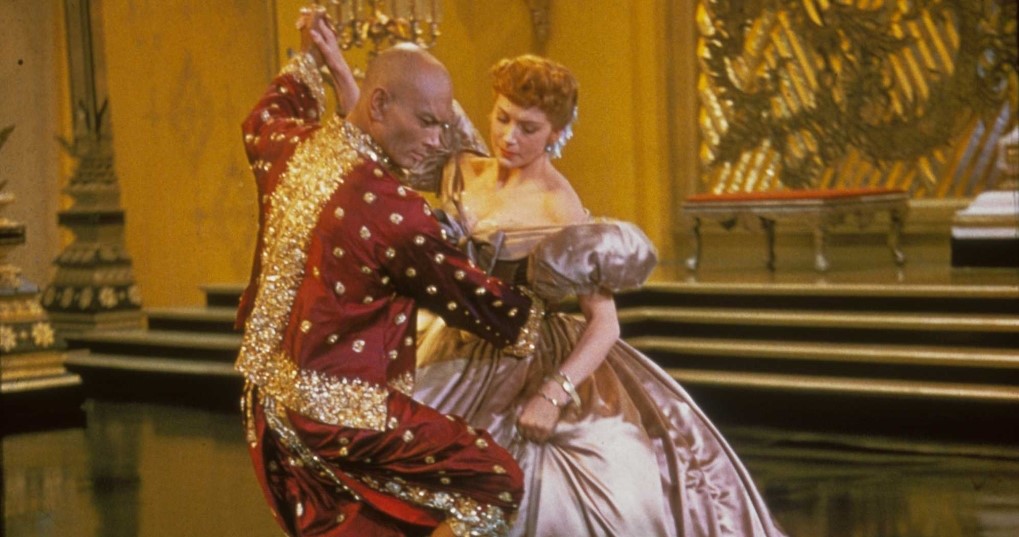
The other was of course Yul Brynner’s star-turn as the King. Brynner’s performance of the role on Broadway had transformed his career and years of honing it on stage meant he was the master of every beat of its eccentric energy. Brynner is magnificent, bombastic, proud, grand but also subtly playful, surprisingly timid and strangely shy. Brynner’s performance with its theatrical touches (the striking pose and the “et ceteras”) could be seen as overplaying, but actually fits perfectly with a man constantly, deliberately, putting on a show.

Brynner really shows the more thoughtful, quiet man under the surface, worried about his kingdom’s future. The earnest autodidact, who lies on the floor reading books. The eager-to-impress man who swots up on topics of conversation to impress the English ambassadors and hands a prompt sheet to Anna to work them into conversation. The careful flirt who only allows flashes of his romantic interest in Anna show. It’s a clever, grand but very human performance. Brynner had wanted to direct (and, rumour has it, partially did so) but settled for a Best Actor Oscar instead.

He also sparks extremely well off Deborah Kerr, buried under some truly might dresses (so heavy, that Kerr allegedly lost twelve pounds over the course of filming). Kerr turns a potentially stodgy part into a woman who is independent but not judgemental, forward-looking but diplomatic and very careful about allowing any expression for romantic feelings. Although her singing is dubbed by Marnie Nixon, it’s Kerr’s engaging sprightliness that carries a lot of the drama. She and Brynner’s chemistry also ensures the scenes between the two of them are by far the film’s highlights.

Most of the faults of The King and I can be traced to the musical itself. There isn’t much in the way of plot. The quiet will-they-won’t-they bond between Anna and the King is partly because that’s the nature of these things, but partly because the musical doesn’t really give them much material to work with. Virtually every character other than these two feels like either a sketch, a plot function or a stereotype, with the actors given almost nothing to work with. Impressive as the ballet is, it essentially takes up almost 15 minutes of screentime without advancing the plot or the themes of the film at all. Thematically the film explores very little, either on social progress in Siam or its place in the world. The film rushes towards a conclusion that feels like it comes out of the blue.

But then people aren’t watching The King and I for its social commentary or thematic depth. They are watching it for some hit songs, impressive production values and charismatic performers. You certainly get that and if the overall shape of the film feels rather loosely plotted and doesn’t go anywhere, that’s neither here or there. And of course, it’s a triumph for Brynner (who, late in life, dedicated his final years to performing the role, racking up over 4,600 performances), whose confidence and star-quality carries thing. Pretty, fun, not deep but pleasant – but then that’s Rodgers and Hammerstein for you and if that’s for you, this is the film for you.

EO (2022)

EO (2022)

Skolimowski’s passionate call for animal rights is a modern Au Hasard Balthasar

Director: Jerzy Skolimowski

Cast: Sandra Drzymalska (Kasandra), Tomasz Organek (Ziom), Lorenzo Zurzolo (Vito), Mateusz Kościukiewicz (Mateo), Isabelle Huppert (Countess)

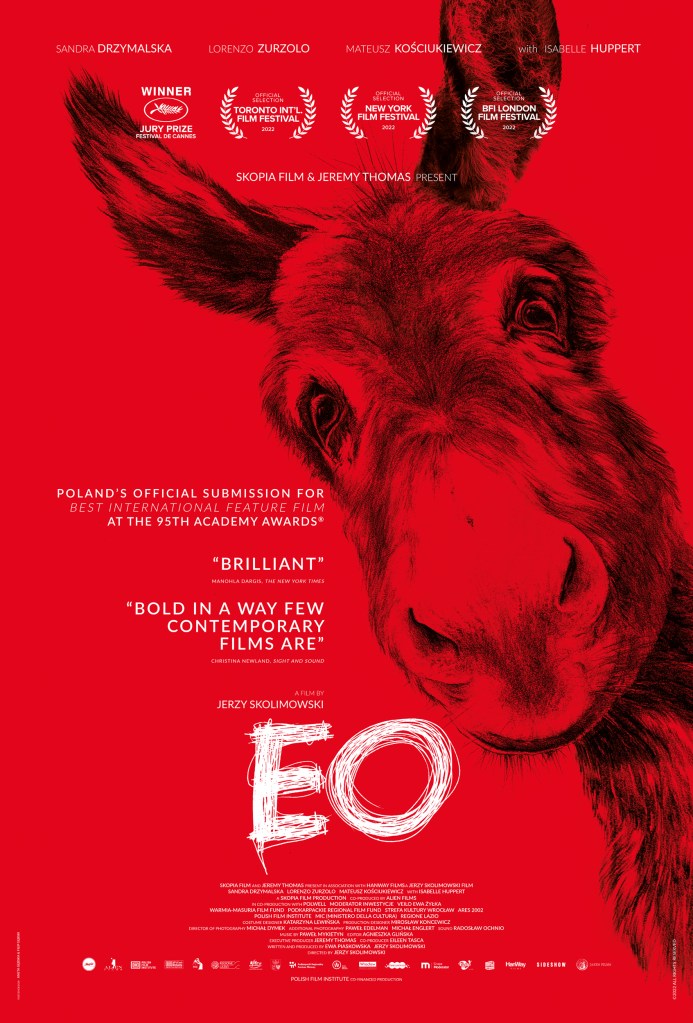
You can make a lot of judgements on humanity, based on how it treats animals. EO, a poetic and deeply heartfelt film, makes a passionate plea for kindness and respect in our treatment of the natural world, qualities it all too often finds lacking. In that sense, it’s surprisingly different from its ancestor Robert Bresson’s Au Hasard Balthasar. Where Bresson turned the rite-of-passage of a donkey into a Calvary-like journey, with the donkey a poetic substitute for Christ, Skolimowski’s film presents a donkey who is nothing more or less than a donkey, but whose experiences become universal for our treatment (and mistreatment) of animals.

We first meet EO as a circus performer, working closely performing tricks with Kasandra (Sandra Drzymalska). When the circus’ finances collapse, under the demands of animal rights activities EO is taken from his home and deposited in a sanctuary where he feels unsettled and uncertain. From there, his life becomes migratory as wanders encountering violent football hooligans, exploitative mink farmers and the odd decent person, progressing towards an abrupt fate that parallels Bresson’s Balthasar.

Even more so than Bresson’s work, Skolimowski’s EO front-and-centres its donkey star. Among many things, EO is a strikingly beautiful art film. The camerawork – shot by two DPs who pull the film together into a beautifully consistent visual style – is radiant, presenting a series of luscious 4:3 images which capture both the beauty of nature and the starkness of man’s presence in it. Several scenes are shot with a slightly frog-eyed lens, its blurred wet-looking edges suggesting EO-perspective POV shots. Skolimowski presents several sequences with a red-tinged dream-like quality, that suggests EO’s own day-dreams – soaring vistas, locations that visually merge together, flashes of his circus life. All this pushes EO himself into the film’s lead role, a real character.

But yet no attempt is made to anthropomorphise this animal. Although the camera lingers over EO’s face, his emotions are left entirely for us to interpret. In many ways, EO is a proof for that old editing test: show the same neutral face followed by a series of contrasting happy and sad events, and the mind will interpret that neutral face as holding different emotions. That is what EO does marvellously. Perhaps we just imagine EO’s joy at seeing Kasandra again (she is certainly moved – drunk, but moved). Perhaps his fear and discomfort in his new animal shelter home is us reading in what we might feel in his place. When EO kicks a mink battery farmer in the face, do we feel he’s angry because we are? There are no answers from EO: he’s just a donkey.

Nevertheless, he is a donkey on a journey and Skolimowski’s film is a surprisingly sharp-edged fable, deeply critical about our unthinking, brutal exploitation of animals. To too many of us, the film argues, their rights are not worth considering – they are dumb creatures good to work until they are too difficult to keep alive or we wish to use their bodies for something else, from clothing to food. EO’s encounters with humans invariably see him being used for their own needs, rarely considering what the desires of the donkey might be.

Skolimowski establishes from the film’s opening, with its animal rights activists who are (surprisingly considering the film itself is an act of animal rights activism) smug, self-righteous and so convinced they know what is best for EO that they are crucial in separating him from the only human in the film who cares for him. Far from ill-treated in the circus, it gives EO a home, love and a purpose. The instant he is removed from this circus, all three of these elements disappear from his life.

Not that Kasandra is an unequivocally positive influence in EO’s life. Settled onto a farm – again we read depression into his refusal to eat, although maybe EO’s just not hungry – EO’s new surroundings are not unpleasant (in fact, the farm seems to be partly about helping disabled children connect with animals, in a sweetly touching sequence). Kasandra gate-crashes one night, drunk, feeds EO a muffin and then disappears over the horizon. Her presence does enough to cause EO to follow her, escaping from his pen and walking out into the Polish countryside.

This pilgrimage through a forest and shooting range (laser guided hunters track wolves, EO at one point starring at a dying wolf, left to bleed out from the hunt), leads eventually to a village football game where EO’s braying causes one side to miss a crucial penalty. Suddenly EO is flotsam in a hooligan-tinged battle between rivals. The winners adopt him as a sort of comedy mascot, before forgetting him in their drunken haze. Hooligans from their rivals beat EO nearly to death, in a twisted act of revenge. EO has no say in either side of this war, merely becoming a passive and innocent war-ground that humans can exact their primal instincts on.

Treatment of animals is increasingly, cruelly, exposed. Nursed back to health by a vet (a worker at the hospital matter-of-factly asks why they don’t put EO down), he is sold to a mink farm that feels like nothing less than a brutal prison, where animals live in misery until their inevitable skinning to make a scarf. Trafficked across countries with horses, EO is again adopted by a stranger who uses him as a sounding board for his own concerns (this happens arguably three times: Kasandra arguably sees EO’s as a sentimental toy, a drunk unties EO before the fateful football ground because he wants his “friend” to be free and Vito uses him to stave off loneliness). This is as nothing compared to the film’s bleak ending – a terrifying view of the ruthlessness we push animals towards their fate.

EO is so masterful at front-and-centring the experience of an animal, and investing it with immense interpretative empathy, that it means the film actually drags when humans enter the frame. The film feels like it has to include scenes with humans in to bulk up it up to feature length (a better EO would surely be about 60 minutes long). A Polish truck-driver (Mateusz Kościukiewicz) playfully flirts before discovering man is just as inhuman to man as he is to animals. Vito and his mother-in-law, Isabelle Huppert’s countess, play out a small-scale human drama which seems trivial and uninteresting compared to the animal message that dominates the film.

Perhaps this is because EO succeeds so utterly in making us care and even (perhaps) understand the perspective of an animal. It’s a superb act of interpretative art – filmed with an astonishing visual beauty and with a gorgeous score of Pawel Mykietyn – and warm empathetic understanding. It also builds into a surprisingly moving and powerful message on the importance of treating animals with the same dignity and kindness that we would expect to be treated with ourselves. It makes for a thought-provoking and immersive film, that emerges successfully from the shadow of its forbear.

Anatomy of a Fall (2023)

Anatomy of a Fall (2023)

Brilliant courtroom drama, full of enigmatic questions around the nature of truth

Director: Justine Triet

Cast: Sandra Hüller (Sandra Voyter), Swann Arlaud (Vincent Renzi), Milo Machado-Graner (Daniel Maleski), Antoine Reinartz (the Prosecutor), Samuel Theis (Samuel Maleski), Jehnny Beth (Marge Berger), Saadia Bentaieb (Nour), Camille Rutherford (Zoé Solidor), Anne Rotger (the President)

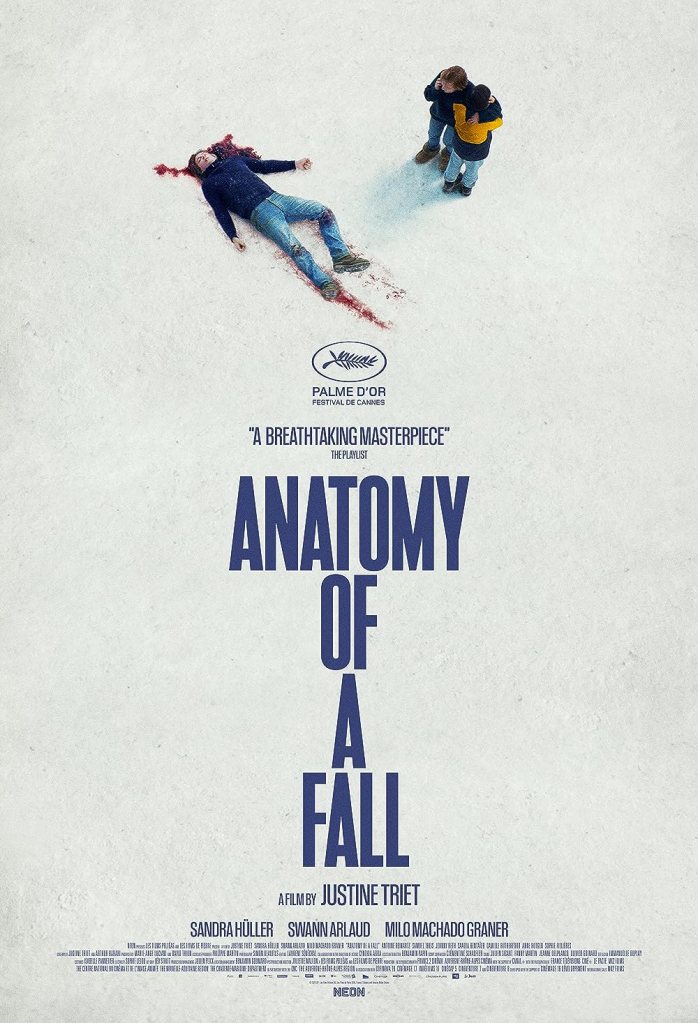
What is a trial? A forum for discovering the truth? Or a theatre where the best story wins? Anatomy of a Fall, Justine Triet’s Palme d’Or winning courtroom drama, explores this and takes its place as one of the finest courtroom films made. Complex, fascinating and compelling, it asks searching questions about the unknowable nature of truth. Presenting only perspectives, recollections and conflicting inferences based on the same handful of facts, it places the viewer in the same position as the jury: ultimately we must choose a version of the truth “we can live with”.

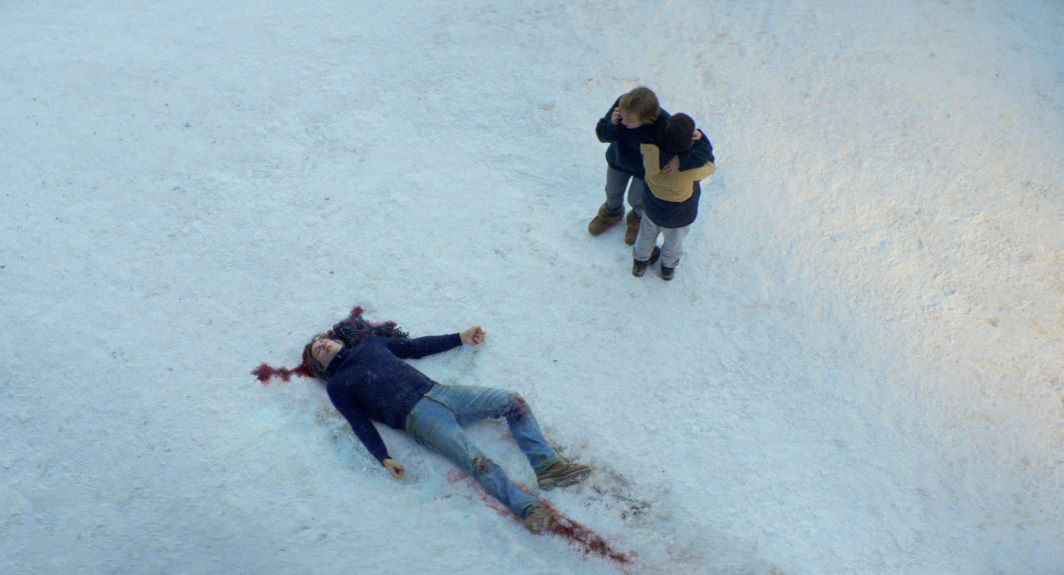
The trial revolves around the death of Samuel Maleski (Samuel Theis), lecturer and amateur house renovator, discovered dead by his son Daniel (Milo Machado-Graner) having fallen from the attic of their Grenoble chalet. Did he fall, jump or was he pushed? Suspicions fall on the only suspect: his wife, famous novelist Sandra Voyter (Sandra Hüller). Sandra’s story doesn’t quite stack up and her assurance that they were in a difficult but loving relationship isn’t supported by the facts. A dramatic court case begins, in which both the prosecutor (Antoine Reinartz) and Sandra’s lawyer, old friend Vincent (Swann Arlaud), lay out compelling, but utterly conflicting versions of Sandra and Samuel’s marriage, with their son Daniel (the only real witness) caught horrifically in the middle.

Anatomy of a Fall only shows us facts that a jury could have. We open no more than an hour before the fateful event, with Sandra’s interview at home with a young student (Camille Rutherford) halted by an unseen Samuel playing an instrumental cover of 50 Cent’s P.I.M.P. at deafening volume. Is his playing of loud music an everyday event (as Sandra says) or a passive aggressive move designed to disrupt the interview of a wife he is jealous of? We don’t know because we never get to see their subsequent confrontation, as we follow Daniel walking his dog, returning find Samuel’s body.

This sets the tone for the superbly uneasy courtroom drama that follows. Throughout, Samuel is literally a ghost. The film finally shows him only when a recording he made of a vicious argument between the couple is played to the courtroom. Triet cuts from the courtroom to a flashback so we can see Sandra and Samuel’s increasingly heated conversation, where he condemns her for selfishly dominating their lives, while she accuses him of a martyr complex and blaming her for his own failures. But the second the recording hits a disputed physical clash we cut back to the courtroom and hear only the sounds themselves and their interpretations from prosecution and defence.

Those interpretations are effectively stories, and Anatomy of a Fall makes it clear a compelling and relatable story is essential. Taking a leaf from Anatomy of a Murder (a clear inspiration), it’s less the facts and more the presentation that is likely to win either conviction or acquittal. Vincent carefully coaches Sandra on her version of events – the loving relationship turned sour by her husband’s depression, bought on by his guilt for the accident that left their son visually impaired – advising her on tone, wording and when to stress certain points and which to avoid. He flatly tells her an accident is something “I don’t believe” and stresses their only chance is to establish Samuel’s suicidal intent. Lawyers aren’t paid to find the truth: they are paid to secure verdicts.

There is an added complexity as Sandra, a German, must conduct the trial in French, her third language, rather than her preferred second language of English. Language is itself a topic of debate in the marriage – her French husband Samuel accuses Sandra of forcing him and French-speaking Daniel to meet on her preferred ground of English, rather than improve her French. She counters that English makes them all equal, speaking a second language. In the trial, Sandra struggles to articulate her points, floundering for precise words. Eventually the pressures of the trial force her to revert to English, which is then translated for the rest of the court.

Superbly played by Sandra Hüller, Sandra is an assured professional, struggling to understand how she has ended up in this position. She can be distant and doesn’t suffer fools gladly. Unspoken as it is, it’s clear for police and prosecution she doesn’t fit their profile of a grieving widow. Every beat of Hüller’s performance is brilliantly open to interpretation: is she anxious about the pressure on her son, or scared about what he might say? Is she filled with stoic regret or did she never care for her husband? Even when she switches to English in the court, is this a result of pressure or because it is easier for her to elaborate a story in this language?

The truth is increasingly sidelined. We see no reconstruction of the possible crime, only two (both convincing) versions of it presented with models and computer graphics that outline first a murder then a suicide, both plausibly explaining how a suspicious blood splatter appeared on a shed. A psychiatrist arguing passionately for Samuel’s clear-headedness and determination to live, is blamed by Sandra for getting him hooked on anti-depressants. Sandra’s novels are dragged into the trial (on the excuse that she has talked extensively about their autobiographical content) – was her use of Samuel’s idea from his abandoned novel theft or agreement? We can never be sure.

This struggle for the best story has an increasingly damaging impact on their son Daniel. Beautifully played by Milo Machado-Graner, Daniel is a quiet, sensitive, precocious young boy, whose accidental visual impairment becomes crucial. Certain at first of what he saw and heard, we see his certainty crumble during police-escorted reconstructions at the scene (the loud music making what he claimed he heard from where, impossible). On the stand he tries to reconcile his love for both his parents with knowledge of their arguments. At home with his mother, he becomes increasingly withdrawn and closer to his court-appointed guardian Marge (a superbly conflicted Jehnny Beth).

It is Marge who gives voice to, perhaps, Anatomy of a Fall’s central message. The truth is, in the end, the story we choose to believe, the one we can live with. Anatomy of a Fall presents us with multiple choices but no definitive answers. It is up to us to listen to the evidence and decide on Sandra’s guilt or innocence. Triet’s superb film throws in a final additional mystery with a late piece of evidence that is even more open to interpretation than anything else, a story that could be argued as a late realisation or an elaborate lie. We even see Samuel again, as the witness recounts words they claim he said, but this time we just see him lip synching to the audio of the witness’ testimony – are words literally being put into his mouth? The truth is what we make of it, and as subjective as any story.

Anatomy of a Fall is a brilliant courtroom drama and a scintillatingly human story with a superbly enigmatic performance from Sandra Hüller at its heart. Triet and Arthur Harari’s script is sharp and marvellously balances objective and subjective facts. Triet directs with a tight, pacey assurance, with a striking series of final images that remain open to viewer interpretation as to who is protecting whom and why. Fascinating, compelling and open to endless reconsideration and reinterpretation, Anatomy of a Fall can take its place as one of the definitive courtroom dramas on film.