Tag: Dan Aykroyd

The House of Mirth (2000)

The House of Mirth (2000)

Masterful adaption of Wharton, beautifully judged, brilliantly acted and superbly filmed

Director: Terence Davies

Cast: Gillian Anderson (Lily Bart), Eric Stoltz (Lawrence Seldon), Dan Aykroyd (Gus Trenor), Anthony LaPaglia (Simon Rosedale), Laura Linney (Bertha Dorset), Terry Kinney (George Dorset), Eleanor Bron (Julia Peniston), Jodhi May (Grace Stepney), Elizabeth McGovern (Carry Fisher), Penny Downie (Judy Trenor), Pearce Quigley (Percy Glyde), Lorelei King (Mrs Hatch)
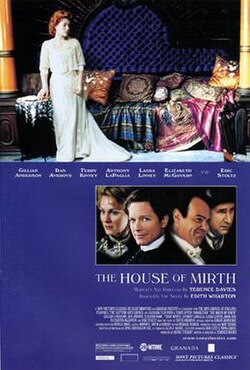
When Scorsese bought Edith Wharton’s The Age of Innocence to the screen, it was seen as a wild swing out in his career. You could have said the same thing when Terence Davies made The House of Mirth, an unlikely follow-up from a host of artistically constructed, meditative memory pieces. But in doing so, Davies executed perhaps one of the most perfectly executed translations of a novel to the screen, a gorgeous, beautifully moving film. Put simply, in its grace and magic glow, it’s pretty hard to imagine The House of Mirth being done better.

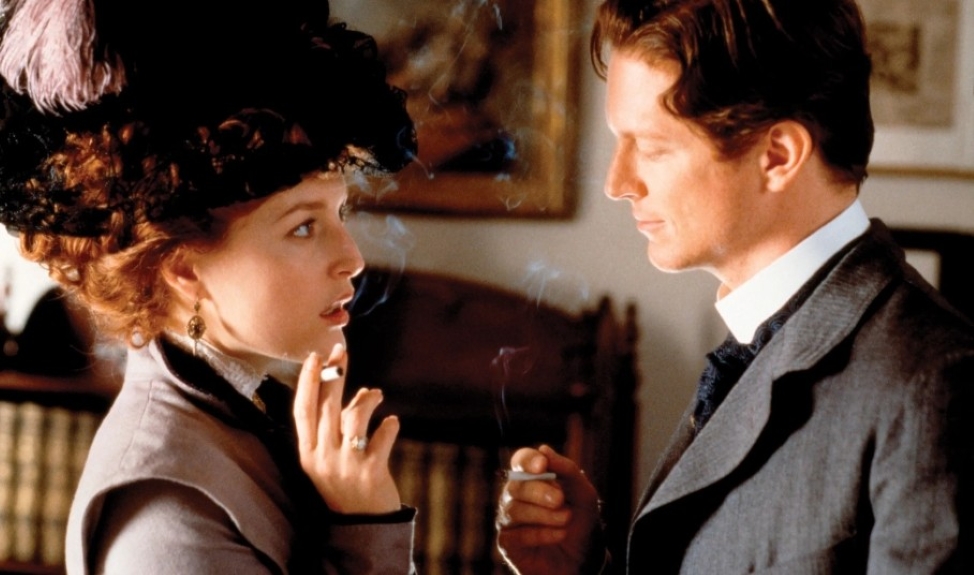
Our hero is Lily Bart (Gillian Anderson), a woman who feels she is at the heart of 1905 New York society but will discover her grip on life is far less secure than she believes. Dependent on her aunt (Eleanor Bron) for financial support, needing to marry for money, perhaps in love with not-quite-rich-enough bachelor Lawrence Seldon (Eric Stoltz), unwilling to compromise on her principles and desires, Lily will make a series of catastrophic decisions. Thee will leave her facing the brunt of the ruthlessness of her so-called friends such as banker Gus Trenor (Dan Aykroyd) or Bertha Dorset (Laura Linney) and her world falling apart with extraordinary speed.

Shot with a visual beauty inspired by a host of painters – most notably John Singer Sergeant, whose compositions are referenced throughout to breathtaking effect – Davies film is measured, wise and slowly unleashes a powerful emotional impact. Carefully adapted, Davies film is awash with the intricate, ornate dialogue of early twentieth century New York: speech that, it quickly becomes clear, is about disguising and obscuring the true meaning of what is being said. New York society is awash with lies, deceptions, selfishness and greed, all of it disguised with fine words and high-living – as Lily says “Why is it when we meet we always play this elaborate game?”

What’s tragic about Lily Bart is that it’s a game she believes herself to be skilled at, time revealing she is a novice stumbling in the big leagues. On top of which, as someone penniless, unmarried and reliant on others, she has a terrible lack of security. A lack of security meaning people like Trenor can demand a very personal reward in exchange for his financial services, without worrying about disgrace. Someone savvier would have seen through Ackroyd’s wonderful portrait of barely concealed greed under Trevnor’s avuncular pleasantness. Just as a more worldly figure would have seen that (the simply brilliant) Laura Linney’s gossipy Bertha sees Lily as nothing more than a simple soul ripe for manipulation, a pathetic fall-guy to hide her own infidelities.

It becomes clear there is a doomed, tragic quality to Lily. She’s introduced emerging from a blackened screen in a puff of train steam, an Anna Karenina-ish echo hinting at her eventual fate. In an extraordinarily complex, perfectly judged performance from Gillian Anderson, Lily emerges as a woman of far greater depth and principle than we (or she) suspects. But prone to terrible errors of judgment, often for the right reasons. She is too principled to marry for money, but not savvy enough to play the courting game, publicly humiliating the wealthy Percy Glyde (Pearce Quigley) who she dutifully woos, only to stand him up for a walk that is a clear proposal hint.

But she is too aware of her wordly needs to embrace the mutual love between her and Eric Stoltz’s charmingly enigmatic Lawrence Stern. These two conduct a dance of suggestive flirtation, without ever truly committing their feelings openly. Lily seems to be almost a tease, but Anderson beautifully demonstrates a hesitancy born from an attempt to be honest, to find love and money in one man. The heart-rending realisation later in the film that she has made a terrible mistake, out of a mix of principle, pride, foolishness and decency is captured in Anderson’s superbly pained expression – not to mention a late emotional out-pouring that is heart-breaking in its pain and honesty.

Slowly, Lily’s world falls apart, Davies capturing the tragedy with coolly observant camerawork gliding through society, echoing the photographic approach that defined his earlier work. In every sequence, and between every scene cut, Lily’s position slowly, at first imperceptibly, becomes worse and worse. Less and less secure, until eventually she’s lost to society, in a world of run-down bedsits and laudanum addictions. Where she brutally realises her life of society balls has made her a “useless person”, with no skills and utterly out-of-depth in a world where she must earn her living.

Anderson’s punctures Lily beautifully throughout with a naïve vulnerability. In a way, the undeserved social disgrace Lily suffers (wrongly seen as a slut and a home wrecker) makes her cling even more closely to her principles – even as they become more and more damaging to her. These principles can seem as inexplicable to us as they do to her few allies: she pays out a stock of her limited personal finances to cover up Bertha’s affair with Lawrence, continuing to cover for her even as Bertha burns her in front of all of New York (and barely considers using her evidence for blackmail). It’s part of what makes Lily an astonishingly admirable figure, even as her life spirals downward.

The powerful emotion of this, the deep investment Davies helps us feel for a woman who becomes more and more understandable to us as she is more and more stripped of privilege, is complemented by exquisite film-making. One breath-takingly superb transition sees Davies camera drift through a grand house with all its furniture and fittings carefully hidden under dustsheets, out into a rain-speckled stream, the camera swooping lower and faster until the water transitions into the sun-kissed waves of the Mediterranean: a gorgeously, masterfully simple transition that moves us across weeks and miles in a moment. Haunting images abound, a spilt ink pot in the film’s closing sequence like a gut punch of emotional rawness.

Really, what Davies understands, is that Wharton’s bitter comedy is set in a ‘vile’ world. In society, nothing matters other than the quality of homes and classiness of backgrounds. The finest people can lie, cheat and steal with no blowback. Nouveau riche like Simon Rosedale (a very good Anthony LaPaglia) are judged as vulgar when their actions reveal they are decent. It’s a world where you start to expect no one is happy: Lily’s cousin Grace (an excellent Jodhi May) is unloved, her aunt miserable, half of society are privately humiliated cuckolds, deeply bitter and unhappy.

The House of Mirth is a truly outstanding literary adaptation, beautifully assembled, wonderfully acted – Anderson, in particular, was and is an absolute revelation – and directed with a deeply powerful simplicity by Davies. It’s possibly his masterpiece.

Trading Places (1983)

Trading Places (1983)

Very 80s comedy, full of rude gags and the glories of money still funny in many places

Director: John Landis

Cast: Dan Aykroyd (Louis Winthorpe III), Eddie Murphy (Billy Ray Valentine), Ralph Bellamy (Randolph Duke), Don Ameche (Mortimer Duke), Denholm Elliott (Coleman), Jamie Lee Curtis (Ophelia), Paul Gleason (Clarence Beeks), Kristin Holby (Penelope Witherspoon), Jim Belushi (Harvey)

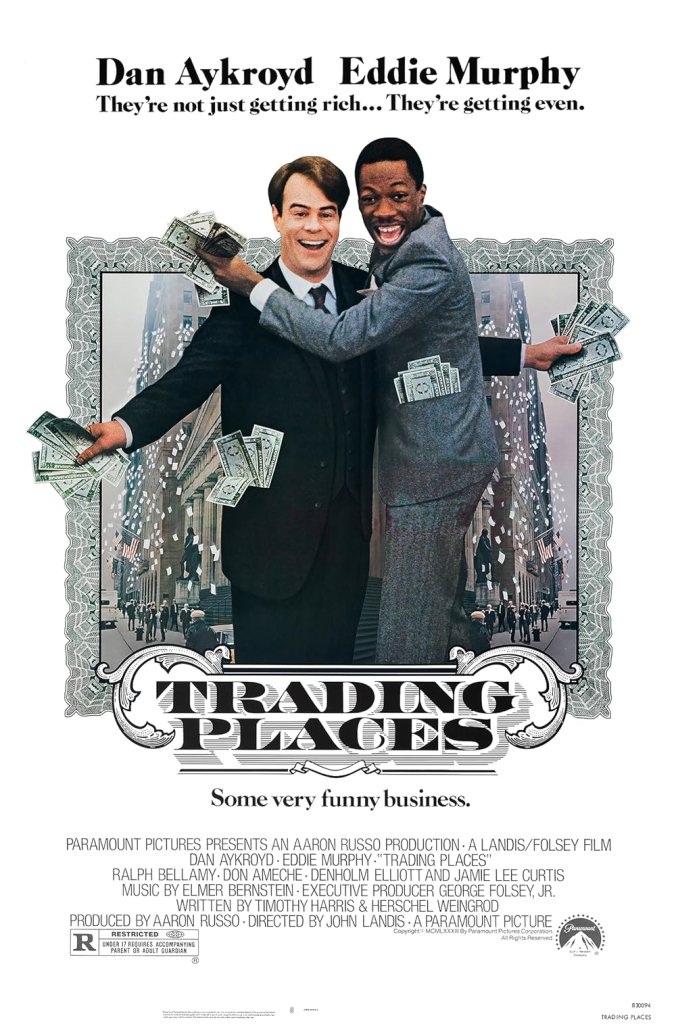
Louis Winthorpe III (Dan Aykroyd) has it all. A house in Philadelphia, glamourous fiancée and high-flying job as Managing Director at Duke & Duke, the leading blue-chip commodities brokers. Billy Ray Valentine (Eddie Murphy) has nothing: penniless, homeless, hustling on the Philly streets. But is their fate due to nature or nurture? Finding that out is the subject of a bet between heartless Duke brothers Randolph (Ralph Bellamy) and Mortimer (Don Ameche). They turn both men’s lives upside-down by swopping their positions – Louis will be disgraced and left with nothing and Billy Ray will get his house and job. Will they fall or rise? And what will they do when they find out their lives are the Duke’s playthings?

Trading Places was one of the big box-office smashes of 1983, a film that changed the lives of virtually the whole cast. It showed the world Aykroyd could carry a comedy without partner Jim Belushi, gave a second career to Bellamy and Ameche, led Curtis to say the role “changed her life” from just a scream queen and, perhaps most of all, turned Murphy into a mega-star. It’s still witty, fast-paced and funny today, even if in places it’s not always aged well.

Landis takes a screwball approach, unsettling the lives of two contrasting people and then throwing them into an unlikely revenge partnership. Trading Places is very strong on the contrasting world of rich and poor. The wood-lined, club-bound world of the Dukes is carefully staged, paintings of financial and political grandees staring down from walls as assured, masters-of-the-universe easily sachet around posh clubs and squash clubs, to the sound of Elmer Bernstein’s Mozart-inspired score. By contrast, the rough, litter-lined squalor of Philadelphia’s poorer neighbourhoods is unflinchingly shown with, under the comedy, the suggestion life is cheap and everyone is for sale.

Of course, a lot of the ensuing laughs come from seeing a rich person who has only known comfort thrown into this life of a tramp and vice versa. Ackroyd’s Winthorpe bristles with disbelief at his situation and the rich man’s blithe assurance that (any moment) someone will say there has been a terrible mistake carries a lot of comic force. Meanwhile, Murphy’s fast-talking Billy Ray assumes he is the subject of an elaborate prank (or perverted sex game) as stuffs the pockets of his first tailored suit with knick-knacks around the house the Duke’s assure him is now his. Hustler Billy Ray turns out, of course, to be well-suited to the blue-collar hustle of financial trading. He also finds himself, much to his surprise, increasingly interested in the culture and artworks around him.

Under all this, Trading Places has a surprisingly negative view of rich and poor. Louis posh friends and shallow fiancée are all status-obsessed snobs who turn on him in minutes when he is framed for theft, embezzlement and drug trafficking. The servants in their posh clubs – all, interestingly, Black men in a quiet statement on race that you still wish the film could take somewhere more interesting – are treated as little better than speaking items of furniture and there is a singular lack of interest or concern for anyone outside their social bubble. Playing fair, every working-class character we see (apart from Curtis and Murphy) is lazy, grasping and shallow, ignoring Billy Ray until they can get something from him, at which point they fall over each other to snatch freebies from his house.

Trading Places is, in many ways, a very 80s screwball. Money is the aim and reward here. Trading Places has respect only for aspirational characters who save and invest their money. (Curtis’ prostitute is marked out as savvy and decent because she has invested nearly $42k from her work in a nest-egg). The film culminates in a financial scam (playing out on the trading floor of the World Trading Centre) designed to reward our heroes with wealth and punish the villains with poverty. For all the film stares at the reality of poverty and riches, the implications and injustices of wealth are ignored, with money ultimately framed as a vindication.

But then, Trading Places is just a comedy so perhaps that’s reading a bit too much in it. There is a frat-house energy to Trading Places under its elaborate framing and a lot of its gags come from a rude, smutty cheek that sometimes goes too far (not least a punchline involving a villain being repeatedly raped by a randy gorilla). Murphy’s energy – every scene has the crackle of improvised wildness to it – is certainly dynamic (this is probably his funniest and – eventually – most likeable role) and while Aykroyd is a stiffer comic presence, he makes an effective contrast with Murphy.

The real stars here though are the four supporting actors. Bellamy and Ameche seize the opportunity to play the villains of the piece with an experienced gusto, brilliantly funny in scene-stealing turns. Outwardly debonair, the seemingly cudily Bellamy and prickly Ameche superbly reveal the greed and casual cruelty of these two heartless Scrooges. Elliot is also extremely funny, and the most likeable character, as a kind butler just about disguising his loathing of the Dukes. Curtis’ vivacity and charm makes a lot of an under-written “hooker with a heart of a Gold” trope – like her co-stars she seizes her chance with a fun role.

Some of Trading Places has of course not aged well. Jokes with gay slurs pop up a little too frequently. While the Duke’s use of racist language makes sense (after all they are vile people who see Billy Ray as nothing but a curious toy), it’s more of a shock to hear our nominal hero Louis do the same. Murphy’s improvised sexual harassing of a woman on the streets (ending with him screaming “bitch!” after her when she walks off) doesn’t look good. Curtis twice exposes her breasts for no reason. The film’s closing heist involves Aykroyd blacking up and affecting a Jamaican accent.

But, dubious as some of this is now (and while you can argue times have changed, surely even then some people would have been unsettled by this sort of stuff framed for good-old-belly laughs), Trading Places is still funny enough to be a pleasure. And, with the performances of Bellamy, Ameche, Elliot and Curtis we have four very good actors providing a humanity and professionalism to ground two wilder comedians. It’s easy to see why this was a hit.

Driving Miss Daisy (1989)

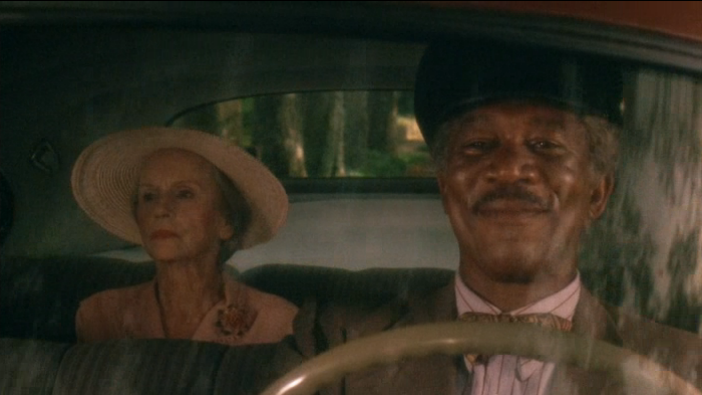
Jessica Tandy and Morgan Freeman drive through the South in Driving Miss Daisy

Director: Bruce Beresford

Cast: Morgan Freeman (Hoke Colburn), Jessica Tandy (Daisy Werthan), Dan Aykroyd (Boolie Werthan), Patti LuPone (Florine Werthan), Esther Rolle (Idella)

Retired Jewish teacher Daisy Wethan (Jessica Tandy) crashes her car while trying to drive down to the store. Her wealthy businessman son Boolie (Dan Aykroyd) decides she’s too old to drive herself, so hires black chauffeur Hoke Colburn (Morgan Freeman) for the job of Driving Miss Daisy. At first Daisy resists this new servant in her life but, doncha know it, over the next 23 years the two of them grow closer together as they deal with the ups-and-downs of life and find out that, heck, under the surface maybe we are all more alike than we think.

It’s been a recurrent theme that some films (like Shakespeare in Love or The Greatest Show on Earth) have found themselves actually diminished by the burden of being an “Oscar Winning Film”. Driving Miss Daisy joins them, an impossibly slight little puff of air film which could be blown away by the faintest breeze. It won out in a year where the most exciting movies of the year (sex, lies and videotape and most strikingly of all Do the Right Thing) failed to get nominated. It seemed a particular slap in the face that a film which looks at racial relations with such a cozy, nostalgic view as this one should triumph in the year Spike Lee made a film that exposed how close America was to racial tensions erupting into violence (worst of all this wouldn’t be the last time for Lee).

Driving Miss Daisy wants no part of that though. This is the Downton Abbey of racial dramas, a nostalgic and overwhelmingly “nice” film that uses odd-couple drama to make us feel good about ourselves. In this vision of the south, the Whites (and I am not buying the film’s pained attempts to suggest anti-Semitic mutters here and there is on a par with lynching) are mostly paternalistic masters, and the blacks forelock tugging servants hoping for a better life but grateful for the support of their betters. There isn’t a single black character (bar Hoke’s niece who appears wordlessly in the final minutes of the film) who isn’t a domestic servant, and not a single white person who isn’t genteel (bar a single racist cop 52 minutes into the film).

Not a single black character is ever angry, complains about injustice or is anything less than patient, noble and humble. It’s all part of a film designed to make us feel better about the South’s appalling record of racism and segregation by presenting it as exactly the sort of genteel Gone-with-the-Wind-good-old-cause fantasy many people remain comfortable with today, where black people needed to be looked after because (as even Daisy puts it in the film) they are basically children.

Now saying that, the film is of course light, fluffy, inoffensive and (there is no better word for it) nice. You can sit down and let the gentleness wash over you, no problem at all. I can see why it was a word-of-mouth hit in 1989, and why the Oscars gave it the big one. It’s well made and very faithful to the Pullitzer winning play it’s based on. Beresford’s genteel direction lets the dialogue and actors do the work (he didn’t get a nomination – though even he modestly said later he didn’t really feel he deserved one).

Freeman and Tandy do decent work with these incredibly simple characters. Tandy could have played this cookie-cutter “cantankerous-but-loveable-old-lady” role standing on her head. But she does it well (again, drawing those Downton parallels, this is exactly the same role Maggie Smith has in that series) and nails a little speech where she wistfully remembers visiting the sea then stops as if embarrassed by her self-indulgence. She won the Oscar.

Freeman here (and in Glory) invents a screen persona. He’s kindly, worldly-wise (but not bookly wise – he ain’t never had time to learn readin’), patient, long-suffering but full of dignity. But, with his repeated “Yassums”, his non-complaining acceptance of his position and status and his deferential nature, he’s pretty close to a sort of fantasy Uncle Tom-ish figure. Sure, Freeman can sell those quiet moments, where it’s clear Hoke has learned to bury feelings of fear (his brief confrontation with a racist cop – and his controlled fear – is the film’s most effective moment) but the whole performance feels like a carefully constructed lie.

It’s in line with the film, where the black experience has been cut down and filtered in such a way to make white people feel good about themselves. Because we can watch the film and go “oh yeah I’d be like Daisy and Boolie, they’re so sweet” and we wait 52 minutes before an unpleasant character turns up and uses the n word – and then he’s mean to Daisy as well for being Jewish and heck gosh darn it we are all the same after all, what a relief, pass the popcorn. You come out of Driving Miss Daisy and you have learned nothing.

Worse than that, you’ve been shown a cuddly fantasy world. We never see Hoke outside of the setting of his master’s homes (there is no other way of putting it) and learn nothing about his life or experiences. We see him melt the heart of an already-fundamentally-decent woman, but their relationship always has boundaries. Driving Miss Daisy would be fine as an escapist piece of fluff – but time has shown it increasingly to be a film designed to make us feel reassured that history wasn’t as distressing as it might have been. And I’m not sure that’s a good thing.