Masterful adaption of Wharton, beautifully judged, brilliantly acted and superbly filmed
Director: Terence Davies
Cast: Gillian Anderson (Lily Bart), Eric Stoltz (Lawrence Seldon), Dan Aykroyd (Gus Trenor), Anthony LaPaglia (Simon Rosedale), Laura Linney (Bertha Dorset), Terry Kinney (George Dorset), Eleanor Bron (Julia Peniston), Jodhi May (Grace Stepney), Elizabeth McGovern (Carry Fisher), Penny Downie (Judy Trenor), Pearce Quigley (Percy Glyde), Lorelei King (Mrs Hatch)
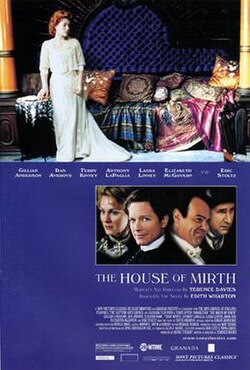
When Scorsese bought Edith Wharton’s The Age of Innocence to the screen, it was seen as a wild swing out in his career. You could have said the same thing when Terence Davies made The House of Mirth, an unlikely follow-up from a host of artistically constructed, meditative memory pieces. But in doing so, Davies executed perhaps one of the most perfectly executed translations of a novel to the screen, a gorgeous, beautifully moving film. Put simply, in its grace and magic glow, it’s pretty hard to imagine The House of Mirth being done better.
Our hero is Lily Bart (Gillian Anderson), a woman who feels she is at the heart of 1905 New York society but will discover her grip on life is far less secure than she believes. Dependent on her aunt (Eleanor Bron) for financial support, needing to marry for money, perhaps in love with not-quite-rich-enough bachelor Lawrence Seldon (Eric Stoltz), unwilling to compromise on her principles and desires, Lily will make a series of catastrophic decisions. Thee will leave her facing the brunt of the ruthlessness of her so-called friends such as banker Gus Trenor (Dan Aykroyd) or Bertha Dorset (Laura Linney) and her world falling apart with extraordinary speed.
Shot with a visual beauty inspired by a host of painters – most notably John Singer Sergeant, whose compositions are referenced throughout to breathtaking effect – Davies film is measured, wise and slowly unleashes a powerful emotional impact. Carefully adapted, Davies film is awash with the intricate, ornate dialogue of early twentieth century New York: speech that, it quickly becomes clear, is about disguising and obscuring the true meaning of what is being said. New York society is awash with lies, deceptions, selfishness and greed, all of it disguised with fine words and high-living – as Lily says “Why is it when we meet we always play this elaborate game?”
What’s tragic about Lily Bart is that it’s a game she believes herself to be skilled at, time revealing she is a novice stumbling in the big leagues. On top of which, as someone penniless, unmarried and reliant on others, she has a terrible lack of security. A lack of security meaning people like Trenor can demand a very personal reward in exchange for his financial services, without worrying about disgrace. Someone savvier would have seen through Ackroyd’s wonderful portrait of barely concealed greed under Trevnor’s avuncular pleasantness. Just as a more worldly figure would have seen that (the simply brilliant) Laura Linney’s gossipy Bertha sees Lily as nothing more than a simple soul ripe for manipulation, a pathetic fall-guy to hide her own infidelities.
It becomes clear there is a doomed, tragic quality to Lily. She’s introduced emerging from a blackened screen in a puff of train steam, an Anna Karenina-ish echo hinting at her eventual fate. In an extraordinarily complex, perfectly judged performance from Gillian Anderson, Lily emerges as a woman of far greater depth and principle than we (or she) suspects. But prone to terrible errors of judgment, often for the right reasons. She is too principled to marry for money, but not savvy enough to play the courting game, publicly humiliating the wealthy Percy Glyde (Pearce Quigley) who she dutifully woos, only to stand him up for a walk that is a clear proposal hint.
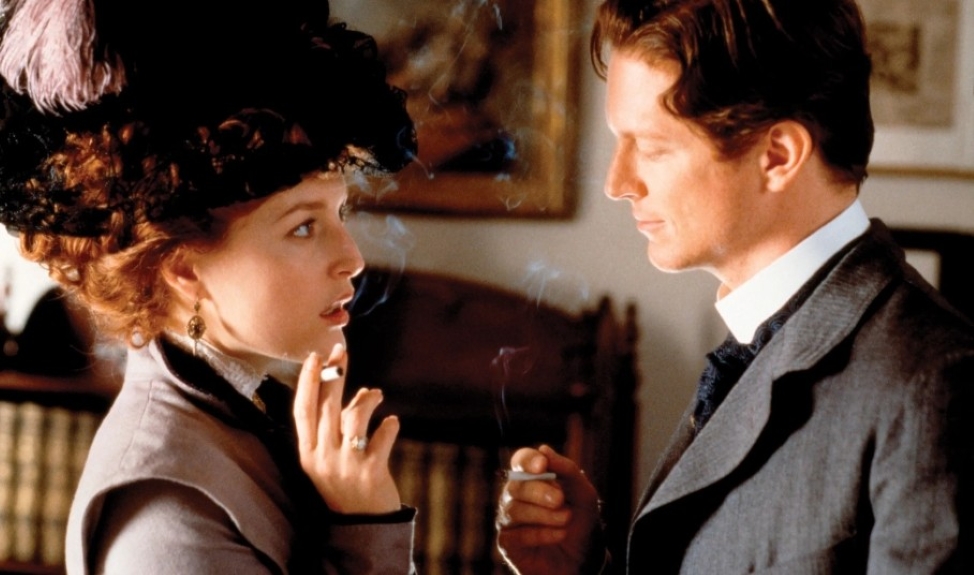
But she is too aware of her wordly needs to embrace the mutual love between her and Eric Stoltz’s charmingly enigmatic Lawrence Stern. These two conduct a dance of suggestive flirtation, without ever truly committing their feelings openly. Lily seems to be almost a tease, but Anderson beautifully demonstrates a hesitancy born from an attempt to be honest, to find love and money in one man. The heart-rending realisation later in the film that she has made a terrible mistake, out of a mix of principle, pride, foolishness and decency is captured in Anderson’s superbly pained expression – not to mention a late emotional out-pouring that is heart-breaking in its pain and honesty.
Slowly, Lily’s world falls apart, Davies capturing the tragedy with coolly observant camerawork gliding through society, echoing the photographic approach that defined his earlier work. In every sequence, and between every scene cut, Lily’s position slowly, at first imperceptibly, becomes worse and worse. Less and less secure, until eventually she’s lost to society, in a world of run-down bedsits and laudanum addictions. Where she brutally realises her life of society balls has made her a “useless person”, with no skills and utterly out-of-depth in a world where she must earn her living.
Anderson’s punctures Lily beautifully throughout with a naïve vulnerability. In a way, the undeserved social disgrace Lily suffers (wrongly seen as a slut and a home wrecker) makes her cling even more closely to her principles – even as they become more and more damaging to her. These principles can seem as inexplicable to us as they do to her few allies: she pays out a stock of her limited personal finances to cover up Bertha’s affair with Lawrence, continuing to cover for her even as Bertha burns her in front of all of New York (and barely considers using her evidence for blackmail). It’s part of what makes Lily an astonishingly admirable figure, even as her life spirals downward.
The powerful emotion of this, the deep investment Davies helps us feel for a woman who becomes more and more understandable to us as she is more and more stripped of privilege, is complemented by exquisite film-making. One breath-takingly superb transition sees Davies camera drift through a grand house with all its furniture and fittings carefully hidden under dustsheets, out into a rain-speckled stream, the camera swooping lower and faster until the water transitions into the sun-kissed waves of the Mediterranean: a gorgeously, masterfully simple transition that moves us across weeks and miles in a moment. Haunting images abound, a spilt ink pot in the film’s closing sequence like a gut punch of emotional rawness.
Really, what Davies understands, is that Wharton’s bitter comedy is set in a ‘vile’ world. In society, nothing matters other than the quality of homes and classiness of backgrounds. The finest people can lie, cheat and steal with no blowback. Nouveau riche like Simon Rosedale (a very good Anthony LaPaglia) are judged as vulgar when their actions reveal they are decent. It’s a world where you start to expect no one is happy: Lily’s cousin Grace (an excellent Jodhi May) is unloved, her aunt miserable, half of society are privately humiliated cuckolds, deeply bitter and unhappy.
The House of Mirth is a truly outstanding literary adaptation, beautifully assembled, wonderfully acted – Anderson, in particular, was and is an absolute revelation – and directed with a deeply powerful simplicity by Davies. It’s possibly his masterpiece.