Author: Alistair Nunn

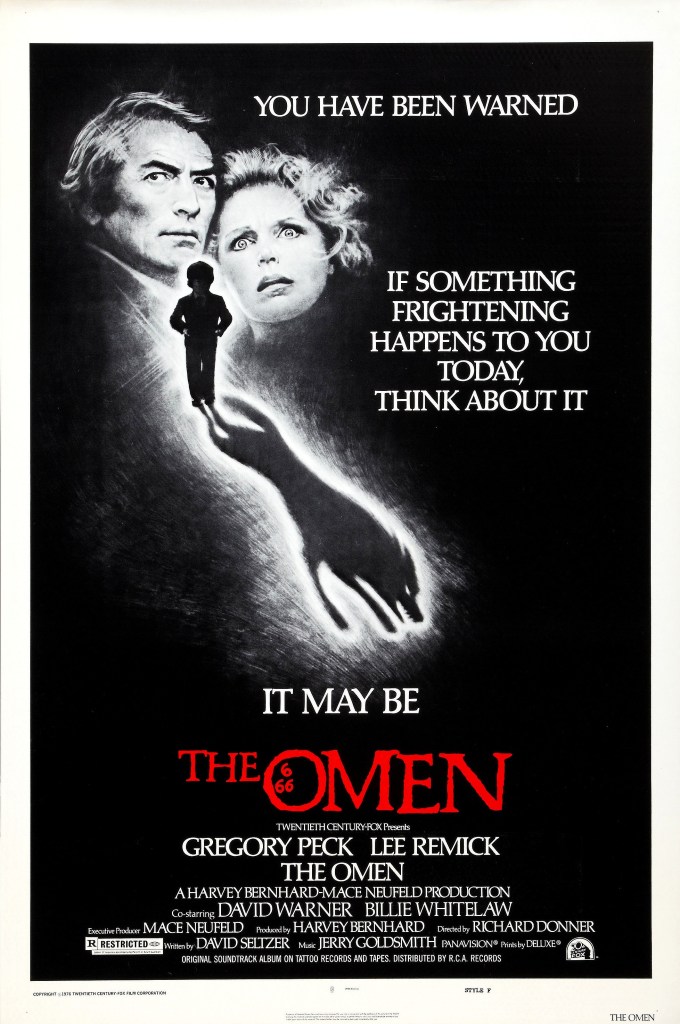
The Omen (1976)

The Omen (1976)

Extremely silly horror with a great score, more interested in inventive deaths and genuine fear or dread

Director: Richard Donner

Cast: Gregory Peck (Robert Thorn), Lee Remick (Katherine Thorn), David Warner (Keith Jennings), Billie Whitelaw (Mrs Baylock), Patrick Troughton (Father Brennan), Leo McKern (Carl Bugenhagen), Harvey Stephens (Damien Thorn), Martin Benson (Father Spiletto), Robert Rietty (Monk), John Stride (Psychiatrist), Anthony Nicholls (Dr Becker), Holly Palance (Nanny)

“Let him that hath understanding count the number of the beast; for it is the number of a man; and his number is 666.” One of the sweetest things about The Omen is that the number of the Beast was considered such an unknown concept to original viewers, that its painstakingly explained to us. In some ways The Omen is quite sweet, a big, silly Halloween pantomime which everyone involved takes very seriously. If The Exorcist was about tapping into primal fears, The Omen is a gory slasher (with a cracking score) that’s about making you go “Did you fucking see that!” as actors are dispatched in inventively gory ways. It’s brash, overblown and (if we’re honest) not very good.

Robert Thorn (Gregory Peck, selling every inch of his innate dignity for cold, hard lucre) is an American diplomat told one night in Rome that his pregnant wife Katherine (Lee Remick) has given birth to a stillborn child. “Not a problem” he’s told by an absurdly creepy Priest (Martin Benson) – just so happens there’s another motherless new-born child in the hospital tonight so he can have that one, no questions asked, and his wife need never know. Flash forward five years: Thorn is Ambassador to the Court of St James and young Damien (Harvey Stephens) is a creepy kid, with few words and piercing stare. In a series of tragic accidents people start dying around him. Could those people warning Thorn that his son is in fact the literal anti-Christ himself, be correct?

Want to see how powerful music can be? Check out how The Omen owes nearly all the menace it has to it imposing, Oscar-winning score from Jerry Goldsmith (wonderfullyGothic full of Latin-chanting and percussive beats). It certainly owes very little to anything else. The Omen is an exploitative, overblown mess of a film, delighting in crash-zooms, jump-cuts and extreme, multi-cut build-ups to gore. Richard Donner never misses an opportunity to signpost an approaching grisly death, by cutting between the horrified face of the victim, the object of their demise and then often back again. For the best stunts – including a famous demise at the hands of a sheet of glass – Donner delights in showing us the death multiple times from multiple angles.

This slasher delight in knocking off actors – people are hanged, impaled, crushed and decapitated in increasingly inventive manners – is what’s really at the heart of The Omen. None of this is particularly scary in itself (with the possible exception of the hypnotised madness in the eyes of Holly Palance’s nurse before her shocking suicide at Damien’s birthday party) just plugging into the sort of delight we take in watching blood and guts that would be taken in further in series like Halloween (which owed a huge debt to the nonsense here). Donner isn’t even really that good at shooting this stuff, with his afore-mentioned crude intercutting and even-at-the-time old-fashioned crash zooms.

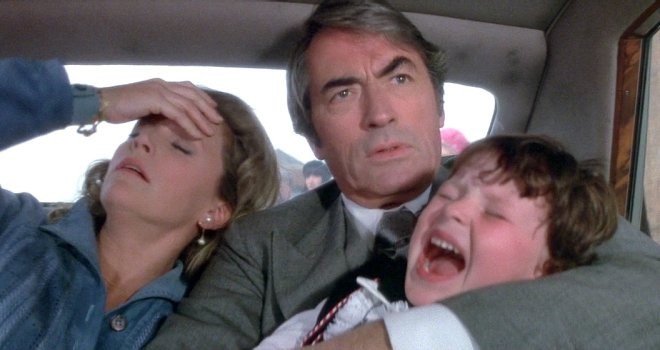
With Goldsmith’s score providing the fear, The Omen similarly relies on its actors to make all this nonsense feel ultra serious and important. They couldn’t have picked a better actor than Gregory Peck to shoulder the burden of playing step-dad to the Devil’s spawn. Peck has such natural authority – and such an absence of anything approaching fourth-wall leaning playfulness – that he invests this silliness with a strange dignity. Of course, Atticus Finch is going to spend a fair bit of time weighing up the moral right-and-wrongs of crucifying with heavenly knives the son of Satan! Peck wades through The Omen with a gravelly bombast, managing to not betray his “for the pay cheque” motivations, and investing it with his own seriousness of purpose.

Peck’s status also probably helps lift the games of the rest of the cast. Lee Remick may have a part that requires her to do little more than scream (and fall from a great height twice) but she does manage to convey a neat sense of dread as a mother realising her son is not quite right. David Warner gives a nice degree of pluck to a sceptical photojournalist (while also bagging the best death scene). Troughton and McKern ham it up gloriously as a drunken former devil-worshipping priest and an exorcist archaeologist respectively. Best in show is Billie Whitelaw who filters her Beckettian experience into a series of chillingly dead-eyed stares as Damien’s demonic nanny.

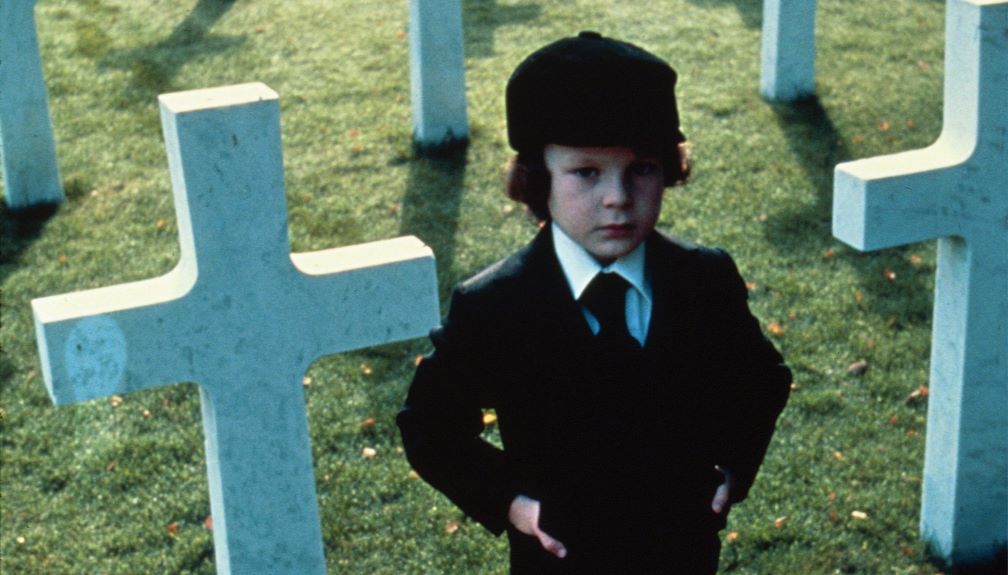
The Omen does make some good hay of its neat paedophobia. Harvey Stephens with his shaggy hair, impish smile and pale skin (not to mention darkly sombre wardrobe) looks like your worst nightmare – he’s creepy enough that the film doesn’t need to gift him a vicious rottweiler as well. Donner’s decision to never have Damien show a touch of any real emotion for most of the film also pays off, meaning even something as silly as Damien inflicting slaughter from behind the pedals of a child’s tricycle seems scary.

Of course, if Damien was savvy enough to present himself as a bright and sunny child perhaps Troughton, Warner, McKern and co would have struggled to convince Peck he was the Devil’s seed. In that sense he takes after his dad: Satan loves an over-elaborate death, and from a storm herding one victim to a fatal impalement under a tumbling church spire to popping the handbrake of a glass-bearing van for another, no trouble is too much for Satan when bumping off those who cross him. (The Omen could be trying to suggest that maybe everything is a freak accident and Thorn goes wild and crazy with grief – but that Goldsmith score discounts any possibility other than Damien is exactly what we’re repeatedly told he is.)

The Omen trundles along until its downbeat, sequel-teasing ending, via a gun-totting British policeman who sticks out like a sore thumb in a country where the cops carry truncheons not pistols. Donner balances the dialled up, tricksy, overblown scares with scenes of po-faced actors talking about prophecies and the apocalypse, all shot with placid straight-forwardness. There is a really scary film to be made here about finding out your beloved son is literally a monster, or how a depressed father could misinterpret a series of accidents as a diabolical scheme. But it ain’t The Omen – this is a bump-ride of the macabre. The Devil may have the best tunes – but he needs to talk to his Hollywood agent.

Blackberry (2023)

Blackberry (2023)

Comic-drama about business collapse wants to The Social Network but lacks its deft touch and humanity

Director: Matt Johnson

Cast: Jay Baruchel (Mike Lazaridis), Glenn Howerton (Jim Balsillie), Matt Johnson (Doug Fregin), Rich Sommer (Paul Stannos), Michael Ironside (Charles Purdy), Martin Donovan (Rick Brock), Michelle Giroux (Dara Frankel), Saul Rubinek (John Woodman), Cary Elwes (Carl Yankowski)

“We’ll be the phone people had before they had an iPhone!” I’ve always found successful products that collapsed overnight fascinating. The Blackberry tapped into something people didn’t even realise they wanted: a phone that combines a computer and pager, a status symbol that told everyone you were a Master of the Universe. It was the product everyone wanted – until Steve Jobs announced the iPhone that did everything the Blackberry did better. It should be material for an entertaining film – but Blackberry isn’t quite it.

The film is set up as a classic Faust story. Our Faust is Mike Lazaridis (Jay Baruchel), co-founder and CEO of Research in Motion, a tiny Canadian business with an idea for lovingly crafted cellular devices. Our Mephistopheles is Jim Balsille (Glenn Howerton), an aggressive blowhard businessman who sees the potential – and knows he can sell it the way the timid Lazaridis never could. The angel on Faust’s shoulder is co-founder Doug Fregin (Matt Johnson), who worries the quality-and-fun parts of the business will be sacrificed. Nevertheless, Mephistopheles tempts Faust into partnership and they turn Blackberry into a huge business destined to all fall apart.

Blackberry desperately wants to be The Social Network. What it lacks is both that film’s wit and sense of humanity. It’s a film trying too hard all the time, always straining to be edgy. You can see it in its hand-held, deliberately soft-focus filming style, the camera constantly shifting in and out of blur. (Watching after a while I genuinely started to feel uncomfortable, with a wave of motion sickness nausea.) It goes at everything at one hundred miles an hour, but never manages to make its depiction of a company bought low by arrogance and unwillingness to adapt either funny or moving. It’s aiming to capture the chaos, but instead feels slightly like a student film.

It’s Faustian theme of selling out your principles for glory is just too familiar a story – and the dialogue isn’t funny enough to make the film move with the zingy outrageousness it’s aiming for. It also lacks momentum, the woozy hand-held camerawork actually slowing things down, a very shot lurches into focus. It’s a film crying out for speedy montage and jump-cuts to turn it into a sort of cinematic farce, as the business makes ever more sudden, chancy calls which switch at the mid-point from paying off to unravelling. Instead, it stumbles around like a drunken sailor.

At the centre, Jay Baruchel delivers the most complex work as the awkward and timid Lazaridis who slowly absorbs more and more smart business styling and ruthlessness over the film. But the film fumbles his corruption. His opening mantras – that “good enough is the enemy of humanity”, that Chinese mass production equals low quality because the workers aren’t paid enough to care about the product, that companies should focus on human needs – are all-too obviously dominos set up to get knocked over as Lazaridis gets corrupted and cashes out his principles to turn out exactly the sort of bug-filled mass-produced crap he railed against at the start – but this makes the character himself feel more like a human domino himself rather than living, breathing person.

The other performances all verge on cartoonish. Glenn Howerton channels Gordon Gekko and The Thick of It’s Malcolm Tucker as abusive, sweary, would-be Master-of-the-Universe, only-interested-in-the-bottom-line Jim Balsille. Balsille will do everything Lazaridis won’t do: he’ll cut corners and browbeat his way into meetings. A smarter film would make clear Balsille is in many ways more effective than Lazaridis – that without him Research in Motion would have gone bust years ago. It could also have looked with more sympathy at a guy who so believed in his one shot at glory he re-mortgaged his house to pay for it. But the film leans into Howerton’s skill at explosive outburst and never really humanises him, constantly shoving him into the role of villain.

The film also fails with its more human element. Director Matt Johnnson plays Doug Fregin, Lazaridis’ best friend and business partner. Fregin is set-up as the angel in Lazaridis shoulder, the decent guy against selling out. But Johnson’s performance lacks charm or likeability. Fregin – like many of the other workers of the company – is a geek-bro, his veins pumping with fratboy passions, who thinks the best way to get people working is to throw a string of parties. He’s, in a way, as wrong as Balsille is on what makes long-term business success. Crucially as well, the friendship between him and Lazaridis never really rings true, not least because Fregin browbeats and bullies the timid Lazaridis as much as Balsille does.

With no-one to really care for, the tragedy of this business never hits home. It does capture the sense of desperation as the once-mighty company collapses in the face of Apple – Lazaridis ramming his head into the sand and refusing to believe anyone would want a phone sans keyboard – but it fails to successfully illustrate why an innovator lost his ‘magic’ touch. The script fails to land much of its humour, and tiptoes around positioning Lazaridis as increasingly corrupted, even as starts hiring brash businessmen (epitomised by Michael Ironside’s sergeant-major fixer) to say the thing to his underlings that he’s too scared to. The financial shenanigans that land Blackberry in trouble with the SEC aren’t properly explained, and the actual reasons the iPhone finally put Blackberry in the dust bin of history are hand-waved away (“minutes… data… look just accept it ok”)

Blackberry would, in the end, have been better as an hour-long documentary, with dramatic reconstructions supported by informative talking heads. The film we have fails to deliver on a concept that bursts with comic and dramatic potential.

Persona (1966)

Persona (1966)

Bergman’s masterpiece, a fascinatingly brilliant Rorschach test that challenges and rewards the viewer

Director: Ingmar Bergman

Cast: Bibi Andersson (Alma), Liv Ullman (Elizabet Volger), Margareta Krook (Doctor), Gunnar Björnstrand (Herr Volger), Jorgen Lindstrom (Boy)

Even Bergman considered Persona a moment he “had gone as far as I could go…touched wordless secrets that only cinema can discover”. Persona, Bergman’s most consciously artistic and psychologically challenging work is a mass of contradictions and puzzles that defies easy categorisation (even Bergman claimed to be only half sure what definitively was happening). A whirling mix of themes, haunting moments and unknowable incidents all within a framework that constantly reminds us we are watching a film, Persona has been influencing, challenging and fascinating viewers for over 60 years. If cinema’s Everest is Citizen Kane, Persona is its K2.

The plot seems simple. Famed actress Elizabet Volger (Liv Ullman) fell silent for a minute during a production of Electra, then carried on. A day later she stopped speaking and hasn’t spoken since. Her doctors can’t find an answer so she is sent to an island to recuperate, with the support of a nurse, Alma (Bibi Andersson). On the island, Alma fills the silence with long monologues that become more and more confessional, intimate and personal. Does Elizabet betray these confidences in a letter to her doctor? Does Alma plot revenge? Are these events even happening? As the personalities of the two women blur, merge, swop and consume each other the film fractures (at one point literally so) until we are left as uncertain of who and what is real as perhaps the women themselves.

There is, in some ways, no understanding Persona. It perhaps best resembles a cinematic Rorschach test. I’d argue it’s a fool’s journey to stare at it for a definitive answer. Different days, different moods, different conditions will make the picture re-shape and resemble something else. Bergman has created a film devoid of traditional ‘clues’, that provides no trace of an ‘answer’, but instead asks – demands? – us to take away only what we choose.

Throughout, Bergman makes it vitally clear film is a constructed, artificial representation of reality. Persona starts and ends with film literally spooling through a projector, the arc lights cranking up to project a reality. The opening prologue is a host of suggestive images which may, or may not, relate to what we are about to watch. Their meaning is almost deliberately vague – much as the epilogue’s brief shot of Bergman and crew shooting the film is – but it lets us know beyond doubt this is a subjective presentation of a series of images, not real life. Perhaps reading meaning into it is as impossible a task as trying to interpret the contents of a library from the page of a single book.

Which is to say, I think Bergman is both inviting us to interpret the film but also warning us that this isn’t a jigsaw, but a deliberately obtuse and open-ended work, our experience of it controlled by the director. Film is after all a dream – a world where we think we move freely, but in fact we never do. Which might make you think Persona is Bergman’s punking the world, a Thermot’s Last Theorem designed to infuriate. It isn’t because it’s made with such grace, humanity and honesty.

To understand Persona you can only discuss – and wonder – at the complex, multi-layered themes and decide which speaks most to you on the day. A lot of this boils down to how you are affected by the breathtaking, seismic performances from Andersson and Ullman. Playing two characters whose identities merge, shift, mirror and absorb each other both performers give outstandingly intelligent, infinitely challenging and unreadable performances. For Andersson the film is virtually a monologue, where the more Alma talks, the more our grasp on who (or what?) she is slips through our fingers. Ullman’s impassive face, awash with micro-expressions (caught in scintillating close-ups) constantly disorientates – is that a sneer or a smile? Is that head-turn impatience or a desire to know more?

At several points I find myself falling into the trap Bergman lays of wanting to categorise the film, as I became convinced first one than the other of these women was just an element of the psyche of the other. It’s not as simple as that. They are both the same and different, two people and one. Bergman frequently frames their bodies overlapping and, in one horrifying moment, their face literally merged half-and-half. Elizabet, we think at first, is a near vampiric figure sucking the life out of Alma, drawing confessions from Alma to restore herself. Then Elizabet becomes a ghostly figure, moving in the margins of Alma’s life, a horrific silent figure from her subconscious holding her back. Then you feel Alma to be nothing more than Elizabet’s id, demanding her right to be independent.

The unreadability of the film becomes ever more acute at the half-way point. After an enraged Alma deliberately leaves Elizabet to cut her foot on glass, the film pauses, burns away and then restarts with an echo of its earlier montage. Has the story restarted? Did all or any of what went before actually happen? Or is everything from this point a cinematic fantasy? Later in the film Bergman throws in a sequence with Alma and Elizabet back in the hospital before returning to the island – is this a flashback or a dream or a vision or something else entirely?

Bergman’s mastery of horror comes to the fore. The haunting repeated shot of Elizabet embracing Alma from behind, the two of them starring into a mirror (and the camera) at times seems sexually charged, at others disturbingly possessive at others supernaturally controlling. Is Bergman’s point that the context of an image can change its meaning? These hazy definitions of truth and reality lie throughout. The confrontations between the two taking on an increasingly surreal nature.

In a stunning sequence, Bergman repeats the same Alma monologue twice, one focused solely on Elizabet (her face contorted with pain as she hears of her rejection of a child), the second on Alma (now dressed identically to Elizabet), Alma’s bitterness now taking on a totally different light. Alma, back in nurses’ outfit, confronts Elizabet screaming that she is her own person even as her words collapses into an incoherence that might as well match Elizabet’s silence. Which is projection and which reality? When they leave at the film’s end, do they go their separate ways or merge? Does Alma imagine herself with Elizabet’s husband, or when Elizabet’s husband recognises Alma as his wife is he tipping the nod to us?

Bergman gives no clear reasons for Elizabet’s silence. It could be connected to horror at the world’s terrors (Vietnam and the Holocaust are referenced). It could be shame at her own post-natal depression. It could be that the silent Elizabet is a projection of the Alma-Elizabet’s own turmoil and isn’t real in the first place. After all the hospital we are introduced to Elizabet in doesn’t feel like a real place but a sparsely dressed film set (and shot like it).

Sex weaves it’s way tellingly through the film. The sexual bond between Alma and Elizabeth, physically, seductively close and possibly sleeping together is clear. Alma relates a hugely erotic monologue about an orgy she and a friend initiated on a beach, the only time she describes herself a purely happy and content. Is this her memory or a fantasy of Elizabet’s? If Alma is Elizabet, is this what she longs for or the thing she finds missing now from her own life? Alma talks of wanting a family – but in a haphazard, casual way and has already had an abortion. Elizabet has a son but doesn’t want him – is Alma what she dreams she could be, or is Elizabet the truth Alma doesn’t want to face? At various points both, all or nothing of the above could be true.

The film opens with a mysterious boy starring at a blurred series of images of female faces. We never learn who he is (theories abound from Elizabet’s son to Bergman himself). He wakes seemingly from the dead, but perhaps he is given life by the film. Perhaps, Bergman is saying, Alma and Elizabet are themselves given life only by the film. That both of them are fictious illusions, as unreal as the blurred pictures on the wall. Persona is the sort of film only a director of pure courage could have made. An object that fascinates and frustrates but always leaves you wanting to reconsider and reposition it to see if the picture becomes clearer or if new truths are presented if you look at it from a different angle. Maybe Elizabet is a succubus. Maybe Alma is an angry inner self, longing to escape and liver her own life. Maybe Alma is the silent actress. Maybe Elizabet longs for the simpler life of the nurse. Perhaps every single idea is true and perhaps none of them are. That’s part of the mystery that makes Persona one of the greatest films ever made.

A Haunting in Venice (2023)

A Haunting in Venice (2023)

Branagh’s third Poirot outing lowers the scale but feels more real and involving than any others

Director: Kenneth Branagh

Cast: Kenneth Branagh (Hercule Poirot), Kyle Allen (Maxime Gerard), Camille Cottin (Olga Seminoff), Jamie Dornan (Dr Leslie Ferrier), Tina Fey (Ariadne Oliver), Jude Hill (Leopold Ferrier), Ali Khan (Nicholas Holland), Emma Laird (Desdemona Holland), Kelly Reilly (Rowena Drake), Riccardo Scamarcio (Vitale Portfoglio), Michelle Yeoh (Joyce Reynolds)

Branagh’s Poirot films have been a mixed bag. Big on starry cast and luscious locations, they’ve also succumbed too readily to bombast not to mention the sort-of tricksy directorial flourishes Branagh has such a weakness for. It’s a pleasant surprise then that A Haunting in Venice turns itself into the smallest-scale and tightest of his Poirot films and might just be the most successful of the lot.

It’s 1947 and a retired Hercule Poirot (Kenneth Branagh) lives as a recluse in Venice, studiously ignoring potential cases, his door firmly guarded by bodyguard (and retired policeman) Vitale Portfoglio (Riccardo Scamarcio). All this changes when he is visited by an old friend, crime novelist Ariadne Oliver (Tina Fey) who recruits Poirot to help debunk spiritualist Joyce Reynolds (Michelle Yeoh). Reynolds is conducting a séance for retired opera singer Rowena Drake (Kelly Reilly), still grieving the recent death of her daughter Alicia. With other guests including Alicia’s former fiancée Maxime (Kyle Allen), PTSD suffering Dr Ferrier (Jamie Dornan) and his precocious son Leopold (Jude Hill) and housekeeper Olga Seminoff (Camille Cotton), the stage is set when a storm and a murder all strike on the same night. Finally, Poirot takes up arms again.

A Haunting in Venice has a fair bit of latitude to work with since there is not an Agatha Christie Poirot mystery actually called that (or even set in Venice). Instead, this is a fast-and-loose adaptation of Hallowe’en Party (definitely one of the lesser-known books) which shifts its location, reshuffles the characters backgrounds, brings a few off-page murders very much “on page” and repackages the story to take place in a sadness-tinged, post-war misery which neatly reflects Poirot’s private grief and guilt at a life which has seen so much death.

This actually works rather well. Contrary to much of the publicity, which played up the horror elements, this is about a million miles away from The Exorcist (although Branagh clearly rewatched Don’t Look Now for Venice scares inspiration), offering instead a camp-fire spookiness and a couple of jump scares. A Haunting in Venice is actually the first Branagh Poirot that feels it would fit into the Suchet-Poirot mould: a slightly maudlin atmosphere mixed with gentle humour, a tight interview-based structure and a (thankful) reduction in gun-toting stand-offs.

A Haunting in Venice is predominantly set in one crumbling Venetian house over one night during a wild storm. The house is given a ghostly backstory of a medieval orphanage left walled-up to prevent a plague outbreak spreading – and there are suggestions of supernatural mischief (objects fall down seemingly on their own) at various points (most of which are swiftly debunked by Poirot). The film is shot and framed with a series of fish-eye lenses and some oblique angles (as per Branagh, the second shot of the film is a Dutch angle) to maximise the dimensions of the house but also at key points stress its claustrophobia, all of which works rather well. It’s moodily lit in a series of shadows (to maximise those spooky jump scares) but its horror elements are lite – a whirligig of screaming and bloodshot eyes at the séance are about as far as it goes.

Instead, it unfolds in a traditional manner, bookended by a prologue and epilogue that indulges the beauty of the location shooting (including a luscious final aerial shot over Venice). The film effectively uses its post-war setting to add emotional impact – after suffering through a war that claimed millions of lives, is it surprising that people are more susceptible to the attractions of taking to the dead? The impact of war blights several characters, from Jamie Dornan’s doctor (Dornan is very good in the role), forever scared by the sights he saw liberating Bergen Belsen to a pair of young Eastern European refugees who have fled the Nazis.

Poirot’s background as a soldier and his own traumatic familiarity with death are also rather neatly wrapped up in questions of his faith. In Branagh’s quiet, melancholic performance (where its clear moments of warmth are only covering deep regrets), it becomes clear his faith in God is as lost as his belief that the world can be improved by deduction. His rejection of spiritualism is pointedly based on a belief that there is nothing outside of the tangible.He fits in witha house awash with traumatised doctors, opera singers lost in grief, housemaids who feel their lives have no purpose and even a crime novelist who’s last three books were flops.

Tina Fey is very playful as this Agatha Christie self-portrait, bouncing effectively off Branagh’s more sombre Poirot. The cast is in fact uniformally strong – a reduced cast list from previous Branagh Poirot’s means each one feels slightly more developed. Yeoh bites into the juicy part of Joyce with movie-star confidence, Reilly is subtly fragile, Cottin and Scamarcio both effectively hiding secret depths. Jude Hill, fresh from playing the young Branagh in Belfast marks himself as a kid with a golden future with a stand-out turn as the mature, worldly-wise young Leopold, comforting and caring for his emotionally scarred Dad.

All of this is marshalled into a tight murder-mystery – we get a bit of Grand Guignal slaughter as well as an effective locked room mystery thrown on top (as well as a homage to the originals apple-bobbing murder) – with a Poirot who is unsettled and out of sorts (for reasons that I guessed but make perfect, secular sense when revealed). It even wraps up on a quietly affecting note of hope. By dialling down the flourishes, scale and action (even if Branagh can’t resist a snorricam shot of himself through the house), A Haunting in Venice actually becomes more rewarding than either of the previous films in the series – and Branagh’s Poirot remains a strong, very human interpretation of the character. Surprisingly, despite its playing with the supernatural, it feels more grounded and human and, despite effectively creating a new story, closer to Christie.

The Lesson (2023)

The Lesson (2023)

Sinister family mystery, full of good moments that don’t come together into something that really works

Director: Alice Troughton

Cast: Daryl McCormack (Liam Sommers), Richard E. Grant (JM Sinclair), Julie Delpy (Hélène Sinclair), Stephen McMillan (Bertie Sinclair), Crispin Letts (Ellis)

Liam Sommers (Daryl McCormack) strides onstage for an interview about his literary debut, that has set the world alight. How did he get the inspiration to write about a domineering patriarch in a rich country house? Flashback to Liam’s summer spent as an English tutor to Bertie (Stephen McMillan), who is trying to get into Oxford to impress his domineering father JM Sinclair (Richard E Grant), Britain’s leading literary novelist. The Sinclair household bubbles with suppressed grief over the accidental drowning of JM and Hélène’s (Julie Delpy) older son Archie in their private lake. As Sinclair puts the finishing touches to his new novel – and ropes in Liam to help him as “final lap amanuensis”, what secrets will Liam uncover about this family?

The Lesson revolves heavily around its oft-repeated pithy mantra from JM Sinclair – “Great writers steal”. So often is this repeated, that it drains much of what little surprise there might be about the true origins of JM Sinclair’s latest tome. It’s a fitting mantra from the film that feels like a mood piece, assembled from little touches of other filmmakers (Kubrick for starters), reassembled into something just a little too pleased with its reveals and secrets-within-secrets structure, but is well enough made that you are willing to cut it some slack.

Effectively all filmed in a single location, the Sinclair’s luscious house (a mix of the modern and the classical) set amongst rich private grounds, it’s well directed by Alice Troughton, who makes effective use of angles and transitions (particularly its cuts back and forth between the working practices of Sinclair and would-be novelist Liam, which subtly stress both their similarities and differences) to enhance mood and an air of unknowable menace. The camera drifts with a chilling intimacy across the fateful lake, giving it a sense of ominous power and mystery.

The film is at its strongest in its opening sections (like Sinclair’s novel, it is divided into three parts with short prologues and epilogues). Within a self-contained theatrical space, tensions and resentments between the family are carefully but not pointedly outlined. The father who switches between indifference, annoyance and gregarious enthusiasm. The mother who feels like both a dutiful supporter and a resentful slave. The prickly, difficult son scared of affection, who attempts (unsuccessfully) to ape his father’s authoritarianism, but is crying out to be hugged. Troughton skilfully cuts between these characters, frequently positioning them at opposing sides of the frame, setting them at visual odds with each other.

In the middle of this, Liam becomes an out-of-place, equally unreadable presence. Very well played by Daryl McCormack, full bluntness mixed with inscrutability, Liam is impossible to categorise and totally outside the upper-class formality of the Sinclair home (with its servants, home fine-dining accompanied with classical music and casually displayed artwork). He’s Irish, working-class, Black and sexually ambiguous. But he’s also hard for us to read: is his admiration for Sinclair something that could tip into resentful violence? Does he really like Bertie, or does he see him as a tedious, brattish child? As the prologue sets up, is he an innocent or a destructive, vampiric presence?

These beats are neatly set up in The Lesson’s opening parts, added to by the presence of a Pinteresque butler (a fiercely polite Crispin Letts) whose status and loyalties prove equally hard to read. Liam’s slowly becomes an intimate figure in the house, moving from a servant occasionally allowed to dine with the family, to Sinclair’s IT consultant, proof-reader and one-sided sounding-board for conversations about his novel, becoming an object of sexual fascination for Bertie and Hélène and given the late Archie’s clothes to wear (adding an Oedipal frisson to his flirtation with Hélène).

Ambiguity however slowly gives way as The Lesson continues, as it fails to weave its initial jarring mood into a reveal that feels truly satisfying, logical or surprising. This effect is magnified by the fact the more time we spend with Sinclair, the more it’s made clear he is less complex than we think, but simply an egotistical monster. Richard E Grant has huge fun with this larger-than-life braggart, a man so competitive that he feels compelled to aggressively slap down Liam’s draft novel as “airport trash” and smilingly telling him he has “done him a favour” by encouraging him not to write. But Sinclair’s monstrous, bullying self-importance sign-posts a little too clearly where the plot is heading.

The final reveal that we have been witnessing a secret plot unfold in front of us feels like a flawed attempt to add a narrative coherence to a series of events that would be impossible to pre-plan. This also relies on chance events and skills (events hinge on Liam’s near-photographic memory). The final ‘answer’ is also too clearly sign-posted from the opening, leaving you expecting a rug-pull that never comes.

The Lesson has a good sense of atmosphere in its opening half and some strong performances – Julie Delpy is very effectively unreadable as the enigmatic Hélène – but for all its sharp direction, its plot is too weak to be truly rewarding on a first viewing or give you a reason to want to return for a second lesson. Despite some good scenes, a bravura Grant and a subtle McCormack, the resolution of its quiet atmosphere of tension and inscrutability doesn’t quite ring true.

The Lives of Others (2006)

The Lives of Others (2006)

Breathtaking, heartfelt and in-the-end deeply moving film which leaves you with a profound sense of hope for humanity

Director: Florian Henckel von Donnersmarck

Cast: Ulrich Mühe (Hauptmann Gerd Wiesler), Sebastian Koch (Georg Dreyman), Martina Gedeck (Christa-Maria Sieland), Ulrich Tukur (Oberstleutnant Anton Grubitz), Thomas Thieme (Minister Bruno Hempf), Hans-Uwe Bauer (Paul Hauser), Volkmar Kleinert (Albert Jerska), Matthias Brenner (Karl Wallner), Herbert Knaup (Gregor Hessenstein), Charly Hübner (Udo Leveh)

For almost half the twentieth century, Germany was a country divided. West Germany was a world we might recognise today. East Germany was one George Orwell would have found eerily familiar, a surveillance state, where neighbour reported on neighbour, conversations and opinions were monitored and controlled, and the Stasi had ultimate power. Everything was designed to undermine personal loyalty, introduce mistrust into every relationship and keep in power apparatchiks who enjoyed privileges beyond the imagination of others. But what happens when humanity comes up against this system? Can the lives of others affect what the system’s agents think and feel?

1985, East Berlin. Gerd Wiesler (Ulrich Mühe) is the perfect cog in the Stasi machine. Emotion isn’t an issue when he interrogates dissidents for hours at a time, or sits overnight listening to every word spoken in a suspect’s bugged house. All that starts to change when Wiesler is ordered to carry out an operation against noted playwright Georg Dreyman (Sebastian Koch). Dreyman appears to be the perfect citizen, but is suspected of dissident sympathies. More dangerously for him, he’s having a relationship with famed actor Christa-Maria Sieland (Martina Gedeck) who has attracted the lascivious attentions of the corpulent and corrupt Minister Hempf (Thomas Thieme). As Wiesler listens to Dreyman and Sieland’s lives, he finds himself deeply affected by exposure to art he has never experienced and begin to question the certainties of his world-view.

The Lives of Others is a moving, humane debut from von Donnersmarck, offering a rich and chilling insight into the horror of living in a country where thoughts are not free and words are strictly monitored. It carries such emotional impact because it gives us hope that, no matter the strictures of the world around us, common humanity and decency can break through and change us – even the most mechanical servants of a regime. The Lives of Others does this with realism and a lack of sentiment, showing life and the after-effects of our decisions in non-romantic detail, while also giving us hope that goodness can shine through no matter the cost.

Shot in a series of cold colours reflecting the featureless surroundings of East Germany, The Lives of Others exposes the beige hopelessness of Soviet life. It opens with Weisler’s long interrogation of “Prisoner 227”, cutting between it and a lecture hall, where Weisler plays tapes of it to teach a class. He shows no emotion of any type in either setting for the distressed, exhausted prisoner he’s talking to, and matter-of-factly marks down the name of a student who questions the ethics of what he’s doing. Weisler’s life is one of quiet exactitude: his apartment is featureless, his meals are bland pasta with ketchup, he has no friends and barely seems able to smile.

He contrasts totally with Geog Dreymon. Played with an ebullient innocence by Sebastian Koch, Dreymon has accommodated himself with the regime’s requirements. Does he believe in socialism? It’s one of the film’s mysteries – Dreymon may have an intellectual romanticism but he’s averse to making pointless protests or stands that will only lead to him being silenced. He is willing to accept the shelving of his director friend, for his works to be pushed into a realist factory-setting by plodding directors. His charm sees him befriend the high and mighty (“it was a gift from Frau Honecker” he tells a Stasi officer who questions his possession of a Western book) and he has boyish innocence, like someone who has never known the Orwellian horrors he lives amidst.

His friends however have. His director friend Jerska (Volkmar Kleinert) is an ‘unperson’ whose presence is an embarrassment at parties. Another is a closet radical who feels he should take a stance. Above all, Christa-Marie (a marvellous Martina Gedeck) lives with the abuse of Minister Thieme. This corrupt man – who orders Stasi investigations against people he doesn’t like and is the only character who looks overfed and well-dressed – fondles Christa-Marie at parties and forces her into sexual encounters in his chauffeured car. Corrupt men run this state – similarly Wiesler’s Stasi superior Grubitz (a wonderfully smug Ulrich Tukur), is interested only in promotion.

The system is propped up by men like Wiesler. But all that changes as listening to Dreymon’s life pulls something out of Wiesler he has never thought about before. What pivots this? Perhaps Wiesler truly listening to the warmth and vibrancy of Dreymon’s home life? Perhaps exposure to art? Von Donnersmarck masterfully shows (with complimentary camera moves between two locations) Wiesler teary, spellbound listening to Dreymon’s playing of a piano sonata. It opens up a new world of artistic and cultural understanding to Wiesler, who is drawn to the books in Dreymon’s apartment and begins turning more than a blind eye to Dreymon’s flirtation with dissidents.

In fact, Wiesler morphs from Dreymon’s dark shadow to his protective guardian angel. He awakens in himself a care for people around him, from the son of a neighbour to Dreymon and Christa-Maria. He conceals Dreymon’s involvement in a scheme to smuggle someone across the border (tragically the plan is a fake, designed to test if Dreymon’s apartment is bugged). He does his best to reassure Christa-Maria, “bumping into her” anonymously to provide her a moment of solace with a stranger and subtle counselling on her relationship with Dreymon. As Dreymon carefully writes an article, to be smuggled to the West, critical of the regime, Wiesler fills his reports with imagined plot details and quotes for the Lenin play Dreymon claims to be writing.

Dreymon is actually writing an article about the suicide rate in East Germany. Suicide becomes a heart-wrenching central theme. An oppressive, domineering regime like East Germany offers only one real escape: death. A state designed to make its own people suspect and turn on each other is designed to grind you into a choice between blank conformism or taking your own life. And we see the effects of this on multiple characters, as people are separated from the things that give their life meaning, stripped of their own identity, or made to betray those they love. For some, this is more than they can bear.

In this world, just displaying humanity is the victory. Ulrich Mühe’s breath-taking performance slowly fills with growing doubts, longings and passions under the surface of an impassive, quiet man who suddenly realises the world is larger and more magical than he ever imagined. Like a butterfly emerging from a chrysalis, he starts burrowing in the bowels of Stasi HQ, his eyes fixed only on what is in front of him. The film’s victory is turning this man into one who makes huge, unrewarded, sacrifices to protect another, the very attitude he quietly deconstructed in the film’s opening. Mühe is superb, the film constantly exploring his face for unspoken depths.

von Donnersmarck’s film ends with an extended coda of life after reunification. Some things are not as triumphant as hoped: Wiesler lives in poverty, the streets are lined with graffiti and tramps, cockroaches like Thieme remain in authority. But it is also a place where hope and friendship are possible, where things can be spoken rather than suppressed. It culminates in the sort of free-publishing Dreymon could never dream of and a tribute that could never have been spoken before.

After the crushing misery and suicidal pressures of the East, a world of possibility and freedom is one where we all could change our stars like Wiesler, to find an inner contentment from doing the right thing for no reward. Brilliantly filmed and deeply moving, The Lives of Others is a masterpiece.

War and Peace (1956)

War and Peace (1956)

Tolstoy is boiled down in this epic and luscious but soapy adaptation of the greatest novel ever

Director: King Vidor

Cast: Audrey Hepburn (Natasha Rostova), Henry Fonda (Pierre Bezukhov), Mel Ferrer (Andrei Bolkonsky), Vittorio Gassman (Anatole Kuragin), Herbert Lom (Napoleon Bonaparte), Oskar Homolka (Field Marshal Mikhail Kutuzov), John Mills (Platanov), Anita Ekberg (Hélène Kuragina), Helmut Dantine (Fedor Dolokhov), Tulio Carminati (Vasily Kuragin), Barry Jones (Mikhail Rostov), Milly Vitale (Lisa Bolkonskaya), Lea Seidl (Natalya Rostova), Anna Maria Ferrero (Mary Bolkonskaya), Wilfrid Lawson (Nikolai Bolkonsky), May Britt (Sonya Rostova), Jeremy Brett (Nicholas Rostov)

Let’s just say it right from the start: you can’t do Tolstoy’s War and Peace in three hours. All you can hope for is the little chunk of it you’ve bitten on is the most succulent part. King Vidor’s War and Peace zeroes in on the elements of the book Hollywood is most comfortably reproducing: a golden-tinged romance between Natasha and Pierre and the sweeping epic spectacle of Napoleon’s soldiers surging towards Moscow and limping home in the snow. While War and Peace, bravely, barely cuts a single major character or development, almost every other theme Tolstoy attempted gets shoved to the margins. This makes it both a SparkNotes version of the Greatest-Novel-Written, but also a very earnest attempt to do the impossible.

Tolstoy’s story stretched over seven years. The great Russian struggle against Napoleon is a backdrop to the lives of dilettante-turned-thinker Pierre Bezukhov (Henry Fonda), vivacious and impulsive Natasha Rostov (Audrey Hepburn) and stolid-but-thoughtful Andrei Bolkonsky (Mel Ferrer). Around them swirl other characters: Natasha’s warm-but-useless family, worthless womaniser Kuragin (Vittorio Gassman), his sister and Pierre’s faithless wife Hélène (Anita Ekberg), heartless roister Dolokhov (Helmut Dantine) and of course Napoleon (Herbert Lom) and his military antagonist, the pragmatic Kutuzov (Oscar Homoloka). Natasha falls in love with Andrei, betrays him then finds maturity caring for soldiers retreating from Napoleon, all while silently loved by Pierre.

This is compressed together into a film that certainly doesn’t feel like it is covering seven years despite its epic run-time. No one seems to age (just as well since everyone starts the film far too old) and the attempt to cover as much of the plot as possible means the film is moving forward so swiftly any sense of time is lost. It also means that the script frequently has to fill in the dots, communicating vital information that alters the lives of characters – major figures often die or are married off in short, easy-to-miss, sentences – and the ideas Tolstoy masterfully expounded about spirituality, destiny, fate, the quest for a life of meaning, are pretty much rinsed out in the plot focus.

War and Peace effectively reduces Tolstoy down into a sudsy romance against an epic backdrop. The romance is handled reasonably well, even if there is very little chemistry of any sort between any of the three protagnonists. Tolstoy’s rich leads, with the fascinating inner lives, are reduced to pen-portraits. There are odd moments where we have access to the inner thoughts and voices – sprinklings of voiceover dot around the picture – but they never feel real. Andrei has been robbed of the decency and warmth behind his thoughtfulness that attracts Natasha, while Pierre feels more like a second father or benevolent uncle than a soul mate.

This stripping down of Tolstoy’s complex characters to their bare principles fatally compromises all three lead performances. Hepburn comes off best, making a decent fist of Natasha Rostov. This is, after all, a character who embodies in her mix of passion, loyalty, fecklessness and self-sacrifice the very nature of Russia itself. No adaptation has ever managed to translate Tolstoy’s unplayable creation, but Hepburn has all the radiance and self-sacrificial guilt down pat. The film has to rush through her foiled elopement with Kuragin (Hepburn has more chemistry with Gassman than any of the others and their near elopement is artfully framed by Vidor with mirrors, reflections and a real illicit charge). Hepburn conveys the mesmeric impact this playboy has on Natasha and her selfish, tear-stained fury at the foiling of her disgraceful plans is laced with enough genuine guilt and pain by Hepburn to keep us caring. Hepburn skilfully translates this into a far wiser and more generous Natasha, placing others needs before her own.

By contrast, literally nobody reading the novel could picture Henry Fonda as Pierre (he’s the wrong age, shape, manner – there is nothing right about him at all), but Fonda does his best (as one reviewer at the time mentioned he’s one of the few actors who looks like he has read the book). He never convinces as the drunken playboy who gets into duels (he looks and sounds far too mature) and similarly doesn’t capture any of Pierre’s doubt and uncertainty (Fonda always looks like he knows exactly what he needs to do). It’s an intelligent reading for all that, but fundamentally miscast. Which is more than you can say about Mel Ferrer who turns Andrei into a stuff bore, ramrod straight and flatly monotone, an intellectual we never get interested in.

Honestly the film would have done better cutting more. Fonda is so unconvincing as the reckless young Pierre, they may as well have made him officially middle-aged to begin with. Similarly, Natasha’s brother Nicholas and his one-sided romance with cousin Sonya is given a mention so token its likely to confuse casual viewers. Andrei’s first marriage gets about five minutes and his sister Mary is reduced to a few dull scenes. Even John Mills’ thoughtful performance as Platanov strips out the characters worldview (and its profound impact on Pierre), turning it into one of simple, symbolic tragedy. It’s all the more noticeable when the film gets some stuff right, most notably Helmut Dantine’s bullying Dolokhov who war turns into someone with a sense of shame.

Faring much better are the historical characters. Like all War and Peace adaptations, this dials up the presence of Napoleon played with an excellent puffed-up grandeur by Herbert Lom, prowling with a swagger stick and collapsing into childish frustration, then silent tears as his plans for world domination collapse. Equally stand-out is Oscar Homoloka as scruffy realist Kutuzov.

Vidor’s film may offer a simplified, romantic vision of the characters but he delivers on the scale. If you can bemoan the fact the peace leaves the characters neutered, the film completely nails the war.  War and Peace is a beautifully filmed by Jack Cardiff. From the sweeping vistas of the battlefield of Borodino, to the Dante-tinged flames at Moscow that cast orange light through the arches of a monastery where the Rostov’s take shelter, through the white-and-blue chill of the snow-covered retreat from Moscow, the film is an explosion of gorgeous colours. It’s also got the scale that old Hollywood loved. Borodino is restaged seemingly at 1:1 scale with a literal army of extras, soldiers and cavalry charging in their hundreds in long-shot and cannon fire peppering the land as far as the eye can see. Ballrooms are overflowing with extravagantly costumed extras and seemingly never-ending lines of Frenchmen march through the snow in the films closing moments.

It’s what this War and Peace is: a coffee-table accompaniment to the novel. You can look at the images it brings to life and the sweeping camera work Vidor uses to create nineteenth century Russia. But you’ll not understand anything that makes the novel great. In fact, to the uninitiated, you are likely to come away thinking the film must be a sort of high-brow Mills-and-Boon page-turner, a Gone with the Snow. What this tells us, more than anything, is that fifteen years on from the definitive Hollywood epic, Hollywood was still trying to remake it – and bringing Tolstoy to the screen was very much second to that.

Past Lives (2023)

Past Lives (2023)

Lost opportunities and the path not taken carries real emotional force in this fabulous debut

Director: Celine Song

Cast: Greta Lee (Nora), Teo Yoo (Hae Sung), John Magaro (Arthur), Seung Ah Moon (Young Nora), Seung Min Yim (Young Hae Sung), Ji Hye Yoon (Nora’s mum), Min Young Ahn (Hae Sung’s mum)

Few things carry such mystique and indestructible promise as the paths not taken. We can invest choices we didn’t make with overpowering possibilities. In them, every moment can be perfect, every outcome joyful, every conclusion perfect. But when we look back at who we were when we made those choices, our past lives can feel like exactly that: other lives of different people. The passions, desires and dreams of those people can feel completely foreign to us today, while at the same time carrying a strong nostalgic pull.

The mystique of the past is a key theme in Celine Song’s debut. Partially inspired by events in her own life, Past Lives covers 24 years in the lives of Nora (Greta Lee) and Hae Sung (Ted Yoo). Childhood sweethearts in Seoul in the late 90s, Nora migrates to Canada with her family and the two lose touch, reconnecting in their early 20s. Nora is now a writer-in-training in New York, Hae Sung an engineering student in Seoul. Communicating by Skype, they recapture some of their closeness but never meet in person before Nora cuts off contact to focus on her writing career. Twelve years later, Nora is a playwright married to novelist Arthur (John Magaro), living in the East Side of New York, when Hae Sung visits the city, looking for he-knows-not-what from Nora, who is herself torn between the pull of her past, the happiness of her present and her plans for future.

Past Lives is a romance devoid of contact, features no words of love and built on unspoken feelings and distance (a distance that covers metres in person, continents online and years in understanding). Gentle, poetic and full of lingering moments, it’s wistful and quietly involving. In many ways very little happens, but everything is at stake for all of the film’s characters and their future happiness. Song gives the dialogue a poetic naturalness, but also knows when silence speaks volumes. It’s particularly striking that nearly half the film – and 24 years – pass by before Nora and Hae Sung actually meet in person and the extent to which they recognise the differences between who they are and who they were is one of Song’s central themes.

Nora is key to this. Beautifully played by Greta Lee, she is a mix of unspoken desires and determined ambition, focused and driven but with a deep vein of romantic nostalgia in her. An immigrant who has moved from Seoul to Toronto to New York, she has a career in English but (as her husband tells her) dreams in Korean. She is also a woman who has effectively remade herself at several junctures: from the child who dreams of the Nobel Prize, to the trainee writer who wishes to win the Pulitzer Prize for journalism, to the playwright cracking Broadway. She moves forward at every point.

This contrasts sharply with Hae Sung. Ted Yoo is wonderful as this quiet, polite, romantic soul whose ambitions are simpler and desires more homespun. He’s the sensitive boy reduced to sullen, hurt silence when Nora leaves for Canada. He supports his parents, forms friendships for life (he has a core group of three university friends who remain his closest friends 12 years later – they are, by the way, a wonderful portrait of male supportiveness) and remains unspokenly devoted to Nora all his life. While she can compartmentalise him away for a decade, it’s clear her image stays with him every day, the pain of that tearful goodbye over Skype lingering through his future relationships.

He arrives in New York to see if there may be something there, to see if in-person those long-distance Skype calls (at dawn in New York and dusk in Seoul) can turn into something real. It relates to a Korean idea of In-Yun – that over several lives, an invisible force can bring people together by destiny. In-Yun is what Nora and Hae Sung both wonder may join them together: play-dates in a park in Seoul, Skype calls in their twenties, walks along the banks of the East River in their thirties. These are like different lives, but yet they keep returning to each other. Could this mean they are meant to be together? Or could this all just be groundwork for a future life to come?

The characters don’t know. Perhaps they will never know. But as Nora and Hae Sung stroll through New York – surrounded by canoodling couples at every turn – it’s hard to escape the pull of that possibility. It’s recognised by Nora’s husband Arthur, a difficult part well-played by John Maguro. In many ways, Arthur is patience embodied. Arthur, who recognises that part of the groundwork of their marriage is the pragmatism of Nora needing a green card, doesn’t complain. He sits quietly (admittedly with flashes of pain in his eyes) while they chat in Korean at a bar and makes every effort to be welcoming. But the obvious bond makes him ask, does he have the same bond with Nora? Could he affect her life, the way Hae Sung has – and the way Nora has affected his own. In a bedroom chat, he playfully (but with a tinge of passive aggressiveness) suggests she might be happier with Hae Sung. Maybe Arthur sees a lot of himself in Hae Sung – it’s not a stretch to imagine Arthur flying halfway around the world on the off-chance of a date with Nora.

If Past Lives has a fault, it is that it doesn’t do enough of really using this relationship-that-never-was as a way to delve into the immigrant experience. Nora has a passing wistfulness for Seoul and Korean culture, but Song relies a little too much on Nora bluntly telling us this. Any sense of conflict, between the pull of these two cultural heritages doesn’t really come to life in the film. Past Lives doesn’t really delve into the alienation and lack of understanding Nora now has for parts of her Korean culture – for instance she is stunned to hear Hae Sung lives with his parents and about his sense of financial obligation before marriage, but the film treats these as more personal eccentricities rather than insights into a cultural divide that has grown up.

Past Lives though builds – in a year that feels very French New Wave and inspired by Richard Linklater – into a masterful single-shot sequence that plays out a fateful wait for a taxi in real time that carries devastating emotional force, where every possible outcome guarantees pain. It uses the slightly awkward, self-conscious distance between two people who never touch but want to, to extraordinary effect and creates an atmosphere replete with longing, sadness and inevitability. With superb performances from the three leads – who are all in turns both wonderfully patient and desperately needy – it’s a simple but universal tale that grows rich in the telling.

The Exorcist (1973)

The Exorcist (1973)

Unimaginable horrors seep into your mind in Friedkin’s hugely influential terrifying shocker

Director: William Friedkin

Cast: Ellen Burstyn (Chris MacNeil), Jason Miller (Father Damien Karras), Max von Sydow (Father Merrin), Linda Blair (Regan MacNeil), Lee J Cobb (Lt William F Kinderman), Kitty Wenn (Sharon Spencer), Jack MacGowran (Burke Dennings), Father William O’Malley (Father Joseph Dyer)

Growing up in the 90s in the UK it was easier to get your hands on a porno than a video copy of The Exorcist. For 12 years the film was banned because its influence was considered so insidious that it would inevitably lead to the corruption of the children who would (of course) dig out a copy to watch. Why was The Exorcist considered so powerful? After all no-one banned The Omen. Perhaps because there is something existential – unknowable, unexplained and unstoppable – at the heart of The Exorcist, while The Omen is a pulpy slasher about imaginatively bumping off Brit character actors. The Exorcist has a poetic nihilism, that reaches into your soul and takes a long-hard squeeze.

Hollywood actress Chris MacNeil (Ellen Burstyn) has problems. Her daughter Regan (Linda Blair) is growing increasingly unbalanced, suffering mood swings and saying the unsayable in grotesquely crude, sexual language. Doctors can’t find anything wrong with her. Above all they can’t explain her increased strength, contortions, the shaking of her bed and the freezing conditions in her bedroom. Could it be that Regan is possessed by a force darker than any we understand? After an unexplained death, Chris has no choice but to consult psychiatrist turned priest Father Damian Karras (Jason Miller) who reluctantly agrees that Satanic forces have taken control of Regan – and that an exorcism by himself and experienced Father Merrin (Max von Sydow) may be the only option.

Adapted from a chilling novel by William Peter Blatty (who also wrote the screenplay and produced), The Exorcist is an all-consuming experience film, directed with immersive power by William Friedkin. Everything in it is designed to unsettle, disturb and dig deep into the fears of the viewer. What could revile us more than a child, her body twisted into the features of a revolting, malign spirit, spouting revolting, bile-filled rants and revelling in a twisted, macabre sexuality? All this wrapped inside a film that makes your skin crawl with its coldness, precision and drained out colours, where sound is unpredictable, discordant and unnatural and which offers very few answers.

The Exorcist does this in spades. It’s methodical and quietly repetitive in aspects of its editing and framing, constantly using visual and audio association to build dread. Friedkin’s prowling camera glides constantly through the MacNeil’s luscious townhouse, gliding up the stairs to Regan’s bedroom to reveal new horrors. Friedkin builds the dread, his camera first studying the shock and horror on the faces of the characters, before cutting to reveal the terrors they are looking at.

We move from subtle moments – Regan’s Ouija board, through which she communicates with imaginary friend ‘Captain Howdy’, whose glider jumps unprompted from Chris’ hands. The moments of chilling flatness in Regan, such as when she tells a visiting astronaut he “will die up there”. The violent, uncontrollable, impossible shaking of her bed. Regan’s astonishing strength that can hurl people across rooms. All this builds us towards the real grotesqueness: her deformity, her sex-obsessed rantings, impossible body contortions and her revolting sexual defilement of a crucifix. It increases in immediacy, graphicness and in its breaking of social convention, until you get the feeling you watching something that can only be classed as a revolting, all-pervading, all-corrupting evil.

Evil is at the heart of The Exorcist. Friedkin superbly suggests a mystical, eternal clash between that and good at its heart. It’s opening sequence, with the discovery of the relics of the demon Pazazu in an Iraq is awash in suggestive menace: the percussive drum beat of the excavator’s tools, gusts of unexplained wind, the barking of battling dogs. A mist-filled skyline sees Merrin (and the granite faced von Sydow feels like a mythical figure) confronting a terrible statue of Pazazu. The moods –particular the audio features of this landscape – are echoed throughout the film, tying disparate locations together and subtly suggesting an age-long war that can never end.

That lies at the heart of The Exorcist’s ghastly appeal. Everything feels undefeatable, with regular streets and homes transfigured into places of inhuman dread. Little moments – a dog, a tramp, a train – take on echoes of sounds and sights associated with the demon. The brilliant repetitive use of Mike Oldfield’s Tubular Bells provides a mesmeric rhythm that always echoes the discordant tones of other sounds and sights. Friedkin plays this up with visual touches – subliminal imagery is used to flash horrors past us and the film plays with visions of suggestive unease. The demon similarly plays on underlying fears – of guilt, inadequacy and repressed desire – that it flings horrifically to the fore, through parroting the voices of others to changing its shape and appearance.

No wonder medicine is flummoxed. The Exorcist, considering its reputation, surprises for being such a slow-burn. It takes nearly two thirds of the runtime before the idea of the exorcism arises, during which we watch never-ending medical tests on Regan. Friedkin shoots these with a cold, impersonal professionalism (an angiography, with blood spurting from Regan’s neck, is almost unwatchable in its realism) which makes it feel even more powerless against the demon’s existential evil.

The Exorcist gently glides over narrative and logic gaps (not least the sudden onset of Regan’s worsening condition) because it retains a mystic power and the nightmare inducing dread of knowing exactly what is happening, but being unable to step into the film and tell the characters. It all leads perfectly into the exorcism scenes, when the film’s horror culminates in scenes of extraordinarily intensity, difficult to watch, with just the right amount of gore and suggestion.

Is The Exorcist about anything? That might be its greatest flaw. So enamoured is it with infecting us with dread, that it neglects to offer much that can give lasting spiritual or intellectual nourishment. Like a brilliantly constructed haunted house, it thrills but leaves you with little else to consider (other the costly struggle against evil). At heart, it’s a superbly well-made B-movie, a terrific horror-thrill ride where every single moment is masterfully designed to illicit an effect from the audience.

It’s helped by the superbly horrific make-up (not to mention von Sydow’s hugely convincing ageing) and effects whose practical realism increases their dread. Friedkin – at the height of his dictatorial auteurism – directed with little regard for cast and crew, focused on producing the desired effect. Guns were fired to illicit shocks. He slapped Father William O’Malley seconds before shooting a scene to make him look distressed. Burstyn and Blair both suffered lasting back injuries from being jerked around and the exorcism was shot in such refrigerator conditions, the actors couldn’t spend longer than fifteen minutes in the room.

But Friedkin’s determination to produce his vision through every means necessary worked. The Exorcist has a power few other films can dream of. The actors do their part: Burstyn’s increasingly raw pain and distress grounds it extremely well, Blair’s innocence makes her later horrors (voiced by a gravelly Mercedes McCambridge) even more disgusting, Miller is very good as the film’s eventual hero whose soul becomes a battle-ground, von Sydow invests Merrin with a rich hinterland.

They are framed with a film that is immediate, discordant and subtly grotesque. It leaves little to the imagination, but nevertheless encourages the mind to add its own horrors. It feels like the film itself can be a quiet demon, working its way inside to change you. It’s a horrific ride, and if it feels like it ends on a beat of grimness and desolation (despite Blatty’s intentions) that feels fitting for a film that may have little to truly say but affects viewers in a way few other films do. That’s why it was seen as having such power, because it invests deep, subliminal meaning and import to what could have been just (as its sequels are) an exploitation flick. That’s why it was banned.

Barbie (2023)

Barbie (2023)

Fabulously pink comedy with serious – and very earnest – things to say on sexism and gender

Director: Greta Gerwig

Cast: Margot Robbie (Barbie), Ryan Gosling (Ken), America Ferrera (Gloria), Will Ferrell (Mattel CEO), Ariana Greenblatt (Sasha), Kate McKinnon (Weird Barbie), Issa Rae (President Barbie), Alexandria Shipp (Writer Barbie), Emma Mackey (Physicist Barbie), Hari Nef (Dr Barbie), Sharon Rooney (Lawyer Barbie), Kingsley Ben-Adir (Basketball Ken), Simu Liu (Tourist Ken), Ncuti Gatwa (Artist Ken), Michael Cera (Alan), Rhea Pearlman (Ruth Handler), Helen Mirren (Narrator)

Who knew that the film which sparked the most conversation in 2023 about the roles of men and women would be one launched by a toy company, with the goal of selling toys? Barbie feels a little like a project happily hijacked. In another world this could have been a straight-forward, Adventures of Barbie flick, designed only to get kids crying out for that Margot Robbie Barbie to be appearing under the Christmas tree. Instead, thanks to the team of Gerwig and Robbie, this is a self-reverential, witty, smart and highly engaging look at gender politics which also manages to be a fun, gag-filled evening out at the cinema.

Stereotypical Barbie (Margot Robbie) leads a blissful life in Barbie-Land, where every day is the best day ever. Every Barbie knows they’ve inspired change for the better for women in the Real World. Everything is perfect until one day Barbie starts thinking about Death. Before she knows it, she has flat feet, cellulite and a crisis of confidence. The only way to fix this? A journey to that Real World to meet with the child who’s playing with her. But Barbie and Ken (Ryan Gosling) find the Real World very different from what they expected: all women’s problems are not solved and Ken discovers The Patriarchy, a wonder he is determined to bring back with him to Barbie-Land. Can Barbie save Barbie-Land and help rebuild a relationship between moody teenager Sasha (Ariana Greenblatt) and her mother Gloria (America Ferrera) in the real world?

Barbie’s sharp playfulness mixes heartfelt messages on gender politics with the sort of joyful fish-out-of-water stuff beloved of family films where a naïve figure from our childhoods finds the real world a much harsher, more cynical place than they expected. Barbie’s expects our world to reflect of the female-dominated  Barbie-Land is immediately exploded. Arriving in California, the reaction to an attractive woman roller-skating along a beach is remarkably different to what she’s used to. Wolf whistles, a parade of sexualised comments from construction workers (not a woman among them, to her shock) and a world where nearly all the top jobs are held by men.

Barbie addresses head-on whether a doll can really be an aspirational figure. In a surprisingly complex manner, Gerwig’s film looks at the pros and cons. Teenage Sasha doesn’t think Barbie has shown her world of possibilities, but instead sees her as a puppet of corporate America presenting a veneer of opportunity to women, while pushing them back into a box marked “pretty woman”. (This deadpan tirade provokes one the film’s many laugh-out loud lines as Barbie bemoans she can’t be a fascist as “I don’t control the railways!”.) Barbie may be able to do any job under the sun but this encourages attainment and also piles expectations on young women. If you can be almost anything at all, doesn’t that make it even the obligation to be something even more of a burden?

The real world is also a revelation – in a different way – to Ken. In our world, Ken discovers men (and possibly horses, Ken isn’t sure) rule though a marvellous thing called “the patriarchy”. Watching the Kens become infected by toxic masculinity, becoming high-fiveing bros who down beers, mansplain and call all the shots, is both funny and also a continuation of the film’s earnest exploration of gender politics. You can see, unpleasant as he becomes, that Ken might well want a piece of that action, coming from a world where men are so marginal they don’t even have homes (after all Mattel never made “Ken’s Dream House”). It’s also a neat gag that the other Barbies are easily brain-washed into accepting demeaning Stepfordish roles (dressed almost uniformly as French maids or in bikinis) because the confidence with which the Kens express their rightful place as masters-of-the-universe is literally mesmerising.

It’s also a neat part of Gerwig’s commentary here that the crucial factor to breaking out of this state is all about embracing the pressures of being expected to do it all: of being clever but not a know-it-all, ambitious but not a monster, raising a family but also having a career etc. If Barbie-Land in its beginning is a sort of vision of utopian feminism, then its salvation lies in accepting and embracing the struggle of marrying together a raft of contradictions and expectations. Sure, this isn’t exactly reimagining the wheel and its fairly easily digestible stuff – but it also rings true and you can’t argue with the connection its made with people.

All of which might make you think ­Barbie might be a po-faced political lecture. Fortunately, not the case when every point is filled with laugh-out-loud, irreverent humour expertly delivered by a cast clearly having the time of their lives. They are led by Margot Robbie, sensational in bringing to life a character who begins the film feeling like a doll made flesh and ends it as a three-dimensional character who embraces the contradictions of life. Robbie, who produced and set out much of the film’s agenda, is fabulous – funny, endearing, heartbreakingly vulnerable and extraordinarily sweet, mixing light comedy with genuine moments of pathos.

Equally good is Gosling playing the almost preternaturally stupid Ken with a winning sense of self-mockery, walking a brilliant line presenting a character who is (at times) the nominal villain but also a lost soul. Barbie also employs him and Robbie in some outstanding song-and-dance routines, deliciously performed and exquisitely funny. The other Barbies and Kens are uniformly excellent in their winning mix of initial shallowness and growing emotional depth while America Ferrera and Ariana Greenblatt are immensely winning as a mother and daughter overcoming a divide.

Barbie is also an explosion of delightful design and superb eye-for-detail, in its pitch-perfect recreation of a host of Barbie toys and props in real-life size, all thrown together with the perfect level of pink presentationalism. Drily narrated by an unseen Helen Mirren, every scene has a winning gag or laugh-inducing piece of business, especially when poking fun at the naïve optimism and artificiality of the Barbie world. Saying that, the film stumbles when it blurs the lines in the real world, which is half presented straight, half as a weirdly Wes-Andersonish oddity, particularly in the Mattel building and its corporate board, who are played as even more cartoonish than the actual toys populating Barbie-Land.

Barbie though generally works because it successfully mixes a heartfelt, earnest look at gender politics and the pressures on women with great gags, winning performances and a bouncy sense of off-the-wall fun that ensures nothing gets too serious. From its 2001 style opening, through its pink-led-primary colour settings, to its song-and-dance and larger-than-life-but-grounded performances, it’s a treat and in particular a triumph for its originator, producer and star Margot Robbie.